- Product Description Description
- Table of Contents TOC
- List of Table & Figure LOT
- Get Free Sample PDF Sample PDF
Market Size, 2025
$4.34 BnMarket Estimate, 2026
$4.64 BnMarket Forecast, 2034
$7.9 BnCAGR, 2026–2034
6.88%Global Phosphodiesterase (PDE) Inhibitors Market Size, Growth, Trends & Forecast (2026–2034)
The size of the global phosphodiesterase (PDE) inhibitors market was valued at USD 4.34 billion in 2025, is anticipated to reach USD 4.64 billion in 2026, and is projected to scale up to USD 7.90 billion by 2034, registering a compound annual growth rate (CAGR) of 6.88% during the forecast period from 2026 to 2034. Driven by the rising prevalence of erectile dysfunction, expanding clinical uses in pulmonary hypertension and cardiovascular diseases, and emerging neurological and dermatological applications, the market continues to expand steadily worldwide.
Key Executive Metrics (At-a-Glance)
- 2025 Base Valuation: USD 4.34 Billion
- 2026 Current Valuation: USD 4.64 Billion
- 2034 Forecast Valuation: USD 7.90 Billion
- Compound Annual Growth Rate (CAGR): 6.88% (2026–2034)
- Dominant Application & Drug Type: Pulmonary Hypertension / PDE-5 Inhibitors
- Fastest-Growing Region: Asia-Pacific (propelled by rising patient awareness and growing populations in India and China)
- Dominant Region: North America (anchored by extensive healthcare expenditures and prominent industry leaders like Pfizer)
Core Market Drivers
- Rising Prevalence of Erectile Dysfunction: Sedentary lifestyles, stress, and chronic health conditions escalating patient counts globally.
- Broadening Therapeutic Indications: Ongoing research establishing PDE inhibitors as viable treatments for cardiovascular, respiratory, and neurological disorders (such as Alzheimer's and schizophrenia).
Primary Market Restraints & Challenges
- Generic Competition & Side Effects: The market entry of generic alternatives (like generic Sildenafil) and potential adverse side effects impacting brand revenue growth.
- High R&D Costs & Strict Regulations: Extensive financial burdens for drug discovery, combined with rigorous FDA approval requirements for new formulations.
Global PDE Inhibitors Market Segmentation Breakdown
| Segment Category | Leading Sub-Segment (2025 Base) | Fastest-Growing Sub-Segment (2026–2034) |
|---|---|---|
| By Application | Pulmonary Hypertension & Erectile Dysfunction (core revenue drivers backed by high clinical demand) | Neurological & Dermatological Disorders (expanding via advanced clinical pipeline research) |
| By Drug Type | PDE-5 Inhibitors (held major market share supported by widespread use of Viagra and Cialis) | PDE-4 Inhibitors (accelerating due to FDA approvals in atopic dermatitis and anti-inflammatory uses) |
| By Region | North America (held the leading market share due to established infrastructure and high drug adoption) | Asia-Pacific (fastest-growing market driven by rising awareness and expanding patient populations) |
Major Industry Players Profiled
Key corporations leading the global market include Pfizer Inc., Bayer AG, Eli Lilly and Company, AstraZeneca, Takeda Pharmaceuticals, Otsuka Pharmaceutical Co., Verona Pharma, Celgene Corporation, Nusirt Biopharma, and Mist Pharmaceuticals.
 Download Free Sample Report
Global Phosphodiesterase (PDE) Inhibitors Market Size
The size of the global phosphodiesterase (PDE) inhibitors market was worth USD 4.34 billion in 2025. The global market is anticipated to grow at a CAGR of 6.88% from 2026 to 2034 and be worth USD 7.90 billion by 2034 from USD 4.64 billion in 2026.
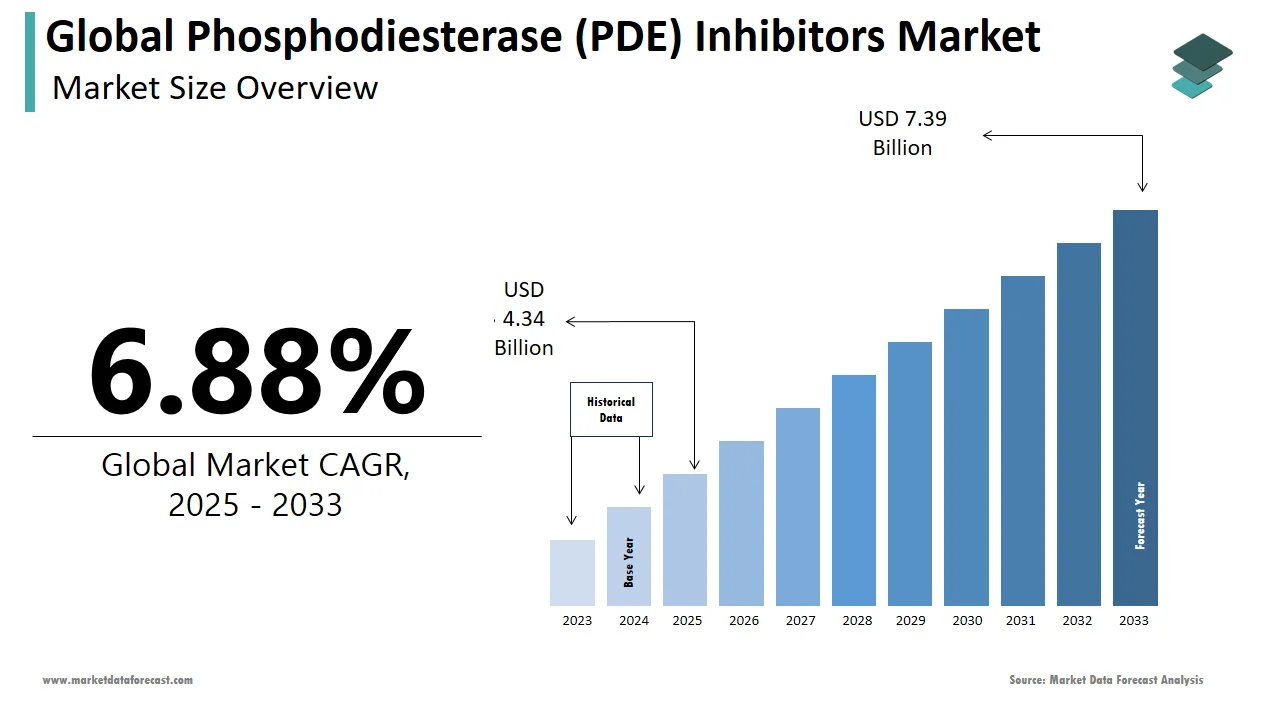
PDE inhibitors play a significant role in treating erectile dysfunction. The key factor driving the PDE Inhibitor Market is the increasing prevalence of erectile dysfunction. PDE inhibitors are now being developed to address the pharmaceutical industry's unmet need in treating neurological diseases and cardiovascular diseases. The PDE inhibitors have also helped treat respiratory disorders and dermatological diseases, and thus new research on finding the cure has driven the PDE Inhibitor Market.
The PDE inhibitors are a group of enzymes that majorly act in regulating the intracellular levels of the secondary messenger cyclic adenosine monophosphate (cAMP) and cyclic guanosine monophosphate. PDE enzymes break down the Phosphodiester bond. These inhibitors are a class of drugs that restricts the Phosphodiesterase’s enzymes. In the U.S, men aged 20 years and above around 18 million are estimated to be affected by erectile dysfunction. As per the World Health Organization (WHO), the dominance of erectile dysfunction is expected to hike from 150 million to 320 million among men from 1995 to 2025. Pfizer is one of the top leading drug manufacturers in erectile dysfunction with the brand name Viagra. These PDE inhibitors can be used as therapies for different diseases like depression, schizophrenia, dementia, and erectile dysfunction in men. The PDE inhibitors are of different families like 11PDE families recognized to date. The growing interest in the advancements of Phosphodiesterase (PDE) Inhibitors for the treatment of cognitive dysfunctions, in turn propels the growth rate of the market.
MARKET DRIVERS
The growing prevalence of erectile dysfunction is primarily driving the global PDE inhibitors market growth.
Several factors can cause erectile dysfunction, including prostate cancer, hypertension, obesity, testosterone deficiency, diabetes mellitus, and hyperlipidemia. PDE inhibitors, both selective and non-selective, are being studied as potential therapies for Alzheimer's disease, chronic obstructive pulmonary disease, and other diseases. PDEs, also known as phosphodiesterases, is a type of enzyme that hydrolyzes cyclic nucleotides and thus regulates intracellular levels of the second messengers, cAMP and cGMP as cell function. Sedentary lifestyles and rising stress levels among men are expected to increase market demand. The market has been effectively guided by the main player's increasing steps and an increase in the costs of treating chronic diseases. Erectile dysfunction affects about 150 million people worldwide, according to the World Health Organization (WHO), and this number is expected to rise to 230 million by 2025. It's a common medical problem that affects about 15% of men per year.
PDE5 inhibitors are expected to become more widely used as healthcare costs associated with chronic diseases such as heart disease, stroke, diabetes, and prediabetes increase. As a result, as the economic and health burden of these diseases grows, so will the use of PDE5 inhibitors for their remission, resulting in market growth over the forecast period. We expect new entrants to aggressively capitalize on this growing opportunity as more molecules progress to late-stage development and ultimately commercialization. In the market for PDE Inhibitors, Pfizer is the market leader. To prevent and treat infectious and chronic diseases in people of all ages, the organization provides a wide variety of medications and vaccines and consumer healthcare goods. With its Viagra brand, Pfizer is the market leader in erectile dysfunction. All these are opportunities for PDE Inhibitors market growth.
MARKET RESTRAINTS
Only a few PDE inhibitor analogs are currently available, and the FDA's strict guidelines for the approval of new treatments or drugs may restrict the global PDE inhibitors market. The negative side effects of PDE inhibitors and the launch of generics harm consumer growth during the forecast period. The main challenge for this PDE Inhibitors market is that most people are unaware of the benefits of PDE inhibitors. Owing to the high cost of PDE inhibitor research and development, only large market players are now involved. Several molecules are being developed to treat neurological disorders such as schizophrenia, Alzheimer's disease, and Huntington's disease; however, the majority of these molecules are still in the early stages of development and are the challenges faced by the market.
REPORT COVERAGE
| REPORT METRIC | DETAILS |
| Market Size Available | 2025 to 2034 |
| Base Year | 2025 |
| Forecast Period | 2026 to 2034 |
| Segments Covered | By Application, Drug Type, and Region. |
| Various Analyses Covered | Global, Regional, and Country-Level Analysis, Segment-Level Analysis, Drivers, Restraints, Opportunities, Challenges; PESTLE Analysis; Porter’s Five Forces Analysis, Competitive Landscape, Analyst Overview of Investment Opportunities |
| Regions Covered | North America, Europe, Asia Pacific, Latin America, Middle East & Africa |
| Market Leaders Profiled | Mist Pharmaceuticals, AstraZeneca, Nusirt Biopharma, Takeda Pharmaceuticals, Bayer AG, Pfizer, Otsuka, Eli Lilly, Verona Pharma, Omeros, Hanmi Science Holding, Celgene Corporation., and Others. |
SEGMENTAL ANALYSIS
By Application Insights
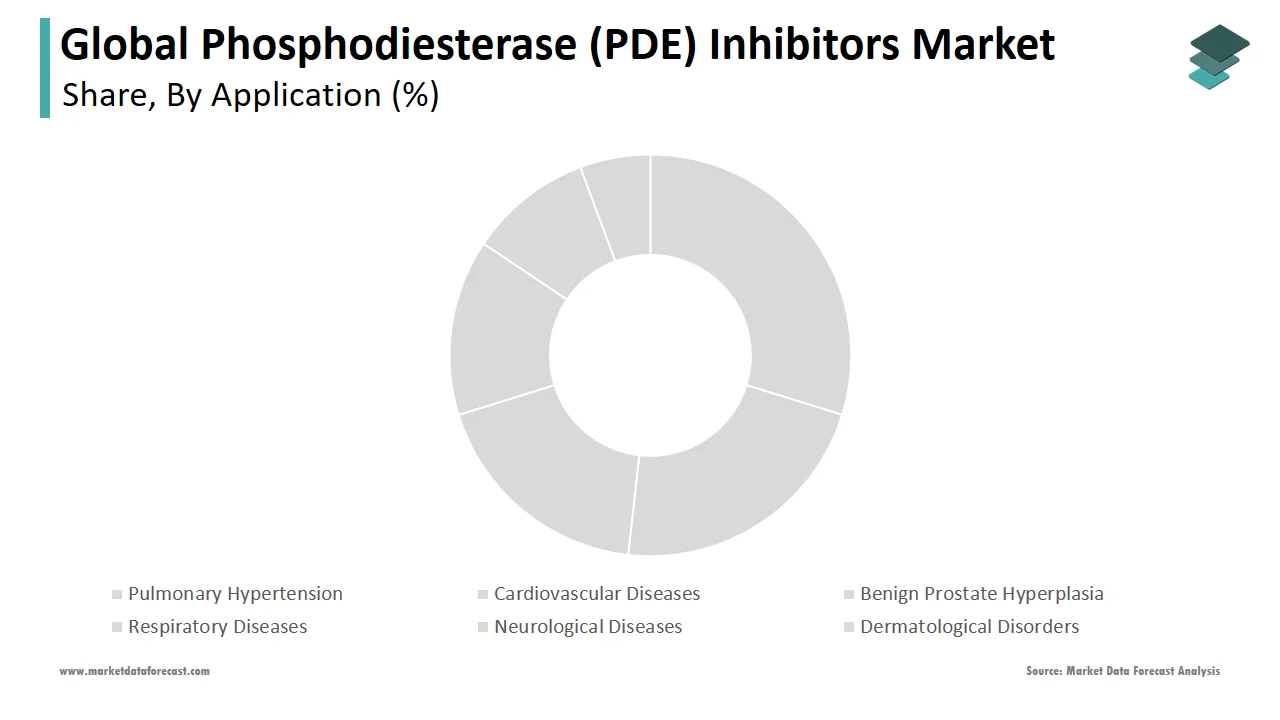
Based on the application, Pulmonary hypertension is mostly treated using PDE inhibitors. It occurs mainly due to congenital heart disease, connective tissue disease, coronary artery disease, high blood pressure, liver disease (cirrhosis), blood clots to the lungs, and chronic lung diseases. The research and development in this field will further drive market growth. Erectile dysfunction n is majorly treated using PDE inhibitors and is now readily available in the market. Erectile dysfunction may occur due to an unhealthy lifestyle.Several molecules are under development to treat neurological diseases (36%), such as schizophrenia, Alzheimer’s disease, and Huntington’s disease; most of these molecules are in the early development phases. Other vital therapeutic areas include genitourinary diseases (25%) and cardiovascular diseases (11%).
By Drug Type Insights
The increasing demand for PDE-5 from pediatric patients suffering from Pulmonary Hypertension has helped it occupy a significant market share based on drug type. Besides, PDE-5 can also be used to treat patients with erectile dysfunction and minor heart attacks; this can further fuel the market size. From recent studies, we can easily conclude that PDE-5 can be safely suggested to infants and children suffering from Pulmonary Hypertension, which can also be attributed to increasing the size of the phosphodiesterase (PDE) inhibitors market. The PDE-4 inhibitor, which is used in treating atopic dermatitis and skin disorders, is also expected to increase its demand as some of its key manufacturers received FDA approval regarding its production.
The PDE5 inhibitor segment had a 30% market share in the world in 2019 and is expected to grow at a promising rate during the forecast period. It is a type of targeted therapy used to treat people with pulmonary hypertension. The inhibition of the enzyme can alter those pathophysiological conditions associated with a lowering cGMP level in tissues.
The PDE4 inhibitor segment accounted for a market share of 28% in the global market in 2019 and is expected to grow at a much faster rate. They work to suppress the immune system, which reduces inflammation. It acts at the cellular level to halt the production of the overactive PDE4 enzyme.
The PDE3 inhibitor segment is expected to grow at a prominent rate during the forecast period. PDE inhibitor inhibits platelet activation/aggregation, relaxes the airway and vascular smooth muscle, and enhances myocardial contractility, failing in long-term chronic cardiac failure trials.
Viagra is expected to grow at an exponential rate in the future. It is used to treat erectile dysfunction and pulmonary arterial hypertension. The increase in the number of erectile dysfunction cases due to an unhealthy lifestyle will further boost the market growth.
Cialis is the second most common drug used to treat erectile dysfunction, benign prostatic hyperplasia, and pulmonary arterial hypertension. The increase in cases and more research on this drug will drive market growth.
REGIONAL ANALYSIS
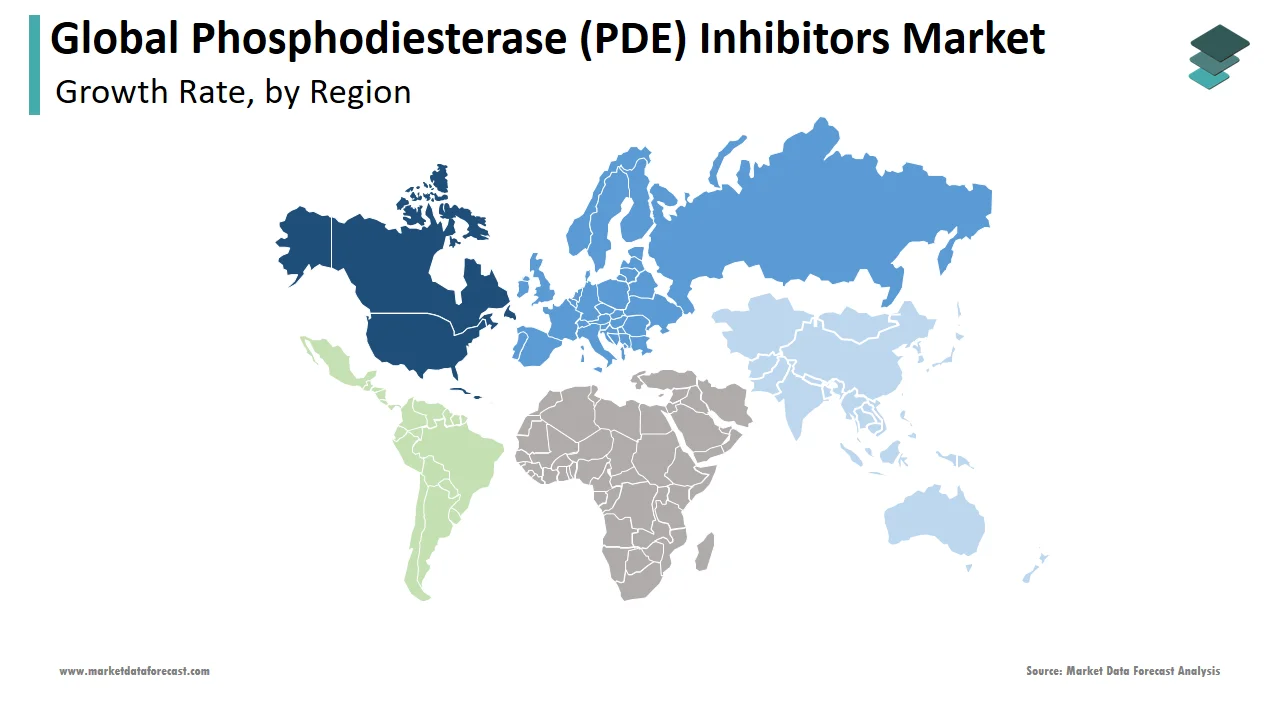
Geographically, North America occupies a significant share of the global phosphodiesterase (PDE) inhibitors market due to key players' presence and increasing demand for the PDE Inhibitors. North America had the largest market share in 2019 and is expected to grow at a healthy rate in the future. The increase in popularity of Viagra and increased erectile dysfunction cases will drive the market growth of the region. The high research has also led to identifying more diseases that can be cured through PDE inhibitors.
Europe's market had the second-largest share in 2019. Increased awareness and the presence of a large number of companies will drive the market growth of this region.
The Asia Pacific had the third-largest market share and is expected to grow at the fastest rate in the future. The rising population and rising number of cases in countries like India and China are the primary reason contributing to the market. Increased awareness about the benefits of PDE inhibitors has also helped contribute to the growth. In developing countries like India and China, the market is showing a considerable rise in the past few years and looking forward to increasing further.
KEY MARKET PLAYERS
Some of the noteworthy companies dominating the global phosphodiesterase (PDE) inhibitors market profiled in this report are
- Mist Pharmaceuticals
- AstraZeneca
- Nusirt Biopharma
- Takeda Pharmaceuticals
- Bayer AG
- Pfizer
- Otsuka
- Eli Lilly
- Verona Pharma
- Omeros
- Hanmi Science Holding
- Celgene Corporation
GLOBAL PHOSPHODIESTERASE (PDE) INHIBITORS MARKET NEWS
- PDE-5 inhibitors, which are used to treat erectile dysfunction, have been shown to reduce the risk of death or hospitalization for heart failure in men who have had at least one heart attack in their lives, according to research published in March 2017.
- The FDA approved Crisaborole (Eucris), a PDE-4 inhibitor developed by Pfizer, Inc., to treat mild to moderate atopic dermatitis in December 2016. Eucrisa was the first non-steroidal topical monotherapy for skin conditions.
- Pfizer, the maker of Viagra, settled trade disputes with Teva Pharmaceutical Industries Ltd in December 2017, allowing Teva to begin selling generic Viagra (Sildenafil), which is expected to increase use rates.
MARKET SEGMENTATION
This research report on the global phosphodiesterase (PDE) inhibitors market has been segmented and sub-segmented into the following categories: drug type, application, and region.
By Application
- Pulmonary Hypertension
- Cardiovascular Diseases
- Benign Prostate Hyperplasia
- Respiratory Diseases
- Neurological Diseases
- Dermatological Disorders
- Erectile Dysfunction
- Other Applications
By Drug Type
- Selective PDE inhibitors
- PDE-1
- PDE-2
- PDE-3
- PDE-4
- PDE-5
- Others (PDE-6 to PDE-11)
- Non-selective PDE inhibitors
- Viagra
- Cialis
- Levitra
- Other Drugs
By Region
- North America
- Europe
- Asia Pacific
- Latin America
- The Middle East and Africa