- Product Description Description
- Table of Contents TOC
- List of Table & Figure LOT
- Get Free Sample PDF Sample PDF
Market Size, 2025
$3.79 BnMarket Estimate, 2026
$4.16 BnMarket Forecast, 2034
$8.65 BnCAGR, 2026–2034
9.6%Global Power Tool Batteries Market Size, Growth, Trends & Forecast (2026–2034)
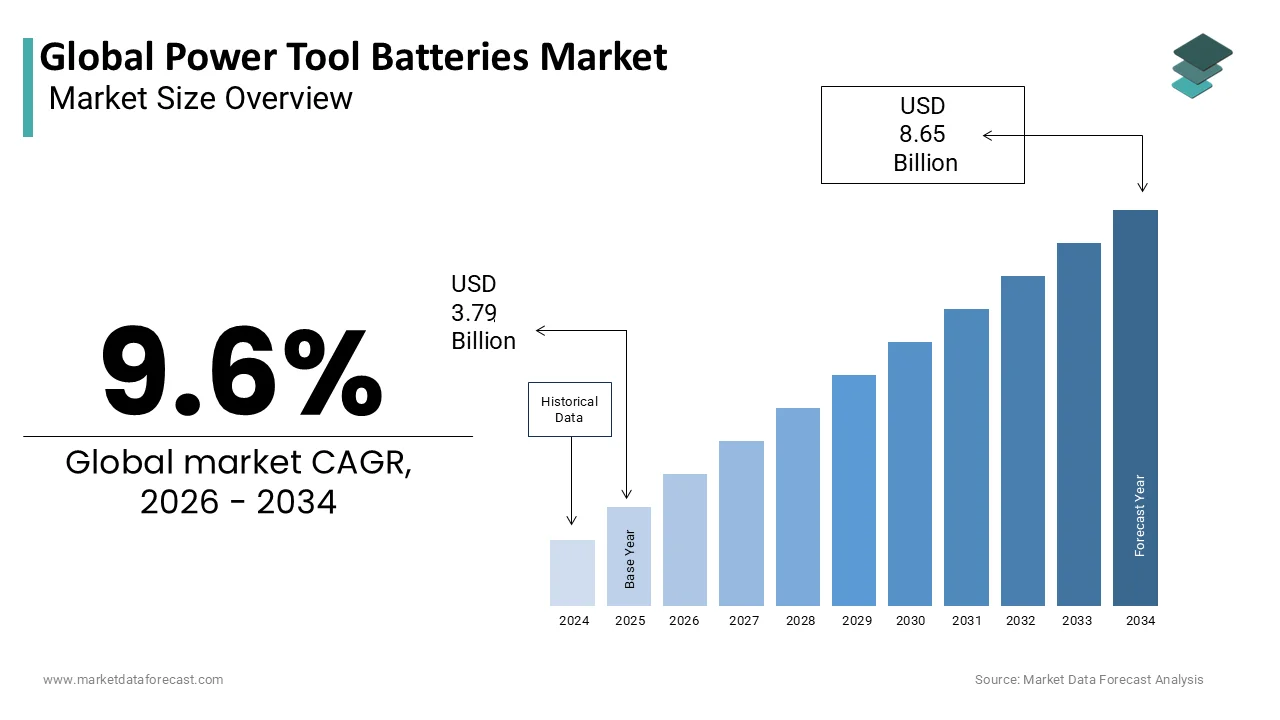
The global power tool batteries market size was valued at USD 3.79 billion in 2025, is estimated at USD 4.16 billion in 2026, and is projected to reach USD 8.65 billion by 2034, expanding at a compound annual growth rate (CAGR) of 9.60% from 2026 to 2034. Market expansion is propelled by the surging transition from corded to cordless systems, rapid advancements in lithium-ion energy density, and high infrastructure and construction activity globally.
Key Executive Metrics (At-a-Glance)
- 2025 Base Valuation: USD 3.79 Billion
- 2026 Current Valuation: USD 4.16 Billion
- 2034 Forecast Valuation: USD 8.65 Billion
- Compound Annual Growth Rate (CAGR): 9.60% (2026–2034)
- Dominant Tool Segment: Drills & Drivers (leading through extensive DIY and professional construction utilization)
- Fastest-Growing Tool Segment: Outdoor Power Equipment / Lawn & Garden Tools (surging due to electrification mandates phasing out gas-powered tools)
- Dominant Application Segment: Construction (driven by heavy job-site reliance on portable, high-efficiency equipment)
- Fastest-Growing Application Segment: Construction & Infrastructure / DIY Renovations (expanding via modernization and urbanization projects)
- Dominant Regional Market: North America (supported by high pro-tool penetration, a strong DIY culture, and advanced manufacturing sectors)
- Fastest-Growing Regional Market: Asia-Pacific (propelled by rapid urbanization, massive infrastructure projects, and expanding local manufacturing)
Core Market Drivers
- Cordless Tool Penetration: Rising operational preference for mobile, flexible, and lightweight tool handling over restricted corded variants.
- Battery Chemistry Evolution: Continuous improvements in lithium-ion technology providing higher energy density, faster recharge rates, and longer running cycles without self-discharge.
Primary Market Restraints & Challenges
- High Maintenance Costs: Ongoing expenses associated with part replacements, component recalibration, and mechanical repairs, which cause users in developing economies to favor equipment rental.
Global Power Tool Batteries Market Segmentation Breakdown
| Segment Category | Leading Sub-Segment | Fastest-Growing Sub-Segment |
|---|---|---|
| By Tools | Drills | Outdoor Power Equipment / Lawn Mowers |
| By Application | Construction | DIY / Residential Renovations |
| By Region | North America | Asia-Pacific |
Major Industry Players Profiled
Key global market leaders driving battery innovation include Atlas Copco AB, Apex Tool Group, LLC, Robert Bosch GmbH, Hilti Corporation, Makita Corporation, Ingersoll-Rand plc, Stanley Black & Decker, Inc., Techtronic Industries Co., Ltd., KOKI Holdings, and Snap-on Incorporated.
 Download Free Sample Report
Global Power Tool Batteries Market Size
The size of the global power tool batteries market was worth USD 3.79 billion in 2025, is anticipated to grow at a CAGR of 9.6% from 2026 to 2034 and be worth USD 8.65 billion by 2034 from USD 4.16 billion in 2026.
The power tool batteries market covers specialized energy storage units that provide portable power for cordless industrial and consumer equipment. These batteries serve as the critical backbone for modern construction and do-it-yourself activities by enabling mobility without compromising performance. According to the International Energy Agency, global battery demand across electric vehicle and storage applications rose to almost 1 TWh in 2024, reflecting the massive scale of portable energy adoption across various sectors. This widespread deployment directly supports the power tool batteries market by driving down costs through economies of scale and accelerating technological advancements in energy density. As per the U.S. Consumer Product Safety Commission, an estimated 31,883 injuries from power home tools and 76,490 injuries from power home workshop saws were treated in U.S. hospital emergency departments in 2018 and this indicate the intense usage frequency of these devices in both professional and residential settings. The high incidence of tool-related incidents underscores the necessity for reliable and consistent battery performance to ensure operational safety and efficiency. Consequently, the market focuses on developing robust power solutions that withstand rigorous daily use while minimizing downtime for users. The integration of advanced chemistries ensures that tools remain lightweight yet powerful, meeting the evolving demands of a global workforce that prioritizes flexibility and productivity in their daily operations.
MARKET DRIVERS
Rising Adoption of Cordless Power Tools in Construction
Growing preference for cordless power tools in the construction sector majorly propels the global power tool batteries market expansion by demanding high capacity and fast charging solutions. Construction professionals prioritize mobility and ease of use, which drives the replacement of traditional corded equipment with battery-operated alternatives. As per Oxford Economics, global construction work done will grow by over $4.2 trillion over the 15 years to 2037, rising from $9.7 trillion in 2022 to $13.9 trillion, creating a vast user base for portable power tools. This substantial expansion in construction activity directly correlates with higher consumption of durable batteries capable of sustaining heavy-duty applications throughout long work shifts. Modern power tools increasingly include smart features that rely heavily on sophisticated battery management systems to monitor performance and optimize energy usage, thereby increasing the value and complexity of each battery unit sold. The synergy between construction growth and digital connectivity ensures that battery manufacturers must continuously innovate to meet the dual demands of power and intelligence. This dynamic environment fosters a competitive landscape where battery longevity and reliability become primary purchasing criteria for contractors and firms worldwide.
Surge in Do-It-Yourself Home Improvement Activities
The booming do-it-yourself home improvement sector is further contributing to the growth of the global power tool batteries market by expanding the consumer base beyond professional tradespeople. Homeowners increasingly undertake renovation and maintenance projects, requiring accessible and user-friendly cordless tools that offer sufficient runtime for occasional use. As per the Harvard Joint Center for Housing Studies, annual homeowner improvement and repair spending in the United States is expected to reach a record $524 billion in early 2026. This robust market scale indicates a sustained demand for affordable yet efficient power tools, which in turn fuels the sales of replacement and spare batteries. This widespread engagement in home projects ensures a steady stream of entry-level users who prefer the convenience of battery-powered devices over complex corded setups. The accessibility of these tools encourages frequent purchases of multi-tool kits that share common battery platforms, enhancing customer loyalty to specific brands. Consequently, manufacturers focus on creating versatile battery ecosystems that cater to both novice DIY enthusiasts and experienced hobbyists, driving volume sales across diverse geographic regions.
MARKET RESTRAINTS
Volatility in Raw Material Prices
Fluctuating costs of critical raw materials such as lithium, cobalt, and nickel primarily restrain the global power tool batteries market growth by creating uncertainty in production expenses and final pricing. Manufacturers face significant challenges in maintaining stable profit margins when the prices of these essential components experience sharp increases or unpredictable swings. As per the International Energy Agency, China undertakes well over half of global raw material processing for lithium and cobalt, which is creating a concentrated supply chain vulnerable to geopolitical disruptions. This heavy reliance on specific regions for material processing means that any trade restrictions or logistical issues can immediately impact the availability and cost of battery cells. As per the International Energy Agency, lithium prices have dropped by more than 85% from their peak in 2022, demonstrating the inherent instability in the battery supply chain. Such volatility forces manufacturers to either absorb higher costs or pass them on to consumers, potentially dampening demand for premium cordless tools. The unpredictability of material costs also hinderslong-termm investment planning for new production facilities, slowing down the expansion of manufacturing capacity. Consequently, the market struggles to achieve consistent price reductions that could otherwise accelerate the adoption of cordless technology in price-sensitive segments.
Low Recycling Rates and Environmental Regulations
Stringent environmental regulations coupled with low recycling rates further impede the global power tool batteries market expansion by imposing additional compliance costs and waste management burdens on producers. The improper disposal of lithium-ion batteries poses significant environmental risks, prompting governments to enforce stricter guidelines for collection and recycling processes. As per CAS, only about 5% of the world's lithium-ion batteries are thought to be recycled, mainly because of difficulties related to collection and recycling infrastructure. This low participation in recycling programs means that many power tool batteries end up in landfills, leading to potential regulatory penalties and increased pressure on manufacturers to establish take-back schemes. The lack of efficient recycling networks increases the overall lifecycle cost of batteries, making them less attractive compared to other sustainable energy solutions. Manufacturers must invest heavily in developing closed-loop systems to recover valuable materials, which diverts resources from research and development efforts. These regulatory and logistical challenges create barriers to entry for smaller players and limit the overall sustainability profile of the power tool battery industry.
MARKET OPPORTUNITIES
Integration of Smart Battery Management Systems
Integrating advanced smart battery management systems is a promising opportunity for the power tool batteries market by enhancing performance monitoring and user safety. These intelligent systems allow for real-time tracking of battery health, temperature, and charge cycles, providing users with valuable data to optimize tool usage. The growth of connected devices enables manufacturers to offer predictive maintenance services and remote diagnostics, adding value beyond the physical battery product. By leveraging these trends, power tool companies can develop batteries that communicate seamlessly with digital platforms, offering personalized insights to professional users. This technological advancement differentiates products in a crowded market and allows for premium pricing strategies based on enhanced functionality. The ability to extend battery lifespan through smart charging protocols also appeals to environmentally conscious consumers, further driving market growth.
Expansion into Emerging Economies
Rapid industrialization and urbanization in emerging economies offer a notable opportunity for the power tool batteries market by opening new customer segments and increasing tool penetration. As infrastructure development accelerates in regions such as Asia Pacific and Latin America, the demand for reliable and portable power tools rises among local contractors and workers. According to Oxford Economics, global construction work done will grow by over $4.2 trillion over the next 15 years, with significant contributions from developing nations. This massive investment in construction projects creates fertile ground for the adoption of cordless tools that improve productivity and reduce setup time on site. Manufacturers can capitalize on this growing labor force by introducing affordable battery platforms tailored to the specific needs of emerging markets. The increasing disposable income in these regions also supports the growth of the DIY segment, further expanding the potential customer base. By establishing local distribution networks and service centers, companies can build brand loyalty and capture a significant share of this expanding market.
MARKET CHALLENGES
Supply Chain Disruptions and Geopolitical Risks
Ongoing supply chain disruptions and geopolitical tensions are primary challenges to the power tool batteries market by causing delays in production and increasing logistical costs. The concentration of battery material processing in specific countries makes the industry vulnerable to trade disputes and export restrictions that can halt manufacturing operations. As per the U.S. Geological Survey, five battery materials have been identified as critical due to potential supply disruptions driven by highly concentrated sources. This dependency on limited geographic sources for essential minerals creates a fragile supply network that is difficult to diversify quickly. These challenges force companies to hold larger inventories, which ties up capital and increases storage costs. The uncertainty surrounding future supply availability also discourages investment in new product lines that rely on scarce materials. Consequently, manufacturers must navigate a complex web of international regulations and trade agreements to secure consistent access to critical components.
Technical Limitations in Energy Density and Safety
Technical limitations in energy density and safety concerns are another significant challenge to the power tool batteries market by restricting performance improvements and user confidence. While lithium-ion technology has advanced considerably, achieving higher energy densities without compromising safety remains a complex engineering hurdle. As per ScienceDirect, solid-state batteries are seen as the future for their higher energy density and faster charging, though they face challenges like flammability and manufacturing scalability. These technical barriers slow down the introduction of next-generation batteries that could offer substantially longer runtimes for power tools. Any incidents involving battery fires or explosions can severely damage brand reputation and lead to costly recalls. Manufacturers must balance the desire for lighter and more powerful batteries with the need for robust safety mechanisms that prevent thermal runaway. This delicate equilibrium requires extensive testing and validation, which extends product development cycles and increases time to market.
REPORT COVERAGE
| REPORT METRIC | DETAILS |
| Market Size Available | 2025 to 2034 |
| Base Year | 2025 |
| Forecast Period | 2026 to 2034 |
| Segments Covered | By Tools, Application, and Region. |
| Various Analyses Covered | Global, Regional, & Country-Level Analysis; Segment-Level Analysis, DROC, PESTLE Analysis, Porter’s Five Forces Analysis, Competitive Landscape, Analyst Overview of Investment Opportunities |
| Regions Covered | North America, Europe, APAC, Latin America, Middle East & Africa |
|
Market Leaders Profiled | Atlas Copco AB (Sweden), Apex Tool Group, LLC (US), Robert Bosch GmbH (Germany), Hilti Corporation (Liechtenstein), Makita Corporation (Japan), Ingersoll-Rand plc (Ireland), Stanley Black & Decker, Inc. (US), Techtronic Industries Co., Ltd. (Hong Kong), KOKI Holdings (Japan), and Snap-on Incorporated (US). |
SEGMENTAL ANALYSIS
By Tools Type Insights
The drills segment led the market with the dominant share of the global power tool batteries market in 2025. The dominance of the drills segment in the global market can be attributed to their universal application across professional construction and residential do-it-yourself projects. This segment drives battery demand because drills are often the first cordless tool purchased by users, establishing brand loyalty for compatible battery platforms. The widespread use of drills in framing, assembly, and general maintenance ensures consistent replacement and upgrade cycles for high-capacity batteries. This rapid shift toward cordless technology directly benefits the drill segment as professionals seek freedom from power outlets on job sites. The versatility of modern cordless drills allows them to function as drivers and borers, increasing their utility and justifying investment in premium battery packs. Manufacturers focus on optimizing battery weight and balance for drills to reduce user fatigue during extended use. This ergonomic consideration further solidifies the leading status of drills in driving overall battery consumption and technological innovation within the global market.
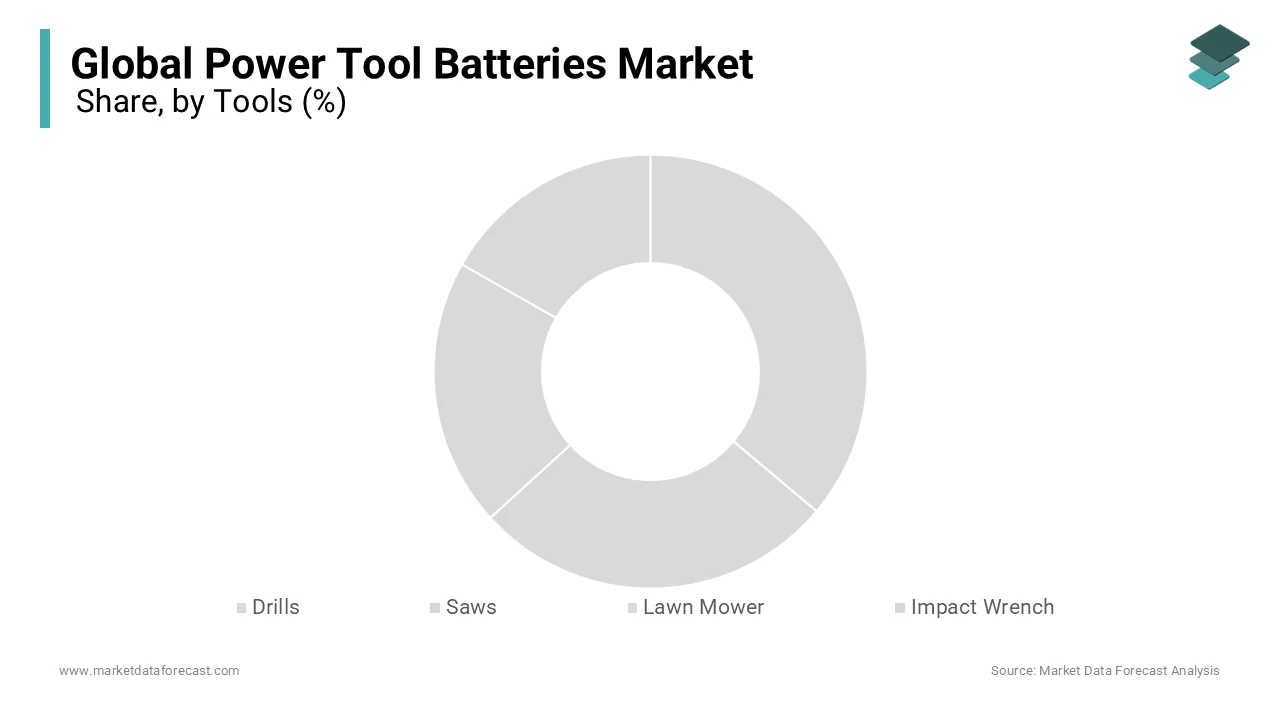
However, the lawn mower segment is the fastest-growing category in the power tool batteries market and is estimated to showcase the fastest CAGR in the global market over the forecast period owing to the stringent environmental regulations and consumer preference for quiet operation. Traditional gas-powered mowers are being rapidly replaced by battery-operated alternatives that offer lower maintenance and zero emissions. The transition to electric landscaping tools is accelerated by municipal noise ordinances and bans on small off-road engines in various regions. This growth trajectory is heavily influenced by the adoption of high-voltage battery systems capable of powering large cutting decks. Homeowners and commercial landscapers appreciate the instant torque and reduced vibration provided by electric motors. The development of fast charging technologies allows users to swap batteries quickly, minimizing downtime during large lawn care tasks. This convenience factor drives repeat purchases of additional battery packs, fueling the rapid expansion of this segment.
By Application Insights
The construction segment dominated the market by holding the leading share of the global market in 2025 because of the intensive daily use of cordless tools by professional contractors and industrial workers. This sector demands robust batteries that can withstand harsh environments and provide all-day runtime for critical tasks such as drilling, fastening, and cutting. As per Oxford Economics, global construction work done is forecast to rise from $9.7 trillion in 2022 to $13.9 trillion in 2037, creating sustained demand for reliable power solutions. The massive scale of infrastructure development worldwide ensures that construction firms continuously invest in advanced cordless tool ecosystems. This prolonged growth phase encourages contractors to standardize on specific battery platforms to streamline inventory and training. Professional users prioritize battery durability and fast charging capabilities to maintain productivity on tight schedules. The shift toward prefabrication and modular construction also increases the need for portable power tools in controlled factory settings. Consequently, the construction segment remains the primary revenue driver for high-end battery technologies and accessories.
On the other end, the do-it-yourself segment is expected to exhibit a promising CAGR in the global market over the forecast period as homeowners increasingly undertake renovation and maintenance projects. This trend is fueled by online tutorials, social media inspiration, and the desire to personalize living spaces without hiring professionals. According to the Harvard Joint Center for Housing Studies, annual homeowner improvement and repair spending is expected to reach a record $524 billion in early 2026. This robust market scale indicates a rising number of amateur users who prefer the convenience and safety of cordless tools. The accessibility of user-friendly battery-powered tools lowers the barrier to entry for complex home projects. Millennials and Gen Z consumers are particularly drawn to sleek, lightweight tools that fit into smaller urban living spaces. Retailers support this growth by offering bundled kits that include multiple tools and batteries at competitive prices. The emotional satisfaction of completing home improvements drives repeat purchases and brand advocacy within this dynamic consumer segment.
COUNTRY LEVEL ANALYSIS
U.S. Power Tool Batteries Market Analysis
The U.S. held the dominant position in the global market in 2025 and is likely to remain a leading market for power tool batteries over the next few years due to a strong culture of homeownership and professional construction activity. The country serves as a major hub for innovation in cordless tool technology and battery chemistry advancements. According to the U.S. Consumer Product Safety Commission, an estimated 31,883 injuries from power home tools were treated in U.S. hospital emergency departments in 2018, reflecting the high frequency of tool usage across the nation. This extensive utilization rate ensures a steady demand for replacement batteries and upgraded power packs. As per the Harvard Joint Center for Housing Studies, homeowner improvement and repair spending is expected to reach a record $524 billion in early 2026, supporting robust sales of consumer-grade cordless tools. The large DIY community contributes significantly to volume sales of entry-level battery platforms. Professional contractors in the U.S. also drive demand for high-performance industrial batteries capable of handling heavy-duty applications. Government initiatives promoting energy efficiency encourage the replacement of gas-powered equipment with electric alternatives. The presence of major tool manufacturers and retailers facilitates easy access to a wide variety of battery options for both professionals and hobbyists.
China Power Tool Batteries Market Analysis
China is likely to keep its dominant role in the power tool batteries market over the next few years, anchored by the world's largest manufacturing base for both tools and lithium-ion cells. The country benefits from established supply chains for raw materials and component production that lower overall manufacturing costs. According to the International Energy Agency, China held about 85% of global battery cell manufacturing capacity in 2024, providing a significant advantage to local tool manufacturers. This concentration of production allows Chinese brands to offer competitive pricing while maintaining acceptable quality standards. The rapid urbanization in China drives domestic demand for cordless tools in both residential and commercial sectors. Export-oriented manufacturers leverage their proximity to battery suppliers to innovate quickly and respond to global market trends. Government policies supporting new energy vehicles also spill over into the power tool sector by advancing battery technology. The scale of production in China enables economies of scale that benefit consumers worldwide through affordable cordless tool options.
Germany Power Tool Batteries Market Analysis
Germany is likely to remain a quality-led, engineering-driven market for power tool batteries over the next few years, backed by its strong industrial base. The country is home to several leading power tool brands that prioritize high-quality battery systems and sustainable manufacturing practices. German professionals prefer durable and efficient battery platforms that enhance productivity on precise technical jobs. As per the International Energy Agency, electric vehicle battery production in
Europe Power Tool Batteries Market Analysis
Europe reached 110 GWh in 2023, with European manufacturers investing heavily in local production capabilities. This investment supports the development of advanced battery management systems tailored to industrial applications. Strict environmental regulations in Germany drive the adoption of cordless tools to reduce emissions and noise pollution on job sites. The country's strong automotive sector also influences battery technology through shared research and development efforts. German consumers value reliability and longevity, prompting manufacturers to focus on robust battery designs.
Japan Power Tool Batteries Market Analysis
Japan is likely to see steady, innovation-led demand for power tool batteries over the next few years, supported by its technological innovation and high-quality manufacturing standards. The country's leading electronics and automotive companies contribute to advanced battery chemistries that benefit the power tool industry. Japanese manufacturers integrate connectivity features into their battery systems to offer enhanced user experience. Japan aging population increases the demand for lightweight and ergonomic cordless tools that reduce physical strain on users. The prevalence of small living spaces in urban areas favors compact and quiet battery-operated equipment. Local regulations promoting energy efficiency encourage the replacement of traditional tools with electric alternatives. Japanese brands focus on precision and reliability, appealing to professional users who require consistent performance. The integration of robotics and automation in Japanese manufacturing also drives demand for specialized cordless tools.
India Power Tool Batteries Market Analysis
India is likely to be one of the faster-growing markets for power tool batteries over the next few years, powered by infrastructure development and increasing industrialization. The country's government initiatives to improve housing and transportation networks create substantial demand for construction tools. As per Oxford Economics, global construction work done will grow by over $4.2 trillion over the next 15 years, with India contributing significantly to this expansion. This growth fuels the adoption of cordless tools among local contractors seeking to improve efficiency. The expanding middle class invests in home renovation projects, driving sales of entry-level cordless tool kits. Local manufacturing policies encourage domestic production of batteries and tools to reduce reliance on imports. The availability of affordable lithium-ion batteries makes cordless tools accessible to a broader segment of the population. Urbanization trends lead to increased construction activity in metropolitan areas, further boosting market growth. Indian consumers are increasingly aware of the benefits of cordless convenience, shifting preferences away from traditional corded options.
COMPETITIVE LANDSCAPE
Intense rivalry among established industrial giants and emerging technology-focused firms defines the competitive landscape of the power tool batteries market. Key participants strive to differentiate their offerings through superior energy density, faster charging capabilities, and enhanced durability. The market features a high degree of consolidation as major players acquire smaller innovators to expand their technological portfolios. Competition centers on creating proprietary battery platforms that lock customers into specific brand ecosystems. Companies invest heavily in research and development to improve lithium-ion chemistry and integrate smart monitoring features. Strategic alliances with raw material suppliers help secure stable access to critical components like cobalt and lithium. Manufacturers also focus on sustainability initiatives to comply with evolving environmental regulations and appeal to eco-conscious consumers. The threat of new entrants remains moderate due to high capital requirements and complex supply chain dynamics. Price competition is prevalent in the consumer segment, while professional users prioritize performance and reliability. Continuous innovation in battery management systems serves as a primary driver for competitive advantage. Firms must balance cost efficiency with technological superiority to maintain market relevance. The integration of Internet of Things capabilities further intensifies competition by enabling data-driven service offerings.
KEY MARKET PLAYERS
Some of the companies that are playing a dominant role in the Global Power Tool Batteries Market include
- Atlas Copco AB
- Apex Tool Group, LLC
- Robert Bosch GmbH
- Hilti Corporation
- Makita Corporation
- Ingersoll-Rand plc
- Stanley Black & Decker, Inc.
- Techtronic Industries Co., Ltd.
- KOKI Holdings
- Snap-on Incorporated
TOP LEADING PLAYERS IN THE MARKET
- Stanley Black&d Decker holds a leading position in the power tool batteries market through its extensive portfolio of professional-grade cordless tools. The company focuses on developing high-performance lithium-ion battery platforms that offer superior runtime and durability for demanding construction applications. Recent initiatives include the expansion of their Flexvolt technology, which allows batteries to adapt voltage output based on tool requirements. This innovation enhances versatility and reduces the need for multiple battery types on job sites. The corporation invests heavily in research and development to improve energy density and charging speeds. Their strategic partnerships with industrial suppliers ensure widespread availability of replacement batteries and accessories. Stanley Black&d Decker also emphasizes sustainability by implementing recycling programs for used battery packs. These efforts strengthen brand loyalty among professional contractors who prioritize reliability and environmental responsibility. The company continues to introduce new tool models that leverage advanced battery management systems for optimal performance.
- Milwaukee Tool drives innovation in the power tool batteries market by specializing in heavy-duty cordless solutions for industrial users. The company's RedLithium battery technology provides consistent power delivery even in extreme temperatures and harsh working conditions. Milwaukee frequently launches new battery capacities and form factors to support its expanding range of power tools. Recent actions include the introduction of high-output battery packs that deliver increased torque and longer runtimes. The brand focuses on creating a unified battery ecosystem that allows seamless compatibility across various tool categories. Milwaukee engages directly with professional tradespeople to gather feedback and refine product designs. Their commitment to durability ensures that batteries withstand rigorous daily use without significant performance degradation. The company also offers comprehensive warranty services that reinforce customer confidence in its battery products. Milwaukee's continuous investment in manufacturing capabilities supports rapid scaling of production to meet global demand.
- Bosch makes a significant contribution to the power tool batteries market through its reputation for engineering precision and technological advancement. The company develops intelligent battery systems that communicate with tools to optimize power usage and prevent overheating. Bosch recent initiatives include the expansion of its ProCORE18 platform, which offers enhanced energy density and faster charging times. The brand prioritizes user safety by incorporating multiple protection layers with its battery cells. Bosch collaborates with automotive divisions to leverage advancements in electric vehicle battery technology for power tools. This cross-industry synergy accelerates the development of more efficient and sustainable energy storage solutions. The company also focuses on ergonomic design to reduce weight while maintaining high capacity. Bosch global distribution network ensures that professional users have access to genuine replacement batteries and chargers. Their commitment to quality control standards guarantees consistent performance across all battery units produced.
TOP STRATEGIES USED BY KEY MARKET PARTICIPANTS
Leading participants in the power tool batteries market use several strategies to strengthen their position. First, companies focus on platform standardization to create interoperable battery ecosystems across multiple tool categories. This approach encourages customer loyalty and increases attachment rates for additional tools. Second, manufacturers invest in vertical integration by securing direct access to raw material sources and cell production facilities. This strategy mitigates supply chain risks and reduces overall production costs. Third, firms prioritize rapid innovation in battery chemistry to achieve higher energy densities and shorter charging times. Continuous improvement in these areas distinguishes premium brands from competitors. Fourth, companies expand their global distribution networks to ensure widespread availability of replacement batteries and service centers. This accessibility enhances customer satisfaction and supports long-term retention. Fifth, participants engage in strategic partnerships with construction firms and rental agencies to promote trial and adoption of their battery platforms. These collaborations provide valuable real-world feedback and drive volume sales.
GLOBAL POWER TOOL BATTERIES MARKET ANALYSIS
- In early 2025, DeWalt began releasing its PowerShift 60V battery and adapter kits to offer gas-level power in a cordless package. This release is anticipated to extend battery performance for demanding job site tasks and strengthen the power tool batteries market.
- In January 2026, Makita introduced its XGT High Power Battery (BL4080H) at World of Concrete, delivering up to 35% more power while running 32% cooler thanks to tabless cell technology. This introduction is anticipated to improve runtime and thermal performance for professional users and strengthen the power tool batteries market.
- In January 2026, Milwaukee Tool announced a new four-bay simultaneous supercharger for its M18 and M12 batteries. This announcement is anticipated to reduce downtime for users and strengthen the power tool batteries market.
MARKET SEGMENTATION
This research report on the global power tool batteries market has been segmented and sub-segmented based on tools, application, and region.
By Tools
- Drills
- Saws
- Lawn Mower
- Impact Wrench
- Others
By Application
- Construction
- Automotive
- Aerospace
- Energy
- DIY
By Region
- North America
- Europe
- Asia-Pacific
- Latin America
- Middle East and Africa