- Product Description Description
- Table of Contents TOC
- List of Table & Figure LOT
- Get Free Sample PDF Sample PDF
Market Size, 2025
$5.36 BnMarket Estimate, 2026
$6.63 BnMarket Forecast, 2034
$36.11 BnCAGR, 2026–2034
23.6%Executive Summary: Global Same Day Delivery Market
- Market Scope: Comprehensive industry evaluation of the global same-day delivery logistics ecosystem, tracking operational segments (B2B vs. B2C), core application domains (retailers, e-commerce), technological enhancements (AI, micro-fulfillment centers, autonomous delivery), and regional growth trajectories.
- Market Valuation: Valued at USD 5.36 billion (2025), estimated at USD 6.63 billion (2026), and projected to reach USD 36.11 billion by 2034, registering a compound annual growth rate (CAGR) of 23.6% during the forecast period from 2026 to 2034.
- Primary Growth Drivers: Escalating consumer expectations for instant gratification, high e-commerce penetration in urban centers, proliferation of micro-fulfillment centers (MFCs), and technological integration of AI-driven route optimization and real-time inventory visibility.
Key Market Segment Metrics (2026–2034)
| Category | Leading Segment | Fastest-Growing Segment / Key Trend |
|---|---|---|
| By Type | B2C (dominated the global market share in 2025 due to rapid online consumerism, urban immediacy, and platforms like Amazon Prime, Instacart, and DoorDash) | B2B (projected to expand at a CAGR of 17.3% from 2025 to 2033, driven by just-in-time inventory models and medical/industrial emergency logistics) |
| By Application | E-commerce (captured the highest market share in 2025, anchored by structural retail evolution and AI-powered urban fulfillment hubs) | Retailers (experiencing the fastest growth with a projected CAGR of 18.1% from 2025 to 2033, powered by omnichannel strategies like BOPIS and physical store fulfillment networks) |
| By Region | North America (top regional performer with a 38.5% market share in 2025, led by high e-commerce maturity, dense dark stores, and extensive U.S. coverage) | Asia Pacific (rapidly scaling as an epicenter of innovation through massive urban populations, AI-driven logistics in China/India, and emerging drone/robotics trials) |
Major Market Participants & Market Structure
Market Structure: Highly competitive and technology-intensive ecosystem where global logistics integrators, major e-commerce platforms, and specialized courier networks compete heavily on speed, automation, and hyper-local infrastructure.
Key Companies: FedEx Corporation, DHL Express, United Parcel Service (UPS), Amazon Logistics/Prime Now, Aramex, Dropoff Inc., A1 Express Services Inc., Jet Delivery Inc., Power Link Expedite, USA Couriers, XPO Logistics Inc., and Deutsche Post AG.
Global Same Day Delivery Market Size
The global same day delivery market was valued at USD 5.36 billion in 2025. The global market size is expected to grow at a CAGR of 23.6% from 2026 to 2034 and be worth USD 36.11 billion by 2034 from USD 6.63 billion in 2026.
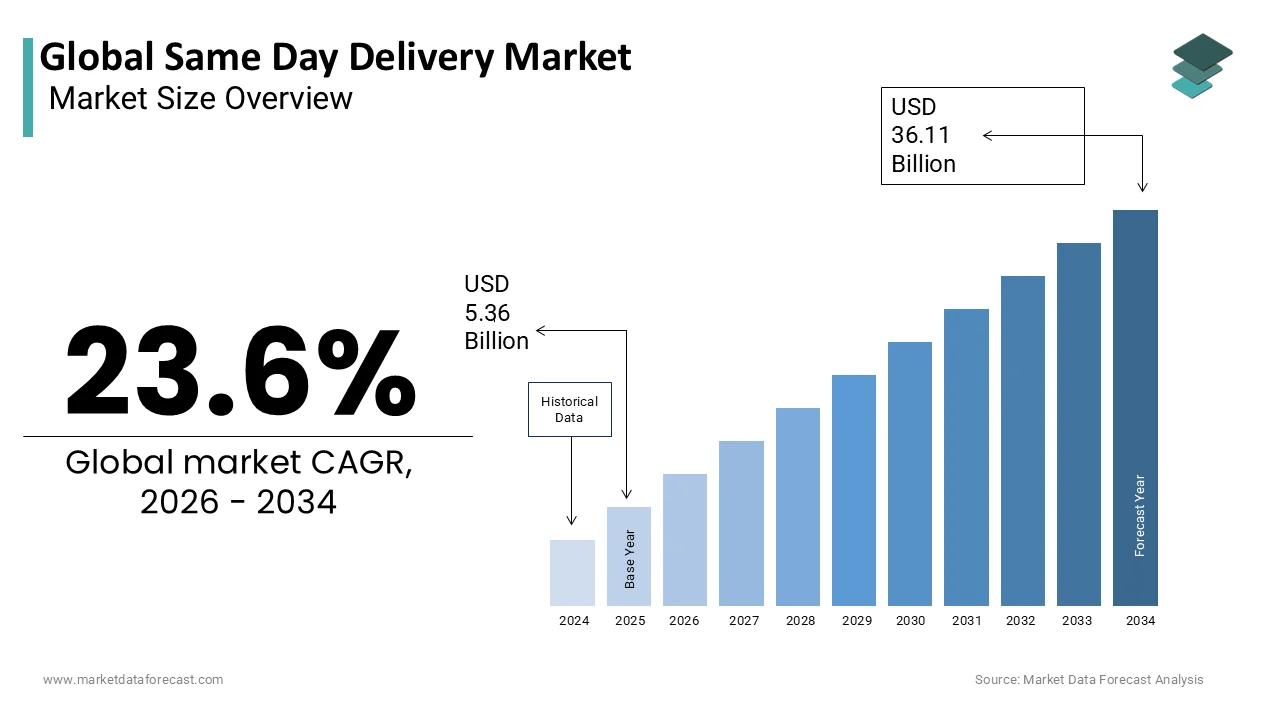
The same day delivery is the logistics ecosystem enabling the pickup, transit, and delivery of goods within a 24-hour window from order placement, which is primarily serving urban consumers and businesses. This model has evolved beyond luxury convenience into an operational imperative, which is driven by shifting consumer expectations and digital commerce infrastructure. Another report from 2023 indicates that 64% of consumers expect groceries to be delivered within 24 hours. Nearly 50% of consumers are more likely to shop online if same-day delivery is an option. The integration of AI-driven route optimization and real-time inventory visibility has enabled retailers to promise reliable time-bound fulfillment.
MARKET DRIVERS
The rising consumer expectation for instant gratification in urban centers with high digital penetration is significantly boosting the growth of Same Day Delivery Market. A 2025 survey showed that approximately 23% of shoppers abandoned their carts because delivery was too slow. This behavioral shift is most pronounced in categories like groceries, pharmaceuticals, and electronics, where immediacy directly influences purchase decisions. For Instance, a 2025 study found that 56% of online consumers aged 18–34 expect same-day delivery. The availability of same-day delivery can boost an online retailer's competitive edge and make 49% of consumers more likely to shop there. Similarly, Amazon Prime members in the UK now receive over 50% of their orders on the same day.
The proliferation of micro-fulfillment centers (MFCs) in metropolitan areas is enabling rapid order processing and reduced dispatch times is majorly driving the Same Day Delivery Market growth. These compact, automated warehouses are typically located within or near urban commercial hubs, often integrated into retail backrooms or underground facilities. A 2025 analysis cites a significant increase from just 50 centers in 2021 to a projected 2,000 by 2026. For Instance, Ocado launched its same-day "Zoom" delivery service in the UK in 2025 and has been developing its rapid delivery offering over time. According to McKinsey & Company, by leveraging robotics and AI inventory management, these centers can process up to 10,000 orders per week from a footprint of less than 10,000 square feet.
MARKET RESTRAINTS
The environmental impact associated with increased urban freight traffic and vehicle emissions is significantly restraining the growth of Same Day Delivery Market. A 2023 analysis by the consulting firm Oliver Wyman found that same-day delivery can generate emissions up to three or four times higher than standard national delivery. For Instance, in Paris, the city government reported in 2023 that delivery vans accounted for 28% of inner-city traffic congestion, by prompting strict low-emission zone regulations. As per the U.S. Environmental Protection Agency found that last-mile delivery emissions in major U.S. cities rose between 2019 and 2022, which is largely driven by express logistics. Many cities, including Amsterdam and Seoul, have imposed curfews or access fees for diesel-powered delivery fleets, which is increasing operational costs.
The economic inefficiency of the last-mile segment, where same-day delivery costs can be 2.5 to 3 times higher than standard shipping is hindering the Same Day Delivery Market growth. For Instance, last-mile delivery accounts for nearly 53% of total logistics expenses, with same-day services pushing unit costs above USD 10 per parcel in dense urban markets. As per the 2023 study by the Indian Institute of Management Ahmedabad revealed that 40% of same-day deliveries in Delhi operated at a loss due to route fragmentation and low order density. The need for real-time dispatch, idle vehicle time, and premium labor wages further erode margins.
MARKET OPPORTUNITIES
The integration of autonomous delivery technologies, including drones and ground-based robots, to reduce labor costs and improve speed is creating growth opportunities for Same Day Delivery Market. f to the Federal Aviation Administration, in 2023, Wing, a subsidiary of Alphabet, completed over 350,000 drone deliveries across worldwide, with an average delivery time of 3 minutes and 24 seconds. Amazon Prime Air conducted its first commercial drone delivery in Texas in 2023, by covering a 1.5-mile route in under 10 minutes. As per the National Research Foundation has approved autonomous robot fleets for pavement-based deliveries in residential zones, with trials showing a 45% reduction in delivery costs. According to the Brookings Institution, widespread adoption of autonomous last-mile solutions could reduce delivery expenses while minimizing human error and traffic congestion is unlocking new operational efficiencies.
The expansion of same-day delivery into healthcare and emergency supply chains, where time-sensitive logistics are emerging significant opportunities in the growth of Same Day Delivery Market. A December 2022 announcement detailed a partnership with the Government of Rwanda to further expand its service to cover the entire country by 2029, with plans to make millions of deliveries in the coming years. In the U.S., UPS Flight Forward partnered with CVS to deliver prescription medications via drone to select neighborhoods in North Carolina. According to the Journal of the American Medical Association, rapid delivery of thrombolytics within the first hour of stroke symptoms can improve recovery rates by up to 50%.
MARKET CHALLENGES
The strain on urban infrastructure, particularly road networks and curb access is posing challenges in the growth of Same Day Delivery Market. In Tokyo, the Ministry of Land, Infrastructure, Transport and Tourism recorded a 33% increase in delivery vehicle stops between 2019 and 2023, by contributing to pedestrian congestion and traffic delays. According to the New York City Department of Transportation, Curbside space in Manhattan is occupied by delivery vehicles for an average of 7.2 hours per day is limiting access for public transit and emergency services. Cities like Barcelona and Vancouver have introduced digital curb management platforms to allocate loading zones dynamically, but implementation remains inconsistent.
The workforce sustainability, particularly in gig-based delivery models where riders face high physical demands and inconsistent pay is creating significant challenges in the expansion of Same Day Delivery Market. For instance, one Indian news report in April 2025 quotes a delivery worker in India working 10 hours daily, and a 2025 news report on Zomato riders mentions 10 - 12 hours shift. For Instance, in London, a 2023 Transport for London report found that 42% of food and parcel couriers experienced at least one accident in the past year, which is often due to pressure to meet tight delivery windows. The lack of standardized training, vehicle maintenance, and rest periods raises safety and ethical concerns. In July 2025, 22 of the 27 EU member states had a national minimum wage. The policy regarding gig workers is implemented at the national level as part of transposing the EU directive.
REPORT COVERAGE
| REPORT METRIC | DETAILS |
| Market Size Available | 2025 to 2034 |
| Base Year | 2025 |
| Forecast Period | 2026 to 2034 |
| Segments Covered | By Type, Application, and Region |
| Various Analyses Covered | Global, Regional & Country Level Analysis, Segment-Level Analysis, DROC, PESTLE Analysis, Porter’s Five Forces Analysis, Competitive Landscape, Analyst Overview of Investment Opportunities |
| Regions Covered | North America, Europe, Asia Pacific, Latin America, Middle East & Africa |
| Market Leader Profiled | FedEx Corporation, DHL Express, United Parcel Service (UPS), Amazon Logistics/Prime Now, Aramex, Dropoff Inc., A1 Express Services Inc., Jet Delivery Inc., Power Link Expedite, USA Couriers, XPO Logistics Inc., and Deutsche Post AG |
SEGMENTAL ANALYSIS
By Type Insights
The B2C segment dominated the global same day delivery market with significant share in 2025. The rapid acceleration of online consumerism in urban centers where immediacy is prioritized is primarily driving the segment growth. The rise of e-commerce giants like Amazon, which offers same-day delivery to over 12 million Prime members in the U.S. alone, has redefined customer expectations. A 2023 study by the consulting firm Market Data Forecast stated that 46% of consumers are willing to pay extra for premium same-day options. This behavioral shift is reinforced by platforms like Instacart and DoorDash, which reported same-day grocery and meal deliveries exceeding 1.3 billion orders in North America in 2023. The proliferation of micro-fulfillment centers, over 1,500 deployed across the U.S. and Western Europe by 2023 has enabled faster dispatch is further entrenching B2C’s lead.
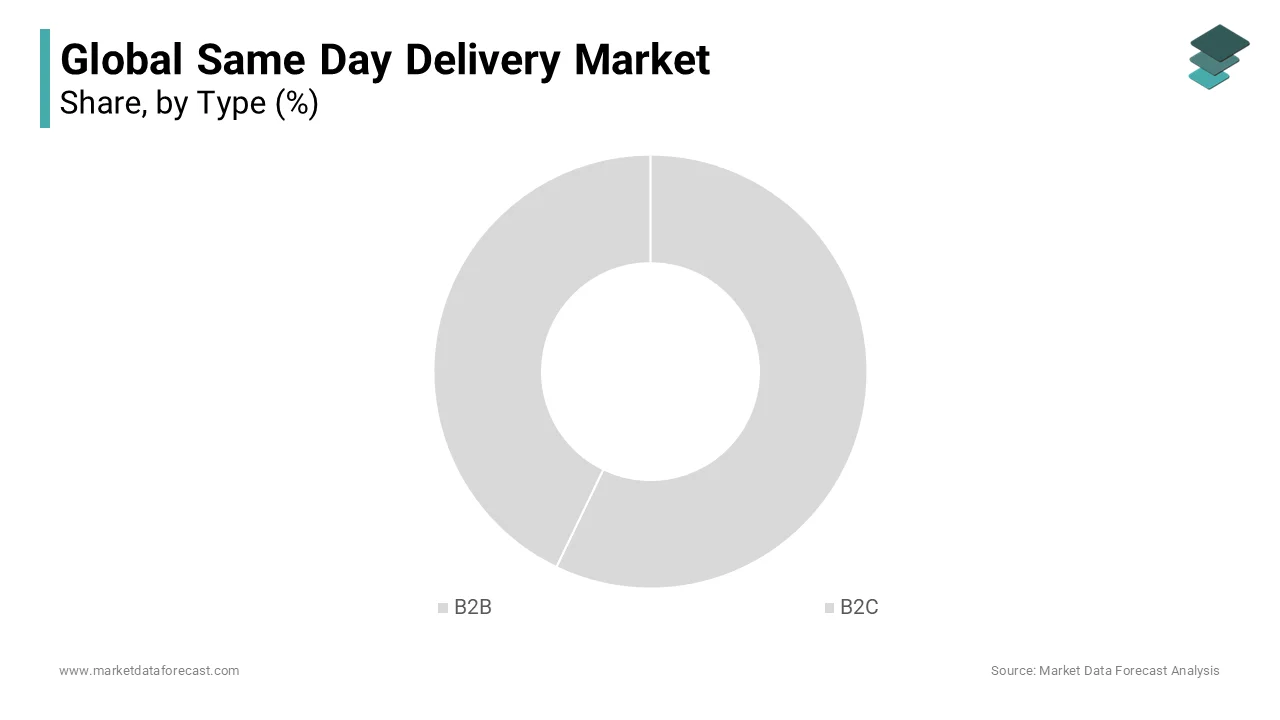
The B2B segment is anticipated to expand at a CAGR of 17.3% from 2025 to 2033 in Same Day Delivery Market. This surge is driven by the digital transformation of supply chains and the increasing reliance on just-in-time inventory models. Industrial and healthcare sectors are particularly instrumental; for instance, Siemens Healthineers reported in 2023 that over 40% of its medical equipment spare parts in Europe are now dispatched within four hours of order placement to minimize hospital downtime. The adoption of cloud-based logistics platforms like project44 and FourKites has enabled real-time B2B shipment tracking by improving coordination between suppliers and manufacturers. A December 2025 Gartner article on last-mile delivery notes that while 90% of survey respondents consider speed a top-three factor, 85% prioritize reliability.
By Application Insights
E-commerce segment led the Same Day Delivery Market by capturing the highest share in 2025. The structural evolution of digital retail, where delivery speed has become a core competitive differentiator is escalating the segment growth. Platforms like Amazon have institutionalized rapid fulfillment; in 2023, Amazon delivered over 1.2 billion items via same-day or two-hour delivery windows in the U.S. As per the MWPVL International’s 2023 network analysis, the integration of AI-powered demand forecasting has enabled precise inventory placement, with 85% of Amazon’s same-day eligible products stored in urban fulfillment centers within 10 miles of customers.
Retailers segment is experiencing the fastest growth in same-day delivery adoption with a projected CAGR of 18.1% from 2025 to 2033 in Same Day Delivery Market. This acceleration is fueled by the resurgence of omnichannel strategies, where physical stores double as mini-distribution hubs. For Instance, Walmart fulfilled over millions of same-day delivery orders in 2023 through its Spark driver network, is leveraging its 4,700 U.S. stores as fulfillment points. As per the National Retail Federation, that over more than half of retailers now offer buy-online-pickup-in-store (BOPIS) or same-day delivery, up from 45% in 2020.
REGIONAL ANALYSIS
North America Market Analysis
North America was the top performer in the global Same Day Delivery Market with a 38.5% share in 2025. The market is establishing itself as the most mature and technologically advanced region in rapid logistics. The U.S. alone accounts for over 90% of this regional volume, which is driven by high e-commerce penetration and consumer demand for immediacy. Amazon’s same-day delivery network covers over 70% of the U.S. population, is reaching 180 cities with two-hour delivery options. The density of fulfillment infrastructure is unparalleled, there are now over 1,200 dark stores and micro-fulfillment centers in major metropolitan areas.
Europe Market Analysis
Europe holds the second position with market share of 27.3% in 2025, with Western European nations like Germany, the UK, and France spearheading adoption. The region’s strength lies in its dense urban populations and strong regulatory support for sustainable logistics. A May 2025 news report from About Amazon Europe announced that Amazon had expanded its same-day delivery to over 135 locations in Europe. As per the European Commission reported that urban logistics emissions fell between 2020 and 2023, partly due to the rise of electric cargo bikes and micro-hubs, Amsterdam alone deployed over 1,200 e-cargo bikes for last-mile delivery by 2023. For Instance, Germany’s DHL launched same-day services in 80 cities, by fulfilling over 35 million urgent shipments in 2023. Consumer demand is also robust; a 2023 YouGov survey found that more than half of UK online shoppers prefer retailers offering same-day options.
Asia Pacific Market Analysis
Asia Pacific adhesive Market is expanding significantly where China and India are the primary engines of this growth. In China, Alibaba’s Cainiao Network processed over 2 billion same-day and instant delivery orders in 2023, which is supported by AI-driven logistics and a dense network of community pickup points. For Instance, JD.com delivers over 90% of its orders in China within 24 hours, with same-day fulfillment in 300 cities. India’s same-day delivery volume surged by 78% in 2023, is driven by Flipkart and Amazon India expanding into tier-2 and tier-3 cities. As per the World Bank urban mobility report with over 600 million urban consumers in Asia expected to demand rapid delivery by 2025, and rising smartphone penetration at 75% across the region, the infrastructure for hyperlocal logistics is scaling rapidly. Investments in drone delivery trials such as Tata Group and Zomato conducted over 10,000 drone deliveries in India in 2023 which signal a leapfrog in delivery technology is positioning Asia Pacific as the future epicenter of innovation.
Latin America Market Analysis
Latin America adhesive Market is witnessing transformative growth, particularly in Brazil and Mexico. São Paulo and Mexico City have become hotspots for rapid delivery, with same-day service availability increasing between 2021 and 2023. For Instance, Rappi fulfilled over millions of same-day deliveries in 2023, including groceries, medicines, and retail goods, across 12 countries. Brazil’s e-commerce sales grew in 2023, reaching $60 billion, with 58% of urban consumers expecting delivery within 24 hours.
Middle East and Africa Market Analysis
The Middle East and African adhesive Market is emerging as high-potential regions due to strategic investments and urban modernization. As per the Dubai Road and Transport Authority, the UAE leads the charge, with Dubai aiming to have 50% of last-mile deliveries conducted via drones or autonomous vehicles by 2030.
COMPETITIVE LANDSCAPE
KEY MARKET PLAYERS
Some of the key players dominating the global same day delivery market are
- FedEx Corporation
- DHL / DHL Express
- United Parcel Service (UPS)
- Amazon (Amazon Logistics / Prime Now)
- Aramex
- Dropoff, Inc.
- A1 Express Services, Inc.
- Jet Delivery, Inc.
- Power Link Expedite
- USA Couriers
- XPO Logistics, Inc.
- Deutsche Post AG
TOP STRATEGIES USED BY THE KEY MARKET PLAYERS
Key players in the Same Day Delivery Market are prioritizing urban fulfillment network expansion, is deploying micro-fulfillment centers within cities to reduce delivery times. They are increasingly adopting automation and AI for route optimization, demand forecasting, and warehouse management to enhance efficiency. Strategic partnerships with local retailers and gig economy platforms enable scalable last-mile delivery. Investment in sustainable logistics, including electric vehicles and drone delivery, supports regulatory compliance and brand image. Companies are also leveraging data analytics to personalize delivery options and improve customer retention. These strategies collectively enhance speed, reliability, and cost-effectiveness is allowing firms to meet rising consumer expectations and maintain competitive advantage in densely populated urban markets across the globe.
COMPETITION OVERVIEW
The competition in the Same Day Delivery Market is intensifying as global logistics providers, e-commerce giants, and tech-driven startups race to dominate urban express logistics. Companies are differentiating through speed, technological innovation, and hyperlocal infrastructure. Amazon, JD Logistics, and regional players like Delhivery and Ninja Van are aggressively expanding micro-fulfillment networks and integrating AI for real-time dispatch optimization. The rise of instant commerce platforms has spurred partnerships between retailers and third-party logistics firms, which is increasing service density. Entry of drone and autonomous vehicle technologies is reshaping delivery models, particularly in Asia Pacific and North America.
TOP PLAYERS IN THE MARKET
- Amazon Logistics has significantly expanded its same-day delivery footprint across the world by investing heavily in localized fulfillment infrastructure. In 2023, Amazon launched same-day delivery in over 25 new cities in India and Japan by leveraging its network of urban fulfillment centers and AI-driven demand forecasting. The company introduced "Amazon Quick" in select metro areas, which is offering two-hour delivery for essentials. It also partnered with local retailers in Australia and South Korea to integrate their inventories into its rapid delivery ecosystem. Its investment in drone delivery trials in Australia, which is approved by CASA in late 2023, escalates its commitment to innovation. These initiatives have enhanced the Amazon’s role as a key enabler of instant commerce by setting new benchmarks for speed and reliability across diverse urban markets in the region.
- JD Logistics plays a pivotal role in advancing same-day delivery capabilities across China and Southeast Asia through its highly automated, tech-integrated supply chain network. The company fulfills over 90% of its orders in China within 24 hours, with same-day delivery available in more than 300 cities. In late 2023, JD Logistics launched its international express delivery service, focusing on cross-border logistics between China and Europe/North America. It launched autonomous delivery robots in over 50 Chinese campuses and residential zones, is completing more than 1.2 million autonomous deliveries annually. The company also strengthened cross-border same-day logistics by partnering with Thailand’s CP Group and establishing smart warehouses in Vietnam.
- Delhivery is a major force in India’s same-day delivery landscape, providing end-to-end logistics solutions to e-commerce platforms, retailers, and enterprises. The company operates one of the largest private logistics networks in India, with over 80 fulfillment centers and a dense last-mile delivery presence in tier-2 and tier-3 cities. In 2023, Delhivery launched instant delivery services in 15 metropolitan areas, by offering sub-three-hour delivery for grocery and pharmaceutical partners. It integrated AI-based dynamic routing and real-time tracking to improve on-time delivery rates to over 95%. The company also partnered with Flipkart to enhance same-day delivery capacity ahead of peak shopping seasons. By investing in automation and expanding its cold-chain capabilities for perishable goods, Delhivery has strengthened its service reliability.
Global Same Day Delivery Market News
- In August 2025, Amazon announced investments to expand its fulfillment and logistics network in India, primarily to enhance same-day and next-day speeds for Prime members.
- In May 2025, Delhivery expanded its rapid commerce services, primarily aimed at businesses and competing with intracity players like Uber and Rapido. Delivery also uses AI for its own route planning and to reduce return-to-origin shipments for clients.
MARKET SEGMENTATION
This research report on the global same day delivery market has been segmented and sub-segmented into the following categories.
By Type
- B2B
- B2C
By Application
- Retailers
- E-Commerce
By Region
- North America
- Europe
- Asia Pacific
- Latin America
- Middle East and Africa