- Product Description Description
- Table of Contents TOC
- List of Table & Figure LOT
- Get Free Sample PDF Sample PDF
Market Size, 2025
$1.5 BnMarket Estimate, 2026
$1.62 BnMarket Forecast, 2034
$3.02 BnCAGR, 2026–2034
8.1%Global Stairlift Market Report Summary
The global stairlift market was valued at USD 1.5 billion in 2025, is estimated to reach USD 1.62 billion in 2026, and is projected to reach USD 3.02 billion by 2034, growing at a CAGR of 8.1% from 2026 to 2034. Market growth is primarily driven by the rapidly aging global population, increasing demand for mobility assistance solutions, and a rising preference for independent living among elderly and disabled individuals. The expansion of home healthcare infrastructure and growing awareness about accessibility solutions are further fueling market growth. Additionally, technological advancements in stairlift design, including compact, customizable, and smart-enabled systems, are enhancing adoption.
Key Market Trends
- Growing aging population and demand for mobility assistance solutions.
- Increasing preference for independent living among elderly individuals.
- Rising adoption of home healthcare equipment.
- Technological advancements in compact and customizable stairlifts.
- Expansion of residential accessibility solutions.
Segmental Insights
- Based on rail type, the straight stair lifts segment dominated the global stairlift market by capturing 65.1% share in 2025, driven by ease of installation and cost-effectiveness.
- Based on installation location, the residential segment held the largest share in 2025, supported by increasing demand for home-based mobility solutions.
Regional Insights
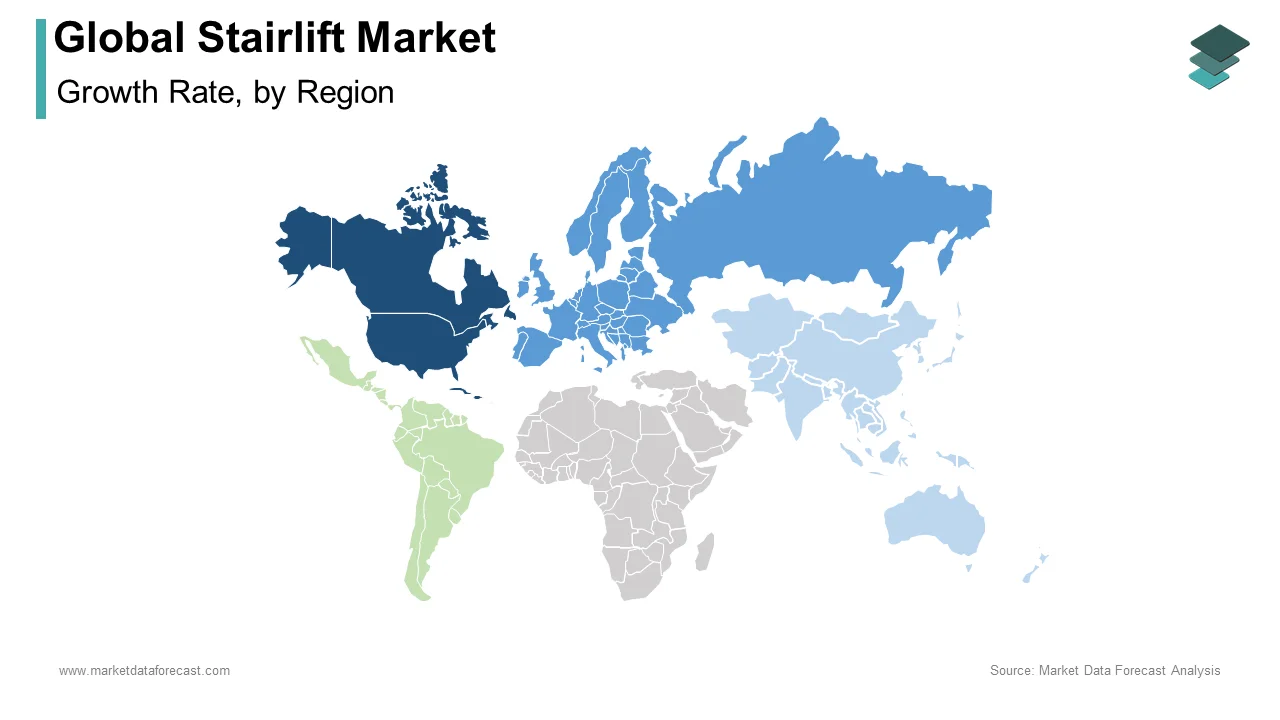
The global stairlift market is expanding steadily across regions due to demographic shifts and increasing accessibility needs.
- North America led the market in 2025 with 38.2% share, driven by advanced healthcare systems and high adoption of assistive technologies.
- Europe followed with 32.3% share, supported by aging populations and strong social healthcare frameworks.
- Asia-Pacific is the fastest-growing region due to rapid population aging, rising disposable incomes, and increasing urbanization in multi-story housing.
Competitive Landscape
The global stairlift market is moderately competitive, with companies focusing on product innovation, customization, and expanding distribution networks. Manufacturers are investing in user-friendly designs and smart features to enhance safety, comfort, and ease of use.
Prominent companies operating in the global stairlift market include Savaria Corporation, Stannah International, Handicare Group AB, Lehner Lifttechnik GmbH, Otolift Stairlifts Ltd., Karmar Mobility LLC, Prism U.K. Medical Limited, Acorn Mobility Services, Platinum Stairlifts Ltd., Bruno Independent Living Aids, HIRO LIFT, Kumalift Co., Ltd., and Symax Lift.
Global Stairlift Market Size
The global stairlift market was worth US$ 1.5 billion in 2025 and is anticipated to reach a valuation of US$ 3.02 billion by 2034 from US$ 1.62 billion in 2026, and it is predicted to register a CAGR of 8.1% during the forecast period 2026 to 2034.

A stair lift is a mechanical device designed to transport people with limited mobility up and down stairs while seated in a chair that moves along a mounted rail. These devices consist of a motorized chair or platform mounted on a rail system, serving as a critical intervention for aging in place by eliminating the fall risks associated with stair navigation. The urgency of this market is underscored by the global demographic shift toward an older population and the rising incidence of mobility impairments. According to the World Health Organization, falls are the second leading cause of accidental injury deaths worldwide, with adults over 60 years suffering the greatest number of fatal falls, estimated at 684000 annually. Furthermore, data from the Centers for Disease Control and Prevention indicate that one in four older adults falls each year, yet less than half tell their doctor, highlighting a silent crisis in home safety. The European Commission notes that over 90% of Europeans aged 55 and older prefer to remain in their own homes as they age, creating a massive demand for home modifications. Stairlifts are no longer merely a convenience; they are an essential infrastructure component as healthcare systems face capacity constraints. They prevent institutionalization, reduce hospital admissions due to falls, and support independent living for millions of individuals with chronic conditions or disabilities.
MARKET DRIVERS
Accelerating Global Demographic Shift Toward an Aging Population
The unprecedented growth in the global elderly population fuels the growth of the stairlift market. Advanced age correlates strongly with reduced mobility and increased fall risk. The proportion of individuals requiring assistance with daily activities like climbing stairs is expanding exponentially. This trend is driven by rising life expectancy and declining birth rates in developed nations. According to the United Nations Department of Economic and Social Affairs, the number of people aged 65 years or older is projected to rise from approximately 703–761 million in recent years to 1.5 billion by 2050, effectively doubling the potential user base for mobility aids. In Europe, Eurostat data reveal that 21.3 percent of the population was already aged 65 or older in 2023, with countries like Italy and Germany seeing even higher concentrations of seniors living in multi-story homes built before modern accessibility standards. The National Institute on Aging reports that mobility limitations affect roughly 35–40% of persons aged 70–75, making stair navigation a significant barrier to independence. This demographic reality forces families and healthcare providers to seek immediate solutions to keep seniors safe in their existing residences. The sheer volume of aging individuals residing in homes with stairs ensures a consistent and growing demand for stairlifts, transforming them from niche products into essential household appliances for the modern aging society.
Strong Policy Support for Aging in Place and Deinstitutionalization
Government policies and healthcare strategies actively promoting aging in place rather than institutional care act as a fundamental driver for the stairlifts market. Public health systems are increasingly recognizing that keeping elderly individuals in their homes is more cost-effective and beneficial for their mental health than moving them to nursing facilities. According to the Organisation for Economic Co-operation and Development, long-term care expenditures for home-based services are significantly lower than institutional care, prompting governments to subsidize home modifications, including stairlift installations. The Administration for Community Living in the United States highlights that programs under the Older Americans Act provide funding and resources specifically for home safety modifications to prevent falls and delay nursing home entry. Similarly, the United Kingdom's National Health Service often collaborates with local councils to provide grants or loans for stairlifts through occupational therapy assessments, recognizing them as preventive medical devices. Data from the European Foundation for the Improvement of Living and Working Conditions shows that nations with robust home care policies see higher uptake of mobility aids. This regulatory and financial backing reduces the economic burden on families, making stairlifts accessible to a broader demographic and cementing their role as a cornerstone of national aging strategies.
MARKET RESTRAINTS
High Initial Acquisition Costs and Limited Insurance Reimbursement
The substantial upfront cost of purchasing and installing a stairlift, combined with inconsistent insurance coverage, is a significant barrier to market penetration for many households and the stairlift market. Unlike basic medical supplies, stairlifts are often categorized as home improvements rather than durable medical equipment, leading to limited reimbursement from private insurers and public health programs. According to analysis from the Kaiser Family Foundation and official Medicare guidelines, stairlifts are generally classified as home modifications rather than medical equipment. This classification excludes them from standard coverage, leaving beneficiaries responsible for the full out-of-pocket expense, which varies significantly based on the complexity of the staircase. This financial burden is particularly acute for fixed-income seniors who constitute the primary user base. The AARP Public Policy Institute emphasizes that the high cost of home modifications is a major source of anxiety for older adults. This financial pressure often leads many homeowners to delay critical safety installations, such as stairlifts, until after a fall or injury has already occurred. In developing regions, the lack of any subsidy mechanisms makes these devices prohibitively expensive for the vast majority of the population. The fragmented nature of funding sources means that access is heavily dependent on geography and personal wealth, restricting market growth to affluent segments and preventing widespread adoption among those who need it most but can least afford it.
Structural Limitations of Older Housing Stock and Installation Complexities
The architectural characteristics of existing housing stock, particularly in older regions, are a technical restraint to the stairlift market. This complicates or prevents the installation of standard stairlift systems. Many historic homes feature narrow, winding, or spiral staircases that do not accommodate straight rail models, necessitating expensive custom-curved solutions that require complex engineering and longer lead times. According to the Joint Center for Housing Studies at Harvard University, a significant portion of the housing inventory in Europe and North America was built before 1980, often with stair dimensions that fall outside modern accessibility standards. The National Association of Home Builders notes that retrofitting these structures can involve structural reinforcements, electrical rewiring, and obstructions like doors or landings that make installation technically challenging or aesthetically unappealing to homeowners. In some cases, the staircase may be too narrow to allow a seated stairlift without obstructing passage for other residents, forcing the consideration of more invasive alternatives like through-floor lifts. Various sources suggest that a meaningful portion of potential sales is never realized due to these physical limitations. Many inquiries end without a purchase because the home's existing architecture presents insurmountable structural barriers or requires customization that becomes prohibitively expensive. These physical constraints limit the addressable market to homes with compatible layouts, slowing the overall expansion of the stairlift sector.
MARKET OPPORTUNITIES
Integration of Smart Technologies and Remote Health Monitoring
The incorporation of Internet of Things technology and remote monitoring capabilities into stairlifts paves the way to evolve these devices from simple transport tools into comprehensive health management hubs, which is likely to promote the growth of the stairlift market. Modern stairlifts equipped with sensors can track usage patterns, detect irregularities in movement that may indicate health declines, and automatically alert caregivers or emergency services in the event of a stall or fall. According to research, the adoption of remote patient monitoring solutions is expanding rapidly. Stakeholders across the healthcare spectrum are increasingly using these tools to extend the reach of medical care well beyond the traditional clinic setting. Manufacturers can leverage this trend by integrating cellular connectivity and artificial intelligence algorithms that predict maintenance needs before failures occur, enhancing safety and reliability. The Mayo Clinic suggests that continuous monitoring of mobility metrics can provide early warnings for conditions like Parkinson's disease or muscle weakness, allowing for timely medical interventions. Furthermore, smart interfaces can offer voice control and app-based scheduling, improving usability for individuals with cognitive impairments. Companies can tap into new revenue streams by positioning stairlifts as connected health devices, offering subscription-based monitoring, and partnering with insurance providers. Such strategies expand the market beyond mere hardware sales.
Expansion of Rental and Leasing Business Models
The development and promotion of flexible rental and leasing models offer a major opportunity to overcome financial barriers and capture customers with short-term or temporary mobility needs, which is expected to boost the expansion of the stairlift market. Many individuals require stairlifts only for a limited recovery period following surgery or during a temporary exacerbation of a chronic condition, making outright purchase economically inefficient. According to various sources, the medical equipment rental sector in Europe is seeing robust growth. Both consumers and payers are increasingly recognizing the financial flexibility and access benefits of renting over owning expensive medical hardware. By offering monthly rental plans with included maintenance and removal services, manufacturers can appeal to a demographic that is hesitant to commit to a permanent installation. Multiple studies indicate that rental options can reduce the initial financial entry point by up to 80 percent, making stairlifts accessible to a much wider audience. This model also facilitates easier upgrades to newer technologies, ensuring users always have access to the latest safety features. Additionally, rental fleets allow companies to refurbish and redeploy units, promoting sustainability and circular economy principles. Healthcare systems are increasingly favoring cost-sharing models. As a result, the rental segment is poised to become a dominant distribution channel, driving volume growth and market penetration.
MARKET CHALLENGES
Shortage of Skilled Technicians for Installation and Maintenance
A critical shortage of trained technicians capable of installing, servicing, and repairing complex stairlift systems poses a serious operational issue that threatens customer satisfaction, market scalability, and the stairlift market. The installation of curved stairlifts requires specialized skills in measurement, rail fabrication, and electrical integration, yet the workforce possessing these qualifications is shrinking due to an aging labor force and a lack of vocational training programs. According to the International Labour Organization, the global care and support sector faces a deficit of millions of workers, a gap that extends to technical roles supporting home care infrastructure. Research shows that wait times for the installation and repair of home devices have risen significantly. These prolonged delays cause substantial frustration for users and create serious safety risks when critical mobility equipment remains out of service for extended periods. The geographic dispersion of customers in rural areas further exacerbates the issue, as travel times reduce technician efficiency and increase service costs. Manufacturers struggle to scale operations and meet rising demand without a robust pipeline of skilled labor. This issue can also lead to deteriorating after-sales service and damage to brand reputation. Addressing this labor gap requires significant investment in training and recruitment, which remains a complex hurdle for the industry.
Stigma Associated with Disability and Aesthetic Concerns
The persistent social stigma surrounding disability aids discourages potential users from adopting stairlifts, which limits the expansion of the stairlift market. Furthermore, the aesthetic impact of installing mechanical devices in private homes acts as a significant psychological barrier. Many seniors view stairlifts as a visible symbol of frailty and loss of independence, leading to denial of their mobility limitations and resistance to installation until a crisis occurs. According to the World Health Organization, stigma remains one of the biggest obstacles to the adoption of assistive technologies, with users fearing judgment from visitors and family members. Furthermore, homeowners often worry that the visual presence of a rail and chair will detract from the interior design of their homes or lower property values. Consumer behavior studies indicate that a large number of people who are eligible for home mobility aids delay their purchase due to concerns about home decor. The fear that a device will look out of place or "clinical" in their private hallway often outweighs the immediate physical benefits of the technology. Manufacturers face the challenge of designing sleeker, less obtrusive models that blend with home decor, but the perception of the device as "medical" rather than "lifestyle" persists. Overcoming this deep-seated resistance requires extensive educational campaigns to reframe stairlifts as tools of empowerment and freedom, a difficult cultural shift that slows market conversion rates.
REPORT COVERAGE
| REPORT METRIC | DETAILS |
| Market Size Available | 2025 to 2034 |
| Base Year | 2025 |
| Forecast Period | 2026 to 2034 |
| Segments Covered | By Rail Type, Install Location, Distribution Channel, and Region. |
| Various Analyses Covered | Global, Regional, and Country-Level Analysis, Segment-Level Analysis, Drivers, Restraints, Opportunities, Challenges; PESTLE Analysis; Porter’s Five Forces Analysis, Competitive Landscape, Analyst Overview of Investment Opportunities |
| Regions Covered | North America, Europe, Asia Pacific, Latin America, Middle East & Africa |
| Market Leaders Profiled | Savaria Corp., Stannah International, Handicare Group AB, Lehner Lifttechnik GmbH, Otolift Stairlifts Ltd., Karmar Mobility LLC, Prism U.K. Medical Limited, Acorn Stairlifts Inc., Platinum Stair Lifts Ltd., HIRO LIFT (Hillenkotter + Ronsieck), Kumalift Co., Ltd and, Symax Lift, and Others. |
SEGMENTAL ANALYSIS
By Rail Type Insights
The Straight Stair Lifts segment held the majority share of 65.1% of the global stairlift market in 2025. This supremacy of the segment is attributed to the prevalence of linear staircase architectures in residential construction, the significantly lower manufacturing and installation costs compared to curved models, and the immediate availability of standard units. A main fuel for sustaining the leadership of straight stairlifts is the architectural reality that a vast majority of residential homes, particularly those built in the mid-to-late 20th century, feature straight flight staircases rather than complex winding designs. Architectural surveys and housing data indicate that a substantial majority of single-family homes in North America and Europe feature at least one straight staircase. This common architectural feature creates a massive, inherent market for linear rail systems, which are easier to retrofit than complex curved designs. The National Association of Home Builders notes that straight runs are the most cost-effective design for builders, making them the standard in affordable housing developments where the aging population increasingly resides. Unlike curved stairs, which require bespoke engineering, straight stairs allow for the mass production of rails and chairs, drastically reducing unit costs. Data from the United States Census Bureau indicates that the median age of housing stock is rising, meaning more seniors are living in older homes with traditional straight layouts that are perfectly suited for these standard lifts. This structural compatibility ensures that straight stairlifts remain the default solution for the majority of mobility challenges, securing their dominant market position through sheer volume of applicable installations. The significant price advantage and rapid deployment capability of straight stairlifts act as a powerful driver for their market dominance, making them accessible to a broader demographic, including fixed-income seniors. Straight models are typically manufactured in standard lengths and can be installed within hours, whereas curved models require weeks for custom fabrication and measurement. Consumer advocacy groups and market reports consistently highlight a stark price difference between lift types. Standard straight stairlifts are relatively affordable, whereas custom curved models command a significantly higher price, creating a financial barrier for households without substantial budget flexibility. Medicare guidelines in the United States generally exclude coverage for home modifications like stairlifts, forcing families to pay out-of-pocket. In Europe, while some nations offer generous grants, access can still be limited by means-testing or bureaucratic delays, leaving many consumers in both regions where cost is the primary deciding factor. Industry distributors frequently maintain a local stock of straight rail units. This inventory depth allows for immediate installation, sometimes within a single day, which is a critical capability for patients who need urgent home accessibility to be safely discharged from the hospital. This combination of affordability and speed makes straight stairlifts the preferred choice for emergencies and budget-conscious families, reinforcing their status as the leading segment in the global market.

The Curved Stairlifts segment is anticipated to witness the fastest CAGR of 8.9% during the forecast period, owing to the increasing renovation of historic properties, the rising demand for customized solutions in multi-story luxury homes, and advancements in modular rail technology that reduce lead times and costs. The rapid expansion of the curved stairlift segment is primarily driven by the growing trend of aging in place within historic and older homes that feature unique, non-linear staircase designs such as spirals, landings, and quarter-turns. As the population ages, there is a strong desire among seniors to remain in their long-term family homes rather than downsizing to single-level apartments, necessitating mobility solutions that adapt to existing architectural quirks. According to the National Trust for Historic Preservation, millions of homes in Europe and North America were built before 1950 and commonly feature curved or winding staircases that cannot accommodate straight rails. The European Commission highlights that retrofitting these heritage buildings with modern accessibility features is a priority, driving demand for bespoke curved systems. As per sources, spending on modifications for aging residents is on a steady upward trajectory. A significant portion of this investment is now directed toward complex staircase solutions that allow residents to remain in multi-story homes. As the inventory of older homes remains a primary residence for the elderly, the need for tailored curved solutions grows faster than the market for standard straight units, propelling this segment to the forefront of growth. Technological innovations in modular rail systems and computer-aided design have significantly reduced the complexity, cost, and installation time of curved stairlifts, acting as a critical catalyst for the segment's rapid growth. Traditional curved lifts required entirely hand-fabricated rails, but new modular systems allow technicians to assemble custom curves on-site using pre-engineered components, slashing lead times from weeks to days. According to the International Organization for Standardization, new safety and design standards have facilitated the development of lighter, more flexible rail materials that can navigate tight turns and multiple landings with greater precision. The Journal of Rehabilitation Research notes that these technological improvements have lowered the price point of curved lifts in recent years, making them more competitive with high-end straight models. Furthermore, enhanced software allows for precise 3D scanning of staircases, ensuring a perfect fit and reducing installation errors. Data from major manufacturers indicates that sales of modular curved systems have doubled since 2022 as consumers recognize the feasibility of installing lifts in previously deemed "impossible" staircases. This convergence of technical feasibility and improved economics is driving the curved segment to become the fastest-growing area in the stairlift market.
By Installation Location Insights
The Residential Spaces segment was the largest in the stairlift market and captured a significant share in 2025. This prominence of the segment is supported by the overwhelming preference of the elderly population to age in their own homes, the high volume of private housing units with multiple floors, and the emotional desire to maintain independence within a familiar environment. The primary factor behind the dominance of residential spaces is the profound cultural and psychological preference among seniors to remain in their own homes rather than relocate to assisted living facilities or nursing homes. This concept, known as "aging in place," is supported by data showing that the vast majority of older adults view their home as a source of comfort, identity, and autonomy. According to the AARP Public Policy Institute, between 77% and 90% of adults over the age of 50 express a strong desire to stay in their current residence for as long as possible, creating a massive and consistent demand for home modification products like stairlifts. The Centers for Disease Control and Prevention emphasizes that staying at home is associated with better mental health outcomes and slower cognitive decline compared to institutionalization. Furthermore, Genworth Financial indicates that the monthly cost of professional nursing home care is exceptionally high. For most families, investing in home modifications is a financially superior option that offers long-term savings over the recurring expenses of assisted living facilities. This deep-seated desire to avoid institutional care, combined with the economic logic of home retention, ensures that the residential sector remains the primary marketplace for stairlift installations globally. The sheer prevalence of multi-story private housing units across global markets acts as a fundamental driver for the residential segment's overwhelming market share. Unlike commercial buildings, which are increasingly designed with universal accessibility standards including elevators and ramps, private homes often lack vertical transportation options, making stairlifts the only viable solution for mobility-impaired residents. According to studies, a significant proportion of the global housing stock consists of two or more story detached or semi-detached houses, particularly in North America, Europe, and parts of Asia. The Eurostat housing conditions survey reveals that more than half of Europeans live in houses with at least one flight of stairs, representing a vast potential user base. As the population within these homes ages, the necessity to navigate these stairs becomes critical. Data from the National Association of Realtors indicates that single-family homes remain the most common dwelling type for families with elderly members. The lack of alternative vertical transport in these private domains forces reliance on stairlifts, cementing the residential sector as the dominant application area for these devices.
The Commercial Spaces segment is likely to experience the fastest CAGR of 7.2% from 2026 to 2034 due to tightening regulatory mandates for public accessibility, the aging of the workforce requiring workplace accommodations, and the retrofitting of historic commercial buildings to comply with disability rights laws. The swift growth of the commercial segment is primarily fueled by increasingly strict government regulations and legal frameworks that mandate equal access to public and commercial buildings for individuals with disabilities. Laws such as the Americans with Disabilities Act in the United States and the Equality Act in the United Kingdom require businesses, hotels, restaurants, and public institutions to remove architectural barriers, including stairs, to ensure inclusivity. Studies indicate a consistent annual rise in lawsuits and complaints regarding accessibility non-compliance. This litigious environment is increasingly pressuring business owners to proactively install mobility aids to avoid costly legal battles and ensure adherence to civil rights laws. The International Labour Organization emphasizes that accessible workplaces are essential for retaining older workers and complying with anti-discrimination laws. Research suggests that retrofitting commercial buildings with stairlifts is often the most financially viable path to compliance. This is particularly true in older structures where installing a full passenger elevator is either structurally impossible or requires a prohibitive capital investment. As governments worldwide strengthen enforcement mechanisms and increase fines for non-compliance, the commercial sector is witnessing a surge in stairlift installations to meet these legal obligations, driving the segment's fast growth rate. The demographic shift toward an older workforce and the consequent need for reasonable accommodations in commercial environments act as a critical catalyst for the expansion of the commercial stairlift segment. As life expectancy increases, many individuals are choosing or needing to work past traditional retirement ages, yet they may face mobility challenges that hinder their ability to navigate office stairs or retail mezzanines. According to the Bureau of Labor Statistics, the labor force participation rate for individuals aged 65 and older has reached historic highs, projecting that one in four workers will be over 55 by 2026. The Job Accommodation Network reports that workplace accommodations are generally a sound investment compared to the high expense of replacing personnel. Providing physical modifications allows employers to retain qualified, experienced staff who might otherwise leave the workforce due to mobility challenges. Furthermore, the tourism and hospitality sectors are adapting to serve an aging clientele, with hotels and museums installing stairlifts to ensure all guests can access upper floors. The Society for Human Resource Management emphasizes that companies investing in accessibility see improved employee morale and broader customer appeal. This dual pressure of retaining older talent and serving an aging customer base is propelling the commercial segment to become the fastest-growing area in the stairlift market.
REGIONAL ANALYSIS
North America Stairlift Market Analysis
North America dominated the global stairlift market and accounted for a 38.2% share in 2025. The dominance of the North American market is driven by a highly developed healthcare infrastructure, strong consumer awareness of aging-in-place solutions, and a robust culture of home ownership. The stairlift market features high market penetration in single-family homes, backed by a strong network of dealers and installers. The United States Census Bureau reports that the population aged 65 and older will reach 80 million by 2040. This rapid aging of the Baby Boomer generation is a primary driver creating unprecedented demand for home modifications. Furthermore, the high cost of assisted living facilities in the US and Canada incentivizes families to invest in home accessibility equipment as a cost-saving measure. Data from the National Council on Aging indicates that fall prevention programs are widely promoted by insurers and government agencies, often covering part of the cost for mobility aids. The presence of major global manufacturers and a competitive distribution landscape ensures easy access to both straight and curved models. Additionally, strict enforcement of the Americans with Disabilities Act drives commercial installations. These converging demographic and economic factors solidify North America's position as the largest and most mature market for stairlifts globally.
Europe Stairlift Market Analysis
Europe followed closely behind in the global stairlift market and held a 32.3% share in 2025. The growth of the European market is attributed to its aging population, extensive stock of historic multi-story housing, and comprehensive social welfare systems that support home care. The market sees a strong preference for renovating existing homes rather than moving, particularly in countries like the UK, Germany, and Italy. A critical driver is the European Union's focus on active aging and independent living, with various national health services offering grants or subsidies for stairlift installations to reduce the burden on state-run care facilities. As per Eurostat, 21.3 percent of the EU population is aged 65 or older, with projections indicating this will rise to nearly 30 percent by 2050, intensifying the need for mobility solutions. The prevalence of older housing stock with narrow, winding staircases in European cities drives significant demand for custom curved stairlifts. A study shows that government-funded home adaptation schemes are widespread, lowering financial barriers for users. Furthermore, stringent building regulations regarding accessibility in public commercial spaces fuel the growth of the commercial segment. This combination of demographic pressure, policy support, and architectural necessity sustains Europe's significant standing as a key growth engine.
Asia Pacific Stairlift Market Analysis
The Asia Pacific is swiftly expanding in the stairlift market owing to rapid population aging, rising disposable incomes, and increasing urbanization in multi-story housing. The market status is dynamic and heterogeneous, ranging from mature markets in Japan and Australia to rapidly emerging sectors in China, India, and Southeast Asia. The dominant driving factor is the unprecedented speed of demographic change, with the United Nations projecting that Asia will be home to a significant share of the world's elderly population by 2050. In Japan, where the super-aged society phenomenon is most advanced, the government actively promotes universal design and home modifications through long-term care insurance schemes. Research indicates that rising middle-class wealth in China and India is enabling more families to purchase premium mobility aids for their elders. The proliferation of vertical living in urban centers means that even within apartments, internal stairs or split-level designs are common, creating niche demand. Furthermore, increasing awareness of fall risks and a cultural shift toward accepting assistive devices are breaking down traditional stigmas. These factors combine to position Asia Pacific as the most vibrant and high-potential frontier for the stairlift market.
Latin America Stairlift Market Analysis
Latin America maintains a significant position in the global market due to gradual improvements in healthcare access, a growing elderly population, and increasing urbanization, leading to multi-story living arrangements. The market status is characterized by a concentration of demand in urban centers of Brazil, Mexico, and Argentina, where the middle class is expanding and becoming more aware of accessibility needs. A key growth enabler is the demographic transition, with the Pan American Health Organization reporting that the number of people aged 60 and older in the region is expected to triple by 2050, creating a future surge in demand for mobility solutions. Economic stabilization in key nations has allowed for greater importation of medical devices and the establishment of local assembly plants, reducing costs. Various sources emphasize that urban housing trends favor vertical expansion due to land scarcity, increasing the prevalence of stairs in residential properties. While high costs and limited insurance coverage remain barriers, the rise of private health insurance and government pilot programs for aging support is beginning to open markets. The growing awareness of disability rights and accessibility standards is also prompting commercial establishments to install stairlifts. These emerging trends make Latin America a region of significant future opportunity.
Middle East and Africa Stairlift Market Analysis
The Middle East and Africa region is predicted to grow notably in the stairlift market from 2026 to 2034. It shows unique growth potential driven by government-led healthcare modernization, large-scale infrastructure projects, and rising awareness of elderly care. The market status is heavily concentrated in Gulf Cooperation Council countries, where high per capita income enables the adoption of premium stairlift solutions, while the African market is largely informal but evolving. A significant driving factor is the strategic vision of nations like Saudi Arabia and the UAE to develop age-friendly cities and healthcare systems as part of their economic diversification plans, leading to investments in assistive technologies. A study notes that as life expectancy improves across the continent, the prevalence of age-related mobility issues is rising, creating a latent demand for solutions. In the Gulf, the expatriate population and affluent locals often reside in large villas with multiple floors, driving specific demand for residential stairlifts. Although cultural stigma and cost remain significant hurdles, the push for modernization and the gradual introduction of disability rights legislation are laying the groundwork for future market expansion in this diverse region.
COMPETITIVE LANDSCAPE
The competition in the global stairlift market is characterized by a mix of established multinational corporations and numerous regional specialists striving for dominance through service quality and product customization. The landscape is moderately consolidated with key players holding significant influence, yet fragmented by local installers who cater to specific geographic niches. Competitive rivalry is intense as companies strive to differentiate their offerings through faster installation times, modular designs for curved stairs, and integrated smart technologies. Price competition remains relevant, particularly in the straight stairlift segment, where products are more commoditized. However, the primary battleground has shifted toward after-sales service reliability and warranty coverage since installation complexity requires skilled technical support. Regulatory compliance regarding safety standards acts as a major barrier to entry, ensuring that only firms with robust quality management systems can sustain operations. Mergers and acquisitions are frequent as larger entities seek to absorb smaller regional players to consolidate market share and streamline distribution networks. This dynamic environment drives continuous improvement in product durability and customer experience while fostering innovation in accessibility solutions.
KEY MARKET PLAYERS
Some of the companies that are playing a dominating role in the global stairlift market include
- Savaria Corp.
- Stannah International
- Handicare Group AB
- Lehner Lifttechnik GmbH
- Otolift Stairlifts Ltd.
- Karmar Mobility LLC
- Prism U.K. Medical Limited
- Acorn Mobility Services
- Platinum Stair Lifts Ltd.
- Bruno Independent Living Aids
- HIRO LIFT (Hillenkotter + Ronsieck)
- Kumalift Co., Ltd
- Symax Lift
TOP PLAYERS IN THE MARKET
- Acorn Mobility Services stands as a global leader in the stairlift industry by specializing in the rapid design, manufacture, and installation of both straight and curved mobility solutions. The company significantly contributes to the global market through its innovative modular rail technology, which allows for faster installation times and reduced costs compared to traditional custom builds. Recent actions to strengthen its market position include the expansion of its direct-to-consumer sales model in North America and Europe, bypassing third-party dealers to offer more competitive pricing. Acorn has also invested heavily in digital marketing campaigns targeting aging demographics and their families to raise awareness about aging in place. Their commitment to manufacturing high-quality units in the United Kingdom and the United States ensures supply chain resilience. Acorn maintains a strong reputation for making stairlifts accessible to a broader range of consumers through a focus on speed of service and affordability. At the same time, they continue to innovate in battery technology and safety features.
- Handicare Group operates as a premier provider of accessibility solutions with a diverse portfolio that includes straight and curved stairlifts, platform lifts, and patient handling equipment. The company plays a vital role in the global market by offering highly customizable products designed to fit complex staircase architectures found in historic European and American homes. Recent strategic moves involve the acquisition of regional distributors to tighten control over installation quality and customer service delivery across key markets. Handicare has also launched new smart stairlift models featuring remote monitoring capabilities that allow technicians to diagnose issues before they become critical failures. Their focus on sustainability is evident in efforts to reduce the carbon footprint of their manufacturing processes and extend product lifecycles. Through continuous investment in research and development, Handicare ensures its products meet the highest safety standards while providing superior comfort and reliability, solidifying its status as a trusted partner for healthcare providers and individual consumers worldwide.
- Bruno Independent Living Aids is a dominant force in the North American stairlift market, known for its robust engineering and extensive network of authorized dealers who provide personalized consultation and installation services. The company contributes extensively to the global sector by producing durable indoor and outdoor stairlifts that withstand various weather conditions and heavy usage patterns. Recent actions to bolster its market standing include the introduction of advanced ergonomic seating options and enhanced safety sensors that detect obstructions with greater precision. Bruno has expanded its manufacturing facilities to increase production capacity and reduce lead times for custom curved models. Their proactive approach to dealer training ensures that installation teams are highly skilled in handling complex residential scenarios. Bruno continues to build strong brand loyalty among users and healthcare professionals by prioritizing product durability and customer support. In doing so, the company reinforces its position as a leading innovator in the independent living solutions industry.
TOP STRATEGIES USED BY KEY MARKET PARTICIPANTS
Key players in the stairlift market primarily focus on product innovation to develop modular rail systems that reduce installation time and lower overall costs for consumers. Companies heavily invest in research and development to create smart connected devices featuring remote diagnostics and predictive maintenance capabilities. Strategic acquisitions of regional dealers and competitors represent another major approach to expand geographic reach and control service quality. Market participants are increasingly adopting direct-to-consumer sales models to bypass intermediaries and offer more competitive pricing structures. Partnerships with healthcare providers and insurance companies help firms secure reimbursement pathways and validate products as essential medical equipment. Additionally, companies are expanding their rental and leasing programs to capture customers with temporary mobility needs or budget constraints. These combined strategies allow leading firms to maintain competitive advantages and drive growth in a demographic-driven landscape.
MARKET SEGMENTATION
The global stairlift market has been segmented by rail type, installation location, distribution channel, and region.
By Rail Type
- Straight Stair Lifts
- Curved Stairlifts
- Platform Stairlifts
By Install Location
- Residential Spaces
- Commercial Spaces
By Distribution Channel
- Direct Channels
- Dealers And Distributors
- Government And Local Authorities
By Region
- North America
- Europe
- Asia Pacific
- Latin America
- Middle East and Africa