- Product Description Description
- Table of Contents TOC
- List of Table & Figure LOT
- Get Free Sample PDF Sample PDF
Market Size, 2025
$16.55 BnMarket Estimate, 2026
$17.94 BnMarket Forecast, 2034
$34.20 BnCAGR, 2026–2034
8.40%Executive Summary: Syringes Market
- Market Scope: Comprehensive global syringes market analysis covering product categories, material types, regional leadership frameworks, vaccination program drivers, and smart safety-engineered design trends.
- Market Valuation: Valued at USD 16.55 billion (2025), estimated at USD 17.94 billion (2026), and projected to reach USD 34.20 billion by 2034, registering a strong CAGR of 8.40% (2026–2034).
- Primary Growth Drivers: Global vaccination expansion (~900 million syringes annually for Gavi initiatives), chronic disease prevalence (diabetes affecting 537 million adults), smart dose-tracking integration, and auto-disable safety adoption.
Key Market Segment Metrics (2026–2034)
| Category | Leading Segment (2025 Position) | Fastest-Growing Segment |
|---|---|---|
| By Product, Material & Type | Disposable Syringes, Glass Syringes (largest material share), & Specialized Syringes (largest revenue type) | Sterilizable/Reusable Syringes (5.4% CAGR) & Plastic Syringes (8.84% CAGR) |
| By Regional Leadership | North America (led regionally with a 32.3% share in 2025) followed by Europe (28.3%) | Asia-Pacific (anticipated to exhibit significant CAGR growth during the forecast period) |
Major Market Players & Market Structure
Market Structure: Highly competitive global medical device and injection technology landscape featuring major international healthcare corporations competing on WHO-compliant safety features, low-dead-volume designs, and regional manufacturing expansions.
Key Companies: Terumo Corporation, B. Braun Medical Inc., Medtronic plc, Becton Dickinson and Company, Smiths Medical, Hindustan Syringes & Medical Devices Ltd., Nipro Corporation, Gerresheimer AG, SCHOTT AG, and CODAN Medizinische Geräte GmbH & Co KG.
Global Syringes Market Size
The global syringes market size was valued at USD 16.55 billion in 2025 and is anticipated to reach USD 17.94 billion in 2026 from USD 34.20 billion by 2034, growing at a CAGR of 8.40% during the forecast period from 2026 to 2034.
The Syringes are precision-engineered medical devices designed for the accurate delivery or withdrawal of fluids in clinical, diagnostic, and therapeutic settings. These devices are integral to parenteral administration, including intravenous, intramuscular, and subcutaneous routes, and are manufactured in various types such as hypodermic, insulin, safety, and auto-disable syringes. As per the World Health Organization, over 16 billion injections are administered globally each year, with approximately 90% used for therapeutic purposes and the remainder for vaccinations.
MARKET DRIVERS
Expansion of Global Vaccination Programs and Immunization Campaigns
The proliferation of large-scale immunization initiatives in low- and middle-income nations is a majorly factor propelling the growth of the Syringes Market. According to Gavi, the Vaccine Alliance, over 880 million vaccine doses were delivered across 68 countries in 2023, which is a proportional supply of sterile, single-use syringes. Each dose typically requires one syringe, translating to nearly 900 million syringes used annually just for Gavi-supported programs. UNICEF, the world’s largest procurer of syringes, distributed 2.1 billion syringes in 2023 alone, a 12% increase from the previous year, which is driven by routine immunization catch-up efforts post-pandemic.
Rising Prevalence of Chronic Diseases Requiring Injectable Therapies
The growing burden of chronic conditions such as diabetes, rheumatoid arthritis, and multiple sclerosis has intensified the need for self-administered injectable treatments, which is directly boosting the growth of the Syringes Market. As per the International Diabetes Federation, approximately 537 million adults were living with diabetes in 2023, a figure projected to rise to 643 million by 2030. Additionally, the increasing adoption of pre-filled syringes in home healthcare settings, particularly in the U.S. and Japan, reflects a shift toward patient-centric delivery systems that prioritize ease of use and dosing accuracy.
MARKET RESTRAINTS
Persistent Use of Non-Sterile and Reused Syringes in Resource-Limited Settings
The reuse of syringes is a public health issue in underdeveloped regions, which is negatively impacting the growth of the Syringes Market. According to the World Health Organization, in 2023, up to 40% of injections in parts of sub-Saharan Africa and South Asia were administered with improperly sterilized or reused syringes. This practice contributes to the transmission of bloodborne pathogens, with the WHO attributing 33,800 annual HIV infections and 1.7 million hepatitis C cases to unsafe injections.
Stringent Regulatory Scrutiny on Medical Device Manufacturing Standards
Manufacturers of syringes face escalating regulatory requirements that increase compliance costs and delay product approvals. The U.S. Food and Drug Administration mandates rigorous validation of sterility, biocompatibility, and device functionality under 21 CFR Part 820, with non-compliance leading to recalls or import bans. In 2023, the FDA issued 17 warning letters to syringe manufacturers in India and China for deviations in quality control processes, as documented in the agency’s enforcement database. These stringent frameworks, while ensuring patient safety, pose significant barriers for smaller manufacturers lacking the resources to maintain continuous regulatory alignment across multiple jurisdictions.
MARKET OPPORTUNITIES
Integration of Smart and Connected Syringes in Digital Health Ecosystems
The emergence of smart syringes equipped with sensors, Bluetooth connectivity, and dose-tracking capabilities is substantially to pose new opportunities for the growth of the Syringes Market. These devices enable real-time monitoring of injection parameters, adherence tracking, and data transmission to electronic health records. In 2023, the U.S. National Institutes of Health funded a pilot program using smart insulin syringes in diabetic patients, resulting in a 32% improvement in glycemic control due to enhanced dosing accuracy and patient feedback. Companies like BD and Sensile Medical are developing electromechanical injection systems that integrate with mobile health apps, allowing remote monitoring by clinicians. As per the Global Digital Health Partnership, 18 countries have initiated national digital health strategies that include connected medical devices, creating a conducive environment for smart syringe adoption in chronic disease management and telehealth delivery.
Adoption of Auto-Disable Syringes in Global Polio and Measles Eradication Initiatives
The Auto-disable (AD) syringes are designed to lock after a single use, and are becoming indispensable in mass immunization campaigns targeting vaccine-preventable diseases that may also eventually pose new opportunities for the growth of the Syringes Market. According to the World Health Organization, AD syringes were used in 95% of all polio vaccination campaigns in 2023, up from 78% in 2020, due to their effectiveness in preventing reuse.
MARKET CHALLENGES
Environmental Impact of Single-Use Plastic Syringes and Waste Management Gaps
The widespread reliance on disposable plastic syringes has led to mounting environmental concerns, as healthcare waste disposal is degrading the growth of the Syringes Market. According to the United Nations Environment Programme, medical plastics, including syringes, constitute 15% of total healthcare waste, with an estimated 15 million tons generated globally in 2023. These environmental and public health risks are prompting regulatory scrutiny and calls for biodegradable or reusable alternatives, though technological and cost barriers remain significant.
Supply Chain Disruptions Due to Geopolitical and Raw Material Volatility
The syringe manufacturing sector is highly dependent on a concentrated supply of medical-grade polymers, primarily polypropylene and cyclic olefin copolymers, which are vulnerable to geopolitical and logistical disruptions this also to hindering the growth of the Syringes Market. As per the International Energy Agency, the 2022 energy crisis in Europe led to a 30% reduction in polymer production at German and French chemical plants, directly affecting syringe output. In 2023, the U.S. Department of Commerce reported a 22% year-on-year increase in the price of medical-grade resins due to supply constraints from China and the Middle East. Additionally, the Red Sea shipping disruptions in late 2023 delayed container shipments from Asian manufacturers to Europe and Africa by up to six weeks, as noted by the International Chamber of Shipping.
REPORT COVERAGE
| REPORT METRIC | DETAILS |
| Market Size Available | 2025 to 2034 |
| Base Year | 2025 |
| Forecast Period | 2026 to 2034 |
| Segments Covered | By Usability, Material, Type, Specialized Syringes, and Region |
| Various Analyses Covered | Global, Regional & Country Level Analysis, Segment-Level Analysis; DROC, PESTLE Analysis, Porter's Five Forces Analysis, Competitive Landscape, Analyst Overview of Investment Opportunities |
| Regions Covered | North America, Europe, APAC, Latin America, Middle East & Africa |
| Market Leader Profiled | Terumo Corporation, 8. Braun Medical Inc., Medtronic plc, Becton Dickinson and Company, Smiths Medical, Hindustan Syringes & Medical Devices Limited, NIPRO Corporation, Gerresheimer AG, SCHOTT AG, and CODAN Medizinische Genera GmbH & Co KG. |
SEGMENTAL ANALYSIS
By Usability Insights
The disposable syringes segment dominated the global syringes market by holding a significant share in 2025 due to the global shift toward infection control and the prevention of cross-contamination in clinical environments. According to the Centers for Disease Control and Prevention, an estimated 1.7 million healthcare-associated infections (HAIs) occur annually in U.S. hospitals alone, with unsafe injection practices contributing to nearly 9% of these cases. Additionally, UNICEF’s 2023 procurement data reveals that 96% of all syringes acquired for immunization programs were single-use, which reflects a global consensus on safety standards in mass vaccination.
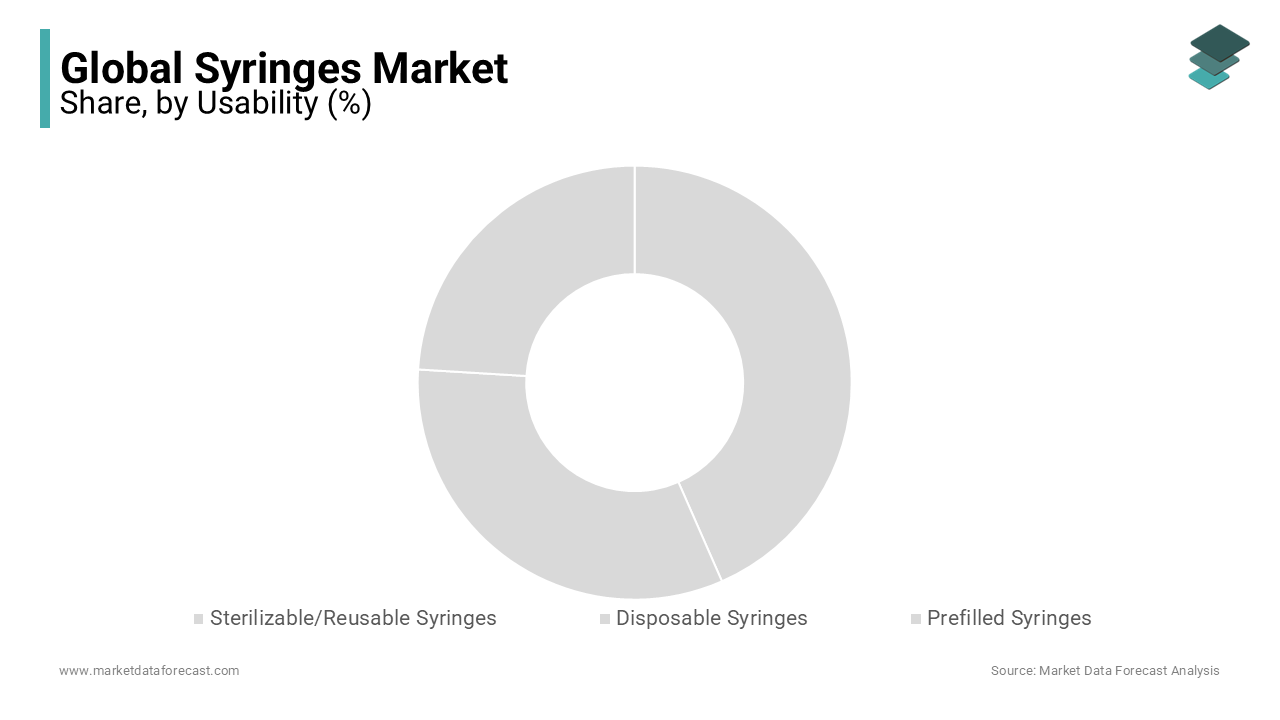
The sterilizable/reusable syringes segment is lucratively growing with an expected CAGR of 5.4% from 2026 to 2034 owing to the increasing adoption in specialized medical fields such as anesthesia and veterinary medicine, where high-pressure injection systems require durable, precision instruments. In Europe, reusable glass syringes are regaining traction in insulin delivery for pediatric diabetes due to their superior dose accuracy and reduced plastic exposure, as noted by the European Society for Paediatric Endocrinology.
By Material Insights
Based on material, the glass syringes segment accounted for the largest share of the global syringes market in 2025, and the domination of the segment is expected to continue during the forecast period. This is because glass syringes are more effective and decrease the chances of syringe material reacting with fluid and can be reused. In addition, manufacturing glass-type syringes with unbreakable features also demands the segment's growth.
The plastic syringe market is growing consistently and is predicted to showcase a CAGR of 8.84% during the forecast period owing to the rising awareness regarding blood-borne infections. In addition, the easy disposal of plastic-related syringes and the easy process of manufacturing these syringes are propelling segmental growth.
By Type Insights
The specialized syringes segment is estimated to grow significantly during the forecast period based on the type. The specialized syringes market is the largest revenue generator. The increasing demand for injectable drugs has fueled the market. The insulin segment has the highest market share. Due to the increasing insulin intake by a large volume of people due to the increase in glucose levels, demand for the manufacturing of different types of syringes is promoting segmental expansion. On the other hand, the available syringes market is growing its share daily during the forecast period.
Due to changing lifestyle habits, environmental pollution results in increasing allergy-related diseases, which demand the growth of syringes which does not contaminate or spread to the other person while injecting the patient.
REGIONAL ANALYSIS
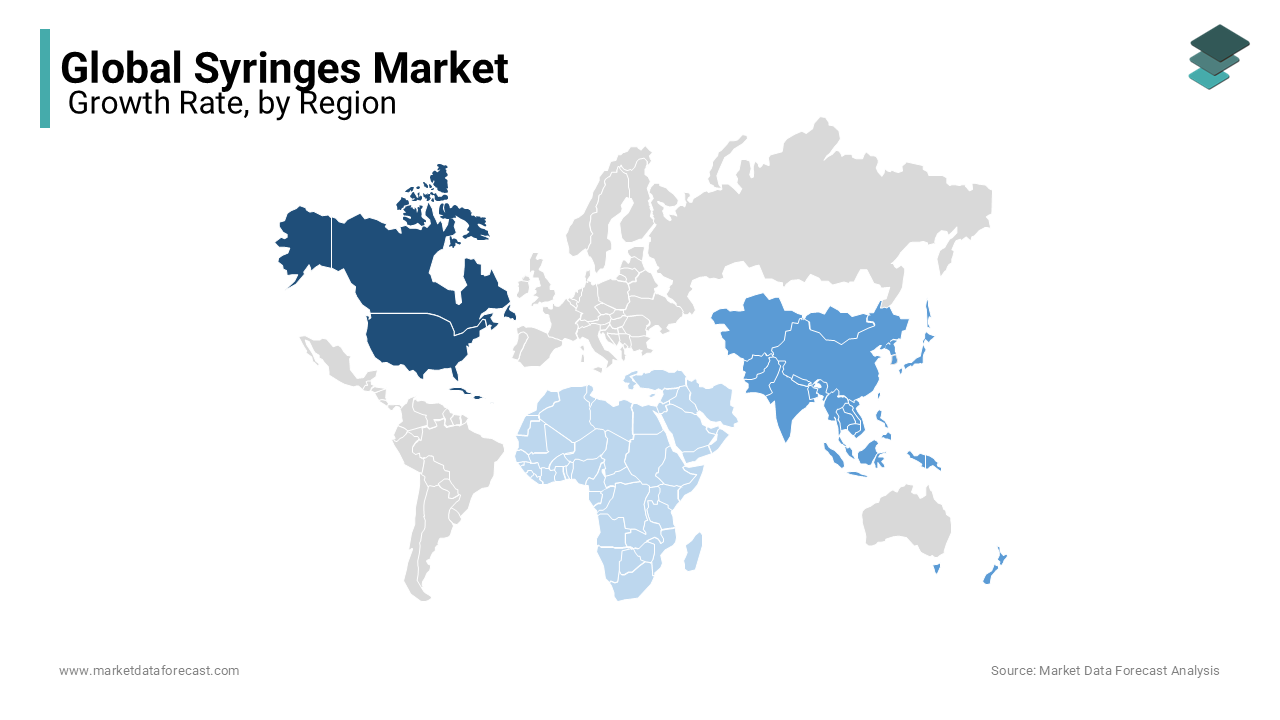
North America was the top performer in the global syringes market by accounting for 32.3% of share in 2025 with its advanced healthcare infrastructure, stringent infection control protocols, and high volume of injectable therapies. The FDA’s mandate for safety-engineered syringes in healthcare settings has driven the adoption of auto-disable and retractable models, with over 75% of acute care hospitals using safety-compliant devices by 2023. Additionally, the rise in home-based care for chronic diseases has boosted demand for pre-filled and insulin syringes with Medicare reimbursement policies that cover self-injection supplies for diabetic patients.
Europe was the second-largest in the Syringes Market with a 28.3% share in 2025, with the robust public health systems, strong regulatory oversight under the EU Medical Device Regulation (MDR), and extensive immunization coverage. France and Germany lead in per capita syringe usage, with national health agencies reporting an average of 12 injections per person annually. The European Commission’s 2023 Health Union initiative prioritized the stockpiling of 500 million safety syringes for pandemic preparedness, reinforcing procurement stability.
Asia-Pacific (APAC) syringes market growth is eventually to have a significant CAGR during the forecast period with the rapid healthcare expansion, rising disease burden, and government-led immunization drives. India and China are the primary consumption hubs, collectively accounting for over 60% of regional demand. In 2023, India’s Universal Immunization Programme administered 380 million vaccine doses, requiring an equivalent number of syringes, according to the Ministry of Health and Family Welfare. China’s National Health Commission reported a 19% year-on-year increase in insulin prescriptions between 2022 and 2023, reflecting the growing diabetes epidemic.
Latin America syringes market growth is likely to grow expanding public health initiatives and rising access to injectable treatments. Brazil’s Ministry of Health distributed 420 million disposable syringes in 2023 through its national immunization program by achieving 85% coverage for routine childhood vaccines. Additionally, PAHO’s Revolving Fund facilitated the procurement of 150 million syringes for regional vaccination campaigns by ensuring supply continuity despite economic volatility in countries like Argentina and Venezuela.The
Middle East and Africa (MEA) syringes market growth is likely to grow with high dependency on international aid for immunization and infectious disease control. Nigeria, the region’s most populous nation, administered 85 million vaccine doses through its Primary Health Care Under One Roof initiative, requiring sustained syringe imports due to limited domestic manufacturing. The Kingdom of Saudi Arabia, by contrast, has invested in local syringe production through its Vision 2030 healthcare localization strategy, which is aiming to meet 30% of domestic demand by 2025, as reported by the Saudi Food and Drug Authority. Persistent challenges in waste management and reuse remain, but donor-backed programs are increasingly mandating auto-disable syringes to enhance safety.
COMPETITIVE LANDSCAPE
New Product Launches and Collaborations are some notable strategies adopted by the companies operating in this market to maintain and maximize their market share. In addition, the recent COVID-19 pandemic has fuelled the sales of syringes across the globe, and market participants have taken new initiatives to manage the increased demand.
The competition in the syringes market is characterized by a blend of established multinational corporations and emerging regional manufacturers vying for dominance through innovation, compliance, and scalability. While global players like BD, Terumo, and Nipro lead in technology and regulatory adherence, local manufacturers in India, China, and Southeast Asia are gaining traction by offering cost-effective alternatives for high-volume public health programs. Differentiation is increasingly based on safety features, precision engineering, and environmental sustainability rather than price alone. The enforcement of infection control standards and the global push for zero reuse are reshaping procurement policies, favoring companies with certified auto-disable and low-dead-volume syringes. Geopolitical supply chain vulnerabilities have also prompted governments to incentivize domestic production, intensifying competition between foreign and indigenous suppliers.
KEY MARKET PLAYERS
Companies leading the global syringes market include
- Terumo Corporation (Japan)
- B. Braun Medical Inc. (U.S.)
- Medtronic plc (Ireland)
- Becton, Dickinson and Company (BD) (U.S.)
- Smiths Medical (U.K.)
- Hindustan Syringes & Medical Devices Ltd. (India)
- Nipro Corporation (Japan)
- Gerresheimer AG (Germany)
- SCHOTT AG (Germany)
- CODAN Medizinische Geräte GmbH & Co KG (Germany)
Top Players in the Syringes Market
Becton, Dickinson and Company (BD)
BD maintains a dominant presence in the Asia-Pacific syringes market through its extensive portfolio of safety-engineered and precision injection devices. The company has established manufacturing and distribution hubs in Singapore and India, enabling rapid supply across Southeast Asia and South Asia. In 2023, BD launched a localized version of its BD Ultrafine™ insulin syringe in India, designed for improved patient comfort and dosing accuracy in diabetic populations. The company also partnered with Thailand’s Ministry of Public Health to supply auto-disable syringes for national immunization campaigns. BD has further strengthened its regional footprint by collaborating with Australian healthcare providers to integrate its safety syringes into hospital infection control protocols, reducing needlestick injuries by 40% in pilot facilities. Its focus on regulatory compliance and clinical training programs reinforces long-term adoption.
Terumo Corporation
Terumo plays a pivotal role in shaping syringe standards across the Asia-Pacific region by leveraging its proximity to high-demand markets and deep integration with local healthcare systems. The company’s manufacturing facilities in Malaysia and China support its supply of precision syringes for insulin, vaccine delivery, and care applications. In 2023, Terumo introduced a new line of low-dead-volume syringes in South Korea and Taiwan, specifically designed to maximize vaccine dose recovery during mass immunization. It also collaborated with Japan’s Pharmaceuticals and Medical Devices Agency (PMDA) to enhance the biocompatibility testing of its polymer-based syringes. Terumo’s emphasis on R&D and partnerships with academic hospitals in Singapore and Australia has enabled the development of next-generation injection systems tailored to regional clinical workflows and aging population needs.
Nipro Corporation
Nipro has its influence in the Asia-Pacific syringes market through vertical integration and localized production strategies that ensure cost efficiency and supply resilience. Based in Osaka, Japan, the company operates large-scale syringe manufacturing units in Indonesia and India, catering to both domestic and export demand. In 2023, Nipro expanded its facility in Pune, India, to increase production capacity for disposable and safety syringes amid rising government procurement for public health programs. The company also supplied 80 million auto-disable syringes to Indonesia’s Ministry of Health to support its routine immunization schedule. Nipro’s collaboration with Vietnam’s medical device distributors has facilitated broader access to sterile syringes in rural clinics. Its focus on affordable, high-quality devices aligns with regional priorities in universal healthcare access and infection prevention.
Top Strategies Used by the Key Market Participants
Key players in the syringes market are employing product differentiation, regional localization, strategic partnerships, regulatory harmonization, and technological innovation to consolidate their market standing. Companies are increasingly investing in safety-engineered syringes with needlestick protection to comply with occupational health mandates in hospitals. Localization of manufacturing facilities reduces import dependency and enhances supply chain responsiveness in emerging economies. Firms are also engaging in public-private partnerships to secure government tenders for immunization programs. Integration of smart technologies, such as dose-tracking and connectivity features, is being pursued to cater to digital health trends. Additionally, manufacturers are strengthening quality management systems to meet stringent regulatory standards in the EU MDR and U.S. FDA frameworks, ensuring global market access and brand credibility.
RECENT HAPPENINGS IN THE MARKET
- In January 2023, BD launched a new safety-engineered syringe line in Indonesia, compliant with WHO auto-disable standards, to support the country’s national immunization program and enhance infection prevention in rural clinics.
- In May 2023, Terumo Corporation partnered with South Korea’s Korea Disease Control and Prevention Agency to supply low-dead-volume syringes for influenza and pediatric vaccination campaigns.
- In August 2023, Nipro expanded its syringe manufacturing facility in Gujarat, India with output by 40% to meet rising demand from state health departments and private hospitals.
- In November 2023, BD collaborated with Australia’s Therapeutic Goods Administration to accelerate the approval of its next-generation retractable syringes for use in public hospitals.
- In March 2024, Terumo initiated a clinical training program in Vietnam to educate healthcare workers on the proper use of safety syringes by improving adoption rates and reducing needlestick injuries in public clinics.
MARKET SEGMENTATION
This research report on the global syringes market has been segmented and sub-segmented based on usability, material, type, specialized syringes, and region.
By Usability
- Sterilizable/Reusable Syringes
- Hypodermic Syringes
- Oral Syringes
- Disposable Syringes
- Conventional Syringes
- Safety Syringes
- Prefilled Syringes
- Safety Syringes
- Retractable Syringes
- Non-Retractable Syringes
By Material
- Glass
- Plastic
By Type
- General
- Specialized Syringes
- Insulin
- Tuberculin
- allergy
By Region
- North America
- Europe
- Asia Pacific
- Latin America
- Middle East and Africa