UK Robo Advisor Market Size, Share, Trends, and Growth Analysis Report, Segmented by Type, Service, End-User and Country – Industry Forecast From 2026 to 2034
Market Size, 2025
$817.19 MnMarket Estimate, 2026
$1,079 MnMarket Forecast, 2034
$9,942 MnCAGR, 2026–2034
32%UK Robo Advisor Market Report Summary
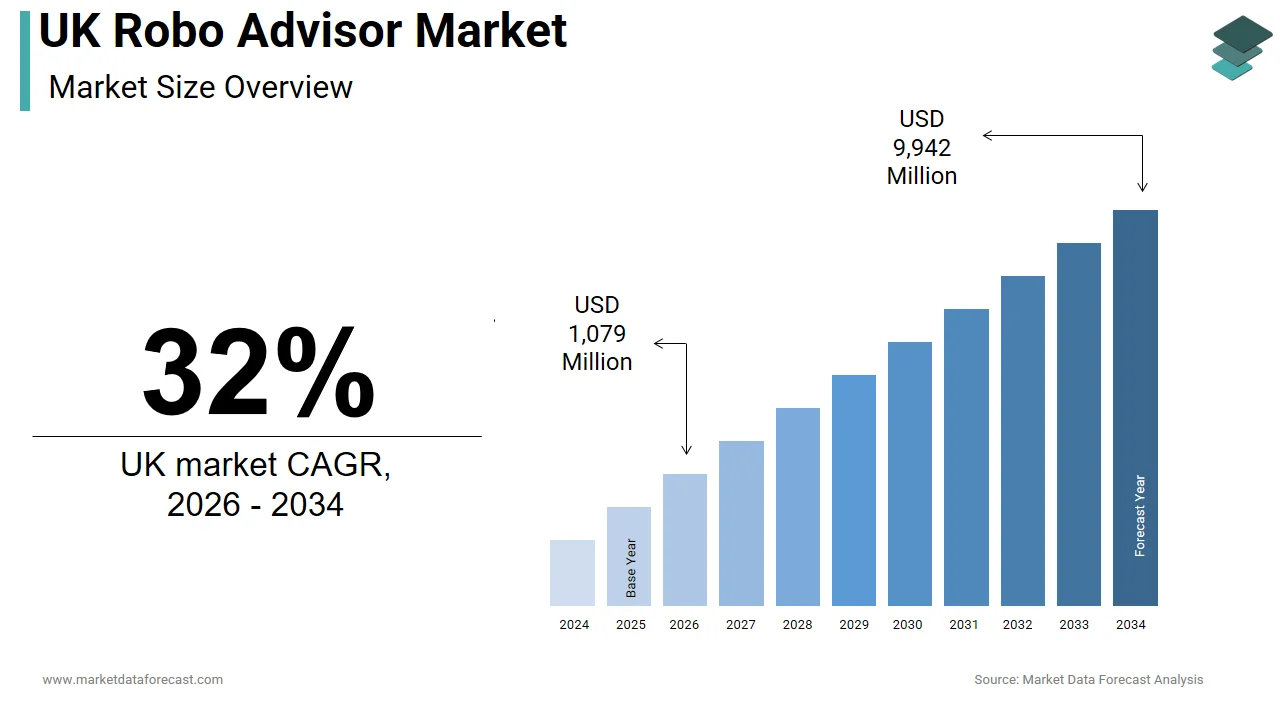
The UK robo advisor market was valued at USD 817.19 million in 2025, is estimated to reach USD 1,079 million in 2026, and is projected to reach USD 9,942 million by 2034, growing at an impressive CAGR of 32% from 2026 to 2034. Market growth is driven by increasing digitalization of financial services, rising demand for low-cost investment management solutions, and growing adoption of automated wealth management platforms. Robo advisors leverage artificial intelligence, machine learning, and algorithm-based portfolio management to provide personalized investment advice and asset allocation services. The increasing preference for digital investing, growing financial literacy, and expanding fintech ecosystem are further accelerating market growth across the United Kingdom.
Key Market Trends
- Rising adoption of AI-driven and automated investment management platforms.
- Increasing demand for low-cost wealth management solutions among retail investors.
- Growing popularity of digital-first financial advisory services.
- Expansion of personalized portfolio management and goal-based investing tools.
- Increasing integration of machine learning and predictive analytics in investment strategies.
Segmental Insights
- Based on type, the pure robo advisor segment dominated the UK robo advisor market by accounting for 54.2% share in 2025, driven by its ability to provide fully automated investment management services at lower costs without requiring human intervention.
- Based on service type, the wealth management segment held a significant share of the market in 2025, supported by increasing demand from investors seeking long-term portfolio growth, retirement planning, and diversified investment strategies.
- Based on end user, the individual retail investors segment led the market by capturing 58.1% share in 2025, owing to the growing demand for accessible, affordable, and user-friendly wealth management solutions among digitally engaged consumers.
Regional Insights
The UK robo advisor market is witnessing rapid growth, supported by the country's advanced fintech ecosystem, increasing adoption of digital financial services, and growing investor preference for automated investment platforms.
- The United Kingdom remains one of Europe's leading markets for robo advisory services due to high levels of digital banking adoption and strong fintech innovation.
- Rising awareness of investment planning, coupled with increasing demand for cost-efficient financial advice, is driving the adoption of robo advisory platforms among retail investors.
- Regulatory support for fintech innovation and the growing availability of app-based investment solutions continue to strengthen market growth prospects.
Competitive Landscape
The UK robo advisor market is highly competitive, with fintech companies, digital wealth management platforms, and investment service providers focusing on automation, personalization, and user experience. Market participants are investing in advanced analytics, AI-powered portfolio management, and diversified investment offerings to strengthen their market positions. Strategic partnerships, platform enhancements, and expansion of digital advisory services are shaping competitive dynamics across the market.
Prominent companies operating in the UK robo advisor market include Betterment, FutureAdvisor, Nutmeg, Wealthify, Personal Capital, Moneyfarm, Vanguard Personal Advisor, Wealthfront, WiseBanyan, and SigFig Wealth Management.
UK Robo Advisor Market Size
The UK robo advisor market was valued at USD 817.19 million in 2025, is estimated to reach USD 1,079 million in 2026, and is projected to reach USD 9,942 million by 2034, growing at a CAGR of 32% from 2026 to 2034.
The robo advisor is the use of algorithmic platforms to provide automated investment management and financial planning services. These digital solutions democratize access to wealth management by lowering entry barriers and reducing fees compared to traditional human advisory models. The sector operates under the stringent regulatory oversight of the Financial Conduct Authority, which ensures consumer protection and transparency in automated advice. This high level of digital literacy enables consumers to trust and utilize online platforms for complex financial decisions. The cultural shift toward self-directed finance is evident, as individuals seek greater control over their portfolios without the high costs associated with private banking. As per a study, only 57% of UK adults feel confident in managing their long-term savings, highlighting a significant gap that robo-advisors aim to fill through education and automation. The integration of open banking APIs allows these platforms to aggregate financial data, providing holistic views of user finances.
MARKET DRIVERS
High Cost Sensitivity Among Retail Investors
The escalating cost sensitivity among retail investors is majorly accelerating the growth of the United Kingdom robo-advisor market. The robo advisors typically charge between 0.25% and 0.75%, making them an attractive alternative for cost-conscious consumers. The average fee for active fund management remains substantially higher than passive strategies employed by most robo platforms. This demographic prefers transparent pricing structures, where costs are clearly defined and predictable. The compounding effect of lower fees over decades results in significantly larger final portfolio values, which appeals to long-term savers. Economic uncertainty and inflationary pressures have further heightened awareness of investment costs, prompting individuals to optimize every aspect of their financial planning. Robo advisors leverage economies of scale and automation to keep operational costs low, passing these savings directly to clients. This value proposition resonates strongly with middle-income earners, who previously found professional advice unaffordable.
Increasing Digital Literacy and Trust in Automation
The widespread increase in digital literacy and growing trust in automated technologies is another factor bolstering the growth of the United Kingdom robo-advisor market. Consumers are increasingly comfortable using digital interfaces for banking, shopping, and communication, which naturally extends to investment management. According to a study, 98% of households in the UK have access to broadband internet, facilitating seamless interaction with online financial platforms. This comfort level reduces the psychological barrier to adopting algorithmic advice, which relies on data rather than human interaction. The success of neobanks and digital payment systems has paved the way for more complex financial products like robo-advising. Users appreciate the convenience of accessing their portfolios 24/7 from mobile devices without needing appointments. Transparency in how algorithms make decisions builds trust, as users can see the logic behind asset allocation. Educational resources provided by these platforms further empower users to understand market dynamics. The perception of algorithms as unbiased and objective enhances their appeal compared to human advisors who may have conflicts of interest.
MARKET RESTRAINTS
Limited Personalization for Complex Financial Situations
The inability of robo advisors to provide nuanced personalization for complex financial situations is hindering the growth of the United Kingdom robo advisor market. While algorithms excel at standard portfolio construction, they struggle with unique life events, such as divorce, inheritance tax planning, or business succession. Many high-net-worth individuals require bespoke strategies that automated platforms cannot currently offer. Many consumers believe that human judgment is essential for navigating the complicated financial sector. Robo advisors typically rely on standardized questionnaires, which may not capture the full depth of a client’s risk tolerance or emotional biases. This limitation restricts their appeal to affluent clients, who have diverse asset classes, including property, private equity, and art. The lack of empathetic communication during volatility can also lead to poor decision-making by users who panic-sell without human reassurance. Regulatory requirements for suitability assessments are difficult to fully automate for non-standard cases. Many users outgrow robo platforms as their financial lives become more intricate.
Regulatory Compliance Burdens Increase Operational Costs
The stringent regulatory compliance requirements impose substantial operational burdens that is also impeding the growth of the United Kingdom robo-advisors market. The Financial Conduct Authority mandates rigorous standards for automated advice, including detailed record keeping, suitability checks, and clear disclosure of risks. These expenses reduce the margin advantage that robo-advisors traditionally hold over traditional firms. The need for regular audits and updates to comply with new laws, such as changes in pension regulations, adds administrative complexity. The liability for incorrect advice generated by algorithms remains a legal gray area, creating uncertainty for providers. Failure to meet regulatory standards can result in heavy fines and reputational damage. This regulatory weight slows down innovation as firms prioritize compliance over feature development. The cost of maintaining regulatory adherence limits the ability to offer ultra-low fees indefinitely.
MARKET OPPORTUNITIES
Integration of Hybrid Advisory Models
The integration of hybrid advisory models to enhance customer retention is likely to pose as a major opportunity for the expansion of the United Kingdom robo advisor market. By combining automated efficiency with access to human experts for complex queries, these platforms can cater to a wider range of client needs. This model allows firms to upsell premium services to clients who reach certain wealth thresholds or face life changes. Human advisors can handle the emotional aspects of investing while algorithms manage day-to-day rebalancing. This synergy improves customer satisfaction and reduces churn rates during downturns. It also enables firms to capture high-net-worth clients who were previously excluded from pure robo offerings. The flexibility to switch between digital and human touchpoints enhances the overall user experience. Regulatory bodies view hybrid models favorably as they ensure better suitability assessments. This evolution transforms robo advisors from standalone tools into comprehensive wealth management ecosystems.
Expansion into Pension and Retirement Planning
The expansion into pension and retirement planning is an additional factor to promote the growth of the United Kingdom robo-advisors market. Many individuals lack engagement with their workplace pensions and seek simple solutions to optimize their retirement savings. According to data from the Department for Work and Pensions, there are over 10 million active members in automatic enrollment schemes, creating a vast pool of potential users. As per the study, only 30% of workers actively manage their pension investments, indicating a large education and service gap. Robo advisors can provide personalized glide paths that adjust asset allocation as users approach retirement age. They can also integrate state pension forecasts and other income sources for holistic planning. The simplicity of digital interfaces appeals to younger workers starting their careers who want set-and-forget solutions. Tax-efficient wrappers, such as Stocks and Shares ISAs, can be seamlessly managed alongside pensions. This focus on long-term goals aligns with the core strength of algorithmic investing. Government initiatives promoting financial literacy support this expansion. By becoming the default choice for retirement planning, robo advisors can secure long-term sticky assets.
MARKET CHALLENGES
Cybersecurity Threats and Data Privacy Concerns
The cybersecurity threats and data privacy concerns, as these platforms handle sensitive financial information is solely to impede the growth of the United Kingdom robo advisor market. Any breach can lead to significant financial loss and erosion of consumer trust, which is difficult to rebuild. Robo advisors rely heavily on cloud infrastructure and third-party APIs, which increase the attack surface for hackers. Users are increasingly aware of privacy risks and may hesitate to share detailed financial data with automated platforms. Compliance with the General Data Protection Regulation requires robust encryption and access controls, which add technical complexity. A single security incident can trigger regulatory investigations and customer exodus. The anonymity of cyber criminals makes prevention challenging, requiring constant vigilance and investment. Insurers are raising premiums for cyber liability coverage adding to operational costs. Firms must balance ease of access with strict security protocols, which can sometimes frustrate users. Maintaining impenetrable defenses is an ongoing arms race against sophisticated threat actors.
Market Volatility and Algorithmic Limitations
The volatility and the inherent limitations of algorithms in maintaining client confidence during economic downturns also inhibit the growth of the United Kingdom robo advisor market. Automated systems typically follow predefined rules, which may not adapt quickly enough to unprecedented shocks or black swan events. Extreme movements can trigger correlated selling across algorithmic platforms, exacerbating declines. Some robo-advisors faced criticism during recent market turbulence for lacking dynamic risk management features. Users who do not understand the underlying strategy may panic when their portfolios drop, expecting human intervention. Algorithms cannot interpret geopolitical nuances or sentiment shifts that human managers might anticipate. This rigidity can lead to suboptimal performance compared to active management in certain conditions. The lack of emotional reassurance during crises increases the likelihood of clients withdrawing funds at the wrong time. Educating users about long-term horizons is difficult when immediate losses are visible. Regulators are scrutinizing whether automated advice truly meets suitability standards in volatile environments.
REPORT COVERAGE
| REPORT METRIC | DETAILS |
| Market Size Available | 2025 to 2034 |
| Base Year | 2025 |
| Forecast Period | 2026 to 2034 |
| Segments Covered | By Type, Service, End-User, and Region. |
| Various Analyses Covered | Global, Regional, and Country-Level Analysis, Segment-Level Analysis, Drivers, Restraints, Opportunities, Challenges; PESTLE Analysis; Porter’s Five Forces Analysis, Competitive Landscape, Analyst Overview of Investment Opportunities |
| Countries Covered | United Kingdom |
| Market Leaders Profiled | Betterment, FutureAdvisor, Nutmeg, Wealthify, Personal Capital, Moneyfarm, Vanguard Personal Advisor, Wealthfront, WiseBanyan, and SigFid Wealth Management. |
SEGMENTAL ANALYSIS
By Type Insights
The pure segment was accounted for in holding 54.2% of the United Kingdom robo advisor market share in 2025, with the ability to offer fully automated, low-cost investment management without human intervention. The scalability of algorithmic platforms, which can serve thousands of clients simultaneously with marginal incremental costs, is also bolstering the growth of the segment. One of the UK’s largest pure robo advisors, the platform manages billions in assets by leveraging automated portfolio rebalancing and tax loss harvesting. As per research from Deloitte, many millennial investors prefer digital-first solutions that allow them to manage their wealth independently via mobile applications. The simplicity of onboarding processes, which often take less than 10 minutes, attracts younger demographics who are accustomed to instant gratification. This cost advantage is crucial for accumulating wealth over long periods as lower fees compound positively. The transparency of algorithmic decision-making builds trust among users who want to understand exactly how their money is invested. Regulatory clarity from the Financial Conduct Authority regarding automated advice has further legitimized this model. The focus on passive investing strategies aligns with evidence-based financial planning principles.
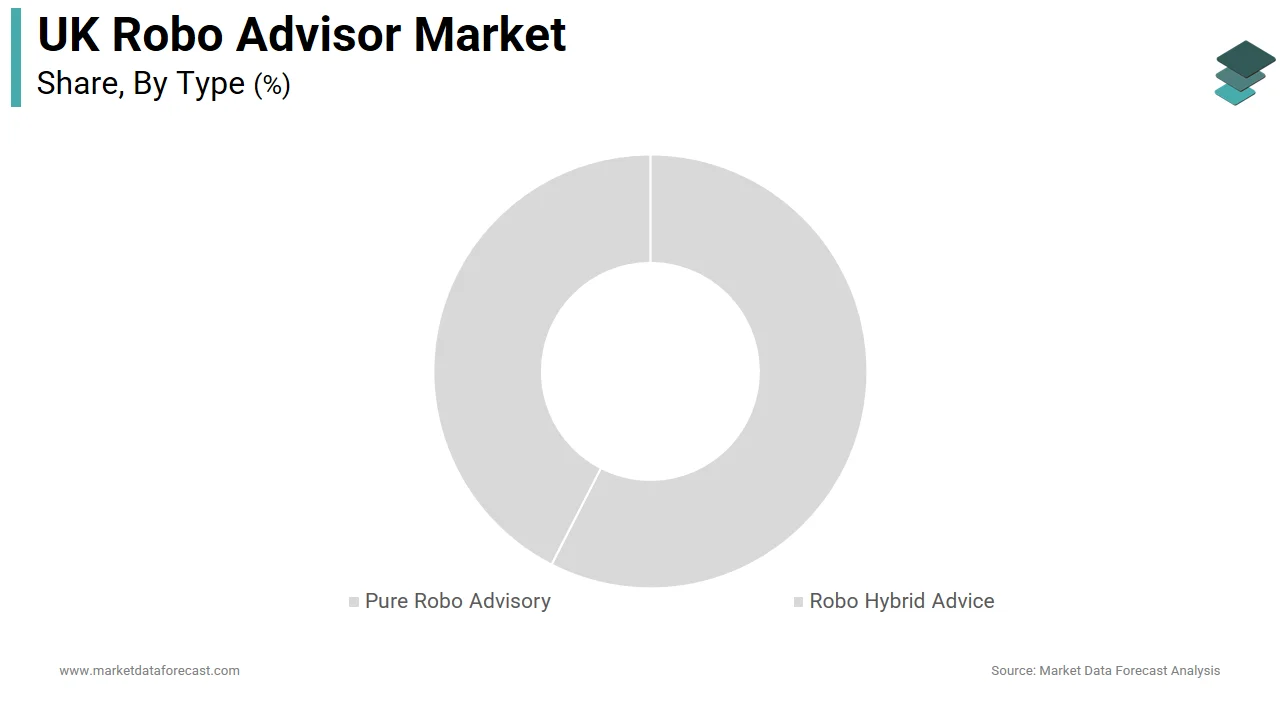
The hybrid segment is projected to register the fastest CAGR of 12.5% from 2026 to 2034, owing to the demand for a balanced approach that combines algorithmic efficiency with human expertise for complex financial decisions. As investors accumulate more wealth, their needs become more intricate, requiring guidance on tax planning, estate management, and behavioral coaching. Introducing hybrid tiers has allowed firms to retain clients who might otherwise leave for traditional private banking. It also enables better suitability assessments for non-standard financial situations. Firms are investing in training staff to work alongside digital tools, creating a seamless omnichannel experience. This evolution allows robo advisors to capture a larger share of wallet from affluent clients. The flexibility to switch between digital and human support enhances customer satisfaction.
By Service Type Insights
The wealth management segment held a significant share of the United Kingdom robo advisor market in 2025, with the universal need for investment growth among retail investors who lack the time or expertise to manage their own portfolios. The household financial wealth in the UK has grown significantly, creating a larger base of investable assets. The majority of assets under management on robo platforms are allocated to diversified equity and bond portfolios aimed at long-term growth. The automation of these tasks ensures consistency and removes emotional bias from investment decisions. Wealth management services are scalable, allowing providers to serve millions of clients efficiently. The regulatory framework supports standardized investment advice, which fits well with algorithmic models. Investors perceive wealth management as the primary value proposition of robo-advisors. The integration of ISAs and pension wrappers enhances the appeal of these services. The focus on passive indexing keeps costs low while delivering market returns.
The cash management segment is expected to grow at the fastest CAGR of 15.2% from 2026 to 2034 with the integration of high-yield savings accounts and liquidity management tools into robo platforms. As interest rates have risen, investors are seeking ways to optimize their idle cash rather than leaving it in low-interest current accounts. The launch of competitive savings features within investment apps has attracted significant inflows. Users appreciate the convenience of managing both investments and cash in one place. Automated sweep features move excess cash into higher-yielding instruments, maximizing returns. The flexibility to withdraw funds quickly provides peace of mind for emergency needs. This segment appeals to risk-averse investors who want better returns than traditional banks offer. The simplicity of digital cash accounts lowers the barrier to entry. The growth of open banking facilitates seamless transfers between accounts.
By End-User Insights
The individual retail investors segment accounted in holding 58.1% of the United Kingdom robo advisor market share in 2025, owing to the direct demand for accessible and affordable wealth management solutions. This segment comprises millennials, Gen Z, and mass affluent individuals who seek to grow their personal savings. There are millions of active ISA holders in the UK, many of whom are turning to digital platforms. The ease of opening accounts with low minimum deposits removes barriers for new investors. Individuals value the autonomy and transparency offered by robo-advisors. The ability to start with small amounts encourages habitual investing. Educational resources empower users to make informed decisions. The mobile-first experience aligns with their lifestyle. This demographic is comfortable with technology and skeptical of traditional banking fees.
The institutional and corporate segment is likely to grow at the fastest CAGR of 18.3% during the forecast period, owing to employers adopting robo advisory platforms for workplace pension schemes and employee financial wellness programs. The auto-enrollment has created a massive pool of passive savers who need guidance. Companies are integrating robo-advisors into benefits packages to improve employee financial health. This reduces stress and improves productivity. The scale of corporate contracts brings large asset inflows. White-label solutions allow brands to offer customized experiences. Regulatory pressure to demonstrate value for money in pensions drives adoption. Employees appreciate the personalized advice at no extra cost.
COMPETITIVE LANDSCAPE
The United Kingdom robo advisor market features intense competition characterized by established digital natives, traditional banks entering the space, and emerging fintech challengers vying for investor assets. Major players leverage brand trust and technological sophistication to maintain strong positions while newer entrants differentiate through niche offerings such as ethical investing or specialized tax planning. The competitive sector is shaped by the pressure to reduce fees while enhancing service quality, prompting continuous innovation in user experience and portfolio management tools. Regulatory compliance with Financial Conduct Authority standards ensures high barriers to entry but also fosters consumer confidence in digital advice. Customer acquisition costs are rising as firms compete for attention in a crowded digital marketplace, leading to increased marketing spend. Retention strategies focus on engagement through educational content and personalized insights to prevent churn. The trend toward hybrid models blurs the lines between pure robo advisors and traditional wealth managers, creating a converged market. Success depends on balancing automation with human touch to meet diverse client needs.
KEY MARKET PLAYERS
The major players in the UK robo-advisor market include
- Betterment
- FutureAdvisor
- Nutmeg
- Wealthify
- Personal Capital
- Moneyfarm
- Vanguard Personal Advisor
- Wealthfront
- WiseBanyan
- SigFig Wealth Management
TOP PLAYERS IN THE MARKET
- Nutmeg operates as a leading digital wealth manager in the United Kingdom, providing automated investment services to retail clients. The company offers fully managed and socially responsible portfolios tailored to individual risk profiles. Nutmeg recently enhanced its platform by integrating advanced tax-efficient wrappers, such as Stocks and Shares ISAs and Lifetime ISAs. The firm has strengthened its market position by launching a hybrid advisory service that combines algorithmic management with access to human financial experts. This strategic move addresses the growing demand for personalized guidance alongside automated efficiency. Nutmeg continues to invest in user experience improvements, ensuring seamless onboarding and transparent reporting. Their focus on educational content empowers users to make informed financial decisions. These initiatives reinforce their reputation as a trusted partner for long-term wealth accumulation and financial planning.
- Wealthify serves as a prominent robo-advisor in the United Kingdom, known for its low cost and ethical investment options. The company provides simple automated portfolios that cater to both novice and experienced investors seeking hassle-free wealth growth. Wealthify recently expanded its product range to include Junior ISAs, allowing parents to invest for their children’s future efficiently. The firm has strengthened its position by partnering with major banks to offer white-label robo advisory services, thereby increasing its reach. They have also introduced fixed-term investment plans providing certainty for risk-averse customers. Wealthify focuses on transparency and customer support, ensuring users understand their investment journey. Their commitment to ethical investing appeals to socially conscious consumers. These actions demonstrate their dedication to accessible and responsible financial management for a broad demographic.
- Moneyfarm distinguishes itself in the United Kingdom robo-advisor market by offering a hybrid model that blends digital automation with professional human advice. The company targets mass affluent clients who require more sophisticated financial planning than pure algorithms can provide. Moneyfarm recently upgraded its technology stack to enhance portfolio personalization and real-time performance tracking. The firm has strengthened its position by expanding its team of certified financial planners to support complex client needs such as retirement planning and tax optimization. They have also integrated open banking features to provide a holistic view of client finances. Moneyfarm emphasizes high-touch service within a digital framework, ensuring clients feel supported. This approach bridges the gap between traditional private banking and fintech innovation.
TOP STRATEGIES USED BY KEY MARKET PARTICIPANTS
Key players in the United Kingdom robo-advisor market employ product diversification as a primary strategy to capture broader customer segments and increase assets under management. Companies expand beyond basic investment accounts to offer pensions, ISAs, and junior savings vehicles, creating comprehensive financial ecosystems. Strategic partnerships with traditional banks and insurers enable white-label solutions that leverage existing customer bases for rapid scaling. Firms increasingly adopt hybrid models combining algorithmic efficiency with human advisory services to address complex financial needs and retain high-net-worth clients. Investment in artificial intelligence enhances personalization and risk assessment accuracy, improving user outcomes. Marketing efforts focus on financial literacy and trust building towards automated advice. Regulatory compliance remains central, with firms proactively adapting to Financial Conduct Authority guidelines to ensure operational stability.
MARKET SEGMENTATION
This research report on the UK robo advisor market has been segmented and sub-segmented based on the following categories.
By Type
- Pure Robo Advisory
- Robo Hybrid Advice
By Service
- Wealth Management
- Cash Management
By End-User
- Healthcare
- Retail
- Education
- Others
Frequently Asked Questions
What is the UK robo advisor market?
The UK robo advisor market is the sector offering automated, algorithm-driven investment advice and portfolio management through digital platforms, providing low-cost wealth management alternatives to traditional financial advisors.
How does the UK robo advisor market work?
In the UK robo advisor market, users complete online questionnaires about risk tolerance and goals, then algorithms automatically build and manage diversified investment portfolios with ongoing rebalancing and monitoring without human intervention.
Who uses the UK robo advisor market?
The UK robo advisor market serves retail investors, beginner investors, tech-savvy individuals, cost-conscious consumers, and those seeking straightforward investment solutions without minimum balance requirements or high management fees.
What are the benefits of the UK robo advisor market?
The UK robo advisor market offers benefits like lower fees than traditional advisors, minimum balance flexibility, automated portfolio rebalancing, diversified investments, easy digital access, and beginner-friendly investment guidance for all users.
What are the risks of the UK robo advisor market?
The UK robo advisor market carries risks including limited personalized advice, algorithm errors, market volatility exposure, lack of human judgment for complex situations, and potential technology issues affecting portfolio management services.
Is the UK robo advisor market regulated?
The UK robo advisor market operates under Financial Conduct Authority regulations requiring providers to comply with investor protection standards, data security requirements, and disclosure obligations for automated investment services.
Who operates in the UK robo advisor market?
Major players in the UK robo advisor market include Moneyfarm, Nutmeg, Wealthify, Interactive Investor, and other digital wealth platforms offering automated investment solutions to British consumers seeking convenient portfolio management.
How valuable is the UK robo advisor market?
The UK robo advisor market represents significant growth in digital wealth management, reflecting increasing consumer adoption of automated investing and changing preferences for technology-driven financial services over traditional advisory models.
What trends affect the UK robo advisor market?
The UK robo advisor market is evolving with advanced AI algorithms, enhanced customer data analysis, growing trust in automated advice, increased digital adoption, and transformation in how Britons perceive technology-based investment services.
Is the UK robo advisor market suitable for everyone?
The UK robo advisor market suits investors seeking simple, automated solutions but may not suit those needing complex personalized advice, tax planning, or estate planning services requiring human financial expert judgment.
Related Reports
Access the study in MULTIPLE FORMATS
Purchase options starting from
$ 1200
Didn’t find what you’re looking for?
TALK TO OUR ANALYST TEAM
Need something within your budget?
NO WORRIES! WE GOT YOU COVERED!
Call us on: +1 888 702 9696 (U.S Toll Free)
Write to us: sales@marketdataforecast.com