- Product Description Description
- Table of Contents TOC
- List of Table & Figure LOT
- Get Free Sample PDF Sample PDF
Market Size, 2025
$27.34 BnMarket Estimate, 2026
$42.16 BnMarket Forecast, 2034
$1,348 BnCAGR, 2026–2034
54.2%Executive Summary: Robo Advisory Market
- Market Scope: Comprehensive global robo advisory market analysis covering advisory models, service segments, end-user categories, regional leadership frameworks, and automated wealth management trends.
- Market Valuation: Valued at USD 27.34 billion (2025), estimated at USD 42.16 billion (2026), and projected to reach USD 1,348 billion by 2034, registering a robust CAGR of 54.2% (2026–2034).
- Primary Growth Drivers: Financial inclusion for underserved demographics, algorithmic efficiency eliminating behavioral biases, open banking integration, hybrid advisory adoption, and rising demand among digitally native Millennials and Gen Z investors. Key challenges include consumer trust deficits, regulatory ambiguity, and cybersecurity risks.
Key Market Segment Metrics (2026–2034)
| Category | Leading Segment (2025 Position) | Fastest-Growing Segment |
|---|---|---|
| By Advisory Model | Hybrid Robo Advisory (dominated the market with a 57.4% share in 2025) | Pure Robo Advisory (projected to grow at a CAGR of 13.6%) |
| By Service Segment | Wealth Management (accounted for the largest service segment in 2025) | Cash Management (anticipated to witness the fastest CAGR of 15.2%) |
| By End-User | Healthcare (led end-users with a 33.2% share in 2025) | Education (expected to grow at a CAGR of 14.8%) |
| By Region / Country | North America (held the largest regional share at 45.3% in 2025) | Global financial markets expanding via automated, low-cost financial planning solutions |
Major Market Players & Market Structure
Market Structure: Highly competitive global digital wealth management landscape featuring specialized fintech platforms and established financial institutions driving strategic international partnerships, AI-powered rebalancing, and white-label API expansion.
Key Companies: Betterment, FutureAdvisor, Personal Capital, Vanguard Personal Advisor, Wealthfront, WiseBanyan, SigFid Wealth Management, and Saxo Bank.
Global Robo Advisory Market Size
The global robo-advisory market was worth USD 27.34 billion in 2025. The global market is expected to grow at a CAGR of 54.2% from 2026 to 2034, and its size is anticipated to be USD 1,348 billion by 2034, up from USD 42.16 billion in 2026.
Robo-advisory is an ecosystem of digital platforms that utilize algorithm-driven financial planning and investment management services with minimal human intervention. These systems assess user risk profiles, financial goals, and time horizons through structured questionnaires, then automatically allocate and rebalance portfolios primarily into ETFs, mutual funds, or other diversified instruments.
MARKET DRIVERS
Financial Exclusion Driving Adoption of Robo-Advisory Services
The growing financial exclusion of middle- and lower-income people due to high minimum investment thresholds and advisory fees is subtantillay propelling the growth of the robo advisory market. According to the U.S. Federal Reserve, in 2023, the median household financial asset holding in the United States was approximately $27,000, rendering traditional advisory services inaccessible to the majority. Robo advisors circumvent this barrier by offering entry points as low as $1, enabling broader participation in capital markets. Platforms such as Acorns and Stash have capitalized on micro-investing models, allowing users to invest spare change from daily transactions. This inclusivity aligns with global financial inclusion agendas and is particularly transformative in emerging economies where formal banking penetration remains limited.
Algorithmic Advisory and AI Enhancing Robo-Advisory Growth
The increasing complexity and volatility is data-driven and low investment decisions a capability inherently embedded in algorithmic advisory systems, which is augmented in levelling up the growth of the robo advisory market. Human advisors are susceptible to behavioral biases such as loss aversion and overconfidence, which can lead to suboptimal portfolio performance. Robo advisors mitigate these risks by enforcing disciplined rebalancing, tax-loss harvesting, and diversified asset allocation based on real-time market data. As per CFA Institute, algorithmic models process over 2 million data points per second during trading hours, far exceeding human cognitive capacity. Additionally, the integration of machine learning enables predictive analytics for macroeconomic shifts by allowing platforms to adjust risk exposure proactively.
MARKET RESTRAINTS
Consumer Trust Deficit Limiting Robo-Advisory Adoption
The persistent lack of trust among consumers among aging people is hampering the growth of the robo advisory market. According to a 2023 survey by the Pew Research Center, only 39% of Americans aged 55 and above expressed confidence in AI-managed investments, citing concerns about transparency, accountability, and error correction. The European Securities and Markets Authority found that 54% of investors in EU countries opted for hybrid advisory models when given a choice, indicating a preference for human oversight.
Regulatory Ambiguity in Algorithmic Accountability and Fiduciary Responsibility
The regulatory ambiguity surrounding algorithmic accountability and fiduciary responsibility in robo advisory services when investment outcomes fall short of expectations is additionally restraining the growth of the robo advisory market. While platforms are required to adhere to financial regulations such as MiFID II in Europe or SEC guidelines in the U.S., the delegation of decision-making to autonomous systems creates legal gray areas in liability attribution. According to the International Organization of Securities Commissions, no jurisdiction has yet established a comprehensive legal framework defining accountability when an AI-driven portfolio underperforms due to flawed data inputs or model bias.
MARKET OPPORTUNITIES
Integration with Open Banking Ecosystems for Personalized Advisory
The integration of robo advisory platforms with open banking ecosystems by enabling real-time synchronization of income, spending, and debt data to generate dynamic, personalized financial plans is ascribed to boosting the growth of the robo advisory market. According to the European Banking Authority, 92% of licensed fintech firms in the EU now leverage application programming interfaces (APIs) to aggregate financial information across institutions. This interoperability allows robo advisors to adjust investment strategies based on cash flow patterns, upcoming liabilities, or changes in employment status. For instance, a platform could automatically reduce risk exposure when detecting a prolonged period of negative savings.
Expansion into Employer-Sponsored Retirement and Financial Wellness Programs
The expansion of robo advisory services into employer-sponsored retirement and employee benefit programs by transforming workplace financial wellness is also to enhance the growth of the robo advisory market. According to the U.S. Department of Labor, 47 million private-sector workers in the United States lack access to employer-sponsored retirement plans by creating a structural savings gap. Companies are increasingly partnering with robo advisors to offer automated enrollment, contribution escalation, and personalized retirement projections through HR platforms. According to the Society for Human Resource Management, 62% of large U.S. employers have integrated financial wellness tools into their benefits packages since 2022, with robo advisors being the fastest-growing component.
MARKET CHALLENGES
Homogenized Algorithms and Systemic Risk Exposure
The homogenization of investment algorithms, which limits differentiation and exposes platforms to systemic risks during shocks may challenge the growth of the robo advisory market. Most robo advisors rely on Modern Portfolio Theory (MPT) and mean-variance optimization, leading to highly similar asset allocations across providers. According to a 2023 analysis by the Bank for International Settlements, over 80% of robo-advised portfolios in the U.S. and Europe exhibited correlation coefficients above 0.9 during the 2022 market downturn, indicating minimal diversification benefit. Additionally, reliance on historical data makes algorithms vulnerable to black swan events, such as the 2020 oil price crash or pandemic-induced market swings, where past trends fail to predict outcomes. The lack of adaptive learning in many models restricts their ability to incorporate geopolitical, climate, or behavioral signals, undermining resilience.
Cybersecurity Threats and Data Privacy Risks
The vulnerability of robo advisory platforms to cybersecurity threats and data privacy breaches are to inhibit the growth of the robo advisory market. In 2023, the U.S. Federal Trade Commission recorded a 37% year-on-year increase in reported cyber incidents involving fintech applications, including unauthorized access to investment accounts and phishing attacks targeting robo advisory users. The European Union Agency for Cybersecurity (ENISA) identified financial algorithms as high-value targets for adversarial machine learning attacks, where malicious actors manipulate input data to distort investment recommendations.
REPORT COVERAGE
| REPORT METRIC | DETAILS |
| Market Size Available | 2025 to 2034 |
| Base Year | 2025 |
| Forecast Period | 2026 to 2034 |
| CAGR | 54.2% |
| Segments Covered | By Type, Service, End User, and Region |
|
Various Analyses Covered | Global, Regional & Country Level Analysis, Segment-Level Analysis, DROC, PESTLE Analysis, Porter’s Five Forces Analysis, Competitive Landscape, Analyst Overview on Investment Opportunities |
| Regions Covered | North America, Europe, APAC, Latin America, Middle East & Africa |
|
Market Leaders Profiled | Betterment, FutureAdvisor, Personal Capital, Vanguard Personal Advisor, Wealthfront, WiseBanyan, SigFid Wealth Management, and Others. |
SEGMENTAL ANALYSIS
By Type Insights
The hybrid robo advisory segment was accounted in holding 57.4% of the robo advisory market share in 2025 with its ability to balance automation with human oversight, addressing a psychological barrier in financial decision-making. Firms like Vanguard and Fidelity have institutionalized hybrid models, which is combining algorithmic portfolio management with on-demand access to certified financial planners. According to the Chartered Financial Analyst Institute, hybrid platforms achieve 2.3 times higher client retention than pure robo models.

The pure robo advisory segment is projected to grow with a CAGR of 13.6% in the next coming years with the rising adoption among digitally native populations Millennials and Gen Z. These users value the immediacy of app-based onboarding, instant portfolio allocation, and round-the-clock access without appointment constraints. Platforms such as Acorns, Betterment, and Wealthsimple have optimized user experience with gamified savings, micro-investing, and AI-driven goal tracking, increasing engagement.
By Service Insights
The wealth management segment was the largest and held a dominant share of the global robo advisory market in 2025. Robo platforms offer tax-loss harvesting, risk profiling, and retirement forecasting services previously reserved for high-net-worth individuals. The Organisation for Economic Co-operation and Development notes that only 35% of OECD citizens have adequate retirement savings, amplifying the need for accessible investment tools. In the U.S., the Department of Labor reports that 401(k) plans integrated with robo advisors saw a 28% increase in participant engagement between 2021 and 2023.
The cash management segment is swiftly emerging with an expected CAGR of 15.2% throughout the forecast period with the increasing integration of liquidity optimization tools within robo advisory platforms, enabling users to earn higher yields on idle balances. Traditionally, cash accounts offered negligible returns, but modern platforms now route uninvested funds into high-yield savings accounts, money market funds, or short-term treasury instruments. According to the U.S. Federal Reserve, the average household held $8,700 in transactional accounts in 2023, much of which was underperforming. Robo advisors like SoFi and Marcus by Goldman Sachs automatically sweep excess cash into vehicles yielding 4–5% annually, which is significantly improving net returns. Additionally, these systems provide real-time liquidity forecasting, helping users avoid overdrafts while maximizing yield.
By End-User Insights
The healthcare sector was the largest and held 33.2% of the robo advisory market share in 2025. According to the American Medical Association, the average medical school graduate carries $200,000 in debt by delaying retirement savings and increasing the need for structured, automated investment guidance. Hospitals and healthcare systems are increasingly partnering with robo advisory firms to offer financial wellness programs as part of employee benefits, addressing burnout and retention. The Mayo Clinic implemented a robo advisory pilot in 2023, resulting in a 41% increase in 403(b) plan participation among staff. Additionally, shift-based work patterns and irregular income streams in healthcare make automated, hands-off investing particularly appealing.
The education sector is likely to grow with an expected CAGR of 14.8% during the forecast period with the rising financial insecurity among educators and the integration of robo tools into institutional retirement plans. Public school teachers in the U.S. face declining pension benefits, with the National Institute on Retirement Security reporting that 43% of them are not confident about retirement readiness. Platforms such as Guideline and Edvest2Go have developed education-specific interfaces that sync with payroll systems and factor in salary schedules and sabbaticals.
REGIONAL ANALYSIS
North America Robo Advisory Market Insights
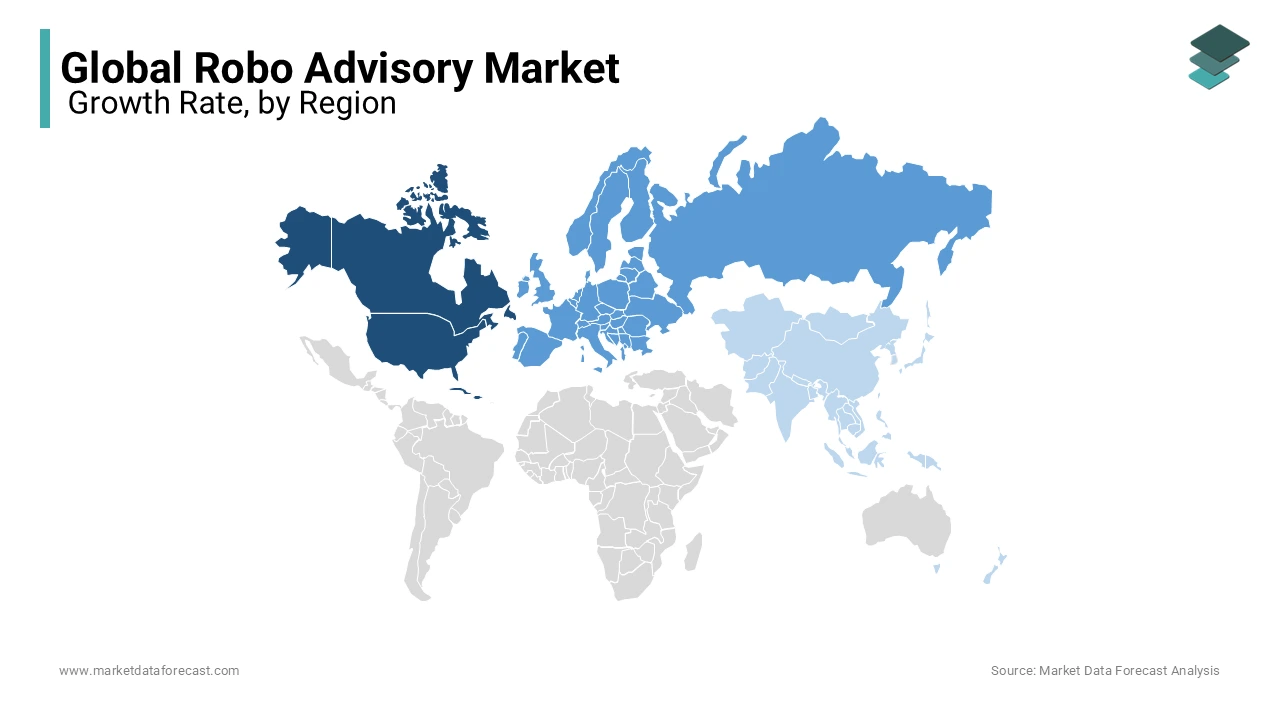
North America was the top performer of the global robo advisory market by occupying 45.3% of share in 2025. United States was the largest contributor in the robo advisory market. The U.S. Department of Labor’s fiduciary rule has encouraged the adoption of transparent, algorithm-driven advice, while SEC oversight ensures baseline accountability. Additionally, 401(k) plan integrations with robo advisors have expanded access to millions of employees. Canada has followed suit, with provincial securities commissions endorsing digital advisory models, and platforms like Questwealth Portfolios achieving over 250,000 client accounts by 2023, as per the Canadian Securities Administrators. Strong venture capital funding and consumer trust in digital finance continue to propel North America’s dominance.
Europe Robo Advisory Market Insights
Europe robo advisory market held 28.3% of the share in 2025. The implementation of MiFID II has mandated suitability assessments and cost transparency by creating a favorable environment for standardized, algorithm-based advice. The United Kingdom is leading the robo advisory market by hosting platforms like Nutmeg and Moneyfarm. Germany and France are witnessing rapid growth due to aging populations and underdeveloped private pension systems.
Asia-Pacific Robo Advisory Market Insights
The Asia-Pacific robo advisory market is expected to grow lucratively due to urbanization and rising financial digitization. China’s Ant Group launched its “Ant Fortune” robo advisory platform, which serves over 70 million users by integrating investment tools into its super-app ecosystem, as reported by the People’s Bank of China. India’s Securities and Exchange Board has licensed over 30 digital investment platforms since 2020, with Groww and Zerodha reporting combined user bases exceeding 120 million. Japan’s Financial Services Agency has endorsed robo advisors for use in the iDeCo retirement program, targeting self-employed workers. Government-backed financial literacy campaigns and mobile-first interfaces are accelerating adoption among younger people in urban centers.
Latin America Robo Advisory Market Insights
Latin America robo advisory market is growing steadily in the coming years. Brazil’s Central Bank recorded over 100 million digital banking accounts in 2023 by creating a foundation for robo advisory expansion. Platforms like Avenue Securities and Monetus have introduced low-cost, app-based investing to middle-class professionals, with assets under robo management growing by 52% year-on-year.
Middle East and Africa Robo Advisory Market Insights
The Middle East and Africa robo advisory market growth is likely to have steady pace throughout the forecast period. The UAE has launched the Dubai Future Fintech Lab to accelerate robo advisory adoption, with Emirates NBD introducing AI-driven investment tools for retail customers. Saudi Arabia’s Vision 2030 includes financial inclusion targets, with the Capital Market Authority licensing digital wealth platforms like Sarwa and Lean. South Africa’s Financial Sector Conduct Authority reports that digital investment platforms have grown by 40% since 2021. Government-backed digital ID systems and stable fintech regulations are expected to unlock significant growth in the coming decade.
KEY MARKET PLAYERS
Companies playing a leading role in the global robo-advisory market include Betterment, FutureAdvisor, Personal Capital, Vanguard Personal Advisor, Wealthfront, WiseBanyan, and SigFid Wealth Management.
TOP LEADING PLAYERS IN THE MARKET
Betterment
Betterment has extended its influence into the Asia Pacific region by establishing strategic partnerships with financial institutions and fintech platforms to localize its automated investment framework. In 2023, the company collaborated with a Singapore-based digital bank to co-develop a robo advisory module tailored for Southeast Asian risk profiles, incorporating regional ETFs and currency hedging mechanisms. It introduced multilingual interfaces and Sharia-compliant portfolio options to align with cultural and regulatory requirements in Malaysia and Indonesia. Betterment also launched financial literacy campaigns in partnership with universities in Australia and India, targeting young professionals and first-time investors.
Wealthfront
Wealthfront has intensified its engagement in the Asia Pacific market by focusing on high-net-worth expatriates and tech-sector professionals in major financial hubs such as Hong Kong, Sydney, and Bangalore. In 2023, it introduced a cross-border tax optimization engine designed to manage investment portfolios for U.S. citizens and dual nationals residing in the region with a gap in automated international wealth planning. The platform integrated real-time currency conversion and local regulatory compliance protocols to facilitate seamless account management across jurisdictions. Wealthfront also partnered with relocation services for expatriate employees of multinational corporations, embedding its advisory tools into onboarding packages.
Saxo Bank (SaxoTraderGO & SaxoInvestmentPro)
Saxo Bank has leveraged its global trading infrastructure to deploy advanced robo advisory solutions across Asia Pacific, particularly in institutional and semi-professional investor segments. Through its SaxoInvestmentPro platform, it offers white-label robo services to private banks and wealth managers in Thailand, South Korea, and the UAE, enabling local firms to deliver algorithm-driven portfolios without developing in-house technology. In 2025, Saxo launched an AI-powered portfolio rebalancing module in collaboration with a Tokyo-based asset manager, optimized for Japan’s low-interest-rate environment and aging investor base. The company also enhanced its API ecosystem, allowing fintech startups in India and Vietnam to integrate Saxo’s risk engines into their apps.
TOP STRATEGIES USED BY KEY MARKET PARTICIPANTS
Key players in the robo advisory market are advancing through technological differentiation, strategic localization, regulatory alignment, ecosystem integration, and behavioral finance innovation. Firms are enhancing algorithmic models with machine learning to improve risk assessment and tax efficiency. Expansion into emerging markets is being driven by culturally adapted interfaces, multilingual support, and compliance with regional financial regulations. Partnerships with banks, employers, and fintech platforms enable embedded finance deployment. White-label solutions allow rapid scaling across institutional clients. Emphasis on financial wellness, goal-based planning, and micro-investing is increasing user engagement. Additionally, integration with open banking and payroll systems facilitates automated savings and investment, transforming robo advisors from standalone tools into core components of holistic financial ecosystems, thereby deepening customer retention and lifecycle value.
COMPETITION OVERVIEW
The competitive landscape of the robo advisory market is defined by a dual dynamic: established financial institutions leveraging scale and trust, and agile fintech startups driving innovation in user experience and algorithmic sophistication. Differentiation increasingly hinges on the depth of personalization, tax efficiency, and integration with broader financial ecosystems rather than mere automation. Incumbents like Fidelity and Charles Schwab combine hybrid models with vast client bases, while pure-play platforms compete on cost, speed, and digital-first design. Geopolitical variations in regulation, financial literacy, and retirement systems necessitate localized strategies, preventing global standardization. The rise of AI-driven direct indexing and ESG customization is creating new tiers of service, fragmenting the market into niche segments.
RECENT MARKET DEVELOPMENTS
- In March 2023, Betterment partnered with a Singaporean digital bank to launch a localized robo advisory service featuring regional ETFs and Sharia-compliant portfolios by enhancing accessibility for Southeast Asian investors.
- In July 2023, Wealthfront introduced a cross-border tax optimization engine for U.S. expatriates in Hong Kong and Japan by enabling automated management of international investment and currency risks.
- In October 2023, Saxo Bank launched an AI-powered rebalancing module in Tokyo, co-developed with a Japanese asset manager to suit local market conditions and investor behavior.
- In January 2024, Betterment initiated financial literacy programs in collaboration with Indian and Australian universities, targeting young professionals to build early engagement with automated investing.
- In May 2024, Saxo Bank expanded its API-driven white-label robo platform to fintech startups in Vietnam and India by enabling local firms to offer algorithm-based wealth management under their own branding.
MARKET SEGMENTATION
This research report on the global robo advisory market has been segmented and sub-segmented based on type, service, end-user, and region.
By Type
- Pure Robo Advisory
- Robo Hybrid Advice
By Service
- Wealth Management
- Cash Management
By End-User
- Healthcare
- Retail
- Education
- Others
By Region
- North America
- Europe
- Asia-Pacific
- Latin America
- Middle East and Africa