- Product Description Description
- Table of Contents TOC
- List of Table & Figure LOT
- Get Free Sample PDF Sample PDF
Market Size, 2025
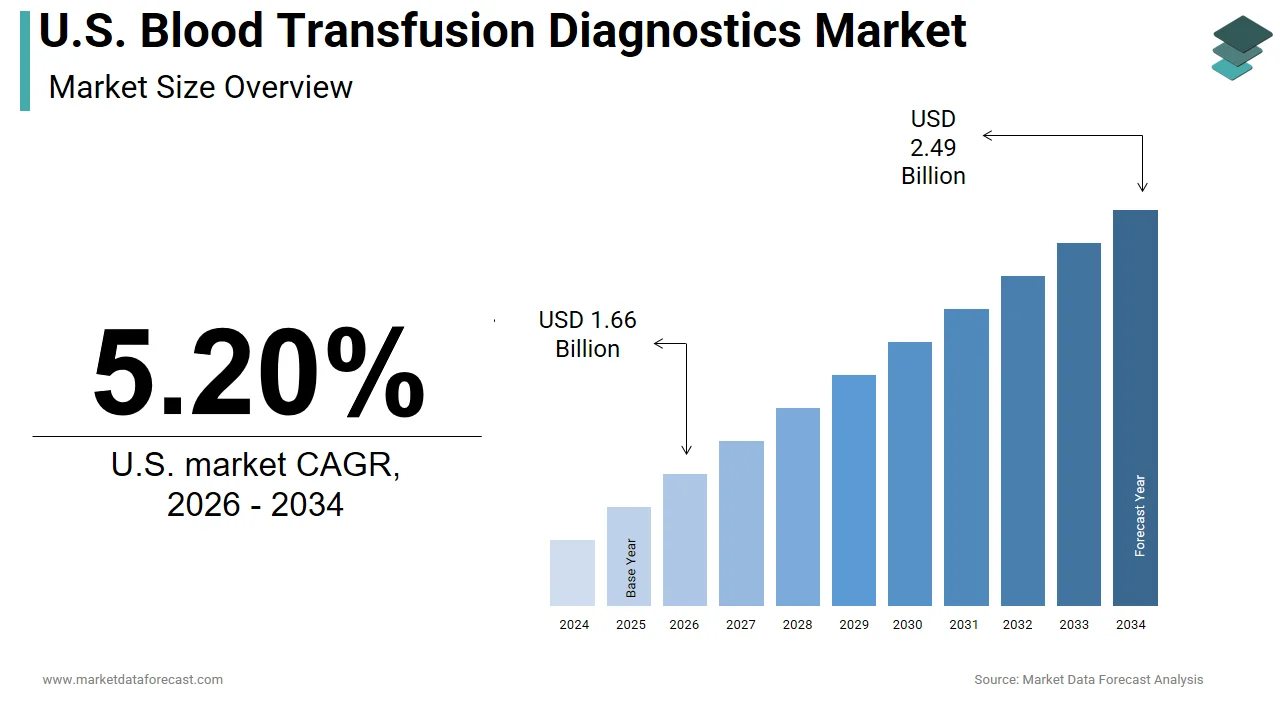
$1.58 BnMarket Estimate, 2026
$1.66 BnMarket Forecast, 2034
$2.49 BnCAGR, 2026–2034
5.20%U.S. Blood Transfusion Diagnostics Market Size
The U.S. blood transfusion diagnostics market was valued at USD 1.58 billion in 2025, is estimated to reach USD 1.66 billion in 2026, and is projected to reach USD 2.49 billion by 2034, growing at a CAGR of 5.20% from 2026 to 2034.
The blood transfusion diagnostics are the technologies and patient blood management assays designed to ensure immunohematological compatibility between donor blood and recipients, which mitigate transfusion-related adverse events, and screen for transfusion-transmissible infections. As per the Centers for Disease Control and Prevention, over 11 million red blood cell units are transfused annually in the United States, each requiring at least three diagnostic validations: ABO/Rh typing, antibody screening, and infectious disease testing. Increasing demand for blood transfusions due to surgeries, trauma, and accidents. Stringent regulatory requirements and safety standards are mandated by bodies like the FDA and AABB. Technological advancements, including automation, molecular diagnostics, and digital integration for improved accuracy, speed, and efficiency. This diagnostic rigor is not ancillary but foundational to transfusion safety, embedded within hospital blood banks, reference labs, and plasma fractionation centers as non-negotiable clinical infrastructure.
MARKET DRIVERS
Rising Complexity of Surgical Interventions and Blood Compatibility Needs
The rising volume of complex surgical interventions requiring perioperative blood support, which is intensifying demand for precision-matched transfusions, is significantly escalating the growth of the U.S. Blood Transfusion Diagnostics Market. As per the American College of Surgeons, over a million inpatient surgical procedures performed annually in U.S. hospitals involve anticipated blood loss exceeding 500 mL, is necessitating pre-transfusion immunohematology workups. Furthermore, the Society of Thoracic Surgeons reports that most of the cardiac surgeries now mandate extended red cell antigen phenotyping to prevent alloimmunization in repeat recipients. This clinical imperative is reinforced by Joint Commission mandates requiring electronic crossmatch validation for all transfusions since 2022, which is compelling hospitals to upgrade from manual tube testing to automated platforms. The diagnostic throughput requirements have surged, with major academic medical centers processing over 12,000 compatibility tests monthly.
Rising Threat of Emerging Transfusion-Transmissible Pathogens
The persistent threat of emerging transfusion-transmissible pathogens demanding continuous diagnostic innovation is enhancing the U.S. Blood Transfusion Diagnostics Market growth. As per the U.S. Food and Drug Administration, three novel pathogen screening assays received emergency use authorization between 2021 and 2023, which include tests for Babesia microti and HEV RNA, is following confirmed transfusion-linked outbreaks. As per the CDC’s Emerging Infections Program documented 187 transfusion-associated Babesiosis cases between 2018 and 2022, which is primarily in the Northeast, is prompting regional blood centers to adopt supplemental testing. According to the American Red Cross, the implementation of universal HEV RNA screening in all plasma-derived products in early 2024 after detecting viral loads exceeding 10^6 IU/mL in asymptomatic donors. These pathogen-specific escalations compel diagnostic manufacturers to rapidly revalidate assay panels, which is driving recurring instrument and reagent adoption cycles within transfusion services.
MARKET RESTRAINTS
Shortage of Certified Medical Technologists in Immunohematology
The acute shortage of certified medical technologists specializing in immunohematology is impeding diagnostic throughput despite technological capacity, which is majorly restraining the growth of the U.S. Blood Transfusion Diagnostics Market. As per the American Society for Clinical Pathology, most of the hospital blood banks reported staffing deficits in 2023, with vacancy rates exceeding 25% in Level I trauma centers. This scarcity is exacerbated by the Bureau of Labor Statistics projection that only 1,200 new medical laboratory scientists graduate annually, while over 3,400 positions remain unfilled. Consequently, even automated platforms like Ortho VISION or Galileo remain underutilized without trained operators to validate results and troubleshoot discrepancies. The ASCP further states that nearly half of the existing technologists are over age 55, which is accelerating workforce attrition. Without workforce pipeline interventions, diagnostic capacity remains hindered by human capital, not hardware.
Regulatory Fragmentation in State-Level Blood Bank Licensure
The regulatory fragmentation across state-level blood bank licensure requirements is complicating the standardization of diagnostic protocols is hindering the expansion of the U.S. Blood Transfusion Diagnostics Market. As per the National Blood Authority’s interstate compliance audit, many states impose unique validation criteria for donor infectious disease testing beyond FDA minimums, which is forcing manufacturers to maintain distinct assay configurations for nationwide distribution. According to the California Department of Public Health, it mandates dual-platform verification for all HIV Ag/Ab combo tests, while New York requires supplemental Western Blot confirmation for indeterminate results. This jurisdictional patchwork inflates validation costs. Manufacturers must navigate this labyrinth without economies of scale, which is delaying the deployment of next-generation multiplex assays.
MARKET OPPORTUNITIES
Integration of Molecular Blood Typing in Pre-Transfusion Workflows
The integration of molecular blood typing into routine pre-transfusion workflows to prioritize alloimmunization in chronically transfused populations is creating significant opportunities for the growth of the U.S. Blood Transfusion Diagnostics Market. As per the Children’s Oncology Group, more than half of the pediatric sickle cell patients develop clinically significant alloantibodies after just five transfusions when typed only serologically. In response, the NIH-funded REDS-IV-P study demonstrated that anticipating RH and KEL genotyping reduced alloimmunization rates. The FDA cleared the first CE-marked multiplex PCR array for 35 red cell antigens in late 2023, which is enabling high-throughput antigen profiling. Hospital systems like Children’s Hospital of Philadelphia now mandate molecular matching for all hematology-oncology transfusions is creating a replicable blueprint for broader adoption across thalassemia and MDS patient populations.
Point-of-Collection Molecular Testing in Mobile Blood Drives
The decentralization of rapid infectious disease screening to mobile blood drives using point-of-collection molecular platforms is escalating the growth opportunities for the U.S. Blood Transfusion Diagnostics Market. As per the Vitalant Research Institute, a few of the whole blood donations collected at temporary sites in 2023 were deferred due to logistical delays in transporting samples to central labs for NAT testing. In pilot deployments, the Cepheid GeneXpert Edge system reduced time-to-result for HIV and HCV RNA from 24 hours to 82 minutes at drive-through donation centers in Texas and Florida. For Instance, the American Red Cross validated that this immediacy increased donor retention among first-time donors anxious about deferral outcomes. With over 45,000 mobile drives conducted annually, deploying cartridge-based NAT at the point of draw transforms donor experience while preserving safety, which is unlocking latent collection capacity constrained by lab dependency.
MARKET CHALLENGES
Cost Pressures vs. High-Sensitivity Diagnostics in U.S. Blood Transfusion
The reconciling of the economic pressure to reduce transfusion costs with the non-negotiable expense of high-sensitivity diagnostics is posing significant challenges in the growth of the U.S. Blood Transfusion Diagnostics Market. As per Premier Healthcare’s supply chain analytics, hospital blood acquisition costs rose in 2023, yet CMS reimbursement for transfusion services remained flat, which is squeezing margins. According to the College of American Pathologists, more than half of the hospital labs have deferred upgrading to chemiluminescent infectious disease platforms. This cost containment paradox forces labs to accept higher false-negative risk: the FDA Adverse Event Reporting System logged more than ten transfusion-linked HIV transmissions between 2019 and 2023 linked to window-period donations missed by legacy EIAs. Until value-based payment models recognize diagnostic precision as cost-avoidance, where safety may be silently compromised.
Diagnostic Interference from Novel Therapeutic Biologics
The management of diagnostic interference from novel therapeutic biologics, particularly monoclonal antibodies, which increasingly distort serologic crossmatch results, is creating challenges in the U.S. Blood Transfusion Diagnostics Market. As per the Mayo Clinic’s Transfusion Medicine Division, daratumumab, a CD38-targeting myeloma drug is causes false-positive agglutination in most of the patients undergoing pre-transfusion testing, which requires costly and time-consuming DTT pretreatment protocols. Similarly, the FDA issued a safety communication in 2023 warning that teclistamab induces pan-reactive antibody screens, which delay transfusions by up to 72 hours in nearly half of the cases. As per the National Cancer Institute, with over 140 monoclonal antibodies now in active oncology use, the transfusion labs face escalating volumes of technically invalid results. Diagnostic manufacturers must now engineer antibody-neutralizing reagents or reflex algorithms, which adds layers of complexity previously absent from routine compatibility testing.
REPORT COVERAGE
| REPORT METRIC | DETAILS |
| Market Size Available | 2025 to 2034 |
| Base Year | 2025 |
| Forecast Period | 2026 to 2034 |
| Segments Covered | By Product, Application, End Users, and Country. |
| Various Analyses Covered | Global, Regional, and Country-Level Analysis, Segment-Level Analysis, Drivers, Restraints, Opportunities, Challenges; PESTLE Analysis; Porter’s Five Forces Analysis, Competitive Landscape, Analyst Overview of Investment Opportunities |
| Countries Covered | New York, Massachusetts, Pennsylvania, Illinois, Ohio, Michigan, Texas, Florida, Georgia, California, Washington, Colorado. |
| Market Leaders Profiled | Grifols, S.A. (Spain), Immucor, Inc. (U.S.), Bio-Rad Laboratories, Inc. (U.S.), QuidelOrtho Corporation (U.S.), F. Hoffmann-La Roche Ltd (Switzerland), QUOTIENT (Switzerland), Merck KGaA (Germany), Abbott (U.S.), and Others. |
SEGMENTAL ANALYSIS
By Product Insights
In 2025, the reagents and kits segment dominated the U.S. blood transfusion diagnostics market with the largest share. This dominance is fueled by the consumable-intensive nature of daily transfusion workflows. As per the College of American Pathologists, the average hospital blood bank processes thousands of compatibility tests annually, each requiring 3–5 discrete reagent applications for ABO, Rh, antibody screening, and crossmatching. Moreover, the U.S. Food and Drug Administration mandates lot-to-lot revalidation for every new reagent batch, which is compelling labs to maintain dual inventory streams. As per CDC data, with over 11 million transfusions annually, and each requiring infectious disease screening kits for HIV, HCV, HBV, and syphilis, reagent volume is structurally inelastic, which is driven not by innovation cycles but by immutable procedural throughput.
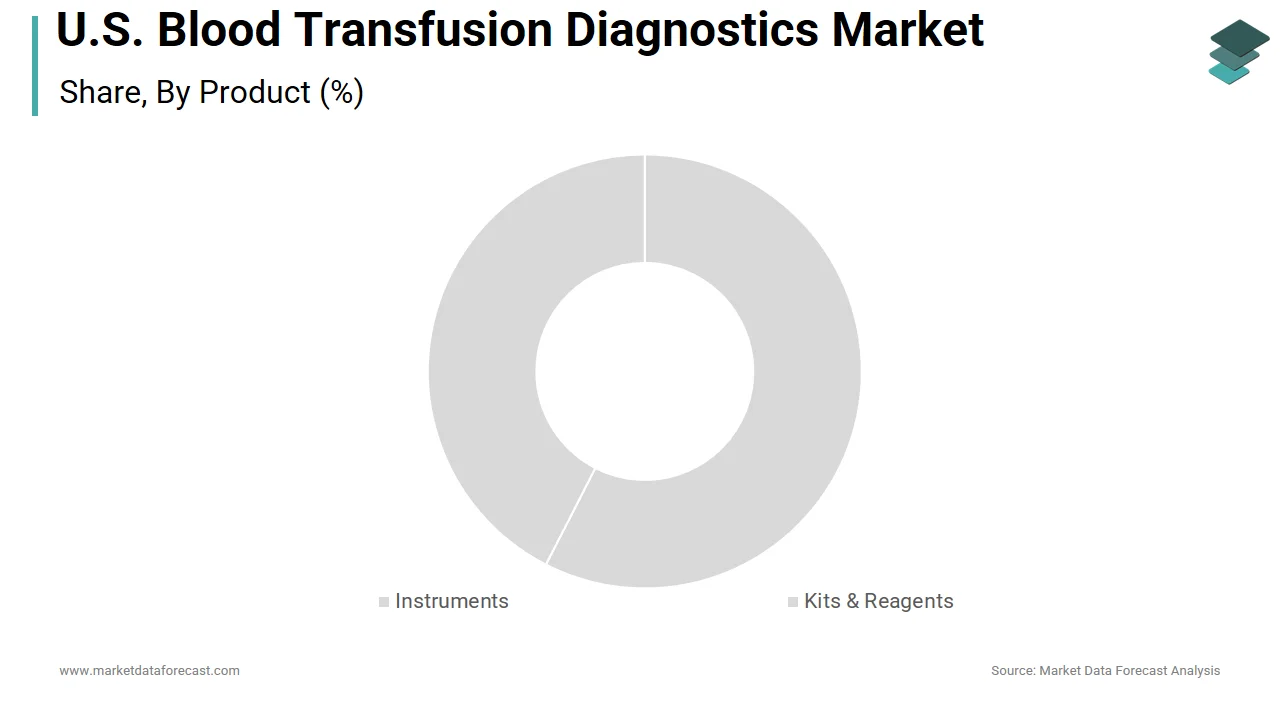
The instruments segment is expected to expand at a CAGR of 9.8% between 2025 to 2033 in the U.S. Blood Transfusion Diagnostics Market. This acceleration stems from regulatory and safety imperatives demanding automation to reduce human error. As per the Joint Commission’s Sentinel Event Database, some of the transfusion-related adverse events between 2020 and 2023 were traced to manual testing misinterpretations, which is prompting mandatory migration to FDA-cleared automated platforms like Ortho VISION and Qwalys 3. As per the AABB’s 2023 guidelines now require electronic crossmatch validation for all non-emergent transfusions, which only integrated instrument systems can reliably execute. As per Premier Healthcare’s procurement data, with 89% of Level I trauma centers upgrading instrumentation in 2023 alone, the shift is not discretionary; it is a compliance-driven capital reinvestment cycle.
By Application Insights
The blood screening holds the largest segment in the U.S. Blood Transfusion Diagnostics Market by representing 58.4% share in 2024. The growth is anchored in federal mandates: the FDA requires nucleic acid testing for HIV-1, HIV-2, HCV, HBV, WNV, and, more recentl,y Babesia microti for every donated unit. The American Red Cross and CDC report that approximately 13.6 to 14 million units of whole blood and red blood cells are collected annually in the U.S. Furthermore, the CDC’s National Healthcare Safety Network documents that transfusion-transmitted infection reporting is legally mandatory in all 50 states is making screening not a clinical option but a statutory obligation. The emergence of HEV and dengue as regionally relevant threats, particularly in Florida and Texas, has further expanded required test menus, which ensures sustained volume irrespective of transfusion demand fluctuations.
The blood group typing segment is projected to register at a CAGR of 12.3% between 2025 to 2033 in the U.S. Blood Transfusion Diagnostics Market. The growth is propelled by the clinical shift toward precision-matched transfusions for chronically transfused patients. As per the Children’s Oncology Group, more than half of the pediatric sickle cell patients develop alloantibodies after five transfusions when typed only serologically, is leads to hemolytic reactions. In response, the FDA cleared extended molecular antigen panels in 2023 capable of profiling 35+ red cell antigens via PCR. Institutions like St. Jude Children’s Research Hospital now mandate RH/KEL genotyping for all hematology patients, which is reducing alloimmunization. With over 100,000 new sickle cell and thalassemia diagnoses annually, the molecular typing is transitioning from niche to standard of care.
By End-Users Insights
The hospital-based laboratories dominate the U.S. Blood Transfusion Diagnostics Market with a significant share in 2025. The growth is structurally embedded: for instance, as per CDC data, most of the transfusions occur within acute care settings, and Joint Commission accreditation requires hospitals to maintain on-site immunohematology capability for emergent transfusions. According to the American College of Surgeons, further mandates that Level I and II trauma centers perform full compatibility testing in-house, with maximum turnaround times of 10 minutes for type-specific units. As per Premier Inc.’s benchmarking, the average academic medical center now runs 14,000 annual compatibility tests, which necessitates dedicated instrumentation, 24/7 staffing, and perpetual reagent inventory. Unlike reference labs, hospitals cannot outsource core transfusion diagnostics without violating care standards, is making this segment immovable and expenditure-intensive.
The independent laboratories and blood banks segment is estimated to expand at a 11.6% CAGR between 2025 to 2033 in the U.S. Blood Transfusion Diagnostics Market. This growth is driven by consolidation and specialization: for instance, regional blood centers like OneBlood and Versiti now serve over hundreds of hospitals collectively, which is centralizing high-complexity testing such as molecular antigen typing and rare antibody identification. As per the AABB, nearly half of the hospital labs outsourced extended phenotyping in 2023 due to staffing shortages, up from 28% in 2020. The plasma fractionators like Grifols and CSL Behring require centralized, high-volume NAT screening for source plasma, which is processed over 22 million liters annually. These independent entities leverage economies of scale and automation depth that individual hospitals cannot replicate, are becoming indispensable nodes in the national transfusion safety infrastructure.
GEOGRAPHIC ANALYSIS
The United States, as a single-country market, constitutes the entire scope of the U.S. Blood Transfusion Diagnostics Market, yet its internal regional dynamics reveal stark disparities in technological adoption and regulatory stringency. As per the New England Journal of Medicine’s regional audit, states in the Northeast, particularly Massachusetts and New York, lead in molecular diagnostics integration, with most of the hospital labs utilizing extended red cell genotyping. This is propelled by state mandates: for instance, New York’s Department of Health requires molecular RH/KEL typing for all pediatric oncology transfusions. In contrast, Southern states like Mississippi and Alabama lag, with only 29% adoption, due to workforce shortages and budget constraints. California dominates innovation deployment, which is hosting around half of the FDA-cleared investigational device exemptions for novel transfusion assays since 2020. These intra-national divergences reflect policy, not geography is making the U.S. not a monolithic market but a federation of 50 distinct regulatory and operational ecosystems.
COMPETITIVE LANDSCAPE
The U.S. Blood Transfusion Diagnostics Market is defined by oligopolistic competition among vertically integrated players who compete on regulatory agility, automation depth, and clinical workflow integration rather than price. Barriers to entry are formidable, FDA 510(k) clearance cycles exceed 18 months, and hospital procurement requires Joint Commission-aligned validation. Incumbents like Ortho, Grifols, and Immucor dominate through installed instrument bases that lock in recurring reagent revenue. Startups survive only via acquisition or niche molecular assays. Competition centers on prioritizing emerging pathogens, which is neutralizing drug-induced serologic interference and compensating for workforce deficits through AI-assisted interpretation. Unlike other diagnostics markets, innovation here is not disruptive but evolutionary; each advance must integrate seamlessly into life-critical, regulation-bound hospital blood bank operations.
KEY MARKET PLAYERS
Some of the companies that are playing a dominating role in the U.S. blood transfusion diagnostics market include
- Grifols, S.A. (Spain)
- Immucor, Inc. (U.S.)
- Bio-Rad Laboratories, Inc. (U.S.)
- QuidelOrtho Corporation (U.S.)
- Hoffmann-La Roche Ltd (Switzerland)
- QUOTIENT (Switzerland)
- Merck KGaA (Germany)
- Abbott (U.S.)
Top Players in the Market
- Ortho Clinical Diagnostics anchors its dominance in high-throughput immunohematology automation, with platforms like Ortho VISION deployed across U.S. trauma centers and reference labs. In the Asia Pacific, Ortho partners with Japan’s Red Cross and Australia’s Lifeblood to validate serologic and molecular assays under regional regulatory frameworks. In early 2024, Ortho launched its Q-Box connectivity hub in India, which is enabling remote instrument monitoring for blood banks in tier-2 cities. It also co-developed a dengue interference-resistant antibody screen with Thailand’s National Blood Centre. These initiatives embed Ortho’s systems into national transfusion infrastructures by ensuring compliance with local pathogen profiles and workforce constraints while maintaining diagnostic precision.
- Grifols leverages its dual identity as plasma collector and diagnostics innovator to dominate transfusion safety through vertically integrated solutions. In the Asia Pacific, Grifols supplies NAT screening systems to China’s plasma fractionation hubs and collaborates with South Korea’s Green Cross on hepatitis-resistant reagent formulations. Grifols has a presence in Asia and has signed large diagnostic modernization agreements in the past, such as providing 28 Procleix Panther systems to the Korean Red Cross in 2021. The company was also working to finalize a strategic alliance with China's Haier Group in the first half of 2024. It also initiated a multicenter study in Malaysia to validate its Babesia microti assay for tropical donor populations. Grifols’ strategy transcends product sales; it engineers diagnostic ecosystems calibrated to regional epidemiology, regulatory cadence, and collection logistics by ensuring entrenched operational relevance.
- Immucor drives innovation in molecular blood typing and automated crossmatching, with platforms like NEO and Capture-R ready for rare antigen detection. In the Asia Pacific region, Immucor supports Japan’s push toward universal RH/KEL genotyping in pediatric oncology and partners with Singapore General Hospital to implement AI-assisted antibody interpretation algorithms. Immucor launched its CE-IVD-marked PreciseType HEA assay, which targets thalassemia-endemic regions. It also signed a training accord with India’s National Institute of Immunohematology to certify 500 technologists annually. Immucor’s expansion prioritizes clinical education and regulatory harmonization, which is transforming complex diagnostics into locally sustainable workflows rather than imported technologies.
Top Strategies Used by Key Market Participants
Key players prioritize regulatory prioritize by securing FDA and CE-IVD clearances ahead of regional outbreaks, co-develop diagnostic panels with national blood authorities to align with local pathogen threats, engineer automation to compensate for technologist shortages, embed connectivity for remote QC and troubleshooting, and offer bundled training-certification programs to ensure operational adoption. They increasingly design reagents to neutralize interference from novel biologics, pursue reflex-testing algorithms to reduce manual interpretation, and deploy cartridge-based NAT at mobile collection sites. Strategic alliances with plasma fractionators and hospital GPOs lock in long-term reagent contracts. Differentiation now lies in workflow resilience, not just assay sensitivity.
U.S. BLOOD TRANSFUSION DIAGNOSTICS MARKET NEWS
- In December 2023, Grifols S.A. deployed Procleix Panther systems in Asian countries' blood centers under a diagnostic modernization agreement with the Ministry of Health. For instance, in December 2023, it announced a strategic alliance with China's Haier Group.
- In May 2024, Immucor, Inc. signed a technologist certification pact with India’s National Institute of Immunohematology to train laboratory professionals annually on molecular blood typing workflows.
MARKET SEGMENTATION
This research report on the U.S. blood transfusion diagnostics market has been segmented and sub-segmented into the following categories.
By Product
- Instruments
- Kits & Reagents
By Application
- Blood Screening
- Blood Group Typing
By End User
- Hospital-based Laboratories
- Independent Laboratories & Blood Banks
By Country
- U.S