U.S. Marketing Automation Software Market Size, Share, Trends, and Growth Analysis Report, Segmented by Application, Deployment Model, Enterprise Type, End-User, and Country – Industry Forecast From 2026 to 2034
Market Size, 2025
$2,016.4 MnMarket Estimate, 2026
$2,290.63 MnMarket Forecast, 2034
$6,353.04 MnCAGR, 2026–2034
13.60%U.S. Marketing Automation Software Market Report Summary
The U.S. marketing automation software market was valued at USD 2,016.40 million in 2025, is estimated to reach USD 2,290.63 million in 2026, and is projected to reach USD 6,353.04 million by 2034, growing at a CAGR of 13.60% from 2026 to 2034. Market growth is driven by increasing adoption of digital marketing strategies, rising demand for personalized customer engagement, and growing integration of artificial intelligence and data analytics into marketing platforms. Businesses across industries are increasingly utilizing marketing automation software to streamline campaign management, improve lead generation, and enhance customer relationship management. The expansion of cloud-based solutions, omnichannel marketing strategies, and AI-powered automation tools is further accelerating market growth across the United States.
Key Market Trends
- Increasing adoption of AI-powered marketing automation and predictive analytics tools.
- Rising demand for personalized and omnichannel customer engagement strategies.
- Growing integration of cloud-based marketing platforms and CRM systems.
- Expansion of email marketing automation and lead nurturing solutions.
- Increasing focus on data-driven campaign optimization and customer journey analytics.
Segmental Insights
- Based on application, the email marketing segment dominated the U.S. marketing automation software market in 2025 by accounting for 36.9% market share, driven by increasing adoption of personalized email campaigns, lead nurturing strategies, and customer retention programs.
- Based on deployment model, the cloud-based deployment segment led the market by capturing 76.7% share in 2025, supported by scalability, lower infrastructure costs, and growing preference for software-as-a-service (SaaS) marketing solutions.
- Based on enterprise type, the large enterprises segment accounted for 58.5% market share in 2025, driven by high marketing budgets, extensive customer databases, and strong adoption of advanced automation technologies.
Regional Insights
- The United States is expected to maintain its dominant global position in the marketing automation software market due to the strong presence of leading software vendors, rapid digital transformation initiatives, and continuous innovation in AI-driven marketing technologies. Increasing investments in cloud infrastructure, customer analytics, and automated campaign management platforms are further strengthening market expansion across the country.
Competitive Landscape
The U.S. marketing automation software market is characterized by intense competition among enterprise software providers and cloud-based marketing technology companies focusing on AI integration, customer engagement solutions, and data-driven marketing capabilities. Market participants are emphasizing development of advanced analytics platforms, automation-driven campaign management tools, and seamless CRM integration to strengthen market positioning. Strategic partnerships, acquisitions, and continuous product innovation are shaping competitive dynamics across the market.
Prominent companies operating in the U.S. marketing automation software market include Adobe, IBM Corporation, Oracle Corporation, HubSpot, Inc., Salesforce, Inc., Creatio, Microsoft Corporation, Zoho Corporation Pvt. Ltd., Act-On, and Sage Group plc.
U.S. Marketing Automation Software Market Size
The U.S. marketing automation software market was valued at USD 2,016.40 million in 2025, is estimated to reach USD 2,290.63 million in 2026, and is projected to reach USD 6,353.04 million by 2034, growing at a CAGR of 13.60% from 2026 to 2034.
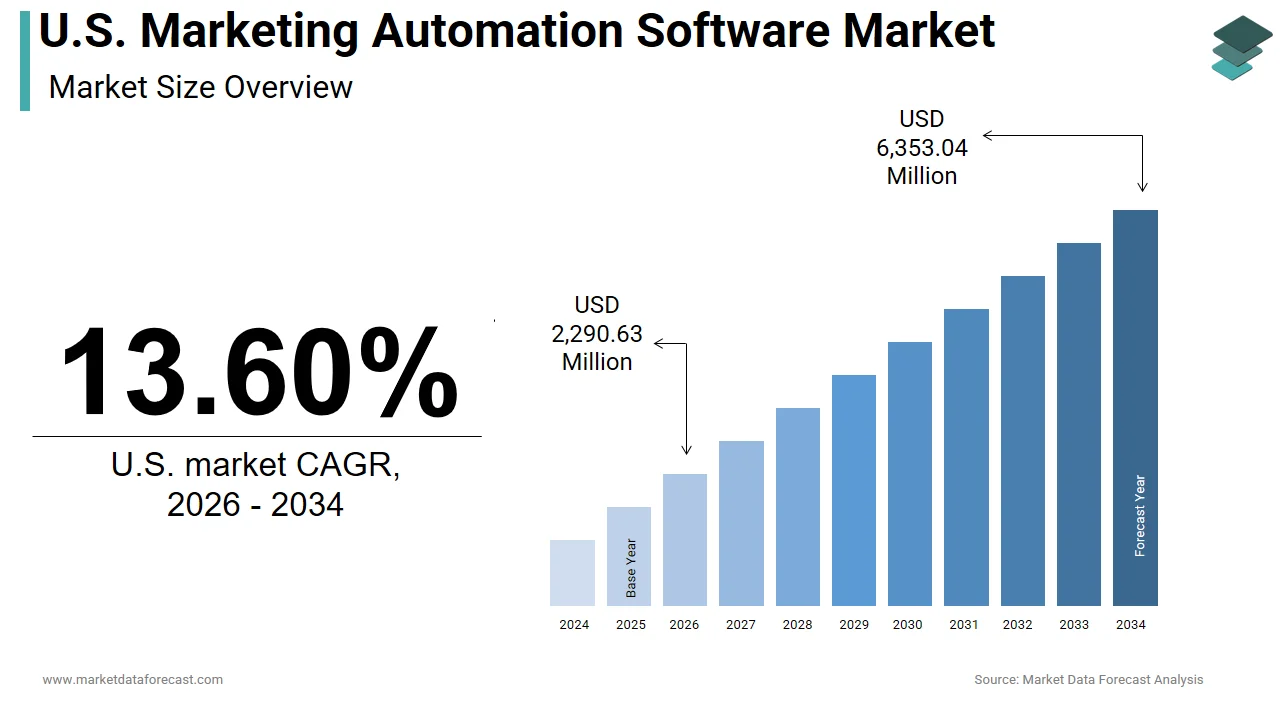
Over the next few years, the U.S. is likely to experience substantial growth in its marketing automation software market, driven by increasing digital transformation across businesses and a heightened reliance on customer data orchestration. The U.S. marketing automation software market is integral to the broader customer relationship management ecosystem, facilitating seamless integration between sales and marketing functions. As per the Small Business Administration, there are approximately 36.2 million small businesses in the country, many of which are increasingly adopting digital tools to compete with larger enterprises. The shift towards remote work has accelerated the need for centralized digital marketing infrastructure. According to the Bureau of Labor Statistics, employment in computer and mathematical occupations, which includes software development and data analysis, is projected to grow much faster than the average for all occupations, reflecting the technical demands of modern marketing. The proliferation of mobile devices and social media platforms has fragmented consumer attention, necessitating sophisticated automation to maintain engagement. Data privacy regulations, such as the California Consumer Privacy Act, influence how these platforms collect and process user information. The market is characterized by a transition from simple email broadcasting to complex omnichannel orchestration powered by artificial intelligence. This evolution allows marketers to deliver hyper-personalized experiences at scale. The integration of automation software with enterprise resource planning and customer support systems creates a holistic view of the customer journey. This interconnectedness drives strategic decision-making and optimizes resource allocation within marketing departments.
MARKET DRIVERS
Increasing Demand for Personalized Customer Experiences
The growing demand for personalized customer experiences is primarily driving the expansion of the U.S. marketing automation software market by compelling businesses to adopt advanced targeting capabilities. Modern consumers expect relevant and timely interactions with brands rather than generic mass communications. According to McKinsey and Company, companies that excel at personalization generate 40% more revenue from those activities than average players. This financial incentive drives organizations to invest in automation tools that can segment audiences based on behavior, demographics, and purchase history. As per Salesforce, 79% of customers expect consistent interactions across departments, yet 55% say it generally feels like they are communicating with separate departments. Marketing automation software bridges this gap by ensuring that messaging is coherent and tailored across email, social media, and web channels. The ability to trigger specific actions based on user behavior, such as abandoning a shopping cart or viewing a product page, enhances conversion rates. Automation platforms utilize machine learning algorithms to predict customer preferences and recommend next-best actions. This level of sophistication requires robust software infrastructure that manual processes cannot support. The competitive landscape forces brands to differentiate through superior customer engagement. Consequently, the need for scalable personalization fuels the adoption of marketing automation solutions. Businesses recognize that automated personalization is no longer a luxury but a necessity for retention and growth.
Integration of Artificial Intelligence and Predictive Analytics
Integration of artificial intelligence and predictive analytics significantly propels the expansion of the U.S. marketing automation software market by enhancing decision-making and operational efficiency. AI-powered features enable marketers to analyze vast amounts of data to identify trends and optimize campaign performance in real time. According to the International Data Corporation, spending on artificial intelligence solutions in the U.S. is expected to reach significant levels as businesses seek competitive advantages. As per Gartner, by 2026, 80% of enterprises will have used generative AI APIs or models, and/or deployed GenAI-enabled applications in production environments, up from less than 5% in 2023. These technologies allow for dynamic content creation, automated A/B testing, and intelligent lead scoring. Predictive analytics help marketers anticipate customer churn and identify high-value prospects with greater accuracy. Automation platforms leverage these insights to allocate budgets more effectively and improve return on investment. The reduction in manual data analysis frees up marketing teams to focus on strategic initiatives and creative development. AI-driven chatbots and virtual assistants integrated into automation workflows provide instant customer support and lead qualification. The ability to process and act on data at speed is crucial in the fast-paced digital environment. Organizations that fail to adopt AI-enhanced automation risk falling behind in responsiveness and relevance. Thus, the technological advancement of automation software drives its widespread adoption.
MARKET RESTRAINTS
High Implementation Costs and Complexity for Small Businesses
High implementation costs and complexity for small businesses significantly restrain the growth of the U.S. marketing automation software market by creating barriers to entry for smaller enterprises. Comprehensive automation platforms often require substantial upfront investment in licensing, training, and integration with existing systems. According to the National Federation of Independent Business, small business owners cite cost as the top concern when adopting new technologies. As per Clutch, 45% of small businesses report that the complexity of marketing tools prevents them from fully utilizing their potential. The need for specialized staff to manage and optimize automation workflows adds to the operational burden. Many small businesses lack the internal expertise to configure complex segmentation rules and integrate application programming interfaces. This skills gap leads to underutilization of software features and poor return on investment. The ongoing maintenance and subscription fees can strain limited marketing budgets. Unlike large corporations, small firms often operate with lean teams that cannot dedicate resources to managing sophisticated software. The perception that automation is only for large enterprises discourages adoption among smaller players. Vendor lock-in and difficult migration processes further exacerbate the risk of initial investment. Consequently, many small businesses rely on basic free tools rather than comprehensive automation suites. This limitation restricts the total addressable market for premium automation providers.
Data Privacy Concerns and Regulatory Compliance Burdens
Data privacy concerns and regulatory compliance burdens are further impeding the growth of the U.S. marketing automation software market by imposing strict limitations on data collection and usage. Regulations such as the California Consumer Privacy Act and the Virginia Consumer Data Protection Act require businesses to obtain explicit consent before processing personal information. According to the International Association of Privacy Professionals, compliance with these varying state laws increases legal and operational costs for software vendors and users. As per the Pew Research Center, 81% of Americans feel they have little or no control over the data companies collect about them, leading to increased scrutiny of marketing practices. Marketing automation platforms must ensure that data handling processes are transparent and secure to avoid hefty fines and reputational damage. The requirement to manage opt-out requests and delete user data upon request complicates database management. Cross-border data transfers face additional restrictions, impacting global campaigns. The deprecation of third-party cookies limits the ability to track user behavior across websites, reducing the effectiveness of some automation features. Companies must invest in first-party data strategies and consent management platforms. The uncertainty surrounding future privacy legislation creates hesitation in adopting new technologies. These regulatory hurdles slow down innovation and increase the cost of compliance. Thus, privacy concerns act as a significant restraint on market expansion.
MARKET OPPORTUNITIES
Expansion into Small and Medium-Sized Enterprises with Simplified Solutions
Expansion into small and medium-sized enterprises with simplified solutions provides a substantial opportunity for the U.S. marketing automation software market by unlocking a vast underserved segment. Many small businesses recognize the value of automation but are deterred by complex enterprise-grade platforms. According to the U.S. Small Business Administration, there are 33.2 million small businesses in the country, representing 99.9% of all U.S. businesses. As per HubSpot, 64% of small businesses plan to increase their investment in marketing technology in the coming year. Vendors who offer intuitive, user-friendly interfaces and affordable pricing models can capture this growing demand. Pre-built templates, drag-and-drop builders, and guided setup wizards reduce the technical barrier to entry. Cloud-based software-as-a-service models eliminate the need for expensive on-premise infrastructure. Partnerships with digital agencies and resellers can facilitate adoption among smaller firms. The focus on specific use cases, such as email marketing or social media scheduling, allows for targeted product development. Providing educational resources and customer support helps small businesses overcome the skills gap. The potential for upselling advanced features as businesses grow creates long-term revenue opportunities. By democratizing access to automation technology, vendors can expand their customer base significantly. This strategy aligns with the trend towards digital transformation among smaller enterprises. Consequently, simplifying automation tools offers a lucrative growth path.
Integration with Emerging Channels (Messaging Apps and Voice)
Integration with emerging channels such as messaging apps and voice offers a promising avenue for the U.S. marketing automation software market. Consumers are increasingly communicating with brands through WhatsApp, Facebook Messenger, and voice assistants like Alexa. According to eMarketer, over 2 billion people worldwide use mobile messaging apps monthly, creating a massive channel for engagement. As per Juniper Research, conversational commerce via chatbots is expected to drive significant retail sales in the coming years. Marketing automation platforms that incorporate these channels can provide seamless omnichannel experiences. Automated chatbots can handle customer inquiries, qualify leads, and guide users through the sales funnel without human intervention. Voice search optimization allows brands to reach users through smart speakers and mobile voice assistants. Integrating these touchpoints into existing automation workflows enables consistent messaging across all interactions. The ability to trigger actions based on voice commands or message responses enhances personalization. Early adopters of these technologies gain a competitive edge in customer engagement. Vendors can develop specialized modules for conversational marketing and voice-activated campaigns. The growing popularity of these channels ensures sustained demand for integrated solutions. By expanding beyond traditional email and social media, automation providers can capture new market segments. This diversification strengthens their value proposition and drives growth.
MARKET CHALLENGES
Fragmentation of Data Silos and Integration Issues
Fragmentation of data silos and integration issues is a major challenge to the U.S. marketing automation software market by hindering the creation of a unified customer view. Marketing data is often scattered across multiple platforms, including customer relationship management systems, e-commerce platforms, and social media networks. According to Ascend2, 44% of marketers cite data fragmentation as their biggest challenge in achieving marketing goals. As per Salesforce, 68% of employees say their company’s data is siloed, making it difficult to share information across departments. Incompatible application programming interfaces and legacy systems complicate the integration process, leading to incomplete or inaccurate data. Without a holistic view of the customer, automation workflows may fail to trigger correctly or deliver irrelevant messages. Data cleansing and synchronization require significant technical resources and ongoing maintenance. The lack of standardization among software vendors exacerbates the problem. Marketers struggle to attribute conversions accurately when data flows are disrupted. This inefficiency reduces the effectiveness of automation campaigns and lowers return on investment. Companies must invest in middleware or customer data platforms to bridge these gaps. The complexity of maintaining integrations diverts resources from strategic marketing initiatives. Until interoperability improves, data silos will remain a persistent obstacle. This challenge limits the full potential of marketing automation software.
Skill Gap and Lack of Technical Expertise
Skill gap and lack of technical expertise pose significant challenges to the expansion of the marketing automation software market in the U.S. Advanced automation platforms require specialized knowledge in data analysis, workflow design, and technical configuration. According to the Content Marketing Institute, 60% of B2B marketers struggle with finding talent with the right skills. As per LinkedIn Learning, the demand for digital marketing skills outpaces the supply of qualified professionals. Many marketing teams lack the technical proficiency to leverage advanced features such as predictive analytics and complex segmentation. This leads to underutilization of software capabilities and reliance on basic functions. The rapid evolution of technology requires continuous learning and upskilling, which can be resource-intensive. Training programs and certifications are necessary but often insufficient to bridge the gap. The turnover rate in marketing roles further complicates knowledge retention within organizations. External consultants and agencies can provide support, but add to operational costs. The inability to fully exploit automation tools results in suboptimal campaign performance. Companies face difficulty in measuring the true impact of their automation investments. Addressing the skill gap requires a combination of hiring, training, and user-friendly design. Until the workforce adapts, the talent shortage will hinder market growth. This human capital challenge remains a critical barrier to success.
REPORT COVERAGE
| REPORT METRIC | DETAILS |
| Market Size Available | 2025 to 2034 |
| Base Year | 2025 |
| Forecast Period | 2026 to 2034 |
| Segments Covered | By Application, Deployment Model, Enterprise Type, End-User, and Country. |
| Various Analyses Covered | Global, Regional, and Country-Level Analysis, Segment-Level Analysis, Drivers, Restraints, Opportunities, Challenges; PESTLE Analysis; Porter’s Five Forces Analysis, Competitive Landscape, Analyst Overview of Investment Opportunities |
| Countries Covered | New York, Massachusetts, Pennsylvania, Illinois, Ohio, Michigan, Texas, Florida, Georgia, California, Washington, Colorado. |
| Market Leaders Profiled | Adobe, IBM Corporation, Oracle Corporation, HubSpot, Inc., Salesforce, Inc., Creatio, Microsoft Corporation, Zoho Corporation Pvt. Ltd., Act-On, Sage Group plc, and Others. |
SEGMENTAL ANALYSIS
By Application Insights
The email marketing segment dominated the market by holding 36.9% of the U.S. market share in 2025. High return on investment and cost-effectiveness drive the domination of email marketing in the U.S. marketing automation software market. Email remains one of the most efficient channels for generating revenue relative to spend. According to the Data and Marketing Association, email marketing generates an average return of $42 for every $1 spent, highlighting its exceptional efficiency. As per Litmus, 77% of marketers have seen an increase in email return on investment over the last 12 months. Automation enhances this by allowing businesses to send personalized messages at scale without proportional increases in labor costs. Triggered emails, such as welcome series and abandoned cart reminders, convert at significantly higher rates than bulk broadcasts. The low barrier to entry makes it accessible for businesses of all sizes. Automated segmentation ensures that messages are relevant, reducing unsubscribe rates and improving engagement. The ability to measure open rates, click-through rates, and conversions provides clear metrics for optimization. This transparency allows marketers to justify budgets and refine strategies continuously. The maturity of email infrastructure ensures high deliverability and reliability. Consequently, the proven financial benefits sustain email marketing as the primary application for automation software.
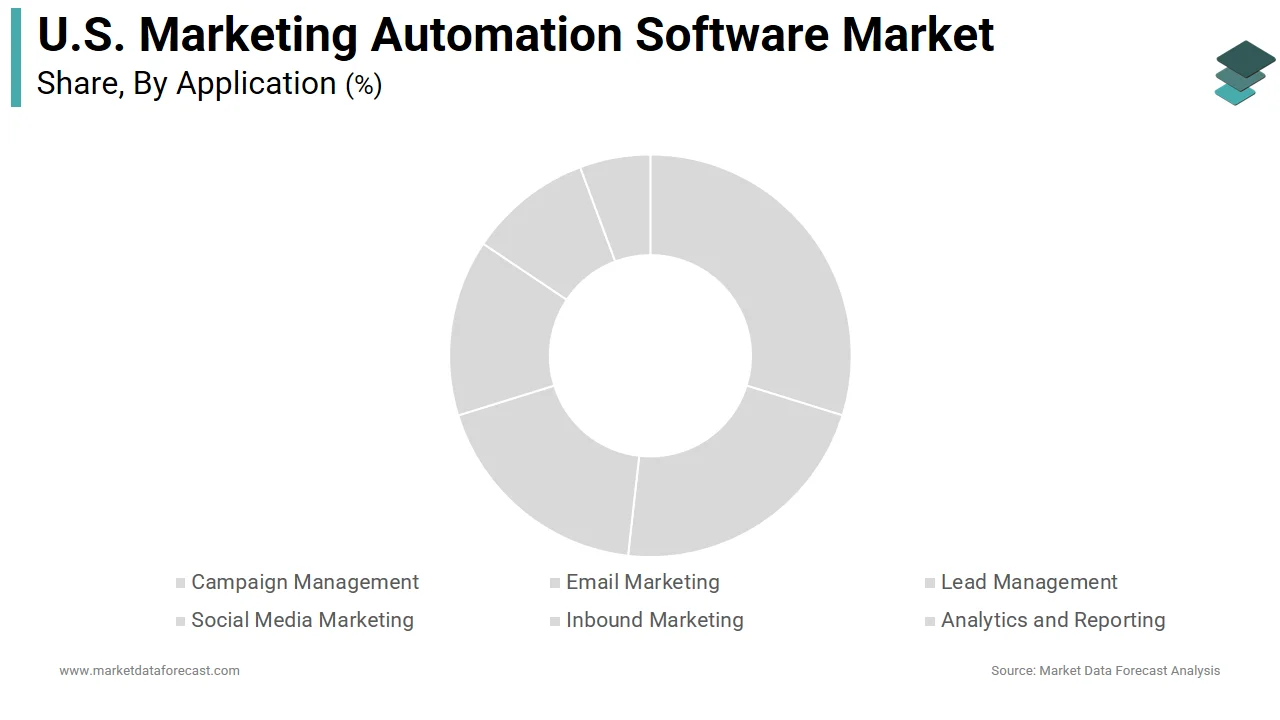
On the other hand, the analytics and reporting segment is the fastest-growing segment and is estimated to progress at a CAGR of 15.5% during the forecast period in the U.S. market. The rising demand for data-driven decision-making and accountability drives the rapid growth of analytics and reporting in the U.S. marketing automation software market. Marketing leaders face pressure to demonstrate the tangible impact of their activities on revenue. According to Gartner, 65% of chief marketing officers feel increased pressure to prove the value of marketing to the C-suite. As per Adobe, 84% of executives say that data-driven marketing is crucial to success in today’s hyper-competitive global economy. Automation platforms provide detailed dashboards that track key performance indicators such as conversion rates, customer lifetime value, and attribution. These insights enable marketers to optimize campaigns in real time and allocate budgets more effectively. The ability to attribute sales to specific touchpoints enhances strategic planning. Advanced analytics tools use machine learning to predict future trends and identify opportunities. This shift from intuition-based to evidence-based marketing requires robust reporting capabilities. Businesses invest in analytics to reduce waste and improve efficiency. The transparency provided by automated reporting builds trust with stakeholders. Consequently, the need for measurable results accelerates the adoption of analytics features. This trend ensures sustained growth for the reporting segment.
By Deployment Model Insights
The cloud-based deployment segment led the market by accounting for 76.7% of the U.S. market share in 2025. Scalability and flexibility for growing businesses drive the domination of cloud-based deployment in the U.S. marketing automation software market. Cloud platforms allow organizations to adjust resources and features according to changing needs without significant infrastructure changes. According to Flexera, 92% of enterprises have a multi-cloud strategy, highlighting the preference for flexible IT environments. As per Gartner, cloud services continue to grow as businesses seek agility in their operations. Marketing teams can easily add users, expand storage, and integrate new tools as their campaigns evolve. The ability to scale up during peak seasons and down during slower periods optimizes costs. Cloud solutions support remote work, enabling teams to access data from anywhere. This flexibility is crucial in the post-pandemic work environment. Automatic updates ensure that users always have access to the latest features and security patches. The reduced need for internal IT support lowers operational burdens. Cloud platforms facilitate faster deployment compared to on-premises systems. This speed to market is essential for competitive advantage. Consequently, the adaptability of cloud deployment sustains its leadership. The alignment with modern business dynamics ensures continued preference for cloud solutions.
On the other side, the hybrid cloud deployment segment is the fastest-growing segment and is anticipated to record a CAGR of 13.4% during the forecast period in the U.S. market. The growth is fueled by the need for data sovereignty and enhanced security for sensitive information. Need for data sovereignty and regulatory compliance drives the rapid growth of hybrid cloud deployment in the U.S. marketing automation software market. Certain industries, such as healthcare and finance, are subject to strict regulations regarding data storage and processing. According to the Health Insurance Portability and Accountability Act, protected health information must be stored securely, often requiring on-premises controls. As per the Financial Industry Regulatory Authority, financial firms must maintain strict oversight of customer data. Hybrid models allow organizations to keep sensitive data on private servers while leveraging the cloud for less critical marketing tasks. This approach ensures compliance with laws such as the California Consumer Privacy Act and General Data Protection Regulation. Businesses can customize security protocols for specific data sets. The flexibility to move data between environments supports audit requirements. Hybrid clouds provide the control needed for regulated industries without sacrificing cloud benefits. The ability to isolate sensitive customer information reduces risk exposure. Compliance officers prefer hybrid architectures for their transparency and governance capabilities. This regulatory pressure accelerates adoption among large enterprises. The balance between compliance and innovation makes hybrid deployment attractive. Consequently, legal requirements sustain the growth of this segment.
By Enterprise Type Insights
The large enterprises segment accounted for 58.5% of the U.S. market share in 2025. The growth of the large enterprises segment in the U.S. market is driven by the necessity for sophisticated tools to manage large-scale campaigns. Complex marketing operations and large customer bases drive the domination of large enterprises in the U.S. marketing automation software market. Multinational corporations manage millions of customer records and execute thousands of campaigns simultaneously. According to Forrester, large enterprises require robust automation to handle the volume and velocity of customer interactions. As per the Chief Marketing Officer Council, 70% of large companies use multiple automation platforms to support diverse business units. The complexity of coordinating global teams and regional strategies necessitates advanced workflow management. Automation software provides the structure needed to maintain consistency across brands and markets. Large enterprises benefit from economies of scale when implementing comprehensive suites. The ability to integrate with enterprise resource planning and customer relationship management systems is critical. These integrations enable seamless data flow and holistic customer views. The scale of operations justifies the investment in premium features and dedicated support. Large firms have the resources to train staff and optimize complex configurations. The need for detailed attribution and reporting supports strategic decision-making at executive levels. Consequently, the operational demands of large organizations sustain their market leadership. The complexity of their ecosystems requires sophisticated automation solutions.
However, the small and medium enterprises segment is estimated to witness a promising CAGR of 15.9% during the forecast period in the U.S. market, owing to the democratization of marketing technology and the increasing recognition of automation benefits among smaller businesses. Democratization of technology and affordable solutions drive the rapid growth of small and medium enterprises in the U.S. marketing automation software market. Vendors are developing simplified and cost-effective packages tailored to smaller budgets. According to the U.S. Small Business Administration, there are 33.2 million small businesses in the country, representing a vast potential market. As per HubSpot, 64% of small businesses plan to increase their marketing technology spend in the coming year. User-friendly interfaces and pre-built templates reduce the need for technical expertise. Cloud-based subscription models eliminate high upfront costs, making automation accessible. The availability of free trials and freemium versions encourages experimentation. Small businesses recognize the competitive advantage of automating repetitive tasks. The ability to compete with larger firms through targeted messaging motivates adoption. Educational resources and community support help SMEs overcome skill gaps. The rise of no-code platforms empowers non-technical users to create complex workflows. This accessibility expands the user base significantly. The focus on return on investment appeals to budget-conscious owners. Consequently, the lowering of barriers sustains the growth of this segment. The alignment with small business needs ensures long-term adoption.
COUNTRY ANALYSIS
U.S. Marketing Automation Software Market Analysis
Over the next few years, the U.S. is likely to maintain its unrivaled global position as domestic software developers systematically deploy next-generation algorithmic tools directly into standardized web-management infrastructures. The presence of major software vendors drives continuous development and competition. Dominance driven by technological infrastructure and enterprise spending defines the U.S. marketing automation software market. The country boasts advanced broadband connectivity and high smartphone penetration, facilitating digital marketing activities. According to the Federal Communications Commission, 92% of Americans have access to high-speed internet, enabling seamless cloud-based software usage. As per the Bureau of Economic Analysis, business investment in software and intellectual property products remains robust, supporting technology adoption. Large corporations in the U.S. prioritize digital transformation, allocating significant budgets to marketing technology. The presence of Silicon Valley fosters innovation and rapid product development. Venture capital funding supports startups entering the market with novel solutions. The competitive landscape drives vendors to improve features and reduce prices. High digital literacy among marketers ensures effective utilization of automation tools. The regulatory environment, although complex, provides a framework for data protection that builds trust. The integration of automation with other enterprise systems is widespread. The culture of data-driven decision-making reinforces the value of analytics. This combination of infrastructure and financial commitment ensures U.S. leadership. The continuous evolution of technology maintains the market's dynamism. The strategic focus on customer experience drives ongoing investment. The U.S. sets global standards for marketing automation practices.
COMPETITIVE LANDSCAPE
The competition in the U.S. marketing automation software market is characterized by intense rivalry among established enterprise vendors and agile niche providers striving to offer superior functionality and ease of use. Major players compete based on artificial intelligence capabilities, integration breadth, and scalability of their platforms. The market features a diverse landscape with solutions tailored for specific industries and business sizes. Companies differentiate themselves by providing unique features such as advanced predictive analytics, seamless content management, and robust customer data platforms. Strategic partnerships with technology giants help firms expand their reach and enhance interoperability. Price competitiveness remains a key factor, particularly in the small and medium business segment, where affordability is crucial. Innovation in user interface design and automation workflows drives customer acquisition and retention. The shift towards omnichannel marketing requires vendors to offer comprehensive solutions that cover email, social media, and web interactions. Intellectual property related to algorithms and data processing serves as a competitive barrier. This dynamic environment fosters continuous improvement and innovation, benefiting customers with diverse and powerful tools. The ability to adapt to regulatory changes and technological advancements determines long-term success in this sector.
KEY MARKET PLAYERS
Some of the companies that are playing a dominating role in the U.S. marketing automation software market include
- Adobe (U.S.)
- IBM Corporation (U.S.)
- Oracle Corporation (U.S.)
- HubSpot, Inc. (U.S.)
- Salesforce, Inc. (U.S.)
- Creatio (U.S.)
- Microsoft Corporation (U.S.)
- Zoho Corporation Pvt. Ltd.
- Act-on (U.S.)
- Sage Group plc
TOP PLAYERS IN THE MARKET
- Salesforce Inc maintains a prominent position in the U.S. marketing automation software market through its Marketing Cloud platform. The company integrates marketing capabilities with customer relationship management to provide a unified view of customer interactions. Recent actions include the integration of Einstein AI to enhance predictive analytics and personalization features for marketers. Salesforce has expanded its data cloud capabilities to allow seamless ingestion of first-party data from various sources. The firm actively collaborates with partners to build a robust ecosystem of applications and integrations. By focusing on artificial intelligence-driven insights, Salesforce helps businesses optimize campaign performance and customer engagement. These initiatives strengthen its reputation as a comprehensive solution provider. The continuous innovation in automation tools ensures that enterprises can deliver personalized experiences at scale. This strategic focus on AI and data unification solidifies its leadership in the competitive landscape.
- Adobe Inc contributes significantly to the market through its Experience Cloud suite, which offers advanced marketing automation and analytics tools. The company leverages its creative heritage to provide seamless content creation and distribution capabilities within automated workflows. Recent developments involve the expansion of Adobe Sensei AI features to automate customer journey mapping and content optimization. Adobe has enhanced its real-time customer data platform to improve audience segmentation and targeting accuracy. The firm focuses on providing omnichannel experiences that connect web, mobile, and email interactions. By integrating creative tools with marketing automation, Adobe enables brands to maintain consistency across all touchpoints. These efforts appeal to large enterprises seeking end-to-end solutions. The emphasis on privacy-compliant data handling builds trust with regulated industries. Adobe continues to invest in research and development to stay ahead of technological trends. This holistic approach reinforces its status as a key player in the market.
- HubSpot Inc plays a vital role in the U.S. marketing automation software market by offering user-friendly and scalable solutions for small and medium-sized businesses. The company is known for its inbound marketing methodology and integrated customer platform. Recent actions include the launch of advanced workflow automation features and enhanced artificial intelligence tools for content generation. HubSpot has expanded its integration marketplace to connect with hundreds of third-party applications. The firm focuses on simplifying complex marketing tasks through intuitive interfaces and guided setup processes. By providing affordable pricing tiers, HubSpot attracts a broad range of users from startups to growing enterprises. The company also invests heavily in educational resources and community building to support user adoption. These strategies enhance customer loyalty and reduce churn rates. The continuous improvement of its CRM and marketing hubs ensures comprehensive functionality. This customer-centric approach drives sustained growth and market presence.
TOP STRATEGIES USED BY KEY MARKET PARTICIPANTS
Key players in the U.S. marketing automation software market primarily employ strategies focused on artificial intelligence integration and platform consolidation to maintain a competitive advantage. Companies invest heavily in machine learning algorithms to enhance predictive analytics and personalized customer experiences. Strategic acquisitions are common tactics used to expand feature sets and acquire specialized technologies such as customer data platforms. Firms prioritize seamless integration with existing enterprise systems like customer relationship management and e-commerce platforms. Providers also focus on improving user experience through intuitive interfaces and no-code automation tools. Emphasis on data privacy and compliance helps build trust with regulated industries. Training and certification programs are implemented to ensure users can effectively leverage advanced features. These strategic initiatives enable firms to differentiate their offerings and respond effectively to evolving customer needs in the dynamic marketing technology sector.
MARKET SEGMENTATION
This research report on the U.S. marketing automation software market has been segmented and sub-segmented into the following categories.
By Application
- Campaign Management
- Email Marketing
- Lead Management
- Social Media Marketing
- Inbound Marketing
- Analytics and Reporting
- Others (Mobile Marketing)
By Deployment Model
- On-Premises
- Cloud
By Enterprise Type
- Large Enterprises
- Small & Medium Enterprises (SMEs)
By End-user
- BFSI
- Retail and Consumer Goods
- Healthcare
- Media and Entertainment
- Manufacturing
- Others (Government, Education)
By Country
- New York
- Texas
- Florida
- Georgia
- California
- Rest of U.S.
Frequently Asked Questions
What is the U.S. marketing automation software market?
The U.S. marketing automation software market includes platforms that automate marketing tasks like email campaigns, lead nurturing, and customer segmentation for businesses across the United States.
Why is the U.S. marketing automation software market growing?
The U.S. marketing automation software market is growing due to rising demand for digital marketing, AI adoption, and the need for efficient customer engagement strategies among U.S. companies.
Who uses the U.S. marketing automation software market?
Businesses of all sizes in the U.S., especially B2B firms, use the U.S. marketing automation software market to streamline campaigns, improve leads, and enhance customer retention through automation.
What features define the U.S. marketing automation software market?
The U.S. marketing automation software market offers email automation, CRM integration, analytics, lead scoring, multi-channel campaign management, and personalized content delivery capabilities.
How does AI impact the U.S. marketing automation software market?
AI enhances the U.S. marketing automation software market by enabling predictive analytics, smart segmentation, personalized content, and automated decision-making for better marketing outcomes.
What challenges exist in the U.S. marketing automation software market?
Challenges in the U.S. marketing automation software market include data privacy concerns, integration complexity, high implementation costs, and the need for skilled marketing automation professionals.
Which industries benefit most from the U.S. marketing automation software market?
Industries like healthcare, finance, retail, SaaS, and professional services benefit most from the U.S. marketing automation software market due to their need for targeted, scalable customer engagement.
How do businesses choose software in the U.S. marketing automation software market?
Companies evaluate the U.S. marketing automation software market based on ease of use, CRM compatibility, scalability, pricing, feature set, customer support, and integration with existing marketing stacks.
What role does email play in the U.S. marketing automation software market?
Email is central to the U.S. marketing automation software market, enabling automated newsletters, drip campaigns, behavioral triggers, and personalized messaging to nurture leads effectively.
Is the U.S. marketing automation software market suitable for small businesses?
The U.S. marketing automation software market offers scalable solutions for small businesses with affordable plans, user-friendly interfaces, and essential automation features for growth.
Related Reports
Access the study in MULTIPLE FORMATS
Purchase options starting from
$ 1200
Didn’t find what you’re looking for?
TALK TO OUR ANALYST TEAM
Need something within your budget?
NO WORRIES! WE GOT YOU COVERED!
Call us on: +1 888 702 9696 (U.S Toll Free)
Write to us: sales@marketdataforecast.com