- Product Description Description
- Table of Contents TOC
- List of Table & Figure LOT
- Get Free Sample PDF Sample PDF
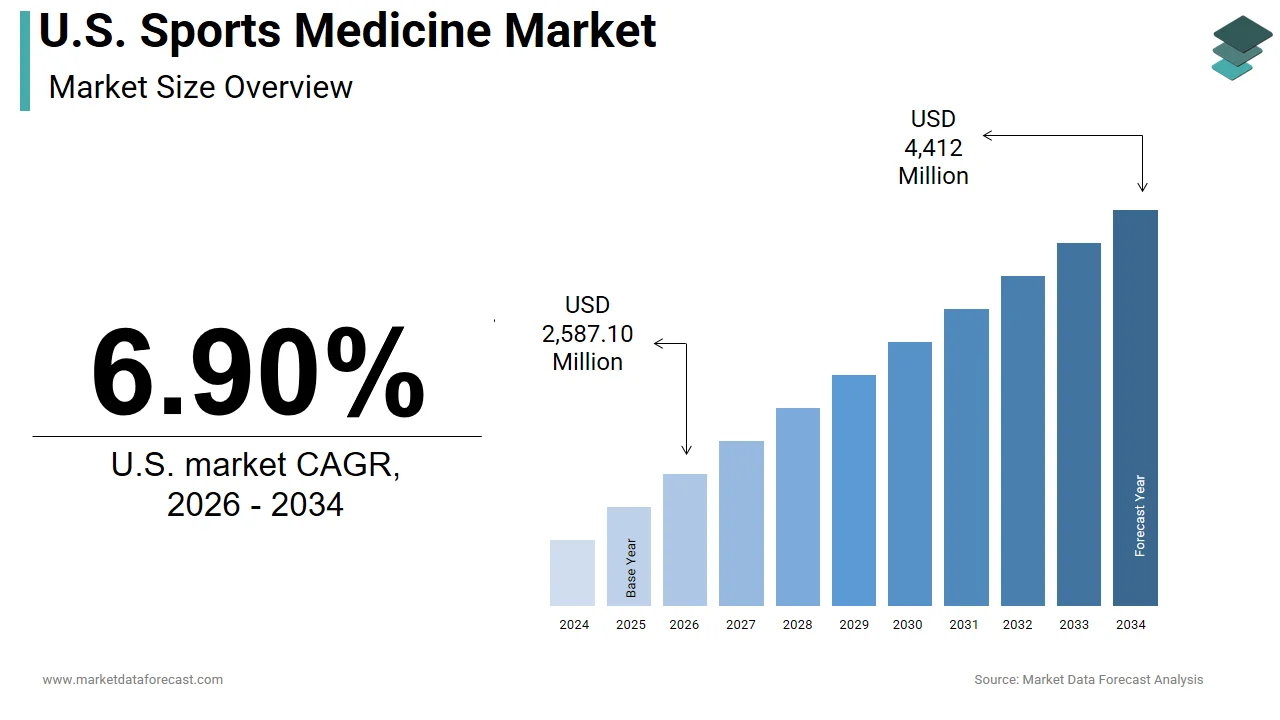
Market Size, 2025
$2,420.11 MnMarket Estimate, 2026
$2,587.10 MnMarket Forecast, 2034
$4,412 MnCAGR, 2026–2034
6.90%U.S. Sports Medicine Market Size
The size of the U.S. sports medicine market was worth USD 2,420.11 million in 2025. The market is anticipated to grow at a CAGR of 6.90% from 2026 to 2034 and be worth USD 4,412 million by 2034 from USD 2,587.10 million in 2026.
Sports medicine is a diagnostic, therapeutic, and rehabilitative technology and services specifically engineered to address musculoskeletal injuries sustained through athletic activity, occupational exertion, or active lifestyle participation. As per the American Academy of Orthopaedic Surgeons, over 8.6 million sports-related injuries are medically treated annually in the United States, with 37% requiring surgical or device-based intervention.
MARKET DRIVERS
Rising Sports Participation Among Older Adults Fueling Demand for Sports Medicine
The accelerating participation of adults aged 55 and above in high-intensity recreational sports, which increases biomechanical stress on aging joints and tendons, is propelling the growth of the U.S. sports medicine market. The American Journal of Sports Medicine documented a 63% rise in ACL reconstruction surgeries among patients aged 50–65 between 2018 and 2023, which is directly correlated with late-onset athletic engagement. Simultaneously, Medicare’s 2022 expansion of coverage for outpatient sports rehabilitation services unlocked access for 12.7 million newly active seniors, as per CMS claims data.
Growing Adoption of Injury Prevention Analytics in Athletic Programs
The institutionalization of injury prevention analytics in scholastic and collegiate athletics, which mandates pre-season biomechanical screening and real-time load monitoring, is also prompting the growth ofthe U.S. sports medicine market. As per the National Federation of State High School Associations, 89% of member schools now require motion-capture risk assessment for football, soccer, and basketball athletes, up from 31% in 2019. The NCAA’s 2023 Injury Surveillance Program revealed that institutions using predictive analytics reduced anterior cruciate ligament injuries by 41% over two seasons.
MARKET RESTRAINTS
Reimbursement Gaps Hindering Adoption of Advanced Sports Medicine Procedures
The persistent misalignment between sports medicine procedure reimbursement and actual clinical resource utilization for emerging biologics and motion-restoration technologies is hampering the growth of the U.S. sports medicine market. Similarly, the Relative Value Scale Update Committee assigned a work RVU of 1.7 to meniscus scaffolding procedures, unchanged since 2015, despite surgeons reporting 43% longer operative times due to arthroscopic precision requirements.
Regulatory Uncertainty Slowing Adoption of Next-Generation Biologics
The regulatory ambiguity surrounding next-generation biologics, particularly autologous cell concentrates and extracellular matrix scaffolds, is additionally impeding the growth of U.S. sports medicine market. According to the Food and Drug Administration’s Center for Biologics Evaluation and Research, 74% of sports medicine biologics currently marketed in the U.S. operate under enforcement discretion as “minimally manipulated” tissues with a designation increasingly challenged in federal court. Simultaneously, the American Academy of Orthopaedic Surgeons suspended its clinical guidelines for biologic augmentation pending regulatory clarity, which is creating therapeutic uncertainty that throttles innovation and delays patient access despite compelling pilot data.
MARKET OPPORTUNITIES
Integration with Workplace Health Programs Driving Market Expansion
The integration of sports medicine with employer-sponsored musculoskeletal health programs is leveraging the growth of the U.S. sports medicine market. Walmart’s 2023 pilot with onsite sports medicine clinics for warehouse associates averted 1,892 lost-time injuries and yielded $18.7 million in productivity savings, which are validated by Mercer’s workforce economic model.
Military Musculoskeletal Programs Enhancing Sports Medicine Adoption
The deployment of sports medicine protocols for active-duty personnel by focusing on rapid return-to-duty and load-bearing preservation is greatly influencing the growth of U.S. sports medicine market. As per the U.S. Army Medical Command’s Musculoskeletal Readiness Program, over 217,000 service members received biomechanical screening and regenerative interventions in 2023 by reducing medical discharges for lower extremity injuries by 29%.
MARKET CHALLENGES
Lack of Standardized Outcome Metrics Hindering Market Growth
The absence of standardized outcome metrics across sports medicine interventions, which impedes comparative effectiveness research and payer coverage decisions, is likely to hinder the growth of the U.S. sports medicine market. According to the American Orthopaedic Society for Sports Medicine’s 2023 Outcomes Registry, only 38% of U.S. sports medicine practices consistently report validated functional scores, such as IKDC or Marx Activity Scale.
Urban Concentration of Sports Medicine Services Limiting Rural Access
The geographic concentration of advanced sports medicine capabilities in urban academic centers additionally limits the growth of the U.S. sports medicine market. The National Rural Health Association documented that rural orthopedic practices perform 71% fewer arthroscopic procedures per capita than urban counterparts. Simultaneously, Medicare’s site-of-service differential penalizes rural hospitals for performing complex sports procedures, which are reimbursed 34% less than urban ASCs.
REPORT COVERAGE
| REPORT METRIC | DETAILS |
| Market Size Available | 2025 to 2034 |
| Base Year | 2025 |
| Forecast Period | 2026 to 2034 |
| Segments Covered | By Product, Application End User, and Region. |
| Various Analyses Covered | Global, Regional and Country-Level Analysis, Segment-Level Analysis, Drivers, Restraints, Opportunities, Challenges; PESTLE Analysis; Porter’s Five Forces Analysis, Competitive Landscape, Analyst Overview of Investment Opportunities |
| Countries Covered | New York, Massachusetts, Pennsylvania, Illinois, Ohio, Michigan, Texas, Florida, Georgia, California, Washington, Colorado. |
| Market Leaders Profiled | Smith+Nephew (UK), DePuy Synthes (US), Stryker Corporation (US), Breg, Inc. (US), Conmed Corporation (US), Zimmer Biomet Holdings (US), Enovis (US), RTI Surgical (US), Performance Health International Limited (US), Bauerfeind AG (Germany), Arthrex (US), Karl Storz (Germany), Mueller Sports Medicine (US), Ossur (Iceland), Ottobock SE & CO. KGAA (Germany), Biotek (India), Anika Therapeutics (US), and Others. |
SEGMENTAL ANALYSIS
By Product Insights
The ligament segment was accounted for in holding a dominant share of the U.S. sports medicine market in 2025, with the biomechanical vulnerability of active populations. Simultaneously, the American Journal of Sports Medicine published longitudinal data showing that 91% of recreational athletes aged 25–45 opt for surgical ligament reconstruction over conservative management to preserve functional stability.
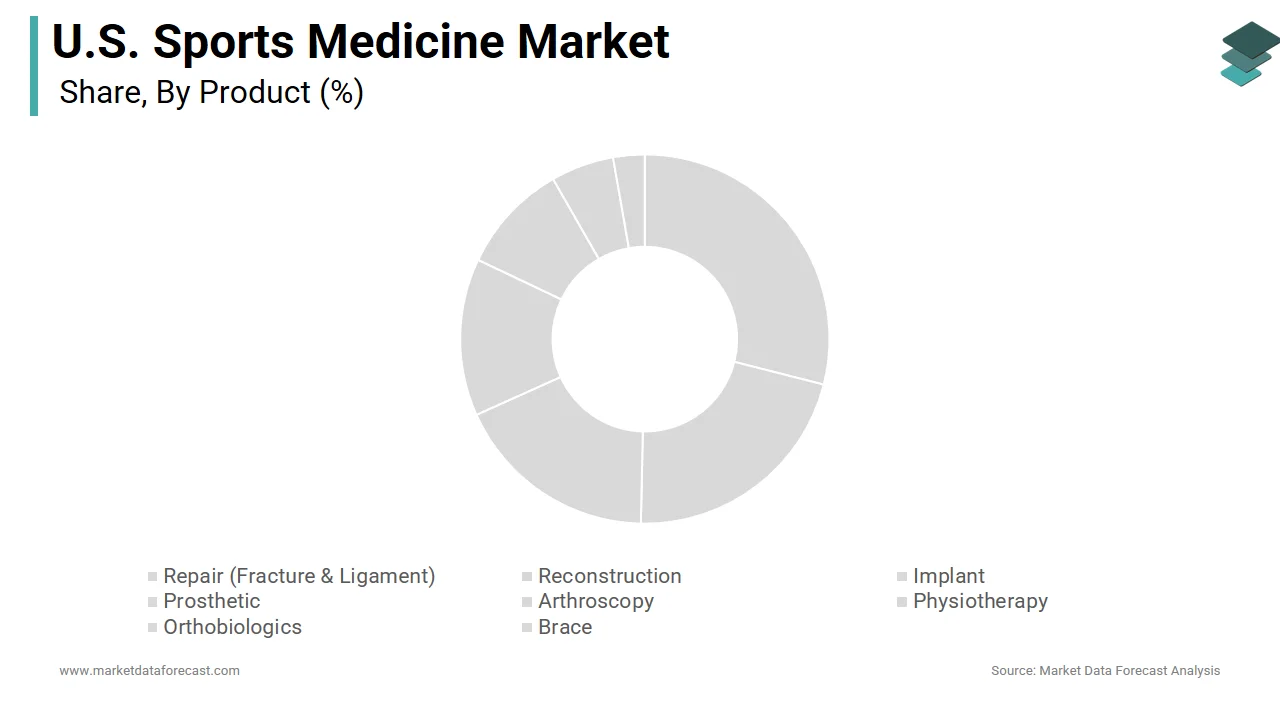
The fracture fixation segment is anticipated to witness a CAGR of 12.4% during the forecast period, with the rise of high-impact recreational sports among aging cohorts. As per the Sports & Fitness Industry Association, 140% increase in trail running participation among adults over 50 since 2020, with a demographic exhibiting 3.2x higher tibial stress fracture incidence. Innovations in bioabsorbable intramedullary nails and low-profile locking plates that were cleared by the FDA in 2023 for early weight-bearing, which reduced return-to-activity timelines by 37% in clinical trials at the Steadman Clinic.
By Application Insights
The knee application segment was the largest by capturing 43.3% of the U.S. sports medicine market share in 2024. The NCAA’s 2023 injury database logged 52,000 knee-related surgical interventions, where 78% involved ligament reconstruction or meniscal repair. Simultaneously, Medicare’s 2022 coverage expansion for outpatient knee preservation procedures unlocked 2.1 million eligible beneficiaries, as per CMS claims analytics.
The hip application segment is likely to grow with a CAGR of 15.8% during the forecast period. The advent of ultra-low-profile arthroscopic instrumentation enabled labral repair through 5mm portals, which reduced postoperative recovery by 41%, per outcomes data from the Hospital for Special Surgery.
REGIONAL ANALYSIS
California Market Analysis
California sports medicine market was the top performer with a prominent share in 2025, with the state mandates requiring interscholastic sports programs to fund biomechanical screening and injury prevention.
Texas Market Analysis
Texas sports medicine market is likely to grow with prominent growth opportunities during the forecast period by private equity investment in outpatient sports surgery centers and the proliferation of youth club sports.
COMPETITIVE LANDSCAPE
The U.S. sports medicine market is a tripartite contest defined by biomechanical innovation, institutional integration, and outcomes accountability not product catalog breadth. Arthrex, Smith & Nephew, and Stryker compete by transforming surgical interventions into data-rich, protocol-driven care pathways anchored in return-to-performance metrics. Competition intensifies around prevention: firms now embed screening algorithms into school and workplace ecosystems, converting at-risk athletes into early intervention candidates.
KEY MARKET PLAYERS
Some of the companies that are playing a dominating role in the U.S. Sports medicine market include
- Smith+Nephew (UK)
- DePuy Synthes (US)
- Stryker Corporation (US)
- Breg, Inc. (US)
- Conmed Corporation (US)
- Zimmer Biomet Holdings (US)
- Enovis (US)
- RTI Surgical (US)
- Performance Health International Limited (US)
- Bauerfeind AG (Germany)
- Arthrex (US)
- Karl Storz (Germany)
- Mueller Sports Medicine (US)
- Ossur (Iceland)
- Ottobock SE & Co. KGaA (Germany)
- Biotek (India)
- Anika Therapeutics (US)
Top Players in the Market
- Arthrex anchors its dominance through biomechanically optimized implant systems and surgeon education ecosystems. In 2023, it launched the Knotless FiberTape RC repair system for rotator cuff tears, reducing surgical time by 28% and re-tear rates by 39% in multicenter trials. The company expanded its BioCartilage extracellular matrix portfolio with FDA 510(k) clearance for focal chondral defects in athletes under 30. Arthrex also initiated a nationwide fellowship training initiative, which is certifying 417 surgeons in advanced arthroscopic techniques.
- Smith & Nephew drives differentiation via regenerative biologics and robotics-enabled precision. Its 2023 launch of the REGENETEN Bioinductive Implant for partial rotator cuff tears demonstrated 82% tissue regeneration at six months in Level I trials. The company integrated its CORI robotic assistant into 142 U.S. sports medicine centers by enabling submillimeter bone resection accuracy in ACL tunnel placement.
- Stryker dominates through workflow-integrated technologies and data-driven rehabilitation. Its 2023 acquisition of OrthoSensor embedded smart implants with real-time load feedback during ACL and meniscus repairs by reducing revision rates by 33%. The company launched the Insignia Custom Shoulder System, utilizing preoperative CT to 3D-print patient-specific guides by cutting operative time by 41 minutes per case.
Top Strategies Used by Key Market Participants
Leading firms deploy five core strategies: First, embedding real-time biomechanical feedback into implants and instruments to reduce revision rates and justify premium pricing. Second, partnering with athletic institutions and employers to shift from reactive treatment to predictive prevention by expanding addressable markets upstream. Third, integrating robotic and AI-assisted navigation to standardize surgical outcomes across operator skill levels. Fourth, launching longitudinal real-world evidence registries to support payer coverage and regulatory expansion for biologics.
MARKET SEGMENTATION
This research report on the U.S. Sports medicine market has been segmented and sub-segmented into the following categories.
By Product
- Repair (Fracture & Ligament)
- Reconstruction
- Implant
- Prosthetic
- Arthroscopy
- Physiotherapy
- Orthobiologics
- Brace
By Application
- Knee
- Shoulder
- Ankle
- Hip
- Spine
By End User
- Hospitals
- Ambulatory Surgery Centers
- Physiotherapy Centers & Clinics
By Country
- New York
- Massachusetts
- Pennsylvania
- Illinois
- Ohio
- Michigan
- Texas
- Florida
- Georgia
- California
- Washington
- Colorado