U.S. Waste-to-Energy Market Size, Share, Trends, and Growth Analysis Report, Segmented by Technology, Waste Type, Energy Output, End-User, and Country – Industry Forecast From 2026 to 2034
Market Size, 2025
$6.56 BnMarket Estimate, 2026
$7.32 BnMarket Forecast, 2034
$17.64 BnCAGR, 2026–2034
11.62%U.S. Waste to Energy Market Report Summary
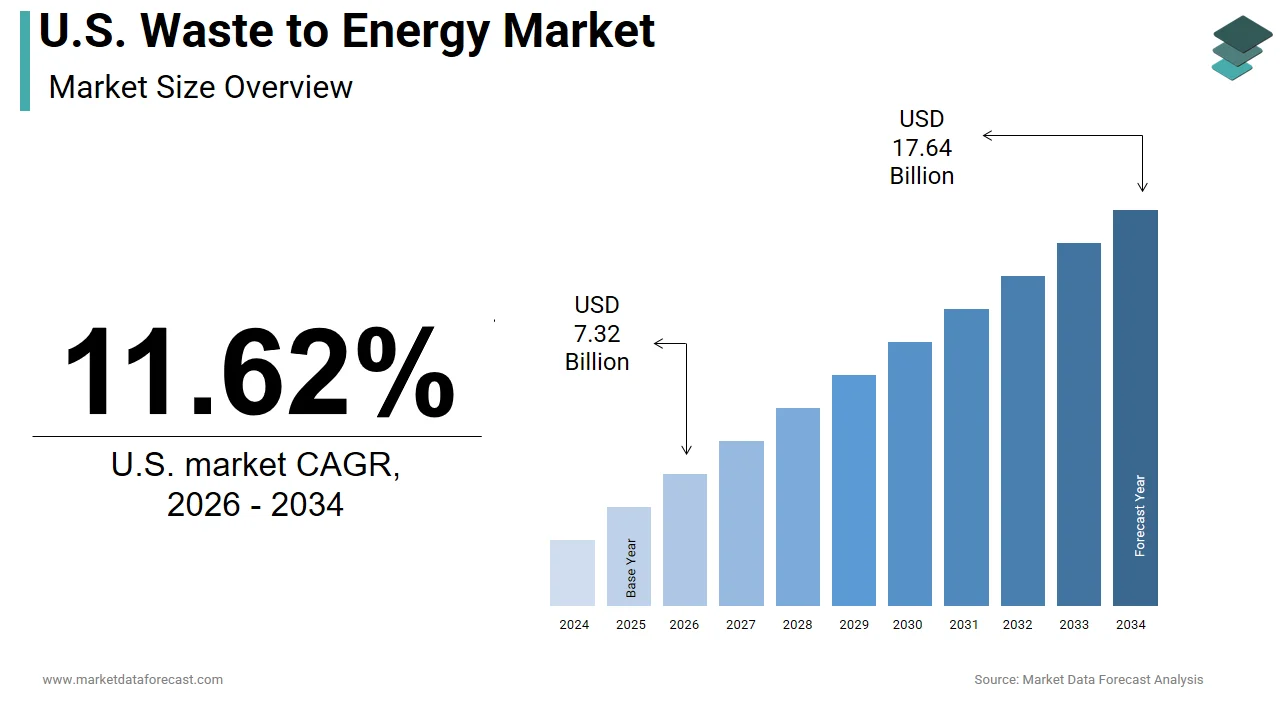
The U.S. waste-to-energy market was valued at USD 6.56 billion in 2025, is estimated to reach USD 7.32 billion in 2026, and is projected to reach USD 17.64 billion by 2034, growing at a CAGR of 11.62% from 2026 to 2034. Market growth is driven by increasing focus on sustainable waste management, rising energy demand, and growing government support for renewable energy generation. Waste-to-energy technologies are gaining traction as they help reduce landfill dependency while generating electricity and heat from municipal and industrial waste. Additionally, advancements in thermal conversion technologies, stricter environmental regulations, and rising investments in circular economy initiatives are accelerating market expansion across the United States.
Key Market Trends
- Rising adoption of sustainable waste management solutions.
- Increasing investment in renewable and alternative energy generation.
- Growth in thermal waste-to-energy conversion technologies.
- Expansion of municipal solid waste processing infrastructure.
- Increasing government focus on carbon reduction and landfill diversion initiatives.
Segmental Insights
- Based on technology, the thermal technology segment dominated the United States waste-to-energy market by accounting for 64.5% share in 2025, driven by high energy recovery efficiency and large-scale adoption of incineration technologies.
- Based on waste type, the municipal solid waste segment led the market with 52.9% share in 2025, supported by increasing urban waste generation and municipal waste management initiatives.
- Based on end user, the utilities and independent power producers segment held the leading share in 2025, driven by the rising integration of waste-derived energy into power generation networks.
Country-Level Insights
- The United States dominated the North American waste to energy market by holding 95.5% share in 2025, supported by advanced waste management infrastructure, strong regulatory support, and increasing investments in renewable energy projects.
Competitive Landscape
The U.S. waste-to-energy market is highly competitive, with companies focusing on advanced conversion technologies, capacity expansion, and sustainable waste processing solutions. Strategic partnerships, acquisitions, and investments in clean energy infrastructure are shaping the competitive landscape.
Prominent companies operating in the U.S. waste-to-energy market include Wheelabrator Technologies Inc., Suez SA, Waste Management, Inc., Covanta Holding Corporation, Advanced Plasma Power, and WIN Waste Innovations.
U.S. Waste-to-Energy Market Size
The U.S. waste-to-energy market was valued at USD 6.56 billion in 2025, is estimated to reach USD 7.32 billion in 2026, and is projected to reach USD 17.64 billion by 2034, growing at a CAGR of 11.62% from 2026 to 2034.
Waste-to-Energy (WTE) or energy-from-waste (EFW) refers to technologies that convert non-recyclable waste materials into usable heat, electricity, or fuel through processes like combustion, gasification, or anaerobic digestion. This sector serves as a vital alternative to landfilling, particularly in regions with limited land availability and high disposal costs. As per the Environmental Protection Agency, approximately 292 million tons of municipal solid waste were generated in the United States in recent years, with only about 32% recycled or composted, leaving a substantial volume for disposal or energy recovery. The market is defined by its ability to reduce waste volume significantly while generating baseload renewable energy. According to the Energy Information Administration, waste-to-energy facilities generate approximately 14 billion kilowatt-hours of electricity annually, which is enough to power about 1.3 million homes, while also reducing the volume of waste sent to landfills. The market operates under strict environmental regulations that mandate advanced emission control technologies to minimize the release of pollutants such as dioxins and heavy metals. State-level policies, including renewable portfolio standards, often classify waste-to-energy as an eligible source of renewable energy, providing financial incentives for operators. The definition of this market encompasses various technologies, including mass burn incineration, refuse-derived fuel systems, and anaerobic digestion. The sector is increasingly viewed through the lens of circular economy principles, where waste is treated as a resource rather than a burden. This perspective drives innovation in efficiency and emissions reduction, positioning waste-to-energy as a sustainable solution for urban waste management challenges.
MARKET DRIVERS
Stringent Landfill Regulations and Capacity Constraints Drive Adoption
The implementation of stringent environmental regulations governing landfills and the subsequent scarcity of landfill space is driving the growth of the United States waste-to-energy market. Federal and state agencies have imposed rigorous standards on landfill operations, including requirements for liners, leachate collection, and methane capture, which significantly increase the cost of disposal. As per the Environmental Protection Agency, the Subtitle D criteria for municipal solid waste landfills have led to the closure of numerous older facilities that cannot meet compliance standards, reducing the overall number of available disposal sites. According to research from Columbia University and the EPA, the number of active municipal solid waste landfills in the U.S. has declined from nearly 8,000 in the 1980s to approximately 2,600 today, largely due to stringent environmental regulations and industry consolidation. This consolidation has driven up tipping fees, making waste-to-energy an economically attractive alternative for municipalities and waste haulers. In densely populated regions such as the Northeast, where land is scarce and expensive, waste-to-energy facilities provide a crucial solution for managing large volumes of waste without transporting it long distances. The regulatory pressure to reduce methane emissions from landfills further incentivizes the diversion of organic waste to energy facilities. By converting waste into energy, these facilities not only alleviate pressure on landfills but also mitigate greenhouse gas emissions associated with decomposition. This regulatory and spatial constraint creates a sustained demand for waste-to-energy services, ensuring their role as a key component of integrated waste management strategies.
Renewable Energy Mandates and Carbon Reduction Goals Stimulate Investment
The inclusion of WtE in state and federal renewable energy mandates is accelerating the growth of the United States waste-to-energy market. This provides financial incentives and regulatory support for facility operators. Many states classify waste-to-energy as a tier one renewable energy source under their Renewable Portfolio Standards, requiring utilities to procure a specific percentage of their electricity from eligible sources. As per the Database of State Incentives for Renewables and Efficiency, more than 20 states recognize waste-to-energy as a compliant technology, allowing facilities to generate renewable energy credits that can be sold to utilities. This revenue stream enhances the economic viability of waste-to-energy projects, offsetting high operational and capital costs. According to the American Public Power Association, the recognition of waste-to-energy as a baseload renewable source provides grid stability that intermittent sources like wind and solar cannot offer. Furthermore, corporate sustainability goals and carbon reduction targets are driving demand for low-carbon energy solutions. Waste-to-energy facilities reduce the carbon footprint of waste management by avoiding methane emissions from landfills and displacing fossil fuel-based electricity generation. The Inflation Reduction Act also provides tax credits for clean energy production, further improving the financial outlook for the sector. These policy mechanisms create a favorable investment environment, encouraging the modernization of existing facilities and the development of new technologies that enhance efficiency and environmental performance.
MARKET RESTRAINTS
High Capital and Operational Costs Restrict Market Expansion
The substantial capital expenditure required for the construction and operation of waste-to-energy facilities is a major restraint on the United States waste-to-energy market expansion. Building a modern waste-to-energy plant involves complex engineering, advanced emission control systems, and extensive safety measures, resulting in initial costs that can exceed hundreds of millions of dollars. As per the World Bank, the capital costs for Waste-to-Energy facilities in developed countries are high, often exceeding $150,000,000 for a mid-sized plant, with investment costs per ton of annual capacity typically ranging between $500 and $1,500 for construction alone, making it a significant financial undertaking for municipalities and private investors. According to the Environmental Research and Education Foundation, the high upfront costs often require long-term financing arrangements and guaranteed waste supply contracts to secure funding, which can be difficult to obtain in uncertain economic conditions. Additionally, operational costs are elevated due to the need for specialized labor, continuous maintenance of sophisticated equipment, and compliance with stringent environmental regulations. The complexity of air pollution control systems, which are essential for meeting federal and state emissions standards, adds to the operational burden. These financial barriers limit the number of new projects that reach financial close, particularly in regions with lower tipping fees or abundant landfill capacity. The long payback period associated with these investments further discourages private sector participation, restricting market growth to areas with strong regulatory support and high disposal costs. The high cost structure remains a persistent obstacle to widespread adoption. This is due to a lack of substantial subsidies or innovative financing models.
Public Opposition and NIMBYism Hinder Facility Siting
Negative public perception and Not In My Backyard sentiments are a significant impediment to the development of new WtE facilities in the country, which negatively impacts the expansion of the United States waste-to-energy market. Local communities often oppose the construction of these plants due to concerns about air quality, odor, traffic, and potential health impacts, despite advancements in emission control technology. As per the National Waste and Recycling Association, public opposition has successfully blocked or delayed numerous waste-to-energy projects across the country, forcing developers to abandon viable sites or incur substantial costs in community engagement and mitigation efforts. Residents living near proposed industrial facilities frequently express skepticism about the safety and environmental benefits of waste-to-energy, citing fears of toxic emissions and decreased property values; while the Edison Electric Institute focuses on the grid benefits of such facilities, community-level opposition remains a primary barrier to development. This resistance is often fueled by misinformation and historical associations with older, less regulated incinerators. The permitting process for new facilities is therefore prolonged and contentious, requiring extensive environmental impact assessments and public hearings. Regulatory agencies must balance technical safety data with community concerns, leading to stricter requirements and increased scrutiny. The social license to operate is difficult to obtain, and even minor incidents at existing facilities can reignite public opposition. This societal barrier limits the geographic expansion of the market and forces operators to invest heavily in public relations and transparency initiatives to build trust and acceptance within host communities.
MARKET OPPORTUNITIES
Integration with Circular Economy Principles Offers Growth Potential
The integration of WtE into broader circular economy frameworks offers a significant opportunity for the United States waste-to-energy market growth. This is driven by policymakers and industries seeking holistic solutions for resource management. Waste-to-energy facilities are increasingly viewed as complementary to recycling programs, processing residual waste that cannot be economically recycled or composted. The circular economy aims to minimize landfill use. However, the Ellen MacArthur Foundation notes that energy recovery is not a core principle as it removes materials from the circular system. According to the United States Conference of Mayors, many cities have adopted Zero Waste principles that follow a hierarchy where waste-to-energy is recognized as a preferred method for managing residual streams compared to landfilling, though it is still classified as a form of disposal. This shift in perspective allows waste-to-energy operators to position themselves as essential partners in sustainable urban management. The production of byproducts such as bottom ash, which can be used in construction materials, further enhances the circularity of the process. Innovations in pre-treatment technologies enable better separation of recyclables before combustion, improving overall resource recovery rates. Furthermore, the development of industrial symbiosis parks, where waste-to-energy facilities provide heat and power to nearby industries, creates additional revenue streams and efficiency gains. The waste-to-energy sector can overcome stigma and demonstrate its value in a sustainable resource management hierarchy by aligning with circular economy principles. Consequently, this alignment opens new avenues for investment and policy support.
Technological Advancements in Emissions Control and Efficiency
Advancements in technology for emissions control and energy conversion efficiency create a pathway for the expansion of the United States waste-to-energy market. This allows to enhance its environmental profile and operational performance. New filtration systems, catalytic converters, and scrubbing technologies significantly reduce the release of pollutants such as nitrogen oxides, sulfur dioxide, and particulate matter, addressing public health concerns. As per the Environmental Protection Agency, modern waste-to-energy facilities emit significantly lower levels of dioxins and heavy metals compared to older plants, meeting some of the strictest air quality standards in the world. According to the American Society of Mechanical Engineers, improvements in boiler design and combustion control have increased the electrical efficiency of waste-to-energy plants, allowing them to generate more power from the same amount of waste. The integration of digital monitoring and artificial intelligence enables real-time optimization of combustion processes, reducing fuel consumption and emissions. Additionally, emerging technologies such as plasma gasification and pyrolysis offer alternative pathways for waste conversion with potentially higher efficiency and lower environmental impact. These innovations allow existing facilities to upgrade their systems and extend their operational life, while new projects can leverage state-of-the-art equipment to achieve superior performance. The market can strengthen its case for regulatory support and public acceptance by demonstrating continuous improvement in environmental stewardship and efficiency. So, this drives modernization and growth in the sector.
MARKET CHALLENGES
Regulatory Uncertainty Regarding Renewable Status Creates Instability
The inconsistent classification of WtE as a renewable energy source across different jurisdictions creates regulatory uncertainty, which slows down the growth of the United States waste-to-energy market. This instability challenges market stability and investment confidence. Some states fully recognize waste-to-energy as renewable, while others exclude it or place it in a lower tier. Consequently, this inconsistency affects eligibility for incentives and renewable energy credits. As per the North Carolina Clean Energy Technology Center, the lack of a unified federal definition for renewable energy leads to a fragmented policy landscape, complicating long-term planning for developers and investors. According to the Institute for Local Self-Reliance, debates over whether waste-to-energy competes with recycling or undermines waste reduction goals often result in fluctuating political support and policy changes. This uncertainty can lead to sudden changes in subsidy availability or compliance requirements, impacting the financial viability of projects. Investors may hesitate to commit capital to facilities in regions where the regulatory status is ambiguous or subject to change. Furthermore, the potential for future regulations to impose stricter emissions limits or carbon pricing adds another layer of risk. Without clear and consistent federal guidelines that affirm the role of waste-to-energy in the renewable energy mix, the market faces ongoing challenges in securing stable revenue streams and attracting long-term investment. This regulatory volatility hinders the industry's ability to plan for expansion and modernization.
Competition from Low-Cost Landfilling and Recycling Initiatives
The availability of low-cost landfilling in many regions and the expansion of recycling initiatives are significant competitive challenges to the United States waste-to-energy market. In areas with abundant land and lax environmental regulations, landfilling remains the cheapest option for waste disposal, undercutting the economic case for waste-to-energy. As per the Environmental Research and Education Foundation, tipping fees at landfills in the Midwest and South are significantly lower than in the Northeast, making waste-to-energy less attractive in those regions. According to The Recycling Partnership, increased investment in recycling infrastructure is successfully diverting millions of tons of recyclables from the waste stream; however, overall municipal solid waste generation continues to provide substantial residual feedstock for waste-to-energy facilities. This competition for waste streams can lead to supply shortages for existing plants, affecting their operational efficiency and revenue. Additionally, the push for zero waste goals often prioritizes recycling and composting over energy recovery, marginalizing waste-to-energy in municipal waste management hierarchies. The economic viability of waste-to-energy relies on a steady supply of non-recyclable waste, and any significant shift in waste composition or volume can impact profitability. The market must demonstrate its value in managing residual waste to remain competitive. Furthermore, it should advocate for policies that recognize its role in integrated waste management systems.
REPORT COVERAGE
| REPORT METRIC | DETAILS |
| Market Size Available | 2025 to 2034 |
| Base Year | 2025 |
| Forecast Period | 2026 to 2034 |
| Segments Covered | By Technology, Waste Type, Energy Output, End-User, and Country. |
| Various Analyses Covered | Global, Regional, and Country-Level Analysis, Segment-Level Analysis, Drivers, Restraints, Opportunities, Challenges; PESTLE Analysis; Porter’s Five Forces Analysis, Competitive Landscape, Analyst Overview of Investment Opportunities |
| Countries Covered | New York, Massachusetts, Pennsylvania, Illinois, Ohio, Michigan, Texas, Florida, Georgia, California, Washington, Colorado. |
| Market Leaders Profiled | Wheelabrator Technologies Inc, Suez SA, Waste Management, Inc, Covanta Holding Corp, Advanced Plasma Power, WIN Waste Innovations, and Others. |
SEGMENTAL ANALYSIS
By Technology Insights
The thermal technology segment maintained the majority share of 64.5% of the United States waste-to-energy market in 2025. This supremacy of the segment was credited to the widespread adoption of mass burn incineration and refuse-derived fuel systems that have been operational for decades. The ability of thermal processes to offer both significant volume reduction and consistent baseload power also contributes to its market dominance. As per the Energy Information Administration, there are 60 waste-to-energy facilities currently operating in the United States as of 2024, the vast majority of which utilize combustion technologies to process municipal solid waste. According to the Energy Information Administration, U.S. waste-to-energy facilities generate approximately 12.8 billion kWh of electricity annually, which is enough to power roughly 1.2 million homes. The technology is particularly favored in densely populated regions such as the Northeast, where landfill space is scarce, and tipping fees are high, making the volume reduction capability of incineration economically advantageous. Thermal plants can reduce the volume of original waste by up to 90 percent and its mass by up to 75 percent, drastically extending the lifespan of remaining landfill capacity for residual ash. Furthermore, modern thermal facilities are equipped with advanced air pollution control systems that meet stringent federal emissions standards, addressing historical concerns about environmental impact. The established regulatory framework and permitting pathways for combustion technologies also reduce development risks compared to newer alternatives. This combination of operational maturity, regulatory clarity, and effective waste management capabilities ensures that thermal technology remains the cornerstone of the US waste-to-energy sector.
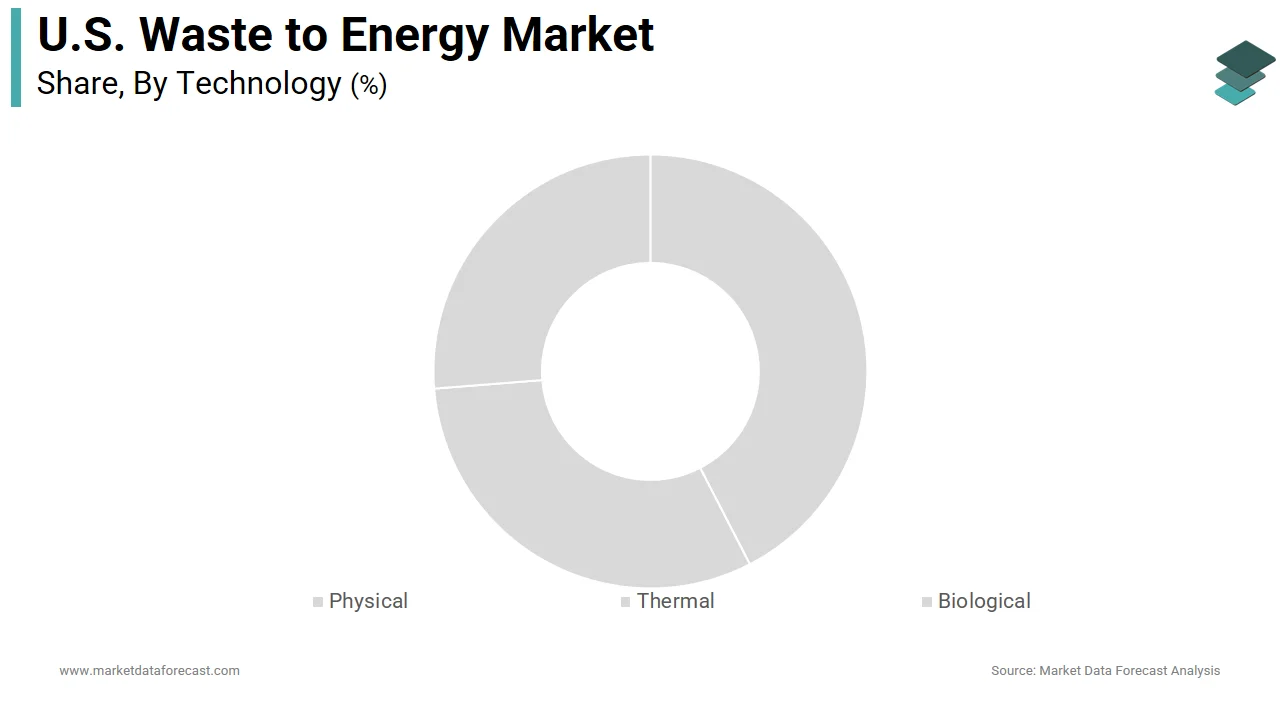
But the biological technology segment is estimated to register the fastest CAGR of 8.5% over the forecast period. This swift growth of the segment is fueled by increasing state and local mandates that require the diversion of organic waste from landfills to reduce methane emissions and promote composting or anaerobic digestion. As per the United States Department of Agriculture, food waste accounts for a significant portion of municipal solid waste, creating a substantial feedstock supply for biological processing facilities. According to the Environmental Protection Agency, several states, including California, Vermont, and Massachusetts, have implemented strict organic waste bans that prohibit businesses and residents from disposing of food scraps in landfills, driving investment in anaerobic digestion infrastructure. Biological technologies such as anaerobic digestion convert organic matter into biogas, which can be upgraded to renewable natural gas or used to generate electricity, offering a versatile energy product. The Environmental Protection Agency’s Food Recovery Hierarchy prioritizes anaerobic digestion over landfilling, providing policy support for project developers. Additionally, the agricultural sector is increasingly adopting digesters to manage livestock manure, further expanding the application of biological technologies. The ability of these systems to produce nutrient-rich digestate for use as fertilizer adds a revenue stream, enhancing economic viability. Awareness of the climate benefits of capturing methane from organic waste is growing. Consequently, biological technologies are poised for sustained expansion.
By Waste Type Insights
In 2025, the municipal solid waste segment dominated the United States waste-to-energy market by accounting for a 52.9% share in 2025. The consistent and large volume of waste generated by urban and suburban populations drives the dominance of this segment. This segment includes household trash, commercial waste, and institutional refuse, providing a steady feedstock for waste-to-energy facilities located near population centers. As per the Environmental Protection Agency, the United States generates approximately 292 million tons of municipal solid waste annually, ensuring a reliable supply for existing and future projects. According to the Columbia University Earth Institute, the concentration of waste generation in metropolitan areas reduces transportation costs and logistical complexities, making municipal solid waste the most economically viable feedstock for large-scale energy recovery. The composition of municipal solid waste, which includes paper, plastics, and organic materials, offers a high calorific value suitable for thermal conversion processes. Many waste-to-energy facilities have long-term contracts with municipalities and waste haulers, guaranteeing feedstock availability and stable revenue through tipping fees. The regulatory pressure to reduce landfill dependence in densely populated regions further reinforces the use of municipal solid waste for energy production. Additionally, the integration of waste-to-energy into municipal waste management plans allows cities to achieve sustainability goals while managing waste efficiently. The predictable nature of municipal waste streams allows for optimized plant operations and maintenance schedules, enhancing overall efficiency and profitability for operators.
On the contrary, the agricultural and agro-industrial residues segment is anticipated to witness the fastest CAGR of 7.2% between 2026 and 2034, owing to the increasing utilization of crop residues, livestock manure, and food processing byproducts. This growth is also supported by federal and state incentives aimed at promoting rural economic development and reducing greenhouse gas emissions from agricultural activities. According to the Rural Energy for America Program, grants and loans are available to farmers and rural small businesses for installing renewable energy systems, including anaerobic digesters and biomass boilers, encouraging the adoption of waste-to-energy technologies. The dairy and livestock industries are particularly active in deploying anaerobic digestion systems to manage manure, which reduces odor and water pollution while producing biogas for electricity or vehicle fuel. The Renewable Fuel Standard also provides credits for renewable natural gas produced from agricultural waste, enhancing the financial attractiveness of these projects. Furthermore, the growing demand for sustainable farming practices encourages the use of digestate as a natural fertilizer, closing nutrient loops. The utilization of agricultural residues for energy production is expected to expand rapidly across rural America. This growth is driven by declining technology costs and increased environmental awareness.
By End-User Insights
The utilities and independent power producers segment led the United States waste-to-energy market and captured a substantial share in 2025. This segment served as the primary end user of the electricity generated by these facilities. It benefits from the ability of waste-to-energy plants to provide baseload power, which is essential for maintaining grid stability and reliability. As per the Energy Information Administration, waste-to-energy facilities operate with high capacity factors, often exceeding 80 percent, making them a reliable source of renewable electricity compared to intermittent sources like wind and solar. According to the American Public Power Association, many municipal utilities own and operate waste-to-energy plants, allowing them to manage local waste while generating revenue from electricity sales. Independent power producers also play a significant role, entering into long-term power purchase agreements with utilities to sell electricity at fixed rates, ensuring financial stability for projects. The integration of waste-to-energy into the existing grid infrastructure is straightforward, as these facilities produce alternating current electricity that matches grid specifications. Regulatory frameworks such as the Public Utility Regulatory Policies Act facilitate the sale of power from qualifying facilities to utilities, supporting market growth. The demand for clean, reliable energy from utilities drives continued investment in waste-to-energy projects, particularly in regions with renewable portfolio standards that recognize waste-to-energy as a compliant source. This established relationship between waste-to-energy operators and utilities ensures a stable market for electricity output.
The transport fuel distributors segment is likely to experience the fastest CAGR of 9.2% during the forecast period. This accelerated growth of the segment is fuelled by the increasing production and utilization of renewable natural gas for vehicle fuel. Biogas from anaerobic digestion and landfill gas is being upgraded to pipeline-quality renewable natural gas, fueling significant growth. This renewable gas acts as a substitute for diesel and gasoline in heavy-duty vehicles. As per the California Air Resources Board, the Low Carbon Fuel Standard (LCFS) incentivizes production by assigning low or negative carbon intensity (CI) scores to fuels derived from waste sources, allowing producers to generate valuable credits for every ton of carbon reduced. According to the Coalition for Renewable Natural Gas, the number of heavy-duty vehicles powered by natural gas is increasing, with major logistics companies committing to sustainable fleet operations. The federal Renewable Fuel Standard also recognizes renewable natural gas from waste as an advanced biofuel, qualifying it for valuable renewable identification numbers. Transport fuel distributors are investing in refueling infrastructure to support this growing demand, creating a new revenue stream for waste-to-energy producers. The ability to monetize biogas as a transportation fuel offers higher returns than electricity generation in many cases, driving the conversion of existing facilities and the development of new projects focused on fuel production. This shift towards transport fuel applications is reshaping the end-user landscape of the waste-to-energy market.
COUNTRY ANALYSIS
U.S. Waste-to-Energy Market Analysis
The United States outperformed other countries in the North American waste-to-energy market and occupied a 95.5% share in 2025. This position of the US market is propelled by its advanced waste management infrastructure and regulatory framework. The country’s market status is characterized by a mature industry that focuses on optimizing existing facilities rather than extensive new construction, driven by high capital costs and public opposition. As per the Environmental Protection Agency and Energy Information Administration, the United States operates 60 waste-to-energy facilities as of 2022, which process approximately 34.6 million tons of waste annually, thereby diverting material from landfills and reducing associated methane emissions. The driving factors behind this market include stringent landfill regulations in states like New York and Florida, which limit disposal options and encourage energy recovery. According to the Energy Information Administration, waste-to-energy contributes significantly to the renewable energy mix in certain states, providing reliable baseload power. The presence of established technologies and experienced operators ensures efficient plant performance and compliance with environmental standards. Federal tax incentives for renewable energy production further support the economic viability of these facilities. However, the market faces challenges from low landfill costs in other regions and competition from recycling initiatives. Despite these hurdles, the United States remains a leader in waste-to-energy technology and operations, leveraging its infrastructure to manage waste sustainably while generating clean energy. The focus on modernization and efficiency improvements continues to drive the market forward.
COMPETITIVE LANDSCAPE
The competition in the United States waste-to-energy market is characterized by a consolidated landscape dominated by a few major operators who manage most of the existing facilities. Market participants compete based on operational efficiency, environmental compliance, and the ability to secure long-term municipal contracts. The high barriers to entry, including significant capital requirements and complex permitting processes, limit new entrants. Leading firms differentiate themselves through proprietary technologies for emissions control and ash management. Price competition is less intense than in other energy sectors due to the dual nature of revenue from tipping fees and electricity sales. Regulatory compliance is a critical competitive factor as stricter standards favor operators with advanced infrastructure. The threat of substitution from low-cost landfilling in certain regions remains a challenge. Companies are increasingly focusing on sustainability credentials and community engagement to gain social license. Strategic alliances with technology providers facilitate the adoption of innovative processes. Overall, the market demands robust operational performance and regulatory adherence to sustain profitability and growth in a mature industry.
KEY MARKET PLAYERS
Some of the companies that are playing a dominating role in the U.S. waste-to-energy market include
- Wheelabrator Technologies Inc
- Suez SA
- Waste Management, Inc
- Covanta Holding Corp
- Advanced Plasma Power
- WIN Waste Innovations
TOP PLAYERS IN THE MARKET
- Covanta Holding Corporation is a leading owner and operator of waste-to-energy infrastructure in the United States. The company manages a large portfolio of facilities that convert municipal solid waste into electricity and steam. Covanta focuses on sustainable waste management solutions and has recently invested in upgrading its emission control systems to meet stricter environmental standards. The company actively engages in partnerships with municipalities to secure long-term waste supply contracts. Covanta also explores opportunities in renewable natural gas production from landfill gas. By prioritizing operational efficiency and environmental compliance, Covanta strengthens its position as a key provider of sustainable energy solutions. Its commitment to community engagement and transparency helps mitigate public opposition and supports project longevity.
- Wheelabrator Technologies Inc is a prominent developer and operator of waste-to-energy facilities across the United States. The company utilizes advanced combustion technologies to generate clean electricity from non-recyclable municipal solid waste. Wheelabrator has recently focused on modernizing its existing plants to improve energy efficiency and reduce emissions. The company collaborates with local governments to provide reliable waste disposal services while producing renewable energy. Wheelabrator also invests in research and development to enhance ash recycling capabilities. By leveraging its technical expertise and operational experience, Wheelabrator maintains a strong presence in the market. Its strategic initiatives include expanding service offerings to include consulting and maintenance for third-party facilities.
- Advanced Plasma Power is an emerging player in the US waste-to-energy sector, specializing in gasification technology. The company offers innovative solutions for converting various waste streams into high-quality synthetic gas for energy production. Advanced Plasma Power has recently partnered with US waste management firms to pilot its gasification systems. These projects aim to demonstrate the commercial viability of advanced thermal treatment for difficult-to-process wastes. The company focuses on providing flexible and scalable technologies that complement existing waste management infrastructure. By introducing novel conversion methods, Advanced Plasma Power diversifies the technological landscape. Its efforts support the industry's transition towards more efficient and environmentally friendly waste processing solutions.
TOP STRATEGIES USED BY KEY MARKET PARTICIPANTS
Key players in the United States waste-to-energy market primarily focus on modernizing existing facilities to enhance efficiency and comply with evolving environmental regulations. Companies are investing in advanced emission control technologies to reduce pollutants and address public health concerns. Strategic partnerships with municipalities ensure long-term waste supply contracts and stable revenue streams. Participants are also exploring diversification into renewable natural gas production from landfill gas and anaerobic digestion. Mergers and acquisitions allow firms to consolidate operations and achieve economies of scale. Lobbying efforts aim to secure a favorable classification of waste-to-energy as renewable energy under state mandates. Investment in research and development drives innovation in gasification and pyrolysis technologies. These strategies enable companies to navigate regulatory challenges and maintain competitiveness in a mature market.
MARKET SEGMENTATION
This research report on the U.S. waste-to-energy market has been segmented and sub-segmented into the following categories.
By Technology
- Physical (Refuse-Derived Fuel, Mechanical Biological Treatment)
- Thermal (Incineration/Combustion, Gasification, Pyrolysis and Plasma-Arc)
- Biological (Anaerobic Digestion, Fermentation)
By Waste Type
- Municipal Solid Waste
- Industrial Waste
- Agricultural and Agro-industrial Residues
- Sewage Sludge
- Others (Commercial, Construction, Hazardous)
By Energy Output
- Electricity
- Heat
- Combined Heat and Power (CHP)
- Transportation Fuels (Bio-SNG, Bio-LNG, Ethanol)
By End-user
- Utilities and IPPs
- Industrial Captive Plants
- District Heating Operators
- Transport Fuel Distributors
By Country
- New York
- Texas
- Florida
- Georgia
- California
- Rest of U.S.
Frequently Asked Questions
What is the U.S. waste to energy market?
The U.S. waste to energy market turns municipal solid waste into electricity, steam, or heat while reducing landfill dependence and supporting cleaner power generation.
How does the U.S. waste to energy market function?
The U.S. waste to energy market burns or processes non-hazardous waste in regulated plants to recover energy and reduce waste volume.
What drives growth in the U.S. waste to energy market?
The U.S. waste to energy market grows from rising waste volumes, landfill constraints, renewable energy demand, and stricter environmental rules.
Which technologies lead the U.S. waste to energy market?
The U.S. waste to energy market is led by thermal technologies, especially mass burn incineration and refuse-derived fuel systems.
What role does municipal solid waste play in the U.S. waste to energy market?
Municipal solid waste is the main feedstock in the U.S. waste to energy market, supplying combustible materials for electricity generation.
How important is thermal treatment in the U.S. waste to energy market?
Thermal treatment is central to the U.S. waste to energy market because it efficiently converts waste into usable energy at scale.
What is mass burn in the U.S. waste to energy market?
Mass burn is the most common system in the U.S. waste to energy market, combusting unprocessed waste in boilers to produce steam and electricity.
How does refuse-derived fuel fit the U.S. waste to energy market?
Refuse-derived fuel supports the U.S. waste to energy market by processing waste into a more uniform fuel for energy recovery.
What trends shape the U.S. waste to energy market?
The U.S. waste to energy market follows landfill diversion, energy security, carbon reduction, and circular economy goals.
What challenges face the U.S. waste to energy market?
The U.S. waste to energy market faces high capital costs, regulatory hurdles, recycling competition, and community opposition.
Related Reports
Access the study in MULTIPLE FORMATS
Purchase options starting from
$ 1200
Didn’t find what you’re looking for?
TALK TO OUR ANALYST TEAM
Need something within your budget?
NO WORRIES! WE GOT YOU COVERED!
Call us on: +1 888 702 9696 (U.S Toll Free)
Write to us: sales@marketdataforecast.com