- Product Description Description
- Table of Contents TOC
- List of Table & Figure LOT
- Get Free Sample PDF Sample PDF
Market Size, 2025
$784.1 BnMarket Estimate, 2026
$815.5 BnMarket Forecast, 2034
$1,116.1 BnCAGR, 2026–2034
4%Executive Summary: United States Food Service Market
- Market Scope: Comprehensive United States food service market analysis covering place types, end-user commercial settings, regional leadership frameworks, consumer spending patterns, and digital adoption trends.
- Market Valuation: Valued at USD 784.16 billion (2025), estimated at USD 815.53 billion (2026), and projected to reach USD 1,116.11 billion by 2034, registering a solid CAGR of 4% (2026–2034).
- Primary Growth Drivers: High consumer and industry operating volumes (food-away-from-home capturing 56.2% of food spending, total revenue hitting USD 1 trillion, and employment reaching 15.7 million people). Key demand and operational trends include fast-food customer satisfaction reaching 79%, digitalization, urbanization, and continuous menu innovation.
Key Market Segment Metrics (2026–2034)
| Category | Leading Segment (2025 Position) | Fastest-Growing Segment |
|---|---|---|
| By Place Type | Full-service and limited-service restaurants (accounted for over 69% of total food-away-from-home spending) | Quick-service restaurants (supported by digitalization, fast-food expansion, and high customer satisfaction) |
| By End User | Commercial and office premises (dominate, accounting for ~80% of the industry across >1 million establishments) | In-transit food service (identified as a rapidly expanding segment) |
| By Region / Setting | Suburban and major metropolitan commercial hubs (led commercial foot traffic and spending volume) | Digital and delivery-centric regional networks (projected to record high expansion driven by mobile ordering) |
Major Market Players & Market Structure
Market Structure: Highly competitive United States food service marketplace featuring global quick-service giants and multi-unit chains competing intensely on digital ordering, personalization, cloud kitchens, organic food, AI, automation, IoT-enabled operations, blockchain traceability, sustainability, clean-label offerings, and menu innovation.
Key Companies: Burger King Worldwide Inc., Starbucks Corp., Yum! Brands Inc., Doctor's Associates Inc., Chipotle Mexican Grill Inc., Seven & I Holdings Co. Ltd., McDonald's Corp., Dunkin' Donuts, Sonic Drive-In, and Papa John's.
United States Food Service Market Size
The size of the United States food service market was calculated to be USD 784.16 billion in 2025 and is anticipated to be worth USD 1,116.11 billion by 2034, from USD 815.53 billion in 2026, growing at a CAGR of 4% during the forecast period.
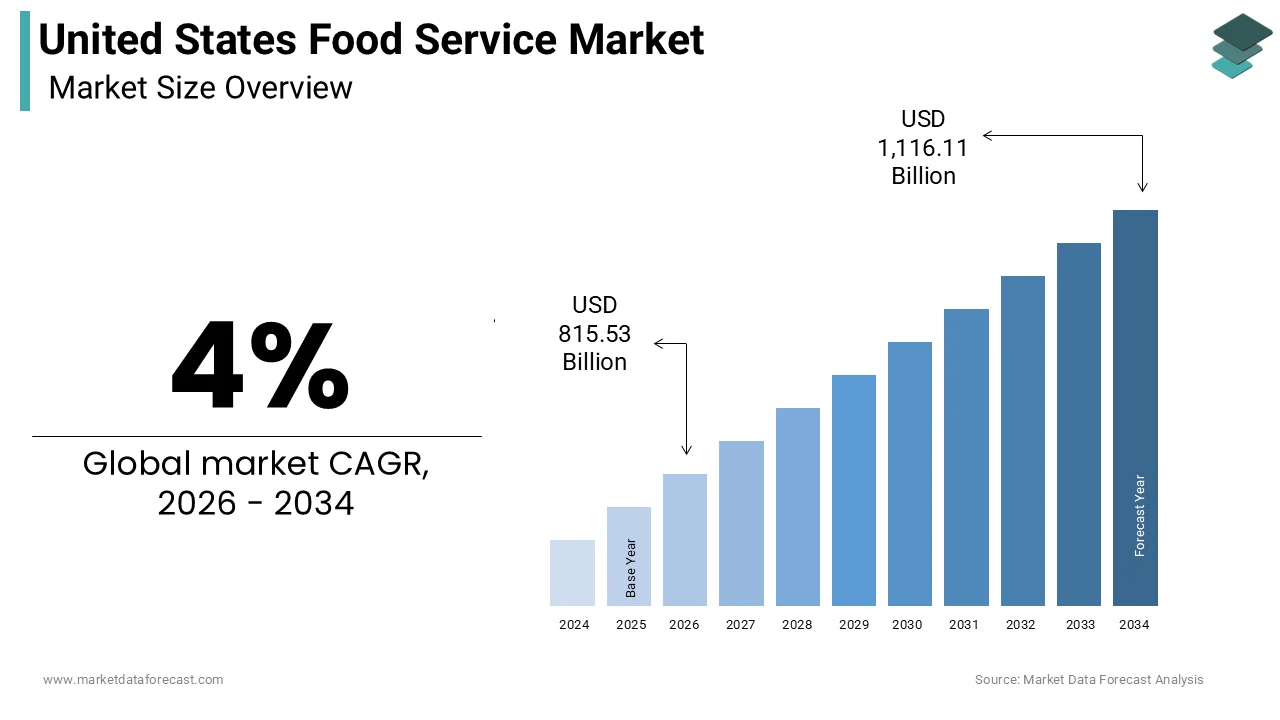
The United States foodservice market is growing rapidly, with a special focus on sustainability and environmentally friendly practices. Moreover, the majority portion of food-away-from-home spending is captured by commercial food service enterprises. Also, the expenditures for food at home and away from home substantially contribute to the expansion of the United States industry. In 2022, 56.2 percent share is captured by food away from home, an all-time highest record, and 43.8 percent by food-at-home expenses. Apart from this, currently, the top food distributors in the USA are Sysco with revenue of 76.32 billion USD in 2024, US Foods, Gordon Food Service, Performance Foodservice, and McLane. As per industry experts, the revenue from the restaurants and food service industry is estimated to reach a record 1 trillion dollars by the end of 2025 and the country’s second-highest private sector employer is proceeding as planned to add 200 thousand jobs to take the overall employment level to 15.7 million individuals.
MARKET DRIVERS
The United States foodservice market growth is driven by aggressive investment in product innovation platforms.
In addition, the rise in demand for personalization in services and easier availability of a wide range of food products also contributes to the market expansion. The surging acceptance of new types of restaurants, like cloud kitchens and shadow eateries especially in delivering food to customers, has registered substantial growth in the past few years. Moreover, key players such as Taco Bell, McDonald’s, and KFC are furnishing a large variety of food products at competitive prices to consumers. Furthermore, the higher customer expenditure on fast food continues to push forward the market growth. The other main factor driving the US food service market is the increased digitization of food services, as consumers prefer to book earlier and make payments online.
In the United States of America, the call for organic food is expanding rapidly. Quick-service restaurants (QSRs) are increasing in the nation, which in general, are fast-food restaurants that are not regular table restaurants due to their simple menus, less service, and as the name suggests, the quick service.
MARKET RESTRAINTS
The increase in labour costs, inflation rate and intensity of competition restrict the United States food service market growth.
According to the study, around 45 percent of industry players estimate the competition to become more aggressive in 2025 compared to 2024 which is expected to further affect the market expansion. Moreover, the progress of the industry is also hindered by the consistent rise in laborers. This is because 98 percent of managers and owners consider this as the main problem for their restaurants. Also, inflated food prices i.e. 97 percent and another 38 percent state their restaurants incurred loss in 2024.
Besides this, the formation of the Departments of Labour (DOL) 2025 Overtime Final Rule 2025 will significantly increase executive salaries and administrative or professional exemptions which in the coming years will derail the United States market growth trajectory. Regarding this, a lawsuit alliance of employers has been filed in the U.S. District Court for the Eastern District of Texas emphasizing irreversible damage from the loss of their staff's previously exempt status. Also, the compliance fees will compel the small operators directors, and non-profit establishments on fixed allocations to reduce essential services, hiring, and programming to the public.
MARKET OPPORTUNITIES
The prospects of the United States foodservice market look promising owing to the application of advanced technologies.
This includes automation for fast and efficient manufacturing, packing and sorting of food items, 3D printing to make innovative and tailormade shapes, flavors, and textures, the Internet of Things (IoT) for security and quality checks, tracking inventory, and improving food processing and warehousing. Further, artificial intelligence (AI) is being utilized in the market to produce new items, enhance manufacturing procedures, and individualize consumer experience. Apart from all this, blockchain technology is also explored to boost traceability and transparency in the supply network.
MARKET CHALLENGES
The United States food service market growth is constrained by the high debit card interchange fees and routing, workforce development and retention and adapting to technological changes.
Moreover, decreasing food waste and reducing the carbon footprint are also challenging the market growth. In addition, acquiring and successfully integrating pathbreaking technological developments exhibits its problems. Furthermore, regular changes in food laws and regulations for a long time continue to be the main obstacle for the industry players. Likewise, the National Restaurant Association and the Restaurant Law Center (RLC) in May 2025 submitted comments against the Notice of Proposed Rulemaking (NPRM)’s Debit Card Interchange Fees and Routing to lower the interchange fees from 14.4 to 6 cents and removal of ad valorem component from this.
This research report on the United States foodservice market is segmented and sub-segmented into the following categories.
United States Food Service Market By Place Type
- Full-Service Restaurants
- Quick Service Restaurants
- Food Junctions Cafeterias/buffets
- Bars and Managed Food Service
The quick-service restaurants segment is the fastest-growing category and is believed to capture more market share of the United States food service industry in the future. This can be attributed to the rapid expansion of prominent fast-food brands, increased digitalization in the food industry, and urbanization. Further, the American Customer Satisfaction Index (ACSI) for fast food restaurants rose in 2025 to 79 percent by 1 percent from the 2024 level.
On the other hand, the full-service restaurant (FSR) segment still holds a significant share and will continue to drive further at a moderate CAGR over the projection period. This can be linked to the market share of fast food joints or cafes is constantly increasing due to rapid urbanization and the hectic lifestyle of the population living in metropolitan areas. The upward trend in mobile restaurants, such as food trucks, is also contributing to the positive growth of these fast-service restaurants. Previously, in 2022, full-service with limited-service restaurants together held over 69 percent of the total food-away-from-home. In the same year-end, the full-service restaurants registered sales growth of 17.3 percent while all remaining food service institutions recorded the biggest surge of 19.5 percent. Ever since the FSRs have been moving forward at a lower pace.
United States Food Service Market By End-User
- Industrial Premises
- Commercial and Office Premises
- Hospital & Nursing Homes
- Educational Premises (Colleges, Universities, Schools)
- In-transit Food Service (Airlines, Trains)
- Sports Centers/Malls
The commercial and office premises are the most prevalent segment with the majority portion of the United States foodservice market share. The segment accounts for about 80 percent of the food service and restaurant industry. This comprises retail, catering and banquets, restaurants, stadiums, airlines, and cruise ships. Apart from this, the presence of over 1 million commercial establishments makes the segment’s market growth rate more resilient than other categories. Also, the industry progressed due to varied menu offerings to satisfy a large number of customer preferences. Additionally, the market players are increasingly focusing on sustainability, environment-friendly packaging, clean labels, and transparency.
Whereas, the in-transit food service segment is quickly gaining traction and is anticipated to expand at a higher CAGR during the forecast period. The rising consumption of handy and high-quality food offerings while traveling. Moreover, airlines particularly are adding new meal options from simple beverages or drinks to gourmet meals to assist travelers with time differences on long-distance travel. In addition, higher passenger volumes, evolving customer expectations, and technological developments are other factors further elevating the segment’s market share. Key airlines and high-speed rail operators like American, Delta, Amtrak, and United are collaborating with eminent chefs to upgrade and provide superior dining options.
COUNTRY ANALYSIS
The United States foodservice market witnessed strong growth in recent times. It is predicted to propel further during the forecast period because of the growing demand for plant-based foods, online food orders, and clean labels and transparency. The industry’s market share is growing due to customer's progressive shift towards high-quality and food safety and is demanding better transparency from market players. This caused the inclination towards clean-label items, which do not contain synthetic preservatives. However, along with the comfort, the family's consumption of food away from home is impacted by its income and demographic features.
KEY MARKET PLAYERS
Major players in the globalUnited SStatesfoodservice market are Burger King Worldwide Inc., Starbucks Corp., and Yum! Brands Inc., Doctor's Associates Inc., Chipotle Mexican Grill Inc. Seven & I Holdings Co. Ltd, McDonald's Corp., Dunkin 'Donuts, Sonic Drive-In, and Papa John's.
RECENT HAPPENINGS IN THE MARKET
- In June 2025, Gordon Food Service announced the inauguration of its 9th local grocery store to further expand in the Houston market. It is a restaurant-focused grocery store chain with 10th and 11th already on opening schedule.
- In April 2025, Neogen Corporation reported establishing a genomics relationship with the Performance Food Group Company (PFGC). With this, it became the official genomics supplier for the PathProven service of the PFGC.
- In October 2025, Sysco Press released the decision to purchase Edward Don & Company (DON), a prominent supplier of food service stocks, equipment and disposables based in Chicago. This will give Sysco additional strategic abilities and a diverse range of products to supplement its existing business and provide consumers with a speciality Equipment and Supplies platform for enhanced options and services.