- Product Description Description
- Table of Contents TOC
- List of Table & Figure LOT
- Get Free Sample PDF Sample PDF
Market Size, 2025
$32.22 BnMarket Estimate, 2026
$33.70 BnMarket Forecast, 2034
$48.30 BnCAGR, 2026–2034
4.60%U.S. Physical Security Market Summary
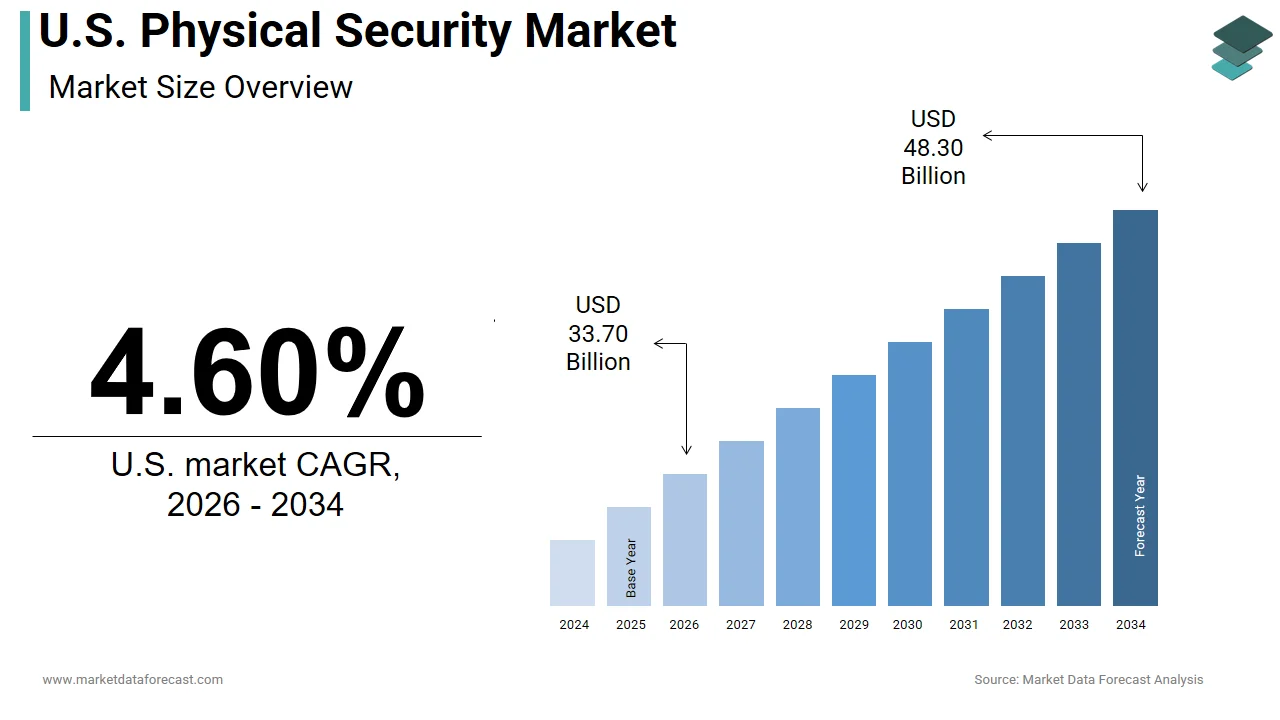
The U.S. physical security market was valued at USD 32.22 billion in 2025, is estimated to reach USD 33.70 billion in 2026, and is projected to reach USD 48.30 billion by 2034, growing at a CAGR of 4.60% from 2026 to 2034. The growth of the U.S. physical security market is driven by the rising need for asset protection, increasing security concerns across government and commercial facilities, integration of AI and IoT in surveillance systems, and expanding adoption of cloud-based access control solutions.
Key Market Trends
- Growing implementation of AI-enabled surveillance cameras and facial recognition technologies to enhance real-time threat detection.
- Increasing demand for cloud-based physical security solutions for scalable monitoring and analytics.
- Expanding integration of physical and cybersecurity frameworks for unified threat management.
- Rising deployment of access control systems, sensors, and video management software in commercial environments.
- Growing investments by the U.S. government in critical infrastructure protection and public safety systems.
Segmental Insights
- Based on component, the hardware segment accounted for 58.3% of the U.S. physical security market share in 2024, driven by the high adoption of surveillance cameras, sensors, alarms, and access control devices across public and private sectors.
- Based on end-user, the commercial/industrial vertical segment was the largest in 2024, reflecting the increasing emphasis on workplace safety, theft prevention, and facility monitoring in manufacturing, logistics, and retail facilities.
- Based on vertical, the government sector held 31.3% of the U.S. physical security market share in 2024, supported by continuous federal initiatives for homeland security, transportation safety, and critical infrastructure protection.
Competitive Landscape
The U.S. physical security market is highly competitive, with players focusing on AI integration, cloud analytics, and unified security platforms. Strategic collaborations, product innovation, and expansion into managed security services are key strategies among leading firms. Prominent players dominating the market include Honeywell International Inc., Axis Communications AB, Bosch Sicherheitssysteme GmbH, Hangzhou Hikvision Digital Technology Co., Ltd., Dahua Technology Co., Ltd, Johnson Controls, Cisco Systems, Inc., SECOM CO., LTD., ADT, Genetec Inc., Anixter International, Inc., Allied Universal Security Services LLC, Senstar Corporation, NordLayer, Evolv Technology, Cloudvue, Ava Security, Acura, Verkada Inc., and SEAtS Software.
U.S. Physical Security Market Size
The size of the U.S. physical security market was worth USD 32.22 billion in 2025. The market is anticipated to grow at a CAGR of 4.60% from 2026 to 2034 and be worth USD 48.30 billion by 2034 from USD 33.70 billion in 2026.
The physical security is to protect personnel, property, and information from real-world threats and unauthorized access. This sector includes video surveillance, access control systems, intrusion detection alarms, and perimeter security solutions that form the backbone of safety infrastructure for commercial, residential, and government entities. The industry is undergoing a significant transformation driven by the convergence of physical and cyber security domains, where digital intelligence enhances traditional hardware capabilities. The crime statistics indicate that property crimes remain a persistent concern, with hundreds of thousands of incidents reported annually, necessitating robust preventive measures. Furthermore, the Department of Homeland Security emphasizes the importance of securing infrastructure against both natural disasters and intentional attacks, which drives federal and private sector investment. The proliferation of Internet of Things devices has enabled smarter, more interconnected security ecosystems that offer real-time monitoring and automated response mechanisms. Regulatory frameworks such as the National Defense Authorization Act mandate stricter security protocols for federal facilities, influencing broader industry standards. The integration of artificial intelligence and machine learning into security platforms allows for predictive analytics and anomaly detection by reducing false alarms and improving response times.
MARKET DRIVERS
Rising Concerns Over Workplace Violence and Internal Threats
The increasing incidents of workplace violence and internal security breaches are compelling organizations to implement advanced monitoring and access control measures is solely bolstering the growth of the United States physical security market. Employers are prioritizing the safety of their workforce due to the growing frequency of violent incidents in corporate retail and educational settings. This statistical reality drives demand for sophisticated access control systems that restrict entry to sensitive areas and video surveillance solutions that provide comprehensive coverage of public and private spaces. Organizations are investing in behavioral analytics and threat detection software to identify potential risks before they escalate. The implementation of emergency notification systems and panic buttons further enhances employee safety and regulatory compliance. High-profile incidents have raised awareness among stakeholders, leading to increased budget allocation for security upgrades. The shift toward hybrid work models has also expanded the security perimeter, requiring protection for remote offices and distributed assets.
Stringent Regulatory Compliance and Government Mandates
The stringent regulatory compliance requirements and government mandates by enforcing standardized security protocols across various industries are also escalating the growth of the United States physical security market. Federal and state regulations mandate specific security measures for infrastructure sectors, including energy, healthcare, finance, and transportation, to protect against terrorism and cyber-physical threats. As per the Department of Homeland Security, the Cybersecurity and Infrastructure Security Agency issues directives that require facility owners to implement robust physical security controls, such as biometric authentication and perimeter fencing. Compliance with standards such as the Health Insurance Portability and Accountability Act in healthcare and the Payment Card Industry Data Security Standard in retail necessitates secure storage and monitoring of sensitive data and physical assets. Non-compliance can result in severe financial penalties, legal liabilities, and reputational damage, motivating organizations to invest in certified security solutions. The government continues to update security guidelines to address emerging threats, driving continuous upgrades and modernization of existing systems. Public sector projects often set benchmarks for private sector adoption, influencing market trends and technology preferences. The emphasis on national security and disaster preparedness further accelerates the deployment of integrated security platforms. These regulatory pressures ensure a steady demand for compliant and high-performance security products and services across the nation.
MARKET RESTRAINTS
High Initial Implementation and Maintenance Costs
The high initial implementation and maintenance costs are limiting adoption among small and medium-sized enterprises with constrained budgets, restricting the growth of the United States physical security market. Deploying a comprehensive security infrastructure involving high-definition cameras, advanced access control panels, and centralized management software requires substantial capital expenditure. As per the Small Business Administration, many small businesses operate with limited financial resources, making it difficult to justify the upfront investment in sophisticated security systems. The cost of installation, professional configuration, and ongoing maintenance adds to the total cost of ownership by creating a barrier to entry for price-sensitive customers. Additionally, the rapid pace of technological obsolescence necessitates frequent upgrades to keep systems compatible with new software and hardware standards that further increases long-term expenses. Smaller organizations may opt for basic or outdated solutions that offer inadequate protection, leaving them vulnerable to security breaches. The complexity of integrating disparate systems from different vendors also increases labor costs and project timelines. Economic uncertainty and inflationary pressures exacerbate these financial challenges, leading some businesses to delay or cancel security projects.
Privacy Concerns and Data Protection Regulations
The privacy concerns and stringent data protection regulations by imposing limitations on the collection, storage, and usage of surveillance data are additionally restricting the growth of the United States physical security market. The widespread deployment of video surveillance and biometric access control systems raises ethical and legal questions regarding individual privacy rights and data security. Numerous states have enacted laws restricting the use of facial recognition technology and requiring explicit consent for biometric data collection. Compliance with regulations, such as the California Consumer Privacy Act, mandates strict data handling protocols, encryption standards, and retention policies, increasing operational complexity for security providers. Violations can lead to significant fines and legal actions, discouraging organizations from adopting advanced surveillance technologies. Public awareness and resistance to pervasive monitoring can also hinder deployment in residential and community settings. The need to balance security efficacy with privacy preservation requires careful system design and transparent policies, which can be resource-intensive. Uncertainty surrounding future legislative changes creates a cautious environment for investment and innovation.
MARKET OPPORTUNITIES
Integration of Artificial Intelligence and Machine Learning
The integration of artificial intelligence and machine learning by enhancing the intelligence and efficiency of security operations is solely to create new opportunities for the growth of the United States physical security market. AI-powered analytics enable real-time video analysis, object detection, and behavioral pattern recognition, transforming passive surveillance into proactive threat mitigation. Spending on cognitive and AI systems in the security sector is projected to grow substantially, reflecting the increasing adoption of smart technologies. These advanced capabilities reduce false alarms by distinguishing between genuine threats and benign activities, such as animal movement or weather changes. Machine learning algorithms can predict potential security breaches based on historical data and anomalies. The automation of routine monitoring tasks frees up human operators to focus on incidents, improving response times and operational efficiency. AI also facilitates seamless integration with other building management systems, enabling holistic facility security and energy optimization. The ability to process vast amounts of data quickly and accurately provides actionable insights for security managers.
Expansion of Cloud-Based Security Solutions
The expansion of cloud-based security solutions by providing scalable, flexible, and cost-effective alternatives to traditional on-premises systems is expected to further escalate the growth of the United States physical security market. Video Surveillance as a Service and cloud-managed access control allow organizations to store data remotely and access security feeds from any location via internet-connected devices. The adoption of cloud services in the security industry is accelerating as businesses seek to reduce hardware dependencies and simplify management. Cloud platforms facilitate easy scalability, enabling users to add cameras or access points without significant infrastructure upgrades. The subscription-based model lowers initial capital expenditures, making advanced security features accessible to small and medium-sized enterprises. Remote monitoring and management capabilities enhance convenience and allow for rapid incident response regardless of physical location. Cloud providers also offer regular software updates and cybersecurity patches, ensuring systems remain protected against emerging threats. The integration of cloud storage with analytics tools enables efficient data retrieval and forensic analysis.
MARKET CHALLENGES
Cybersecurity Vulnerabilities in Connected Devices
The cybersecurity vulnerabilities in connected physical security devices, by exposing systems to hacking and unauthorized access, are one of the challenges for the growth of the United States physical security market. As security components become increasingly networked and reliant on the Internet of Things, connectivity, they become attractive targets for cybercriminals seeking to exploit weak passwords, unpatched software, and insecure communication protocols. IoT-related security breaches have increased significantly, with attackers gaining control over cameras and access control systems to steal data or disrupt operations. The convergence of physical and cyber security domains means that a breach in one area can compromise the other, leading to comprehensive security failures. Manufacturers often prioritize functionality over security, resulting in devices with inherent vulnerabilities that are difficult to rectify post deployment. The lack of standardized security protocols across different vendors complicates the task of securing heterogeneous systems. Organizations face the dual challenge of protecting physical assets while ensuring the integrity of the digital networks supporting their security infrastructure. Remediation efforts require specialized expertise and continuous monitoring, increasing operational costs.
Interoperability Issues Among Multivendor Systems
The interoperability issues among multivendor systems, hindering the seamless integration of diverse security components, are another factor inhibiting the growth of the United States physical security market. Organizations often procure hardware and software from different manufacturers, leading to compatibility conflicts that prevent unified management and data sharing. The lack of universal standards for communication protocols and data formats creates silos that limit the effectiveness of integrated security solutions. Incompatible systems require custom middleware or additional hardware bridges, by increasing complexity and cost. The inability to correlate data from video surveillance, access control, and intrusion detection systems reduces situational awareness and slows down incident response. Upgrading one component may disrupt the functionality of others, forcing organizations to maintain legacy systems longer than intended. Vendor lock-in practices further exacerbate the problem by restricting third-party integrations and limiting consumer choice. The fragmentation of the market makes it difficult for end users to create cohesive security ecosystems that leverage the full potential of each technology. Resolving interoperability challenges requires industry-wide collaboration and adherence to open standards, which has been slow to materialize.
REPORT COVERAGE
| REPORT METRIC | DETAILS |
| Market Size Available | 2025 to 2034 |
| Base Year | 2025 |
| Forecast Period | 2026 to 2034 |
| Segments Covered | By Component, End-user, Type, Vertical, and Country. |
| Various Analyses Covered | Global, Regional, and Country-Level Analysis, Segment-Level Analysis, Drivers, Restraints, Opportunities, Challenges; PESTLE Analysis; Porter’s Five Forces Analysis, Competitive Landscape, Analyst Overview of Investment Opportunities |
| Countries Covered | New York, Massachusetts, Pennsylvania, Illinois, Ohio, Michigan, Texas, Florida, Georgia, California, Washington, Colorado. |
| Market Leaders Profiled | Honeywell International Inc., Axis Communications AB (Sweden), Bosch Sicherheitssysteme GmbH (Germany), Hangzhou Hikvision Digital Technology Co., Ltd. (China), Dahua Technology Co., Ltd. (China), Johnson Controls (Ireland), Cisco Systems, Inc., SECOM CO., LTD. (Japan), ADT, Genetec Inc. (Canada), Anixter International, Inc., Allied Universal Security Services LLC, Senstar Corporation (Canada), NordLayer, Evolv Technology, Cloudvue, Ava Security (U.K.), Acura (Japan), Verkada Inc., SEAtS Software. |
SEGMENTAL ANALYSIS
By Component Insights
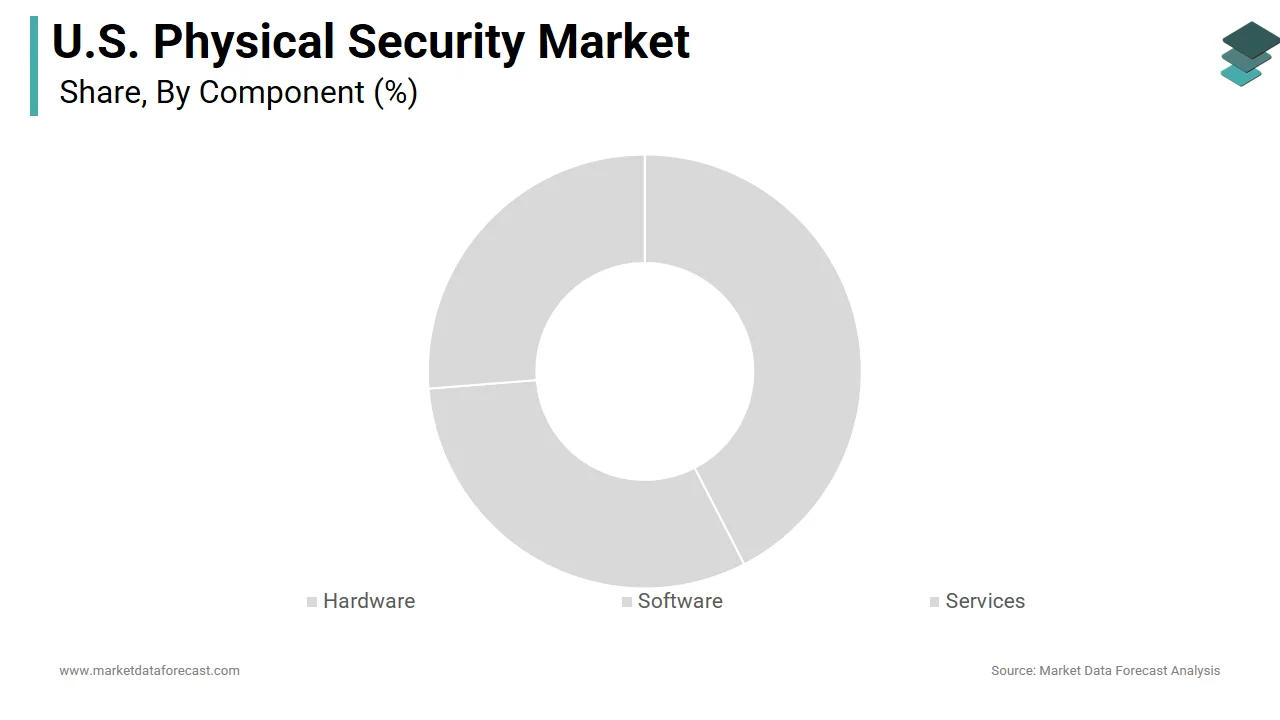
The hardware segment was the largest by holding 47.3% of the United States physical security market share in 2026, with the fundamental necessity of physical devices, such as cameras, sensors, locks, and barriers to establish a security perimeter. The continuous replacement cycles of legacy equipment and the widespread deployment of new infrastructure in commercial and residential sectors are surging the growth of the segment. The construction of non-residential buildings has seen steady growth, with billions of dollars invested annually in new facilities that require integrated security hardware from inception. The proliferation of high-definition Internet Protocol cameras and advanced biometric scanners forms the backbone of modern security systems, necessitating substantial upfront capital expenditure. Hardware serves as the primary data collection point for any security ecosystem, making it indispensable regardless of software advancements. The tangible nature of these assets allows for immediate visibility and deterrence, which is highly valued by end users. Furthermore, government mandates for securing critical infrastructure often specify hardware standards ensuring consistent demand. The sheer volume of devices required to cover large campuses, retail chains, and industrial complexes ensures that hardware remains the largest revenue generator. Manufacturers continuously innovate with weather-resistant and vandal-proof designs to meet diverse environmental needs.
The software segment is projected to register the fastest CAGR of 12% from 2026 to 2034 with the shift toward intelligent analytics and cloud-based management platforms. The need to process vast amounts of data generated by hardware devices efficiently and extract actionable insights. The spending on security software solutions is outpacing hardware investments as organizations prioritize automation and real-time threat detection. Video management software with artificial intelligence capabilities enables automatic recognition of suspicious activities, reducing the reliance on manual monitoring. The transition to Security as a Service models that allow businesses to subscribe to advanced software features without heavy infrastructure costs, enhancing accessibility for small and medium enterprises. Cloud-based platforms facilitate remote access and seamless integration with other enterprise systems, such as human resources and building management. Regular software updates provide continuous improvement in security protocols, protecting against evolving cyber threats. The ability to scale software solutions easily across multiple locations makes them attractive for expanding businesses.
By End User Insights
The commercial and industrial sector was the largest by occupying 54.8% of the United States physical security market share in 2025 due to the extensive footprint of corporate offices, manufacturing plants, and retail establishments that require robust protection for assets and personnel. As per the Census Bureau, there are millions of business establishments in the United States, each requiring tailored security solutions to mitigate risks, such as theft, vandalism, and unauthorized entry. Large corporate campuses often implement layered security architectures, including perimeter fencing, employee badge systems, and centralized monitoring centers. Regulatory compliance requirements for industries such as pharmaceuticals and defense further mandate strict security protocols, driving sustained investment. The complexity of industrial environments requires specialized hardware capable of withstanding harsh conditions while maintaining high performance. Additionally, the rise of smart factories and automated warehouses integrates security systems with operational technology, creating a cohesive safety net. The sheer scale of commercial real estate and industrial zones ensures a consistent and high-volume demand for physical security products. Companies in this sector also prioritize business continuity, making security a component of risk management strategies.
The residential segment is expected to register the fastest CAGR of 14.3% from 2026 to 2034, with the increasing homeowner awareness and the availability of affordable DIY security solutions. The rise in property crimes in certain urban and suburban areas has heightened the demand for home protection systems among residents. The uniform crime reporting data indicates that burglary remains a significant concern, prompting homeowners to invest in preventive measures. The proliferation of smart home technology has made it easier for consumers to install and monitor security cameras, doorbell cameras, and smart locks without professional assistance. Subscription-based monitoring services offer peace of mind with affordable monthly fees appealing to a broad demographic. Insurance companies often provide discounts for homes equipped with certified security systems, further incentivizing adoption. The integration of security devices with voice assistants and mobile apps enhances user convenience and engagement. Social media and neighborhood watch apps also raise awareness about local security threats, encouraging community-wide adoption.
By Type Insights
The video surveillance systems segment held 32.1% of the United States physical security market share in 2025 due to their versatility, effectiveness in deterrence, and critical role in incident investigation. Cameras provide visual evidence that is indispensable for law enforcement and internal reviews, which is making them a standard requirement for most security setups. The video surveillance accounts for the largest share of security product sales, reflecting its universal acceptance across all verticals. The technology has evolved from analog closed-circuit television to high-definition networked systems that offer remote viewing and storage capabilities. The ability to monitor multiple locations simultaneously from a central command center enhances operational efficiency for large organizations. Advances in lens technology and low-light performance ensure clear footage in various environmental conditions. Video analytics features such as motion detection and line crossing alerts add intelligence to traditional monitoring, reducing false alarms. The widespread use of body-worn cameras by law enforcement and private security personnel further expands the market scope. Public safety initiatives in cities often include extensive camera networks to monitor traffic and public spaces. The proven track record of video evidence in solving crimes and resolving disputes sustains its position as the leading type of physical security system.
The biometrics and access control systems segment is expected to grow at an anticipated CAGR of 15.3% from 2026 to 2034, with the need for secure and convenient identity verification. Traditional key and card-based systems are increasingly being replaced by fingerprint, facial recognition, and iris scanning technologies that offer higher security levels and eliminate the risk of credential sharing. The advancements in biometric algorithms have significantly improved accuracy and speed, making them viable for high traffic environments. The healthcare and financial sectors are early adopters due to strict regulatory requirements for protecting sensitive data and restricted areas. The integration of mobile credentials allows users to unlock doors using smartphones, enhancing convenience and hygiene. Contactless biometric solutions have gained traction following health concerns related to shared surfaces. Government facilities and data centers are upgrading to multi-factor authentication systems, combining biometrics with other credentials for enhanced protection. The decreasing cost of biometric sensors has made them accessible to small and medium businesses.
By Vertical Insights
The banking, financial services, and insurance vertical segment accounted in holding 26.3% of the United States physical security market share in 2025 due to the need to protect high-value assets, sensitive customer data, and ensure regulatory compliance. Banks and financial institutions are prime targets for robbery and fraud, necessitating state-of-the-art surveillance vault protection and access control systems. The stringent guidelines mandate comprehensive security measures for all member institutions, driving consistent investment in physical security infrastructure. The integration of physical security with cyber security is particularly vital in this sector to prevent coordinated attacks. Branch networks require standardized security protocols to ensure uniform protection across locations. ATM security involves specialized cameras and sensors to detect tampering and skimming devices. The high cost of security breaches, including financial loss and reputational damage, motivates institutions to invest in premium security solutions.
The healthcare vertical segment is anticipated to witness the fastest CAGR of 13.3% during the forecast period with the need to protect patients’ staff and controlled substances. Hospitals and clinics face unique security challenges, including workplace violence, drug theft, and unauthorized access to sensitive areas, such as nurseries and emergency rooms. As per the American Hospital Association, incidents of violence against healthcare workers have risen significantly, prompting facilities to upgrade their security infrastructure. The implementation of access control systems restricts entry to pharmacies and operating rooms, ensuring only authorized personnel can enter. Video surveillance helps monitor patient safety and investigate incidents of abuse or negligence. The protection of electronic health records requires secure physical servers and data centers. The expansion of telehealth services and outpatient centers increases the number of facilities requiring security solutions. Regulatory requirements, such as the Health Insurance Portability and Accountability Act, mandate strict physical safeguards for patient information. The aging population and increased hospital visits further amplify the need for robust security measures.
COMPETITIVE LANDSCAPE
The competition in the United States physical security market is intense and characterized by the presence of established global conglomerates and agile niche providers vying for dominance through technological innovation and service excellence. Major players leverage their extensive distribution networks and brand reputation to secure large-scale contracts in government and enterprise sectors. Differentiation is achieved through the integration of advanced technologies such as artificial intelligence, cloud computing, and Internet of Things, which enhance system intelligence and usability. Price competition is moderate as customers prioritize reliability and feature richness over cost alone. Strategic partnerships and alliances are common as companies seek to offer comprehensive end-to-end solutions that address both physical and cyber security needs. The market sees continuous product launches featuring improved analytics and connectivity capabilities, driving rapid obsolescence of legacy systems. Customer retention relies heavily on after-sales support and software updates, ensuring long-term value. Regulatory compliance and certification standards also influence competitive dynamics, favoring vendors with robust quality assurance processes. This dynamic environment requires constant adaptation and investment to maintain leadership and meet evolving security challenges effectively.
KEY MARKET PLAYERS
Some of the companies that are playing a dominating role in the U.S. physical security market include
- Honeywell International Inc.
- Axis Communications AB
- Bosch Sicherheitssysteme GmbH
- Hangzhou Hikvision Digital Technology Co., Ltd.
- Dahua Technology Co., Ltd
- Johnson Controls
- Cisco Systems, Inc.
- SECOM CO., LTD.
- ADT
- Genetec Inc.
- Anixter International, Inc.
- Allied Universal Security Services LLC
- Senstar Corporation
- NordLayer
- Evolv Technology
- Cloudvue
- Ava Security
- Acura
- Verkada Inc.
- SEAtS Software
TOP PLAYERS IN THE MARKET
- Honeywell International Inc is a global leader in the United States physical security market, offering integrated solutions that combine hardware, software, and services. The company provides advanced video management systems, access control, and intrusion detection technologies tailored for commercial, industrial, and government sectors. Recent actions include the expansion of its cloud-based security platforms, which enable remote monitoring and data analytics for enhanced situational awareness. Honeywell has also invested in artificial intelligence to improve threat detection accuracy and reduce false alarms. Strategic partnerships with technology firms allow the company to integrate cybersecurity features into physical security products, addressing converging threats. These initiatives demonstrate its commitment to innovation and comprehensive security ecosystems that meet evolving customer needs in a digital age.
- Johnson Controls International plc contributes significantly to the United States physical security market through its OpenBlue platform, which integrates security with building automation and sustainability. The company offers a wide range of products, including video surveillance, access control, and fire safety systems designed for smart buildings. Recent actions involve enhancing its cybersecurity capabilities to protect connected devices from potential breaches, ensuring data integrity and user privacy. Johnson Controls has expanded its service offerings to include predictive maintenance and real-time analytics, helping clients optimize security operations. The acquisition of specialized software firms has strengthened its portfolio in cloud-based security management. These efforts reinforce its leadership by providing scalable and intelligent security solutions that align with modern infrastructure demands and regulatory standards.
- Motorola Solutions Inc plays a pivotal role in the United States physical security market by providing mission-critical communication and video security solutions for public safety and enterprise customers. The company specializes in command center software body-worn cameras, and fixed video surveillance systems that enhance emergency response capabilities. Recent actions include the development of AI-powered video analytics that assist law enforcement in identifying suspects and analyzing incidents in real time. Motorola Solutions has expanded its cloud storage services, enabling secure and accessible data retention for investigations. Strategic acquisitions of software companies have bolstered its capabilities in data integration and visualization. These innovations strengthen its position as a trusted provider of reliable and advanced security technologies for protecting communities and assets.
TOP STRATEGIES USED BY KEY MARKET PARTICIPANTS
Key players in the United States physical security market primarily focus on integrating artificial intelligence and machine learning to enhance threat detection and automate response mechanisms. Companies are increasingly adopting cloud-based architectures to offer scalable and flexible security as a service models that reduce upfront costs for clients. Strategic mergers and acquisitions enable firms to expand their product portfolios and acquire specialized technologies in cybersecurity and analytics. Emphasis on interoperability ensures seamless integration of disparate security systems, providing unified management platforms for users. Investment in research and development drives innovation in biometrics and video analytics, improving accuracy and user experience. Partnerships with technology providers facilitate the convergence of physical and cyber security, addressing complex modern threats. Customer-centric approaches, including customized solutions and comprehensive support services, strengthen brand loyalty and market presence. These strategies collectively aim to deliver smarter, more efficient, and resilient security ecosystems.
MARKET SEGMENTATION
This research report on the U.S. physical security market has been segmented and sub-segmented into the following categories.
By Component
- Hardware
- Software
- Services
By End-user
- Residential
- Commercial/Industrial
- Small and Medium-sized Enterprises
- Large Enterprises
By Type
- Video Surveillance Systems
- Biometrics & Access Control Systems
- Intrusion Detection and Prevention Systems
- Fire Detection Systems
- Physical Security Information Management (PSIM)
- Others (Physical Identity and Access Management, etc.)
By Vertical
- BFSI
- Government
- Healthcare
- Manufacturing
- Retail
- Transportation & Logistics
- Energy & Utilities
- Others (Education, Sports, etc.)
By Country
- New York
- Texas
- Florida
- Georgia
- California
- Rest of U.S.