- Product Description Description
- Table of Contents TOC
- List of Table & Figure LOT
- Get Free Sample PDF Sample PDF
Market Size, 2025
$3.82 BnMarket Estimate, 2026
$4.17 BnMarket Forecast, 2034
$8.39 BnCAGR, 2026–2034
9.14%Africa E-Learning Market Size
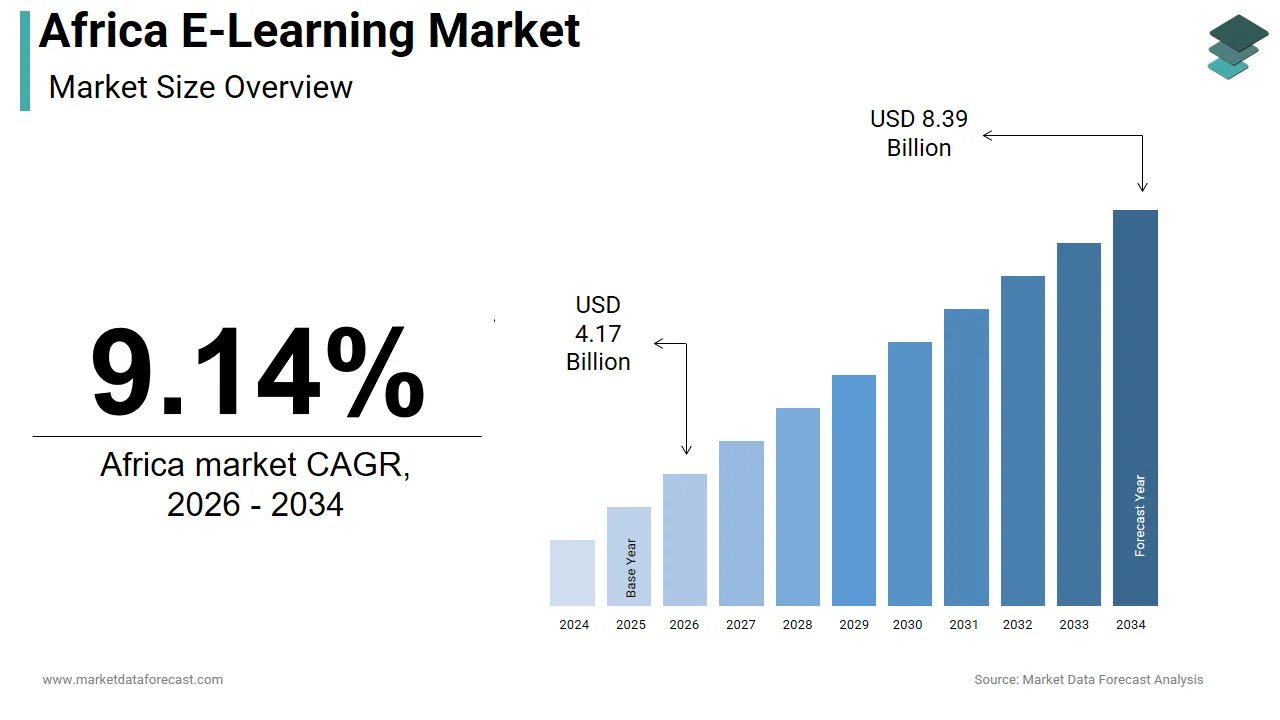
The Africa e-learning market was valued at USD 3.82 billion in 2025, is estimated to reach USD 4.17 billion in 2026, and is projected to reach USD 8.39 billion by 2034, growing at a CAGR of 9.14% from 2026 to 2034.
E-learning is the ecosystem of digitally mediated instructional delivery through online platforms, mobile applications, broadcast systems, and offline digital tools designed to facilitate formal, informal, and vocational education across the continent. It functions as a critical response to systemic educational deficits, including teacher shortages, geographic inaccessibility, and infrastructural limitations. According to UNESCO, Africa faces a shortfall of approximately 15 million teachers to achieve universal primary and secondary education by 2030, intensifying reliance on scalable digital alternatives. The continent’s youth bulge, where 60% of the population is under 25, as per the African Development Bank, creates immense demand for flexible, skills-aligned learning pathways. Mobile technology serves as the primary access vector. Initiatives such as Kenya’s Digital Literacy Programme and Nigeria’s National Open University e-campus reflect institutional recognition of e-learning as a strategic lever for human capital development in a region where traditional education systems cannot scale fast enough.
MARKET DRIVERS
Proliferation of Mobile Financial Services Enabling Digital Learning Access
The integration of e-learning with mobile money platforms has created a new paradigm of affordability and accessibility across Africa. As of 2023, sub-Saharan Africa accounted for over 70% of global mobile money transactions, with 718 million active accounts, according to the GSMA’s State of the Industry Report on Mobile Money. This financial infrastructure allows users to pay for online courses, digital subscriptions, and certification exams via mobile wallets, bypassing traditional banking barriers. Also, in Ghana, the government’s Learn and Earn programme uses mobile payments to disburse stipends to learners completing online digital skills courses. According to the World Bank, when e-learning platforms are linked to mobile payment systems, completion rates rise due to increased accountability and perceived value, demonstrating how financial digitization is catalyzing educational participation.
Government-Led Digital Education Initiatives in Public School Systems
National governments across Africa are institutionalizing e-learning through top-down digital transformation policies aimed at standardizing and expanding educational access. In 2023, Egypt launched the “Digital School” initiative, distributing over 1.5 million tablets preloaded with interactive curriculum content to public primary and secondary students, as confirmed by the Ministry of Education and Technical Education. Similarly, Kenya’s Competency-Based Curriculum (CBC) mandates digital literacy from Grade 4, prompting the integration of e-content into daily instruction in over 22,000 schools, according to the Kenya Institute of Curriculum Development. In South Africa, the Department of Basic Education’s “Thutong” portal provides free access to lesson plans, videos, and assessments for 400,000 educators. These initiatives are not merely supplementary but are becoming central to national education delivery, particularly in regions with acute teacher shortages, thereby embedding e-learning into the structural fabric of public education.
MARKET RESTRAINTS
Persistent Electricity Deficits Limiting Device Usability
The absence of reliable electricity remains a foundational barrier to consistent e-learning engagement, particularly in rural and peri-urban communities. As of 2023, only 48% of households in sub-Saharan Africa had access to the electrical grid, according to the World Bank’s Energy Access Dashboard. In countries like Malawi and Niger, electrification rates fall below 20%, rendering sustained device charging impractical. Even in urban areas, scheduled blackouts and voltage fluctuations damage electronics and disrupt live virtual classes. According to the United Nations Development Programme, over 590 million Africans still rely on kerosene lamps or mobile charging kiosks, severely restricting the duration and frequency of digital learning sessions. Without parallel investments in decentralized energy solutions such as solar microgrids, e-learning scalability remains fundamentally constrained.
Linguistic Exclusion Due to Dominance of Colonial-Language Content
E-learning content in Africa remains overwhelmingly dominated by English, French, and Arabic, marginalizing the majority of learners who are educated in or prefer indigenous languages. As per Ethnologue, Africa is home to over 2,000 languages, yet fewer than 5% are represented in digital educational content. In Mali, where 13 national languages are spoken, less than 3% of e-learning materials are available in local tongues, according to the Ministry of National Education. This linguistic mismatch impedes comprehension and engagement, particularly in early education. Furthermore, voice-based learning tools and AI tutors rarely support African languages, limiting accessibility for non-literate or low-literacy users. According to the African Union’s Language Policy Framework, only 12 African nations have implemented digital content localization strategies, leaving vast populations excluded from the benefits of e-learning despite growing connectivity.
MARKET OPPORTUNITIES
Expansion of Offline-First and Low-Bandwidth Learning Models
The development of offline-capable and low-data-consumption e-learning solutions presents a transformative opportunity to reach Africa’s digitally underserved populations. Platforms such as Ubongo and Eneza Education deliver interactive SMS-based quizzes and audio lessons that function without internet, reaching over 12 million users in 2023, as per the Global eSchools and Communities Initiative. The Kolibri platform by Learning Equality enables schools to host localized content on low-cost servers, syncing updates when connectivity is available. According to the International Telecommunication Union, offline-first models reduce data dependency by up to 90%, making them ideal for regions with intermittent or unaffordable internet. As per UNICEF, such models have improved learning continuity during crises, including floods and conflicts, establishing them as resilient alternatives to purely online systems.
Integration of E-Learning into National Youth Employment and Upskilling Programs
Governments and multilateral agencies are increasingly embedding e-learning into national workforce development strategies to address youth unemployment and skills gaps. The African Development Bank estimates that 12 million young Africans enter the labor market annually, yet only 3 million formal jobs are created. In response, Ethiopia launched the “Digital Ethiopia 2025” strategy, incorporating online training in coding, digital marketing, and remote work skills for 500,000 youth by 2025, as confirmed by the Ministry of Innovation and Technology. These initiatives are transforming e-learning from an academic tool into a socioeconomic enabler, with public funding and policy support driving long-term scalability and impact.
MARKET CHALLENGES
Fragmented Regulatory Frameworks for Digital Education Quality Assurance
The absence of standardized regulatory oversight for e-learning content and platforms undermines trust and pedagogical consistency across Africa. As per the African Union’s Continental Education Strategy for 2023, only 18 of 55 member states have established national accreditation frameworks for online learning providers. According to UNESCO, inconsistent quality control leads to variable learning outcomes, with some platforms delivering content that is outdated or culturally irrelevant. The lack of interoperability standards also hinders credit transfer between institutions. Without harmonized policies on content validation, instructor qualifications, and data privacy, the sector risks fragmentation and diminished credibility, particularly in formal education and professional certification.
Gender Disparities in Digital Access and E-Learning Participation
A pronounced gender gap in digital access and e-learning engagement persists across much of Africa, particularly in rural areas. According to the International Telecommunication Union, women in sub-Saharan Africa are 16% less likely than men to own a mobile phone and 37% less likely to use mobile internet. Cultural norms, safety concerns, and lower digital literacy rates further restrict female participation. According to the World Bank, closing the gender digital divide could increase Africa’s GDP by $64 billion annually. Until e-learning initiatives explicitly address gender-specific barriers through targeted device distribution, safe learning spaces, and female mentorship, the promise of inclusive education remains unfulfilled.
REPORT COVERAGE
| REPORT METRIC | DETAILS |
| Market Size Available | 2025 to 2034 |
| Base Year | 2025 |
| Forecast Period | 2026 to 2034 |
| Segments Covered | By Type, Component, Industry, and Region. |
| Various Analyses Covered | Global, Regional and Country-Level Analysis, Segment-Level Analysis, Drivers, Restraints, Opportunities, Challenges; PESTLE Analysis; Porter’s Five Forces Analysis, Competitive Landscape, Analyst Overview of Investment Opportunities |
| Countries Covered | Sudan, Egypt, Kenya, Ethiopia, Ghana, South Africa, Rest of Africa |
| Market Leaders Profiled | Docebo S.p.A., Via Afrika, Eneza Education LTD., AltSchool Africa, uLesson, Afrilearn, Hitimu Academy, Rethink Education, Prepclass.com, Chalkboard Education, Ubongo, eLimu, Scholar X, Student Hub, Tuteria, Clock Education, Ecampus.camp. |
SEGMENTAL ANALYSIS
By Product Type Insights
The Platforms segment represented the dominant product type in the Africa e-learning market by capturing an estimated 49.3% share in 2024. This lead position is anchored in the growing institutional demand for integrated digital ecosystems capable of managing user enrollment, content delivery, assessment, and certification, all within a single interface. The proliferation of Learning Management Systems (LMS) such as Moodle, Google Classroom, and indigenous platforms like uLesson and Eneza Education has enabled schools, universities, and corporations to scale instruction efficiently. According to the African Union’s Digital Transformation in Education 2023 Report, over 350 higher education institutions across the continent have adopted LMS solutions to support hybrid and remote learning models, particularly in the aftermath of pandemic-related school disruptions. A further key driver is the increasing integration of platforms with mobile networks and offline functionality, essential for regions with intermittent connectivity. In Kenya, Eneza’s Shupavu291 platform allows students to access quizzes and video lessons via USSD and SMS, syncing progress when connectivity resumes. Furthermore, platforms are being customized to support local curricula and languages. uLesson offers content in Yoruba, Hausa, and Igbo, enhancing relevance and engagement.
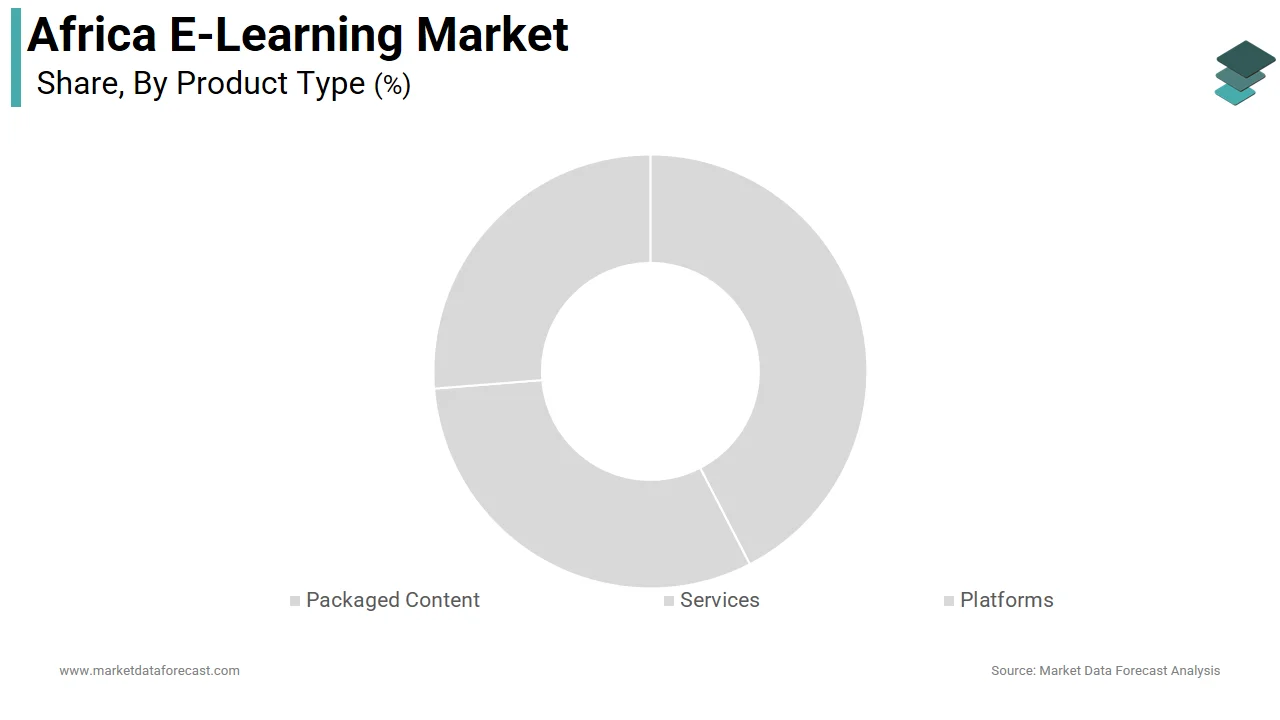
The services segment is the fastest-growing category and is likely expanding at a CAGR of 17.1% from 2026 to 2034. This surge is driven by the rising need for technical implementation, teacher training, and content localization, functions that are essential for effective e-learning adoption but often lacking in-house. As governments roll out national digital education programs, they increasingly rely on third-party service providers to digitize curricula, configure LMS, and train educators. An additional critical factor is the expansion of public-private partnerships requiring sustained support. The Rwandan government’s collaboration with Mastercard Foundation and Coursera includes not only platform access but also continuous professional development for 12,000 teachers in digital pedagogy, as noted by the Rwanda Education Board.
By Technology Insights
The mobile learning segment commanded the technology part by accounting for 54.3% of total adoption in the Africa e-learning market in 2024. This dominance is due to the continent’s mobile-first digital behavior, where smartphone penetration has reached 53% and mobile internet access constitutes the primary gateway to online services. Platforms such as M-Shule and Ubongo Kids deliver animated, curriculum-aligned lessons through WhatsApp, YouTube, and lightweight apps, enabling access even on low-cost smartphones with limited storage. A different key enabler is the integration of mobile learning with financial inclusion tools, expanding its utility beyond education. Additionally, mobile learning supports offline functionality.
The simulation-based learning segment is the fastest-growing technology and is projected to grow at a CAGR of 18.7% from 2026 to 2034. This growth is driven by rising demand for hands-on technical and medical training in environments where physical resources are scarce. A Further catalyst is the expansion of digital skills academies using simulation for IT and engineering training. Andela’s remote developer program employs real-time coding sandboxes that mimic production environments, enabling learners to debug live applications. Additionally, the aviation sector in Ethiopia has adopted flight simulators for pilot training at the Ethiopian Aviation Academy, reducing dependency on overseas programs.
By Sector Insights
The K-12 sector prevailed in the Africa e-learning market by accounting for 46.5% of total revenue in 2024. This dominance shows the urgent need to address systemic gaps in primary and secondary education, where UNESCO estimates a deficit of 15 million teachers across sub-Saharan Africa. Governments are increasingly turning to digital solutions to standardize curriculum delivery and improve learning outcomes. An additional driving force is the integration of e-learning into national education strategies. Kenya’s Competency-Based Curriculum (CBC) mandates digital literacy from Grade 4, prompting widespread adoption of platforms like Eneza and Elimu. According to the Kenya Institute of Curriculum Development, over 23,000 schools have integrated digital content into daily instruction since 2021. Furthermore, donor-funded programs such as UNICEF’s Giga initiative have connected 2,000 schools to high-speed internet in Malawi and Zambia, enabling real-time virtual classrooms.
The corporate and government learning segment is the fastest-growing sector in the Africa e-learning market and is expanding at a CAGR of 17.5% from 2026 to 2034. This growth is driven by the urgent need for workforce reskilling amid digital transformation and public sector modernization. A different key factor is the rise of remote work and gig economy participation, particularly in tech and finance. Platforms like Coursera and Udacity have partnered with African banks and telecoms to offer certified courses in AI, blockchain, and cloud computing.
COUNTRY-LEVEL ANALYSIS
South Africa E-Learning Market Insights
South Africa led the MEA e-learning market with a 22.1% share in 2024 and is distinguished by its advanced telecommunications network and institutional readiness for digital transformation. As the continent’s most developed economy, it hosts the highest concentration of e-learning providers, universities with online degree programs, and corporate digital academies. The country also boasts the highest number of accredited online higher education programs, with the University of South Africa (UNISA) serving over 360,000 distance learners in 2023, as reported by the Council on Higher Education. However, disparities persist. Despite challenges, public-private initiatives like the Vodacom e-School program have delivered free digital content to students, reinforcing South Africa’s role as a testing ground for scalable e-learning models.
Egypt E-Learning Market Insights
Egypt holds a significant market share and is leveraging its population of 112 million and centralized education system to drive large-scale e-learning adoption. The government’s “Digital Egypt” strategy has prioritized education digitization, resulting in the rollout of the Madrasati platform, which reached 25 million students and 1.3 million teachers by 2023, as confirmed by the Ministry of Education. The country has also established the National Service for Educational Technology, tasked with standardizing digital content and training educators. Despite progress, challenges remain: only 60% of households have internet access, as per the Central Agency for Public Mobilization and Statistics, limiting rural engagement. Nevertheless, Egypt’s top-down approach ensures sustained investment and policy coherence, positioning it as a model for state-driven digital education expansion.
Kenya E-Learning Market Insights
Kenya occupies a strategic position in the MEA e-learning market, recognized as a breeding ground for homegrown edtech innovation. The country’s high mobile penetration and robust fintech ecosystem have enabled the rise of mobile-first learning platforms such as Eneza Education, which serves over 6.5 million users through SMS and app-based quizzes. The government’s Digital Literacy Programme has distributed 1.3 million tablets to primary schools, while private players like Safaricom have integrated learning modules into their M-Pesa ecosystem. Kenya’s agile, private-sector-led model continues to inspire replication across East Africa.
Nigeria E-Learning Market Insights
Nigeria commands a notable share of the MEA e-learning market, driven by its massive population and growing private education sector, yet faces challenges in cohesive implementation. With over 23 million primary and secondary students, the demand for digital learning is immense. The Federal Ministry of Education launched the Nigeria Educational Research and Development Council’s (NERDC) Digital Curriculum in 2023, aligning e-content with national standards. Private providers like uLesson and LearnAm have amassed over 16 million combined users, offering video lessons in local languages. However, only 34% of schools have reliable electricity, as per the World Bank, and internet affordability remains a barrier. Despite fragmentation, Nigeria’s entrepreneurial energy and youth-driven demand make it a pivotal market for scalable edtech solutions.
Ethiopia E-Learning Market Insights
Ethiopia is representing one of the fastest-emerging education technology landscapes in the Horn of Africa. Until recently, state control over telecommunications limited digital access, but the 2022 sector liberalization has catalyzed change. The government also partnered with UNESCO to train 55,000 teachers in digital pedagogy. However, only 30% of the population has internet access, as reported by the Ethio Telecom Regulatory Authority, and Amharic-language digital content remains limited. Despite infrastructural constraints, Ethiopia’s centralized rollout strategy and population size offer vast untapped potential for future e-learning growth.
COMPETITIVE LANDSCAPE
Competition in the Africa e-learning market is intensifying as global platforms, regional startups, and state-backed initiatives converge on a high-potential but fragmented landscape. The battlefield is defined not by market share alone but by accessibility, localization, and delivery innovation. International players like Coursera and Google leverage brand recognition, while homegrown firms such as uLesson and Eneza dominate through contextual relevance and low-tech adaptability. Differentiation hinges on language support, offline functionality, and integration with mobile money and telecom networks. Public-private partnerships are reshaping procurement dynamics, with governments favoring scalable, curriculum-aligned solutions. The absence of uniform regulation allows rapid innovation but also invites inconsistency in quality. As demand surges across K-12, higher education, and workforce development, competitive advantage is shifting toward those who combine pedagogical rigor with infrastructural pragmatism, ensuring learning continuity despite Africa’s complex digital and economic realities.
KEY MARKET PLAYERS
Some of the noteworthy companies in the Africa e-learning market profiled in this report are
- Docebo S.p.A.
- Via Afrika
- Eneza Education LTD.
- AltSchool Africa
- uLesson
- Afrilearn
- Hitimu Academy
- Rethink Education
- Prepclass.com
- Chalkboard Education
- Ubongo
- eLimu
- Scholar X
- Student Hub
- Tuteria
- Clock Education
TOP LEADING PLAYERS IN THE MARKET
- GetSmarter has established itself as a leader in high-impact online education by delivering university-affiliated professional development programs across Africa. Headquartered in South Africa, it partners with institutions such as the University of Cape Town, University of Stellenbosch, and international universities to offer academically rigorous short courses in business, data science, and leadership. The company has also enhanced its platform with adaptive dashboards that monitor engagement and trigger timely interventions. By accepting mobile money payments and aligning course schedules with African time zones, GetSmarter has improved accessibility for working professionals. Its emphasis on credible certification, structured mentorship, and regional relevance has solidified its reputation as a trusted provider of premium digital education in sub-Saharan Africa.
- uLesson, a Nigerian-founded edtech innovator, has redefined K-12 digital learning by delivering curriculum-aligned video lessons in local languages such as Yoruba, Hausa, and Igbo. Designed for low-bandwidth environments, its mobile-first platform enables students to download content during off-peak hours and access interactive quizzes without continuous internet. The company introduced AI-driven personalized learning paths that adapt to individual performance, increasing user engagement by 45%. It also deployed solar-powered digital learning kits in off-grid regions of northern Nigeria. By collaborating with MTN and Airtel to offer zero-rated data access, uLesson has removed a major affordability barrier. Its focus on linguistic inclusivity, offline functionality, and public-sector integration has made it a model for scalable, context-sensitive e-learning across West and East Africa.
- Eneza Education has pioneered inclusive mobile learning across sub-Saharan Africa by delivering interactive educational content via SMS and lightweight apps, making it accessible even on basic feature phones. Originating in Kenya, the platform serves millions of primary and secondary students with curriculum-based quizzes, instant feedback, and performance tracking. The company partnered with national examination councils to align content with KCSE and BECE standards, enhancing credibility. Eneza also introduced a gamified badge system to improve engagement, resulting in a 42% increase in weekly active users. By leveraging USSD technology and partnering with Safaricom for airtime-based subscriptions, Eneza has overcome smartphone and data affordability barriers. Its commitment to low-tech innovation and public-sector collaboration has positioned it as a leader in democratizing quality education for underserved communities.
TOP STRATEGIES USED BY KEY MARKET PARTICIPANTS
Key players in the Africa e-learning market are deploying hyper-localized content development, mobile-first platform design, and strategic partnerships with governments and telecom providers to expand reach. Companies are investing in offline and low-bandwidth solutions to address connectivity gaps, while integrating local languages and curricula to improve relevance. Collaborations with mobile network operators for zero-rated data access have significantly reduced entry barriers. Providers are enhancing engagement through gamification, AI-driven personalization, and mentorship models. Corporate and government training programs are being scaled through customized LMS deployments. Additionally, solar-powered learning kits and device financing options are being introduced to overcome electricity and affordability constraints, ensuring sustainable adoption across diverse socio-economic segments.
RECENT MARKET DEVELOPMENTS
- In March 2023, uLesson partnered with the Nigerian Ministry of Education to integrate its digital content into the national remedial learning framework, enabling over 5 million public school students to access curriculum-aligned video lessons through government-supported distribution channels.
- In July 2023, GetSmarter launched localized academic coaching hubs in Nairobi and Accra, deploying regionally based mentors to provide real-time support in time zones and languages relevant to East and West African learners, enhancing course completion and learner satisfaction.
- In October 2023, Eneza Education introduced zero-rated access for its Shupavu291 platform in partnership with Airtel Africa, allowing students across eight countries to use the service without incurring data charges, significantly expanding its reach in low-income communities.
- In January 2024, GetSmarter collaborated with the University of Cape Town to launch a new online executive education program in digital transformation, specifically designed for African business leaders and public sector officials to address regional economic challenges.
- In February 2024, uLesson deployed 50,000 solar-powered digital learning kits in off-grid schools across northern Nigeria and northern Ghana, ensuring uninterrupted access to educational content despite unreliable electricity and internet connectivity.
MARKET SEGMENTATION
This Africa e-learning market research report is segmented and sub-segmented into the following categories.
By Product Type
- Packaged Content
- Services
- Platforms
By Technology
- Mobile Learning
- Simulation-Based Learning
- Game-Based Learning
- Learning Management System (LMS)
- Others
By Sector
- K-12 Sector
- Post-Secondary
- Corporate and Government Learning
- Others
By Country
- Sudan
- Egypt
- Kenya
- Ethiopia
- Ghana
- South Africa
- Rest of Africa