- Product Description Description
- Table of Contents TOC
- List of Table & Figure LOT
- Get Free Sample PDF Sample PDF
Market Size, 2025
$172.90 BnMarket Estimate, 2026
$186.84 BnMarket Forecast, 2034
$347.36 BnCAGR, 2026–2034
8.06%Global Anti-counterfeit Packaging Market Summary
The global anti-counterfeit packaging market was valued at USD 172.90 billion in 2025, is expected to reach USD 186.84 billion in 2026, and is projected to reach USD 347.36 billion by 2034, growing at a CAGR of 8.06% from 2026 to 2034. The growth of the global anti-counterfeit packaging market is driven by increasing counterfeiting activities across industries, strict regulatory frameworks, growing consumer awareness regarding product authenticity, and rising adoption of digital packaging technologies.
Key Market Trends
- Expansion of barcode and QR code-based authentication technologies.
- Rising demand for track-and-trace solutions in pharmaceuticals and FMCG.
- Integration of IoT and blockchain technologies for packaging authentication.
- Increased adoption in luxury goods, food & beverages, and electronics sectors.
- Growing preference for sustainability-focused and smart packaging.
Segmental Insights
- Based on technology, the barcode segment dominated the global anti-counterfeit packaging market by holding 48.2% of the share in 2024.
- Based on end-use, the healthcare and pharmaceutical sector was the largest, accounting for 52.3% of the market share in 2024.
Regional Insights
- Asia-Pacific was the top performer in the global anti-counterfeit packaging market, capturing 38.3% of the share in 2024, driven by strong demand in China and India.
- North America remained a strong contributor with established regulatory standards and advanced packaging adoption.
- Europe witnessed steady growth with increased implementation of anti-counterfeiting directives in the EU.
- Latin America and the Middle East & Africa showed rising adoption due to growing risks of counterfeit goods.
Competitive Landscape
Some of the key companies dominating the global anti-counterfeit packaging market include CCL Industries Inc. (Canada), 3M Company (U.S.), Zebra Technologies Corporation (U.S.), SML Group (China), SICPA HOLDING SA (Switzerland), Avery Dennison Corporation (U.S.), BrandWatch Technologies (U.K.), Impinj, Inc. (U.S.), Applied DNA Sciences (U.S.), and Kao Collins Corporation (U.S.). These players are focusing on digital authentication, supply chain transparency, and blockchain-based solutions to strengthen their market position.
Global Anti-counterfeit Packaging Market Size
The size of the global anti-counterfeit packaging market was worth USD 172.90 billion in 2025. The global market is anticipated to grow at a CAGR of 8.06% from 2026 to 2034 and be worth USD 347.36 billion by 2034 from USD 186.84 billion in 2026.
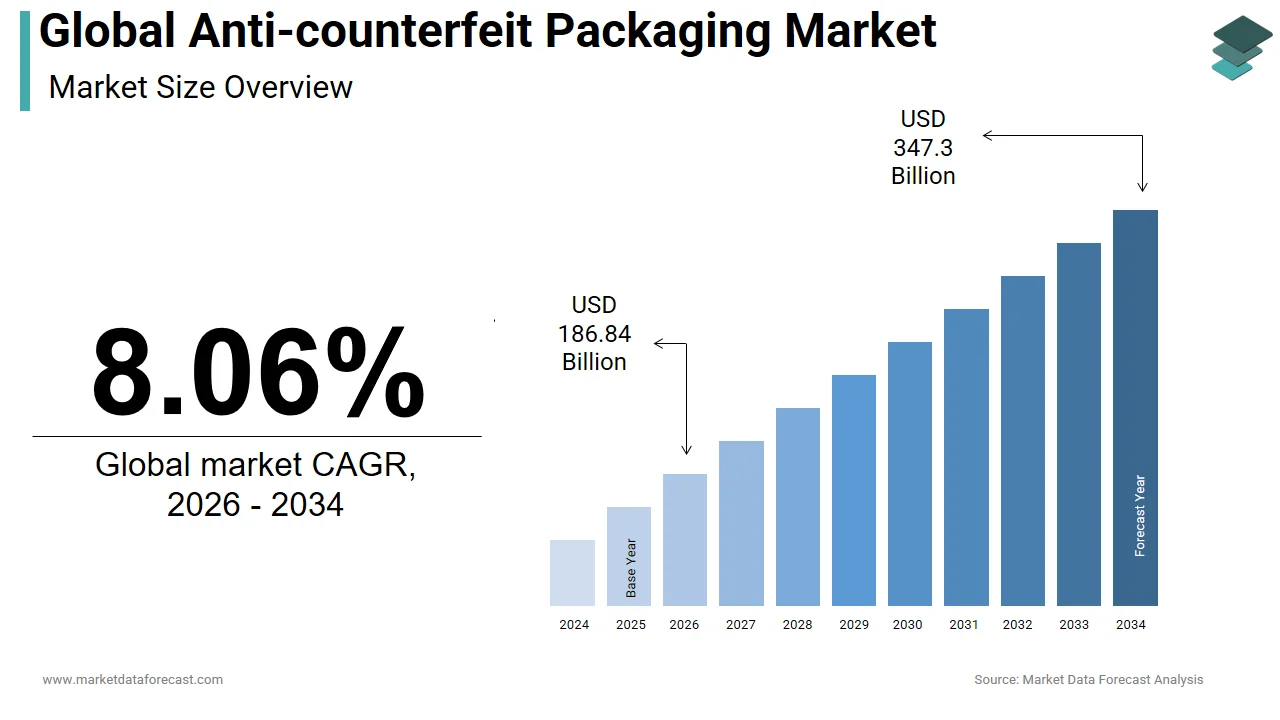
The anti-counterfeit packaging is integrated into product packaging to authenticate goods, deter tampering, and ensure traceability across supply chains. These solutions range from overt features like holograms and color-shifting inks to covert markers such as DNA tags and blockchain-linked QR codes. As global supply networks grow more complex, the need for verifiable product provenance has intensified, particularly in sectors where safety and brand integrity are paramount.
MARKET DRIVERS
Escalating Counterfeiting in the Pharmaceutical Sector
The pharmaceutical industry faces an unprecedented surge in counterfeit drug circulation, which is driving the growth of the anti-counterfeit packaging market. According to the World Health Organization, approximately 10% of medical products in developing nations are falsified, with some regions in Africa and Southeast Asia reporting rates as high as 30%. In 2023, Interpol’s Operation Silver Axe III seized over 1.2 million counterfeit medicine units across 90 countries, many lacking active ingredients or containing harmful substances. This public health crisis has prompted regulatory mandates such as the EU Falsified Medicines Directive and the U.S. Drug Supply Chain Security Act (DSCSA), which require serialized packaging and track-and-trace capabilities by 2024. As per the Pharmaceutical Security Institute, global pharmaceutical counterfeiting incidents rose by 17% in 2023, reinforcing the urgency for authentication. Companies like Pfizer and Novartis now deploy tamper-evident blister packs with QR codes linked to cloud-based verification platforms by ensuring end-user authentication and compliance with evolving global standards.
Expansion of E-Commerce and Direct-to-Consumer Sales Models
The rapid growth of online retail has created fertile ground for counterfeit infiltration, which is enhancing the growth of the anti-counterfeit packaging market. As per a 2023 study by the U.S. Chamber of Commerce, 85% of consumers are concerned about purchasing counterfeit goods online, with 62% stating they would abandon a brand after a single fake product experience. Platforms like Amazon and Alibaba have intensified pressure on manufacturers to implement trackable packaging. Companies such as L’Oréal and Apple have integrated NFC tags and encrypted holograms into their packaging by enabling smartphone-based verification.
MARKET RESTRAINTS
High Implementation Costs for SMEs and Emerging Market Producers
The deployment of advanced anti-counterfeit technologies remains financially prohibitive for small and medium-sized enterprises (SMEs) in developing economies is restraining the growth of the anti-counterfeit packaging market. Technologies such as RFID tags, blockchain integration, and DNA marking can increase packaging costs by 15–40%, according to the International Chamber of Commerce’s 2023 Global Brand Protection Report. For instance, implementing serialized QR codes with cloud verification across a mid-sized pharmaceutical line can require initial investments exceeding USD 500,000 in software, hardware, and staff training. This cost barrier limits widespread adoption and allows counterfeiters to exploit unprotected segments of the supply chain. Additionally, fragmented regulatory enforcement in regions like Southeast Asia and Latin America reduces the incentive for smaller players to invest in high-cost solutions.
Rapid Technological Replication by Sophisticated Counterfeiters
Increasingly sophisticated counterfeiters are replicating security features with alarming precision is limiting the growth of the anti-counterfeit packaging market. According to the European Anti-Fraud Office, over 60% of seized counterfeit goods in 2023 contained replicated holograms, watermarks, or QR codes mimicking legitimate authentication systems. The availability of affordable digital printing and 3D scanning tools has enabled counterfeiters to reverse-engineer packaging within weeks of product launch. As per the Organisation for Economic Co-operation and Development, the average time between a brand’s security feature launch and its replication dropped from 18 months in 2018 to just 6 months in 2023.
MARKET OPPORTUNITIES
Integration of Blockchain with Packaging for End-to-End Traceability
The blockchain technology presents a transformative opportunity for anti-counterfeit packaging by enabling immutable, transparent tracking of products from raw materials to end consumers, which is anticipated to showcase new opportunities for the growth of the anti-counterfeit packaging market. In 2023, Walmart expanded its blockchain traceability program to include over 200 private-label pharmaceutical and food products by allowing customers to scan QR codes and view full production history. The technology prevents data tampering and ensures authenticity through decentralized verification. As per Gartner, by 2026, 30% of consumer goods companies will use blockchain-integrated packaging for high-value products, up from less than 5% in 2022. This shift not only combats counterfeiting but also enhances sustainability claims by verifying ethical sourcing, appealing to increasingly conscious consumers.
Emergence of Smart and Interactive Packaging with AI Verification
The integration of artificial intelligence (AI) and smart packaging is unlocking new frontiers in real-time authentication and consumer engagement, which is expected to fuel the growth of the anti-counterfeit packaging market. AI-powered mobile apps can now analyze packaging images to detect anomalies in holograms, print quality, or color gradients with over 95% accuracy, as demonstrated by IBM’s Proof-of-Concept trials with luxury brands in 2023. Companies like Diageo and LVMH have begun embedding invisible AI-readable markers into labels that remain undetectable to counterfeiters but can be verified via proprietary smartphone applications.
MARKET CHALLENGES
Lack of Global Standardization in Authentication Technologies
The absence of universally accepted standards for anti-counterfeit packaging technologies is hampering the growth of the anti-counterfeit packaging market. According to the International Organization for Standardization (ISO), over 120 distinct authentication protocols were in use globally in 2023, with no single framework adopted across more than 30% of sectors. This fragmentation forces retailers and logistics providers to deploy multiple scanning systems, increasing operational costs. In 2022, the EU’s Anti-Counterfeiting Network reported that 45% of customs officers could not verify all security features due to incompatible technologies.
Consumer Apathy and Low Engagement with Authentication Features
A few consumers failure to verify product authenticity is hampering the growth of the anti-counterfeit packaging market. In high-income countries, convenience often outweighs caution, while in emerging markets, limited smartphone penetration and digital literacy further reduce engagement. A study by the University of Cambridge found that even when authentication is available, 64% of users abandon the process after two steps due to poor interface design. This behavioral gap creates a false sense of security for brands investing in advanced packaging.
REPORT COVERAGE
| REPORT METRIC | DETAILS |
| Market Size Available | 2025 to 2034 |
| Base Year | 2025 |
| Forecast Period | 2026 to 2034 |
| Segments Covered | By Technology, End-use, and Region. |
| Various Analyses Covered | Global, Regional and Country-Level Analysis, Segment-Level Analysis, Drivers, Restraints, Opportunities, Challenges; PESTLE Analysis; Porter’s Five Forces Analysis, Competitive Landscape, Analyst Overview of Investment Opportunities |
| Countries Covered | |
| Market Leaders Profiled | CCL Industries Inc. (Canada), 3M Company (U.S.), Zebra Technologies Corporation (U.S.), SML Group (China), SICPA HOLDING SA. (Switzerland), Avery Dennison Corporation (U.S.), BrandWatch Technologies (U.K.), Impinj, Inc. (U.S.), Applied DNA Sciences (U.S.), Kao Collins Corporation (U.S.), and others. |
SEGMENTAL ANALYSIS
By Technology Insights
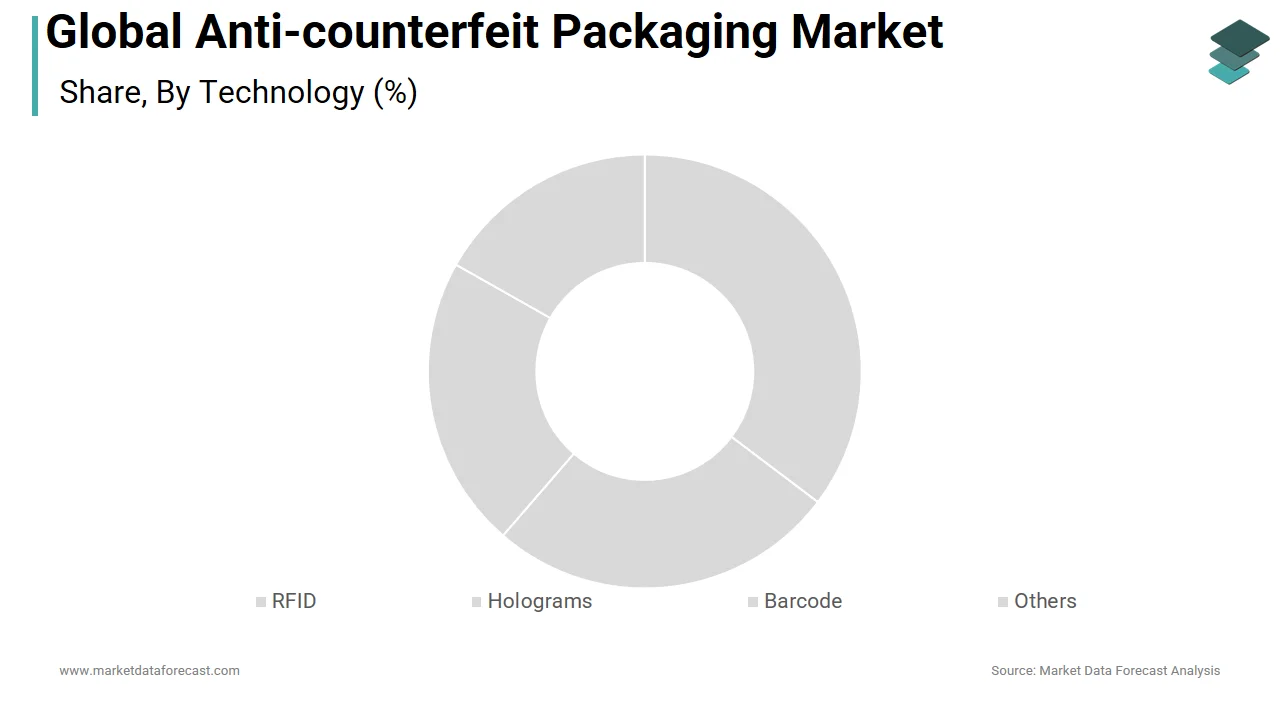
The barcode segment accounted in holding 48.2% of the anti-counterfeit packaging market share in 2024, with its cost-effectiveness and universal compatibility with smartphones, enabling instant consumer verification. The technology is widely adopted in pharmaceuticals under regulatory mandates such as India’s Drug Traceability System, which requires QR codes on all prescription medicines. As per the Indian Ministry of Health, over 90% of scheduled drugs were serialized by mid-2023. Additionally, brands leverage QR codes for dual purpose: authentication and consumer engagement, embedding them with promotional content, usage instructions, or sustainability data, which is significantly enhances return on investment and scalability across high-volume product lines.
The RFID (Radio-Frequency Identification) segment is projected to grow at a CAGR of 14.7% during the forecast period, with its ability to enable real-time, non-line-of-sight tracking across complex supply chains in logistics and high-value manufacturing. In the automotive and aerospace sectors, RFID tags are embedded in packaging and components to ensure part authenticity and prevent the use of counterfeit spare parts, which the International Air Transport Association estimates cost the aviation industry over USD 2 billion annually. Walmart’s supply chain, as documented in its 2023 Sustainability Report, utilizes RFID to track over 700 million consumer goods annually, reducing shrinkage and improving inventory accuracy.
By End-Use Insights
The healthcare and pharmaceutical sector was the largest and held 52.3% of the anti-counterfeit packaging market share in 2024, with the stringent global regulations mandating serialization and traceability to combat life-threatening counterfeit drugs. Additionally, the World Health Organization reports that substandard and falsified medical products cause over 1 million deaths annually, primarily in low-income countries, intensifying public and regulatory pressure.
The consumer electronics segment is growing lucratively with a CAGR of 13.9% during the forecast period, with the escalating trade in counterfeit components and refurbished devices misrepresented as new. According to the Semiconductor Industry Association, counterfeit integrated circuits accounted for nearly 15% of returned field failures in 2023. Samsung and Sony have also introduced AI-powered packaging inspection systems in distribution centers to reduce fake infiltration.
REGIONAL ANALYSIS
Asia Pacific Anti-counterfeit Packaging Market Insights
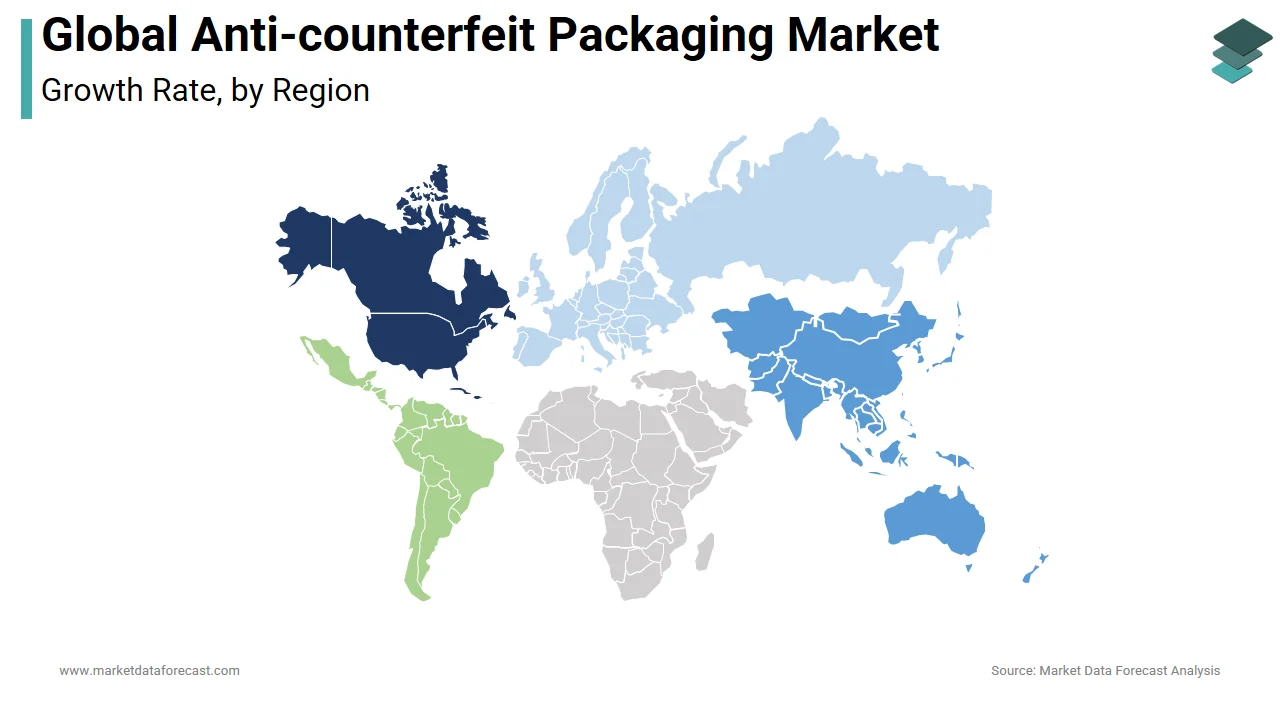
Asia Pacific was the top performer in the anti-counterfeit packaging market by capturing 38.3% of the share in 2024, with its dual role as the world’s largest manufacturing hub and a primary target for counterfeit operations. China, India, and South Korea are rapidly adopting serialization and digital verification systems to meet both domestic regulatory demands and export compliance. India’s pharmaceutical sector, which supplies 20% of global generic drugs, has mandated DSCSA-equivalent tracking, driving barcode and RFID adoption. Additionally, e-commerce platforms like Alibaba and Flipkart have implemented AI-powered counterfeit detection systems, which require sellers to use authenticated packaging.
North America Anti-counterfeit Packaging Market Insights
North America was positioned second by occupying 30.3% of the share in 2024. The United States was the largest contributor to the anti-counterfeit packaging market. As per FDA compliance data, 98% of pharmaceutical manufacturers and 90% of dispensers achieved interoperable data exchange by the 2023 deadline, marking a transformative shift in supply chain transparency. The rise of direct-to-consumer (DTC) e-commerce has further accelerated the adoption of NFC and QR-based verification among luxury and consumer brands.
Europe Anti-counterfeit Packaging Market Insights
Europe market growth is likely to grow with a technologically advanced and policy-led position. Germany, France, and the UK are at the forefront of adopting blockchain-integrated packaging, with companies like Bayer and GSK piloting decentralized verification systems. As per the European Anti-Fraud Office, customs authorities intercepted over 65 million counterfeit goods in 2023, a 12% increase from the previous year, which highlights the need for advanced packaging. Additionally, the EU’s Green Deal and Digital Product Passport initiative are converging with anti-counterfeiting efforts, which require products to carry digital IDs that verify authenticity and sustainability.
Latin America Anti-counterfeit Packaging Market Insights
Latin America market growth is likely to grow in the coming years. Brazil and Mexico face significant challenges from counterfeit pharmaceuticals and food products, with the Pan American Health Organization estimating that 15–20% of medicines in circulation in some countries are falsified. In response, Brazil’s National Health Surveillance Agency (ANVISA) implemented a national drug tracking system in 2023, requiring 2D barcodes on all prescription products. Mexico’s consumer protection agency, PROFECO, reported a 30% increase in counterfeit seizures between 2021 and 2023, prompting retailers to adopt tamper-evident and scannable packaging. E-commerce growth, expanding at 22% annually as per eMarketer, is further driving demand.
Middle East & Africa Anti-counterfeit Packaging Market Insights
Middle East & Africa market is anticipated to grow in the coming years. The United Arab Emirates and Saudi Arabia are emerging as regional leaders, driven by Vision 2030 initiatives that emphasize supply chain integrity and digital transformation. The UAE’s Ministry of Health and Prevention mandated serialization for all pharmaceutical imports by 2023, aligning with EU standards. In South Africa, the Medicines Control Council reported that counterfeit antiretrovirals accounted for 10% of HIV treatments seized in 2022, prompting pilot programs with QR-coded packaging.
COMPETITIVE LANDSCAPE
The anti-counterfeit packaging market is characterized by intense technological rivalry rather than price competition, with differentiation hinging on innovation, regulatory alignment, and system interoperability. While established players dominate through proprietary technologies and global partnerships, nimble tech startups are disrupting the landscape with AI-powered verification and decentralized ledgers. The fragmentation of regulatory requirements across regions fosters a complex environment where adaptability determines competitive advantage. In the Asia Pacific, local manufacturers are rapidly adopting international standards, narrowing the gap with Western firms. Strategic alliances between packaging providers, digital platform operators, and enforcement agencies are redefining market dynamics.
KEY MARKET PLAYERS
Some of the companies that are playing a dominating role in the global anti-counterfeit packaging market include
- CCL Industries Inc. (Canada)
- 3M Company (U.S.)
- Zebra Technologies Corporation (U.S.)
- SML Group (China)
- SICPA HOLDING SA. (Switzerland)
- Avery Dennison Corporation (U.S.)
- (Switzerland)
- (U.S.)
- BrandWatch Technologies (U.K.)
- Impinj, Inc. (U.S.)
- Applied DNA Sciences (U.S.)
- Kao Collins Corporation (U.S.)
Top Players in the Anti-Counterfeit Packaging Market
- Avery Dennison has established a commanding presence in the anti-counterfeit packaging domain through its innovative labeling and RFID-based authentication solutions, with significant traction across the Asia Pacific region. The company’s AD Provenance platform, launched in 2023, integrates QR codes with blockchain to provide end-to-end traceability for luxury goods, pharmaceuticals, and food products in markets such as India, Japan, and Australia. It collaborates with e-commerce platforms and regulatory bodies to ensure compliance with digital verification mandates. Recently, the company expanded its manufacturing footprint in Vietnam to serve fast-growing Southeast Asian supply chains and introduced AI-driven label inspection systems to detect tampering in real time. Its partnership with Alibaba’s Anti-Counterfeiting Alliance enables brands to authenticate millions of products annually, reinforcing trust in digital marketplaces. These initiatives underscore its strategic focus on scalable, interoperable security solutions tailored to the region’s dynamic regulatory and consumer landscapes.
- SICPA, a Swiss leader in security inks and authentication technologies, plays a pivotal role in securing high-risk supply chains across the Asia Pacific, particularly in government-issued documents, pharmaceuticals, and tobacco. In 2023, SICPA partnered with India’s Central Tobacco Board to implement traceability labels on smokeless tobacco products, aligning with new federal regulations. Its ColorCode technology, which embeds invisible spectral markers into packaging, has been adopted by South Korean electronics manufacturers to verify component authenticity. SICPA also operates technical support centers in Singapore and Shanghai, enabling rapid deployment and customization for regional clients.
- Honeywell leverages its expertise in industrial automation and supply chain intelligence to deliver integrated anti-counterfeit packaging solutions, with growing influence in the Asia Pacific’s healthcare, aerospace, and logistics sectors. In India and China, Honeywell collaborates with pharmaceutical distributors to deploy tamper-evident smart labels with real-time GPS tracking, reducing diversion and gray market trade. Its recent integration of AI-powered anomaly detection in packaging lines allows manufacturers to identify counterfeit replicas during production audits. Additionally, Honeywell’s partnership with Singapore’s Logistics Association has led to pilot programs using RFID-enabled pallet tags for high-value goods.
Top Strategies Used by the Key Market Participants
Key players in the anti-counterfeit packaging market are prioritizing technology convergence, integrating physical security features with digital traceability platforms to create multi-layered authentication systems. Companies are investing in blockchain-enabled serialization and AI-driven verification to enhance real-time monitoring and consumer engagement. Strategic partnerships with e-commerce platforms, regulatory agencies, and logistics providers are expanding deployment across complex supply chains. Expansion into high-growth regions like the Asia Pacific is being accelerated through localized manufacturing and technical support centers. Additionally, firms are focusing on interoperability, ensuring their solutions comply with global standards such as DSCSA and EU FMD.
MARKET SEGMENTATION
This research report on the global anti-counterfeit packaging market has been segmented and sub-segmented into the following categories.
By Technology
- RFID
- Holograms
- Barcode
- Others
By End-Use
- Food & Beverages
- Healthcare & Pharmaceuticals
- Industrial & Automotive
- Consumer Electronics
- Others
By Region
- North America
- Europe
- Asia Pacific
- Latin America
- The Middle East and Africa