- Product Description Description
- Table of Contents TOC
- List of Table & Figure LOT
- Get Free Sample PDF Sample PDF
Market Size, 2025
$54.34 BnMarket Estimate, 2026
$60.69 BnMarket Forecast, 2034
$146.98 BnCAGR, 2026–2034
11.69%Executive Summary: Asia Pacific Cybersecurity Market
- Market Scope: Comprehensive regional cybersecurity market analysis covering deployment models, organization sizes, vertical industries, country leadership frameworks, and cloud-native and AI-enabled XDR trends.
- Market Valuation: Valued at USD 54.34 billion (2025), estimated at USD 60.69 billion (2026), and projected to reach USD 146.98 billion by 2034, registering a solid CAGR of 11.69% (2026–2034).
- Primary Growth Drivers: Accelerating digital transformation, rising IoT adoption across connected environments, stringent government regulations enhancing national cyber defenses, and cloud-based security investments exceeding USD 6.1 billion.
Key Market Segment Metrics (2026–2034)
| Category | Leading Segment (Base Position) | Fastest-Growing Segment |
|---|---|---|
| By Deployment & Component | Cloud Deployment and Integrated Software Solutions | Cybersecurity Services (projected to grow at the fastest CAGR) |
| By Enterprise Size | Large Enterprises (estimated to hold the largest market share via cyber insurance adoption) | Small and Medium-Sized Enterprises (adopting scalable, on-demand cloud defense) |
| By Industry Vertical | IT & Telecom and Manufacturing (together accounting for nearly 50% market share) | Aerospace & Defense (predicting considerable growth due to government investments) |
| By Region / Country | China (biggest cybersecurity market in the Asia Pacific region) | India (anticipated to surge via CERT-In incident handling and security architecture enhancements) |
Major Market Players & Market Structure
Market Structure: Highly competitive regional cyber defense landscape where leading multinational tech corporations deliver comprehensive security portfolios, AI-enabled XDR platforms, and cloud-native solutions to counter state-sponsored threats.
Key Companies: NEC Corporation, Cisco Systems Inc., Kaspersky Labs, Dell Technologies Inc., Check Point Software Technologies Ltd., IBM Corporation, Imperva, and Proofpoint Inc.
Asia Pacific Cybersecurity Market Size
The size of the cybersecurity market in the Asia-Pacific region was worth USD 54.34 billion in 2025 and is estimated to grow at a CAGR of 11.69% from 2026 to 2034. The Asia Pacific market size is expected to reach USD 146.98 billion by 2034, up from USD 60.69 billion in 2026.
MARKET DRIVERS
The rise of IoT and the accelerating pace of digital transformation in the Asia-Pacific region are propelling growth in the cybersecurity market.
Asia Pacific is seeing a sharp surge in cybersecurity due to a substantial increase in internet, social media and mobile users in recent years. The scope of cyberattacks is projected to rise in the coming years. The stringent regulations from the governments of the Asia Pacific countries will serve to fuel the growth of the regional market.
The growing number of connected devices such as consumer electronics, connected cars, connected factories and others are driving the adoption of IoT and bolstering cybersecurity in enterprises. The growth of the Asia Pacific cybersecurity market is also fuelled by novel business approaches and applications along with decreasing device costs. Thus, the cybersecurity market in the Asia-Pacific region is propelled using M2M or IoT connectivity.
The rising awareness among people of cyber security and fast digitization are creating various opportunities for the Asia Pacific cybersecurity market. The region's investment in cybersecurity exceeded US $3.2 billion in 2021, and it is predicted to rise by 14% to US 6.1 billion dollars by 2026. The cybersecurity teams of Southeast Asian businesses are also highly confident in their ability to mitigate cyber risks over the past year, enabling remote and hybrid work, accelerating cloud adoption by more than 80 percent, and increasing data volumes. In addition, XDR platforms offer multiple benefits against Endpoint Detection and Response (EDR) and Endpoint Protection Platform (EPP) solutions because of their AI and ML capabilities. These advantages are mostly in the areas of threat prediction and cybersecurity automation.
MARKET RESTRAINTS
Large dependence on traditional authentication methods and poor preparedness are limiting the Asia Pacific cybersecurity market growth. Security experts advise the use of identity management technologies like facial recognition and biometric identification but over 80% of organizations still use usernames and passwords for login. Other difficulties include the difficulty of complying with regulations, the financial limitations of smaller enterprises and the lack of qualified cybersecurity experts. Therefore, constant investment is also necessary due to the dangerous dynamic character.
Gaps in cybersecurity skills, lack of awareness and investments and data privacy concerns are some of the major challenges for the Asia Pacific cybersecurity market. With 2.6 million experts required to properly protect digital assets Asia’s cybersecurity talent gap has hit a record high, which is a 23% increase from 2023 the largest increase globally second only to North America. Since conditions of consent are still new and being developed in the region, users frequently lack clear easy-to-read language that would secure their data and make it difficult to understand modifications.
REPORT COVERAGE
| REPORT METRIC | DETAILS |
| Market Size Available | 2025 to 2034 |
| Base Year | 2025 |
| Forecast Period | 2026 to 2034 |
| CAGR | 11.69% |
| Segments Covered | By Component, Deployment Type, Enterprise, End-User, and Region |
|
Various Analyses Covered | Regional & Country Level Analysis, Segment-Level Analysis, DROC, PESTLE Analysis, Porter’s Five Forces Analysis, Competitive Landscape, Analyst Overview on Investment Opportunities |
| Regions Covered | India, China, Japan, South Korea, Australia, New Zealand, Thailand, Malaysia, Vietnam, Philippines, Indonesia, Singapore, Rest of Asia Pacific |
|
Market Leaders Profiled | NEC Corporation, Cisco Systems Inc., Kaspersky Labs, Dell Technologies Inc., Check Point Software Technologies Ltd., IBM Corporation, Imperva and Proofpoint Inc. |
SEGMENTAL ANALYSIS
By Component Insights
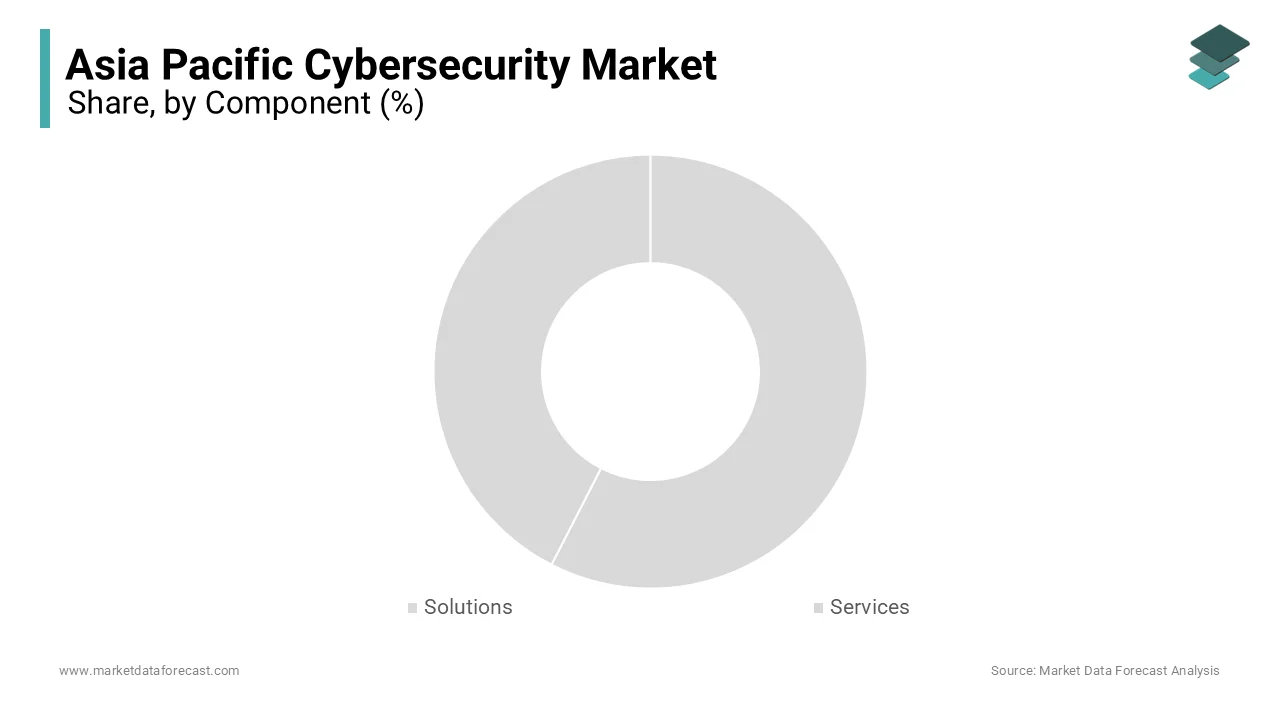
Based on components, the services segment is projected to grow at the fastest CAGR in the Asia-Pacific cybersecurity market during the forecast period. The deployment of cybersecurity services across various industries and sectors is driven by the increased adoption of cybersecurity solutions by enterprises in Asia Pacific depending on organizational structure. Companies are a prime target for cybercriminals because of the large number of resources, data and network connectivity.
By Deployment Type Insights
Based on deployment type, the cloud segment is expected to propel in the coming years in the Asia-Pacific cybersecurity market. As cloud services such as Dropbox, Google Drive, and Microsoft Azure are becoming more prevalent and constitute a vital part of corporate operations, businesses are faced with security challenges including losing control over confidential data. As a result, on-demand cyber-security solutions are being included more often.
By Enterprise Insights
Based on the enterprise, the large enterprises segment is estimated to hold the largest share of the Asia Pacific cybersecurity market during the forecast period. Large enterprises are incorporating cyber insurance into their business insurance plans to mitigate risks like data breaches and hacking associated with the implementation of multiple technologies.
By End-User Insights
The IT and Telecom and Manufacturing segments together accounted for almost 50% of the Asia Pacific cybersecurity market share in 2023. The aerospace & defense segment is predicted to account for a considerable share of the Asia Pacific market during the forecast period. Considering their information is sensitive government and defense organizations are frequently vulnerable to security breaches caused by state-sponsored hacktivists. As a result, many Asian Pacific governments are heavily investing in bolstering their country’s cyber security.
REGIONAL ANALYSIS
China is the biggest cybersecurity market in the Asia Pacific. The Chinese government is enhancing cybersecurity through the Cyberspace Administration, implementing policies and coordinating with other agencies, thereby increasing the demand for such measures.
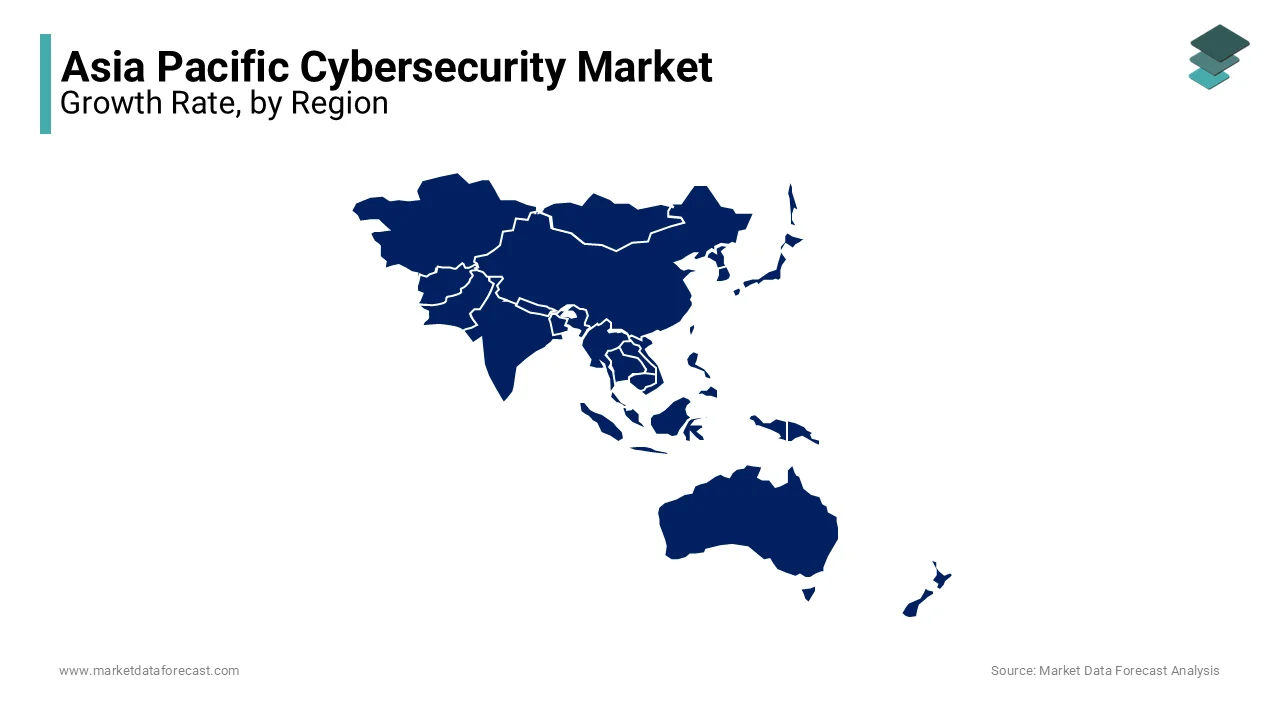
India is anticipated to propel with a significant growth rate in the forecast period. The limited internet hardware control is challenging the national security architecture which is providing opportunities for the companies in the market. Authorities are also tackling localized cybercrimes with CERT-In handling increased incidents, therefore driving demand for cyber security.
Japan's Asia Pacific cyber security market is expected to move forward at a considerable pace in the future. The Japanese government and enterprises are gaining interest in cybersecurity due to the rise in cyberattacks, prompting the establishment of new legislation, strategies, and facilities.
South Korea is estimated to elevate further in the coming years. The ICT ministry of South Korea will make investments of USD 607 million by 2023 to work with significant cloud and data center firms to strengthen cybersecurity capabilities and counteract digital threats. It also intends to broaden the scope of collaborative training and send more employees to the center to improve its cyber response skills.
Singapore's Asia Pacific cyber security market will grow at a steady rate. The demand for cloud-based solutions and on-demand security services is rising as more Singaporean firms realize how cost-effective they can be.
KEY MARKET PLAYERS
NEC Corporation, Cisco Systems Inc., Kaspersky Labs, Dell Technologies Inc., Check Point Software Technologies Ltd., IBM Corporation, Imperva and Proofpoint Inc. are a few of the leading companies in the Asia Pacific cyber security market.
MARKET SEGMENTATION
This research report on the Asia Pacific cybersecurity market has been segmented and sub-segmented into the following categories.
By Component
-
Solutions
-
Services
By Deployment Type
-
Cloud
-
On-Premises
By Enterprise
-
Large
-
SMEs
By End-User
-
Aerospace & Defense
-
Healthcare
-
IT & Telecom
-
Energy
-
Manufacturing
By Region
-
India
-
China
-
Japan
-
South Korea
-
Australia
-
New Zealand
-
Thailand
-
Malaysia
-
Vietnam
-
Philippines
-
Indonesia
-
Singapore
-
Rest of Asia Pacific