- Product Description Description
- Table of Contents TOC
- List of Table & Figure LOT
- Get Free Sample PDF Sample PDF
Market Size, 2025
$2.63 TnMarket Estimate, 2026
$3.04 TnMarket Forecast, 2034
$9.67 TnCAGR, 2026–2034
15.56%Asia Pacific Insurance Market Size
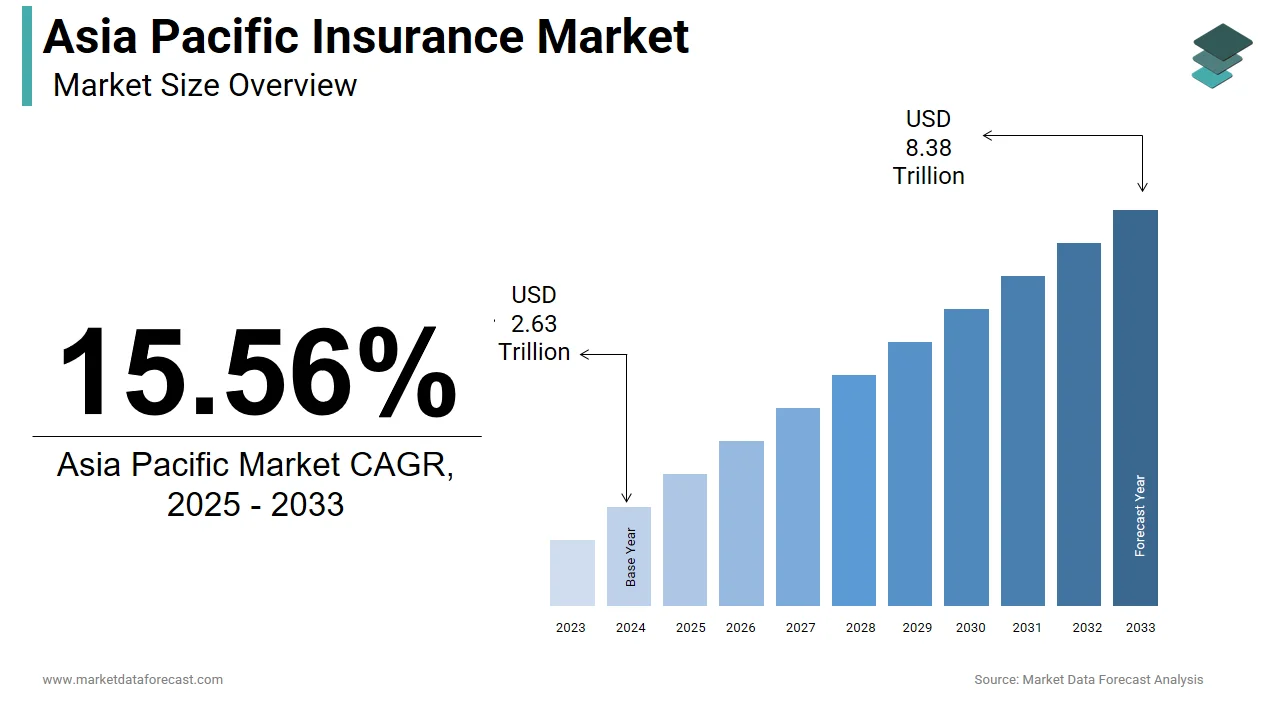
The Asia Pacific insurance market was valued at USD 2.63 trillion in 2025, is estimated to reach USD 3.04 trillion in 2026, and is projected to reach USD 9.67 trillion by 2034, growing at a CAGR of 15.56% from 2026 to 2034.
The insurance plays an important role in mitigating financial risks for individuals, businesses, and governments, while also contributing significantly to capital markets through investment activities. As per the Insurance Australia Group, regulatory reforms in Australia have enhanced consumer protection and encouraged broader participation in insurance products. In India, the Insurance Regulatory and Development Authority (IRDAI) has introduced digital initiatives to increase access to insurance services in rural and semi-urban areas.
MARKET DRIVERS
Rising Middle-Class Population and Disposable Incomes
The rapid growth of the middle-class population, coupled with rising disposable incomes, is anticipated to fuel the growth of the Asia Pacific insurance market. In India, the National Council of Applied Economic Research reported that insurance penetration in urban areas has nearly doubled over the past decade, driven by higher income levels and greater awareness. In Southeast Asia, countries like Indonesia and the Philippines have witnessed a surge in insurance demand, particularly in motor and health insurance segments, as more people can afford premium payments. In China, rising affluence has led to increased interest in wealth protection and investment-linked insurance products.
Digital Transformation and Insurtech Adoption
The rapid adoption of digital technologies and the rise of insurtech platforms are prompting the growth of the Asia Pacific insurance market. Insurtech startups and digital initiatives by traditional insurers are enhancing customer access, improving underwriting efficiency, and streamlining claims processing. According to the Singapore FinTech Association, over 150 insurtech firms were operating in the region as of 2024, with Singapore, India, and Indonesia emerging as key innovation hubs. As per the Indian Institute of Management Ahmedabad, digital insurance sales in India grew by over 40% annually between 2020 and 2024. In Japan, major insurers like Tokio Marine and Sompo Japan have launched AI-driven platforms for personalized risk assessment and claims automation. In Australia, the implementation of open banking and digital identity verification has simplified insurance onboarding and fraud detection.
MARKET RESTRAINTS
Low Insurance Penetration in Rural and Underbanked Areas
The persistently low insurance penetration in rural and underbanked regions is restraining the growth of the Asia Pacific insurance market. Large segments of the population in countries like India, Indonesia, and the Philippines remain uninsured or underinsured. According to the International Labour Organization, over 60% of the workforce in these countries is engaged in informal employment, limiting their access to structured insurance products. The lack of physical distribution networks, limited financial literacy, and affordability issues contribute to this gap. Additionally, in the Pacific Islands and parts of Papua New Guinea, the absence of a formal banking system and weak insurance regulatory frameworks further hinder market growth.
Complex Regulatory Environment and Compliance Burdens
The complex and fragmented regulatory environment varies significantly across countries. Each jurisdiction has its own set of rules governing insurance product design, pricing, distribution, and foreign investment, which makes it difficult for multinational insurers to operate seamlessly. In China, the CIRC (China Insurance Regulatory Commission) has imposed strict capital adequacy and solvency requirements, limiting the ability of foreign insurers to enter or expand their operations. In India, regulatory restrictions on foreign direct investment in insurance have historically limited the inflow of capital and innovation. As per the Insurance Regulatory and Development Authority (IRDAI), while reforms have been introduced, compliance remains a challenge for both domestic and international players. In Japan, the Financial Services Agency (FSA) enforces stringent reporting and risk management standards, which, while ensuring consumer protection, also add administrative burdens.
MARKET OPPORTUNITIES
Expansion of Microinsurance and Inclusive Coverage Models
The growing potential of microinsurance and inclusive coverage models aimed at low-income and rural populations is expected to boost the growth of the Asia Pacific insurance market. Governments and insurers are increasingly recognizing the need to provide affordable insurance products that cater to underserved communities. According to the International Labour Organization, microinsurance schemes have expanded in countries like the Philippines, Bangladesh, and Thailand, where partnerships between insurers and microfinance institutions have enabled broader reach. As per the Reserve Bank of India, over 50 million farmers have enrolled in crop insurance schemes since 2020. Additionally, in Vietnam, mobile-based microinsurance products are gaining traction, allowing low-income individuals to purchase coverage via mobile wallets.
Growth of Climate and Catastrophe Insurance Solutions
The increasing demand for climate and catastrophe insurance solutions in response to rising natural disaster risks is also propelling the growth of the Asia Pacific insurance market. The region is highly vulnerable to typhoons, floods, earthquakes, and other climate-related events, prompting governments and insurers to develop specialized risk transfer mechanisms. According to the United Nations Office for Disaster Risk Reduction, economic losses from natural disasters in the Asia Pacific increased by 25% between 2010 and 2023. In the Philippines, where typhoon damage is frequent, the government has partnered with international reinsurers to establish catastrophe risk pools that provide financial protection to local insurers.
MARKET CHALLENGES
Managing Claims Fraud and Underwriting Risks
The growing incidence of claims fraud and underwriting risks, which affect profitability and consumer trust is posing a great challenge for the Asia Pacific insurance market players. Insurance fraud, including staged accidents, false medical claims, and inflated property damage reports, is a persistent issue across the region. According to the Australian Competition and Consumer Commission, fraudulent insurance claims cost the industry over AUD 2 billion annually. In China, the China Insurance Regulatory Commission has introduced AI-driven fraud detection systems to identify suspicious claims patterns. However, the lack of centralized fraud databases and inconsistent enforcement mechanisms across countries continues to pose challenges. Additionally, underwriting risks are exacerbated by data gaps, particularly in emerging markets where credit histories and health records are not always available.
Cybersecurity Threats and Data Privacy Concerns
The cybersecurity threats and data privacy concerns are expected to degrade the growth of the Asia Pacific insurance market in the coming years. Insurers are handling vast amounts of sensitive customer data, including financial records, health information, and personal identification details, making them prime targets for cyberattacks. According to the Asia Pacific Risk Center, the number of cyber incidents affecting financial institutions, including insurance companies, increased by 45% in 2023 compared to the previous year. In Japan, the Financial Services Agency has issued guidelines requiring insurers to implement stronger cybersecurity protocols following a series of ransomware attacks on major insurance firms. In South Korea, the Financial Supervisory Service has mandated regular cybersecurity audits for insurance companies to prevent data breaches.
REPORT COVERAGE
| REPORT METRIC | DETAILS |
| Market Size Available | 2025 to 2034 |
| Base Year | 2025 |
| Forecast Period | 2026 to 2034 |
| Segments Covered | By Type, Distribution Channel, and Region. |
| Various Analyses Covered | Global, Regional and Country-Level Analysis, Segment-Level Analysis, Drivers, Restraints, Opportunities, Challenges; PESTLE Analysis; Porter’s Five Forces Analysis, Competitive Landscape, Analyst Overview of Investment Opportunities |
| Countries Covered | India, China, Japan, South Korea, Rest of Asia Pacific |
| Market Leaders Profiled | Centene Corporation, Zurich Ins Group, Allianz SE, UnitedHealth Group Incorporated, Progressive Corporation, State Farm Group, Elevance Health, Inc., AXA S.A., HDI V.a.G., MetLife Inc., and others. |
SEGMENTAL ANALYSIS
By Type Insights
The life insurance segment was the largest by occupying 58.3% of the Asia Pacific insurance market share in 2024, with the cultural emphasis on long-term financial security and the increasing awareness of life insurance as a tool for wealth protection and estate planning. In countries like Japan and South Korea, life insurance has been a cornerstone of personal finance for decades, with high household penetration rates. According to the Life Insurance Association of Japan, over 90% of Japanese households have at least one life insurance policy, contributing significantly to the region’s insurance premium volume.
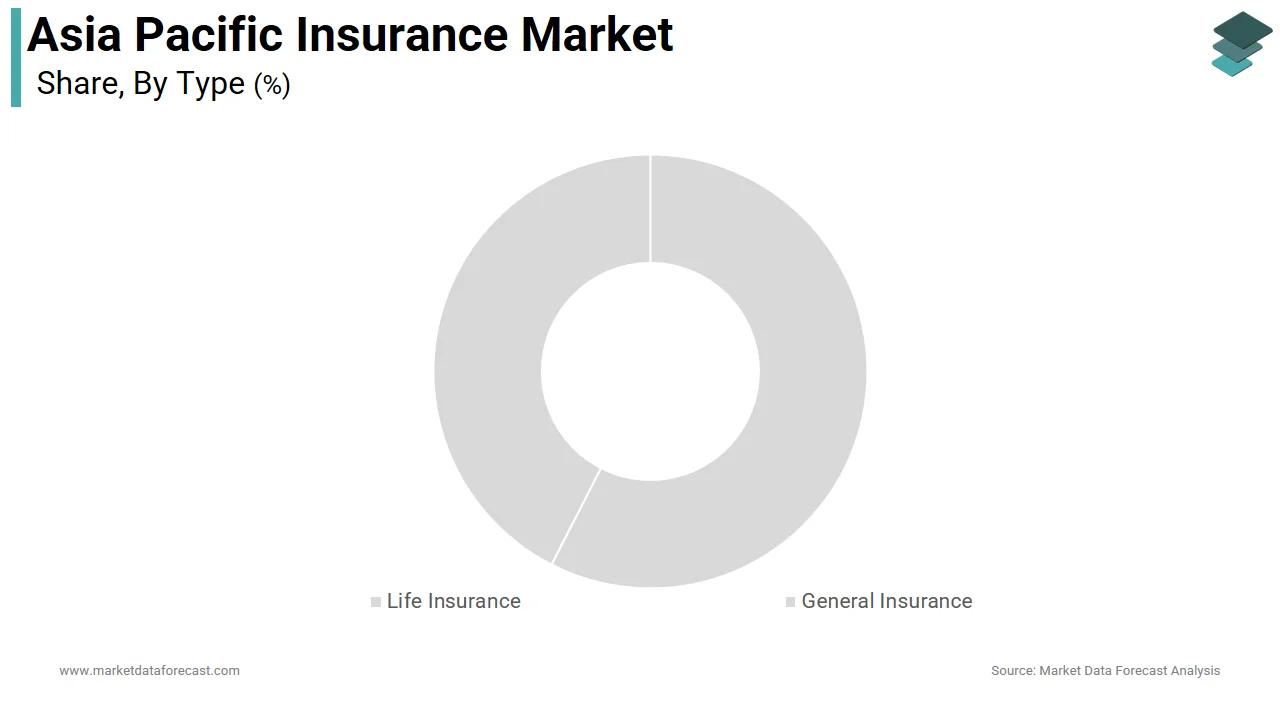
The general insurance segment is lucratively growing with an expected CAGR of 9.6% from 2026 to 2034, owing to the increasing motor vehicle ownership, rising property investments, and expanding health insurance coverage across the region. According to the International Transport Forum, motorization rates in Southeast Asia have surged, with Indonesia, Vietnam, and the Philippines experiencing a 7–10% annual increase in vehicle ownership. Additionally, the expansion of private healthcare and the rising cost of medical treatments have boosted health insurance demand in both urban and rural areas.
By Distribution Channel Insights
The direct sales channel segment accounted in holding 45.3% of the Asia Pacific insurance market share in 2024, with the increasing preference for direct engagement with insurance providers, particularly in digitally advanced markets such as Singapore, Japan, and South Korea. In India, the Insurance Regulatory and Development Authority (IRDAI) has facilitated the growth of direct insurance models by allowing insurers to offer policies through mobile apps and online portals without intermediaries. Additionally, in China, the China Banking and Insurance Regulatory Commission has encouraged insurers to adopt digital-first strategies, leading to a surge in direct-to-consumer insurance platforms. The combination of regulatory support, technological innovation, and consumer preference for transparency and cost efficiency has solidified the position of insurers as the leading distribution channel in the Asia Pacific insurance market.
The banking channel segment is likely to grow with an anticipated CAGR of 10.2% from 2026 to 2034, with the widespread adoption of bancassurance models, where banks act as distribution partners for insurance products, particularly life and health insurance. According to the Reserve Bank of India, over 60% of life insurance policies sold through banks in 2023 were to first-time policyholders. As per the China Banking and Insurance Regulatory Commission, bancassurance accounted for nearly 40% of life insurance sales in the country in 2024. In Southeast Asia, countries like Thailand and Malaysia have also witnessed strong bancassurance growth, with local banks integrating insurance products into digital banking platforms.
COUNTRY-LEVEL ANALYSIS
China Insurance Market Insights
China was the top performer of the Asia Pacific insurance market with 30.3% of the share in 2024. The China Banking and Insurance Regulatory Commission (CBIRC) has implemented reforms to strengthen insurance governance and encourage innovation in digital insurance and bancassurance. According to the Insurance Information Institute of China, life insurance premiums accounted for over 65% of total insurance revenue in 2023, with investment-linked and health insurance products gaining popularity. Additionally, the government’s push for social health insurance expansion has boosted private health insurance demand.
Japan Insurance Market Insights
Japan insurance market was next by capturing 21.3% of the share in 2024, with the aging population and high life expectancy leading to a strong demand for life insurance and annuity products. According to the Life Insurance Association of Japan, the average life insurance coverage per household exceeds JPY 10 million, reflecting deep market penetration. The Japanese government, through the Financial Services Agency (FSA), has encouraged the development of digital insurance platforms and introduced reforms to enhance insurance product transparency. Additionally, the integration of insurance with healthcare services has gained traction, particularly in long-term care insurance.
India Insurance Market Insights
India insurance market growth is likely to be driven by regulatory reforms, digital transformation, and a growing middle class. The Insurance Regulatory and Development Authority (IRDAI) has played a pivotal role in liberalizing the market, allowing increased foreign investment and promoting digital insurance models. According to the Insurance Information Bureau of India, insurance penetration has increased by 15% over the past five years, with general insurance growing at a faster rate than life insurance. The government’s push for financial inclusion through schemes like Pradhan Mantri Jan Arogya Yojana (PMJAY) has expanded health insurance access to low-income groups. Additionally, bancassurance partnerships and mobile-based insurance platforms have enhanced distribution efficiency.
Australia Insurance Market Insights
Australia insurance market growth is anticipated to be fuelled with a well-developed insurance regulatory framework and high insurance penetration. The Australian Prudential Regulation Authority (APRA) ensures strong oversight of insurance firms, maintaining market stability and consumer confidence. According to the Insurance Council of Australia, life insurance ownership is among the highest globally, with over 80% of households having some form of coverage. The country’s compulsory motor insurance and property insurance requirements also contribute to strong general insurance demand.
South Korea Insurance Market Insights
South Korea insurance market growth is driven by high digital adoption and a well-established insurance culture. The Financial Services Commission (FSC) has supported the growth of insurtech startups and digital insurance platforms, making insurance more accessible and personalized. According to the Korea Insurance Development Institute, over 60% of insurance policies in the country are now purchased online, with mobile apps playing a dominant role. The government has also introduced reforms to encourage innovation, including the launch of a regulatory sandbox for insurtech firms. Additionally, the aging population and rising healthcare costs have led to increased demand for health and long-term care insurance.
COMPETITIVE LANDSCAPE
The Asia Pacific insurance market is highly competitive, characterized by a mix of well-established domestic insurers, global insurance giants, and a growing number of agile insurtech startups. The market is evolving rapidly due to shifting consumer expectations, regulatory reforms, and technological advancements. In developed economies like Japan and Australia, competition is centered on digital innovation, customer retention, and product customization. In contrast, emerging markets such as India, Indonesia, and the Philippines are witnessing intense competition driven by affordability, accessibility, and financial inclusion initiatives. Insurers are increasingly focusing on enhancing customer engagement through digital platforms, leveraging data analytics for risk assessment, and forming strategic alliances to expand their distribution networks. The rise of insurtech firms is further intensifying competition by introducing disruptive business models and improving the efficiency of insurance delivery.
KEY MARKET PLAYERS
Some of the noteworthy companies in the Asia Pacific insurance market profiled in this report are
- Centene Corporation
- Zurich Ins Group
- Allianz SE
- UnitedHealth Group Incorporated
- Progressive Corporation
- State Farm Group
- Elevance Health, Inc.
- AXA S.A.
- HDI V.a.G.
- MetLife Inc.
TOP LEADING PLAYERS IN THE MARKET
- China Life is the largest life insurer in China and a dominant force in the Asia Pacific insurance market. The company offers a wide range of life, health, and accident insurance products and plays a crucial role in shaping insurance policy frameworks in the region. With a strong distribution network and government-backed initiatives, China Life has significantly contributed to increasing insurance penetration in both urban and rural areas. The company’s integration of digital platforms and customer-centric services has set industry benchmarks and influenced insurance trends across the Asia Pacific.
- Tokio Marine is a leading global insurer with a strong presence in the Asia Pacific region. The company has expanded its operations across emerging markets such as India, Indonesia, and the Philippines, offering life and general insurance solutions tailored to local needs. Tokio Marine’s focus on innovation, strategic acquisitions, and sustainable insurance practices has positioned it as a key player in the regional market. Its contributions to risk management and disaster resilience programs have further strengthened its reputation and global influence.
- HDFC Life is one of India’s most prominent private life insurers and a key contributor to the growth of the insurance sector in South Asia. The company has played a vital role in expanding insurance access through digital transformation, bancassurance partnerships, and financial literacy initiatives. HDFC Life has influenced insurance market development in emerging economies by making it a major regional player with growing international recognition.
TOP STRATEGIES USED BY KEY MARKET PARTICIPANTS
Digital Transformation and Insurtech Integration Leading insurers in the Asia Pacific region are investing heavily in digital transformation to enhance customer experience, streamline operations, and improve underwriting accuracy. This includes the adoption of AI, machine learning, and blockchain technologies to automate claims processing, personalize insurance products, and offer real-time risk assessments. Insurtech partnerships are also being leveraged to expand market reach and improve customer engagement through mobile and web-based platforms.
Strategic Mergers, Acquisitions, and Joint Ventures to strengthen their market presence and diversify product offerings, major insurance players are engaging in mergers, acquisitions, and joint ventures. These strategic moves allow companies to access new customer bases, enter untapped markets, and integrate complementary capabilities. Partnerships with fintech firms and digital banks are also becoming common in emerging markets where bancassurance models are gaining traction.
Expansion into Emerging Markets and Rural Insurance Programs Recognizing the vast potential in underpenetrated markets, key players are expanding into emerging economies and launching inclusive insurance products tailored for rural and low-income populations. This includes microinsurance, crop insurance, and health coverage models supported by government collaborations and mobile-based distribution systems. These efforts not only improve financial inclusion but also open new growth avenues for insurers in the Asia Pacific.
RECENT MARKET DEVELOPMENTS
- In February 2024, China Life Insurance launched a new digital insurance platform designed to streamline policy issuance and claims processing, which is aiming to enhance customer experience and expand its reach in rural and semi-urban areas.
- In May 2024, Tokio Marine announced a strategic partnership with a leading Indonesian digital bank to offer integrated insurance and banking services by focusing on life and health insurance products for underserved customer segments.
- In July 2024, HDFC Life introduced a mobile-based microinsurance product in collaboration with a telecom provider by enabling low-income individuals to access affordable life and accident coverage via mobile wallets.
- In October 2024, a major Australian insurer partnered with a cybersecurity firm to develop an AI-driven fraud detection system aimed at improving claims verification and reducing insurance fraud across its operations.
- In December 2024, a leading South Korean insurance company acquired a local insurtech startup specializing in AI-based underwriting, which is seeking to enhance its digital insurance capabilities and accelerate product innovation in the life and health insurance segments.
MARKET SEGMENTATION
This Asia Pacific insurance market research report is segmented and sub-segmented into the following categories.
By Type
- Life Insurance
- General Insurance
By Distribution Channel
- Insurers
- Insurance Brokers and Agencies
- Banks
- Others
By Country
- India
- China
- Japan
- South Korea
- Rest Of Asia Pacific