- Product Description Description
- Table of Contents TOC
- List of Table & Figure LOT
- Get Free Sample PDF Sample PDF
Market Size, 2025
$7.05 BnMarket Estimate, 2026
$9.43 BnMarket Forecast, 2034
$96.76 BnCAGR, 2026–2034
33.78%Asia Pacific Legal Process Outsourcing (LPO) Market Summary
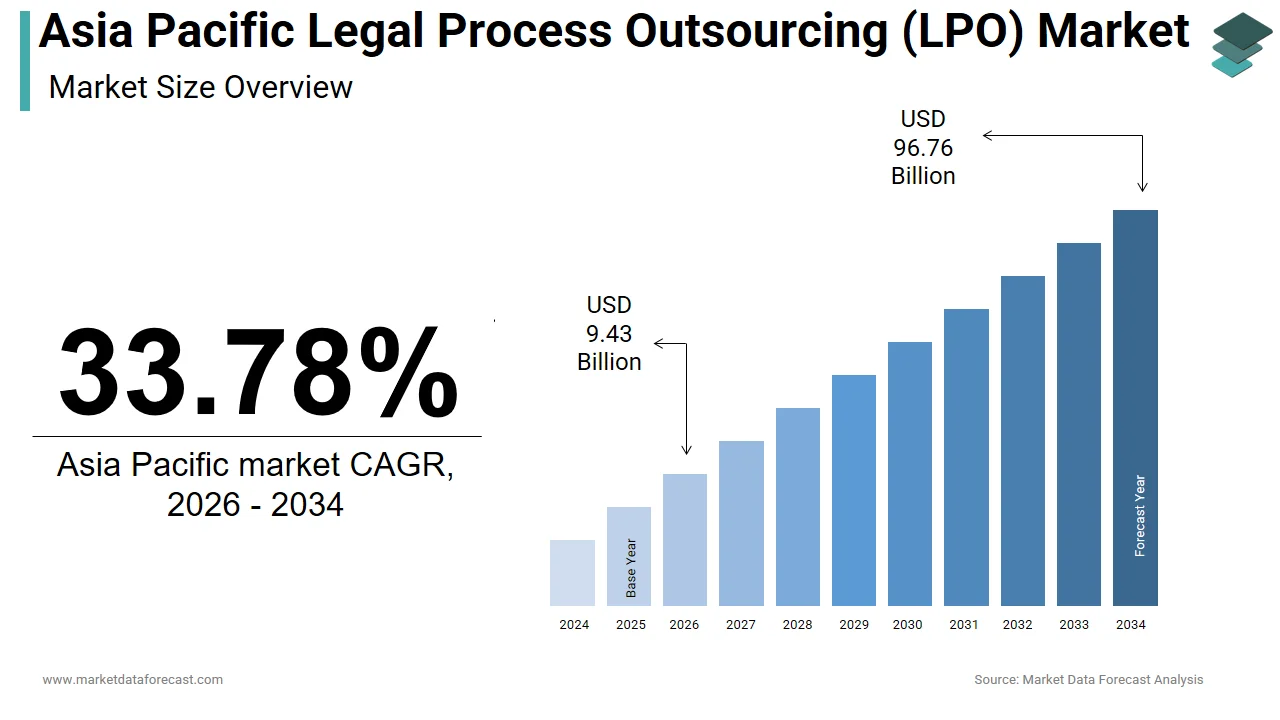
The Asia Pacific legal process outsourcing (LPO) market size was estimated at USD 7.05 billion in 2025, USD 9.43 billion in 2026, and is projected to reach USD 96.76 billion by 2034, growing at a CAGR of 33.78% from 2026 to 2034. The market growth is driven by escalating legal complexity, expansion of cross-border commercial activities, and increasing adoption of AI-powered legal technologies.
Key Market Trends & Insights
- India held the largest share of the Asia Pacific LPO market in 2025.
- Australia is emerging as a premium destination for high-compliance, onshore LPO services.
- Based on location, the offshore segment dominated the market in 2025.
- Based on service, the litigation support was the leading segment in 2025.
Market Size & Forecast
- 2025 Market Size: USD 7.05 Billion
- 2026 Market Size: USD 9.43 Billion
- 2034 Projected Market Size: USD 96.76 Billion
- CAGR (2026 to 2034): 33.78%
- India: Largest market in 2025
- Australia: Fast-growing premium LPO destination
Asia Pacific Legal Process Outsourcing (LPO) Market Size
The size of the Asia Pacific legal process outsourcing market was worth USD 7.05 billion in 2025. The regional market is anticipated to grow at a CAGR of 33.78% from 2026 to 2034 and be worth USD 96.76 billion by 2034 from USD 9.43 billion in 2026.
Legal process outsourcing (LPO) refers to the delegation of legal support functions such as contract review, due diligence, legal research, compliance management, and e-discovery by law firms, corporate legal departments, and regulatory bodies to third-party service providers located within the region. Unlike general legal consultancy, LPO focuses on non-core, repetitive, or volume-intensive legal tasks that can be executed remotely with high accuracy and lower operational cost. The sector has evolved beyond mere cost arbitrage to include advanced services powered by legal technology, including AI-driven document analysis and regulatory monitoring platforms. A key enabler of this transformation is the region’s growing pool of English-proficient legal professionals. Additionally, Urbanization and digital infrastructure development have further accelerated the adoption of secure data transmission and cloud-based legal workspaces. These structural advantages position the region as a strategic hub for scalable, compliant, and technologically integrated legal support services.
MARKET DRIVERS
Escalating Legal Complexity and Regulatory Burden in Corporate Operations
Corporate entities across the Asia Pacific are facing an unprecedented surge in regulatory demands, driving the need for scalable legal support through outsourcing. In India, the implementation of the Digital Personal Data Protection Act 2023 has mandated extensive contractual revisions and vendor audits, requiring thousands of hours of legal review across industries. Multinational corporations operating across multiple jurisdictions face cumulative compliance obligations, making in-house management inefficient. For instance, a single cross-border acquisition may require parallel reviews under Australia’s FIRB regulations, Japan’s Antimonopoly Act, and India’s Competition Act tasks which are both time-consuming and resource-intensive. To manage this burden, firms are increasingly turning to LPO providers with multi-jurisdictional expertise. This institutional shift toward externalized legal capacity is transforming LPO from a cost-saving tool into a strategic necessity for regulatory resilience.
Expansion of Cross-Border Commercial Activity and M&A Transactions
The surge in cross-border trade, foreign direct investment (FDI), and mergers and acquisitions across the Asia Pacific is a critical catalyst for the growth of legal process outsourcing. Each transaction typically involves the review of tens of thousands of documents, including leases, employment contracts, intellectual property registrations, and litigation histories, workloads that are efficiently managed by LPO firms using document management platforms and AI-assisted review tools. Besides, the Regional Comprehensive Economic Partnership (RCEP) agreement, which links 15 Asia Pacific economies, has standardized certain legal documentation requirements, enabling LPO providers to develop scalable templates and workflows. With transaction complexity rising and internal legal teams constrained by bandwidth, the reliance on specialized external legal support has become indispensable for timely deal execution.
MARKET RESTRAINTS
Data Privacy and Cross-Border Data Transfer Regulations
The Asia Pacific legal process outsourcing market faces significant constraints due to the fragmented and evolving landscape of data protection laws, which complicate the transfer and processing of sensitive legal information. While countries like Australia and New Zealand have comprehensive data privacy regimes aligned with global standards, others, such as Indonesia and Thailand, have introduced strict localization mandates. These regulatory disparities increase compliance costs and operational delays for multinational legal service providers. Moreover, law firms in the United States and the European Union are increasingly reluctant to share client data with offshore vendors unless they meet GDPR or ABA Model Rule 1.6 standards, which many regional LPOs have yet to fully certify. These legal and technical barriers hinder scalability and deter high-value, data-intensive legal work from being outsourced to the region.
Perceived Quality and Professional Accountability Concerns
Despite advancements in training and technology, the Asia Pacific LPO market continues to contend with skepticism regarding the quality, consistency, and professional accountability of outsourced legal work. This perception is particularly pronounced in complex areas such as intellectual property litigation or securities regulation, where local precedents and statutory interpretations are critical. Additionally, the absence of uniform licensing or accreditation for LPO professionals means that quality assurance relies heavily on individual firm standards rather than regulatory oversight. Although many LPO providers now employ certified legal analysts and use AI validation tools, the lack of a standardized professional framework continues to impede trust, especially among conservative legal institutions in North America and Western Europe.
MARKET OPPORTUNITIES
Integration of Artificial Intelligence and Legal Technology in Service Delivery
The convergence of artificial intelligence (AI), machine learning, and legal technology presents a transformative opportunity for the Asia Pacific LPO market to transition from labor-intensive operations to high-value, tech-enabled legal solutions. Providers are increasingly deploying AI-powered tools for contract analysis, clause extraction, and predictive coding in e-discovery, significantly enhancing accuracy and throughput. Furthermore, blockchain-based audit trails are being piloted to ensure data integrity and chain-of-custody compliance in litigation support. With global law firms demanding faster, more transparent, and auditable processes, the integration of legal tech enables regional providers to compete on capability rather than cost alone, unlocking access to premium legal workflows in intellectual property, compliance monitoring, and risk assessment.
Rising Demand for Compliance and Regulatory Advisory Services in Emerging Markets
Emerging economies across the Asia Pacific are undergoing rapid regulatory modernization, creating a surge in demand for specialized compliance and legal advisory services that LPO providers are well-positioned to deliver. These regulatory shifts have outpaced the internal capacity of local legal departments, prompting firms to outsource compliance monitoring, policy drafting, and audit preparation. LPO providers with expertise in international standards such as ISO 19600 (compliance management) and SASB frameworks are increasingly engaged to bridge the knowledge gap. Besides, multinational corporations entering these markets rely on LPOs to navigate complex licensing and foreign ownership rules. With regulatory complexity expected to grow, the region’s LPO sector is poised to become a critical enabler of legal compliance and corporate governance in high-growth emerging economies.
MARKET CHALLENGES
Talent Retention and Specialization Gaps in Legal Workforce Development
The Asia Pacific LPO market faces a growing challenge in retaining skilled legal professionals and developing specialized expertise in high-demand domains such as intellectual property, cybersecurity law, and international arbitration. While the region produces a large number of law graduates, only a few receive training in niche legal processes or technology-assisted review, limiting their readiness for advanced LPO roles. Moreover, the lack of formal certification programs in legal process management means that upskilling is often company-specific and non-transferable. In contrast, jurisdictions like Singapore and Australia offer structured legal technology certifications, but access remains limited in tier-two cities. The shortage of professionals trained in e-discovery platforms such as Relativity or Nuix further constrains service scalability. Without standardized training pipelines and competitive career progression, LPO providers struggle to build deep expertise, undermining their ability to handle complex, high-value legal workflows and maintain long-term client trust.
Geopolitical and Regulatory Fragmentation Across Jurisdictions
The Asia Pacific LPO market operates within a highly fragmented legal and geopolitical landscape, where divergent legal systems, language barriers, and bilateral relations complicate cross-border service delivery. The region encompasses civil law, common law, and hybrid legal frameworks, requiring LPO providers to maintain jurisdiction-specific expertise for accurate legal interpretation. Also, discrepancies in evidence admissibility, attorney-client privilege, and discovery rules between countries like Japan, India, and Australia create operational hurdles for unified legal workflows. Additionally, geopolitical tensions, such as those between China and several Southeast Asian nations over maritime disputes, have led to increased scrutiny of data flows and Foreign Service providers. Also, Australia’s Foreign Influence Transparency Scheme now requires disclosure of contracts involving legal work for foreign governments, adding compliance layers for LPOs engaged in public sector projects. These regulatory and political frictions increase operational complexity, deter investment, and limit the harmonization of legal processes, forcing providers to adopt siloed, market-specific strategies that reduce efficiency and scalability.
REPORT COVERAGE
| REPORT METRIC | DETAILS |
| Market Size Available | 2025 to 2034 |
| Base Year | 2025 |
| Forecast Period | 2026 to 2034 |
| Segments Covered | By Location, Service, and Region. |
| Various Analyses Covered | Global, Regional and Country-Level Analysis, Segment-Level Analysis, Drivers, Restraints, Opportunities, Challenges; PESTLE Analysis; Porter’s Five Forces Analysis, Competitive Landscape, Analyst Overview of Investment Opportunities |
| Countries Covered | India, China, Japan, South Korea, Australia, New Zealand, Thailand, Malaysia, Vietnam, Philippines, Indonesia, Singapore, Rest of APAC |
| Market Leaders Profiled | Crane Co., Advantech Co. Ltd., Azkoyen Group, FAS International S.p.A., Bianchi Vending Group S.p.A., Rhea Vendors Group, N&W Global Vending S.p.A., Westomatic Vending Services Ltd., Seaga, Jofemar, Sanden Corp., and Royal Vendors. |
SEGMENTAL ANALYSIS
By Location Insights
The offshore segment dominated the Asia Pacific legal process outsourcing market by capturing 62.5% of total revenue in 2024. This dominance is primarily driven by the compelling cost advantage and access to large pools of English-proficient legal talent in countries like India, the Philippines, and Malaysia. The Philippines has emerged as a key hub for transcription, contract management, and litigation support. Additionally, time zone alignment with North America allows for 24-hour workflow continuity, particularly for e-discovery and due diligence projects. Multinational law firms such as Clifford Chance and Baker McKenzie have institutionalized offshore LPO units in Mumbai and Manila to handle high-volume document review. With mature delivery models, robust infrastructure, and scalable talent pipelines, offshore LPO remains the cornerstone of legal cost optimization in the region.
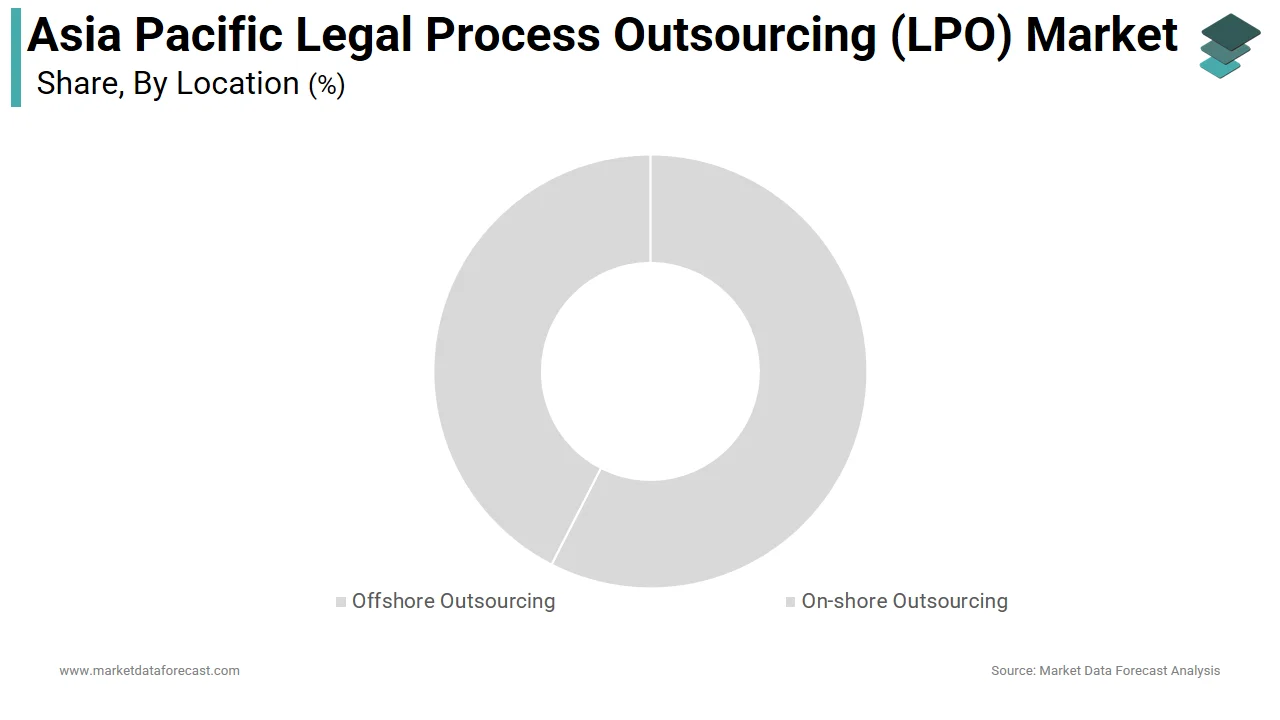
The onshore LPO segment is experiencing rapid growth and is expanding at a compound annual growth rate of 11.3% from 2023 to 2028, according to KPMG’s Asia Pacific Legal Innovation Survey. This acceleration is fueled by increasing concerns over data privacy, regulatory compliance, and the need for jurisdiction-specific legal expertise. Onshore LPO providers in Singapore, South Korea, and New Zealand are capitalizing on this trend by offering secure, compliant legal support for corporate investigations, regulatory filings, and internal audits. These providers combine local legal expertise with advanced legal technology, ensuring adherence to national procedural rules and attorney-client privilege standards. As data sovereignty becomes a non-negotiable requirement, particularly in financial, healthcare, and government sectors, onshore LPO is emerging as a premium, trust-based alternative to offshore models.
By Service Insights
The litigation support segment was the largest service within the Asia Pacific legal process outsourcing market by accounting for 44.3% of total revenue in 2024. This dominance stems from the growing volume and complexity of commercial disputes, regulatory investigations, and class-action lawsuits across the region. In India, the National Judicial Data Grid reports that over 48 million cases are pending in district and high courts, creating a sustained demand for document management, witness statement compilation, and trial preparation services. LPO providers are increasingly engaged to manage discovery workflows, including document indexing, privilege logging, and deposition summarization. Providers such as UnitedLex and Elevate have established regional hubs to support these high-stakes cases with AI-assisted review platforms. The integration of legal project management methodologies has further enhanced efficiency, reducing litigation cycle times. With litigation volumes rising and in-house legal teams under pressure, litigation support remains the most critical and scalable LPO service.
The patent support segment is the fastest-growing LPO service in the Asia Pacific and is registering a CAGR of 13.7% from 2026 to 2034. This surge is driven by the region’s transformation into a global innovation hub, with a year-on-year increase in patent filings between 2022 and 2023. LPO providers in India and the Philippines have developed specialized teams of engineers with legal training to handle complex patent analytics and claim charting. Additionally, the rise of green technology and semiconductor innovation has intensified demand for patent landscaping and freedom-to-operate analyses. Firms like CPA Global and Anaqua have partnered with LPOs in Chennai and Manila to scale their patent operations. With intellectual property becoming a strategic asset in global competition, patent support is evolving into a high-value, knowledge-intensive LPO domain.
COUNTRY-LEVEL ANALYSIS
India Legal Process Outsourcing (LPO) Market Insights
India held the leading position in the Asia Pacific legal process outsourcing market by contributing 45.6% of regional revenue in 2024. The country’s dominance is anchored in its vast supply of English-speaking law and engineering graduates, cost efficiency, and well-established delivery infrastructure. With a large number of law graduates produced since 2015, India offers a deep talent pool for roles in e-discovery, contract management, and patent support. Major global law firms and corporate legal departments have established captive centers in cities like Mumbai, Bengaluru, and Hyderabad, while third-party providers such as Integreon and QuisLex operate at scale. The government’s Digital India initiative has enhanced broadband connectivity and data security standards, enabling seamless cross-border operations. Besides, India’s common law system aligns closely with jurisdictions like the U.S. and U.K., reducing legal interpretation gaps. The presence of global legal tech hubs and AI training academies further strengthens service quality. With continuous investment in upskilling and technology integration, India remains the undisputed leader in offshore legal services, serving as the backbone of global legal operations for Fortune 500 companies.
Australia Legal Process Outsourcing (LPO) Market Insights
Australia is also a key player in the Asia Pacific LPO market. The country has emerged as a strategic hub for onshore and nearshore legal support, particularly for high-compliance, data-sensitive work. Australian law firms and corporations increasingly outsource litigation support, regulatory compliance, and corporate governance tasks to local LPO providers to meet strict data privacy requirements under the Privacy Act 1988. Sydney and Melbourne host advanced legal operations centers that integrate AI tools for e-discovery and contract analytics. The country also serves as a gateway for legal services into the Pacific Islands and Southeast Asia, leveraging its regulatory expertise and stable legal framework. With a strong emphasis on professional standards and ethical compliance, Australia is positioning itself as a premium destination for secure, high-integrity legal outsourcing, particularly in financial services and healthcare sectors.
Singapore Legal Process Outsourcing (LPO) Market Insights
Singapore occupies a notable share of the Asia Pacific LPO market. The nation’s status as a global legal and financial hub has enabled it to develop a sophisticated onshore LPO ecosystem focused on cross-border dispute resolution, arbitration support, and regulatory compliance. The Singapore International Commercial Court attracts complex international cases, many of which require multilingual document management and e-discovery services provided by local LPO firms. The Smart Nation Initiative has facilitated the adoption of blockchain-based legal records and AI-powered contract review platforms, enhancing service precision. The Ministry of Law supports legal innovation through the LegalTech Office, which funds startups developing secure legal workflows. Additionally, Singapore’s neutral geopolitical stance and robust data protection laws under the Personal Data Protection Act (PDPA) make it a trusted node for handling sensitive legal data from across Asia. With strong government backing, world-class infrastructure, and a focus on high-value legal services, Singapore is redefining the role of LPO in the era of digital justice.
Philippines Legal Process Outsourcing (LPO) Market Insights
Philippines has established itself as a key player in voice-based and documentation-intensive legal services. The country’s high English proficiency, cultural affinity with Western legal systems, and competitive labor costs have attracted major contracts in legal transcription, deposition summarization, and litigation support. Firms such as One Legal and Metro Legal specialize in U.S.-bound litigation support, handling millions of pages of discovery annually. The government has launched the Legal Services Export Program to train law graduates in e-discovery platforms and U.S. procedural rules. With a growing focus on upskilling and technology adoption, the Philippines is transitioning from a cost-driven to a capability-driven LPO destination, particularly in high-volume, time-sensitive legal workflows.
China Legal Process Outsourcing (LPO) Market Insights
China is increasingly recognized for its expertise in patent support and regulatory compliance. The country’s surge in innovation has led to a massive demand for patent drafting, prior art searches, and IP portfolio management. LPO providers in Beijing, Shanghai, and Shenzhen are staffed with technical specialists who combine engineering degrees with legal training to handle complex IP workflows. Besides, foreign companies operating in China rely on local LPO firms to navigate regulatory filings under the Cybersecurity Law and Data Security Law. While data localization remains a challenge, China’s focus on high-value, technology-driven legal services positions it as a critical player in the future of IP-centric LPO in the region.
COMPETITIVE LANDSCAPE
The competition in the Asia Pacific legal process outsourcing market is characterized by a dynamic convergence of global legal service providers, specialized LPO firms, and captive centers, all vying to deliver cost-effective, secure, and technologically advanced legal support. Traditional dominance by Indian offshore providers is being challenged by the rise of onshore and nearshore models in Australia, Singapore, and Japan, driven by data privacy regulations and demand for jurisdiction-specific expertise. Multinational law firms are institutionalizing in-house LPO units, while independent providers differentiate through AI integration, niche specialization, and vertical-specific solutions. The Philippines and Vietnam are emerging as alternative hubs, offering competitive labor costs and improving legal English proficiency. At the same time, clients are increasingly demanding transparency, scalability, and compliance assurance, pushing providers to adopt standardized quality frameworks and cybersecurity certifications. The proliferation of legal tech platforms has lowered entry barriers, enabling agile startups to compete with established players. As regulatory complexity, cross-border litigation, and intellectual property disputes grow, competition is shifting from cost arbitrage to capability, innovation, and trust, reshaping the strategic landscape of legal support in the region.
KEY MARKET PLAYERS
Some of the noteworthy companies in the Asia Pacific legal process outsourcing market profiled in this report are
- Crane Co.
- Advantech Co. Ltd.
- Azkoyen Group
- FAS International S.p.A.
- Bianchi Vending Group S.p.A.
- Rhea Vendors Group
- N&W Global Vending S.p.A.
- Westomatic Vending Services Ltd.
- Seaga
- Jofemar
- Sanden Corp.
- Royal Vendors
TOP LEADING PLAYERS IN THE MARKET
- Integreon has established itself as a leading legal process outsourcing provider in the Asia Pacific through its hybrid delivery model and deep integration of legal technology. The company operates major centers in India and the Philippines, offering services in e-discovery, contract lifecycle management, and litigation support to global law firms and corporate legal departments. In recent years, Integreon has intensified its focus on AI-driven solutions, launching its proprietary platform, Intell-AI, to automate document review and legal research. It has also partnered with Relativity and Microsoft to enhance data security and workflow efficiency. By combining scalable offshore resources with advanced legal tech, Integreon delivers precision and speed in complex legal workflows, particularly for U.S. and European clients navigating cross-border disputes and due diligence mandates.
- QuisLex has emerged as a transformative force in the Asia Pacific LPO market by pioneering a managed services model that blends legal expertise with technology-enabled efficiency. Headquartered in the U.S. but with extensive delivery operations in Bengaluru and Manila, the company specializes in contract management, compliance, and e-discovery for Fortune 500 corporations. The company has also invested in upskilling its workforce in data privacy laws such as GDPR and CCPA, enabling seamless handling of cross-border legal data. Its client-centric approach emphasizes transparency, with real-time dashboards and performance metrics. QuisLex has deepened its presence in the region by collaborating with Indian law schools to train graduates in legal project management and AI-assisted review. By focusing on quality, innovation, and long-term client partnerships, QuisLex has redefined the value proposition of LPO beyond cost reduction to strategic legal enablement.
- Clifford Chance Legal Services (CCLS), the dedicated legal operations arm of the global law firm Clifford Chance, plays a pivotal role in advancing onshore and offshore legal support in the Asia Pacific. Based in Belfast and Mumbai, CCLS delivers high-compliance legal processes including transaction support, regulatory reporting, and due diligence for complex cross-border deals. The firm also introduced a cybersecurity certification program for its offshore team to meet stringent data protection standards in Australia and Japan. By embedding LPO within a top-tier law firm’s ecosystem, CCLS ensures alignment with legal ethics, privilege, and quality control, setting a benchmark for institutionalized, high-integrity outsourcing in the region.
TOP STRATEGIES USED BY THE KEY MARKET PARTICIPANTS
Key players in the Asia Pacific legal process outsourcing market are leveraging technology integration, talent upskilling, geographic diversification, service specialization, and strategic client partnerships to strengthen their competitive positioning. Firms are investing in AI and machine learning platforms to automate document review, contract analysis, and e-discovery, enhancing accuracy and reducing turnaround time. Legal professionals are being trained in jurisdiction-specific regulations, data privacy laws, and legal tech tools to improve service quality and compliance. Providers are expanding delivery centers across multiple jurisdictions, such as India, the Philippines, and Malaysia, to balance cost efficiency with data sovereignty requirements. Specialization in high-value domains like patent support, regulatory compliance, and litigation analytics enables differentiation in a crowded market. Additionally, long-term managed services contracts and co-innovation initiatives with law firms and corporations are fostering deeper client integration, transforming LPO from a transactional function into a strategic legal operations partner.
RECENT MARKET DEVELOPMENTS
- In February 2023, Integreon launched its AI-powered platform Intell-AI in its Mumbai and Manila centers, enabling automated document classification and legal research, significantly improving accuracy and reducing processing time for e-discovery and compliance projects across Asia Pacific clients.
- In June 2023, QuisLex expanded its legal operations center in Hyderabad with a USD 15 million investment, adding 500 new workstations and integrating machine learning tools for contract lifecycle management, enhancing its capacity to serve global corporate clients.
- In September 2023, Clifford Chance Legal Services introduced a cybersecurity certification program for its Mumbai team, aligning with ISO 27001 and GDPR standards, strengthening client confidence in handling sensitive legal data from Australia, Japan, and Europe.
- In January 2024, Integreon partnered with Microsoft to deploy secure cloud-based legal workspaces in its Philippine operations, enabling real-time collaboration with law firms in North America while complying with cross-border data transfer regulations.
- In May 2024, QuisLex collaborated with the National Law School of India University to launch a legal operations training curriculum, equipping graduates with skills in AI-assisted review and legal project management, ensuring a steady pipeline of high-caliber talent for the LPO sector.
MARKET SEGMENTATION
This Asia Pacific legal process outsourcing market research report is segmented and sub-segmented into the following categories.
By Location
- Offshore Outsourcing
- On-shore Outsourcing
By Service
- Contract Drafting
- Review and Management
- Compliance Assistance
- E-discovery
- Litigation Support
- Patent Support
- Others
By Country
- India
- China
- Japan
- South Korea
- Rest Of Asia Pacific