- Product Description Description
- Table of Contents TOC
- List of Table & Figure LOT
- Get Free Sample PDF Sample PDF
Market Size, 2025
$82.58 BnMarket Estimate, 2026
$87.55 BnMarket Forecast, 2034
$139.75 BnCAGR, 2026–2034
6.02%Global Baby Food Market Summary
The global baby food market was valued at USD 82.58 billion in 2025 and is projected to reach USD 139.75 billion by 2034, growing at a CAGR of 6.02% from 2026 to 2034. With a forecasted market size of USD 87.55 billion in 2026 and an estimated value of USD 139.75 billion by 2034, the market is experiencing steady expansion, driven by increasing parental focus on infant nutrition, rising disposable incomes, and the growing participation of women in the workforce.
Baby foods are a wide range of nutritionally balanced food products designed for infants and toddlers aged 0–3 years. This includes infant milk formula, prepared baby food (purees, cereals, snacks), and growing-up milks. The market is shaped by evolving consumer preferences for organic, non-GMO, allergen-free, and functional ingredients that support immune health, digestion, and cognitive development.
Key Market Trends
- Rising demand for organic, hypoallergenic, and fortified baby food is reshaping product development and brand positioning.
- Expansion of premium and functional baby food with probiotics, prebiotics, and DHA is gaining traction globally.
- An increasing number of working mothers and busy urban lifestyles are boosting reliance on convenient, ready-to-feed baby nutrition.
- E-commerce and direct-to-consumer (DTC) brands are disrupting traditional distribution with personalized offerings and digital engagement.
Key Market Insights
- Based on product, the infant milk formula segment held the largest product share in 2025, driven by its critical role in early nutrition, especially in regions with low breastfeeding rates. Prepared baby food follows as a rapidly growing segment, fueled by demand for convenient, ready-to-eat meals with clean labels.
- Based on sales channel, offline retail channels—such as supermarkets, hypermarkets, and specialty health stores—led sales in 2025 due to consumer trust and product visibility. However, online retail is witnessing rapid growth, driven by e-commerce platforms, subscription models, and home delivery convenience.
- By region, Asia-Pacific dominates the global baby food market in terms of both size and innovation, supported by large birth populations, rising urbanization, and increasing awareness of scientific nutrition in countries like China and India.
- Europe ranks as the second-largest market, with strong consumer demand for organic, natural, and sustainably sourced baby food products.
- Danone SA, Mead Johnson & Company LLC, Perrigo Company PLC, Abbott Laboratories, The Campbell Soup Company, Hero Group, Bellamy's Organic Pty Ltd, H. J. Heinz Company, Hain Celestial Group, Royal Friesl, and Campina N.V. are a few of the promising players in the global baby food market.
Leading companies in the global baby food market are focusing on clean labeling, sustainability, and innovation in formulation and packaging to meet evolving regulatory standards and consumer expectations. With Asia-Pacific leading innovation and Europe maintaining high standards for quality, the global baby food industry is poised for sustained growth through 2034.
Global Baby Food Market Size
The size of the global baby food market was assessed to be USD 82.58 billion in 2025. The global market is further expected to grow at a CAGR of 6.02% from 2026 to 2034 and be valued at USD 139.75 billion by 2034 from USD 87.55 billion in 2026.
Baby Food is nutritionally formulated products designed for infants and toddlers aged 0–36 months, encompassing prepared formulas, purees, cereals, snacks, and growing-up milks. These products are engineered to meet developmental needs during early life stages, when dietary intake directly influences cognitive, immune, and physical growth.
MARKET DRIVERS
The increasing prevalence of working mothers and urbanization-driven lifestyle shifts are major attributes enhancing the growth of the Baby Food Market. As per the International Labour Organization, the global labor force participation rate for women with children under six reached 62% in 2023, with rates exceeding 70% in North America and Northern Europe. Additionally, the World Bank notes that 56% of the global population now resides in urban centers, where fast-paced routines and limited access to fresh cooking facilities further amplify demand for pre-packaged infant nutrition solutions.
The growing awareness of early-life nutrition and pediatric health outcomes is another factor amplifying the growth of the Baby Food Market. The Lancet’s 2021 Series on Early Childhood Development emphasized that 80% of brain development occurs within the first two years of life, with nutrition playing a decisive role in cognitive and behavioral outcomes. As per the American Academy of Pediatrics, infants who receive iron-fortified cereals and DHA-enriched formulas exhibit measurable improvements in neural connectivity and visual acuity. This evidence-based understanding has led to increased demand for products containing essential micronutrients such as zinc, vitamin D, and prebiotics. Additionally, healthcare professional endorsements and digital health education are amplifying consumer trust in commercial baby food. A 2023 survey by the European Society for Pediatric Gastroenterology, Hepatology, and Nutrition found that 64% of pediatricians in Western Europe recommend specific commercial brands due to standardized nutrient profiles and safety testing. Mobile health platforms such as the WHO’s “Parenting in Early Years” app and regional telehealth services now integrate feeding guidelines that reference commercial baby food as a viable option when breastfeeding is insufficient.
MARKET RESTRAINTS
The persistent preference for breastfeeding and cultural resistance to processed infant foods are restricting the growth of the Baby Food Market. The World Health Organization strongly advocates exclusive breastfeeding for the first six months of life, a recommendation supported by extensive clinical evidence showing reduced risks of infections, allergies, and obesity. As per UNICEF, only 48% of infants under six months are exclusively breastfed globally, but in countries like Ethiopia and Bangladesh, this rate exceeds 70%, reflecting deeply rooted cultural and public health norms.
The stringent regulatory scrutiny and compliance burden across geographies are restraining the growth of the Baby Food Market. Baby food formulations are subject to rigorous safety and labeling standards that vary significantly between jurisdictions, complicating multinational product development. The European Union’s Commission Directive 2006/125/EC sets precise limits on nutrient composition and contaminant levels for infant foods, while the U.S. FDA enforces Good Manufacturing Practices under the Infant Formula Act of 1980. As per the Global Food Safety Initiative, over 40% of new baby food product launches in 2022 were delayed due to regulatory alignment challenges across target markets. In China, the National Health Commission mandates pre-market registration for all infant formulas, a process that can take 12–18 months and requires clinical data submission.
The expansion of organic and clean-label baby food products is additionally to hinder the growth of the Baby Food Market. According to the Soil Association, sales of organic baby food in the UK grew by 18% in 2023, outpacing conventional product growth by a factor of three. Parents are increasingly avoiding synthetic additives, preservatives, and genetically modified ingredients, favoring products labeled “no added sugar,” “non-GMO,” and “free from pesticides.” Additionally, e-commerce and direct-to-consumer (DTC) models are enabling niche brands to reach discerning parents with specialized offerings. Companies like Yumi and Little Spoon in the U.S. use subscription-based platforms to deliver fresh, chef-prepared, and pediatrician-approved meals tailored to developmental stages.
MARKET OPPORTUNITIES
The rising demand for functional and medically tailored baby foods is solely to enhance the growth of the Baby Food Market. A growing number of infants present with food allergies, digestive sensitivities, or metabolic disorders, necessitating specialized formulations. According to the American Academy of Allergy, Asthma & Immunology, the prevalence of peanut allergy in U.S. children has tripled since 2010, reaching 2.5%, while cow’s milk allergy affects 2–3% of infants globally. This has spurred demand for hypoallergenic, amino acid-based, and hydrolyzed protein formulas.
The supply chain vulnerability and ingredient sourcing instability additionally expected to further escalate the growth of the Baby Food Market. Infant formulas and purees require high-purity raw materials such as organic grains, dairy proteins, and single-origin fruits sourced under strict hygienic and traceability conditions. According to the Food and Agriculture Organization, climate change has disrupted crop yields for key ingredients like oats and apples, with global apple production declining by 7% in 2022 due to extreme weather in major growing regions. Additionally, geopolitical disruptions and trade restrictions impact access to essential nutrients. China produces over 80% of the world’s vitamin B12, an additive in fortified cereals, making the supply chain vulnerable to export controls. The 2022 global logistics crisis delayed shipments of hydrolyzed whey protein to European manufacturers by up to 14 weeks, as reported by the International Special Dietary Foods Industries (ISDI). These disruptions not only delay production but also increase costs and risk contamination due to rushed sourcing alternatives.
MARKET CHALLENGES
The evolving consumer awareness and misinformation in digital spaces are likely to degrade the growth of the Baby Food Market. A 2023 report by the London School of Hygiene & Tropical Medicine found that 54% of parenting groups on Facebook and Reddit contained misinformation about infant formula safety, including unfounded links to autism and gut damage. This digital echo chamber amplifies fear around ingredients like palm oil, carrageenan, and synthetic vitamins, even when deemed safe by EFSA and FDA. Moreover, the lack of standardized labeling and greenwashing further confuses consumers. Terms such as “natural,” “holistic,” and “doctor-approved” are frequently used without regulatory definition, leading to consumer distrust. As per the European Consumer Organisation (BEUC), 62% of surveyed parents in 2023 could not distinguish between legally defined organic labels and marketing claims on packaging. This ambiguity undermines legitimate brands investing in compliance and transparency. Regulatory bodies are struggling to keep pace with digital influence, leaving manufacturers to combat misinformation through costly education campaigns.
REPORT COVERAGE
| REPORT METRIC | DETAILS |
| Market Size Available | 2025 to 2034 |
| Base Year | 2025 |
| Forecast Period | 2026 to 2034 |
| CAGR | 6.02% |
| Segments Covered | By Product Type, Sales Channel, and Region |
| Various Analyses Covered | Global, Regional, & Country Level Analysis; Segment-Level Analysis, DROC, PESTLE Analysis, Porter’s Five Forces Analysis, Competitive Landscape, Analyst Overview of Investment Opportunities |
| Regions Covered | North America, Europe, APAC, Latin America, Middle East & Africa |
| Market Leaders Profiled | Danone SA, Mead Johnson & Company LLC, Perrigo Company PLC, Abbott Laboratories, The Campbell Soup Company, Hero Group, Bellamy's Organic Pty Ltd, H. J. Heinz Company, Hain Celestial Group, Royal Friesl and Campina N.V. |
SEGMENTAL ANALYSIS
Global Baby Food Market Analysis By Product
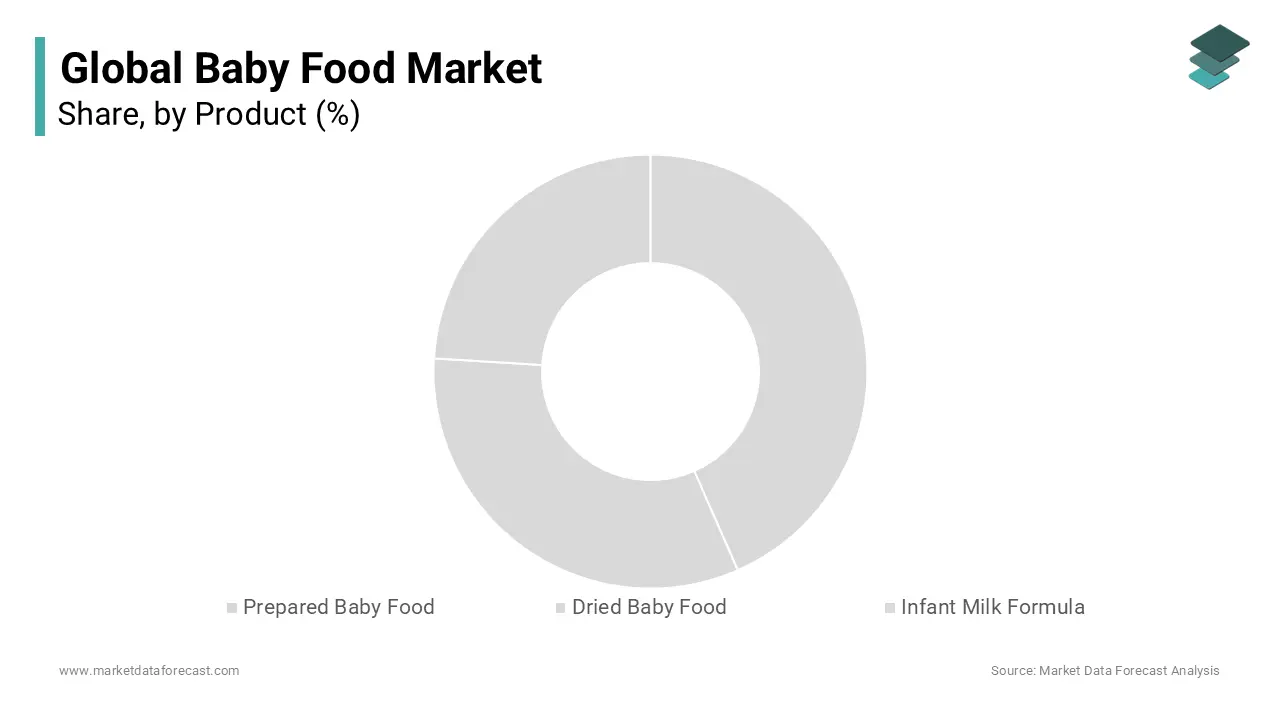
The milk formula segment dominated the global baby food market by capturing 52.3% of share in 2025. According to the World Health Organization, only 48% of infants under six months are exclusively breastfed globally, leaving a substantial proportion dependent on infant formula. In urban China, a 2023 National Health Commission survey revealed that 68% of newborns receive formula within the first week of life, often due to maternal employment, perceived low milk supply, or medical necessity.
The prepared baby food segment is projected to grow at a CAGR of 10.8% in the coming years, with the rising adoption of complementary feeding practices and demand for convenient, ready-to-eat meals as infants transition from liquid to solid diets. According to UNICEF, only 55% of children aged 6–8 months globally receive foods that meet minimum dietary diversity, prompting parents and health authorities to seek nutritionally balanced off-the-shelf options. Additionally, product innovation and clean-label positioning are driving consumer preference. Brands such as Hero Baby, Plum Organics, and Nestlé Gerber have introduced refrigerated, organic, and single-ingredient purees with transparent sourcing claims, appealing to health-conscious parents.
Global Baby Food Market Analysis By Sales Channel
The offline sales channel segment was the largest by occupying a significant share of the Baby Food Market in 2025, with deep-rooted consumer habits, in-store availability, and healthcare provider influence in traditional retail environments. Supermarkets, hypermarkets, and pharmacies remain primary points of purchase, particularly in regions where digital infrastructure is underdeveloped or consumer trust in e-commerce is limited.
The online sales channel segment is projected to grow at a CAGR of 14.2% during the forecast period, with the increasing digital literacy of millennial and Gen Z parents, who favor seamless, subscription-based purchasing models. In the United States, 56% of parents with infants now buy baby food online at least once a month, as reported by the National Retail Federation, with platforms like Amazon, Walmart+, and specialized DTC brands leading adoption. The rise of mobile commerce and same-day delivery services has eliminated traditional barriers of accessibility and immediacy.
REGIONAL ANALYSIS
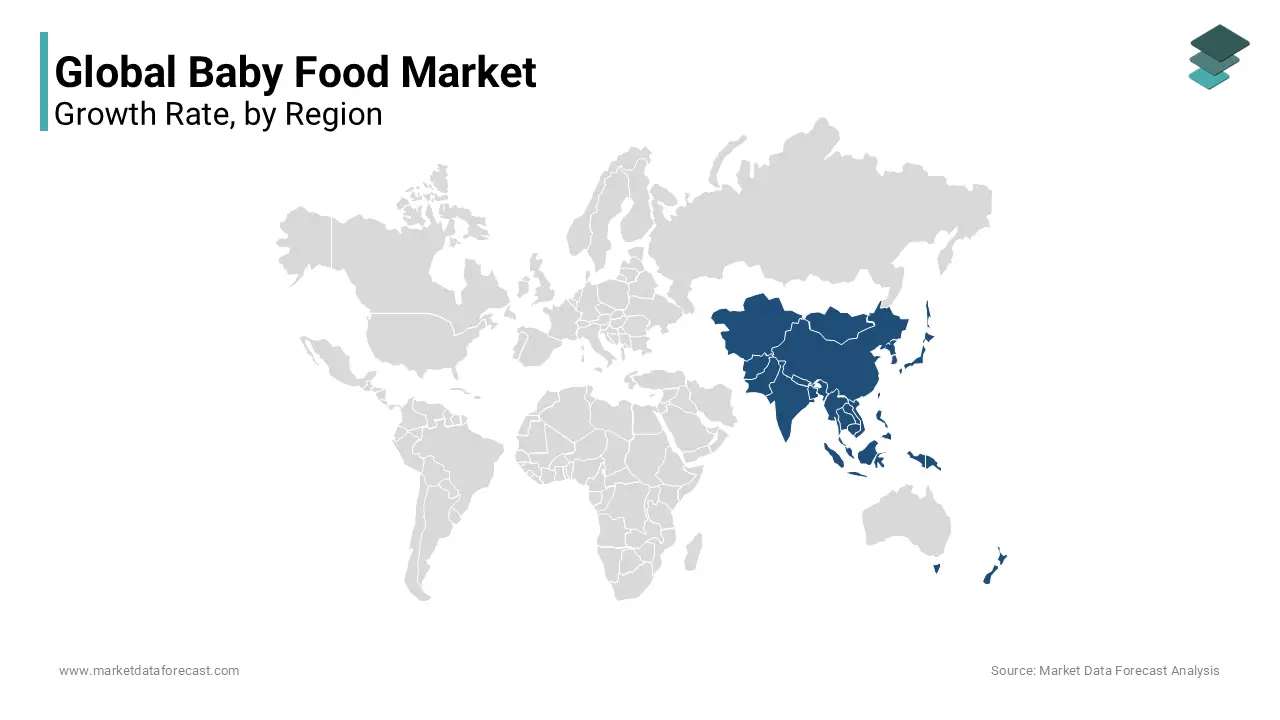
North America was the largest contributor to the global baby food market by accounting for 31.3% of share in 2025 with anchored in high per capita expenditure, advanced regulatory frameworks, and strong integration of infant nutrition into public health policy. In the United States, the Special Supplemental Nutrition Program for Women, Infants, and Children (WIC) provides formula and baby food to over 6 million low-income mothers annually, shaping consumption patterns and brand accessibility. According to the CDC, 74% of infants in the U.S. receive some form of commercial formula in their first year, reflecting widespread reliance on manufactured nutrition.
Europe was positioned second by holding 28.3% of the Baby Food Market share in 2025, with Germany, France, and the U.K., where stringent safety standards and high consumer awareness drive premium product adoption. As per the European Food Safety Authority, over 90% of infant formulas sold in the EU now contain DHA and prebiotics. Additionally, the EU’s organic farming regulation (EU 2018/848) has spurred growth in organic baby food, with countries like Austria and Sweden reporting over 40% market penetration. Retailers such as Carrefour and Tesco enforce private quality standards, further elevating product expectations and fostering innovation in clean-label and functional formulations.
The Asia-Pacific (APAC) Baby Food Market is likely to have significant growth opportunities in the coming years. China is the largest contributor in APAC, where concerns over food safety scandals have increased trust in branded, imported infant formula. According to China’s National Health Commission, domestic production of infant formula fell to 30% of the market in 2023, with parents preferring Australian, New Zealand, and European imports. India’s baby food market is growing at 12.5% annually, as per the Federation of Indian Chambers of Commerce & Industry, driven by increasing awareness among urban mothers.
LEADING PLAYERS IN THE BABY FOOD MARKET
Nestlé has established a foundational presence in the Asia Pacific baby food market through localized product development and robust distribution networks. The company’s Gerber and NAN brands are widely recognized across Japan, Australia, China, and Southeast Asia, where they offer stage-specific formulas, organic purees, and fortified cereals aligned with regional dietary preferences. Nestlé has invested in research centers in Singapore and Shanghai to tailor formulations to Asian infants’ nutritional needs, including reduced iron levels and rice-based alternatives. In 2023, the company launched a clean-label Gerber line in India with no added sugars or artificial preservatives, responding to rising consumer demand for transparency. Additionally, Nestlé collaborates with maternal health clinics in Indonesia and Thailand to provide feeding education, reinforcing brand trust and accessibility in both urban and semi-rural communities.
Danone plays a transformative role in the Asia Pacific infant nutrition landscape, particularly through its Aptamil and Nutricia brands, which emphasize science-led formulations. The company has prioritized the integration of human milk oligosaccharides (HMOs) and probiotics into its infant formulas sold in Australia, South Korea, and Hong Kong, aligning with clinical research on gut health and immunity. Danone’s partnership with the National University of Singapore has enabled localized clinical trials to validate product efficacy for Asian infants.
FrieslandCampina has significantly influenced infant nutrition standards in the Asia Pacific through its Dutch Lady and Friso brands, known for premium dairy-based formulas. The company sources milk from grass-fed cows in the Netherlands and New Zealand, emphasizing purity and traceability—key selling points in safety-conscious markets like China and Taiwan. FrieslandCampina has established cold-chain logistics networks to ensure product integrity across Southeast Asia’s tropical climates. In 2023, it introduced a new line of partially hydrolyzed formulas in Thailand targeting infants at risk of cow’s milk allergy, supported by pediatric endorsements.
TOP STRATEGIES USED BY KEY MARKET PARTICIPANTS
Key players in the Baby Food Market employ a range of strategic initiatives to strengthen their global and regional positions. Major companies prioritize product innovation by incorporating advanced nutrients such as HMOs, probiotics, and DHA to align with pediatric research and differentiate offerings. Geographic expansion, particularly into high-growth Asia Pacific and African markets, is pursued through localized formulations, halal certification, and partnerships with healthcare providers. Strategic acquisitions and joint ventures enable access to new technologies and distribution channels. Digital engagement through parenting apps, e-commerce platforms, and social media campaigns enhances consumer loyalty.
KEY MARKET PLAYERS AND COMPETITION OVERVIEW
Companies such as Danone SA, Mead Johnson & Company LLC, Perrigo Company PLC, Abbott Laboratories, The Campbell Soup Company, Hero Group, Bellamy's Organic Pty Ltd, H. J. Heinz Company, Hain Celestial Group, Royal Friesl, and Campina N.V. are currently playing a leading role in the global baby food market and are profiled in this report.
The competition in the Baby Food Market is characterized by a blend of scientific differentiation, brand trust, and strategic localization. Multinational corporations dominate due to their R&D capabilities, regulatory expertise, and extensive distribution networks, particularly in safety-sensitive categories like infant formula. However, regional players and emerging DTC brands are gaining traction by offering organic, clean-label, and culturally relevant products that appeal to health-conscious parents. The market is highly sensitive to safety scandals and misinformation, making reputation management crucial. Companies differentiate through clinical validation, transparent sourcing, and digital engagement.
RECENT HAPPENINGS IN THE MARKET
- In January 2022, Nestlé launched a clean-label Gerber range in India with no added sugars or artificial preservatives by targeting health-conscious urban parents and aligning with the rising demand for transparent, minimally processed baby food in emerging markets.
- In June 2022, Danone introduced HMO-enriched Aptamil formulas in South Korea and Hong Kong, leveraging clinical research on immune support to strengthen its science-based positioning in premium infant nutrition across East Asia.
- In September 2022, FrieslandCampina expanded its halal-certified production facility in Malaysia, enabling increased supply of Friso brand infant formula to Indonesia and Brunei, two of the largest Muslim-majority markets in Southeast Asia.
- In March 2023, Nestlé partnered with maternal health clinics in Indonesia to distribute feeding education materials and sample packs by enhancing brand accessibility and trust in semi-urban and rural communities.
- In November 2023, Danone launched a digital parenting platform in the Philippines, offering personalized feeding advice and e-commerce integration, which is strengthening consumer engagement and direct-to-consumer reach in a rapidly digitizing market.
MARKET SEGMENTATION
This research report on the global baby food market has been segmented and sub-segmented based on product, sales channel, & region.
By Product
- Prepared Baby Food
- Dried Baby Food
- Infant Milk Formula
- Others (Biscuits, Puffs, and Snacks)
By Sales Channel
- Offline
- Online
By Region
- North America
- Europe
- Asia-Pacific
- Latin America
- Middle East and Africa