- Product Description Description
- Table of Contents TOC
- List of Table & Figure LOT
- Get Free Sample PDF Sample PDF
Market Size, 2025
$1.09 BnMarket Estimate, 2026
$1.15 BnMarket Forecast, 2034
$1.78 BnCAGR, 2026–2034
5.6%Global Carrageenan Market Summary
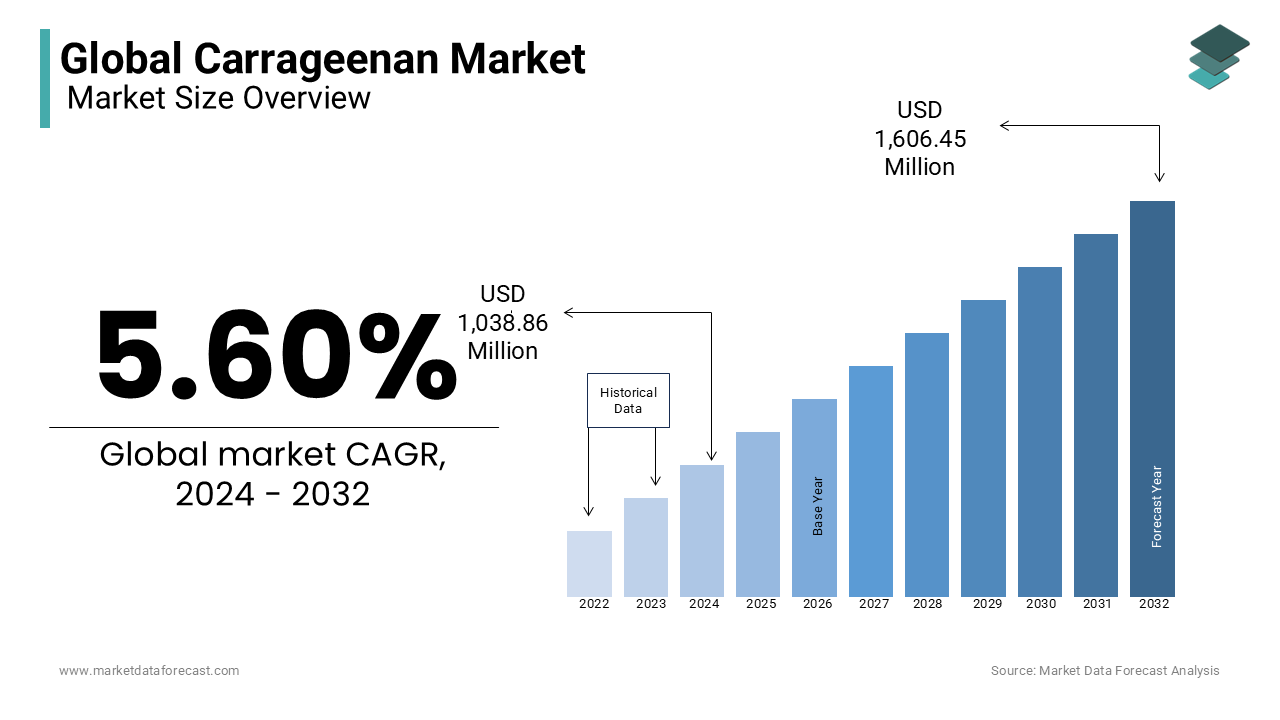
The global carrageenan market size was valued at USD 1.09 billion in 2025 and is projected to reach USD 1.78 billion by 2034, growing at a CAGR of 5.60% during the forecast period. With a forecasted market size of USD 1.15 billion in 2026, the industry is experiencing steady growth, driven by rising demand for natural hydrocolloids as thickening, gelling, and stabilizing agents across food & beverage, pharmaceuticals, and personal care industries.
The carrageenan market is involved in the production and distribution of carrageenan, a natural polysaccharide extracted from red seaweed (such as Chondrus crispus and Eucheuma species). It is widely used as a plant-based texturizing agent in dairy products, plant-based alternatives, processed meats, beverages, and pharmaceutical formulations due to its excellent gelling, emulsifying, and water-binding properties.
Key Market Trends
- Rising demand for vegan and plant-based food products is boosting carrageenan adoption as a sustainable gelling agent.
- Increasing focus on clean-label and natural ingredients is driving the replacement of synthetic additives with carrageenan.
- Expansion of the dairy alternatives market (e.g., almond milk, oat milk) is creating new growth avenues for carrageenan manufacturers.
- Innovations in semi-refined and specialty carrageenan grades are enhancing functionality and broadening application scope.
Key Market Insights
- Based on type, the kappa carrageenan segment held the largest market share in 2025, owing to its strong gelling capability and widespread use in dairy and meat products.
- Based on grade, the refined carrageenan segment dominated the market in 2025, preferred for its high purity, clarity, and superior functional performance in sensitive applications.
- Based on application, the food industry is expected to register the fastest growth rate during the forecast period, fueled by increasing demand for clean-label ingredients, plant-based meat and dairy alternatives, and processed convenience foods.
- Regionally, the Asia Pacific is anticipated to maintain a dominant share of the global carrageenan market, supported by abundant seaweed cultivation in countries like Indonesia, the Philippines, and Malaysia, along with growing industrial demand and expanding food processing sectors.
- Prominent companies in the global carrageenan market include DuPont (U.S.), Cargill (U.S.), Kerry Group (Ireland), CP Kelco (U.S.), Ashland Inc. (U.S.), Ingredion (U.S.), Danisco A/S, TIC Gums (U.S.), Gum Technology Corporation, Ingredients Solutions Inc., Gelymar S.A., Soriano S.A., Shemberg Marketing Corporation, Marcel Trading Corporation, Scalzo Food Industries, Altrafine Gums, and Tate & Lyle (U.K.), who are investing in sustainable sourcing, R&D, and strategic partnerships to meet evolving industry demands.
With Asia Pacific leading production and global demand rising across food and specialty applications, the carrageenan market is poised for sustained growth through 2034.
Global Carrageenan Market Size
The global carrageenan market size was calculated to be USD 1.09 billion in 2025 and is anticipated to be worth USD 1.78 billion by 2034, from USD 1.15 billion in 2026, growing at a CAGR of 5.60% during the forecast period.
Carrageenan is a family of linear sulfated polysaccharides extracted from red edible seaweeds such as Chondrus crispus and Eucheuma species. Functions as a versatile hydrocolloid in food, pharmaceutical, and cosmetic applications due to its gelling, thickening, and stabilizing properties. Predominantly derived from marine macroalgae cultivated in tropical coastal regions, carrageenan is classified into kappa, iota, and lambda forms, each exhibiting distinct functional attributes. The global reliance on natural texturizing agents has elevated carrageenan’s role in plant-based dairy alternatives and processed meat analogs. As per the Food and Agriculture Organization (FAO), seaweed farming supports over 30 million people globally, with Indonesia, the Philippines, and Tanzania leading in Eucheuma cultivation. The increasing integration of carrageenan in clean-label formulations reflects evolving consumer preferences for natural ingredients, with its position in industrial applications beyond traditional food systems.
MARKET DRIVERS
Rising Demand for Plant-Based Dairy Alternatives
The exponential growth of the plant-based food sector has significantly amplified the demand for functional natural stabilizers, which is escalating the growth of the Carrageenan Market. The carrageenan’s ability to prevent phase separation and improve mouthfeel in almond, oat, and soy milks has become indispensable. Carrageenan is present in over 60% of shelf-stable plant-based dairy products due to its synergistic interaction with proteins and pH stability. The expansion of alt-dairy offerings in emerging markets such as India and Brazil further amplifies raw material demand with the supply chain investments in sustainable seaweed farming.
Expansion of Ready-to-Eat and Processed Food Consumption
The urbanization and changing lifestyle stabilizer in processed meats, sauces, and ready-to-eat meals is additionally levelling up the growth of the Carrageenan Market. Its capacity to retain moisture, enhance sliceability, and prolong shelf life in deli meats and canned products makes it a preferred additive in industrial food manufacturing. As per the United Nations Department of Economic and Social Affairs, over 56% of the world’s population resides in urban centers, a figure projected to rise to 60% by 2030, which is intensifying demand for time-saving food solutions. Carrageenan’s role in maintaining product consistency under thermal processing and refrigeration cycles has made it integral to food safety and quality assurance protocols, which is further entrenching its use across multinational supply chains.
MARKET RESTRAINTS
Health Controversies Surrounding Degraded Carrageenan
The carrageenan faces persistent public health scrutiny due to confusion between undegraded (food-grade) and degraded (poligeenan) forms is hampering the growth of the Carrageenan Market. Poligeenan, a byproduct of acidic hydrolysis, has been associated with gastrointestinal inflammation in animal studies, leading to consumer skepticism. Although the U.S. Food and Drug Administration and the European Food Safety Authority affirm the safety of food-grade carrageenan, the Organic Consumers Association and Cornucopia Institute have campaigned for its removal from organic labels. A 2022 survey by the International Food Information Council revealed that 37% of American consumers expressed concern over carrageenan’s safety, influencing brand reformulations. This perception gap has prompted companies like Trader Joe’s and Silk to phase out carrageenan in certain products, despite scientific consensus on its safety when properly processed.
Environmental and Sustainability Challenges in Seaweed Cultivation
The unsustainable harvesting and farming practices threaten the long-term viability of carrageenan feedstock is inhibiting the growth of the Carrageenan Market. Overfarming of Kappaphycus alvarezii in the Philippines, which supplies nearly 80% of the world’s kappa-carrageenan, has led to genetic erosion and increased susceptibility to ice-ice disease, a bacterial infection causing tissue necrosis. As per a 2023 study published in Aquatic Botany, outbreaks of ice-ice disease have caused up to 70% biomass loss in Philippine seaweed farms during warm El Niño cycles. Additionally, unregulated farming contributes to reef degradation and biodiversity loss in coastal ecosystems. The lack of standardized cultivation protocols and certification frameworks complicates traceability and deters eco-conscious buyers.
MARKET OPPORTUNITIES
Biopharmaceutical and Tissue Engineering Applications
The carrageenan is gaining traction in advanced biomedical applications due to its biocompatibility, antiviral properties, and structural mimicry of extracellular matrices is creating new opportunities for the growth of the Carrageenan Market. Kappa-carrageenan exhibits mucoadhesive characteristics ideal for nasal and oral drug delivery systems. As per a 2023 publication in Biomaterials Science, carrageenan-based hydrogels demonstrated a 40% improvement in sustained release of antiviral agents compared to synthetic polymers. Furthermore, iota-carrageenan is being explored in 3D bioprinting scaffolds for cartilage regeneration, with researchers at the University of Auckland reporting a 92% cell viability rate in chondrocyte cultures grown on carrageenan matrices.
Innovation in Sustainable and Circular Seaweed Farming Models
Integrated multi-trophic aquaculture (IMTA), which combines seaweed cultivation with fish and shellfish farming, is likely to escalate the growth of the Carrageenan Market. Seaweeds absorb excess nitrogen and phosphorus from fish waste by reducing eutrophication while generating high-value biomass. As per a 2022 United Nations Environment Programme report, IMTA systems can increase farm profitability by up to 35% while cutting carbon emissions by 20% compared to monoculture aquaculture. Pilot projects in Zanzibar and Malaysia have demonstrated that co-cultivating Eucheuma with cobia and mussels improves carrageenan yield by 18% due to optimized nutrient availability. These regenerative models align with the EU’s Farm to Fork Strategy and attract climate financing, enabling smallholder farmers to scale sustainably.
MARKET CHALLENGES
Volatility in Raw Material Supply Due to Climate Change
The climate-induced oceanic changes are disrupting the geographical and seasonal stability of carrageenan-producing seaweeds is ascribed to the decline in the growth of the Carrageenan Market. Rising sea surface temperatures and increased frequency of marine heatwaves have altered the growth cycles of Kappaphycus and Eucheuma species, which thrive within a narrow thermal range of 26–30°C. According to the Intergovernmental Panel on Climate Change, sea temperatures in Southeast Asia have risen by 0.15°C per decade since 1980, which is exacerbating disease outbreaks and bleaching events. Additionally, unpredictable monsoon patterns affect planting and harvesting schedules, leading to inconsistent biomass quality. These climatic pressures necessitate costly adaptive measures such as offshore farming and shade nets, which are increasing production expenses and threatening small-scale producers.
Regulatory Fragmentation Across International Markets
The absence of harmonized global standards for carrageenan specifications, labeling, and permissible usage levels complicates international trade and formulation strategies. While the Joint FAO/WHO Expert Committee on Food Additives (JECFA) has established acceptable daily intake levels, individual jurisdictions impose divergent restrictions. For instance, the European Union permits carrageenan in infant formula under strict purity criteria, whereas China mandates additional certification for imported carrageenan-based products. As per the World Trade Organization’s 2023 report on technical trade barriers, food additives account for 22% of all sanitary and phytosanitary disputes, with carrageenan frequently cited in import rejections due to sulfate content discrepancies. This regulatory asymmetry forces manufacturers to maintain multiple product variants, increasing compliance costs and delaying market entry in Africa and Latin America, where standards are evolving rapidly.
REPORT COVERAGE
| REPORT METRIC | DETAILS |
| Market Size Available | 2025 to 2034 |
| Base Year | 2025 |
| Forecast Period | 2026 to 2034 |
| CAGR | 5.60% |
| Segments Covered | By Type, Application, Grade, Seaweed Source & Region |
| Various Analyses Covered | Global, Regional & Country Level Analysis, Segment-Level Analysis, DROC; PESTLE Analysis. Porter’s Five Forces Analysis, Competitive Landscape, Analyst Overview of Investment Opportunities |
| Regions Covered | North America, Europe, APAC, Latin America, Middle East & Africa |
| Market Leaders Profiled | Shemberg Marketing Corporation, AEP Colloids, Ingredients Solutions Inc., Gelymar SA, Soriano SA, Marcel Trading Corporation, Danisco A/S, Scalzo Food Industries, Altrafine Gums, TIC Gums Incorporation, Gum Technology Corporation, DuPont (U.S.), Cargill (U.S.), Kerry Group (Ireland), CP Kelco (U.S.), Ashland Inc (U.S.), Ingredion (U.S.), TIC Gums (U.S.), and Tate & Lyle (U.K.) |
SEGMENTAL ANALYSIS
Global Carrageenan Market Analysis By Type
The Kappa-carrageenan segment was the largest and held 58.2% of the global carrageenan market share in 2025, with its superior gelling strength and thermal reversibility, making it indispensable in processed meat and dairy analogs. In meat applications, kappa-carrageenan enhances water retention and slice integrity, reducing yield loss by up to 15% during cooking, according to research conducted by the American Meat Science Association. Additionally, its cost-effectiveness compared to alternative hydrocolloids like gelatin or gellan gum makes it a preferred choice for large-scale food manufacturers.
The iota-carrageenan segment is lucratively growing with an expected CAGR of 6.8% during the forecast period, with its unique rheological behavior in calcium-rich environments, enabling soft, elastic gels ideal for plant-based dairy and medical hydrogels. Its rising adoption in functional beverages and fortified yogurts stems from its ability to suspend particulates without compromising mouthfeel. A 2023 study published in Food Hydrocolloids demonstrated that iota-carrageenan improved calcium bioavailability in fortified plant milks by 22% compared to pectin-based systems.
Global Carrageenan Market Analysis By Application
The dairy segment accounted in holding 42.3% of the global carrageenan market in 2025. This dominance is underpinned by carrageenan’s role in stabilizing homogenized and ultra-high-temperature (UHT) processed dairy products. In skimmed and low-fat milks, where natural fat globules are absent, carrageenan prevents sedimentation of casein micelles, ensuring consistent texture over shelf life. The global UHT milk market, valued at $147 billion in 2023 as per Statista, relies on carrageenan in over 60% of long-life formulations, particularly in tropical regions where refrigeration infrastructure is limited.
Pet food is emerging as the fastest-growing application segment, anticipated to grow at a CAGR of 7.2% between 2025 and 2030, as stated by the Pet Food Institute. This surge is driven by the rising humanization of pets and the premiumization of companion animal diets, particularly in developed economies. Wet pet food, which constitutes over 30% of total pet food sales in the United States, requires hydrocolloids to maintain gravy consistency and ingredient suspension. Kappa-carrageenan is preferred for its ability to form rigid gels that mimic meat texture while enhancing palatability.
Global Carrageenan Market Analysis By Grade
The refined carrageenan accounted in holding a prominent share of the Carrageenan Market in 2025, with its high purity, clarity, and compliance with stringent food safety regulations in North America and Europe. Over 90% of carrageenan used in infant nutrition in the European Union is of refined grade, as mandated by Regulation (EU) No 609/2013 on foods for specific groups. Furthermore, its neutral flavor profile and superior solubility make it ideal for transparent beverages and clear gels, sectors where aesthetic quality is paramount.
The semi-refined segment is expected to grow with an expected CAGR of 6.5% in the coming years, with its cost efficiency and suitability for tropical food applications in processed meats and canned seafood. Unlike refined carrageenan, semi-refined (or process-grade) carrageenan is produced through direct drying and milling of seaweed, reducing energy consumption by nearly 30%, as confirmed by a 2022 lifecycle assessment from the University of the Philippines. Additionally, its compatibility with traditional cooking methods in soups and stews enhances texture without requiring cold dissolution by aligning with local culinary practices.
REGIONAL ANALYSIS
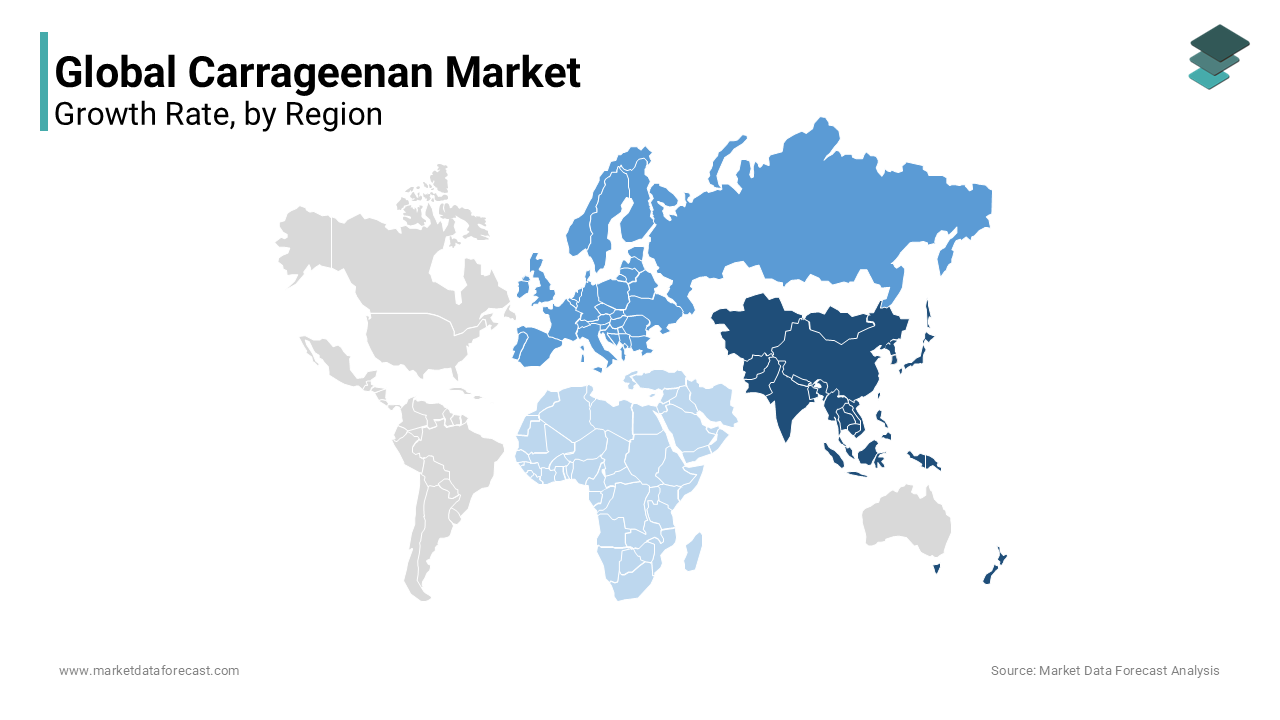
The Asia-Pacific was the largest contributor with 48.3% of the share in 2025. Indonesia stands as the epicenter of production, contributing over 50% of the world’s Eucheuma and Kappaphycus biomass, cultivated across 120,000 hectares of coastal farms. The region’s dominance is anchored in low-cost labor, favorable marine conditions, and established export infrastructure.
North America was positioned second by accounting for the Carrageenan Market with 21.2% of the share in 2025. The United States drives regional demand in the plant-based food and dairy sectors, where carrageenan remains a stabilizer despite periodic consumer skepticism. As of 2023, over 40% of almond milk products sold in U.S. supermarkets contain carrageenan, as verified by the Plant Based Foods Association. Regulatory clarity from the FDA, which reaffirmed carrageenan’s safety in 2022, has stabilized industry confidence. Additionally, the rise of private-label brands in major retailers like Walmart and Kroger has sustained demand for cost-effective hydrocolloids. The National Institutes of Health also recognizes iota-carrageenan’s antiviral efficacy, supporting its inclusion in nasal sprays, which opened a niche but growing non-food application avenue.
Europe carrageenan market growth is growing with a significant CAGR during the forecast period. France and Germany are central to European consumption, driven by stringent clean-label regulations and a mature functional food industry. The European Union permits carrageenan in infant formula under strict purity thresholds, reinforcing demand for refined grades. According to the European Commission’s Food Safety Authority, carrageenan usage in chilled ready meals increased by 8.6% between 2021 and 2023, reflecting its role in moisture retention and texture preservation. Moreover, the EU’s Farm to Fork strategy has incentivized sustainable seaweed farming in Portugal and Ireland, with pilot farms reporting a 25% increase in carrageenan yield through integrated aquaculture systems, as noted by the European Maritime and Fisheries Fund.
Latin America carrageenan market growth is expected to have a steady pace in the coming years. The Brazilian food processing industry in dairy and meat relies on imported refined carrageenan due to limited domestic production. As per Brazil’s Ministry of Agriculture, processed meat output reached 3.2 million metric tons in 2023, with over 65% of exported sausages and hams containing carrageenan for juiciness and sliceability.The
Middle East and Africa carrageenan market growth is likely to be slow during the forecast period. The Gulf Cooperation Council’s food security initiatives have spurred investment in shelf-stable dairy and halal-certified processed foods, where carrageenan ensures consistency under high-temperature storage.
LEADING PLAYERS IN THE CARRAGEENAN MARKET
CP Kelco
CP Kelco maintains a strong footprint in the Asia-Pacific carrageenan market through its strategic manufacturing presence in Indonesia and technical collaboration with regional food manufacturers. The company emphasizes innovation in clean-label and plant-based applications, launching a low-viscosity kappa-carrageenan variant in 2023 tailored for ready-to-drink protein beverages. CP Kelco has deepened engagement with Southeast Asian dairy processors by providing application-specific formulation support, enhancing product stability under tropical storage conditions. In 2025, it expanded its R&D collaboration with the Indonesian Institute of Sciences to improve carrageenan yield from locally farmed Kappaphycus. Additionally, CP Kelco participates in sustainability initiatives with local seaweed farmer cooperatives, promoting responsible cultivation practices to ensure long-term raw material quality and traceability across its supply chain.
FMC Corporation
FMC Corporation has its influence in the Asia-Pacific region by integrating carrageenan into broader hydrocolloid portfolios that serve the region’s fast-growing processed food sector. The company’s focus on technical service and regulatory compliance has enabled seamless adoption of its carrageenan solutions in dairy alternatives and meat analogs across China, India, and Vietnam. In 2023, FMC launched a customized iota-carrageenan solution for plant-based cheese manufacturers in Taiwan, addressing melt and stretch challenges. It also strengthened its regional logistics network by partnering with cold-chain providers in Thailand to ensure product integrity. FMC continues to invest in application laboratories in Singapore and Shanghai by enabling real-time customer co-development and accelerating time-to-market for new food formulations requiring high-performance stabilizers.
JRS Marine Colloids
JRS Marine Colloids has emerged as a pivotal player in the Asia-Pacific carrageenan landscape by prioritizing vertical integration and sustainable sourcing. Based in the Philippines, the company operates integrated processing facilities that convert raw seaweed into semi-refined and refined carrageenan, reducing dependency on external refining. In 2023, JRS introduced an eco-certified carrageenan line compliant with EU organic standards, targeting premium export markets. It has also initiated farmer training programs in Mindanao to improve Eucheuma quality and disease resistance, directly enhancing raw material consistency.
TOP STRATEGIES USED BY THE KEY MARKET PARTICIPANTS
Key players in the carrageenan market are deploying vertical integration, product differentiation, strategic partnerships, sustainability certification, and regional R&D expansion to consolidate their positions. Companies are investing in seaweed farming alliances to secure raw material supply and ensure quality control from source to processing. Collaborations with research institutions are accelerating the development of novel applications in biopharma and clean-label systems. Market leaders are also obtaining organic, halal, and non-GMO certifications to meet diverse regulatory and consumer demands.
KEY MARKET PLAYERS AND COMPETITION OVERVIEW
Major Players of the Carrageenan Market include Shemberg Marketing Corporation, AEP Colloids, Ingredients Solutions Inc., Gelymar SA, Soriano SA, Marcel Trading Corporation, Danisco A/S, Scalzo Food Industries, Altrafine Gums, TIC Gums Incorporation, Gum Technology Corporation, DuPont (U.S.), Cargill (U.S.), Kerry Group (Ireland), CP Kelco (U.S.), Ashland Inc (U.S.), Ingredion (U.S.), TIC Gums (U.S.), and Tate & Lyle (U.K.)
The competitive landscape of the carrageenan market is characterized by technological differentiation, supply chain control, and strategic geographic positioning. While a few multinational corporations dominate formulation expertise and global distribution, regional producers in Indonesia, the Philippines, and Malaysia are gaining influence through cost-effective semi-refined production and proximity to raw materials. Competition is intensifying as companies invest in sustainable farming partnerships and traceability systems to meet evolving regulatory and consumer expectations. The rise of clean-label and plant-based food trends has increased demand for high-purity, functionally optimized carrageenan, prompting players to enhance R&D and application support.
RECENT HAPPENINGS IN THE MARKET
- In January 2023, CP Kelco launched a new low-viscosity kappa-carrageenan product specifically designed for plant-based protein beverages by enhancing stability and mouthfeel in shelf-stable formulations across Asia-Pacific markets.
- In June 2023, FMC Corporation expanded its application laboratory in Shanghai, enabling localized co-development with Chinese food manufacturers to optimize carrageenan use in dairy alternatives and processed meats.
- In September 2023, JRS Marine Colloids initiated a blockchain-based traceability system for its carrageenan supply chain in the Philippines, which is improving transparency for European and Japanese importers requiring certified sustainable sourcing.
- In February 2025, CP Kelco partnered with the Indonesian Institute of Sciences to develop disease-resistant Kappaphycus strains by aiming to boost yield and reduce ice-ice disease impact on raw material supply.
- In May 2025, FMC Corporation introduced an iota-carrageenan solution for vegan cheese manufacturers in Taiwan, which addresses melting and textural challenges in non-dairy cheese products.
DETAILED SEGMENTATION OF THE GLOBAL CARRAGEENAN MARKET IS INCLUDED IN THIS REPORT
This research report on the global carrageenan market has been segmented and sub-segmented based on type, application, grade, seaweed source, & region.
By Type
- Kappa
- Lota
- Lambda
By Application
- Food Industry
- Pharmaceutical Industry
- Cosmetic Industry
By Grade
- Refined Carrageenan
- Semi-Refined Carrageenan
By Region
- North America
- Europe
- APAC
- Latin America
- Middle East & Africa