- Product Description Description
- Table of Contents TOC
- List of Table & Figure LOT
- Get Free Sample PDF Sample PDF
Market Size, 2025
$19.69 BnMarket Estimate, 2026
$21.19 BnMarket Forecast, 2034
$38.07 BnCAGR, 2026–2034
7.6%Global Commercial Seaweed Market Size, Share, Trends & Forecast (2026–2034)
- Market Scope: Comprehensive global assessment of the commercial seaweed industry, analyzing product categories, physical forms, end-use verticals, regional distribution, and key commercial drivers.
- Market Valuation: Valued at USD 19.69 billion (2025), estimated at USD 21.19 billion (2026), and projected to reach USD 38.07 billion by 2034, expanding at a compound annual growth rate (CAGR) of 7.6% (2026–2034).
- Primary Growth Drivers: Escalating demand for food hydrocolloids (agar, carrageenan, alginate), surging preference for plant-based nutrition and vegan food options, expansion of cosmetic/personal care applications, and agricultural use of seaweed-derived biofertilizers.
Global Commercial Seaweed Market Segment Metrics (2026–2034)
| Category | Leading Segment (2025 Position) | Fastest-Growing Segment |
|---|---|---|
| By Product Type | Red Seaweed (capturing ~43% share, driven by extensive carrageenan and agar extraction for food processing) | Green Seaweed (expanding rapidly due to high beta-carotene content and functional health supplements) |
| By Form | Dry Seaweed / Powder (holding the dominant share due to extended shelf life and transport efficiency for food/cosmetics) | Wet / Liquid Extracts (growing via beverage flavoring and direct culinary consumption in regional markets) |
| By End Use | Food & Beverages (anchoring the largest market revenue share through thickeners, stabilizers, and protein alternatives) | Personal Care & Pharmaceuticals (accelerating via anti-aging, antioxidant skincare and targeted therapeutics) |
Major Industry Players & Market Structure
Market Structure: A diverse global market balancing major multinational hydrocolloid ingredient leaders with specialized regional processors and harvesters competing on product purity, sustainability credentials, and traceability.
Key Companies: CP Kelco, Cargill, Marcel Carrageenan, Yan Cheng Hairui Food Co., Ltd., Mara Seaweed, Biostadt India Limited, Algea AS, Qingdao Seawin Biotech Group Co., Ltd., FMC BioPolymer AS, and Arcadian Seaplants Ltd.
Global Commercial Seaweed Market Size
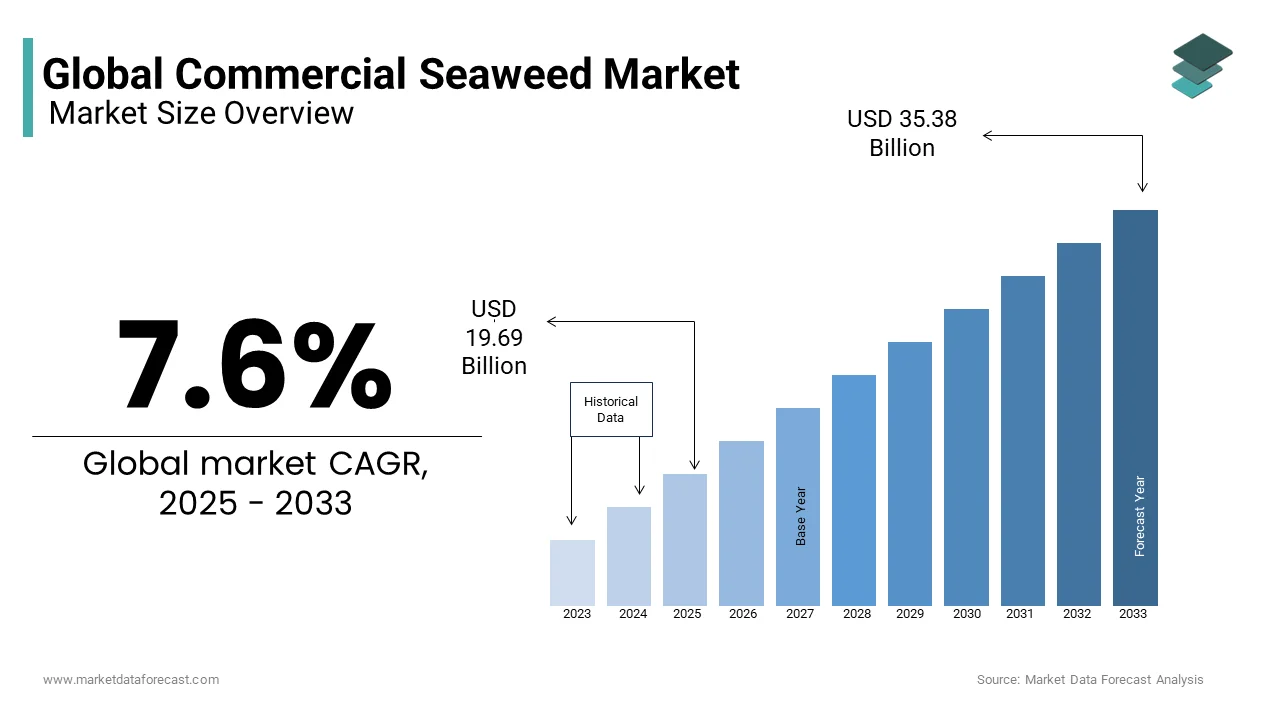
The global commercial seaweed market was valued at USD 19.69 billion in 2025 and is anticipated to reach USD 21.19 billion in 2026 from USD 38.07 billion by 2034, growing at a CAGR of 7.6% during the forecast period from 2026 to 2034.
CURRENT SCENARIO OF THE GLOBAL COMMERCIAL SEAWEED MARKET
The consumption of seaweeds was facilitated a long time ago in the fourth century in Japan and the sixth century in China.
The commercial seaweed market will be initiated by increasing calls from the food business. These days, they are becoming more popular among customers due to advantages like nutrition-rich content, supporting thyroid function, and an excellent source of vitamins, antioxidants & minerals. Furthermore, they help in weight loss and decrease the risk of heart disease and diabetes. The present global population is around 7.5 billion and is estimated to cross 9 billion at the end of 2050, which will further propel the demand for food production.
The United Nations has been forecasting a lot of interest in escalating seaweed production as it promotes global food security.
Carrageenan farming has an economic potential with less capital investment, decent farming techniques, and a short production cycle. A biologist at Wageningen University has shown findings on decreasing the acidification of the oceans by promoting sea lettuce growth. As per recent studies, lettuce can reduce the acidity in water as it grows, and the biologist team also discovered that a marine garden covering over 180,000 square kilometers could offer enough protein for the global population.
MARKET DRIVERS
Rising Demand for Food Hydrocolloids, Plant-Based Nutrition, and Personal Care Applications Driving the Global Commercial Seaweed Market
The growing demand for hydrocolloids in the food industry due to their comprehensive utilization as food additives is the primary factor contributing to the global commercial seaweed market growth. The rising awareness among the people regarding seaweed's health benefits, as it is a rich source of amino acids, peptides, lipids, vitamins, and polysaccharides, is fueling the global market growth. Products such as alginate, agar, and carrageenan are the most common seaweed-based derivatives with broad applications in the food industry, such as gelling, stabilizing, emulsifying, and thickening agents, propelling market growth opportunities. The increased consumption of plant-based products due to the rising number of vegan people worldwide is another factor augmenting the global commercial seaweed market growth. The escalation in the trend of veganism in various end-user industries is enhancing the adoption of plant-based products, creating opportunities for the seaweed market. Seaweed is in high demand in the personal care industry due to its beneficial properties, such as anti-aging and antioxidants, which accelerate market revenue.
Expanding Agricultural, Pharmaceutical, and R&D Applications Creating New Growth Opportunities in the Commercial Seaweed Market
Due to its natural activities and wide applications of seaweed, various industries such as agriculture and the pharmaceutical industries are opening market expansion opportunities. Seaweed has had active applications in cancer prevention, enhancing growth opportunities in the pharmaceutical industry, and leading to market expansion in the coming years. The growing investments in the R&D activities by the major market players to increase the benefits of the seaweed will augment the market growth over the forecast period. Seaweed is extensively used as a biofertilizer for crops, enhancing crop yield and effectiveness and increasing farmers' adoption.
MARKET RESTRAINTS
High Production Costs, Regulatory Constraints, and Environmental Concerns Limiting Growth of the Commercial Seaweed Market
The high costs associated with seaweed production are the primary factor hampering the market growth. The increased rate of water pollution from the past years due to the release of industrial waste, chemicals, and toxins is restricting seaweed production, leading to limited market growth. The cultivation and harvesting of seaweeds pose various challenges due to the need to harvest from the ocean beds, which raises production costs and leads to an overall increase in the final product, hindering the market growth rate. The presence of stringent regulations for the utilization of seaweed in medicinal products and in the food industry, which are complex and have high-time consumption procedures, is challenging for manufacturers. The continuous fluctuations in seaweed prices due to the availability of quality raw materials are expected to limit the market expansion. The cases of a few side effects, such as high consumption of seaweeds, lead to hyperthyroidism, which may limit the consumption among people with thyroid issues and impede market growth. The presence of environmental concerns for cultivating seaweed and the limited awareness among the people, especially among the underdeveloped and emerging nations, may restrain the market revenue.
REPORT COVERAGE
| REPORT METRIC | DETAILS |
| Market Size Available | 2025 to 2034 |
| Base Year | 2025 |
| Forecast Period | 2026 to 2034 |
| CAGR | 7.6% |
| Segments Covered | By Product, Form, End Use, and Region |
| Various Analyses Covered | Global, Regional & Country Level Analysis, Segment-Level Analysis, DROC, PESTLE Analysis, Porter’s Five Forces Analysis, Competitive Landscape, Analyst Overview of Investment Opportunities |
| Regions Covered | North America, Europe, APAC, Latin America, Middle East & Africa |
| Market Leaders Profiled | CP Kelco, Yan Cheng Hairui Food Co., Ltd., Mara Seaweed, Biostadt India Limited, Algea AS, Qingdao Seawin Biotech Group Co., Ltd., FMC BioPolymer AS, Indigrow Ltd., Chase Organics GB Ltd., Arcadian Seaplants Ltd., Pacific Harvest, Aquatic Chemicals, and Marcel Carrageenan and Others. |
SEGMENT ANALYSIS
By Product Insights
The red seaweed segment dominated the global commercial seaweed market with a prominent share of around 43% in 2024 and is expected to dominate during the forecast period. The red seaweed is derived from Seaweeds such as Gelidium and Gracilaria, which are red or purplish. Red seaweed has broad applications in various industries, such as food, medicines, and cosmetics, propelling the segment's growth. Red seaweed consists of high amounts of proteins and vitamins, making it an excellent source for people seeking protein intake. The primary purpose of red seaweed is to produce carrageenan, which is widely used in food processing. This is a significant factor contributing to the market growth in the segment.
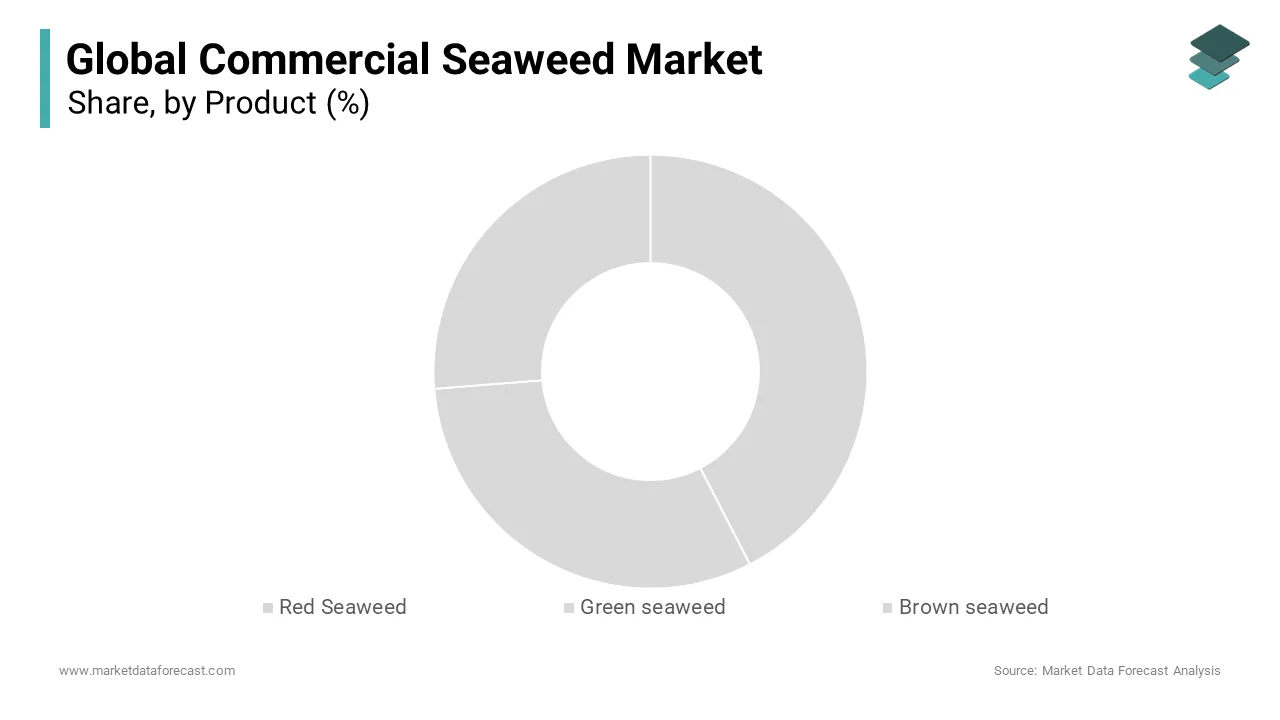
The green seaweed segment is estimated to have a rapid growth rate during the forecast period owing to its high beta-carotene content. Beta-carotene is extensively used to prevent cancer, and the growing demand for green seaweed supplements boosts the growth rate.
Red seaweed is predicted to rise at a CAGR of over 7% during the forecast period. These seaweeds are small in length, ranging from a few centimeters to about a meter, and are mainly employed as a food and sources of hydrocolloids like agar and carrageenan.
By Form Insights
The dry segment held the most significant share in the commercial seaweed market and is projected to witness a prominent growth rate during the forecast period. Seaweed powders are in high demand among the food and cosmetic industries, fueling revenue growth for the segment. Growing applications of seaweed powder in people's health are a great alternative to artificial fragrances, dyes, and preservatives, which augments the segment growth rate. The cosmetic applications of seaweed are expanding due to its antiaging, moisturizing, and antioxidant properties, which will enhance growth opportunities in the coming years.
The wet segment is estimated to have considerable growth during the forecast period. The rising use of wet seaweed in beverages to add flavors and fragrances boosts growth opportunities.
The wet seaweed sector recorded around USD 9.5 billion in 2018. Countries like China, South Korea, Chile, Norway, Japan, Madagascar, and other Southeast Asian countries are mainly consuming the wet seaweeds in the form of salads, curd soups, seasoned snacks, and also with rice dishes. The demand for dry products is also estimated to expand steadily in the coming years.
By End Use Insights
The food and beverages segment accounted for the notable growth and is expected to maintain the highest CAGR during the forecast period. The increased applications of seaweed in the food industry, such as protein alternatives, and the growing demand for food additives are escalating the market growth opportunities in the segment. The seaweeds are widely harvested and cultivated to extract polysaccharides such as alginate, agar, and carrageenan, which are in high demand in the food industry, leading to the expansion of the segment revenue.
The personal care and pharma segment is estimated to have the fastest growth during the forecast period due to the comprehensive utilization of seaweeds in cosmetics. The increasing demand for antioxidant and antiaging components in cosmetics is fueling the segment's growth. The wide application of green seaweeds in cancer treatment and prevention methods is escalating the demand for seaweeds in the pharmaceutical industry, contributing to the segment expansion.
Animal feed captured around 4% volume share in 2018 and shows a positive outlook in future years. The product is employed as an additive in animal feed, particularly in the coastal regions. It contains a massive amount of essential vitamins and different minerals like potassium, phosphorus, calcium, sodium, magnesium, chlorine & sulphur, which play a vital role in the healthy development of the animal.
REGIONAL ANALYSIS
Asia Pacific Market Analysis
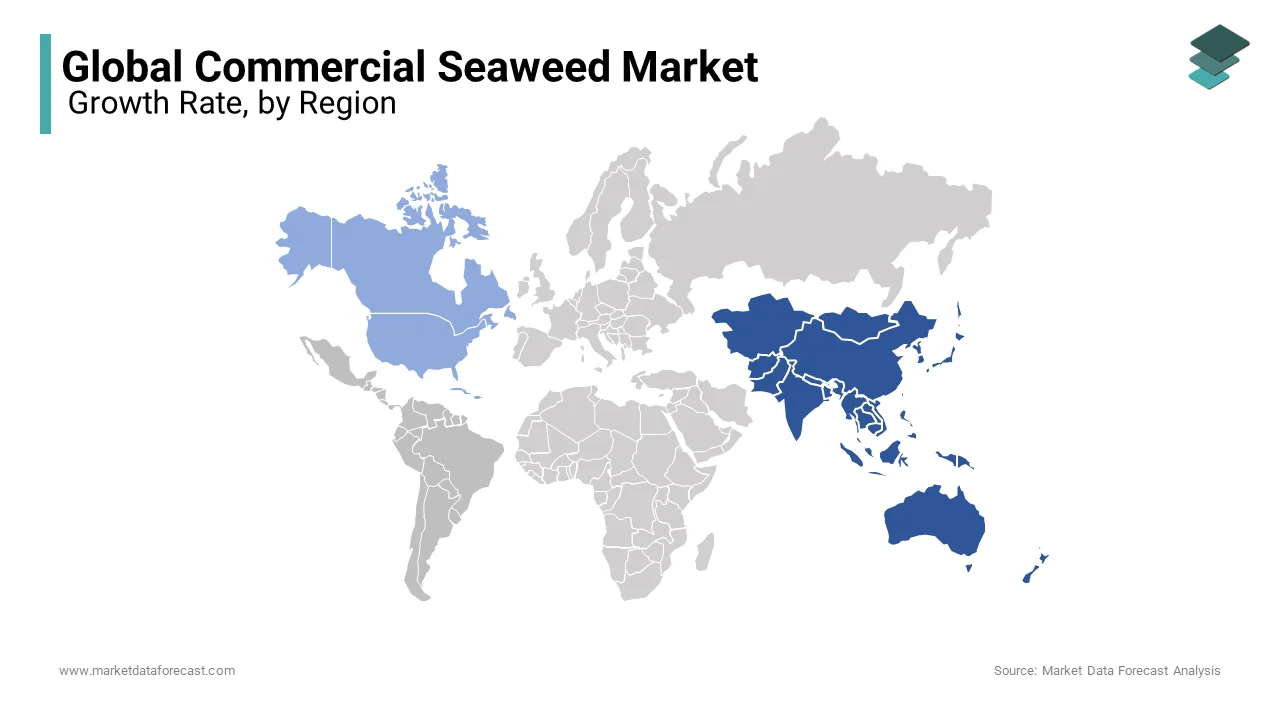
The Asia Pacific region dominates the global commercial seaweed market revenue with a notable share of 87.34% in 2024 and is projected to maintain the domination in the coming years. Regional countries such as China, Japan, and South Korea are the major contributors to market revenue growth. Seaweed is the most common seafood consumed in most Asian countries due to its medicinal benefits, which are driving the regional market growth rate. The increased demand for plant-based protein food across the region and the broad traditional consumption practices due to the historical medicinal practices in the regional countries.
North America Market Analysis
The North American region is expected to record considerable growth during the forecast period owing to a surge in plant-based products in the United States. The growing awareness among the people regarding the health benefits of seaweed and the presence of well-established R&D centers that are boosting the activities to enlarge the medicinal properties of seaweed are a few factors contributing to the regional market growth rate. The strong food and beverage industry in the region, along with the presence of significant market players, is boosting regional market growth opportunities.
Europe Market Analysis
The European region is estimated to have a steady growth rate in the coming years due to the rising demand for vegan food. The growing trend of veganism escalates the demand for plant-based products and their health benefits, fueling the regional market growth. The enlarging cosmetics industry across the regional countries is enhancing the demand for natural and plant-based products such as seaweeds, which is augmenting the region's growth rate.
Latin America Market Analysis
The Latin American, Middle Eastern, and African regions are projected to witness moderate growth in the coming years due to expanding awareness of the benefits of seaweed in the food and beverage, cosmetics, and medicinal industries.
COMPETITIVE LANDSCAPE
The commercial seaweed market is characterized by a blend of global ingredient giants like Cargill and CP Kelco, and strong regional processors like Marcel Carrageenan, competing on functionality, sustainability, and supply chain integrity. While multinationals lead in R&D, certification, and global distribution, regional players leverage cost efficiency and community-based sourcing. Competition centers on purity, functionality in end-use applications, and environmental credentials. Rising demand for plant-based foods, cosmetics, and biodegradable materials is accelerating innovation. Traceability, non-GMO status, and carbon footprint are key differentiators. Digital tools for farm-to-factory monitoring and partnerships with food tech firms are reshaping competitive dynamics. Leaders combine scientific formulation expertise, ethical sourcing models, and application versatility to meet the demands of health-conscious and eco-aware industries.
KEY MARKET PLAYERS
Some of the major producers in the global commercial seaweed market are
- Seasol International
- Marcel Carrageenan (PT. Marcel Gourmet Seaweed)
- Cargill
- CP Kelco
- Yan Cheng Hairui Food Co., Ltd
- Mara Seaweed
- Biostadt India Limited
- Algea AS
- Qingdao Seawin Biotech Group Co., Ltd
- FMC BioPolymer AS
- Indigrow Ltd.
- Chase Organics GB Ltd.
- Arcadian Seaplants Ltd
- Pacific Harvest,
- Aquatic Chemicals
- Marcel Carrageenan
Top Players in the Market
- Cargil, through its acquired FMC BioPolymer seaweed hydrocolloid division, is a global leader in commercial seaweed derivatives, particularly alginates used in food, pharmaceuticals, and industrial applications. The company sources sustainably harvested brown seaweed from global coastlines and converts it into high-purity functional ingredients. Recently, Cargill expanded traceability systems for seaweed sourcing and invested in fermentation-based alternatives to complement wild harvest. It launched clean-label alginate solutions for plant-based foods and partnered with food tech startups to develop texture systems for alternative proteins.
- CP Kelco is a premier global producer of seaweed-derived hydrocolloids, including carrageenan and alginate, serving the food, beverage, personal care, and pharmaceutical industries. The company emphasizes sustainable harvesting and processing, working closely with coastal communities and certifiers. Recently, CP Kelco introduced non-GMO and organic-compliant carrageenan grades and expanded production capacity in Asia and Europe. It launched digital platforms for application support and collaborated with plant-based food manufacturers to develop clean-label texture solutions. Investment in seaweed cultivation trials and lifecycle assessments reinforces environmental stewardship.
- Marcel Carrageenan, based in Indonesia, is a major global supplier of semi-refined and refined carrageenan derived from red seaweed farmed by local coastal communities. The company plays a critical role in the global food and dairy industries, offering cost-effective, functional hydrocolloids for gelling, thickening, and stabilizing. Recently, Marcel expanded its processing facilities with energy-efficient technologies and achieved multiple international food safety and sustainability certifications. It launched traceable, community-sourced seaweed programs and partnered with global brands to develop customized carrageenan blends.
Top Strategies Used by Key Market Participants
Key players invest in sustainable and traceable seaweed sourcing to ensure quality and ethical compliance. Strategic partnerships with coastal communities and certifiers enhance supply chain credibility. Companies develop non-GMO, organic, and clean-label hydrocolloid variants to meet food industry trends. R&D focuses on novel applications in plant-based foods, pharmaceuticals, and bioplastics. Geographic expansion targets high-growth regions with cultivation potential. Digital platforms for traceability and application support improve customer engagement. Product innovation includes fermentation-derived alternatives and hybrid blends. Sustainability certifications and lifecycle assessments build brand trust. M&A and vertical integration secure raw material access. Educational outreach and farmer training ensure consistent, responsible seaweed production in a rapidly evolving global bioeconomy.
RECENT MARKET NEWS
- In 2024, Sway, a California-based bioplastic industry, announced the development of edge-cutting technology, which is expected to produce commercial seaweed-based bioplastics. Sway's Thermoplastic Seaweed resin is a bio-based, microplastic-free, and home-compostable product derived from the ocean crop.
- In March 2024, Sea6 Energy, a leading seaweed company, announced the launch of the world's first large-scale mechanized tropical seaweed farm off the coast of Lombok, Indonesia.
- In March 2023, Loliware, a seaweed company, introduced a new seaweed resin that replaced plastics at the International Materials Conference.
- In 2023, Algaia announced the expansion of its R&D sector and was estimated to introduce highly equipped machinery that supports the building of new workshops to produce new seaweed extracts.
- Mara Seaweed introduces new blends in Morrisons Supermarkets in the UK. After several months of hard work, Mara's seaweed blends, Shony and Furikake, are in a key UK supermarket for the first time. Mara's products are now present in 403 Morrisons stores nationwide.
- Seawin Biotech Group Introduced the United States Business Division. As China's biggest manufacturer of fertilizers made from seaweed, Seawin Biotech Group is the business leader in China, with a 17-year history of offering high-quality products. The company has recently established a business division in the United States to expand its operations further.
MARKET SEGMENTATION
This research report on the global commercial seaweed market is segmented and sub-segmented based on Product, Form, End-Use, and Region.
By Product
- Red Seaweed
- Green seaweed
- Brown seaweed
By Form
- Wet
- Dry
By End Use
- Food
- Animal feed
- Personal care & pharma
- Biofuels
- Others
By Region
- North America
- Europe
- Asia Pacific
- Latin America
- Middle East and Africa