- Product Description Description
- Table of Contents TOC
- List of Table & Figure LOT
- Get Free Sample PDF Sample PDF
Market Size, 2025
$2.87 BnMarket Estimate, 2026
$3.07 BnMarket Forecast, 2034
$5.26 BnCAGR, 2026–2034
6.97%Global Craniomaxillofacial Implants Market Report Summary
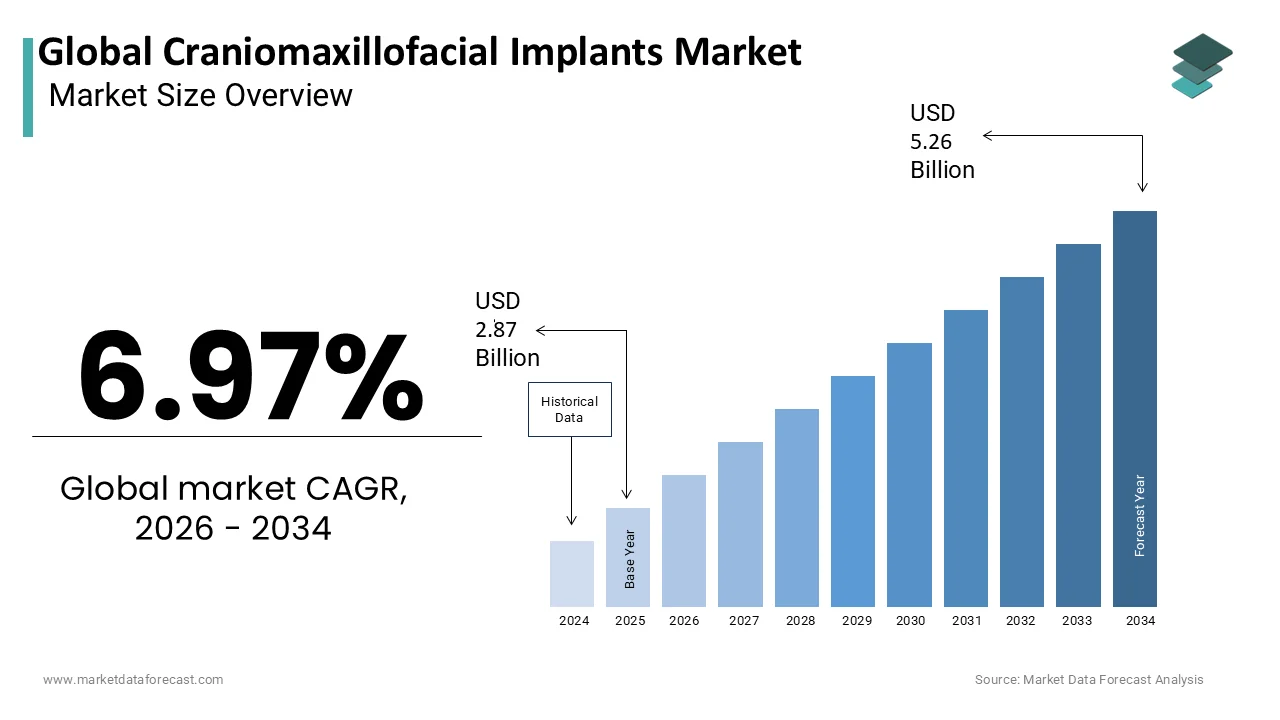
The Global Craniomaxillofacial Implants Market was valued at USD 2.87 billion in 2025 and is projected to reach USD 5.26 billion by 2034, growing from USD 3.07 billion in 2026 at a CAGR of 6.97% during the forecast period. Growth is driven by the rising incidence of traumatic injuries, increasing prevalence of congenital craniofacial anomalies, and growing adoption of patient-specific implants enabled by advanced 3D printing technologies. However, high costs of advanced implant systems, stringent regulatory approval processes, and postoperative complications continue to restrain market growth.
Key Market Trends
- Increasing adoption of patient-specific implants using 3D printing and computer-aided design technologies.
- Growing integration of digital surgical planning and customized implant manufacturing.
- Rising demand for bioresorbable and advanced polymer-based implant materials.
- Expansion of minimally invasive craniofacial reconstruction procedures.
- Increasing investments in biomaterials and additive manufacturing for personalized reconstructive surgery.
Segmental Insights
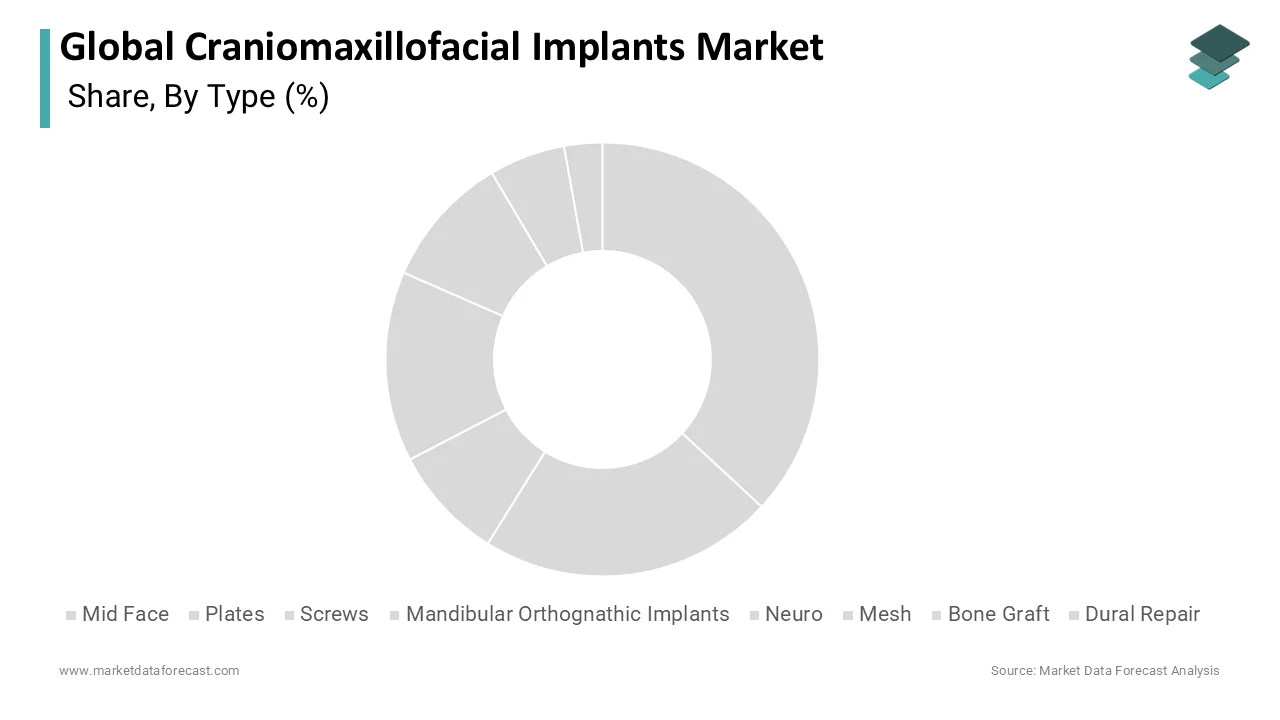
- Based on type, plates and screws held the largest market share of 43.2% in 2025, driven by their widespread use in facial fracture fixation, trauma management, and reconstructive surgeries.
- Based on material of construction, titanium dominated the market with a 38.1% share in 2025, supported by its superior biocompatibility, corrosion resistance, high strength-to-weight ratio, and long-term clinical reliability.
- Patient-specific implants are the fastest-growing type segment, projected to register a CAGR of 9.8%, driven by advancements in 3D printing, personalized medicine, improved surgical precision, and enhanced aesthetic outcomes.
Regional Insights
- North America led the market in 2025, accounting for 44.5% of the global market, supported by advanced healthcare infrastructure, strong reimbursement systems, high trauma incidence, and rapid adoption of innovative implant technologies.
- Europe holds a significant share, driven by stringent quality standards, growing adoption of patient-specific implants, and strong research in biomaterials and additive manufacturing.
- Asia Pacific is a prominent market, supported by improving healthcare infrastructure, rising medical tourism, increasing road traffic injuries, and expanding access to reconstructive surgery.
- Latin America contributes notably through growing private healthcare investments, increasing trauma cases, and expanding availability of advanced surgical technologies.
- Middle East and Africa is an emerging market, driven by expanding healthcare infrastructure in Gulf countries, rising investments in trauma care, and increasing demand for reconstructive procedures.
Competitive Landscape
The market is highly competitive, with multinational medical device manufacturers and specialized implant companies competing through technological innovation, patient-specific implant development, advanced biomaterials, and digital surgical planning solutions. Companies are investing in 3D printing technologies, AI-enabled surgical planning, surgeon training programs, strategic partnerships, and expansion into emerging markets to strengthen their global market presence.Prominent players in the market include Stryker Corporation, KLS Martin Group, DePuy Synthes (Johnson & Johnson), Zimmer Biomet Holdings, Inc., Medtronic plc, Integra LifeSciences Holdings Corporation, OsteoMed LLC, Medartis AG, Matrix Surgical USA, and Calavera Surgical Design, Inc.
Global Craniomaxillofacial Implants Market Size
The Global Craniomaxillofacial Implants Market is projected to grow from USD 2.87 billion in 2025 to USD 3.07 billion in 2026 and reach USD 5.26 billion by 2034, registering a CAGR of 6.97% during the forecast period from 2026 to 2034.
Craniomaxillofacial implants are medical devices designed for the reconstruction and repair of skeletal defects in the skull, face, and jaw regions. These implants are important for restoring structural integrity, ty function, and aesthetics following trauma, congenital deformities, tumor resection,n or degenerative diseases. According to the World Health Organization, road traffic injuries result in approximately 1.35 million deaths annually, with a significant proportion involving head and facial trauma requiring surgical intervention. As per the Global Burden of Disease study, craniofacial anomalies affect nearly 1 in every 700 births globally,y necessitating early surgical correction and long-term reconstructive care. The aging population further contributes to demand as older adults are more susceptible to falls and fractures requiring complex reconstruction. Advances in digital health technologies have transformed surgical planning, enabling precise customization of implants through computer-aided design and manufacturing. This precision reduces operative time and improves clinical outcomes. The integration of three-dimensional printing has accelerated the production of patient-specific solutions, allowing for better anatomical fit. Regulatory bodies emphasize strict quality standards to ensure safety and efficacy, driving innovation in material science.
MARKET DRIVERS
Rising Incidence of Traumatic Injuries Drives Demand
The escalating frequency of traumatic injuries resulting from road accidents,s sports activities, es and interpersonal violence positively impacts the growth of the Craniomaxillofacial Implants Market. Facial and cranial fractures are among the most common injuries in emergency departments requiring immediate and often complex surgical reconstruction to prevent neurological damage and restore facial symmetry. According to the Centers for Disease Control and Prevention, traumatic brain injury contributes to about 30% of all injury-related deaths in the United States alone, with many survivors requiring cranioplasty or facial reconstruction. As per the research, workplace accidents and transport incidents generate thousands of maxillofacial trauma cases annually across Europe, necessitating the use of fixation devices and bone grafts. The high-energy impact in modern vehicular collisions often results in comminuted fractures that cannot be treated with traditional methods, thereby increasing the reliance on advanced implant systems. Sports-related injuries, particularly in contact sports like football and rugby, also contribute significantly to the patient pool. Young athletes are prone to orbital zygomatic and mandibular fractures, which require durable and lightweight implants for optimal recovery. The immediacy of trauma care ensures a consistent demand for off-the-shelf and custom implant solutions. Hospitals and trauma centers are increasingly stocking comprehensive craniomaxillofacial kits to handle emergencies efficiently.
Growing Prevalence of Congenital Craniofacial Anomalies
The persistent prevalence of congenital craniofacial anomalies such as cleft lip and palate, craniosynostosis,s and hemifacial microsoma, significantlyamplifiesg the growth of the craniomaxillofacial implants market. These conditions require multidisciplinary surgical interventions often starting in infancy and continuing through adolescence to address functional impairments and aesthetic concerns. As per the World Health Organization, untreated clefts can lead to difficulties in feeding, speech development, and social integration, necessitating timely surgical repair using bone grafts and fixation hardware. The complexity of these procedures has increased with the adoption of patient-specific implants that offer superior anatomical fit compared to standard plates. Early intervention is crucial to prevent long-term developmental delays, which drives parents and healthcare providers to seek advanced surgical options. The availability of resorbable implants has further enhanced treatment protocols by eliminating the need for secondary removal surgeries in growing children. This continuous need for corrective and reconstructive procedures throughout childhood and adulthood ensures a stable and growing patient base for craniomaxillofacial device manufacturers.
MARKET RESTRAINTS
High Cost of Advanced Implant Systems Restricts Access
The substantial financial burden associated with advanced implant systems, with their limited accessibility in resource-constrained healthcare settings, is limiting the growth of the craniomaxillofacial implants market. Patient-specific implants and those made from premium materials like polyetheretherketone or customized titanium meshes command a premium price due to the complex manufacturing processes involved. Healthcare expenditure varies significantly across nations, with out-of-pocket expenses posing a barrier to elective reconstructive surgeries in many developing regions. The limited public health funding in low- and middle-income countries often prioritizes life-saving emergency care over complex reconstructive procedures that utilize high-cost implants. Insurance coverage for cosmetic or non-essential reconstructive aspects of craniomaxillofacial surgery is frequently limited or excluded, leaving patients to bear the full cost. This financial disparity restricts the adoption of cutting-edge technologies such as three-dimensional printed custom implants to wealthy demographics or well-funded healthcare systems. Hospitals in budget-constrained environments may opt for traditional, less expensive fixation methods even when advanced implants would offer better clinical outcomes. The high cost of regulatory compliance and quality assurance further inflates the final price of these devices.
Stringent Regulatory Approval Processes Delay Market Entry
The rigorous and prolonged regulatory approval processes for new products and innovations are additionally impeding the growth of the craniomaxillofacial market. Medical devices that come into contact with bone and neural tissues are classified as high risk, requiring extensive clinical data to demonstrate safety and efficacy. The premarket approval for novel implant materials or designs can take several years, involving multiple phases of clinical trials and detailed documentation. The implementation of the Medical Device Regulation has increased the scrutiny on clinical evidence andpost-markett surveillance, placing additional burdens on manufacturers. The need for biocompatibility testing,g mechanical strength validation, and long-term stability studies adds to the development timeline and cost. Small andmedium-sizedd enterprises often struggle to navigate these complex regulatory landscapes due to limited resources and expertise. Delays in approval postpone the commercialization of innovative solutions such as bioactive coatings or smart implants that could improve patient outcomes. Furthermore, varying regulatory requirements across different jurisdictions necessitate separate submissions and adaptations, increasing the administrative load. This regulatory inertia slows down the pace of innovation and limits the availability ofnext-generationn products to surgeons and patients. The uncertainty surrounding approval timelines also discourages investment in early-stage technologies.
MARKET OPPORTUNITIES
Integration of Three-Dimensional Printing Technologies
The rapid integration of three-dimensional printing technologies by enabling the production of highly customized patient-specific implants is a major factor to bolster the growth of the craniomaxillofacial market. Additive manufacturing allows for the creation of complex geometries that perfectly match the unique anatomical contours of a patient’s skull or facial structure, improving fit and reducing operative time. The patient-specific implants reduce the need for intraoperative bending and shaping of standard plates, minimizing the risk of material fatigue and failure. This technology facilitates the use of porous structures that promote bone ingrowth and osseointegration, enhancing long-term stability. The ability to print with biocompatible materials such as titanium alloys and polyetheretherketone expands the range of applications for complex reconstructions. Digital workflows streamline the process from imaging to manufacturing, allowing for rapid prototyping and iteration. Hospitals are increasingly adopting in-house printing capabilities or partnering with specialized service providers to accelerate delivery. This shift towards personalized medicine enhances patient satisfaction and clinical efficiency. The scalability of three-dimensional printing also supports the production of small-batch custom implants economically.
Expansion into Emerging Markets with Improving Healthcare Infrastructure
The expansion of healthcare infrastructure in emerging countries, as access to advanced surgical care improves, is also expected to show positive opportunities for the expansion of the craniomaxillofacial implants market. Countries in Asia Pacific, Latin America, and the Middle East are investing heavily in modernizing hospitals and training specialists in reconstructive surgery. Many developing nations are expanding their universal health coverage schemes, which include provisions for essential surgical procedures, including trauma repair. The increased public and private investment in healthcare facilities is driving the adoption of modern medical devices and technologies in regions previously underserved. The rising middle class in these regions has higher disposable income and awareness of aesthetic and functional reconstruction, leading to higher demand for quality implants. Local manufacturing initiatives and partnerships with global players are reducing costs and improving supply chain efficiency. Government programs aimed at treating congenital defects such as cleft lip and palate are creating organized demand for fixation devices and bone grafts. The establishment of trauma centers equipped with advanced imaging and surgical tools facilitates the use of sophisticated implant systems. Educational programs for surgeons in these regions promote the adoption of best practices and new technologies.
MARKET CHALLENGES
Complexity of Anatomical Reconstruction Poses Technical Challenges
The inherent complexity of craniofacial anatomy for the design and application is most likely to inhibit the growth of the craniomaxillofacial implants market. The skull and face comprise intricate structures with varying bone densities,s thin cortices, es and proximity to nerves and blood vessels. Achieving stable fixation in areas with poor bone quality such as the orbital rim or frontal sinus requires specialized implant designs and surgical techniques. The risk of implant expo, sure migr,ation or infection is higher in regions with thin soft tissue coverage, complicating postoperative recovery. Surgeons must balance the need for rigid fixation with the preservation of blood supply to prevent bone necrosis. The curvature and asymmetry of facial bones make it difficult to use standard off-the-shelf plates effectively, often requiring extensive intraoperative modification. This variability increases the learning curve for surgeons and the potential for procedural errors. Custom implants mitigate some issues but require precise imaging and planning, which may not always be available. The dynamic forces exerted by facial muscles during expression and mastication add mechanical stress to implants, necessitating robust material properties. Ensuring long-term durability while maintaining aesthetic contour is a delicate engineering challenge.
Risk of Post Operative Complications and Implant Failure
The risk of postoperative complications, affecting patient outcomes and confidence, is also a challenge for the growth of the craniomaxillofacial implants market. Despite advancements in biocompatible materials, foreign body reactions and bacterial colonization can lead to serious complications requiring revision surgery. The journal implant exposure due to wound dehiscence is a common complication, particularly in patients with compromised soft tissue or prior radiation therapy. Metal allergies, although rare, can cause chronic inflammation and pain necessitating removal of titanium or stainless-steel components. Mechanical failure, such as screw loosening or plate fracture, can occur due to excessive load or improper placement. These complications increase healthcare costs, prolong recovery times,s and diminish patient quality of life. Manufacturers face pressure to develop antimicrobial coatings and improved material formulations to mitigate these risks. However, validating the long-term safety of new materials requires extensive clinical follow-up.
REPORT COVERAGE
| REPORT METRIC | DETAILS |
| Market Size Available | 2025 to 2034 |
| Base Year | 2025 |
| Forecast Period | 2026 to 2034 |
| Segments Covered | By Type, Material of Construction, Application, Property, and Region |
| Various Analyses Covered | Global, Regional & Country Level Analysis, Segment-Level Analysis; DROC, PESTLE Analysis; Porter’s Five Forces Analysis, Competitive Landscape, Analyst Overview of Investment Opportunities |
| Regions Covered | North America, Europe, APAC, Latin America, Middle East & Africa |
| Market Leader Profiled | Stryker, KLS Martin, Depuy Synthes, Zimmer Biomet, Medtronic, Integra Lifesciences |
SEGMENTAL ANALYSIS
By Type Insights
The plates and screws segment was the largest, accounting for 43.2% of the craniomaxillofacial implants market share in 2025 due to their fundamental role in open reduction and internal fixation procedures for facial fractures. As per the World Health Organization, road traffic accidents are a leading cause of maxillofacial trauma globally, generating consistent demand for these fixation devices. The versatility of plate and screw systems allows surgeons to address simple linear fractures as well as complex comminuted injuries. Their widespread availability in various sizes and configurations makes them suitable for diverse anatomical sites. Hospitals maintain large inventories of these essential items to handle emergency trauma cases efficiently. The routine nature of these procedures ensures high utilization rates across both public and private healthcare settings.
The patient-specific implants segment is projected to register a CAGR of 9.8% during the forecast period, with the rapid advancements in three-dimensional printing andcomputer-aidedd design technologies. These technologies enable the creation of implants that perfectly match the patient’s unique anatomy, improving fit and aesthetic outcomes. According to the Journal of Neurosurgery, the use of patient-specific implants has been shown to reduce operative time by up to 25% compared to intraoperative contouring of standard plates. The custom implants significantly lower the risk of complications such as implant exposure and asymmetry, which are common with off-the-shelf devices. The ability to pre-plan surgery using virtual models enhances precision and confidence among surgeons. Hospitals are increasingly investing in digital workflows that integrate computed tomography data with additive manufacturing processes. This shift towards personalized medicine addresses the limitations of standard implants in complex reconstruction cases. The growing acceptance of these technologies by regulatory bodies further facilitates entry. Patients are also demanding better aesthetic results, driving the adoption of custom solutions.
By Material Of Construction Insights
The titanium segment was accounted for,n holding 38.1% of the craniomaxillofacial implants market share in 2025 due to its exceptional biocompatibility, high strength-to-weight ratio, and corrosion resistance. These properties make it the gold standard for long-term implantation in the harsh environment of the facial skeleton. The material’s modulus of elasticity is closer to bone than stainless steel, reducing stress shielding and bone resorption. Titanium is also radiolucent enough to allow for clear postoperative imaging, which is crucial for monitoring healing. Its inert nature minimizes the risk of allergic reactions and inflammatory responses. Surgeons trust titanium for its predictable performance in both load-bearing and non-load-bearing areas. Manufacturers continue to refine titanium alloys to enhance fatigue resistance and handling characteristics.
The polymer segment is lucratively growing at the fastest CAGR of 8.5% during the forecast period, with the demand for implants that eliminate the need for secondary removal surgeries. These materials degrade naturally over time, as the bone heals, removing the burden of additional surgical procedures. According to the study, resorbable polymer implants maintain sufficient strength during the critical healing phase before gradually transferring load to the regenerating bone. Polymers are also radiolucent,t allowing forunobstructed postoperativee imaging, which is advantageous for monitoring brain development. The flexibility of certain polymers reduces the risk of stress shielding and palpability under thin skin. Advances in polymer chemistry have improved their mechanical properties and degradation profiles,s making them viable for more applications. Surgeons are increasingly adopting these materials for their convenience and patient benefits.
By Property Insights
The non-absorbable fixators segment held a significant share of the craniomaxillofacial implants market in 2025 due to their proven long-term stability and superior mechanical strength required for rigid fixation. These devices, typically made from titanium or stainless steel, provide permanent support,t ensuring that bones remain aligned throughout the healing process and beyond. The non-absorbable plates offer higher resistance to bending and torsional force compared to early-generationresorbable systems, making them ideal for load-bearing areas like the mandible. The majority of adult trauma and reconstructive procedures still rely on non-absorbable fixators due to their predictability and ease of use. Surgeons value the immediate rigidity these implants provide, which allows for early function and mobilization. The long clinical history of non-absorbable materials provides a wealth of data supporting their safety and efficacy. Hospitals prefer these devices for their cost-effectiveness and availability in standard kits. The lack of degradation concerns simplifies postoperative management.
The re-absorbable fixators segment is projected to register the fastest CAGR of 7.2% during the forecast period, with extensive use in pediatric craniofacial surgery. In growing children, permanent metal implants can restrict skull expansion and require secondary surgeries for removal, which poses additional risks. The use of resorbable plates in craniosynostosis repair allows for normal cranial growth without the need for explantation. As per the American Association of Neurological Surgeons, resorbable fixators eliminate the risk of implant migration as the child grows, which is a concern with rigid metal plates. The degradation of these materials coincides with the healing process, transferring load gradually to the bone. Parents and surgeons prefer this approach to avoid multiple anesthetics and surgeries for young patients. Advances in materials science have improved the initial strength of resorbable devices, making them suitable for more demanding pediatric cases. The psychological benefit of avoiding permanent foreign bodies in children is significant.
COUNTRY LEVEL ANALYSIS
North America Craniomaxillofacial Implants Market Analysis
North America was the top performer in the global craniomaxillofacial implants market by occupying 44.5% of the share in 20,25 wihe advanced healthcare infrastructure, high prevalence of trauma, and strong adoption of innovative technologies. The region benefits from a well-established reimbursement framework that supports the use of premium implants, including patient-specific solutions. According to the Centers for Disease Control and Prevention, the United States sees millions of emergency department visits for facial injuries annually, creating a robust demand for fixation devices. The presence of major medical device manufacturers fosters continuous innovation and product availability. High healthcare expenditure allows for the adoption of expensive advanced materials like PEEK and custom titanium implants. The aging population contributes to increased incidence of falls and fractures requiring surgical intervention. Strong regulatory standards ensure high quality and safety of implants. The concentration of skilled surgeons and specialized trauma centers enhances market penetration.
Europe Craniomaxillofacial Implants Market Analysis
Europe craniomaxillofacial implants market is characterized by stringent regulatory standards and a growing focus on patient-specific solutions. The implementation of the Medical Device Regulation has raised the bar for clinical evidence influencing product development and market entry. According to Eurostat, the aging population in countries like Germany, Italy, and France increases the incidence of craniofacial fractures and degenerative conditions requiring reconstruction. As per the study, there is a strong emphasis on minimally invasive techniques and aesthetic outcomes driving the adoption of advanced implants. Government-funded healthcare systems in many European countries provide broad access to reconstructive surgery. The region is a hub for research and development in biomaterials and three-dimensional printing technologies. Rising healthcare costs are prompting efficiency improvements which favor implants that reduce operative time. The presence of leading academic institutions supports clinical innovation. However, budget constraints in some public systems may limit the uptake of high-cost custom implants.
Asia-Pacific Craniomaxillofacial Implants Market Analysis
Asia-Pacific craniomaxillofacial implants market growth is likely to grow with the improving healthcare infrastructure, rising medical tourism, and increasing awareness of reconstructive options. Countries like China, India, and Japan are investing heavily in modernizing hospitals and training specialists in maxillofacial surgery. Road traffic accidents are a major cause of trauma in the region, generating significant demand for fixation devices. The rising disposable incomes and expanding insurance coverage are making advanced surgical procedures more accessible to the middle class. The large population base provides a vast pool of patients requiring congenital defect repair and trauma reconstruction. Local manufacturing is increasing,g which reduces costs and improves supply chain efficiency. Medical tourism hubs in Thailand and Singapore attract international patientsseeking high-qualityy reconstructive care. Government initiatives to treat cleft lip and palate are creating organized demand.
Latin America Craniomaxillofacial Implants Market Analysis
Latin America craniomaxillofacial implants market growth is expected to grow with economic development and increasing investment in healthcare services. Countries like Brazil and Mexico are seeing a rise in private healthcare facilities equipped with advanced surgical technologies. As per local health ministries, the prevalence of interpersonal violence and traffic accidents contributes to a steady demand for craniofacial fixation devices. Medical tourism is a significant driver, with patients from North America and Europe seeking cost-effective surgical care. Local distributors are partnering with global manufacturers to expand product availability. Regulatory frameworks are evolving to align with international standards, facilitating market entry. However, economic volatility and uneven healthcare access remain challenges.
Middle East and Africa Craniomaxillofacial Implants Market Analysis
The Middle East and Africa craniomaxillofacial implants market is likely to grow with the disparities between wealthy Gulf nations and developing African countries. Countries like Saudi Arabia and the United Arab Emirates are investing heavily in world-class healthcare facilities, attracting top talent and advanced technologies. The high healthcare spending in the Gulf supports the adoption of premium implants and patient-specific solutions. The initiatives to strengthen surgical capacity are slowly improving access to trauma care in sub-Saharan Africa. The high incidence of conflict-related injuries in some areas creates urgent demand for reconstructive devices. Non-governmental organizations play an important role in providing surgical care and implants in resource-limited settings. Medical tourism in Dubai and Abu Dhabi drives demand for high-end aesthetic and reconstructive procedures.
COMPETITIVE LANDSCAPE
The competition in the Craniomaxillofacial Implants Market is characterized by the presence of established multinational corporations and specialized niche players, who compete on product quality, innovation,n and clinical support. Major companies leverage their extensive distribution networks and brand recognition to maintain dominance, while smaller firms focus on specialized technologies such as patient-specific implants or novel biomaterials. Product differentiation is achieved through advancements in material science, including resorbable polymers and porous titanium structures that promote osseointegration. Digital integration has become a key competitive factor, with companies offering comprehensive software suites for surgical planning and custom implant design. Price competition is moderate as healthcare providers prioritize clinical outcomes and reliability over cost alone. Strategic collaborations with academic institutions and hospitals drive clinical evidence generation, which is crucial for gaining surgeon trust. Customer service and surgeon training programs are critical differentiators that foster long-term relationships.
KEY MARKET PLAYERS
Some of the companies that are playing a dominating role in the Global Craniomaxillofacial Implants Market include:
- Stryker Corporation
- KLS Martin Group
- DePuy Synthes (Johnson & Johnson)
- Zimmer Biomet Holdings, Inc.
- Medtronic plc
- Integra LifeSciences Holdings Corporation
- OsteoMed LLC
- Medartis AG
- Matrix Surgical USA
- Calavera Surgical Design, Inc.
TOP LEADING PLAYERS IN THE MARKET
- Stryker Corporation is a global leader in the Craniomaxillofacial Implants Market, offering a comprehensive portfolio of plates, screw,s and mesh systems. The company leverages its extensive distribution network to provide high-quality titanium and resorbable fixation devices to hospitals worldwide. Recent actions include the expansion of its digital surgery ecosystem, integratingthree-dimensionall planning software with implant manufacturing for patient-specific solutions. Stryker actively invests in research and development to enhance material biocompatibility and ergonomic design. The company also focuses on surgeon education programs to promote best practices in facial trauma reconstruction. By combining advanced technology with robust clinical support, Stryker strengthens its position as a trusted partner for complex craniofacial procedures.
- Zimmer Biomet Holdings plays a pivotal role in the Craniomaxillofacial Implants Market through its specialized CMF Solutions division, which provides innovative fixation and reconstruction products. The company offers a wide range of standard and patient-specific implants designed for precision and ease of use. Recent initiatives involve enhancing its digital workflow capabilities by partnering with software providers to streamline surgical planning and implant customization. Zimmer Biomet focuses on developing next-generation resorbable materials that offer improved strength and predictable degradation profiles. The company also expands its global footprint by strengthening partnerships with local distributors in emerging markets. Their emphasis on clinical evidence and surgeon collaboration drives continuous product improvement.
- Medtronic plc contributes significantly to the Craniomaxillofacial Implants Market with its broad array of cranial and facial reconstruction devices, including dura repair and bone graft substitutes. The company integrates its implant offerings with advanced navigation and robotics technologies to enhance surgical precision. Medtronic actively collaborates with academic institutions to conduct clinical studies validating the efficacy of its products. The company also invests in training centers to educate surgeons on minimally invasive techniques and digital planning tools.
TOP STRATEGIES USED BY KEY MARKET PARTICIPANTS
Key players in the Craniomaxillofacial Implants Market primarily focus on product innovation through the development of patient-specific implants using three-dimensional printing technologies. Companies invest heavily in digital workflows that integrate imaging data with manufacturing processes to improve surgical precision and outcomes. Strategic partnerships with software firms enhance virtual planning capabilities and streamline the custom implant production cycle. Expanding into emerging markets with growing healthcare infrastructure allows manufacturers to tap into new patient pools and diversify revenue streams. Continuous education and training programs for surgeons build brand loyalty and ensure proper utilization of advanced devices. Mergers and acquisitions are used to acquire niche technologies or expand product portfolios in specialized areas like resorbable materials. Regulatory compliance and quality assurance remain central to maintaining market access and trust.
GLOBAL CRANIOMAXILLOFACIAL IMPLANTS MARKET NEWS
- In May 2019, the FDA granted Kelyniam Global Inc. premarketing clearance, allowing it to make unique modifications to its PEEK craniomaxillofacial implant products.
- Renishaw's craniomaxillofacial implants, developed using additive manufacturing techniques, were featured at the British Association of Oral and Maxillofacial Surgeons (BAOMS) Annual Scientific Meeting in June 2018.
MARKET SEGMENTATION
This market research report on the global craniomaxillofacial implants market has been segmented and sub-segmented based on the type, material of construction, application, property, and region.
By Type
- Mid Face
- Plates
- Screws
- Mandibular Orthognathic Implants
- Neuro
- Mesh
- Bone Graft
- Dural Repair
By Material of Construction
- Titanium
- Polymer
By Property
- Non-Absorbable Fixators
- Re-absorbable Fixators
By Country
- North America
- Europe
- Asia Pacific
- Latin America
- The Middle East and Africa