- Product Description Description
- Table of Contents TOC
- List of Table & Figure LOT
- Get Free Sample PDF Sample PDF
Market Size, 2025
$0.91 BnMarket Estimate, 2026
$1.12 BnMarket Forecast, 2034
$5.69 BnCAGR, 2026–2034
22.60%Europe Anti-Drone Market Summary:
Market Size & Growth Projections:
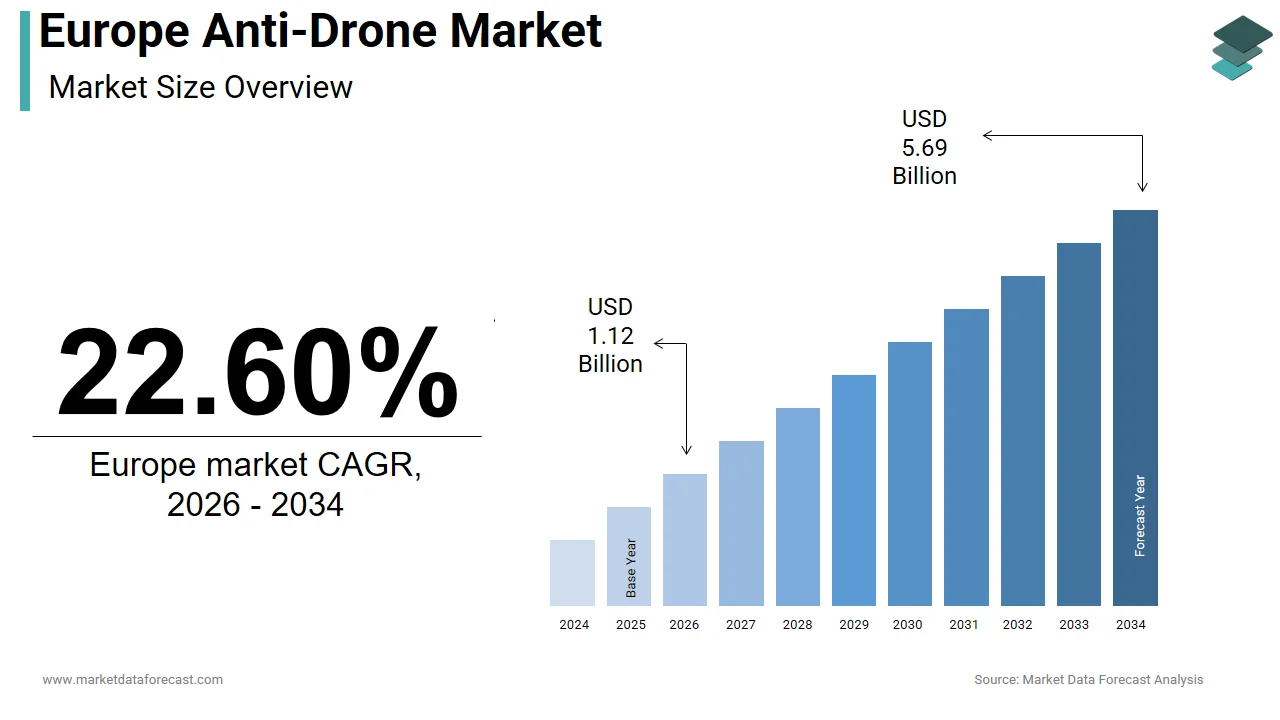
- 2025 Market Size: USD 0.91 billion
- 2026 Market Size: USD 1.12 billion
- Projected Market Size: USD 5.69 billion by 2034
- Growth Forecasts: 22.60% CAGR (2026–2034)
Key Regional Dynamics:
- Largest Country Market: United Kingdom
- Strong Growth Regions: France & Germany
- Dominating Countries: United Kingdom, France, Germany, Netherlands, Sweden
- Emerging Markets: Italy, Spain, Turkey, the Czech Republic, Denmark
Regional Highlights:
The United Kingdom leads the Europe anti-drone market, driven by airport protection mandates, national counter-UAS authority, and advanced defense programs.
France demonstrates strong growth supported by nuclear facility protection, Olympic security deployment, and national anti-drone modernization initiatives.
Germany strengthens adoption through critical infrastructure protection, industrial security, and federal airport surveillance networks.
Segment Insights:
- The detection segment accounted for the largest share of the Europe anti-drone market in 2024 (65.5%), driven by legal permissibility, airport deployment requirements, and EU regulatory alignment.
- The interdiction segment is projected to grow at a significant CAGR, supported by increasing authorization for RF disruption and neutralization at high-risk security sites.
- The RF analyzer technology segment dominated the market in 2025 due to high identification accuracy, operator geolocation capability, and strong law-enforcement adoption.
- The radar technology segment is expected to grow rapidly, driven by autonomous drone detection, all-weather performance, and infrastructure protection demand.
- The government & defense segment held the highest market share in 2025, supported by national defense budgets, centralized counter-UAS programs, and multi-agency coordination.
- The airports segment is forecasted to register the fastest growth, driven by EU-mandated drone detection requirements and major airport security investments.
Key Growth Drivers:
- Rising drone threats to airports, nuclear plants, and energy networks
- Increasing deployment at public events and high-risk gathering venues
- Integration of anti-drone systems with U-space and national air traffic networks
- Expansion of non-kinetic & cyber takeover neutralization technologies
Major Challenges & Restraints:
- Strict EU radio spectrum and RF-jamming restrictions
- Lack of a unified legal framework for civilian anti-drone deployment
- Evolving swarm-based drone tactics are overwhelming legacy systems
- Urban RF interference affecting detection reliability
Key Players:
- Raytheon Technology Corporation, Lockheed Martin Corporation, Israel Aerospace Industries, DroneShield, Detect Inc, Dedrone Holdings Inc., Liteye Systems Inc., Elbit Systems Ltd., Saab AB, Thales Group, and Others.
Europe Anti-Drone Market Size
The size of the Europe anti-drone market was worth USD 0.91 billion in 2025. The regional market is anticipated to grow at a CAGR of 22.60% from 2026 to 2034 and be worth USD 5.69 billion by 2034 from USD 1.12 billion in 2026.
Anti-drone systems encompass technologies and protocols designed to detect, identify, track,k and neutralize unauthorized unmanned aerial vehicles that pose security, safety,y or privacy risks. In Europe, these countermeasures are increasingly deployed at critical infrastructure sites, major public venues, es and sensitive government facilities as drone incursions grow in frequency and sophistication. According to the European Union Aviation Safety Agency, unauthorized drone activity has become a growing concern across EU member states, with tens of thousands of sightings reported in 2023, marking a significant increase from the previous year. Eurostat data shows that more than 87,000 critical infrastructure assets fall under EU protective mandates requiring layered security under the revised European Critical Entities Resilience Directive. The European Commission’s 2023 Action Plan on Countering Unmanned Aircraft Threats has accelerated the procurement of radio frequency detection, radar, and RF jamming systems while promoting standardized response protocols. With recreational and commercial drone registrations surpassing 2.3 million in the EU, as confirmed by national aviation authorities, the need for proportionate and legally compliant counter-drone capabilities has become an urgent operational priority across defense, civil, and private sectors.
MARKET DRIVERS
Rising Security Threats to Critical Infrastructure Drive System Deployment
The vulnerability of airports, energy grids, and public institutions to drone disruption has made anti‑drone systems a non‑optional layer of physical security across Europe, which is one of the major factors propelling the growth of the European anti-drone market. According to Europol, hundreds of drone‑related security incidents at European airports were reported in 2023, with Heathrow and Charles de Gaulle experiencing multiple flight suspensions due to rogue UAVs. According to ENTSO‑E, 38% of EU member states documented reconnaissance drone flights near substations in 2023, prompting mandatory anti‑drone perimeters under the Critical Entities Resilience Directive. In response, Germany’s Federal Police deployed integrated RF and radar detection systems at all major airports by early 2024, while France’s nuclear operator EDF confirmed installation of anti‑drone shields at 19 power plants. These measures reflect a strategic shift from reactive monitoring to proactive neutralization, ensuring continuity of essential services in an era where a single drone can trigger cascading economic and safety consequences.
Expansion of Major Public Events and High‑Profile Gatherings Increases Demand for Temporary Protection
Europe’s dense calendar of international summits, sporting events, and cultural festivals creates recurring demand for mobile and rapidly deployable anti‑drone solutions, which is further contributing to the expansion of the European anti-drone market. According to the European Commission, more than 120 high‑risk public events are held annually across the EU, requiring layered airspace security. In 2024, the Paris Olympics Organizing Committee mandated comprehensive drone detection and mitigation coverage for all venues following a 2023 incident where a drone carrying a smoke device disrupted a French Open match. Similarly, the Dutch National Coordinator for Counterterrorism deployed portable RF detection units during King’s Day celebrations in Amsterdam after a near‑miss involving a drone near royal motorcades in 2023. As per Europol, the number of anti‑drone activations at public events rose by 57% in 2023, which indicates a new normal where airspace vigilance is as essential as ground security.
MARKET RESTRAINTS
Stringent EU Radio Spectrum Regulations Limit Neutralization Capabilities
European anti‑drone systems face significant operational constraints due to strict regulations governing radio frequency emissions under the European Telecommunications Standards Institute framework. According to BEREC, RF jamming is prohibited in most civilian contexts because it interferes with licensed spectrum, including emergency services and aviation bands. In 2023, Germany’s Federal Network Agency fined three private security firms for unauthorized jamming during corporate events, highlighting regulatory enforcement. Consequently, most European deployments rely solely on detection and tracking, with physical interdiction by law enforcement as the only legal response. As per the European Commission’s 2023 evaluation, only 11 member states permit limited RF disruption under strict judicial authorization. This legal barrier forces operators to use less effective kinetic or net capture systems, which fail against fast or swarm drones, which is creating a critical capability gap between threat evolution and lawful response options.
Lack of Harmonized Legal Framework for Civilian Anti‑Drone Use
Despite growing threats, the authority to deploy and operate anti‑drone systems remains fragmented across EU member states, which is creating uncertainty for private entities and local governments and hampering the regional market growth. According to Eurojust, only 14 countries have clear legislation defining who may operate counter‑drone technology and under what circumstances. In Italy, for example, only state police may deploy detection systems at public venues, while in Sweden, private airports can install them with municipal approval. This inconsistency complicates procurement and training, particularly for multinational corporations or event organizers operating across borders. As per the European Aviation Safety Agency, 63% of reported drone incursions in 2023 occurred at facilities where the operator lacked legal authority to deploy countermeasures. The absence of a unified EU directive on civilian anti‑drone rights leaves critical sites vulnerable and discourages investment in comprehensive protection strategies due to fear of legal liability.
MARKET OPPORTUNITIES
Integration with National Airspace Management Systems Enables Proactive Defense
Europe is pioneering the fusion of anti‑drone platforms with national U‑space and unmanned traffic management infrastructures to enable preemptive threat identification, which is a promising opportunity in the European anti-drone market. As per the European Union Aviation Safety Agency, 27 member states are implementing U‑space services that require drone operators to broadcast identification and flight paths via remote ID. Anti‑drone systems from companies such as Dedrone and Aaronia can cross‑reference detected RF signatures with authorized flight registries in real time, flagging non‑compliant UAVs before they breach perimeter airspace. In Switzerland, the Sky49 system integrates airport radar, drone detection, and U‑space data to automatically alert authorities of anomalies,ies a model being replicated in the Netherlands and Finland. According to the Single European Sky ATM Research Programme, this data fusion reduces false alarms by 72% and enables automated response protocols. This shift from passive detection to intelligent airspace awareness transforms anti‑drone operations from reactive to predictive, significantly enhancing protection for airports and urban centers.
Development of Non‑Kinetic Neutralization Technologies Aligns with Urban Safety Norms
Recognizing the dangers of kinetic or explosive countermeasures in densely populated areas, European developers are advancing precision electronic and cyber takeover solutions, which are another prominent opportunity in the European market. According to the European Defence Agency, projects such as COUNTER‑UAS under the European Defence Fund have funded GPS spoofing and command injection technologies that safely land drones without collateral damage. In 2024, the Swedish Defence Research Agency demonstrated a system that hijacks a drone’s control link and redirects it to a secure location using only 200 milliwatts of power, which is well below harmful emission thresholds. Similarly, French firm Thales unveiled a directional RF system that disables only the target drone’s navigation without affecting nearby electronics. These approaches align with EU urban safety principles that prioritize public protection over asset destruction. As per the European Committee for Standardization, new technical specifications for “non‑disruptive neutralization” are expected by 2025, accelerating adoption in cities where public tolerance for explosive or net‑based systems remains low.
MARKET CHALLENGES
Evolving Drone Swarming Tactics Overwhelm Current Detection Architectures
Adversaries are increasingly deploying coordinated drone swarms that saturate traditional anti‑drone sensors designed for single‑target tracking, which is one of the major challenges to the growth of the European anti-drone market. According to the European Defence Agency, a 2023 simulation at a NATO exercise in Poland showed that legacy RF detection systems failed to maintain track on more than eight simultaneous drones due to signal congestion and processing bottlenecks. Real‑world incidents are following suit, with a 2024 attack on a Ukrainian energy facility near the EU border involving a 32‑drone swarm overwhelming local defenses. European systems often rely on narrowband scanning, which cannot resolve dense RF environments. As per the Fraunhofer Institute for Communication Systems, current commercial anti‑drone platforms achieve less than 40% detection accuracy in swarm scenarios. This technical shortfall creates a dangerous asymmetry where low‑cost commercial drones can defeat high‑cost defense systems, which is forcing urgent investment in wideband spectrum analysis, AI‑powered signal separation, and multi‑sensor fusion to restore defensive parity.
Electromagnetic Interference in Urban Environments Degrades System Performance
The dense electronic noise of European cities severely compromises the reliability of RF‑based anti‑drone detection, which is further challenging the expansion of the European market. According to the Technical University of Munich, urban background RF noise exceeds detection thresholds for small drones at distances beyond 300 meters, reducing effective coverage by up to 65% compared to rural settings. In Paris, tests by the French National Gendarmerie found that 42% of drone alerts in the city center were false positives caused by microwave ovens and Bluetooth devices. Similarly, radar systems struggle with building clutter, creating blind spots in narrow streets. As per the European Space Agency, urban multipath interference causes location errors of up to 15 meters, which makes kinetic or cyber neutralization unsafe. Until systems incorporate advanced machine learning filters and multi‑static sensor networks, urban anti‑drone protection will remain partial and prone to both missed detections and disruptive false alarms, which limits confidence in high‑stakes deployments.
REPORT COVERAGE
| REPORT METRIC | DETAILS |
| Market Size Available | 2025 to 203 |
| Base Year | 2025 |
| Forecast Period | 2026 to 2034 |
| Segments Covered | By Method, Technology, Platform, End-use, and Country. |
| Various Analyses Covered | Global, Regional, and Country-Level Analysis, Segment-Level Analysis, Drivers, Restraints, Opportunities, Challenges; PESTLE Analysis; Porter’s Five Forces Analysis, Competitive Landscape, Analyst Overview of Investment Opportunities |
| Countries Covered | UK, France, Spain, Germany, Italy, Russia, Sweden, Denmark, Switzerland, Netherlands, Turkey, Czech Republic, and the Rest of Europe. |
| Market Leaders Profiled | Raytheon Technology Corporation, Lockheed Martin Corporation, Israel Aerospace Industries, DroneShield, Detect Inc, Dedrone Holdings Inc., Liteye Systems Inc., Elbit Systems Ltd., Saab AB, Thales Group, and Others. |
SEGMENTAL ANALYSIS
By Method Insights
The detection segment captured 65.5% of the European anti-drone market share in 2024. The dominance of the detection segment in the European market is driven by the legal permissibility, widespread deployment needs, and its foundational role in all counter‑drone workflows. Unlike interdiction, which faces strict radio spectrum and safety restrictions, detection technologies are legally deployable by a wide range of entities, including airports, stadiums, and private facilities. According to the Body of European Regulators for Electronic Communications, RF detection and radar systems do not emit disruptive signals and thus comply with EU electromagnetic compatibility directives. As per the European Commission’s Critical Entities Resilience Guidelines (2023), passive detection was explicitly endorsed as the primary layer of drone defense. Consequently, 92% of European airports have installed detection systems even if they lack neutralization authority, according to the European Union Aviation Safety Agency. This legal clarity enables broad adoption by entities that cannot risk regulatory penalties, which is making detection the universal first step in any anti‑drone strategy across public and private sectors. Legal permissibility, EU regulatory endorsement, and airport adoption directly sustain detection as the dominant method segment.
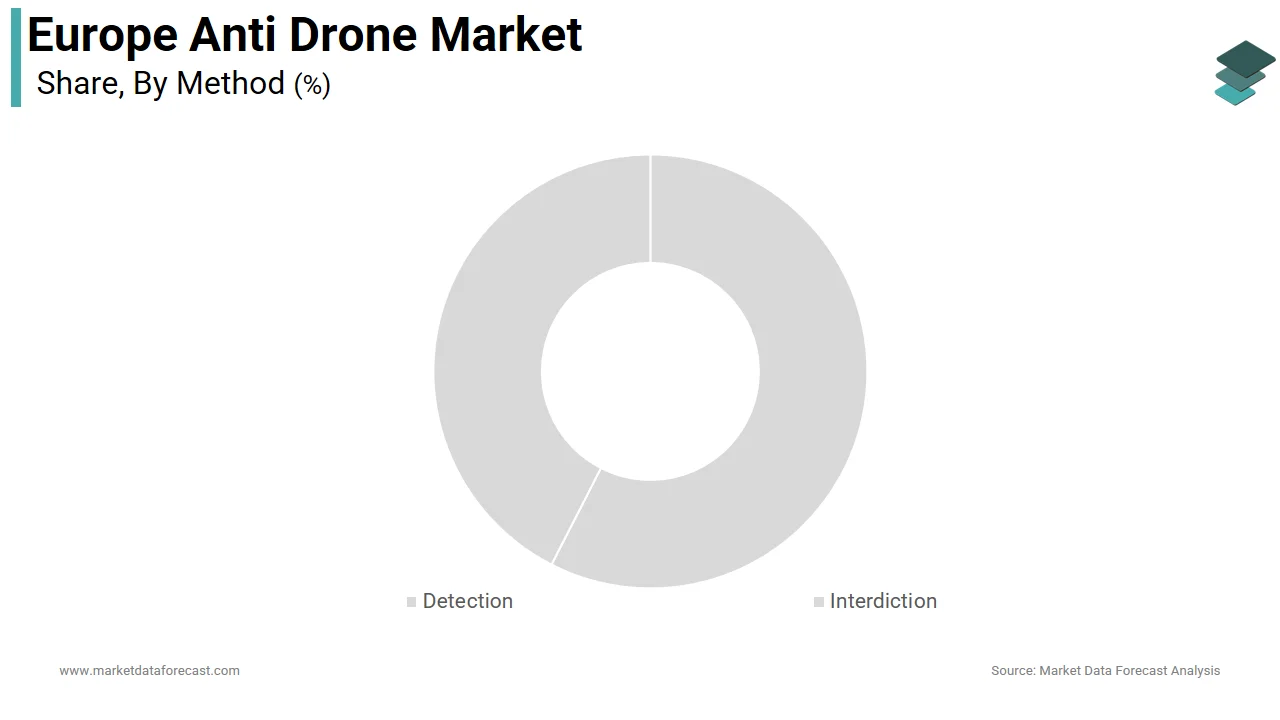
The interdiction segment is promising and is projected to grow at a CAGR of 18.4% over the forecast period. While interdiction remains restricted, EU member states are progressively granting limited authorization for neutralization at critical sites. According to the European Commission, 12 countries now permit RF jamming or GPS spoofing within 500‑meter perimeters of airports, nuclear facilities, and government buildings under judicial oversight. In 2024, France updated its Internal Security Code to allow police to deploy directional RF jammers during major public events, following repeated drone disruptions at the Tour de France. Similarly, as per the UK Civil Aviation Authority, Gatwick and Heathrow airports received the first civilian interdiction licenses in early 2024 after trials reduced incident response time by 83%. These regulatory shifts unlock high‑value deployments where detection alone is insufficient to mitigate imminent threats. Regulatory authorizations, national security updates, and airport licensing directly drive interdiction as the fastest-growing method segment.
By Technology Insights
The RF analyzers segment occupied 42.4% of the Europe anti‑drone market in 2024. The leading position of the RF analyzer segment in the European market can be credited to its ability to identify drone command and control signals with high specificity. RF analyzers detect the unique communication signatures between drones and their controllers, which enable not only UAV identification but also geolocation of the pilot and are a critical capability for law enforcement. According to the European Union Agency for Law Enforcement Cooperation, RF‑based systems correctly identified drone models in 89% of test cases during the 2023 EUROPOL Drone Shield exercise. In Germany, as per the Federal Criminal Police Office, RF triangulation locates illegal drone operators within 15 meters even in urban canyons. Unlike radar or acoustic sensors, RF analyzers provide actionable intelligence rather than mere presence alerts, which makes them indispensable for judicial and security responses. High identification accuracy, operator geolocation, and law enforcement adoption directly sustain RF analyzers as the dominant technology segment.
The radar segment is a prominent segment and is expected to expand at a CAGR of 20.5% over the forecast period. Radar excels in detecting drones that do not emit RF signals, such as pre‑programmed autonomous UAVs or those using encrypted mesh networks. According to the Technical University of Munich, radar maintains 94% detection reliability in heavy rain, fog, or snow, as these are the conditions where optical and RF systems fail. In 2024, as per the Swiss Air Force, Leonardo’s KRONOS Ground Master radar was deployed at all major airports to counter silent drone threats during winter operations. Similarly, the Swedish Civil Contingencies Agency uses X‑band radar to monitor drone activity near power lines year‑round, regardless of visibility. This operational resilience makes radar essential for critical infrastructure that cannot afford blind spots during adverse weather, which is a key driver in Northern and Alpine regions. All‑weather reliability, autonomous UAV detection, and infrastructure deployment directly drive radar as the fastest-growing technology segment.
By End‑Use Insights
The government and defense segment had 55.4% of the European anti-drone market share in 2024. National defense and law enforcement agencies possess both the legal mandate and funding to deploy full‑spectrum detection and interdiction systems. According to the European Defence Agency, 23 member states included anti‑drone capabilities in their 2024 national defense reviews, with average budget allocations exceeding €85 million per country. As per the French Ministry of Armed Forces, a dedicated Counter‑Drone Command was established in 2023 to oversee the protection of military bases, embassies, and critical events. Similarly, the UK’s National Protective Security Authority coordinates anti‑drone protocols across 15 government departments. This centralized authority enables integrated procurement, training, and operational deployment that civilian sectors cannot replicate, which is making the government the anchor customer for advanced and legally complex solutions. Defense budgets, centralized commands, and cross‑department coordination directly sustain government and defense as the dominant end‑use segment.
The airports segment is predicted to register a CAGR of 23.5% over the forecast period in the European anti-drone market. The European Union Aviation Safety Agency now requires all EU airports handling over 1 million passengers annually to implement drone detection systems by 2025. As per the German Air Transport Association, the 2023 drone incursion at Frankfurt Airport grounded flights for 90 minutes, costing airlines an estimated €4.2 million. In response, Heathrow invested €18 million in a multi‑layer system combining RF, radar, and RF jamming, which is the first in Europe with neutralization authority. Similarly, Amsterdam Schiphol deployed Dedrone’s RF mesh network across its perimeter in 2024, achieving 99.6% detection accuracy in trials. These regulatory and operational pressures transform anti‑drone systems from optional to essential infrastructure for airport viability. EU mandates, high‑profile disruptions, and airport investments directly drive airports as the fastest-growing end‑use segment.
COUNTRY-LEVEL ANALYSIS
United Kingdom Anti-Drone Market Analysis
The United Kingdom occupied 19.8% of the European market share in 2024 due to its advanced regulatory framework, high airport traffic, and proactive defense posture. According to the UK Civil Aviation Authority, over 3,200 unauthorized drone reports were filed in 2023, with 68% involving airports or critical infrastructure. The country was the first in Europe to grant civilian airports legal authority to use RF jamming following the 2018 Gatwick incident that cost €50 million in disruptions. The National Protective Security Authority now mandates anti‑drone systems for all Crown Premises and major event venues. Additionally, the Defence Science and Technology Laboratory funds projects like AUDREY, which integrates AI with multi‑sensor detection for urban environments. This blend of legal innovation, operational urgency, and R&D investment sustains the UK’s leadership despite post‑Brexit challenges in EU coordination.
France Anti-Drone Market Analysis
France held a promising share of the European anti-drone market in 2025. The growth of France in the European market is driven by its dense network of nuclear facilities, major public events, and assertive internal security doctrine. According to the French Directorate General for Civil Aviation, 410 drone incursions occurred near sensitive sites in 2023, prompting the deployment of Thales’ Ground Observer 40 radar at all 19 nuclear plants. The 2024 Paris Olympics triggered a €280 million national anti‑drone program covering stadiums, transport hubs, and the Seine River corridor. As per the Ministry of Interior, the GIGN elite unit operates mobile RF and radar units capable of neutralizing drones within 300 meters of presidential motorcades. Furthermore, France actively shapes EU policy through its leadership in the European Defence Fund’s COUNTER‑UAS initiative. This combination of critical asset density, event‑driven urgency, and strategic influence makes France a powerhouse in both deployment and technology development.
Germany Anti-Drone Market Analysis
Germany is expected to grow at a healthy CAGR in the European anti-drone market during the forecast period due to its industrial infrastructure density, strict regulatory compliance culture, and federalized security model. According to the Federal Office for Civil Protection, over 280 chemical plants, power stations, and airports require anti‑drone perimeters under the Critical Entities Resilience Act. The Federal Police operates the SkyPatriot network covering all major airports and government districts. German engineering firms such as Rohde & Schwarz and Hensoldt supply advanced RF detection and radar systems used across NATO. Additionally, as per national data protection laws, anti‑drone systems must avoid recording civilian communications, which is a technical challenge that has spurred innovation in selective signal processing. This emphasis on legal compliance, technical precision, and industrial security creates a high‑integrity market where quality outweighs cost.
Netherlands Anti-Drone Market Analysis
The Netherlands stands out as a hub for anti‑drone innovation, interoperability, and airport security leadership. According to the Dutch Ministry of Defense, the country hosts NATO’s Counter‑UAS Test Centre, which evaluates systems from 27 nations for joint deployment. Amsterdam Schiphol Airport was the first in Europe to achieve full integration of drone tracking into its air traffic management system, reducing response time to under 45 seconds. Dutch firms such as Robin Radar and Aerial Technologies export advanced X‑band radar and AI‑powered RF detection to over 40 countries. As per the national government, public‑private partnerships such as the DroneShield NL consortium are funded to develop non‑kinetic neutralization for urban use. This ecosystem of testing, integration, and export‑oriented innovation allows the Netherlands to exert influence far beyond its size.
Sweden Anti-Drone Market Analysis
Sweden expects to do well in this regional market during the forecast period through its focus on non‑lethal technologies, Arctic security, and civilian defense preparedness. According to the Swedish Civil Contingencies Agency, over 190 critical infrastructure sites deployed anti‑drone systems in 2023 following increased reconnaissance flights near military zones. The country prioritizes low‑power microwave and GPS spoofing that comply with strict environmental and safety norms. Saab’s LISA system can disable drones at 200 meters without harmful emissions. Sweden also integrates anti‑drone sensors into its nationwide early warning network used during public emergencies. As per the Swedish Defence Research Agency, Sweden leads EU projects on AI‑driven swarm detection using multi‑static radar. This commitment to ethical, effective, and resilient solutions positions Sweden as a model for sustainable counter‑UAS development in sensitive environments.
COMPETITIVE LANDSCAPE
Competition in the Europe anti drone market is characterized by a tension between technological sophistication and legal compliance. Global defense giants like Thales and Saab compete on system integration and non-kinetic neutralization capabilities, while specialized firms such as Dedrone differentiate through AI-driven software and scalable civilian deployment models. The absence of a unified EU regulatory framework for interdiction creates a fragmented procurement landscape where national laws dictate technical choices, which favors companies with local presence and legal expertise. Incumbents benefit from early deployment at airports and defense sites but face pressure from startups offering modular and cost-effective solutions. Crucially, success hinges not on hardware alone but on the ability to deliver a legally defensible chain of custody data interoperability with existing security systems and minimal false alarm rates. As drone threats evolve toward swarms and autonomy, the market increasingly rewards adaptive architectures over static point solutions.
KEY MARKET PLAYERS
The leading companies operating in the Europe anti-drone market include:
- Raytheon Technology Corporation
- Lockheed Martin Corporation
- Israel Aerospace Industries
- DroneShield
- Detect Inc
- Dedrone Holdings Inc.
- Liteye Systems Inc.
- Elbit Systems Ltd.
- SaaB AB
- Thales Group
TOP PLAYERS IN THE MARKET
- Thales is a cornerstone of the Europe anti drone market through its integrated Ground Observer and ForceShield systems, which combine radar RF detection and precision electronic neutralization. The company supplies critical protection for airports, nuclear sites, and government facilities across France, Germany, and the UK. In 2024, Thales enhanced its ForceShield platform with AI-driven signal separation to counter drone swarms in urban environments while remaining compliant with EU radio emission limits. It also partnered with the French Ministry of Armed Forces to deploy mobile anti-drone units for the Paris Olympics. These initiatives reinforce Thales’s role as a European defense technology leader whose counter-UAS solutions set benchmarks for interoperability, legal compliance, and operational resilience in both civil and military domains globally.
- Dedrone contributes significantly to the Europe anti drone landscape via its AI-powered multi-sensor detection platform that fuses RF radar and video analytics to identify and classify drone threats in real time. Headquartered in Germany with major operations in the UK and France, the company serves airports, prisons, and stadiums across the continent. In early 2024, Dedrone integrated its technology into Amsterdam Schiphol’s air traffic management system, which is the first in Europe to achieve full airspace fusion for drone tracking. It also launched a cloud-based threat intelligence network that aggregates anonymized drone data from 40 countries to enhance predictive analytics. By prioritizing software-centric, scalable architecture and regulatory alignment, Dedrone has become a trusted partner for civilian infrastructure operators seeking legally defensible and future-proof protection.
- Saab holds a strategic position in the Europe anti drone market through its non-kinetic LISA system, which uses low-power microwave and GPS spoofing to safely neutralize drones without collateral damage. The Swedish company focuses on urban safety, critical infrastructure, and defense applications where explosive or network-based solutions are prohibited. In 2023, Saab delivered its anti-drone systems to the Swedish Civil Contingencies Agency and the Finnish Defence Forces under a Nordic security cooperation agreement. It also participated in the EU-funded COUNTER UAS project to develop swarm detection capabilities using multi-static radar. Saab’s emphasis on ethical electronic warfare and environmental compliance aligns with Northern European security values and influences global standards for proportionate and sustainable counter-drone operations.
TOP STRATEGIES USED BY THE KEY MARKET PARTICIPANTS
Key players in the Europe anti drone market invest in multi-sensor fusion combining RF radar and optical technologies to improve detection accuracy and reduce false alarms. They prioritize non-kinetic neutralization methods such as GPS spoofing and command link hijacking to comply with urban safety and spectrum regulations. Companies actively integrate their systems with national air traffic management and critical infrastructure control centers for real-time response. Strategic partnerships with defense agencies, airports, and EU institutions ensure alignment with evolving legal and operational requirements. Additionally, they develop cloud-based threat intelligence platforms that leverage aggregated data to enhance predictive analytics and system adaptability across diverse European environments.
MARKET SEGMENTATION
This research report on the Europe anti-drone market has been segmented and sub-segmented into the following categories.
By Method
- Detection
- Interdiction
By Technology
- RF Analyzer
- Acoustic Sensors
- Optical sensor
- Radar
- RF Jammer
- GPS Spoofer
- High Power Microwave Devices
- Nets and Guns
- High Energy Lasers
By Platform
- Handheld
- UAV
- Ground Based
By End-use
- Government and Defense
- Commercial
- Airports
- Others
By Country
- United Kingdom
- France
- Spain
- Germany
- Italy
- Russia
- Sweden
- Denmark
- Switzerland
- Netherlands
- Rest of Europe