- Product Description Description
- Table of Contents TOC
- List of Table & Figure LOT
- Get Free Sample PDF Sample PDF
Market Size, 2025
$1.43 BnMarket Estimate, 2026
$1.80 BnMarket Forecast, 2034
$11.38 BnCAGR, 2026–2034
25.92%Europe Artificial Intelligence in Construction Market Report Summary
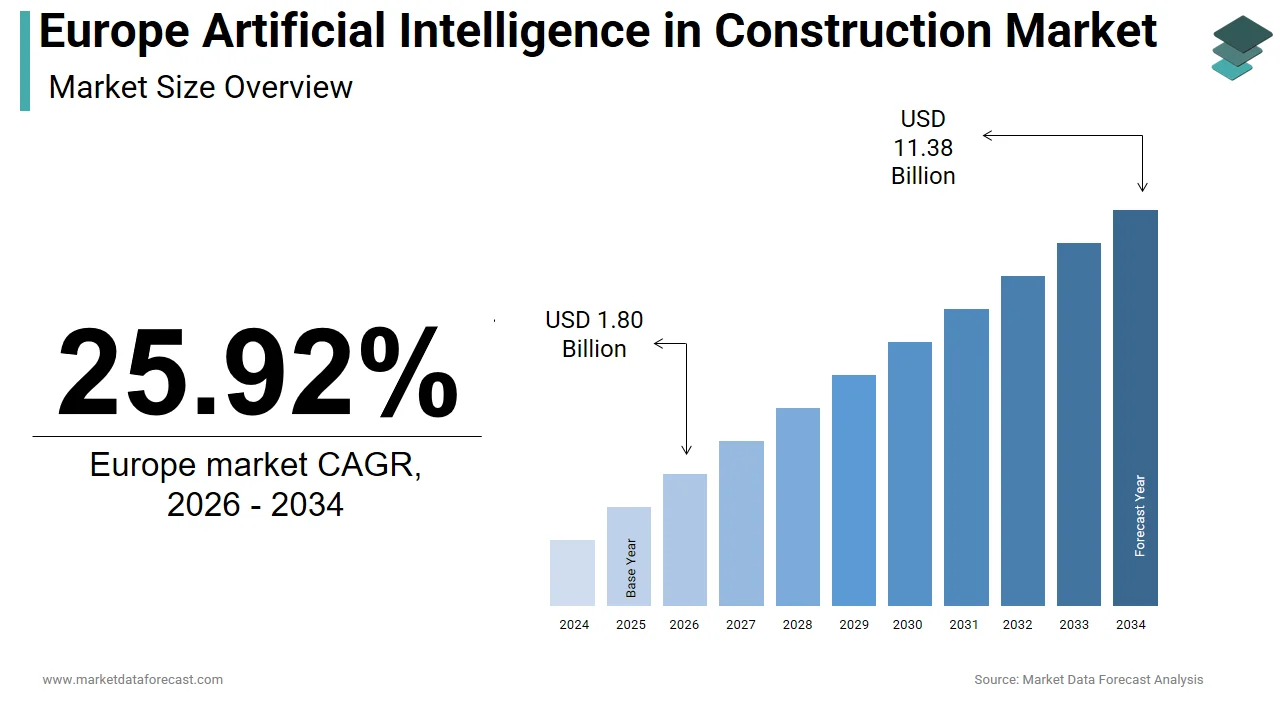
The Europe artificial intelligence in construction market was valued at USD 1.43 billion in 2025, is estimated to reach USD 1.80 billion in 2026, and is projected to reach USD 11.38 billion by 2034, expanding at a robust CAGR of 25.92% from 2026 to 2034. Market growth is driven by rapid digital transformation in the construction sector, rising adoption of Building Information Modeling (BIM), and increasing demand for AI-powered tools to improve project efficiency, safety, and sustainability. Governments across Europe are promoting smart infrastructure, carbon tracking, and performance-based procurement, accelerating the integration of AI into construction workflows.
Key Market Trends
- Increasing adoption of AI-enabled BIM and digital twins for infrastructure planning and asset management.
- Rising use of computer vision and predictive analytics to improve site safety and reduce accidents.
- Strong demand for AI-driven project management tools for cost control and scheduling optimization.
- Growth in AI-based energy and carbon optimization solutions aligned with net-zero building goals.
- Expansion of AI-powered automation and robotics for precision construction activities.
Segmental Insights
- Based on offering, the solutions segment led the Europe artificial intelligence in construction market in 2025, driven by high demand for AI software platforms that enable real-time analytics, automation, and digital project management.
- Based on application, the project management segment commanded the highest market share in 2025 due to the growing need for AI tools that improve scheduling accuracy, cost forecasting, and resource allocation.
- Based on stage, the construction stage segment captured the major share of the regional market in 2025, supported by the widespread use of AI for site monitoring, safety management, and productivity optimization.
Regional Insights
The Europe artificial intelligence in construction market is witnessing strong growth across major economies, supported by digital infrastructure investments, sustainability mandates, and government-led innovation programs.
- Germany led the market with a 24.4% share, driven by mandatory BIM adoption for federal projects, AI-enabled safety monitoring, and strong public funding for construction digitalization.
- France held the second-largest share, supported by the France 2030 investment plan, BIM mandates for public works, and AI use in heritage restoration and carbon tracking.
- The United Kingdom remains a key market due to its National Digital Twin Programme, AI-driven retrofit initiatives, and performance-based construction procurement standards.
Competitive Landscape
A dynamic mix of global technology leaders, specialized construction software providers, and emerging AI startups characterizes the Europe artificial intelligence in construction market. Competition is centered on domain expertise, regulatory compliance, and measurable improvements in safety, productivity, and sustainability. Established players are integrating AI into existing BIM and automation ecosystems, while startups focus on niche applications such as drone-based progress tracking and heritage restoration analytics. Public procurement policies favoring innovation and green outcomes are shaping a collaborative, partnership-driven competitive environment.
Prominent companies in the Europe artificial intelligence in construction market include Autodesk Inc., International Business Machines Corporation, Microsoft, Oracle, SAP SE, Trimble Inc., ALICE Technologies Inc., Siemens AG, BuildingConnected, NVIDIA Corporation, and The Access Group.
Europe Artificial Intelligence in Construction Market Size
The Europe artificial intelligence in construction market was valued at USD 1.43 billion in 2025, is estimated to reach USD 1.80 billion in 2026, and is projected to reach USD 11.38 billion by 2034, growing at a CAGR of 25.92% from 2026 to 2034.
Artificial intelligence in the construction sector refers to the deployment of machine learning algorithms computer vision natural language processing and predictive analytics to enhance design optimization project planning site safety labor productivity and asset lifecycle management. Unlike conventional construction informatics, AI systems autonomously interpret complex datasets from Building Information Modeling drones, sensors and historical project archives to generate actionable insights. According to the European Commission, the construction sector in the EU is responsible for about half of all extracted materials and energy demand and about one third of water consumption waste and CO2 emissions which makes AI enabled energy modeling and material efficiency critical to achieving the European Green Deal targets. Furthermore, as per Eurostat, production in construction across the EU has remained relatively stagnant with only marginal increases such as 0.2% growth in early 2025 which underscores the urgency for digital transformation. As per the FIEC Statistical Report, the construction industry employs over 12 million workers and contributes around 9% of EU GDP highlighting its strategic importance in Europe’s economy.
MARKET DRIVERS
Integration of AI in Public Infrastructure Projects Drives Adoption
European governments are increasingly mandating or incentivizing AI integration in publicly funded infrastructure, to improve cost control and delivery timelines, which is primarily driving the growth of the European artificial intelligence (AI) in construction market. As per the European Investment Bank, digital technologies including AI and digital twins are increasingly embedded in transport and energy infrastructure projects under the EU Recovery and Resilience Facility since 2021, which is making them part of procurement criteria. This policy shift is most evident in Germany, where the Federal Ministry of Transport and Digital Infrastructure requires AI powered progress tracking and delay prediction systems in large scale rail and highway projects. In France, the Banque des Territoires has allocated billions of euros to smart construction technologies under its Infrastructure Digitalization Plan, with AI-based design optimization tools receiving priority funding. According to the European Environment Agency, AI enabled material take off and waste forecasting has shown measurable reductions in concrete over ordering in pilot social housing projects across the Netherlands and Denmark. Additionally, the European Committee for Standardization is finalizing CEN/TS 18101, a technical specification that will standardize AI data inputs for public works tenders by 2025. These institutional mechanisms transform AI from an optional innovation into a contractual necessity, thereby accelerating enterprise-scale deployment across contractors and engineering consultancies.
Persistent Labor Shortages Catalyze AI-Driven Productivity Solutions
A structural deficit in skilled construction labor across Europe is compelling firms to deploy AI, to compensate for workforce gaps, which is further supporting the expansion of the European artificial intelligence (AI) in construction market. As per Eurostat, the construction sector continues to face vacancy rates above the EU economy wide average, with Germany, Italy, and Poland reporting the most acute shortages. As per the estimations of the European Construction Institute, the EU will need hundreds of thousands of additional construction workers by 2030 to meet housing and infrastructure demands and yet demographic trends suggest a net decline in available labor. In response, companies are turning to AI-powered solutions such as computer vision enabled progress monitoring drones, and autonomous layout robots, that reduce reliance on manual surveying. According to the German Federal Institute for Vocational Education and Training, AI-assisted quality inspection systems have cut rework hours on residential sites in Bavaria, by flagging deviations in real time. Similarly, the Swedish Transport Administration reported that AI-based scheduling reduced crane idle time on bridge rehabilitation projects in 2023. These productivity gains are not merely efficiency measures, but operational necessities in a labor-constrained environment, where delays carry high financial and social costs.
MARKET RESTRAINTS
The European construction industry: Fragmented Data Ecosystems Inhibit AI Model Training and Deployment
operates with highly siloed and non-standardized data formats across design, procurement, and execution phases, which severely limits the effectiveness of AI systems that require large and consistent datasets and is hampering the growth of the regional market. According to the European Federation of National Engineering Associations, fewer than 35% of EU construction firms use interoperable BIM standards beyond Level 1, and only a small share maintains structured historical project databases suitable for machine learning. This fragmentation is exacerbated by national regulatory divergence, with France mandating BIM for public projects above 5 million euros, while countries like Greece and Romania lack any formal digital construction policy. According to the European Commission’s Built Environment Data Study, most project data remain trapped in unstructured PDFs, paper records, or proprietary software formats, inaccessible to AI engines. Even when data exists, variance in classification, such as differing cost coding between German DIN and British NRM standards, prevents cross project model training. Consequently, AI vendors must rebuild foundational datasets for each client or country, drastically increasing deployment time and cost. Until the EU achieves harmonized data governance through initiatives like the Digital Product Passport for buildings, AI’s scalability in construction will remain constrained by informational disarray.
High Initial Investment and Uncertain ROI Deter SME Adoption
Small and medium sized enterprises, which constitute 98% of Europe’s construction firms according to Eurostat, face significant barriers to AI adoption due to upfront costs and ambiguous return on investment, which is also significant impediment to the growth of the European artificial intelligence (AI) in construction market. As per the European Small Business Portal, the cost of implementing an AI enabled project management or safety monitoring system often exceeds the annual IT budgets of most SMEs. Moreover, the lack of standardized performance metrics makes it difficult to quantify productivity gains. The European Association of Craft Trades and SMEs in Construction reported that only a small fraction of its members had piloted AI tools, primarily due to concerns over cost recovery and workforce disruption. Unlike large contractors, who can amortize AI expenses across multiple billion-euro portfolios, SMEs operate on thin margins, often below 5%, making technology investments financially precarious. National support schemes exist, but are fragmented. Germany’s BAFA grants cover part of digitalization costs, yet require complex eligibility verification, while Italy’s Industry 4.0 tax credit excludes standalone AI software. This uneven support landscape leaves the vast majority of the construction ecosystem unable to participate in the AI transition, thereby slowing sector wide transformation.
MARKET OPPORTUNITIES
AI-Enabled Energy Optimization Aligns with EU Green Building Mandates
The European Union’s tightening building performance regulations create a high value opportunity for the European artificial intelligence (AI) in construction market. As per the revised Energy Performance of Buildings Directive, all new public buildings must be zero emission by 2028, and all new buildings by 2030, a target unattainable without dynamic simulation and control. AI algorithms that analyze weather, occupancy, and grid data to adjust HVAC and lighting can reduce operational energy by 25 to 35%, according to the European Environment Agency’s 2023 Smart Building Assessment. Furthermore, the EU Taxonomy for Sustainable Activities now requires disclosure of whole life carbon metrics, prompting firms like Skanska and Bouygues to deploy AI tools that calculate embodied emissions from material choices during design. In the Netherlands, the government’s BENG standards mandate that all new homes meet strict energy neutrality criteria, driving adoption of AI driven thermal modeling platforms that simulate thousands of design permutations in minutes. The European Commission’s New European Bauhaus initiative has also funded 17 AI for sustainability pilots, including a Barcelona project where machine learning reduced concrete volume by 19% without compromising structural integrity. These regulatory and funding tailwinds position AI as an essential enabler of Europe’s green construction agenda.
Expansion of Digital Twins in Asset Lifecycle Management Unlocks New Service Models
The maturation of digital twin technology, powered by AI analytics is transforming construction firms into long term facility operators, which is creating recurring revenue streams beyond project delivery and offering growth possibilities to the European artificial intelligence (AI) in construction market. According to the European Construction Institute, over 40% of Europe’s top 50 contractors now offer digital twin enabled facility management services for hospitals, airports, and data centers. These virtual replicas continuously ingest sensor data from IoT devices, and use AI to predict maintenance needs, optimize space utilization, and simulate retrofit scenarios. In Sweden, the Karolinska Hospital’s digital twin reduced energy consumption by 28% in 2023, by dynamically adjusting ventilation based on real time occupancy and air quality data, as confirmed by the Swedish Energy Agency. Similarly, Germany’s Frankfurt Airport uses an AI-driven twin to simulate passenger flows and maintenance bottlenecks, reducing operational downtime by 17%. The European Committee for Standardization is advancing EN 17925 to standardize digital twin handover protocols by 2026, facilitating contractual adoption. This shift from one time construction to continuous value delivery redefines business models, and positions AI not as a tool, but as the core of a service-oriented future.
MARKET CHALLENGES
Lack of AI Literacy Among the Construction Workforce Hinders Effective Utilization
Despite technological availability, the European construction workforce remains largely unprepared to interact with or trust AI systems, due to insufficient digital literacy, which is challenging the expansion of the European artificial intelligence (AI) in construction market. According to the European Centre for the Development of Vocational Training, fewer than 20% of construction professionals have received formal training in data interpretation or AI assisted decision making. This gap is especially pronounced among site supervisors and tradespeople, who constitute the primary users of AI safety and quality tools. According to the 2023 survey of the European Federation of Building and Woodworkers, 68% of on-site personnel either ignored or overrode AI generated alerts, due to perceived inaccuracy or lack of contextual understanding. In Italy, pilot programs using computer vision for fall risk detection saw compliance rates below 40%, because workers did not understand how the system classified hazards. Unlike manufacturing, where human machine collaboration is institutionalized, construction’s project based transient labor model impedes consistent upskilling. National vocational curricula across the EU still rarely include AI modules, with only Finland and the Netherlands integrating digital twin simulation into apprenticeship programs. Until AI interfaces are designed for intuitive use, or workforce capabilities are upgraded, this adoption barrier will persist.
Regulatory Ambiguity Around AI Liability in Construction Errors Creates Legal Risk
The absence of clear legal frameworks assigning responsibility when AI systems contribute to design flaws, safety incidents, or cost overruns deters widespread deployment in high stakes construction environments, which is further challenging the growth of the regional market. According to the European Law Institute, current EU product liability directives do not adequately address situations where an error stems from a hybrid decision involving both human judgment and algorithmic recommendation. In Germany, a 2023 court case involving an AI optimized foundation design that failed under unexpected soil conditions stalled for 14 months, due to disputes over whether liability lay with the software vendor, the engineering firm, or the contractor. The European Commission’s 2024 AI Act provides limited guidance, excluding most construction applications from its high-risk category, despite their physical safety implications. Consequently, firms hesitate to delegate critical decisions to AI. A survey by the Royal Institution of Chartered Surveyors revealed that 74% of European project managers restrict AI to advisory roles only, avoiding autonomous control over structural or scheduling decisions. This legal uncertainty not only slows adoption but also stifles innovation, as developers avoid functionalities that might trigger unquantifiable liability exposure in a litigious industry.
REPORT COVERAGE
| REPORT METRIC | DETAILS |
| Market Size Available | 2025 to 2034 |
| Base Year | 2025 |
| Forecast Period | 2026 to 2034 |
| Segments Covered | By Offering, Application, Stage, Deployment, Industry, Organization Size, and Country. |
| Various Analyses Covered | Global, Regional, and Country-Level Analysis, Segment-Level Analysis, Drivers, Restraints, Opportunities, Challenges; PESTLE Analysis; Porter’s Five Forces Analysis, Competitive Landscape, Analyst Overview of Investment Opportunities |
| Countries Covered | UK, France, Spain, Germany, Italy, Russia, Sweden, Denmark, Switzerland, Netherlands, Turkey, Czech Republic, and the Rest of Europe. |
| Market Leaders Profiled | Autodesk Inc., International Business Machines Corporation, Microsoft, Oracle, SAP SE, Trimble Inc., ALICE Technologies Inc., Siemens AG, BuildingConnected, NVIDIA Corporation, The Access Group, Doxel, and Others. |
SEGMENTAL ANALYSIS
By Offering Insights
The solutions segment led the market by accounting for 60.5% of the regional market share in 2024. The dominance of solutions segment in this regional market is driven by the foundational need for deployable software platforms that embed AI capabilities directly into design, planning, and monitoring workflows. According to the European Construction Institute, many large European contractors now operate proprietary or licensed AI platforms for tasks such as automated quantity take-off, generative design, and safety hazard detection. These solutions, often integrated with Building Information Modeling environments, deliver immediate operational value by reducing manual input errors and accelerating decision cycles. As per the European Commission, the Digital Europe Programme has allocated significant funding since 2021 to subsidize AI solution adoption in construction SMEs, particularly for energy modeling and structural optimization. Furthermore, vendors like Autodesk and Siemens have localized their AI powered construction suites to comply with national BIM mandates in Germany, France, and the Netherlands, enabling seamless regulatory alignment. According to the European Federation of National Engineering Associations, solution-based AI adoption correlates strongly with public procurement requirements, with many EU infrastructure tenders above 20 million euros now specifying digital delivery standards that necessitate embedded AI functionality. This institutional embedding ensures solutions remain the core of market activity.
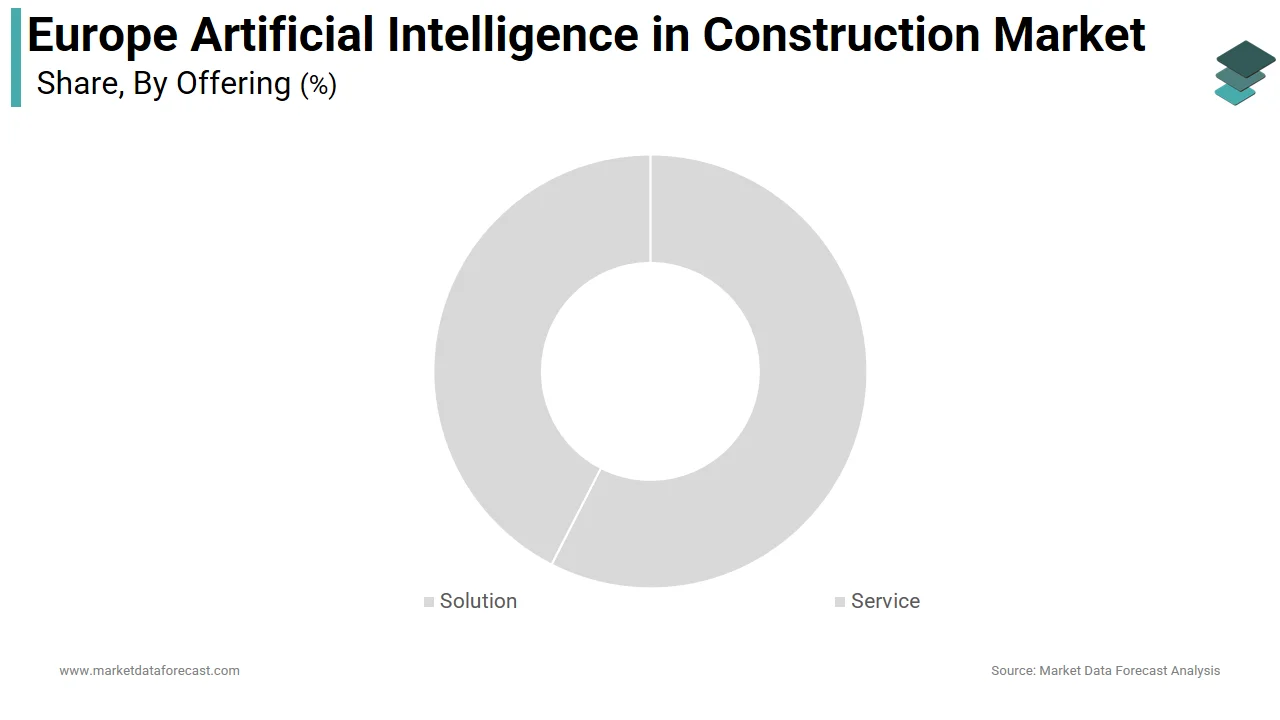
The service segment is the fastest growing offering in the Europe artificial intelligence in construction market and is predicted to expand at a CAGR of 27.7% over the forecast period in this regional market owing to the increasing complexity of AI implementation, which demands specialized expertise in data integration, model training, and change management as these are the capabilities most construction firms lack internally. For instance, a majority of contractors now outsource AI deployment to third party service providers who offer end to end support from data cleansing to performance validation. According to the Germany’s Federal Ministry for Economic Affairs and Climate Action, many AI adoption grants awarded in 2023 included mandatory service components such as workforce training and system calibration. Additionally, the rise of outcome-based contracting, where AI vendors are paid based on achieved productivity or safety improvements, has shifted the model from one time software sales to recurring service engagements. In Sweden, consultants like Sweco have launched AI as a Service-offerings that bundle drone analytics, predictive maintenance, and carbon tracking into monthly subscriptions for public infrastructure owners. As per the European Investment Bank, this trend is amplified by public sector preference for operational expenditure over capital expenditure, making service models financially attractive and scalable across fragmented national markets.
By Application Insights
The project management segment commanded for the highest share of 30.6% of the regional market in 2024. The growth of the project management segment in this regional market is driven by the chronic inefficiencies in time and cost control across complex builds. As per the European Court of Auditors, many EU funded infrastructure projects between 2018 and 2023 experienced delays exceeding six months, with average cost overruns of around 17% as these problems AI powered project management platforms directly address through real time progress tracking and predictive delay modeling. Major contractors, including Vinci and Skanska, have deployed AI systems that synthesize inputs from site cameras, weather forecasts, labor logs, and supply chain data to dynamically adjust workflows. The European Construction Institute notes that AI enhanced project management reduced scheduling deviations in a 2023 cross national trial involving transportation projects. Furthermore, the EU Recovery and Resilience Facility require beneficiaries to demonstrate digital monitoring capabilities for all construction grants, reinforcing adoption. National agencies, such as France’s ADEME, now mandate predictive scheduling for public housing developments exceeding 100 units. These regulatory and performance pressures make project management the most immediate and measurable application of AI in an industry historically plagued by unpredictability.
The asset management segment is the fastest growing application segment in the Europe artificial intelligence in construction market and is predicted to witness a CAGR of 30.9% over the forecast period owing to the EU’s shift from construction to long term asset performance under the Green Deal and Energy Performance of Buildings Directive. According to the European Environment Agency, buildings with AI driven digital twins consume significantly less energy over their lifecycle by enabling predictive maintenance and adaptive control of HVAC, lighting, and occupancy systems. The European Commission’s Digital Product Passport initiative, set for full rollout by 2027, requires continuous data collection on building materials, energy use, and carbon footprint, which is a mandate achievable only through AI enabled asset platforms. In the Netherlands, all new public buildings must now include an operational digital twin, with AI algorithms forecasting component failures well in advance. Similarly, Germany’s EnEV 2024 regulations tie energy compliance to real time performance, not just design intent, pushing facility owners toward AI analytics. Hospitals, airports, and data centers are leading adoption, with many European operators investing in AI asset platforms in 2023, according to the European Facility Management Association. This convergence of regulation, sustainability, and operational necessity propels asset management into the fastest growth trajectory.
By Stage Insights
The construction stage segment captured the major share of 49.4% of the regional market in 2024. The dominance of construction stage segment in the European market is attributed to the urgent need to manage real time risks, costs, and labor productivity on active sites. According to the European Agency for Safety and Health at Work, construction accounts for a significant share of EU workplace fatalities, making AI powered safety monitoring a critical intervention. Systems using computer vision to detect unsafe acts, such as missing harnesses or unguarded machinery, are now deployed on major sites across Germany, France, and the UK, as per the European Federation of Building and Woodworkers. Additionally, AI driven progress tracking via drone imagery and site sensors reduces rework by identifying deviations before they cascade. The Swedish Transport Administration reported reductions in inspection hours on highway projects in 2023, using AI to compare as built conditions with BIM models. Labor shortages further intensify reliance on AI, with Eurostat noting that construction sites in Poland and Italy use autonomous layout robots to compensate for surveyor shortages. Unlike pre or post stages, the construction phase offers immediate return on AI investment through accident prevention, schedule adherence, and material savings, making it the focal point of current deployment.
The post construction segment is the fastest growing stage segment in the Europe artificial intelligence in construction market and is estimated to record a CAGR of 31.3% over the forecast period owing to the regulatory and economic shifts that extend contractor and owner responsibility far beyond project handover. As per the European Commission, buildings must now demonstrate whole life carbon performance under the EU Taxonomy for Sustainable Activities, a requirement that necessitates continuous AI monitoring of energy use, material degradation, and maintenance needs. The revised Energy Performance of Buildings Directive mandates that all public buildings over 2500 square meters implement automated energy management systems by 2026, with AI analytics at their core. In Denmark, the national building registry requires owners to submit annual AI generated performance certificates showing deviations from predicted energy use. Furthermore, the rise of performance-based contracts, such as those used by NHS Scotland, ties contractor payments to facility uptime and energy efficiency over 10-to-20-year periods. According to the Royal Institution of Chartered Surveyors, many European developers now retain post construction AI service agreements to manage these obligations. This transformation of buildings into data generating assets ensures post construction AI adoption will outpace all other phases.
COUNTRY-LEVEL ANALYSIS
Germany Artificial Intelligence in Construction Market Analysis
Germany led the Europe artificial intelligence in construction market with a 24.4% share in 2024. The dominance of Germany in the European market is driven by its dual role as Europe’s largest construction economy and most advanced digital policy setter. The country mandates Level 2 BIM for all federal infrastructure projects above 5 million euros, and integrates AI readiness into public procurement scoring, as confirmed by the Federal Ministry of Transport and Digital Infrastructure. According to the German Social Accident Insurance, many of Germany’s top contractors use AI for real time site safety monitoring, with computer vision systems reducing reportable incidents in 2023. The nation’s strong engineering base enables local development of AI tools such as Hilti’s Jaibot, which autonomously drills ceiling grids using BIM data. Additionally, Germany’s BAFA digitalization grants covered part of AI implementation costs for SMEs in 2023, accelerating market penetration beyond large firms. With the Energiewende policy demanding net zero operational buildings by 2030, AI driven energy optimization has become non optional. These factors position Germany not just as a volume leader, but as the standard setter for Europe’s construction AI future.
France Artificial Intelligence in Construction Market Analysis
France held the second largest share of the regional market in 2024 due to its aggressive state led digital transformation of infrastructure delivery. The French government’s France 2030 investment plan allocates significant funding to AI in construction, with emphasis on generative design and carbon tracking. As per the Banque des Territoires, all public housing projects exceeding 100 units must now use AI powered platforms for schedule and cost control, a rule that affected many projects in 2023. The country’s BIM mandate for public works, introduced in 2022, has created a fertile environment for AI integration, with design firms reporting AI usage in energy simulation according to the French Association of Construction Companies. Notably, France leads in AI for heritage construction, where algorithms analyze historical data to guide restoration, which is critical given that a large share of its public buildings are classified monuments, as per the Ministry of Culture. The national AI strategy also funds academic industry partnerships, such as the AI Construction Lab in Lyon, which has developed predictive models for tunneling risks now used in Grand Paris Express. This fusion of heritage modernization and climate compliance makes France a unique and influential market.
United Kingdom Artificial Intelligence in Construction Market Analysis
The United Kingdom is anticipated to command for a promising share of the Europe artificial intelligence in construction market over the forecast period owing to its post Brexit regulatory autonomy to pioneer performance based digital standards. The UK’s National Digital Twin Programme, managed by the Centre for Digital Built Britain, has established one of the world’s most advanced frameworks for AI driven infrastructure twins, now mandated for all National Infrastructure Commission projects. As per the Department for Levelling Up, Housing and Communities, many central government construction contracts awarded in 2023 included clauses requiring AI enabled carbon measurement and progress validation. The UK also leads in AI for retrofitting, with the Future Homes Standard pushing AI platforms that simulate thermal upgrades across millions of existing dwellings. Companies like Balfour Beatty and Mace have deployed AI safety systems that reduced site injuries in 2023, according to the Health and Safety Executive. Moreover, the UK’s Construction Playbook prioritizes outcome-based procurement, enabling AI vendors to monetize performance gains rather than software licenses. While no longer under EU jurisdiction, the UK’s proactive stance ensures it remains a high value innovation corridor within the European ecosystem.
Netherlands Artificial Intelligence in Construction Market Analysis
The Netherlands is predicted to register a healthy CAGR in the Europe artificial intelligence in construction market over the forecast period owing to its seamless fusion of AI with circular economy mandates. Dutch law requires all new public buildings to achieve a minimum BENG energy label, and submit a material passport—both of which rely on AI for real time compliance tracking. As per the Netherlands Enterprise Agency, many municipal construction tenders in 2023 specified AI powered platforms capable of calculating embodied carbon and material reuse potential. The country’s dense urban environment and flood resilience needs drive AI adoption in underground infrastructure, with systems like those from Royal BAM Group using machine learning to predict ground movement during tunneling. Amsterdam’s Digital City initiative mandates that all large developments include an operational digital twin, managed by AI algorithms that optimize energy, water, and space usage. According to the Dutch Green Building Council, buildings with AI asset management achieved lower lifecycle emissions in 2023. Furthermore, the Netherlands hosts Europe’s most active AI construction startup scene, with firms developing interoperable AI modules adopted across Belgium and Germany. This regulatory clarity and innovation density cement the Netherlands as a sustainability driven AI leader.
Sweden Artificial Intelligence in Construction Market Analysis
Sweden is expected to exhibit a notable CAGR in the Europe artificial intelligence in construction market during the forecast period, with a focus on public infrastructure safety and environmental performance. The Swedish Transport Administration requires all road and rail projects over 50 million kronor to use AI for real time risk prediction and labor allocation, a policy that reduced project delays in 2023, according to the National Road and Transport Research Institute. Sweden’s stringent workplace safety laws have made AI powered vision systems standard on all large sites, with fatalities declining between 2020 and 2023, as reported by the Swedish Work Environment Authority. The country also leads in AI for cold climate construction, where algorithms adjust concrete curing and insulation based on real time weather data, critical given that much of Sweden lies above the 60th parallel. Furthermore, Sweden’s national goal of fossil free construction by 2030 has driven AI adoption in logistics, with Skanska’s CO2 calculator using machine learning to select lowest emission material routes. Public procurement transparency ensures these innovations scale nationally before influencing Nordic and Baltic markets. Sweden’s combination of safety rigor, climate adaptation, and green ambition defines its distinctive and influential market role.
COMPETITIVE LANDSCAPE
Competition in the Europe artificial intelligence in construction market is characterized by a dynamic mix of global technology giants specialized construction software firms and emerging AI startups. Unlike volume driven markets competition here centers on domain expertise regulatory alignment and demonstrable return on investment in safety productivity or sustainability. Large vendors like Autodesk and Siemens leverage their existing BIM and building automation ecosystems to embed AI natively while startups differentiate through niche applications such as drone-based progress analytics or AI for heritage restoration. The absence of standardized AI performance benchmarks fosters a project-by-project validation culture where trust and integration ease outweigh brand recognition. Public procurement rules that favor innovation and green outcomes create fertile ground for agile players but also raise entry barriers due to compliance complexity. As a result, the market evolves through collaboration rather than direct rivalry with partnerships and platform integrations shaping competitive advantage more than proprietary algorithms alone.
KEY MARKET PLAYERS
The leading companies operating in the Europe artificial intelligence in construction market include:
- Autodesk Inc.
- International Business Machines Corporation
- Microsoft
- Oracle
- SAP SE
- Trimble Inc.
- ALICE Technologies Inc.
- Siemens AG
- BuildingConnected
- NVIDIA Corporation
- The Access Group
TOP PLAYERS IN THE MARKET
- Autodesk Inc plays a pivotal role in the Europe artificial intelligence in construction market through its AI-integrated design and construction platforms, including BIM 360 and Construction Cloud. The company embeds machine learning algorithms to enable predictive risk analysis automated design validation and real time progress tracking across European infrastructure projects. Autodesk actively collaborates with EU institutions to align its tools with BIM mandates and sustainability regulations such as the Energy Performance of Buildings Directive. In 2023 the company launched an AI powered carbon estimator within its European BIM workflows enabling designers to assess embodied emissions during early planning stages. Autodesk also partnered with major contractors like VINCI and Skanska to co-develop safety monitoring modules that analyze site imagery for hazard detection. These initiatives reinforce its global leadership while deepening its relevance in Europe’s regulatory and sustainability driven construction landscape.
- NVIDIA Corporation contributes to the Europe artificial intelligence in construction market by providing the foundational AI computing infrastructure and simulation frameworks that power digital twins and generative design. Its Omniverse platform enables real time collaboration across European engineering firms using physics-based AI models for structural and energy performance simulation. NVIDIA has established strategic alliances with European software developers and research institutes including the Fraunhofer Institute in Germany to optimize construction specific AI workloads on its GPUs. In early 2024 NVIDIA introduced Metropolis for Construction a suite of AI models trained on European site safety and productivity data to support computer vision applications in compliance with GDPR. The company also supports academic initiatives like the AI for Sustainable Construction Lab at ETH Zurich accelerating the development of localized models for energy efficient building design. These efforts position NVIDIA as an enabler of Europe’s AI transformation beyond just hardware supply.
- Siemens AG is a key player in the Europe artificial intelligence in construction market through its integrated digital twin and building performance solutions under the Siemens Xcelerator platform. Headquartered in Germany the company leverages AI to connect construction planning with long term building operations enabling predictive maintenance energy optimization and carbon tracking across the asset lifecycle. Siemens actively aligns its offerings with EU Green Deal objectives by embedding AI driven energy modeling into early design phases for public infrastructure projects. In 2023 Siemens enhanced its Desigo CC platform with machine learning capabilities that forecast HVAC load based on occupancy and weather patterns now deployed in hospitals and airports across France and the Netherlands. The company also launched a dedicated AI sandbox for European construction startups offering access to its simulation tools and cloud infrastructure. By bridging construction and facility management Siemens extends AI value beyond project completion reinforcing its global influence in sustainable built environments.
TOP STRATEGIES USED BY THE KEY MARKET PARTICIPANTS
Key players in the Europe artificial intelligence in construction market pursue strategic alignment with EU regulatory frameworks by embedding sustainability and safety compliance directly into AI algorithms. They form partnerships with public agencies and large contractors to co-develop use case specific solutions such as carbon tracking or autonomous progress monitoring. Companies invest in localized training data and language models to ensure AI systems function effectively across diverse European construction practices and languages. They offer modular AI as a Service models to lower adoption barriers for small and medium enterprises through subscription-based pricing. Additionally, firms prioritize interoperability by building APIs that integrate seamlessly with existing BIM and ERP systems ensuring minimal workflow disruption during deployment.
MARKET SEGMENTATION
This research report on the Europe artificial intelligence in construction market has been segmented and sub-segmented into the following categories.
By Offering
- Solution
- Service
By Application
- Asset Management
- Project Management
- Risk Management
- Schedule Management
- Supply Chain Management
- Others
By Stage
- Pre-construction
- Construction-stage
- Post-construction
By Deployment
- Cloud
- On-premises
By Industry
- Residential
- Public Infrastructure
- Heavy Construction
- Others
By Organization Size
- Small & Medium-sized Enterprises (SMEs)
- Large Enterprises
By Country
- United Kingdom
- France
- Spain
- Germany
- Italy
- Russia
- Sweden
- Denmark
- Switzerland
- Netherlands
- Rest of Europe