Europe BioPesticide Market Size, Share, Trends And Growth Forecasts Research Report, Segmented By Crop Type, Ingredients, Microorganism’s Type, Application Type and Country (UK, France, Spain, Germany, Italy, Russia, Sweden, Denmark, Switzerland, Netherlands, Turkey, Czech Republic & Rest of Europe), Industry Analysis From (2026 to 2034)
Market Size, 2025
$2.28 BnMarket Estimate, 2026
$2.62 BnMarket Forecast, 2034
$8.05 BnCAGR, 2026–2034
15.04%Europe Biopesticide Market Size
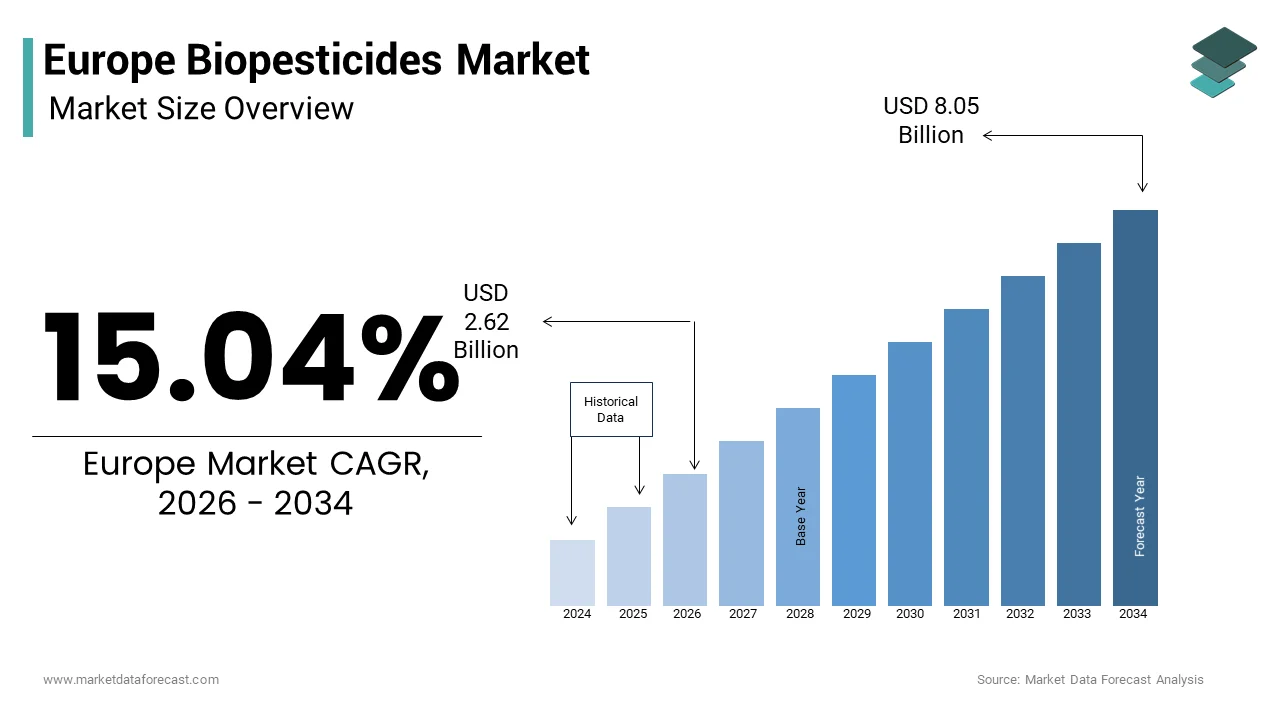
The European biopesticide market was valued at USD 2.28 billion in 2025 and is anticipated to reach USD 2.62 billion in 2026 and USD 8.05 billion by 2034, growing at a CAGR of 15.04% during the forecast period from 2026 to 2034.
The biopesticide is naturally derived pest control agents, including microbial biopesticides, plant-incorporated protectants, and biochemical pesticides that target agricultural and horticultural pests through non-synthetic modes of action.
MARKET DRIVERS
Stringent EU Regulatory Frameworks Accelerate Adoption of Biological Alternatives
The European Union’s progressive regulatory architecture is a primary driving factor for the growth of the European biopesticide market. The EU has implemented a fast-track evaluation process for low-risk substances under Article 22 of the same regulation, reducing approval timelines for biopesticides by up to 40% compared to chemical counterparts.
Rising Consumer Demand Residue-Free and Organic Produce Fuels Commercial Uptake
European consumers are increasingly prioritising food safety and environmental stewardship, which is also enhancing the growth of theEuropeane biopesticide market. Organic certification standards prohibit synthetic pesticides, making biopesticides indispensable for pest management in these systems.
MARKET RESTRAINTS
Inconsistent Efficacy and Performance Limitations Under Variable Field Conditions
The variable performance of biopesticides across diverse agroclimatic conditions is significantly degrading the growth of the European biopesticide market. These performance gaps create yield uncertainty, particularly for risk-averse farmers cultivating high-value crops. Moreover, the lack of standardised efficacy testing protocols across EU member states complicates product comparison and trust building. While the European and Mediterranean Plant Protection Organisation has initiated harmonisation efforts, progress remains slow.
Complex and Fragmented Registration Processes Across Member States
The authorisation of biopesticides remains hindered by procedural inconsistencies and data requirements that vary significantly among member states. Although Regulation EC 1107 2009 establishes a zonal system dividing Europe into three zones for mutual recognition applications often face additional national data requests, particularly for environmental fate and non-target organism studies. This fragmentation disproportionately affects small and medium-sized enterprises, which lack the regulatory expertise and financial resources to navigate multiple dossiers.
MARKET OPPORTUNITIES
Integration of Biopesticides into Digital and Precision Agriculture Platforms
The emergence of biopesticide application with precision agriculture technologies is expected to create new opportunities for the growth of thEuropeanpe biopesticide market. Digital tools such as drone-based spraying, satellite imaging, and AI-driven pest forecasting enable targeted delivery of biopesticides precisely when and where pest pressure peaks, maximising their limited residual activity. Furthermore, digital farm management platforms such as 365FarmNet integrate biopesticide usage data with crop health analytics, allowing growers to demonstrate compliance with sustainability certifications and retailer requirements.
Expansion of Biopesticide Use in Urban and Non-Agricultural Settings
The application of biopesticides in urban green spaces, public health, vector control, and amenity horticulture is emerging as a new opportunity for the growofe f tEuropeanope biopesticide market. Municipalities are increasingly adopting biological solutions to manage pests in parks, gardens, and public infrastructure in response to citizen demands for chemical-free urban environments. Additionally, golf courses and sports turf managers are turning to Trichoderma and Streptomyces-based products to suppress fungal diseases in compliance with the EU’s Sustainable Use of Pesticides Directive.
MARKET CHALLENGES
Limited Shelf Life and Complex Storage Requirements Impede Distribution
The inherent biological nature of many biopesticides imposes significant logistical challenges on the growth of the European biopesticide market. These limitations are particularly acute in Southern and Eastern Europe, where ambient temperatures frequently exceed 30 degrees Celsius and cold storage infrastructure is less developed. Even biochemical pesticides like neem oil are prone to oxidation and hydrolysis when exposed to light and heat, reducing their field performance.
Knowledge Gaps and Insufficient Advisory Support for End Users
The successful deployment of biopesticides demandspecialiseded agronomic knowledge that is often lacking among European farmers and extension services. Unlike conventional pesticides, which follstandardisedzed application protocols, biopesticides require precise timing of environmental conditions and integration strategies to be effective. National agricultural advisory networks remain under-equipped with training on biologicals, with the European Network for Rural Development reporting that less than 15 % of public extension agents received formal biopesticide training in 2022.
REPORT COVERAGE
| REPORT METRIC | DETAILS |
| Market Size Available | 2025 to 2034 |
| Base Year | 2025 |
| Forecast Period | 2026 to 2034 |
| CAGR | 15.04% |
| Segments Covered | By Ingredients, Type, Crop, Application, And By Country |
| Various Analyses Covered | Global, Regional, and Country-Level Analysis, Segment-Level Analysis, DROC, PESTLE Analysis, Porter’s Five Forces Analysis, Competitive Landscape, Analyst Overview of Investment Opportunities |
| Regions Covered | UK, France, Spain, Germany, Italy, Russia, Sweden, Denmark, Switzerland, Netherlands, Turkey, Czech Republic,lic & Rest of Europe |
| Market Leaders Profiled | Parry America, Andermatt Biocontrol AG, Marrone Bio Innovations Inc., Agbitech Pty Limited, Bioworks Inc., Som Phytopharma Limited, Camson Bio Technologies Limited, Hebei Veyong Bio-Chemical Co. Limited, Becker Underwood Inc., Agraquest Inc., Growth Products Limited, Valent Biosciences Corp, Biocare, Natural Industrie, and Novoenzymes A/S. |
SEGMENTAL ANALYSIS
By Ingredients Insights
The microbial pesticides segment held 48.3% of Europeanrope biopesticide market share in 2024 due to their proven efficacy, broad regulatory acceptance, and compatibility with integrated pest management systems. The segment’s dominance is further reinforced by successful commercial deployment in protected cultivation. Additionally, microbial pesticides align with the European Green Deal’s Farm to Fork Strategy, which mandates a 50 % reduction in chemical pesticide use by 2030. National programs such as France’s Ecophyto Plan have allocated dedicated funding for microbial biocontrol trials in vineyards and orchards, accelerating adoption among conventional farmers.
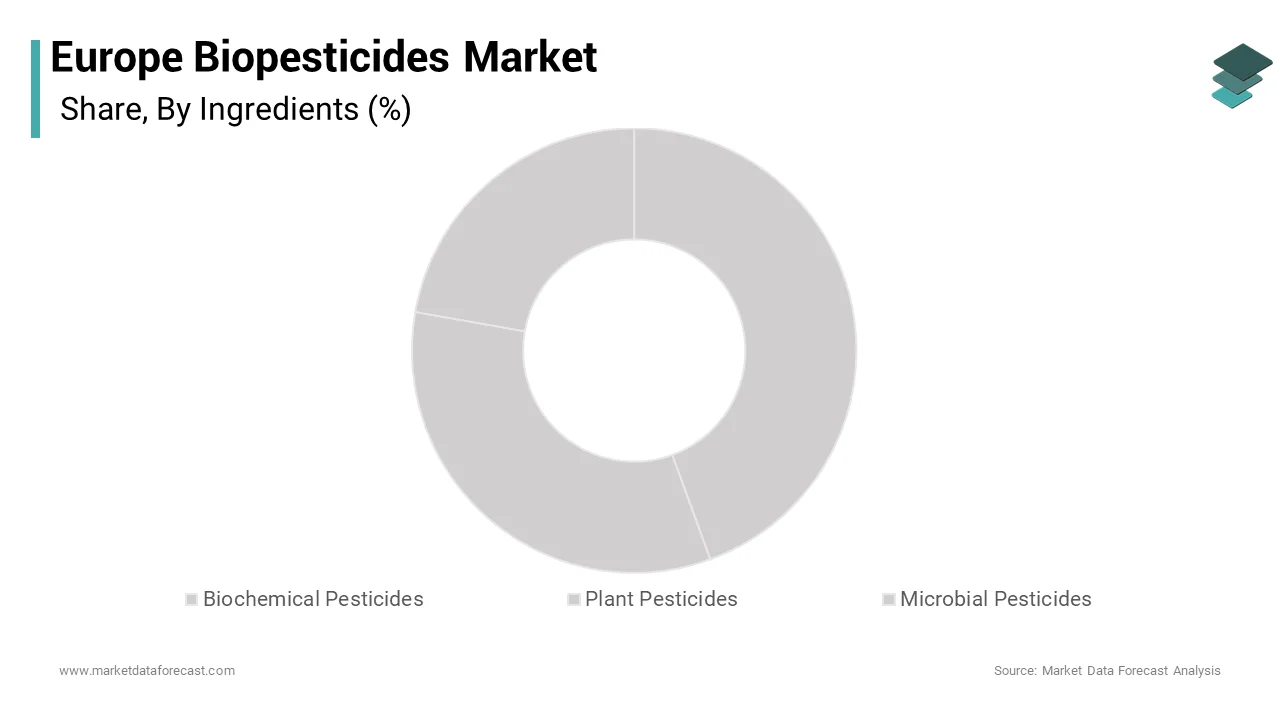
The biochemical pesticides segment is projected to grow with an expected CAGR of 14.2% during the forecast period, with the increasing demand for residue-free pest control solutions in organic and conventional fruit production, particularly for mating disruption and repellency applications. Pheromone-based formulations dominate this segment with over 200 species-specific dispensers approved for use against codling moth, oriental fruit moth, and grapevine moth across the EU as per the European Commission’s pesticide database. Retailer sustainability standards further accelerate uptake with Edeka requiring German apple suppliers to implement mating disruption for key lepidopteran pests.
By Type Insights
The bioinsecticides segment was the largest by accounting for 42.2% of tEuropeanope biopesticide market share in 2,024, with the intense pressure to control insect pests in fruits, vegetables, and greenhouse crops without compromising pollinator health or food safety.
The biofungicide segment is estimated to register a CAGR of 15.1 % from 2025 to 2,033 with the urgent need to manage fungicide resistance in key pathogens such as Botrytis cinerea and powdery mildew complexes, which have developed resistance to multiple chemical classes. Investment in formulation science has enhanced rainfastness and shelf l,, life with companies like Koppert Biological Systems launching wettable powder formats that maintain viability for 18 months. These advances, coupled with resistance management imperatives, are propelling biofungicides into mainstream use across conventional and organic farming alike.
By Crop Insights
The permanent and arable crops segment was the largest by occupying 58.3% of tEuropeanope biopesticide market share in 20,24 policy-driven transitions in perennial systems where residue concerns and export standards necessitate biological alternatives. The scale of these cropping systems, combined with regulatory and market pressure, ensures continued leadership of this segment.
The greenhouse crops segment is likely to grow with a CAGR of 16.3% during the forecast period, with the controlled environment of protected cultivation, which maximises the efficacy of biologicals by minimising external stressors. Additionally, the high value of greenhouse produce justifies the premium cost of biopesticides, with average returns per hectare exceeding 100000 euros in Dutch cucumber production.
By Application Insights
Thon-farmrm and post-harvest application segment accountforing a significant share of tEuropeanope biopesticide market in 2024, with the need to manage pests and diseases at intervention points where synthetic alternatives face regulatory or market restrictions. On-farm use is equally robust with foliar and soil drench applications dominating in horticulture.
The seed treatment segment is on the rise and expected to exhibit a noteworthy CAGR of 13.8 %from 2025 to 2033, with the strategic advantage of early-season applicationsminimal active ingredient quantities, while enhancing seseed vigournd stress tolerance. Microbial seed treatments based on Pseudomonas fluorescens and Bacillus amyloliquefaciens are increasingly used in cereals, oilseed rap, and pulses to suppress oil-borne pathogens such as Fusarium and Rhizoctonia. The European Commission’s Sustainable Use of Pesticides Directive encourages such prophylactic biological approachto minimiseeze crop interventions. Additionally, major seed companies like KWS and Limagrain have launched bio-treated seed lines for sugar beet and maize in response to neonicotinoid bans.
COUNTRY ANALYSIS
France Biopesticides Market Analysis
France was the top performer of tEuropeanope biopesticide market by occupying 21.2% the market the share in 2024, with the aggressive policy implementation and extensive horticultural acreage. The country hosts major biopesticide innovators such as Biobest France and Laboratoires Goëmar, accelerating product development. Retailer pressure from chains like Carrefour further drives adoption with sustainability scorecards requiring biocontrol documentation. This combination of regulatory ambition,n anagri an agriculturalre, and innovation infrastructure solidifies France’s dominant position.
Germany Biopesticides Market Analysis
Germany was ranked second by holdi17.2% e of tEuropeanope biopesticide market with a science-driven approach to biopesticide validation and integration into arable systems. Germany is Europe’s largest producer of sugar beet and wheat, creating vast potential for bioherbicide and biofungicide use following neonicotinoid and glyphosate restrictions. Additionally, public funding through the Federal Ministry of Food and Agriculture supports demonstration farms that showcase biopesticide efficacy to conventional farmers.
Spain Biopesticides Market Analysis.
Spain's biopesticide market growth is fueled by its extensive greenhouse agriculture and export-focused fresh produce sector. The country is Europe’s leading producer of greenhouse vegetables, with over 30000 hectares concentrated in Almería,ía where integrated pest management using biopesticides is standard practice.
Italy Biopesticides Market Analysis
Italy biopesticide market is likely to grow with a prominent CAGR in the coming years. Italy is Europe’s largest producer of olives and wine, with over 1 million hectares of olive groves. Fungicides are being replaced by biofungicides like Aureobasidium pullulans to comply with EU copper reduction mandates.
COMPETITIVE LANDSCAPE
The European biopesticide market features a dynamic competitive landscape characterised by the interplay of multinational agrochemical firmspecialisedzed biological companies, and emerging biotech startups. Multinationals like BASF and Bayer leverage their global scale, regulatory expertise, and integrated digital platforms to embed biopesticides within broader crop protection portfolioIn contrastts,, the niche players such as Koppert and Biobest dominate through deep biological expertise and strong relationships with greenhouse and organic growers. Competition is primarily driven by product differentiation,n efficacy validation, and speed of regulatory approval rather than price. The market is highly innovation-intensive, with companies investing heavily in microbial discovery, formulation stability, and compatibility with conventional inputs.
KEY MARKET PLAYERS
A few of the market players in the Europebiopesticides market include
- Parry America
- BASF SE
- Bayer AG
- Andermatt Biocontrol AG
- Koppert Biological Systems
- Marrone Bio Innovations Inc.
- Agbitech Pty Limited
- Bioworks Inc.
- Som Phytopharma Limited
- Camson Bio Technologies Limited
- Hebei Veyong Bio-Chemical Co. Limited
- Becker Underwood Inc.
- Agraquest Inc.
- Growth Products Limited
- Valent Biosciences Corp
- Biocare
- Natural Industrie
- Novoenzymes A/S.
Top Players In The Market
- BASF SE is a leading contributor to theEuropeane biopesticide market through its Biological Solutions portfolio, which includes microbial and biochemical products for crop protection and soil health. The company leverages its global R and D infrastructure to develop innovative biocontrol agents such as Serenad, based on Bacillus ssubtilissand nd Votivo for nematode management. In recent years, BASF has strengthened its position by acquiring biological startups and expanding production capacity at its facility in Limburgerhof, Germany, to meet rising European demand.
- Koppert Biological Systems is a pioneer in the European biopesticide sectospecialisinging in beneficial insects, microbes, and natural substances for biological crop protection. Headquartered in the Netherlands, the company supplies biocontrol solutions to over 100 countries and plays a central role in shaping integrated pest management practices in European greenhouse and open field agriculture.
- Bayer AG actively participates in tEuropeanope biopesticide market through its Biologicals by Bayer initiative, which focuses on microbial and plant health-enhancing products. The company integrates biopesticides into its broader digital farming ecosystem, including the Climate FieldView pppplatformomote data-driven biological applications. It also collaborated with research institutions across Germany and France to validate the efficacy of native microbial strains under local field conditions.
Top Strategies Used By The Key Market Participants
Key players in the European biopesticide market pursue multifaceted strategies to enhance competitiveness and address evolving agricultural needs. Product innovation remains central with companies investing in strain improvement, formulation science, and delivery systems to boost efficacy and shelf life. Strategic acquisitions and partnerships enable rapid access to novel technologies and expanded distribution networks. Regulatory engagement prioritised to navigate the complex EU approval process and secure fast-track status for low-risk substances. Companies also integrate biopesticides into digital agronomy platforms, offering data-driven application advice to farmers. Geographic expansion is achieved throulocalisedzed production and field trials tailored to regional pest complexes.
MARKET SEGMENTATION
This research report on the European biopesticide market has been segmented and sub-segmented into the following regions.
By Ingredients
- Biochemical Pesticides
- Plant Pesticides
- Microbial Pesticides
By Type
- Bioherbicides
- Bio Fungicides
- Bionematicides
- Bioinsecticide
By Crop
- Permanent And Arable Crops
- Forage & Turf Grasses
- Greenhouse Crops
By Application
- Seed Treatment
- On-Farm And Post-Harvest Application
By Country
- United Kingdom
- France
- Spain
- Germany
- Italy
- Russia
- Sweden
- Denmark
- Switzerland
- Netherlands
- Rest of Europe
Frequently Asked Questions
What is the Europe biopesticide market?
It refers to the regional industry for biological pest control products derived from natural organisms, microorganisms, and plant extracts.
What drives growth in the Europe biopesticide market?
Increasing adoption of sustainable agriculture, strict pesticide regulations, and rising demand for organic produce fuel market growth.
What are biopesticides used for?
Biopesticides are used to manage weeds, insects, fungi, and other crop pests while minimizing environmental impact.
What types of biopesticides are available?
Microbial, biochemical, and plant-derived biopesticides are the main categories in the market.
How do biopesticides benefit crop production?
They offer targeted pest control, reduce chemical residue, and improve soil health with lower toxicity.
Are biopesticides accepted in organic farming?
Yes, many biopesticides are certified for use in organic agriculture due to their natural origin and safety profile.
How do regulations impact the Europe biopesticide market?
EU and national standards on pesticide safety and environmental protection encourage biopesticide adoption and innovation.
Which crops benefit most from biopesticide use?
Fruits, vegetables, cereals, and specialty crops benefit significantly from biopesticide applications.
What challenges face the biopesticide market in Europe?
High production costs, complex registration processes, and inconsistent field performance are key challenges.
How do biopesticides compare to chemical pesticides?
Biopesticides generally have lower environmental risk, reduced non-target toxicity, and better integration into sustainable systems.
Related Reports
Access the study in MULTIPLE FORMATS
Purchase options starting from
$ 2000
Didn’t find what you’re looking for?
TALK TO OUR ANALYST TEAM
Need something within your budget?
NO WORRIES! WE GOT YOU COVERED!
Call us on: +1 888 702 9696 (U.S Toll Free)
Write to us: sales@marketdataforecast.com