- Product Description Description
- Table of Contents TOC
- List of Table & Figure LOT
- Get Free Sample PDF Sample PDF
Market Size, 2025
$189 MnMarket Estimate, 2026
$209.03 MnMarket Forecast, 2034
$468.01 MnCAGR, 2026–2034
10.6%Europe Breast Biopsy Market Size, Growth, Trends & Forecast (2026–2034)
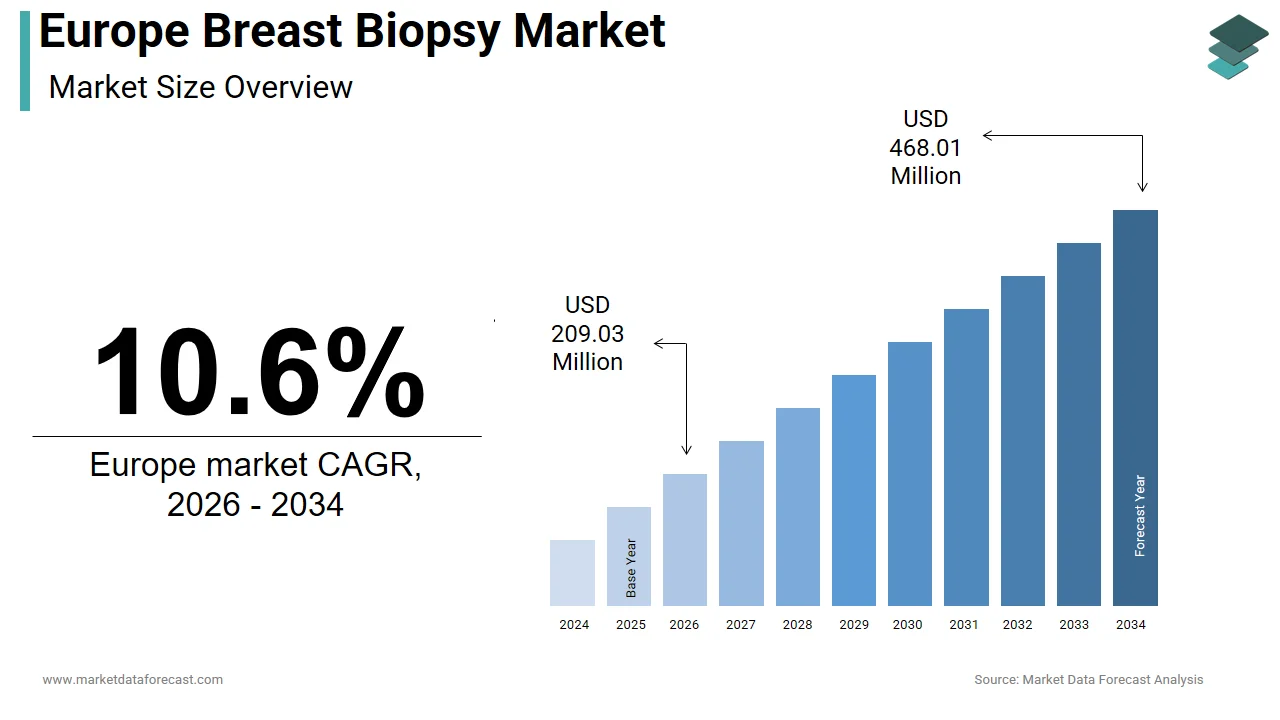
The Europe breast biopsy market size was valued at USD 189 million in 2025, is estimated at USD 209.03 million in 2026, and is anticipated to reach USD 468.01 million by 2034, expanding at a compound annual growth rate (CAGR) of 10.6% during the forecast period from 2026 to 2034. Market growth is primarily propelled by the expansion of organized national breast cancer screening programs, widespread clinical adoption of image-guided minimally invasive techniques, rising integration of artificial intelligence in biopsy planning, and the growing demand for molecular subtyping and biomarker-driven therapy.
Key Executive Metrics (At-a-Glance)
- 2025 Base Valuation: USD 189 Million
- 2026 Current Valuation: USD 209.03 Million
- 2034 Forecast Valuation: USD 468.01 Million
- Compound Annual Growth Rate (CAGR): 10.6% (2026–2034)
- Key Geographic Footprint: Germany, United Kingdom, France, Netherlands, Sweden, Spain, Italy, Russia, Denmark, Switzerland, Turkey, Czech Republic, and Rest of Europe
Europe Breast Biopsy Market Segmentation Breakdown
| Segment Category | Leading / Dominant Segment | Fastest-Growing Segment |
|---|---|---|
| By Type | Needle Breast Biopsy | Needle Breast Biopsy (CAGR of 6.8%) |
| By Product | Biopsy Needles (41% share in 2024) | Guidance Systems (CAGR of 9.2%) |
| By Guidance | Mammography-Guided Stereotactic Breast Biopsy | MRI-Guided Breast Biopsy (CAGR of 10.4%) |
| By Country | Germany (20.6% share in 2024) | The Netherlands & Sweden |
Major Industry Players Profiled
Key market participants shaping the European breast biopsy landscape include Hologic Inc., Becton, Dickinson and Company (BD), Siemens Healthineers, Leica Biosystems Nussloch GmbH (Devicor Medical Products), C. R. Bard, Inc., Argon Medical Devices, Cook Medical Incorporated, Ethicon Endo-Surgery (Johnson & Johnson), and Galini SRL.
Europe Breast Biopsy Market Size
The size of the Europe breast biopsy market was valued at USD 189 million in 2025. This market is expected to grow at a CAGR of 10.6% from 2026 to 2034 and be worth USD 468.01 million by 2034 from USD 209.03 million in 2026.
A breast biopsy is a medical procedure to remove a small sample of breast tissue, examined under a microscope to check for cancer or other abnormalities, providing a definitive diagnosis when imaging or exams find suspicious lumps or changes. Breast screening initiatives facilitated by the European Commission Joint Research Centre continue to identify millions of women across the European Union for follow-up diagnostic assessments, including biopsy, aimed at reducing mortality through early detection. Organized national breast cancer screening programs, targeting women within a specific age range, are widespread across the European Union, with, however, substantial disparities in participation rates observed between Member States. The shift toward minimally invasive methods has been accelerated by EU clinical guidelines that prioritize diagnostic accuracy with minimal morbidity. Furthermore, the integration of digital breast tomosynthesis and contrast-enhanced mammography has improved lesion localization, increasing biopsy yield. Europe's Beating Cancer Plan is driving the breast biopsy market, which remains a key diagnostic hub within European oncology.
MARKET DRIVERS
Expansion of Organized National Breast Cancer Screening Programs
The systematic rollout of national breast cancer screening initiatives across the region fuels the growth of the Europe breast biopsy market. This is a primary driver of biopsy volume and procedural standardization. Policy initiatives are leading to the implementation and expansion of organized, population-based breast cancer screening programs across European nations. The majority of European Union countries have established structured screening frameworks that align with quality assurance guidelines and are designed to cover a vast population of eligible women. These programs adopt guidelines that establish specific timeframes for the diagnostic assessment of suspicious findings to ensure timely follow-up care. Organized screening efforts in various countries involve a substantial volume of diagnostic assessments, with a portion of these cases requiring follow-up biopsies. Data from national screening initiatives indicate that a distinct proportion of assessed cases proceed to biopsy within the structured diagnostic pathway. The structured referral pathway ensures consistent demand for biopsy services, while quality indicators such as cancer detection rate and inadequate sample rate drive adoption of advanced techniques like vacuum-assisted biopsy. This policy-driven framework transforms screening from opportunistic to systematic, directly fueling procedural volumes across the continent.
Adoption of Image-Guided Minimally Invasive Biopsy Techniques
The clinical shift toward image-guided minimally invasive breast biopsies, particularly ultrasound and stereotactic vacuum-assisted methods, has significantly expanded market demand, and contributes to the expansion of the Europe breast biopsy market. This growth is driven by improvements in diagnostic precision and patient compliance. These techniques yield larger tissue samples than core needle biopsy, reducing the need for repeat procedures and enabling comprehensive biomarker testing. Imaging-guided vacuum-assisted biopsy systems are becoming a frequently used method for sampling breast lesions in European clinical settings. Medical guidelines increasingly favor vacuum-assisted approaches over core needle biopsies for specific, high-risk, or suspicious breast lesions due to improved tissue acquisition and diagnostic accuracy. Patient preference toward minimizing cosmetic damage, specifically reducing visible scarring, strongly influences the selection of minimally invasive breast biopsy procedures. The integration of tomosynthesis-guided technology is associated with improved operational efficiency during diagnostic procedures. This convergence of clinical efficacy, patient-centered care, and regulatory endorsement ensures sustained growth in advanced biopsy technologies.
MARKET RESTRAINTS
Shortage of Radiologists and Interventional Specialists
A shortage of trained radiologists and breast interventionalists constrains the capacity and accessibility of breast biopsy services across the region, which hampers the growth of the Europe breast biopsy market. The European Society of Radiology reports a critical, worsening shortage of radiologists across the European Union, driven largely by an aging workforce approaching retirement. Moreover, the Italian Society of Medical Radiology identifies a substantial deficit in the national radiologist workforce, with staffing levels falling well below recommended European standards relative to the population. This scarcity translates into prolonged wait times. The European Commission emphasizes that Poland struggles to meet recommended, timely intervals between abnormal breast screening results and diagnostic biopsy, frequently missing established quality benchmarks. In addition, the Royal College of Radiologists indicates that UK breast imaging departments face a significant ongoing recruitment crisis, with a high percentage of positions remaining unfilled. The complexity of image-guided biopsies, requiring dual expertise in imaging and procedural skills, exacerbates the bottleneck. The success of expanded screening under the Beating Cancer Plan is jeopardized by potential diagnostic bottlenecks. Without enhanced training and teleradiology, critical intervention times will be compromised.
Reimbursement Fragmentation and Cost Containment Policies
Divergent and often restrictive reimbursement frameworks across European healthcare systems hinder the expansion of the Europe breast biopsy market. This impedes the consistent adoption of advanced breast biopsy technologies. While vacuum-assisted biopsy offers superior diagnostic yield, it is reimbursed at significantly lower rates than surgical excision in several countries, disincentivizing its use. Vacuum-assisted breast biopsy in Spain has varying reimbursement rates depending on the region and specific hospital, rather than a universal national fee, according to clinical quality guidelines. Germany’s G-DRG system bundles biopsy costs into broader diagnostic packages, offering no premium for minimally invasive techniques. Separate, specialized reimbursement codes for advanced imaging-guided biopsy techniques, such as tomosynthesis, remain limited in most European Union countries, according to imaging surveys. This fragmentation creates geographic disparities. The utilization of advanced breast biopsy technologies is generally more widespread in the Netherlands, contrasting with a lower adoption rate in Portugal, according to European radiology analyses. Cost containment measures also delay technology refresh. Many public hospitals in Greece and Romania still rely on outdated spring-loaded core guns. Precision biopsy in Europe cannot achieve its full potential until payment systems align with its true innovative value.
MARKET OPPORTUNITIES
Integration of Artificial Intelligence in Lesion Detection and Biopsy Planning
The incorporation of artificial intelligence into breast imaging workflows offers a potential opportunity to enhance biopsy accuracy and efficiency, which is predicted to propel the growth of the Europe breast biopsy market. AI algorithms now assist radiologists in identifying subtle malignancies on mammograms and tomosynthesis scans, reducing false negatives and optimizing biopsy targeting. AI-based imaging analysis tools have been observed to decrease the rate of patient recalls for further investigation, while maintaining the capability to detect invasive findings, thus potentially refining the process of referring patients for biopsies. Advanced AI platforms are increasingly employed to assist with real-time, three-dimensional visualization of lesions during ultrasound-guided interventions, which can enhance the accuracy of needle positioning. European collaborative research efforts are actively funding the integration of artificial intelligence into cancer diagnostics, facilitating further development and implementation of these technological tools. AI boosts patient satisfaction and eases workload in radiology departments by minimizing the need for repeat scans and biopsies. New regulatory frameworks for AI-based medical devices are paving the way for AI to become a staple in biopsy procedures.
Rise of Molecular Subtyping and Biomarker-Driven Therapy Selection
The growing necessity for comprehensive tissue sampling to enable molecular subtyping and biomarker analysis is creating new demand for high-yield biopsy techniques. This is likely to boost the expansion of the Europe breast biopsy market. Modern breast cancer management requires assessment of estrogen receptor, progesterone receptor, HER2 status, and increasingly, genomic signatures like Oncotype DX or PAM50, all of which demand sufficient tumor tissue. Updated clinical guidelines for newly diagnosed invasive carcinomas necessitate larger tissue samples for more comprehensive profiling. Vacuum-assisted biopsy techniques allow for acquiring significantly more tissue compared to traditional core needle methods. The adoption of vacuum-assisted biopsy helps lower the rates of insufficient samples. A growing number of breast cancer patients are undergoing molecular profiling to inform treatment decisions. This shift transforms biopsy from a binary diagnostic step into a foundational enabler of precision oncology. The routine use of immune profiling and NGS is driving a greater need for superior tissue acquisition, which fuels the uptake of advanced biopsy technologies across Europe.
MARKET CHALLENGES
Variability in Preanalytical Tissue Handling and Pathology Workflows
Inconsistent preanalytical practices in tissue handling, from fixation delay to processing protocols, affect biopsy reliability and biomarker validity across European pathology labs, which challenges the growth of the Europe breast biopsy market. Observations suggest that a considerable proportion of breast biopsy samples in specific areas are subject to cold ischemia times longer than advised, which may compromise RNA quality. These extended pre-fixation periods could contribute to inaccuracies in HER2 status reporting. A significant number of community hospitals in certain regions appear to lack uniform, standardized procedures for specimen handling, increasing the potential for misidentification. Even in Western Europe, variability persists. These inconsistencies compromise therapy decisions and clinical trial eligibility. The European Society of Pathology's guidelines are recommendations, as their enforcement is voluntary. Even advanced biopsy techniques are vulnerable to upstream errors without mandatory harmonization of preanalytical steps, supported by accreditation and digital tracking.
Patient Anxiety and Low Uptake of Follow-Up Biopsies
Psychological barriers and fear of diagnosis significantly impede biopsy compliance, particularly among women with abnormal screening results, which is among the major obstacles to the Europe breast biopsy market. Significant proportions of women do not complete recommended diagnostic procedures within standard observation periods following suspicious screening results. Geographic patterns across various regions indicate that individuals from lower socioeconomic backgrounds experience higher rates of diagnostic discontinuation. Psychological factors, including the anticipation of physical discomfort and the emotional weight of a potential diagnosis, serve as notable barriers to follow-up care. Concerns regarding physical changes or alterations to the body influence the decision-making process for those facing invasive medical evaluations. Prevailing cultural attitudes and social perceptions surrounding certain health conditions contribute to the avoidance of necessary medical steps. Even when biopsies are performed, patient distress can lead to motion artifacts during image-guided procedures, compromising sample quality. While some countries like the Netherlands employ dedicated breast care nurses to provide counseling, most lack structured psychological support. This behavioral gap undermines the efficacy of screening programs and delays life-saving interventions. Addressing anxiety through empathetic communication, same-day biopsy options, and community outreach is essential to closing this critical gap in the diagnostic cascade.
REPORT COVERAGE
| REPORT METRIC | DETAILS |
| Market Size Available | 2025 to 2034 |
| Base Year | 2025 |
| Forecast Period | 2026 to 2034 |
| Segments Covered | By Technology, Application, and Country. |
| Various Analyses Covered | Global, Regional, and Country-Level Analysis, Segment-Level Analysis, Drivers, Restraints, Opportunities, Challenges; PESTLE Analysis; Porter’s Five Forces Analysis, Competitive Landscape, Analyst Overview of Investment Opportunities |
| Countries Covered | UK, France, Spain, Germany, Italy, Russia, Sweden, Denmark, Switzerland, Netherlands, Turkey, Czech Republic, and the Rest of Europe. |
| Market Leaders Profiled | Hologic Inc., Leica Biosystems Nussloch GmbH (Devicor Medical Products, Inc.), C. R. Bard, Inc., Becton and Dickinson Company, Argon Medical Devices, Cook Medical Incorporated, Encapsule Medical Devices LLC., Siemens Healthineers, Ethicon Endo-Surgery (Johnson & Johnson), Intact Medical Corporation, and Galini SRL. |
SEGMENTAL ANALYSIS
By Type Insights
The needle breast biopsy segment dominated the Europe breast biopsy market by accounting for a substantial share in 2024. The dominance of the needle breast biopsy segment is driven by strong clinical endorsement, patient preference, and policy alignment with minimally invasive care standards. European oncology guidelines highlight needle-based biopsy techniques as a highly reliable, safe, and accurate standard for cancer diagnosis, offering high accuracy with a low risk of serious complications. Sweden heavily relies on percutaneous needle biopsies for cancer screening and diagnosis, supported by organized pathways that emphasize minimally invasive, rapid, and efficient diagnostic services. Patient satisfaction is significantly higher. Surveys within German cancer care settings indicate that patients strongly prefer needle biopsy over surgical methods, citing superior cosmetic outcomes, outpatient care, and quicker recovery. Besides, healthcare systems benefit from lower costs; needle biopsies are less expensive than surgical excision, according to research. These clinical, economic, and experiential advantages have entrenched needle biopsy as the standard of care across Europe.
The needle breast biopsy segment is also the fastest-growing segment in the Europe market, and is projected to expand at a CAGR of 6.8% from 2025 to 2033 due to the rising demand for high-yield tissue sampling to support molecular subtyping and genomic testing in precision oncology. Vacuum-assisted biopsy, a subset of needle techniques, provides more tissue than fine needle aspiration, enabling comprehensive biomarker panels including PD L1, ESR1, and genomic risk scores. Furthermore, integration with digital breast tomosynthesis has expanded its use to subtle architectural distortions previously requiring surgical biopsy. The European Beating Cancer Plan’s emphasis on early and precise diagnosis accelerates this shift, ensuring needle biopsy remains at the forefront of Europe’s evolving diagnostic landscape.
By Product Insights
The biopsy needles segment led the Europe breast biopsy market by capturing a share of 41% share in 2024. The leading position of the biopsy needles segment is credited to its universal use across all percutaneous biopsy types, fine needle aspiration, core needle, and vacuum-assisted, with each procedure requiring at least one needle and often multiple passes. Breast cancer remains one of the most frequently diagnosed cancers among women in the European Union, requiring a high volume of imaging and diagnostic biopsies to assess potential cases. The shift toward reusable handle systems with disposable needles has further amplified consumption. In Germany, the vast majority of radiology departments adhere to safety standards by utilizing single-use, disposable needles for breast biopsies. Regulatory compliance under the EU Medical Device Regulation mandates rigorous biocompatibility and sterility validation, favoring established manufacturers with CE certification. Besides, innovations like echogenic tips and reduced gauge sizes improve patient comfort and ultrasound visibility, driving repeat procurement. The needle’s role as a consumable, used once per procedure, ensures recurring revenue and operational indispensability across all imaging-guided biopsy workflows.
The guidance systems segment is likely to experience the fastest CAGR of 9.2% over the forecast period, owing to the integration of advanced imaging modalities, particularly digital breast tomosynthesis and contrast-enhanced mammography, into biopsy workflows, which require sophisticated navigation software and hardware interfaces. In addition, a notable share of new biopsy suites installed in France and Denmark featured integrated tomosynthesis guidance, enabling 3D lesion localization with sub-millimeter precision, as per sources. Companies have launched AI-enhanced guidance platforms that auto-contour lesions and suggest optimal needle trajectories, reducing procedure time. The European Commission has allocated funds to support the adoption of smart guidance systems in public hospitals as part of its cancer care modernization initiative. So, the demand for precision guidance is set to exceed other product categories, driven by the identification of smaller and more complex lesions.
By Guidance Insights
The mammography-guided breast biopsy segment was the largest in the Europe guidance market by holding a significant share in 2024. The prominence of the mammography-guided breast biopsy segment is attributed to the widespread deployment of digital mammography and digital breast tomosynthesis within national screening programs, which detect the majority of non-palpable lesions, particularly microcalcifications, that require stereotactic or tomosynthesis-guided biopsy. In Germany, numerous screening units are equipped with biopsy-capable mammography systems, enabling same-site diagnosis for a significant share of screen-detected cases, as per research. The procedure is cost-effective, widely reimbursed, and supported by standardized protocols under the European Guidelines for Quality Assurance. In contrast, MRI-guided biopsy is reserved for high-risk cases due to cost and availability constraints. Mammography guidance also benefits from shorter procedure times, compared to those for MRI, improving patient throughput. These factors of accessibility, efficiency, and policy integration ensure mammography remains the backbone of image-guided biopsy in Europe.
The MRI-guided breast biopsy segment is on the rise and is expected to be the fastest-growing segment in the market by witnessing a CAGR of 10.4% from 2025 to 2033. The rapid growth of the MRI-guided breast biopsy segment is fuelled by the rising use of breast MRI in high-risk populations, such as BRCA mutation carriers and women with dense breast tissue, where mammography sensitivity drops. Updated clinical guidelines recommend annual MRI screening for high-risk individuals, which has increased the demand for MRI-guided biopsy procedures. Certain European countries are incorporating MRI-guided biopsies into a significant portion of their high-risk diagnostic pathways. Technological advances have also reduced barriers. Advancements in MRI technology, including open-bore systems, specialized coils, and real-time tracking, have improved the efficiency of these interventions. Collaborative efforts are underway to standardize imaging protocols and enhance training for specialists across various European regions. Improved access to MRI and genetic screening is elevating this high-precision guidance technique from specialized use to essential practice in European diagnostics.
COUNTRY-LEVEL ANALYSIS
Germany Breast Biopsy Market Analysis
Germany outperformed other countries in the Europe breast biopsy market by accounting for a 20.6% share in 2024. The dominance of the German market is driven by its robust national breast cancer screening program, which covers millions of women and achieves a notable participation rate. Germany operates numerous certified screening units, nearly all equipped with digital breast tomosynthesis and vacuum-assisted biopsy capabilities. The German Radiological Society mandates continuous training in image-guided techniques, ensuring high procedural standards. Additionally, statutory health insurance provides full reimbursement for advanced biopsies, including MRI-guided procedures for high-risk patients. This synergy of policy enforcement, infrastructure density, and universal coverage positions Germany as the diagnostic benchmark for Europe.
United Kingdom Breast Biopsy Market Analysis
The United Kingdom followed closely in the Europe breast biopsy market by capturing a share of 15.8% in 2024. The national breast screening initiative is characterized by a high level of operational maturity compared to regional counterparts, managing a substantial volume of annual assessments and diagnostic procedures. Also, the system facilitates a fast-tracked diagnostic pathway, often exceeding recognized standards for the timely completion of biopsies following a referral. The National Institute for Health and Care Excellence mandates vacuum-assisted biopsy for microcalcifications and radial scars, driving adoption of high-yield techniques. Furthermore, a portion of breast cancer patients undergo genomic testing, requiring sufficient tissue to be obtained through advanced needle methods. Despite workforce challenges, the UK invests in radiographer-led biopsy services to alleviate radiologist shortages. This focus on speed, precision, and biomarker readiness ensures the UK remains a high-throughput, high-quality market.
France Breast Biopsy Market Analysis
France is also a key player in the Europe breast biopsy market. The country’s organized screening program covers a large number of women annually and achieves a considerable biopsy rate among recalled cases. France is a pioneer in integrating AI into biopsy workflows. Several diagnostic centers use AI-assisted mammography systems that improve lesion detection and reduce unnecessary biopsies. The national health authority reimburses vacuum-assisted biopsy at premium rates when used for microcalcifications or lobular neoplasia, incentivizing advanced techniques. The concentration of comprehensive cancer centers in Paris, Lyon, and Marseille creates hubs of innovation and standardization that influence national practice.
Netherlands Breast Biopsy Market Analysis
The Netherlands is moving ahead steadily in the Europe breast biopsy market by volume. Despite its small population, the country excels in diagnostic efficiency and innovation. The national screening program achieves a significant participation rate and integrates MRI for high-risk women, resulting in one of Europe’s highest rates of MRI-guided biopsy. The Netherlands was the first EU country to mandate genomic testing for early breast cancer, directly increasing demand for high-yield vacuum-assisted biopsy. Additionally, the Dutch Association of Radiologists has implemented a national registry that tracks biopsy adequacy and cancer detection rates, driving continuous quality improvement. This data-driven, patient-centered model makes the Netherlands a high-impact market per capita.
Sweden Breast Biopsy Market Analysis
Sweden is anticipated to grow in the Europe breast biopsy market from 2025 to 2033, owing to universal access, high-quality standards, and early adoption of minimally invasive techniques. Moreover, Sweden maintains a high level of population participation in national breast cancer screening programs. Swedish healthcare providers predominantly use minimally invasive needle-based biopsy methods over surgical methods to diagnose breast abnormalities. The national cancer strategy mandates that all biopsies be conducted by certified breast radiologists, ensuring procedural consistency. Sweden utilizes a widespread digital radiology network that enables regional health centers to leverage expertise from major hospitals, facilitating equitable access to specialist consultations and improving diagnostic efficiency. The country also leads in patient support, with dedicated breast care nurses providing counseling before and after biopsy to reduce anxiety and improve compliance. Sweden’s combination of equity, expertise, and empathy positions it as a leader in holistic diagnostic care.
COMPETITIVE LANDSCAPE
Competition in the Europe Breast Biopsy Market is defined by a blend of global medical technology leaders and specialized diagnostic innovators vying for integration into standardized oncology pathways. Companies compete on precision tissue acquisition, speed of diagnosis, and compatibility with national screening infrastructures. The shift toward minimally invasive high-yield biopsies has intensified demand for vacuum-assisted systems and smart guidance software. Regulatory compliance under the EU Medical Device Regulation acts as both a barrier and differentiator, favoring established players with robust quality management systems. National reimbursement policies significantly influence adoption, with countries like Sweden and the Netherlands supporting advanced techniques while others lag. The market rewards vendors that combine clinical performance with workflow efficiency and educational support. Emerging competition also comes from AI-enabled software startups that partner with hardware providers to offer end-to-end diagnostic solutions. Success hinges on aligning with Europe’s precision oncology agenda, patient-centered care models, and data-driven quality improvement initiatives across fragmented but increasingly harmonized healthcare systems.
KEY MARKET PLAYERS
The leading companies operating in the Europe breast biopsy market include:
- Hologic Inc.
- Leica Biosystems Nussloch GmbH
- R. Bard, Inc.
- Becton, Dickinson and Company
- Argon Medical Devices
- Cook Medical Incorporated
- Encapsule Medical Devices LLC
- Siemens Healthineers
- Ethicon Endo-Surgery
- Intact Medical Corporation
- Galini SRL
TOP PLAYERS IN THE MARKET
- Hologic Inc is a pivotal player in the Europe breast biopsy market, offering an integrated portfolio of 3D mammography systems, vacuum-assisted biopsy devices, and guidance software. The company’s Affirm and Brevera platforms are widely deployed across screening centers in Germany, the UK, and France, enabling same-day diagnosis with high precision. Hologic has strengthened its European position by launching AI-enhanced tomosynthesis guidance features that auto-identify and target lesions, reducing procedural time. It also expanded training programs for radiologists through partnerships with the European Society of Breast Imaging to promote standardized biopsy protocols. Recent regulatory approvals for its next-generation vacuum probe under the EU Medical Device Regulation further solidify its compliance leadership and clinical relevance across diverse healthcare settings.
- BD plays a significant role in the Europe breast biopsy market through its advanced core needle and fine needle aspiration products designed for ultrasound and stereotactic guidance. The company’s Magnum and Performax biopsy needles are valued for echogenic visibility and tissue yield consistency across diagnostic settings. BD has reinforced its European footprint by upgrading manufacturing lines in Ireland to meet EU MDR sterilization and traceability requirements. It also introduced a new line of low-gauge vacuum-assisted needles compatible with third-party systems, enhancing interoperability. Collaborations with hospital procurement networks in the Netherlands and Sweden ensure broad distribution, while its focus on single-use safety-engineered devices aligns with EU infection control mandates and occupational health standards.
- Siemens Healthineers contributes to the Europe breast biopsy market by integrating high precision MRI and digital mammography systems with advanced interventional software. Its Magnetom MRI platforms and MAMMOMAT Revelation mammography units support both MRI-guided and tomosynthesis-guided biopsy workflows in comprehensive cancer centers across France and the Nordic region. The company recently enhanced its syngo Breast Care software with real-time 3D lesion tracking and needle path simulation, improving targeting accuracy. Siemens also partners with academic hospitals to validate AI algorithms for biopsy planning under the Horizon Europe initiative. These innovations position Siemens as a leader in multimodal image-guided diagnostics, aligning with Europe’s shift toward personalized and precision-based breast cancer care.
TOP STRATEGIES USED BY THE KEY MARKET PARTICIPANTS
Key players in the Europe Breast Biopsy Market focus on achieving full compliance with the EU Medical Device Regulation through rigorous clinical validation and traceability systems. They integrate artificial intelligence into imaging and guidance platforms to enhance lesion detection and procedural accuracy. Companies offer comprehensive training and certification programs for radiologists and technologists to standardize biopsy practices. Strategic collaborations with national cancer screening programs and comprehensive cancer centers ensure embeddedness in diagnostic pathways. Additionally, they develop interoperable and high-yield biopsy devices compatible with multiple imaging modalities to maximize adoption across diverse hospital infrastructures.
MARKET SEGMENTATION
By Type
- Open Surgical Breast Biopsy
- Needle Breast Biopsy
By Product
- Biopsy Tables
- Localization Wires
- Biopsy Needles
- Guidance Systems
- Others
By Guidance
- MRI-Guided Breast Biopsy
- Mammography-Guided Stereotactic Breast Biopsy
- Ultrasound-Guided Breast Biopsy
- Other Techniques
By Country
- UK
- France
- Spain
- Germany
- Italy
- Russia
- Sweden
- Denmark
- Switzerland
- Netherlands
- Turkey
- Czech Republic
- Rest of Europe