- Product Description Description
- Table of Contents TOC
- List of Table & Figure LOT
- Get Free Sample PDF Sample PDF
Market Size, 2025
$5.82 BnMarket Estimate, 2026
$5.97 BnMarket Forecast, 2034
$7.28 BnCAGR, 2026–2034
2.52%Europe Business Jet Market Report Summary
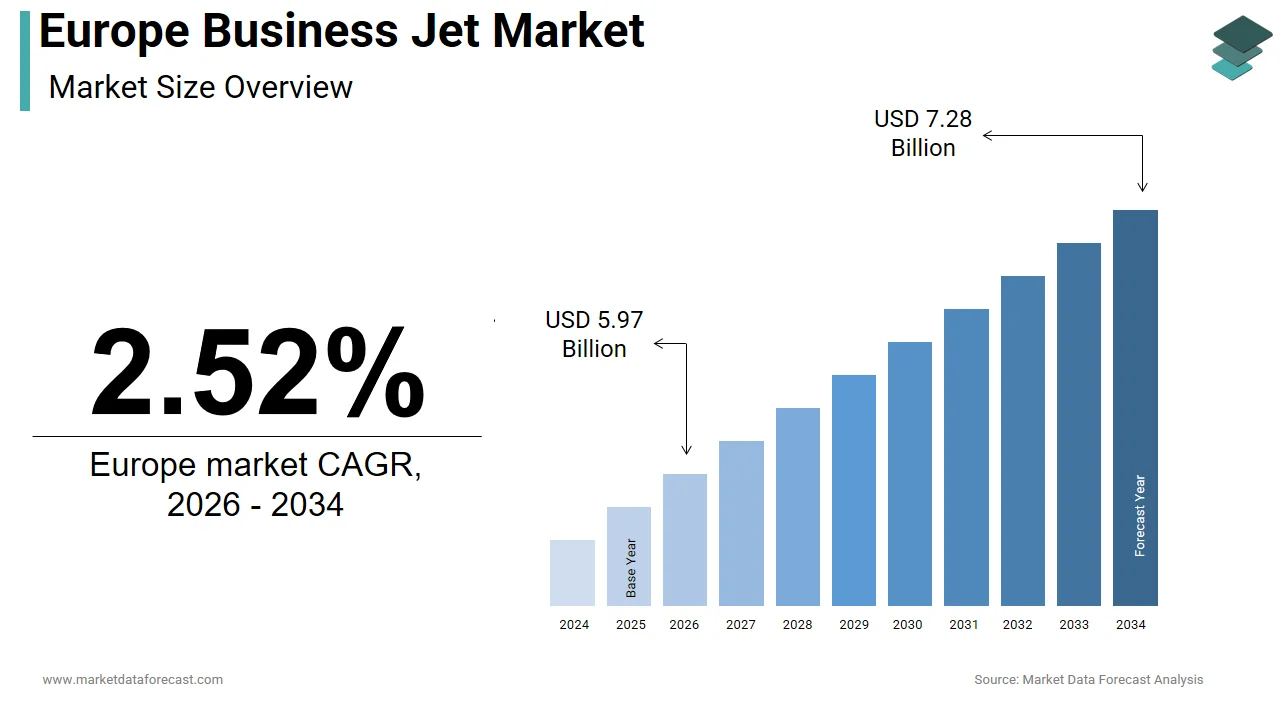
The Europe business jet market was valued at USD 5.82 billion in 2025 and is expected to grow from USD 5.97 billion in 2026 to USD 7.28 billion by 2034, registering a CAGR of 2.52% from 2026 to 2034. Market growth is driven by rising demand for time-efficient corporate travel, increasing cross-border business activities, and the strategic use of private aviation by multinational enterprises. The growing preference for flexible travel schedules, enhanced onboard productivity, and optimized asset utilization through pre-owned aircraft purchases is further supporting market expansion across Europe.
Key Market Trends
- Increasing adoption of mid-size business jets for optimal range, cabin comfort, and operating efficiency.
- Rising demand from corporate and business users is integrating private aviation into global operations.
- The growing popularity of pre-owned aircraft purchases for cost optimization and faster acquisition.
- Continued use of business jets for executive travel, client engagement, and site connectivity.
- Stable demand supported by Europe’s strong industrial, luxury, and financial sectors.
Segmental Insights
- Based on body type, the mid-size jet segment accounted for the largest share of 40.8% in 2025, driven by its balance of range capability, cabin space, and cost efficiency for regional and intercontinental travel.
- Based on end user, the businesses and corporate entities segment captured the leading market share in 2025, supported by the strategic integration of private aviation into multinational operational frameworks.
- Based on ownership model, the pre-owned purchase segment occupied 36.4% of the market share in 2025, driven by value optimization in a capital-intensive and volatile asset class.
Regional Insights
The Europe business jet market is witnessing steady demand across major economies, supported by strong corporate travel needs, luxury industry expansion, and established aviation infrastructure.
- The United Kingdom led the market with a 23.8% share in 2025, driven by its status as a global financial hub and high executive travel activity.
- France captured the second-largest share, supported by demand from luxury conglomerates, aerospace leadership, and strategic Mediterranean access.
- Germany commanded a notable share, with activity rooted in its industrial export economy and engineering-driven corporate culture.
Competitive Landscape
The Europe business jet market is characterized by the presence of established aircraft manufacturers with strong engineering capabilities and premium product portfolios. Leading companies are focusing on fuel efficiency, cabin innovation, and performance optimization to meet evolving corporate travel requirements. Strategic aircraft upgrades, fleet modernization, and expansion of service networks are strengthening their competitive positioning across Europe.
Prominent companies in the Europe business jet market include Bombardier Inc., Gulfstream Aerospace Corporation (General Dynamics Corporation), Dassault Aviation SA, Textron Inc., and Embraer S.A.
Europe Business Jet Market Size
The size of the Europe business jet market was worth USD 5.82 billion in 2025. The regional market is anticipated to grow at a CAGR of 2.52% from 2026 to 2034 and be worth USD 7.28 billion by 2034 from USD 5.97 billion in 2026.
Business jets are private turbine powered aircrafts configured for executive transport across the civilian and corporate sectors. These aircraft serve as critical mobility tools for multinational enterprises, high-net-worth individuals, and specialized missions such as medical evacuation or government transport. Unlike commercial aviation, business aviation in Europe operates primarily through a fragmented network of hundreds of general aviation airports, many of which lack customs or night curfew restrictions, enabling point-to-point efficiency unattainable via scheduled carriers. According to Eurocontrol, business jet flights numbered in the hundreds of thousands in European airspace in 2024, reflecting sustained reliance on private aviation for time-sensitive missions. As per the European Union Aviation Safety Agency, a significant share of Europe’s business jet fleet is registered in offshore jurisdictions such as the Isle of Man, Malta, and Aruba due to favorable tax and regulatory frameworks. Furthermore, the European Commission’s Single European Sky ATM Research program notes that business aviation accounts for approximately 8% of total civil air traffic movements, yet contributes disproportionately to airspace flexibility and regional connectivity, particularly in remote or underserved areas where scheduled service is economically unviable.
MARKET DRIVERS
Rising Demand for Time-Efficient Executive Mobility in Multinational Corporate Operations
European businesses increasingly rely on business jets to maintain operational agility across fragmented regulatory and geographic landscapes, which is one of the key factors driving the growth of the European business jet market. As per the European Business Aviation Association, a majority of Fortune 500 companies with European headquarters utilize private aviation to coordinate cross-border management visits, factory audits, and client engagements. The average commercial flight itinerary between secondary European cities, such as Stuttgart to Toulouse or Gothenburg to Valencia, often involves at least one connection and a total travel time exceeding several hours. In contrast, a light jet completes the same route in under two hours door to door. Studies on executive productivity confirm that business jet users save significant time compared to commercial alternatives, which translates into thousands of additional productive hours annually for large corporate subsidiaries. This time advantage is especially critical in sectors like pharmaceuticals, automotive, and finance, where rapid decision-making and site visits directly impact revenue. As supply chains decentralize and talent pools scatter across rural innovation hubs, the need for flexible point-to-point access intensifies, making business jets not a luxury but a strategic operational asset.
Growth of Ultra High Net Worth Population Driving Fractional and Full Ownership
Europe’s expanding cohort of ultra-high-net-worth individuals is fuelling sustained demand for private aviation through direct ownership and fractional programs, which is another major factor contributing to the growth of the European business jet market. According to the Global Wealth Report published by Credit Suisse, the number of individuals in Europe with investable assets exceeding 30 million US dollars grew in 2024. These individuals prioritize privacy, security, and schedule control, as these are the attributes inherently delivered by business jets. Unlike commercial first class, private aviation eliminates exposure to crowded terminals, security lines, and fixed departure times. Surveys by UBS Wealth Management found that many European UHNWIs view private jet access as essential for personal and family mobility, particularly for leisure travel to destinations such as Sardinia, the Alps, or the Greek islands, where commercial service is seasonal or non-existent. Additionally, the rise of family office structures has institutionalized aviation as a managed asset with dedicated flight departments overseeing safety, maintenance, and compliance. This demographic tailwind ensures baseline demand even during economic slowdowns, as wealth preservation and lifestyle continuity remain non-negotiable.
MARKET RESTRAINTS
Stringent Environmental Regulations and Carbon Pricing Increase Operational Costs
The Europe business jet market faces mounting pressure from climate policies that directly elevate flight expenses and constrain operations. According to the European Commission, all business jet operators flying within the EU must participate in the EU Emissions Trading System, which in 2024 priced carbon allowances at over 85 euros per ton. For a typical light jet emitting nearly two tons of CO₂ per hour, this adds significant compliance costs to every flight hour. Furthermore, the EU’s ReFuelEU Aviation mandate requires that 2% of all aviation fuel supplied at EU airports be sustainable aviation fuel by 2025, rising to 70% by 2050. As per the European Environment Agency, sustainable aviation fuel currently costs several times more than conventional Jet A1, making compliance financially burdensome for small operators. Several countries have introduced additional levies; France imposes a departure tax on private jets, while the Netherlands plans a progressive noise and emissions surcharge by 2026. These cumulative costs disproportionately impact light and mid-size jet operators who lack the economies of scale to absorb them, potentially forcing fleet reductions or market exits.
Public and Political Backlash Against the Perceived Inequity of Private Aviation
Business aviation in Europe increasingly contends with social stigma and policy hostility rooted in perceptions of excess amid economic and climate crises, which is further hindering the growth of the European business jet market. According to a 2024 Eurobarometer survey, a majority of EU citizens believe private jets should be banned or heavily taxed due to their disproportionate carbon footprint relative to passenger capacity. This sentiment has translated into concrete political action; the European Parliament’s Transport Committee proposed a continent-wide ban on short-haul business jet flights where rail alternatives under six hours exist, which is a measure that would affect a large share of current operations between major European cities. Local governments have also restricted access; London City Airport prohibits private jet arrivals during peak hours, while Geneva and Nice impose steep night landing fees. Media scrutiny intensifies the pressure as investigations have linked offshore aircraft registrations to tax avoidance schemes, prompting calls for transparency reforms. This reputational and regulatory headwind complicates fleet planning, market expansion, and brand positioning for operators and manufacturers alike.
MARKET OPPORTUNITIES
Adoption of Sustainable Aviation Fuel and Electrification Pathways Creates Green Premium Segment
The emergence of low-carbon propulsion technologies is opening a new value tier for environmentally conscious operators, which is a prominent opportunity in the European business jet market. According to the European Business Aviation Association, dozens of business jet operators in Europe now offer carbon-neutral flight options through sustainable aviation fuel blending or verified offset programs. Leading manufacturers such as Dassault and Gulfstream have certified their latest models for 100% sustainable aviation fuel use, which is enabling immediate emissions reduction without airframe modification. In 2024, the European Commission approved significant funding under the Innovation Fund to support sustainable aviation fuel production plants in Spain and the Netherlands, with output prioritized for business aviation due to its early adopter profile. As per a survey by VistaJet, a majority of corporate clients are willing to pay a premium for flights powered by certified sustainable fuel. This green premium segment not only mitigates reputational risk but also aligns with corporate net-zero commitments under the EU Taxonomy, creating a strategic differentiation avenue in an otherwise mature market.
Expansion of On-Demand Jet Card and Subscription Models Lowers Entry Barriers
The proliferation of flexible access models is democratizing business aviation beyond traditional ownership circles, which is offering prominent opportunities in the European business jet market. According to the European Business Aviation Association, fractional and jet card programs now account for a growing share of private flight hours in Europe compared to earlier years. Companies such as LunaJets and Victor offer subscription plans starting at accessible annual fees, granting guaranteed availability without capital outlay or management overhead. These models appeal to mid-sized enterprises and affluent professionals who fly 25 to 50 hours per year, which is below the threshold for cost-effective ownership. According to a PwC analysis, jet card users achieve lower total cost per flight hour compared to ad hoc charter due to volume pricing and fixed hourly rates. Additionally, digital platforms provide real-time pricing, fleet availability, and carbon footprint tracking, enhancing transparency and ease of use. As digital payment infrastructure and dynamic pricing algorithms mature, this on-demand ecosystem is transforming business aviation from an asset-intensive luxury into a scalable mobility service accessible to a broader economic stratum.
MARKET CHALLENGES
Fragmented Air Traffic Management and Airport Access Restrictions Limit Operational Flexibility
Despite the Single European Sky initiative, business jet operators continue to face inefficiencies due to national airspace fragmentation and localized airport constraints, which are major challenges to the growth of the European business jet market. According to Eurocontrol, average en route flight times for business jets in Europe remain longer than optimal due to uncoordinated air traffic flows and restricted military zones. Furthermore, hundreds of general aviation airports across the EU impose noise quotas, night curfews, or slot limitations that restrict access during critical business hours. According to a study by the European Business Aviation Association, many operators experienced denied airport access in the past year due to ad hoc restrictions in countries such as Germany, France, and Switzerland. These bottlenecks undermine the core value proposition of private aviation and force rerouting that increases fuel burn and carbon output. Until the EU fully implements centralized flow management and harmonizes noise certification standards across member states, business jets will operate in a patchwork regulatory environment that erodes efficiency and reliability.
Supply Chain Constraints for Advanced Avionics and Engine Components Delay Fleet Renewal
The Europe business jet market contends with persistent delivery bottlenecks driven by global shortages of high-specification aerospace components. According to the European Union Aviation Safety Agency, lead times for next-generation flight deck systems have extended significantly due to semiconductor allocation priorities favoring commercial airliners. Similarly, engine manufacturers report backlogs exceeding two years for popular light and mid-size jet engines. As per a 2024 audit by Roland Berger, European operators planning fleet upgrades faced delays in aircraft delivery compared to pre-pandemic norms. This supply constraint forces businesses to retain older, less efficient aircraft longer, increasing maintenance costs and carbon intensity. Without dedicated allocation channels or regionalized component manufacturing, the market will remain vulnerable to aerospace industry-wide capacity limits that suppress modernization and sustainability goals.
REPORT COVERAGE
| REPORT METRIC | DETAILS |
| Market Size Available | 2025 to 2034 |
| Base Year | 2025 |
| Forecast Period | 2026 to 2034 |
| Segments Covered | By Body Type, End User, Ownership Model, and Country. |
| Various Analyses Covered | Global, Regional, and Country-Level Analysis, Segment-Level Analysis, Drivers, Restraints, Opportunities, Challenges; PESTLE Analysis; Porter’s Five Forces Analysis, Competitive Landscape, Analyst Overview of Investment Opportunities |
| Countries Covered | UK, France, Spain, Germany, Italy, Russia, Sweden, Denmark, Switzerland, Netherlands, Turkey, Czech Republic, and the Rest of Europe. |
| Market Leaders Profiled | Bombardier Inc., Gulfstream Aerospace Corporation (General Dynamics Corporation), Dassault Aviation SA, Textron Inc., Embraer S.A., and Others. |
SEGMENTAL ANALYSIS
By Body Type Insights
The mid-size jet segment accounted for the major share of 40.8% of the regional market in 2025. The dominating position of the mid-size jet segment in the European market is driven by its optimal balance of range, performance, and operating economics for intra-European and transatlantic missions. Mid-size jets such as the Cessna Citation Latitude, Bombardier Challenger 350, and Embraer Praetor 500 offer 2,500 to 3,500 nautical mile range and stand-up cabins that suit the most common European business itineraries. As per Eurocontrol, a majority of business jet flights in Europe originate or terminate within the EU’s core economic triangle of London, Frankfurt, and Milan. These routes typically require 1,000 to 2,000 nautical miles of range while also supporting transatlantic legs when needed. Independent analyses confirm that mid-size jets achieve the lowest cost per seat mile among all categories for missions under 3,000 nautical miles due to fuel efficiency and lower maintenance intensity than large jets. Their eight to nine-passenger capacity also aligns with typical executive team sizes, avoiding the underutilization common with larger cabins.
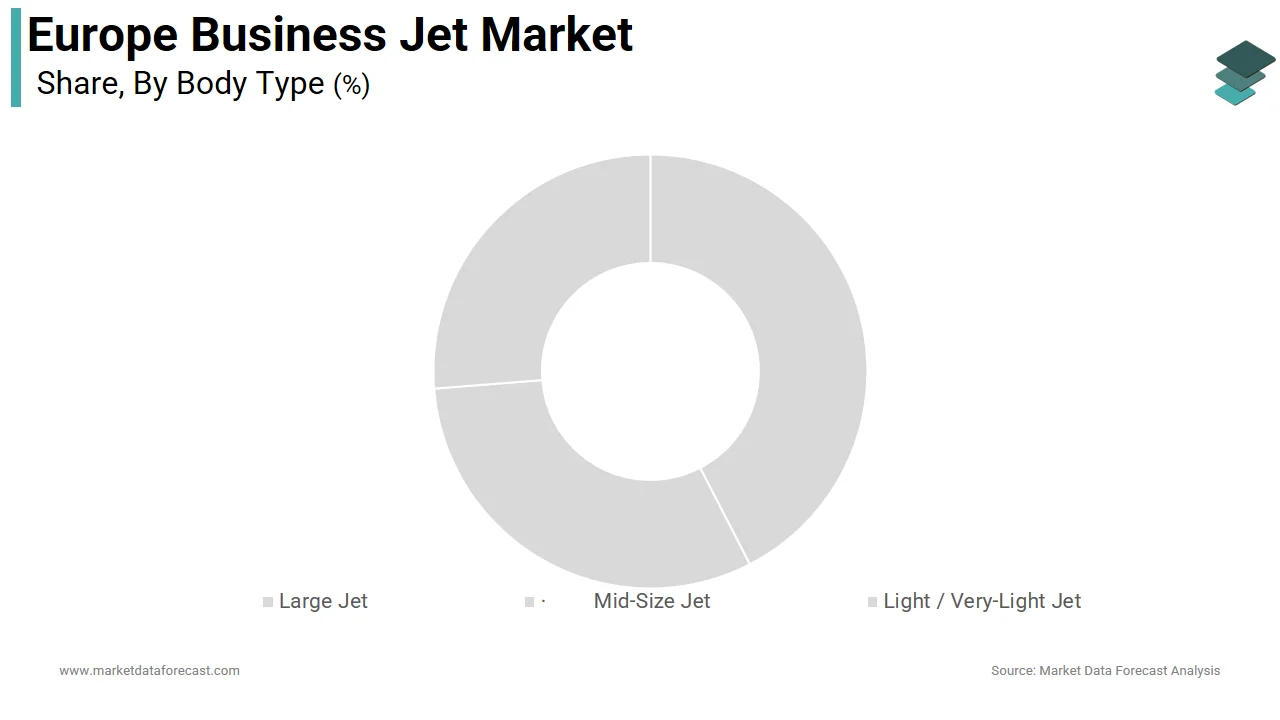
The light/very-light jet segment is the fastest-growing segment in the European market and is estimated to register a CAGR of 7.07% over the forecast period. The rise of subscription-based mobility is driving demand for efficient small cabin aircraft. As per the European Business Aviation Association, a significant share of private flight hours in 2024 were conducted through jet card or membership programs, with light jets such as the Phenom 300 and Citation CJ4 forming the backbone of these fleets due to low hourly operating costs. Companies like LunaJets and Victor report that many new clients in Germany and the Netherlands opted for light jet access plans priced between 15,000 and 40,000 euros annually. A PwC study found that these models reduce entry barriers compared to fractional ownership, enabling mid-sized enterprises and affluent professionals to adopt private aviation for the first time. This democratization creates a structural growth vector beyond traditional ultra-high-net-worth ownership.
By End User Insights
The businesses and corporate entities segment captured the leading share of the European business jet market in 2025 due to the strategic integration of private aviation into multinational operational frameworks. European corporations use business jets to maintain agility across fragmented regulatory and logistical landscapes. For instance, companies with pan-European manufacturing footprints conduct numerous executive flights annually to coordinate audits, supplier negotiations, and crisis response. Commercial alternatives often lack direct routes to secondary industrial hubs such as Toulouse, Wolfsburg, or Lund, forcing multi-leg itineraries that waste significant time. A corporate jet reduces this to under four hours, enabling same-day round trips. As per the European Commission’s Single Market Observatory, a majority of Fortune 500 European subsidiaries consider private aviation essential for maintaining just-in-time supply chain oversight. This operational ROI justifies fleet investment even during economic uncertainty.
The charter/air-taxi operators segment is on the rise and is expected to record a CAGR of 8.05% over the forecast period. Technology-driven charter platforms have dramatically lowered access barriers through transparent real-time pricing and instant availability. As per the European Business Aviation Association, digital brokers such as Victor, LunaJets, and JetApp accounted for a growing share of ad hoc charter bookings in 2024 compared to earlier years. These platforms aggregate empty legs, utilize AI for route optimization, and offer fixed hourly rates, eliminating traditional opaque quoting. A Roland Berger analysis confirmed that digital charter users achieve lower costs per flight hour than traditional brokers due to reduced positioning and idle time. The rise of API integration with corporate travel management systems further embeds on-demand aviation into enterprise workflows, making it a seamless alternative to scheduled service for unpredictable trips.
By Ownership Model Insights
The pre-owned purchase segment occupied 36.4% of the regional market share in 2025 due to the value optimization in a capital-intensive and volatile asset class. Pre-owned jets offer 30 to 50% lower acquisition costs than new equivalents while delivering near-identical performance due to rigorous maintenance standards. As per the European Union Aviation Safety Agency, all aircraft registered in Europe must comply with mandatory airworthiness directives and undergo annual inspections regardless of age. For instance, mid-life aircraft often include factory-installed upgrades such as enhanced vision systems or updated interiors, reducing retrofit expenses. For corporations and high-net-worth individuals seeking asset efficiency, this residual value curve makes pre-owned the rational choice, particularly amid economic uncertainty.
The fractional ownership segment is anticipated to register a CAGR of 8.2% over the forecast period in the European business jet market. Fractional programs are increasingly adopted by companies that fly 50 to 200 hours annually, which is too much for charter but too little for full ownership. As per NetJets Europe, a majority of new fractional clients in 2024 were mid-sized European enterprises in sectors such as renewable energy, medtech, and fintech. These firms gain guaranteed availability, access to large cabin aircraft, and full operational support without managing crew, maintenance, or insurance. A PwC analysis found that fractional users achieve lower total cost per flight hour than full owners at this utilization level due to shared fixed expenses. As corporate sustainability reporting intensifies, fractional providers also offer carbon-neutral flight options, enhancing ESG alignment.
COUNTRY-LEVEL ANALYSIS
United Kingdom Business Jet Market Analysis
The United Kingdom led the business jet market in Europe in 2025 by holding 23.8% of the regional market share. The dominance of the UK in the European market is driven by its global financial hub status, extensive general aviation infrastructure, and favorable tax environment for aircraft registration. As per the UK Civil Aviation Authority, hundreds of business jets are registered in the UK, with London Oxford, Biggin Hill, and Farnborough forming a high-density corridor that handles a significant portion of European private jet movements. The country’s time zone advantage enables same-day flights to both Asia and the Americas, making it a strategic base for multinational corporations. Additionally, the UK’s departure from the EU has not diminished its appeal; the Civil Aviation Authority maintains EASA-aligned safety standards while offering streamlined customs for non-EU flights. This combination of connectivity, regulatory clarity, and service depth ensures the UK remains a central hub of European business aviation.
France Business Jet Market Analysis
France captured the second leading share of the European market in 2025 with demand fuelled by luxury conglomerates, aerospace leadership, and strategic Mediterranean access. According to France’s Directorate General for Civil Aviation, hundreds of business jets are registered in the country, with Paris Le Bourget serving as Europe’s busiest business airport. French luxury groups such as LVMH, Kering, and L’Oréal operate dedicated fleets for global executive coordination, while Dassault Aviation’s Falcon production in Bordeaux anchors local industry expertise. France also leads in environmental regulation; its private jet departure tax and proposed short-haul restrictions reflect a dual identity as both an aviation hub and climate policy pioneer. This tension drives demand for sustainable aviation fuel and newer efficient models as operators seek to balance operational needs with social license.
Germany Business Jet Market Analysis
Germany commanded a notable share of the European business jet market in 2025 with activity rooted in its industrial export economy and engineering precision culture. As per the German Federal Aviation Office, hundreds of business jets serve the country’s Mittelstand as mid-sized industrial champions that drive a large share of German exports. These companies rely on private aviation to maintain just-in-time oversight of global supply chains, particularly in the automotive and machinery sectors. Frankfurt Egelsbach and Munich Oberpfaffenhofen are key hubs with EASA Part 145 maintenance facilities, ensuring rapid turnaround. Unlike leisure-focused markets, German usage is overwhelmingly mission-critical, with most flights linked to factory audits or client visits. This utilitarian approach ensures steady demand, insulated from consumer sentiment shifts and aligned with Germany’s export-dependent economic model.
Switzerland Business Jet Market Analysis
Switzerland is anticipated to hold a noteworthy share of the European business jet market over the forecast period. Despite its small size, due to its role as a global wealth and diplomacy center. According to the Swiss Federal Office of Civil Aviation, hundreds of business jets are registered in the country, benefiting from political neutrality, low VAT on maintenance, and traditions that attract international UHNWIs. Airports such as Geneva and Lugano offer discreet 24-hour operations with customs pre-clearance for Schengen and non-Schengen flights. The country’s mountainous terrain and limited commercial service to alpine resorts further justify private access. According to UBS Wealth Management, many Swiss-based family offices include aviation in their asset portfolios. This convergence of wealth, privacy, and geography creates a high-value concentrated market that punches far above its population weight.
Italy Business Jet Market Analysis
Italy is predicted to showcase a healthy CAGR in the European business jet market during the forecast period, with dynamics shaped by fashion, luxury, and regional economic disparity. According to the Italian Civil Aviation Authority, hundreds of business jets are registered, primarily serving Milan-based fashion houses, automotive magnates, and industrial families in the North. Airports such as Milan Linate and Olbia cater to seasonal leisure traffic to Sardinia and the Amalfi Coast, driving summer peak demand. However, the South lacks comparable infrastructure, limiting national fleet growth. Studies confirm that Italian UHNWIs often prioritize cabin comfort and design over range, reflecting cultural emphasis on aesthetics. Additionally, the government’s tax credit for sustainable aviation fuel adoption has accelerated fleet modernization among top owners. This blend of lifestyle-driven usage and emerging green incentives positions Italy as a unique and resilient niche within the European landscape.
COMPETITIVE LANDSCAPE
Competition in the Europe business jet market is characterized by a high-stakes contest among established manufacturers to balance performance, sustainability and service excellence amid tightening environmental and social scrutiny. The market is dominated by a handful of global OEMs who compete not on price but on range efficiency, cabin innovation, and lifecycle support. Barriers to entry are formidable due to EASA certification complexity, high R and D costs, and entrenched customer relationships. Competition is intensifying around environmental credentials as EU policies mandate sustainable aviation fuel use and carbon pricing, making fuel efficiency and SAF compatibility critical differentiators. At the same time, digitalization is reshaping customer expectations with demand for seamless flight planning, real-time maintenance tracking, and carbon reporting. Unlike commoditized transport segments, success here depends on integrated value combining aircraft performance, ground support, and regulatory foresight to retain corporate and ultra-high net worth clients in an era of climate accountability and operational transparency.
KEY MARKET PLAYERS
The leading companies operating in the Europe business jet market include:
- Bombardier Inc.
- Gulfstream Aerospace Corporation (General Dynamics Corporation)
- Dassault Aviation SA
- Textron Inc.
- Embraer S.A.
TOP PLAYERS IN THE MARKET
- Dassault Aviation is a premier European manufacturer renowned for its Falcon business jet family, which serves corporate, government, and special mission operators across the continent. The company contributes globally by setting benchmarks in aerodynamic efficiency, cabin comfort, and long-range performance with aircraft like the Falcon 6X and 8X. In Europe, Dassault has strengthened its position by achieving 100% sustainable aviation fuel certification for its entire Falcon line, enabling immediate carbon reduction. It also expanded its customer support network with new service centers in Geneva and Lisbon, offering EASA-certified maintenance and digital aircraft health monitoring. These actions reinforce its reputation for engineering excellence and operational reliability in a market increasingly demanding environmental accountability and service proximity.
- Bombardier is a leading force in the Europe business jet market through its Challenger and Global series, known for spacious cabins, transcontinental range, and smooth ride quality. The company plays a pivotal global role by pioneering advanced wing designs and cabin pressurization systems that enhance passenger well-being. In Europe, Bombardier has reinforced its market presence by launching the Global 5500 and Challenger 3500 with updated interiors, reduced emissions, and full compliance with EU noise and carbon regulations. It also deepened partnerships with European fractional operators like Flexjet to standardize fleet configurations and streamline pilot training. Additionally, the company introduced a digital flight planning portal integrated with EU customs and slot coordination system,s enhancing operational efficiency for European clients.
- Embraer Executive Jets delivers high-performance mid-size and light business aircraft with strong adoption across Europe’s corporate and charter segments. The company contributes globally by offering best-in-class economics in the Praetor and Phenom families, combining range efficiency and cabin innovation. In Europe, Embraer has strengthened its position by establishing an EASA-certified training center in Madrid and expanding its line maintenance network to 12 countries. It also achieved full sustainable aviation fuel approval for the Praetor 500 and 600, enabling European operators to meet ReFuelEU mandates. Recent collaborations with digital charter platforms like Victor ensure its aircraft remain central to the on-demand mobility ecosystem, driving accessibility beyond traditional ownership models.
TOP STRATEGIES USED BY THE KEY MARKET PARTICIPANTS
Key players in the Europe business jet market prioritize full certification for sustainable aviation fuel to comply with ReFuelEU mandates and meet corporate net-zero commitments. They expand EASA-certified maintenance and training infrastructure across major European hubs to ensure rapid turnaround and regulatory compliance. Companies enhance cabin technologies, focusing on air quality pressurization and connectivity to differentiate the passenger experience. Strategic partnerships with fractional operators and digital charter platforms increase fleet utilization and market reach. Additionally, they invest in digital flight support tools integrated with EU customs slot coordination and carbon reporting systems to streamline cross-border operations and reduce administrative burden for European clients.
MARKET SEGMENTATION
This research report on the Europe business jet market has been segmented and sub-segmented into the following categories.
By Body Type
- Large Jet
- Mid-Size Jet
- Light / Very-Light Jet
By End User
- Individual Owners
- Businesses and Corporate Entities
- Charter / Air-Taxi Operators
- Training and Academic Institutions
- Government and Special-Mission Operators
By Ownership Model
- New Aircraft Purchase
- Pre-Owned Purchase
- Fractional Ownership
- Jet Cards / Membership
By Country
- United Kingdom
- France
- Spain
- Germany
- Italy
- Russia
- Sweden
- Denmark
- Switzerland
- Netherlands
- Rest of Europe