- Product Description Description
- Table of Contents TOC
- List of Table & Figure LOT
- Get Free Sample PDF Sample PDF
Market Size, 2025
$16.52 BnMarket Estimate, 2026
$19.02 BnMarket Forecast, 2034
$58.63 BnCAGR, 2026–2034
15.11%Europe Butter and Ghee Market Report Summary
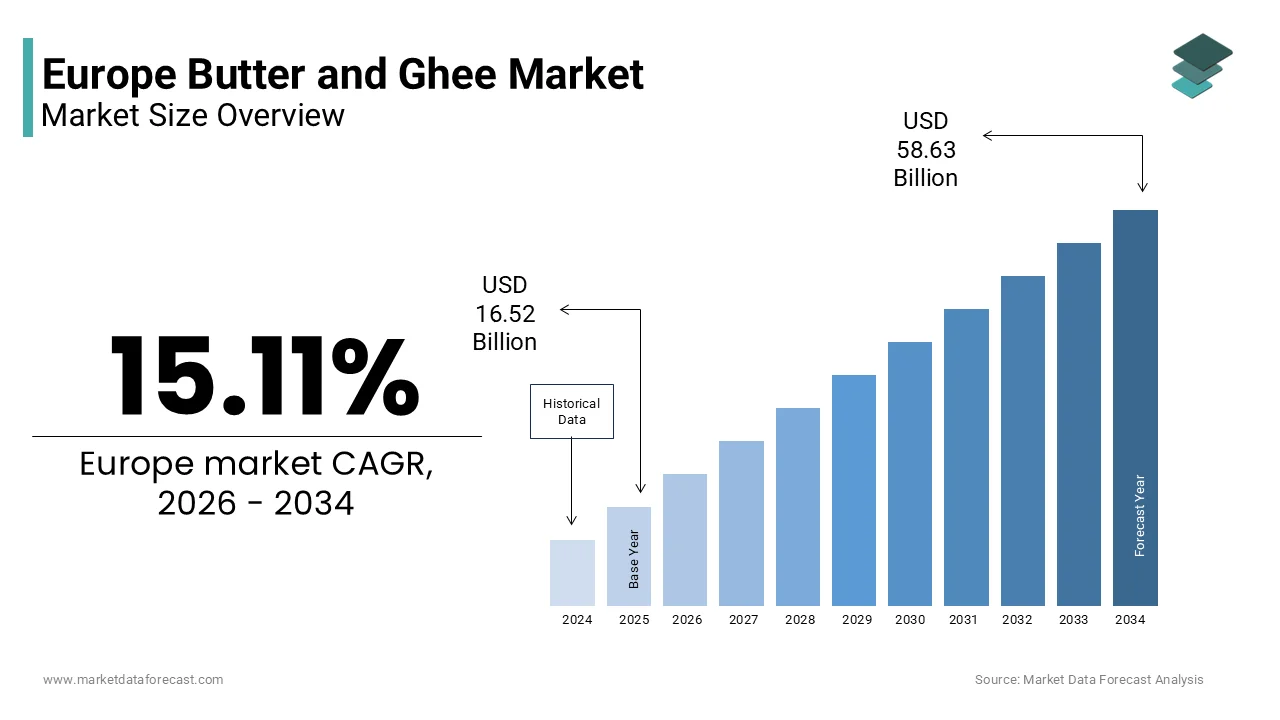
The Europe butter and ghee market was valued at USD 16.52 billion in 2025, is estimated to reach USD 19.02 billion in 2026, and is projected to reach USD 58.63 billion by 2034, growing at a CAGR of 15.11% during the forecast period from 2026 to 2034. The growth of the European butter and ghee market is driven by increasing consumer demand for natural dairy products, rising consumption of premium bakery and confectionery products, and growing preference for traditional cooking fats. The expanding foodservice industry, increasing popularity of ethnic cuisines, and rising demand for clean-label and minimally processed dairy products are further supporting market growth. Additionally, growing imports of specialty butter and ghee products and continuous product innovation are contributing to market expansion across Europe.
Key Market Trends
-
Rising demand for natural and clean-label dairy products is driving the consumption of butter and ghee across Europe.
-
Growing popularity of premium bakery, confectionery, and dairy-based food products is increasing market demand.
-
Increasing consumer preference for traditional cooking ingredients and authentic ethnic cuisines is supporting ghee consumption.
-
Expansion of modern retail and e-commerce channels is improving the availability of premium butter and ghee products.
-
Rising product innovation, including organic, grass-fed, and flavored butter varieties, is strengthening market growth.
Segmental Insights
-
Based on volume, the imports segment dominated the Europe butter and ghee market and accounted for 58.4% of the market share in 2025. The segment's leadership is attributed to strong regional demand, increasing imports of premium dairy products, and the need to meet consumer requirements across diverse food processing and retail sectors.
-
Based on distribution channel, the supermarkets segment held the largest share of 48.3% of the Europe butter and ghee market in 2025. The segment's dominance is driven by extensive product availability, competitive pricing, and growing consumer preference for organized retail channels offering a wide variety of dairy products.
Regional Insights
-
The European butter and ghee market is experiencing robust growth due to increasing dairy consumption, rising demand for premium food ingredients, and expanding applications across the food and beverage industry.
-
Germany dominated the Europe butter and ghee market by accounting for 18.2% of the regional market share in 2025. The country's leadership is supported by strong dairy consumption, a well-established food processing industry, and increasing demand for high-quality butter and specialty dairy products.
Competitive Landscape
The Europe butter and ghee market is moderately competitive, with manufacturers focusing on premium product offerings, sustainable dairy sourcing, and expansion of retail distribution networks to strengthen their market presence. Companies are investing in product innovation, organic dairy production, and strategic partnerships to meet evolving consumer preferences and growing demand for high-quality butter and ghee products. Key players operating in the Europe butter and ghee market include Terra Food LLC, AVN Products, SEWRI Trading Company, Worldlink Entt, Mousa Al Mazim General Trading, Umang Dairies Limited, Prime Lac Supplies, and Marsho.
Europe Butter and Ghee Market Size
The Europe butter and ghee market size was valued at USD 16.52 billion in 2025, and is expected to reach USD 58.63 billion by 2034 from USD 19.02 billion in 2026. The market is growing at a CAGR of 15.11%.
Butter is traditionally churned from milk cream and serves as a critical ingredient in baking, cooking, and table spreads, while ghee is a clarified form of butter where milk solids and water are removed, resulting in a higher smoke point and extended shelf life. The consumption landscape for these dairy fats is intricately linked to broader agricultural outputs and shifting nutritional paradigms across the region. The foundational supply of these products relies heavily on the massive dairy farming infrastructure present throughout the continent. Eurostat shows that the European Union produces roughly 161.8 million tonnes of raw milk annually, driving a robust manufacturing baseline where 70% of available whole milk is processed directly into cheese and butter. Furthermore, the dietary integration of these products is reflected in overall consumption patterns. As per Eurostat, the average household expenditure on dairy products and eggs remains a significant portion of the total food budget, demonstrating the enduring cultural and nutritional reliance on these items. Additionally, the physiological tolerance of the population influences product preferences, particularly the shift toward clarified variants.
MARKET DRIVERS
Rising demand for lactose-free products increases clarified butter consumption
A substantial portion of the regional demographic experiences physiological difficulty in digesting lactose, which fuels the growth of the Europe butter and ghee market. This primary sugar is found in conventional milk and standard butter. This biological constraint forces many individuals to seek alternative dairy products that do not trigger gastrointestinal discomfort. Ghee, through its traditional clarification process, effectively removes almost all milk solids, including lactose and casein, rendering it highly tolerable for those with sensitivities. According to the National Institutes of Health, approximately 65 percent of the global human population exhibits a reduced ability to digest lactose after infancy, a prevalence that extends significantly across various European ethnic groups. Furthermore, the medical community increasingly recognizes the benefits of ghee for gut health due to its high butyric acid content. Biomedical studies indicate that butyrate significantly supports intestinal cell barrier performance, leading holistic dietary specialists to favor ghee as an exceptional cooking medium due to its high, concentrated concentration of short-chain fatty acids. This intersection of biological necessity and nutritional science creates a powerful, sustained demand driver for clarified butter across the continent.
Growing artisanal baking boosts demand for premium dairy fats
There has been a massive cultural shift in recent years toward homemade food preparation, which further boosts the expansion of the Europe butter and ghee market. This is driven by a desire for higher quality ingredients and the therapeutic benefits of cooking. Artisanal baking, in particular, relies heavily on the superior flavor and structural properties that only pure dairy fat can provide. Eurostat document that despite fluctuating grocery bills, traditional dairy fats like butter remain structurally stable core items in Western European family food portfolios. Furthermore, the proliferation of culinary media and online cooking tutorials has demystified complex pastry techniques, encouraging amateur cooks to experiment with laminated doughs and rich sauces that demand high fat content. Sources confirm that premium traditional dairy products boasting official EU regional origin protections consistently capture a premium market share due to consumer demand for clean-label authenticity. This enduring enthusiasm for scratch cooking ensures a robust and continuous demand for high quality butter in the retail sector.
MARKET RESTRAINTS
Fluctuating raw milk prices pressure profit margins and pricing stability
Severe fluctuations in raw milk procurement costs severely constrain the profit margins of dairy fat manufacturers, which restricts the growth of the Europe butter and ghee market. Consequently, this volatility compromises their ability to maintain pricing stability in the market. The production of butter and ghee is entirely dependent on the availability and pricing of raw milk cream, making the industry highly vulnerable to agricultural commodity volatility. Dairy farmers face immense pressure from fluctuating feed prices, energy costs, and unpredictable weather conditions, all of which directly impact the producer price of milk. According to the European Commission agricultural market observatory, the average price of raw milk paid to producers in the European Union fluctuated by nearly 15 percent over recent fiscal cycles due to severe inflation in animal feed and fertilizer costs. As per the European Dairy Association, energy and feed costs account for over 40 percent of total farm expenditures, creating a highly unstable raw material base for processors. When milk prices spike, dairy processors are often forced to absorb the increased costs to maintain competitive retail pricing, or pass them on to consumers, which can suppress overall demand. Furthermore, the seasonal variations in milk production, with peak yields occurring in the spring and summer, require expensive storage and preservation infrastructure to ensure year round butter availability.
Growing veganism reduces demand for traditional animal-based dairy fats
A growing segment of the population in the region is actively eliminating all animal products from their diets, which hinders the expansion of the Europe butter and ghee market. This is due to ethical concerns regarding animal welfare and environmental sustainability. Also, this philosophical shift directly translates into a reduced consumption of traditional butter and ghee, as consumers substitute these dairy fats with plant based alternatives like margarine, coconut oil, or specialized vegan butter blends. As per a survey by ProVeg International, approximately 10 percent of the German population now identifies as strictly vegetarian or vegan, with similar trends observed in the Netherlands and the United Kingdom. Furthermore, the food industry has heavily invested in improving the taste and texture of plant based spreads, making them highly competitive substitutes for traditional dairy fats in both cooking and baking applications. The permanent dietary migration restricts the absolute growth potential of traditional butter and ghee, forcing manufacturers to compete for a shrinking pool of conventional dairy consumers.
MARKET OPPORTUNITIES
Rising demand for grass-fed and organic dairy drives premium product growth
Growing consumer demand for nutrient-dense, grass-fed, and organic dairy offers excellent opportunities to stand out in the premium segment of the Europe butter and ghee market. Modern European consumers are increasingly scrutinizing the origin and production methods of their food, leading to a strong preference for dairy products sourced from cows raised on natural pastures. Grass fed butter and ghee are perceived to possess superior nutritional profiles, containing higher levels of omega 3 fatty acids, conjugated linoleic acid, and fat soluble vitamins compared to conventional grain fed variants. FiBL confirm that total farmland managed under organic practices in Europe has reached 19.6 million hectares, validating a major structural transition toward natural agriculture. Also, FiBL reveals that total retail sales for organic food in Europe reached a record €58.7 billion, underscoring a strong consumer demographic driving value across clean-label categories Furthermore, luxury food retailers and high end restaurants actively seek out artisanal, terroir driven butters to elevate their culinary offerings. Companies can invest in transparent supply chains and obtain rigorous organic certifications. By doing so, they can capture highly profitable niche segments and build intense brand loyalty among affluent, health-focused demographics.
High-fat, low-carb diets boost demand for ghee as a functional nutrition product
The boom in low-carb, high-fat lifestyles opens a massive door to establish clarified butter as an elite functional fat for athletes, which is likely to drive the growth of the Europe butter and ghee market. Nutritional paradigms have shifted dramatically, with a significant portion of the population embracing ketogenic and paleolithic diets that prioritize high fat intake while strictly limiting carbohydrates. In these dietary frameworks, ghee is celebrated not merely as a cooking fat, but as a vital source of clean, sustained energy and essential fatty acids. The International Food Information Council (IFIC) confirm that low-carbohydrate and ketogenic eating frameworks remain a steady consumer trend, creating a reliable niche for functional cooking fats like clarified butter. Clinical research into short-chain fatty acids supports high-fat metabolic pathways for energy production, which specialized food brands leverage to position clarified fats to consumers seeking alternative fuel sources. Ghee is rich in butyric acid and conjugated linoleic acid, compounds that support gut health and metabolic function, making it highly attractive to the sports nutrition community. The European Specialist Sports Nutrition Alliance (ESSNA) highlights steady market diversification as active sports nutrition consumers increasingly transition toward natural, single-ingredient food items to power active lifestyles. Manufacturers can tap into a highly profitable demographic by repositioning ghee and marketing it through specialized sports nutrition retailers. This allows consumers to view dairy fat as a functional performance enhancer rather than merely a culinary ingredient.
MARKET CHALLENGES
Strict livestock emission regulations increase compliance costs for dairy producers
The dairy industry is under intense regulatory scrutiny due to the significant environmental footprint associated with cattle farming, particularly regarding methane emissions and land use, which in turn holds back the expansion of the Europe butter and ghee market. European governments are implementing aggressive climate targets that directly impact dairy cooperatives and butter manufacturers, forcing them to invest heavily in sustainable farming practices and emission reduction technologies. According to the European Environment Agency, agriculture accounts for approximately 10 percent of total greenhouse gas emissions in the European Union, with enteric fermentation from cattle being a primary contributor. As per the European Commission Farm to Fork strategy, the region aims to reduce nutrient losses by 50 percent and pesticide use by 50 percent by the year 2030, requiring fundamental changes in how feed is grown and how cattle are managed. These stringent environmental mandates necessitate massive capital expenditures for methane digesters, precision feeding systems, and carbon footprint tracking software. Furthermore, the potential introduction of carbon border adjustment mechanisms and strict emission caps could limit herd sizes, directly threatening the raw milk volumes required to sustain current butter and ghee production levels across the continent.
High saturated fat health concerns continue to limit butter and ghee market growth
Persistent public health advisories warn about the cardiovascular risks associated with high saturated fat intake, which slows down the expansion of the Europe butter and ghee market. These warnings continuously hinder mainstream consumption growth. Despite the resurgence of certain high fat diets, the broader medical establishment and public health organizations maintain strict guidelines regarding the consumption of saturated fats, which are abundant in butter and ghee. Decades of nutritional guidance have deeply ingrained the perception that excessive animal fat intake elevates low density lipoprotein cholesterol and increases the risk of heart disease. As per the World Health Organization European Regional Office, cardiovascular diseases remain the leading cause of mortality in the region, responsible for over 4 million deaths annually, prompting national health ministries to actively discourage excessive consumption of animal fats. This persistent medical consensus creates a significant psychological barrier for mainstream consumers, particularly older demographics and those with existing health conditions, who actively limit their butter purchases. Furthermore, food reformulation initiatives by governments aiming to reduce the overall saturated fat content of the national food supply place additional pressure on manufacturers.
REPORT COVERAGE
| REPORT METRIC | DETAILS |
| Market Size Available | 2025 to 2034 |
| Base Year | 2025 |
| Forecast Period | 2026 to 2034 |
| CAGR | 15.11% |
| Segments Covered | By Volume, Distribution Channel, and Region |
| Various Analyses Covered | Global, Regional, & Country Level Analysis; Segment-Level Analysis; DROC, PESTLE Analysis; Porter’s Five Forces Analysis; Competitive Landscape; Analyst Overview of Investment Opportunities |
| Regions Covered | UK, France, Spain, Germany, Italy, Russia, Sweden, Denmark, Switzerland, Netherlands, Turkey, and the Czech Republic |
| Market Leaders Profiled | Terra Food LLC, AVN Products, SEWRI Trading Company, Worldlink Entt, Mousa Al Mazim General Trading, Umang Dairies Limited, Prime Lac Supplies, and Marsho, among others |
SEGMENTAL ANALYSIS
By Volume Insights
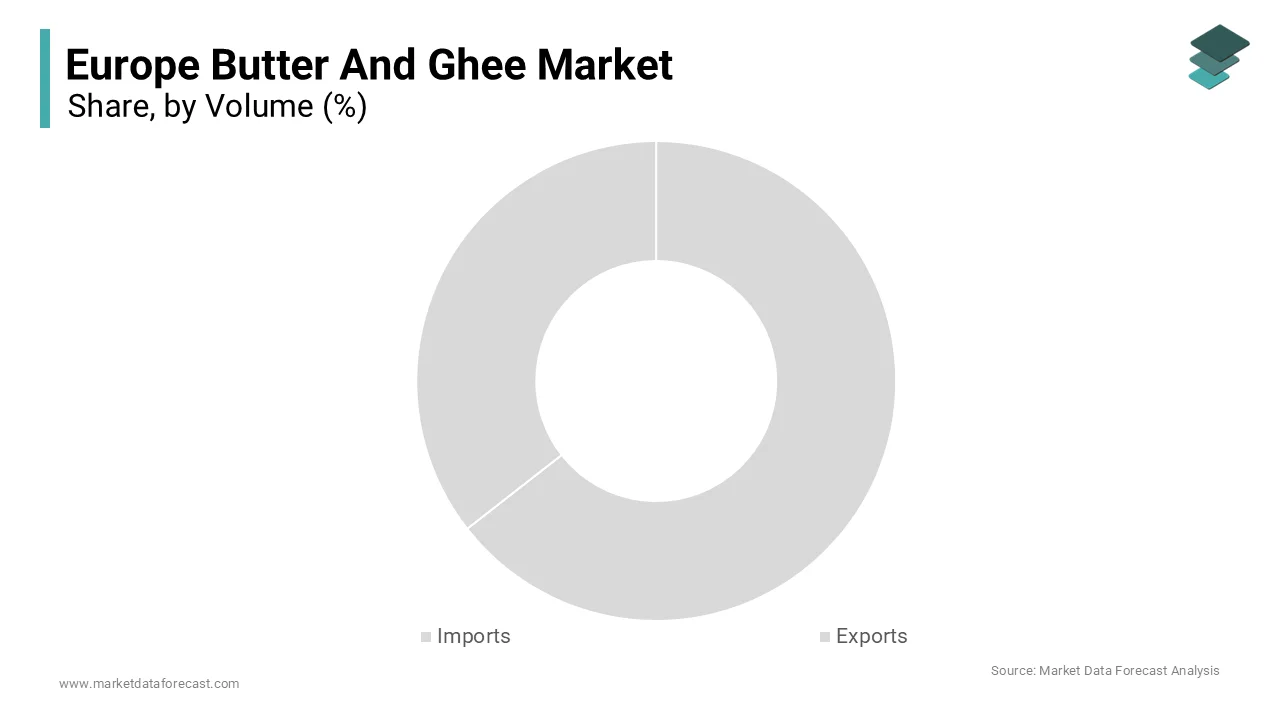
The imports segment was the largest in the Europe Butter and Ghee Market and occupied a 58.4% share in 2025. Moreover, the region’s substantial domestic demand for dairy fats consistently outpaces its internal production capacity, necessitating large scale imports to bridge the supply gap. Despite being a major milk producer, the European Union allocates a significant portion of its raw milk output toward cheese and liquid milk, leaving insufficient cream volumes for butter and ghee manufacturing to meet total consumption needs. The structural shortfall is exacerbated by seasonal fluctuations in milk production, with winter months seeing a natural decline in output that cannot be fully offset by storage. Key import partners include New Zealand, Australia, and Argentina, whose counter seasonal production cycles perfectly complement European supply gaps. This dependable import pipeline ensures market stability and price equilibrium, preventing domestic shortages that could disrupt both retail and food service sectors across the continent.
The strategic diversification of import sources acts as a critical buffer against geopolitical and climatic disruptions in global dairy supply chains. Overreliance on a single supplier nation creates significant vulnerability to trade policy shifts, shipping route blockages, or adverse weather events impacting pasture quality. To mitigate this risk, European importers have deliberately expanded their procurement networks across multiple continents. According to the FAO, the European Union's external butter imports are highly concentrated, with New Zealand traditionally anchoring the vast majority of non-EU dairy fat access via specialized tariff quotas. This geographic diversification strategy proved invaluable during recent global crises. Furthermore, free trade agreements between the European Union and various South American and Oceanic nations have significantly reduced tariff barriers, making diversified sourcing economically viable. This sophisticated, multi source import architecture ensures a resilient and uninterrupted supply of dairy fats, safeguarding the European market against external volatility and guaranteeing consistent product availability for consumers and manufacturers alike.
The exports segment is anticipated to witness the fastest CAGR of 7.1% from 2026 to 2034 due to the rising global prestige of European artisanal and specialty dairy products. European butter, particularly varieties like French Beurre d Isigny or Irish Kerrygold, is globally recognized for its superior taste, high fat content, and traditional production methods. This reputation allows European exporters to command significant price premiums in international markets, particularly in Asia and North America where affluent consumers seek authentic gourmet ingredients. The culinary influence of European gastronomy further amplifies this demand, as professional chefs worldwide replicate classic French and Italian recipes that mandate the use of premium European butter. Also, the powerful combination of culinary heritage and perceived quality transforms European butter from a simple commodity into a luxury food item, enabling sustained export expansion into high margin international markets and establishing a durable competitive advantage based on terroir and tradition.
The proactive negotiation of bilateral trade agreements by the European Union has dramatically lowered tariff barriers for dairy exports. Historically, many countries imposed high protective tariffs on imported dairy products to shield their domestic industries, severely limiting European market access. However, through strategic diplomatic efforts, the European Union has successfully secured favorable trade terms with numerous key economies. Furthermore, ongoing negotiations with Southeast Asian and Latin American trading blocs promise to open even more lucrative markets. This deliberate policy driven approach to trade liberalization systematically dismantles financial barriers, allowing European dairy producers to compete on quality rather than price alone and fueling the rapid acceleration of export volumes across the globe.
By Distribution Channel Insights
In 2025, the supermarkets segment held the majority share of 48.3% of the Europe Butter and Ghee Market. The unparalleled convenience and extensive product assortment offered by supermarkets make them the primary destination for household dairy purchases. Modern European consumers prioritize one stop shopping experiences where they can procure all their weekly groceries, including fresh dairy, within a single, efficient visit. Supermarkets leverage their massive purchasing power to stock a wide variety of butter and ghee options, ranging from standard commodity brands to premium organic and grass fed variants, catering to diverse consumer preferences under one roof. A study confirms that supermarkets serve as the dominant distribution channel for grocery purchases across Europe, anchoring the sales infrastructure for high-turnover staples like fresh milk and butter. Furthermore, the strategic placement of dairy sections adjacent to bakery and produce departments encourages impulse purchases and cross category bundling. The combination of convenience, variety, and reliability solidifies the supermarket as the dominant and most influential retail channel for butter and ghee across the continent.
The sophisticated promotional infrastructure within supermarkets drives significant sales volume through targeted marketing and strategic product placement. Supermarket chains possess advanced data analytics capabilities that allow them to understand local consumer preferences and tailor their dairy offerings accordingly. They utilize end of aisle displays, dedicated dairy coolers, and prominent shelf positioning to highlight high margin or new product launches, directly influencing purchase decisions at the point of sale. Furthermore, supermarkets frequently run bundled promotions, such as buy one get one offers on baking essentials, which include butter, effectively increasing basket size and overall category consumption. This powerful ability to shape consumer behavior through physical and digital in store marketing makes supermarkets an indispensable partner for dairy brands seeking maximum market penetration and brand visibility.
The hypermarkets segment is likely to experience the fastest CAGR of 6.7% during the forecast period over the forecast period. Also, the hypermarket model’s unique ability to cater to bulk purchasing behaviors of large families and small food service operators fuels its accelerated growth. Hypermarkets, with their vast floor space and warehouse style layout, excel at offering large format packaging of staple goods like butter and ghee at highly competitive per unit prices. This is particularly attractive to demographic segments with high consumption volumes, such as multi generational households and independent cafes or bakeries that operate on tight margins. The hypermarket’s hybrid retail model, blending elements of wholesale and traditional retail, perfectly addresses this dual consumer base, driving a consistent increase in foot traffic and basket size for dairy categories. This fundamental alignment with high volume purchasing patterns ensures sustained growth in the hypermarket channel.
The strategic integration of private label dairy products within hypermarkets provides a powerful competitive advantage that accelerates channel growth. Hypermarkets invest heavily in developing their own store brand butter and ghee lines, which offer significant price advantages over national brands while maintaining acceptable quality standards. These private label products typically carry a 15 to 20 percent lower price tag, making them highly attractive to budget conscious shoppers without sacrificing the essential functional properties required for cooking and baking. Furthermore, hypermarkets control the entire value chain for these products, from specification to shelf placement, allowing them to maximize profit margins and ensure consistent availability. This potent combination of affordability, quality, and strategic control makes the hypermarket channel an increasingly dominant force in the European dairy fat landscape.
REGIONAL ANALYSIS
Germany led the Europe butter and ghee market and captured an 18.2% share in 2025. The country dominance was propelled by its immense domestic dairy processing infrastructure and its status as a central logistics hub for the entire region. Germany operates the largest number of industrial scale butter churns in Europe, converting vast quantities of domestically sourced cream into a diverse array of dairy fat products. According to the German Federal Ministry of Food and Agriculture, the nation processes over 30 million tonnes of raw milk annually, providing a robust foundation for high volume butter production. Furthermore, German consumers exhibit a strong cultural preference for high fat dairy products, with per capita butter consumption consistently ranking among the highest in the European Union. The German Dairy Industry Association indicate that individual German consumers use an average of 6 kilograms of butter per capita annually. This powerful combination of massive production capacity, high domestic demand, and a well developed cold chain distribution network solidifies Germany as the undisputed leader in the continental market, setting benchmarks for quality and efficiency that influence neighboring countries.
France followed closely behind in the European market and occupied a 15.8% share in 2025. The country reputation is built upon its world renowned appellation controlled butters, such as Beurre d Isigny and Beurre Charentes Poitou, which are protected by stringent geographical indications and traditional production methods. These premium products are celebrated for their rich flavor, high fat content, and distinctive golden hue derived from grass fed cow diets. The French Dairy Interbranch Organization (CNIEL) shows that a selective portion of France's premium butter production qualifies for stringent AOP regional protections. French culinary tradition places butter at the absolute center of gastronomy, with classic sauces like beurre blanc and pastry techniques like laminated dough being impossible to execute authentically without high quality French butter. Studies demonstrate that premium French butter commands high demand in luxury hospitality and pastry sectors due to its specific fat thresholds and traditional culturing methods. This deep cultural entrenchment and global culinary prestige ensure that France maintains a powerful, high margin segment of the market, influencing consumer perceptions of quality and taste standards across the entire continent.
The United Kingdom is a rapidly evolving player in the regional market. In addition, the post Brexit regulatory environment has created a unique opportunity for the UK to redefine its dairy import and export relationships independently of the European Union framework. This newfound trade autonomy has allowed British dairy processors to negotiate bespoke deals with global suppliers, securing competitive pricing for imported ghee to meet the demands of its large South Asian diaspora. According to the OEC, the United Kingdom imports its primary volumes of butter and processed milk fats from close neighbors, led heavily by Ireland, France, and the Netherlands. Simultaneously, iconic British butter brands like Kerrygold have leveraged their grass fed narrative to expand aggressively into European retail channels. As per sources, retail grocery data tracks an increase in specialized grass-fed and artisan organic spreads on British supermarket shelves. This unique blend of multicultural demand, agile trade policy, and retail innovation positions the UK as a highly adaptive and strategically important player in the regional market.
COMPETITIVE LANDSCAPE
The competitive dynamics of the Europe Butter And Ghee Market are characterized by a complex interplay between large multinational dairy cooperatives and specialized regional producers. The market is moderately consolidated, with a handful of major players controlling a significant portion of branded retail shelf space, yet it remains highly fragmented at the artisanal and local level. Competition is primarily driven by product quality, brand heritage, and price, with premiumization emerging as a key differentiator. Major cooperatives leverage their vast supply chains and economies of scale to offer competitively priced commodity butter, while simultaneously investing in high margin premium lines to capture affluent consumers. Regional producers, on the other hand, compete on the basis of geographical indication, traditional methods, and unique taste profiles, often commanding loyal local followings. The threat of substitution from plant based alternatives adds another layer of complexity, forcing traditional dairy players to innovate and defend their nutritional credentials. Intense rivalry exists in securing prime placement within supermarket dairy coolers, with promotional spend and private label development being critical battlegrounds. Ultimately, success in this market requires a dual strategy of operational efficiency for volume products and compelling brand narratives for premium offerings, all while navigating stringent EU food safety and labeling regulations.
KEY MARKET PLAYERS
The major players operating in the Europe butter and ghee market include
- Terra Food LLC
- AVN Products
- SEWRI Trading Company
- Worldlink Entt
- Mousa Al Mazim General Trading
- Umang Dairies Limited
- Prime Lac Supplies
- Marsho
Top Players in the Market
- Arla Foods is a leading European dairy cooperative with a profound presence in the butter and ghee sector across multiple national markets. The company leverages its integrated farm to shelf model to ensure consistent quality and traceability of its dairy fat products. Arla continuously invests in sustainable farming initiatives and has launched several premium grass fed butter lines under its Lurpak brand, which enjoys strong recognition in both retail and food service channels. The company actively expands its ghee portfolio to cater to the growing demand from ethnic communities and health conscious consumers seeking lactose free alternatives, thereby strengthening its position through product diversification and brand authenticity.
- Sodiaal is a major French dairy cooperative renowned for its high quality appellation controlled butter products, particularly under the President brand. The company benefits from direct access to premium milk from its member farms in Normandy and Brittany, regions famed for their lush pastures. Sodiaal places a strong emphasis on preserving traditional churning methods while integrating modern quality control systems to meet stringent European food safety standards. The company actively promotes the nutritional benefits of its high fat butters and has invested in educational campaigns targeting professional chefs and culinary schools to reinforce the essential role of authentic French butter in fine gastronomy.
- FrieslandCampina is a Dutch multinational dairy cooperative with a significant footprint in the European butter market through its well established brands like Hollandia and Landliebe. The company operates one of the most advanced dairy processing facilities in Europe, enabling it to produce a wide range of butter and ghee variants, including organic and salt reduced options. FrieslandCampina focuses heavily on sustainability, implementing programs to reduce the carbon footprint of its dairy farms and processing plants. The company has also strengthened its e commerce distribution partnerships to reach direct to consumer audiences, ensuring its products are accessible through modern digital retail channels alongside traditional supermarkets.
Top Strategies Used by Key Market Participants
Key participants in the European butter and ghee market predominantly employ product premiumization and strategic brand storytelling to differentiate themselves in a competitive landscape. Companies heavily invest in highlighting the provenance of their milk, emphasizing grass fed diets, specific regional terroir, and traditional production methods to justify higher price points. Simultaneously, they expand their portfolios to include specialized variants such as organic, lactose free ghee, and high fat content butters to capture niche, high margin segments. Strategic partnerships with retail chains for exclusive product launches and prominent shelf placement are crucial for maximizing visibility. Furthermore, companies actively engage in sustainability initiatives, obtaining certifications and reducing their environmental footprint to appeal to eco conscious consumers. Finally, leveraging e commerce platforms and direct to consumer models allows brands to bypass traditional retail markups and build stronger customer relationships through personalized marketing and subscription services.
MARKET SEGMENTATION
This research report on the European butter and ghee market has been segmented and sub-segmented based on categories.
By Volume
- Imports
- Exports
By Distribution Channel
- Retail Stores
- Supermarkets
- Hypermarkets
By Country
- UK
- France
- Spain
- Germany
- Italy
- Russia
- Sweden
- Denmark
- Switzerland
- Netherlands
- Turkey
- Czech Republic
- Rest of Europe