- Product Description Description
- Table of Contents TOC
- List of Table & Figure LOT
- Get Free Sample PDF Sample PDF
Market Size, 2025
$9.52 BnMarket Estimate, 2026
$10.07 BnMarket Forecast, 2034
$15.81 BnCAGR, 2026–2034
5.80%Europe Compressor Market Report Summary
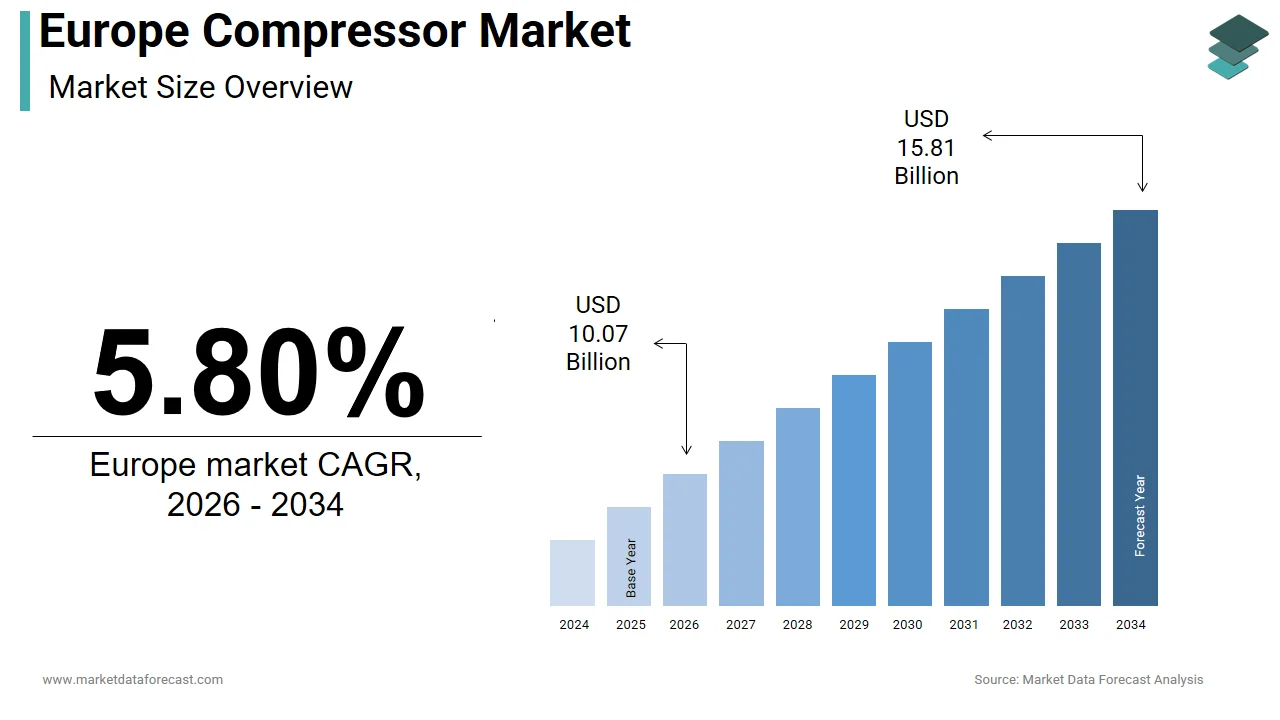
The Europe compressor market was valued at USD 9.52 billion in 2025, is estimated to reach USD 10.07 billion in 2026, and is projected to reach USD 15.81 billion by 2034, growing at a CAGR of 5.80% from 2026 to 2034. Market growth is driven by increasing industrial automation, expanding manufacturing activities, and rising demand for energy-efficient compressed air systems. Compressors are widely used across industries such as manufacturing, energy, automotive, and construction for powering machinery, maintaining pressure systems, and supporting industrial processes. Growing investments in renewable energy, hydrogen production, and modern industrial infrastructure are further supporting the expansion of the compressor market across Europe.
Key Market Trends
- Increasing demand for energy-efficient and environmentally sustainable compressor technologies.
- Rising adoption of advanced compressors in industrial automation and manufacturing processes.
- Growing investments in green hydrogen production and renewable energy infrastructure.
- Expansion of compressed air systems in automotive and heavy industries.
- Continuous advancements in smart monitoring and predictive maintenance technologies.
Segmental Insights
- Based on type, the positive displacement compressors segment dominated the Europe compressor market in 2025 by accounting for the largest share, driven by their high efficiency, reliability, and widespread use in industrial applications.
- Based on end user, the manufacturing segment held the dominant share in 2025, supported by increasing industrial production, expansion of manufacturing facilities, and rising demand for automated machinery powered by compressed air systems.
Regional Insights
The Europe compressor market is witnessing steady growth across major economies, supported by strong industrial bases, infrastructure investments, and technological advancements.
- Germany led the regional market in 2025 with 24.4% share, driven by its strong manufacturing sector, advanced industrial automation, and high demand for industrial machinery.
- Italy held the second-largest position in the regional market in 2025, supported by a well-developed industrial machinery sector and strong manufacturing activities.
- France is expected to hold a promising share over the forecast period due to its strong aerospace, nuclear power, and transportation industries, along with ambitious national strategies for green hydrogen development.
- The United Kingdom maintained a notable presence in the market, supported by investments in industrial modernization and energy infrastructure.
Competitive Landscape
The Europe compressor market is characterized by strong competition among global industrial equipment manufacturers and specialized compressor technology providers. Market players are focusing on developing energy-efficient compressors, integrating smart monitoring technologies, and expanding service capabilities. Strategic partnerships, technological innovation, and expansion into renewable energy applications are shaping the competitive landscape across Europe.
Prominent companies operating in the Europe compressor market include Siemens Energy AG, Atlas Copco AB, Sulzer AG, Kaeser Kompressoren SE, Baker Hughes Co., and Aerzener Maschinenfabrik GmbH.
Europe Compressor Market Size
The Europe compressor market was valued at USD 9.52 billion in 2025, is estimated to reach USD 10.07 billion in 2026, and is projected to reach USD 15.81 billion by 2034, growing at a CAGR of 5.80% from 2026 to 2034.
Compressor encompasses the design, manufacturing, and deployment of mechanical devices that increase the pressure of gases for diverse applications ranging from industrial manufacturing and energy generation to healthcare and transportation. These systems serve as the critical backbone for pneumatic automation, refrigeration cycles, and gas transmission networks across the continent. The strategic landscape for compressors has shifted dramatically due to the European Union's aggressive decarbonization agenda and the urgent need to secure energy independence following geopolitical disruptions. As per Eurostat, the industrial sector in the European Union consumes a notable share of total final energy, with compressed air systems contributing significantly to this electrical load. According to the International Energy Agency, optimizing compressor efficiency is recognized as one of the most cost-effective measures for reducing industrial carbon emissions in the region.
MARKET DRIVERS
Expansion of Green Hydrogen Infrastructure and Renewable Gas Networks
The massive strategic investment in green hydrogen production and distribution networks aimed at decarbonizing heavy industry and transport sectors is one of the major factors propelling the expansion of the Europe compressor market. As per the European Union, ambitious targets have been set for renewable hydrogen production by 2030, necessitating the installation of specialized high-pressure compressors for electrolysis plants and refueling stations. According to the Clean Hydrogen Partnership, significant funding has been allocated to projects that require robust compression technology to handle hydrogen's unique physical properties. As per infrastructure plans released by national governments in Germany and the Netherlands, the conversion of existing natural gas pipelines to carry hydrogen blends demands extensive upgrades to compressor stations to ensure safe and efficient transport. The automotive sector is also driving demand as major manufacturers commit to fuel cell electric vehicle fleets, requiring a dense network of 35 to 70 bar charging stations equipped with advanced diaphragm and piston compressors. This systemic shift from fossil fuels to renewable gases creates a sustained and high-value order book for compressor manufacturers capable of delivering certified hydrogen-ready solutions. The urgency to replace Russian gas imports further accelerates the deployment of domestic renewable gas facilities, cementing compression technology as a cornerstone of European energy security.
Stringent Energy Efficiency Regulations and Industrial Decarbonization Mandates
The rigorous enforcement of EU Ecodesign directives and corporate net zero commitments is further contributing to the growth of the Europe compressor market. As per the European Commission, compressed air systems are recognized as highly energy-intensive, making them a primary target for optimization initiatives. According to regulations established by the European Commission, new compressor units must meet specific energy efficiency classes that older fixed-speed machines cannot achieve, forcing industries to upgrade their infrastructure to remain compliant. As per studies by the Fraunhofer Institute for Manufacturing Engineering and Automation, retrofitting industrial plants with modern oil-free screw compressors and heat recovery systems can significantly reduce energy consumption. Industries such as food and beverage, pharmaceuticals, and electronics are increasingly adopting ISO 50001 energy management standards, which mandate continuous monitoring and improvement of compressed air usage. The combination of legal mandates and economic incentives drives a robust replacement cycle, ensuring steady demand for advanced compressor technologies that offer superior specific power performance and lower lifecycle costs.
MARKET RESTRAINTS
High Volatility in Raw Material Costs and Supply Chain Instability
The persistent fluctuation in the prices of critical raw materials such as steel, aluminum, copper, and rare earth elements required for manufacturing motors and components is majorly hampering the expansion of the Europe compressor market. The production of robust industrial compressors relies heavily on these commodities, the costs of which have experienced dramatic swings due to global geopolitical tensions and trade restrictions. According to alerts from the European Raw Materials Alliance, the dependency on imported critical minerals for high-performance magnets used in compressor motors exposes manufacturers to supply bottlenecks and unpredictable pricing structures. The scarcity of semiconductor chips, essential for the electronic control units in modern variable speed drives, has also led to production delays and extended lead times for delivery. As per economic analyses from manufacturing federations, input cost increases are often passed on to customers, dampening demand among price-sensitive small and medium enterprises that may postpone capital expenditures. The logistical challenges of transporting heavy machinery components across borders have further exacerbated lead times, making it difficult for suppliers to maintain optimal inventory levels. This economic uncertainty forces companies to hedge against future price movements, tying up capital and limiting investment in research and development for next-generation technologies.
Technical Complexity of Maintenance and Skilled Labor Shortages
The increasing sophistication of modern compressor systems is further hindering the compressor market expansion in Europe. Contemporary compressors integrate advanced sensors, Internet of Things connectivity, and artificial intelligence-driven control algorithms that require specialized training to operate effectively. As per labor market studies from the European Centre for the Development of Vocational Training, there is a widening gap between the demand for digital skills in industrial maintenance and the available workforce across the continent. This skills deficit leads to longer downtime during repairs, increased risk of configuration errors, and higher reliance on expensive external service contracts. According to industry feedback, many end-users hesitate to adopt the latest smart compressor technologies, fearing that their internal teams lack the expertise to troubleshoot issues, potentially leading to costly production stoppages. The complexity is further compounded by the diversity of communication protocols and integration requirements across different factory automation systems. This human capital constraint limits the speed at which industries can deploy advanced compressor solutions, forcing some to stick with simpler, less efficient systems that their staff can manage confidently, thereby slowing overall market modernization.
MARKET OPPORTUNITIES
Integration of Waste Heat Recovery Systems for the Circular Economy
The widespread adoption of waste heat recovery technologies integrated into compressor systems that allow industries to capture thermal energy generated during compression for heating processes or district heating networks is a significant opportunity in the Europe compressor market. Compressors convert a significant portion of electrical input into heat, which is traditionally dissipated into the atmosphere, representing a massive loss of potential energy. As per engineering assessments by the European Association for the Promotion of Energy Efficiency, recovering this waste heat can significantly improve overall system efficiency. This capability aligns perfectly with the European Green Deal objectives to maximize resource utilization and reduce reliance on fossil fuel boilers. According to pilot projects in Sweden and Denmark, industrial plants utilizing heat recovery from compressors have achieved notable energy savings, creating a compelling economic case for upgrades. Municipalities are increasingly encouraging such installations through subsidies and grants aimed at decarbonizing district heating grids. The ability to monetize waste heat transforms compressors from pure energy consumers into dual-purpose utility assets, opening new revenue streams for operators. This synergy between compression and thermal recovery positions the market for significant growth as industries seek holistic energy solutions.
Adoption of Predictive Maintenance and Digital Twin Technologies
The rapid advancement of digital twin technology and predictive maintenance capabilities offers a promising opportunity in the Europe compressor market. Modern compressors equipped with embedded sensors can transmit real-time data on vibration, temperature, and pressure to cloud platforms where artificial intelligence algorithms predict failures before they occur. As per case studies from leading automation providers, predictive maintenance via connected compressors has been shown to reduce unplanned downtime in critical process industries. This capability allows facility managers to optimize spare parts inventory and schedule maintenance during non-peak hours, significantly enhancing operational continuity. According to industry trends, the integration of digital twins enables virtual simulation of compressor performance under various load conditions, facilitating optimal system design and energy tuning without physical trial and error. The growing emphasis on operational excellence and asset reliability in European manufacturing makes these smart features highly attractive to plant operators. By transforming the compressor into a continuous data source, manufacturers can offer subscription-based monitoring services, creating recurring revenue streams and deepening customer relationships. This digital evolution drives demand for premium connected units over standard offline models.
MARKET CHALLENGES
Cybersecurity Risks Associated with Connected Industrial Assets
A major challenge confronting the Europe compressor market is the escalating threat of cyberattacks targeting connected industrial equipment as compressors become increasingly integrated into corporate networks and the internet. As manufacturers equip compressors with remote access capabilities for monitoring and control, they inadvertently expand the attack surface for malicious actors seeking to disrupt critical infrastructure or steal proprietary data. According to cybersecurity assessments by the European Union Agency for Cybersecurity, the convergence of operational technology and information technology has led to a surge in ransomware attacks targeting industrial facilities. The potential consequences range from unauthorized parameter changes leading to equipment failure to complete shutdowns of essential gas supply lines. As per regulatory developments, the upcoming Cyber Resilience Act will impose stricter security requirements on connected industrial products, forcing manufacturers to invest heavily in secure boot mechanisms, encryption, and regular firmware updates. However, implementing these measures without compromising ease of use or real-time performance remains a technical dilemma. The fear of cyber incidents causes some cautious industries to delay the adoption of fully connected compressor solutions, limiting the market potential for the most advanced Internet of Things-enabled products until trust and standardized security frameworks are firmly established.
Regulatory Fragmentation and Complex Permitting Processes
The Europe compressor market faces a persistent challenge stemming from the fragmented regulatory landscape and complex permitting procedures governing the installation of high-pressure gas equipment and noise emissions across different member states. While EU-wide directives set general safety and efficiency standards, national and local authorities often impose additional requirements regarding noise limits, visual impact, and environmental impact assessments that vary significantly. As per legal analyses of industrial development, navigating this patchwork of rules can delay project timelines, increasing development costs and discouraging investment. The installation of large centrifugal compressors for gas transmission or industrial clusters often triggers rigorous public consultations and environmental studies, particularly in densely populated regions. According to industry reports, the inconsistency in noise regulation enforcement between neighboring countries creates uncertainty for multinational operators seeking to standardize their fleets. Furthermore, the classification of hydrogen compressors under existing pressure equipment directives sometimes leads to ambiguous interpretations by local inspectors, causing approval bottlenecks. This administrative burden hinders the rapid deployment of new compressor infrastructure, as developers must allocate significant resources to ensure compliance with diverse local ordinances. Until greater harmonization is achieved, these regulatory hurdles will continue to impede market velocity.
REPORT COVERAGE
| REPORT METRIC | DETAILS |
| Market Size Available | 2025 to 2034 |
| Base Year | 2025 |
| Forecast Period | 2026 to 2034 |
| Segments Covered | By Type, End User, and Country. |
| Various Analyses Covered | Global, Regional, and Country-Level Analysis, Segment-Level Analysis, Drivers, Restraints, Opportunities, Challenges; PESTLE Analysis; Porter’s Five Forces Analysis, Competitive Landscape, Analyst Overview of Investment Opportunities |
| Countries Covered | UK, France, Spain, Germany, Italy, Russia, Sweden, Denmark, Switzerland, Netherlands, Turkey, Czech Republic, and the Rest of Europe. |
| Market Leaders Profiled | Siemens Energy AG, Atlas Copco AB, Sulzer AG, Kaeser Kompressoren SE, Baker Hughes Co., Aerzener Maschinenfabrik GmbH and Others. |
SEGMENTAL ANALYSIS
By Type Insights
The positive displacement compressors segment dominated the market by holding the major share of the Europe compressor market in 2025. The dominance of the positive displacement compressors segment in the European market is attributed to their versatility in handling varying pressure requirements, ability to compress diverse gas types, including hydrogen, and widespread adoption across small to medium industrial applications. As per engineering data from the European Compressor Industry Committee, positive displacement machines such as screw and piston compressors can generate very high pressures, which is critical for emerging sectors like green hydrogen refueling and natural gas vehicle infrastructure. According to technical assessments by leading manufacturers, the ability of these compressors to handle wet gases, corrosive chemicals, and mixed compositions without significant performance degradation makes them the default choice for the complex chemical and petrochemical landscapes in Europe. The modular design of rotary screw compressors further enhances their appeal, allowing facilities to scale capacity incrementally without replacing entire systems. This broad operational envelope ensures that positive displacement units remain the backbone of European industrial compression needs, securing their majority market position.
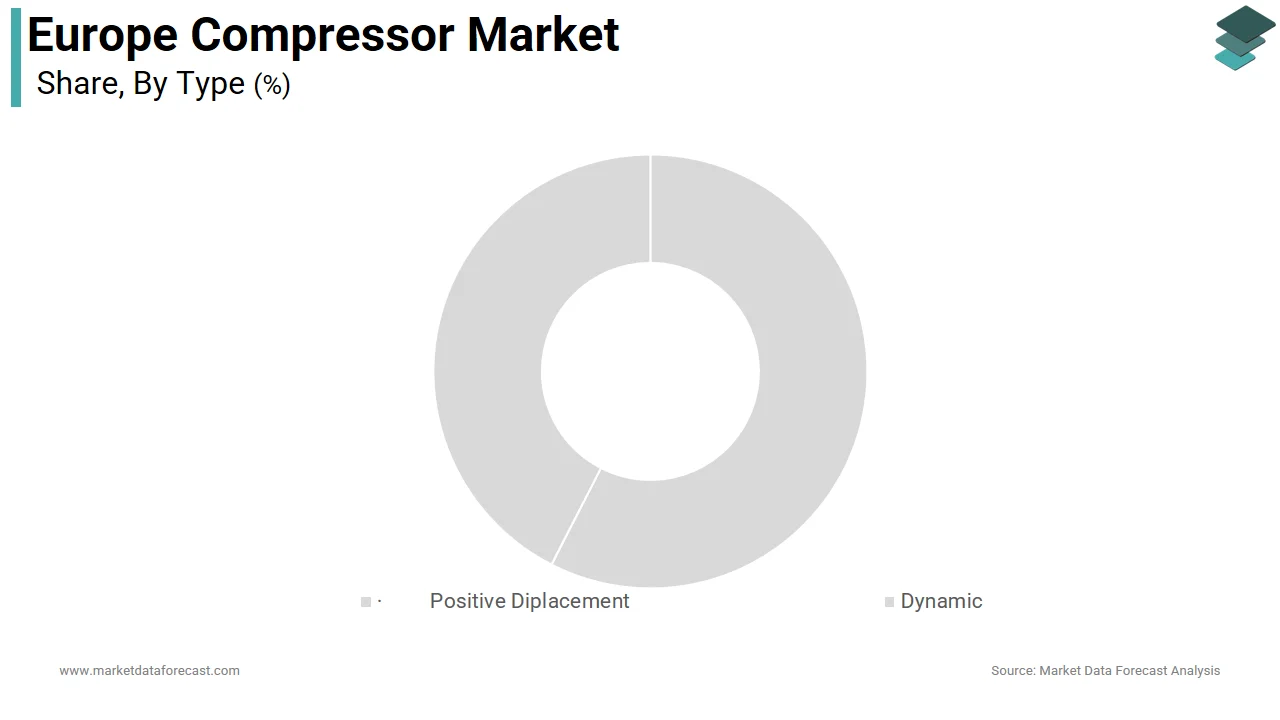
The dynamic compressors segment is projected to register the highest CAGR of 7.5% over the forecast period in this regional market. The rapid growth of the dynamic compressors segment is primarily driven by the strategic push to secure energy supplies through expanded liquefied natural gas terminals and cross-border gas transmission networks, which require massive volumes of gas movement. Centrifugal and axial compressors are the only viable technology for handling the enormous flow rates needed in these mega-projects due to their continuous flow characteristics and high efficiency at scale. As per infrastructure plans outlined by the European Network of Transmission System Operators for Gas, significant investments are being made in new regasification terminals and pipeline interconnectors to reduce dependency on single-source suppliers, directly boosting demand for large turbocompressors. According to project announcements from major energy firms, the construction of floating storage and regasification units along the European coast necessitates compact yet powerful axial compressors capable of operating in harsh marine environments. The shift toward importing green ammonia and hydrogen blends also favors dynamic machines for their ability to manage high throughput in mainline transmission scenarios. This surge in macro-level energy infrastructure development creates a specialized but rapidly expanding market niche for dynamic compression technology that outpaces general industrial growth.
By End User Insights
The manufacturing segment held the dominant share in the Europe compressor market in 2025. The leading position of the manufacturing segment in the European market is attributed to the dense concentration of automotive, machinery, and consumer goods production facilities that rely heavily on compressed air as a fourth utility. As per data from the International Federation of Robotics, Europe hosts one of the highest densities of industrial robots globally, many of which utilize pneumatic grippers and actuators that demand consistent air pressure to function correctly. The automotive industry, a cornerstone of the European economy, utilizes compressed air for everything from painting booths to tire inflation and component testing, creating a perpetual demand for both central plant compressors and point-of-use units. According to industry benchmarks, compressed air is recognized as a significant contributor to electricity consumption in manufacturing plants, highlighting its critical role in operational continuity. The trend toward flexible manufacturing systems, where production lines are frequently reconfigured, further increases the need for modular compressed air networks that can be easily expanded or redirected. This deep integration of pneumatics into the very fabric of European manufacturing ensures that the sector remains the largest consumer of compressor technology, driving steady replacement and upgrade cycles.
The power segment is a promising segment and is estimated to witness a promising CAGR of 8.4% over the forecast period in this regional market. The aggressive deployment of carbon capture, utilization, and storage technologies, the expansion of gas-fired peaker plants, and the integration of compressed air energy storage systems are driving the expansion of the power segment in the European market. These facilities require massive amounts of compression capacity to transport captured carbon dioxide from flue gases to high-pressure states suitable for pipeline transport and geological storage. As per funding allocations from the European Innovation Fund, several flagship carbon capture projects are underway in countries like Norway, the Netherlands, and Germany, each requiring large compressor trains to handle corrosive CO2 streams. According to technical specifications from the Global CCS Institute, compressing carbon dioxide involves unique thermodynamic challenges that demand highly specialized integrally geared or reciprocating compressors, creating a lucrative niche for manufacturers. The EU's Emissions Trading System has made carbon capture economically viable, accelerating the timeline for these installations and driving immediate demand. The scaling of these technologies from pilot to commercial scale represents a significant new revenue stream for the compressor market, positioning the power sector as the fastest-growing end user.
COUNTRY-LEVEL ANALYSIS
Germany Compressor Market Analysis
Germany led the compressor market in Europe in 2025 with 24.4% of the regional market share. The status of Germany as the continent's industrial powerhouse and a global hub for compressor manufacturing innovation is driving the German market growth. Germany serves as the headquarters for several world-leading compressor OEMs, which is fostering a culture of engineering excellence and technological advancement. The catalyst for this dominance is the sheer density of its manufacturing base, particularly in the automotive, chemical, and machinery sectors, which creates immense domestic demand for both standard and specialized compression solutions. As per the German Federal Ministry for Economic Affairs and Climate Action, the country's "Efficiency First" strategy has spurred widespread retrofitting of industrial compressed air systems with variable speed drives and heat recovery units. The strong presence of research institutes dedicated to fluid dynamics and thermodynamics ensures that Germany remains at the forefront of developing next-generation hydrogen and oil-free compressors. According to industry export figures, German manufacturers supply a significant portion of the high-end compressor market globally, reinforcing the country's central role. The combination of robust domestic consumption, leading-edge production capabilities, and supportive government policies for energy efficiency cements Germany's position as the primary engine of the European compressor market.
Italy Compressor Market Analysis
Italy held the second-largest position in the regional market in 2025. The growth of Italy in the European market can be credited to its vibrant manufacturing ecosystem specializing in packaging, textiles, and automotive components that are intensive users of pneumatic systems. The country's market strength is derived from a high concentration of small and medium-sized enterprises that are increasingly modernizing their production facilities to compete globally. As per the Italian National Institute of Statistics, the industrial sector has seen a steady rise in automation investments, with compressed air systems being a critical component of these upgrades. The packaging industry in Italy, renowned worldwide for its innovation, relies heavily on precise and reliable compressed air for bottling, labeling, and wrapping operations, driving consistent demand. According to sector reports, the push toward Industry 4.0 certification has encouraged Italian firms to adopt smart compressors with remote monitoring capabilities to optimize energy usage and reduce downtime. The government's tax credit schemes for digital transformation and energy efficiency improvements have further accelerated the replacement of aging fleets. This blend of specialized industrial applications, a strong SME base, and financial incentives sustains Italy's significant influence in the European compressor landscape.
France Compressor Market Analysis
France is anticipated to account for a promising share of the Europe compressor market over the forecast period, owing to its robust aerospace, nuclear power, and transportation sectors, along with ambitious national strategies for green hydrogen development. The nation's market is distinguished by large-scale infrastructure projects and a renewed focus on reindustrialization, which boosts demand for heavy-duty and specialized compressors. As per the French Agency for Ecological Transition, strict environmental regulations are forcing industries to adopt high-efficiency and oil-free compression technologies to meet carbon reduction targets. The aerospace sector, a cornerstone of the French economy, requires ultra-reliable compressed air for aircraft assembly and testing, contributing to high-value market segments. According to government announcements, the France 2030 investment plan allocates substantial funds for developing a comprehensive hydrogen economy, including the deployment of thousands of refueling stations equipped with high-pressure compressors. The nuclear power generation sector also utilizes specialized compressors for safety systems and maintenance activities, adding to the diversified demand base. The convergence of heavy industry, strategic energy transitions, and state-supported innovation positions France as a key driver of market dynamics in Western Europe.
United Kingdom Compressor Market Analysis
The United Kingdom maintained a notable foothold in the market. The advanced pharmaceutical, food and beverage, and offshore energy industries, with a strong emphasis on net-zero targets and the modernization of critical infrastructure, including gas networks and renewable energy facilities, are driving the market growth in the UK. As per the Carbon Trust, UK industries are aggressively pursuing energy efficiency measures, with compressed air audits identifying significant savings potential through the adoption of modern variable speed compressors. The offshore wind sector, where the UK is a global leader, requires specialized compressors for turbine operation and subsea maintenance, creating a unique demand vector. According to industry observations, the pharmaceutical sector's requirement for sterile environments fuels the adoption of certified oil-free screw and centrifugal compressors. The government's industrial decarbonization challenge fund supports projects that integrate carbon capture and hydrogen technologies, further stimulating demand for large-scale compression solutions. Despite economic fluctuations, the long-term commitment to sustainability and energy security ensures the UK remains a vital and evolving market for compressor technologies.
Netherlands Compressor Market Analysis
The Netherlands has emerged as a dynamic growth engine in the Europe compressor market. The strategic role of the Netherlands as a European energy hub, extensive port logistics, and pioneering initiatives in green hydrogen and carbon capture are driving the market growth in the Netherlands. The nation is currently experiencing a surge in investments related to the Port of Rotterdam, which is transforming into a center for renewable fuel production and distribution, requiring massive compression infrastructure. As per the Dutch Ministry of Economic Affairs and Climate Policy, the country aims to become a primary importer and distributor of green hydrogen, necessitating the installation of extensive pipeline networks and refueling stations equipped with state-of-the-art compressors. The chemical cluster in the Botlek and Europoort regions relies heavily on process compressors for petrochemical refining and base chemical production, driving steady industrial demand. According to economic data, the Dutch focus on circular economy principles has led to increased adoption of waste heat recovery systems integrated with compressor plants. The combination of strategic geographic location, ambitious energy transition goals, and a concentrated industrial base positions the Netherlands as a critical high-growth market for advanced compressor solutions in Northern Europe.
COMPETITIVE LANDSCAPE
The competition within the Europe compressor market is characterized by intense rivalry between established global conglomerates and specialized regional manufacturers striving for dominance in the rapidly evolving industrial compression sector. Geopolitical tensions and energy security concerns have triggered a race to innovate, with companies vying to produce the most efficient hydrogen-ready and carbon capture-compatible compression solutions. Major contractors leverage their extensive portfolios of integrated air management systems to retain large industrial clients while simultaneously courting small and medium enterprises with cost-effective and energy-saving models. The landscape features a mix of full-service providers who offer end-to-end compressed air audits and niche players who focus on specific applications like medical air or high-pressure gas boosting. Differentiation increasingly relies on advanced digital features such as artificial intelligence-driven energy optimization and robust cybersecurity protocols rather than hardware specifications alone. Supply chain resilience has become a critical competitive advantage as firms struggle to secure raw materials and electronic components amidst global volatility. Strategic collaborations with energy utilities and engineering firms are common as companies seek to embed their compressors into new renewable energy infrastructure projects to meet surging demand driven by the European Green Deal and net-zero targets across the continent.
KEY MARKET PLAYERS
The leading companies operating in the Europe compressor market include:
- Siemens Energy AG
- Atlas Copco AB
- Sulzer AG
- Kaeser Kompressoren SE
- Baker Hughes Co
- Aerzener Maschinenfabrik GmbH
TOP PLAYERS IN THE MARKET
- Atlas Copco AB stands as a preeminent force in the Europe compressor market with a profound influence on global industrial air and gas compression standards. The Swedish conglomerate specializes in manufacturing energy-efficient screw compressors, vacuum solutions, and blowers for diverse industries ranging from manufacturing to healthcare. Recently, the company has aggressively expanded its portfolio of oil-free and variable speed drive units to meet stringent European Ecodesign regulations and sustainability goals. Atlas Copco initiated strategic investments in digital connectivity features that enable remote monitoring and predictive maintenance for industrial clients across the continent. The firm continues to lead innovation in waste heat recovery systems that transform compressors into dual-purpose energy assets. Its commitment to circular economy principles and sustainable productivity ensures it remains the preferred choice for large-scale industrial projects and critical infrastructure applications throughout Europe and worldwide.
- Siemens Energy AG operates as a pivotal entity in the European sector, leveraging its German engineering heritage to deliver robust turbomachinery and process gas compressor solutions globally. The corporation offers a comprehensive range of integrally geared and axial compressors renowned for their reliability in power generation, oil and gas, and chemical processing applications. Recent strategic actions include the development of specialized compressor trains designed specifically for green hydrogen production and carbon capture, utilization, and storage projects. Siemens Energy has intensified its focus on helping customers achieve decarbonization targets by providing high-efficiency machines that minimize energy consumption and emissions. The company actively collaborates with major energy firms to deploy large-scale compression infrastructure for renewable gas networks across Europe. Its continuous investment in research and development facilitates the creation of advanced materials and coatings that enhance durability in harsh environments. These initiatives solidify its reputation as an innovator, driving the transition toward cleaner and more efficient industrial operations across international markets.
- Kaeser Kompressoren SE maintains a formidable presence in the Europe compressor market through its extensive expertise in compressed air supply systems and innovative rotary screw technology. The German manufacturer produces a wide array of air compressors, vacuum pumps, and breathable air systems, catering primarily to small and medium enterprises as well as large industrial facilities. The company recently accelerated its shift toward smart factory integration by introducing compressors equipped with advanced sigma control units that optimize energy usage in real time. Kaeser has focused on expanding its global service network to provide rapid maintenance and customized air audits that help clients reduce operational costs. Its strong commitment to manufacturing quality and long-term product durability enables deep market penetration and high customer loyalty. By prioritizing energy efficiency and user-friendly interfaces, Kaeser Kompressoren continues to capture significant demand from businesses seeking reliable and sustainable compressed air solutions across the continent and beyond.
TOP STRATEGIES USED BY KEY MARKET PARTICIPANTS
Key players in the Europe compressor market primarily employ product innovation strategies focusing on the development of oil-free and variable speed drive technologies to meet strict environmental regulations and energy efficiency mandates. Companies frequently engage in strategic acquisitions of digital software firms to enhance their predictive maintenance capabilities and offer comprehensive connected service ecosystems. Manufacturers invest heavily in research and development to design compact and modular compressor units that simplify installation and reduce footprint requirements in crowded industrial facilities. Firms actively expand their service networks and training programs to address the skilled labor shortage and ensure optimal system performance for clients. Brand building through participation in major industrial trade fairs and sustainability summits remains a central tactic to showcase technological leadership and commitment to decarbonization. Additionally, companies pursue localization strategies by establishing regional production facilities to mitigate supply chain risks and comply with specific European standards for safety and energy performance.
MARKET SEGMENTATION
This research report on the Europe compressor market has been segmented and sub-segmented into the following categories.
By Type
- Positive Diplacement
- Dynamic
By End User
- Oil and Gas Industry
- Power Sector
- Manufacturing Sector
- Chemicals and Petrochemical Industry
- Other End Users
By Country
- United Kingdom
- France
- Spain
- Germany
- Italy
- Russia
- Sweden
- Denmark
- Switzerland
- Netherlands
- Rest of Europe