- Product Description Description
- Table of Contents TOC
- List of Table & Figure LOT
- Get Free Sample PDF Sample PDF
Market Size, 2025
$1.83 BnMarket Estimate, 2026
$1.96 BnMarket Forecast, 2034
$3.35 BnCAGR, 2026–2034
6.94%Europe Conditional Access System Market Report Summary
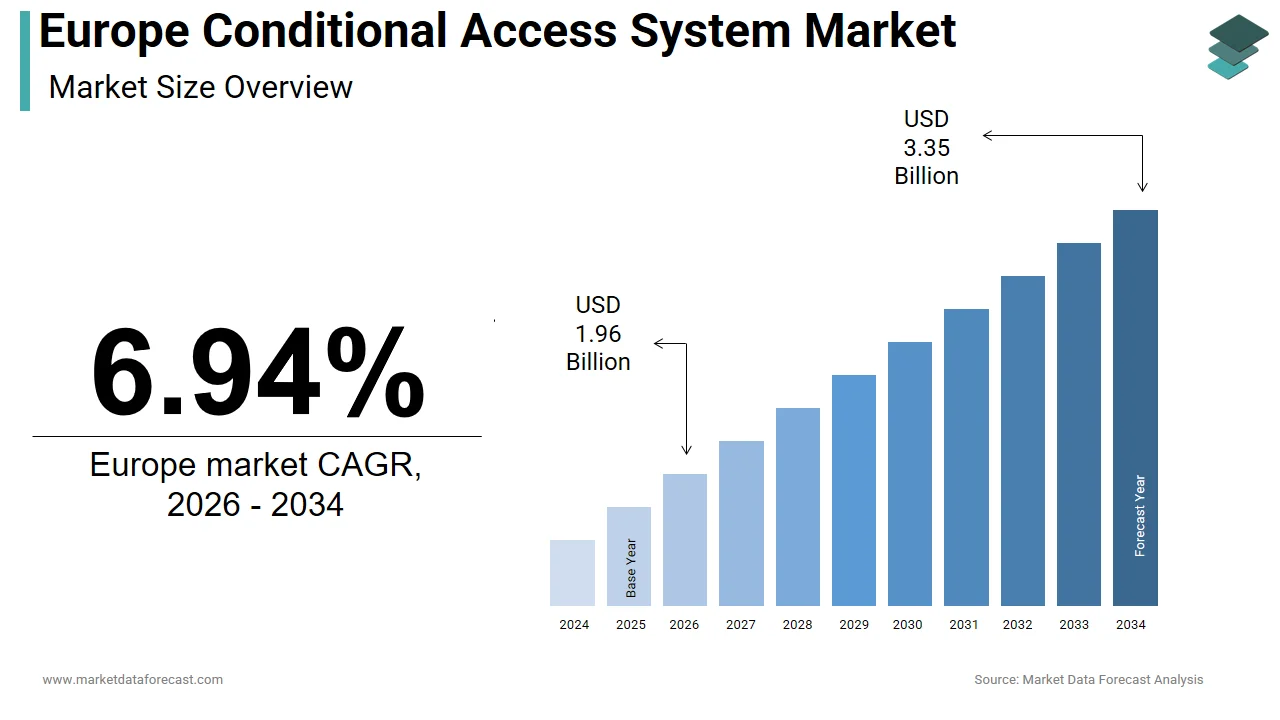
The Europe conditional access system market was valued at USD 1.83 billion in 2025, is anticipated to reach USD 1.96 billion in 2026, and is projected to reach USD 3.35 billion by 2034, growing at a CAGR of 6.94% from 2026 to 2034. Market growth is driven by the increasing demand for secure digital content distribution, rising adoption of subscription-based television services, and growing concerns regarding content piracy. Conditional access systems (CAS) play a crucial role in controlling user access to encrypted digital television and streaming services, ensuring that only authorized subscribers can view protected content. The rapid expansion of OTT platforms, advancements in digital broadcasting technologies, and increasing investments in content protection infrastructure are further supporting market expansion across Europe.
Key Market Trends
- Rising demand for advanced digital content protection technologies.
- Increasing adoption of hybrid broadcast and OTT security solutions.
- Growing focus on anti-piracy and digital rights management strategies.
- Expansion of subscription-based pay-TV and streaming platforms.
- Integration of cloud-based and software-defined conditional access systems.
Segmental Insights
- Based on technology, the hybrid simulcrypt solutions segment dominated the Europe conditional access system market in 2025 by accounting for the largest share. The segment’s leadership is driven by its ability to support multiple encryption systems simultaneously, enabling broadcasters to transition smoothly between legacy and next-generation security architectures.
- Based on end user, the pay-TV operators segment held the largest share in 2025, supported by increasing demand for secure content delivery, premium channel subscriptions, and protection of high-value sports and entertainment broadcasting rights.
Regional Insights
The Europe conditional access system market is witnessing steady growth across major broadcasting markets, supported by strong digital television penetration and increasing investment in content security technologies.
- The United Kingdom dominated the regional market in 2025 with 23.2% share, driven by its mature pay-TV ecosystem, concentration of premium content rights holders, and strict anti-piracy enforcement.
- Germany ranked second in the regional market, supported by strong public and private broadcasting sectors, high demand for encrypted sports content, and stringent data privacy regulations.
- France is expected to register a prominent share over the forecast period due to its strong domestic film industry, protective cultural content policies, and highly consolidated pay television landscape.
Competitive Landscape
The Europe conditional access system market is characterized by strong competition among digital security solution providers and broadcast technology companies. Market participants are focusing on developing advanced encryption technologies, cloud-based security solutions, and integrated digital rights management platforms to combat piracy and ensure secure content delivery. Strategic partnerships with broadcasters, streaming platforms, and telecom operators are shaping competitive dynamics across the region.
Prominent companies operating in the Europe conditional access system market include Nagravision (Kudelski Group), Irdeto, Synamedia, Conax AS, Verimatrix Inc., and Viaccess-Orca.
Europe Conditional Access System Market Size
The size of the Europe conditional access system market was valued at USD 1.83 billion in 2025. This market is expected to grow at a CAGR of 6.94% from 2026 to 2034 and be worth USD 3.35 billion by 2034 from USD 1.96 billion in 2026.
Conditional access system comprises the sophisticated cryptographic frameworks and software architectures designed to restrict access to digital content, ensuring that only authorized subscribers can view protected television broadcasts, streaming media, and data services. These systems function as the digital gatekeepers for pay television operators, satellite providers, and emerging over the top platforms by encrypting signals and managing subscriber entitlements through secure keys. The strategic relevance of this technology has intensified as the continent transitions from traditional broadcast models to hybrid IP and cloud-based delivery mechanisms. As per Eurostat, household internet penetration in the European Union is reported to be very high, which is creating a vast digital landscape where content piracy poses a significant threat to revenue streams. According to the European Audiovisual Observatory, the proliferation of illegal streaming sites has required robust security measures to protect intellectual property rights. The regulatory environment is further shaped by the Audiovisual Media Services Directive which mandates strict protection of copyrighted content across borders. This ecosystem drives the adoption of advanced conditional access solutions that integrate digital rights management and multi-screen authentication to secure content delivery in an era where consumption habits are rapidly shifting toward on demand and mobile viewing experiences.
MARKET DRIVERS
Proliferation of Hybrid Broadcast Broadband TV and Multi-Screen Consumption
The rapid evolution of television consumption habits toward hybrid broadcast broadband TV models and the ubiquitous demand for multi-screen access to premium content are primarily driving the growth of the Europe conditional access system market. Modern viewers expect seamless transitions between linear broadcasting and internet-based video on demand services across smartphones, tablets, smart TVs, and laptops, requiring conditional access systems that can manage entitlements across diverse devices and networks simultaneously. As per the Digital Television Research group, households in Western Europe subscribing to over-the-top video services have increased significantly, compelling traditional broadcasters to upgrade their legacy security infrastructures to support IP delivery. According to the European Broadcasting Union, the fragmentation of viewing devices necessitates a unified security layer that prevents unauthorized sharing of credentials while enabling legitimate portability. This shift forces operators to deploy software-based conditional access solutions that are agnostic to the underlying transmission medium, whether satellite, cable, or fiber. The ability to offer personalized content packages and dynamic ad insertion securely further drives the need for advanced entitlement management systems. Consequently, the demand for flexible and scalable conditional access architectures that can handle complex subscription models and diverse device ecosystems has become a critical imperative for service providers aiming to retain subscribers in a highly competitive market.
Escalating Threats from Content Piracy and Signal Theft
The relentless rise in sophisticated content piracy operations and signal theft is further contributing to the expansion of the Europe conditional access system market. As per the European Union Intellectual Property Office, piracy causes significant annual losses, compelling stronger protection measures. According to enforcement data from the Alliance for Creativity and Entertainment in Europe, the availability of illicit streaming boxes and cracked smart card emulators has forced broadcasters to adopt next-generation encryption standards and frequent key rotation protocols to stay ahead of hackers. The emergence of organized cybercrime rings specializing in breaking older conditional access algorithms has made legacy systems obsolete, necessitating urgent upgrades to cloud-native and virtualized security platforms. Regulatory bodies in countries like France and the United Kingdom have tightened laws against piracy, increasing the liability for operators who fail to implement adequate protection measures. This regulatory and financial pressure compels service providers to invest heavily in state-of-the-art conditional access technologies that offer real-time threat detection and automated response capabilities. The constant arms race between pirates and security vendors ensures a sustained demand for innovative access control solutions that can safeguard high-value sports rights and premium movie content from unauthorized distribution.
MARKET RESTRAINTS
High Costs of Migration from Legacy Hardware to Cloud Native Architectures
The substantial capital expenditure and operational complexity associated with migrating from entrenched hardware-based security systems to modern cloud-native and software-defined architectures are hampering the Europe conditional access system market growth. Many European broadcasters and cable operators have invested heavily in proprietary set-top boxes and smart card infrastructures over decades, creating a deeply embedded installed base that is costly and risky to replace. As per the European Cable Communications Association, upgrading millions of end-user devices and retraining technical staff requires significant upfront investment that strains the budgets of mid-sized operators. The transition involves not only replacing physical components but also overhauling backend headend systems and integrating new software layers, which can lead to service disruptions if not managed meticulously. As per industry case studies, migration timelines often span several years, during which operators must maintain parallel systems, doubling their operational overhead. Furthermore, the lack of standardization among different conditional access vendors creates vendor lock-in scenarios that hinder flexibility and increase switching costs. This financial and logistical burden causes some operators to delay necessary security upgrades, leaving them vulnerable to emerging threats and slowing the overall adoption rate of advanced conditional access solutions in the region.
Regulatory Fragmentation and Cross-Border Portability Compliance Issues
The fragmented regulatory landscape regarding digital copyright and cross-border portability within Europe acts as a formidable restraint by complicating the deployment of unified conditional access strategies for pan-European service providers. While the European Union has made strides with the Portability Regulation allowing subscribers to access content while traveling, varying national implementations and differing copyright licensing agreements create a complex compliance matrix. As per the European Commission, operators must navigate a patchwork of national laws governing data privacy, consumer protection, and content licensing that often conflict with each other, making it difficult to implement a single standardized conditional access protocol across multiple jurisdictions. The requirement to geoblock content in certain regions while enabling portability in others demands highly sophisticated and granular entitlement management systems that increase technical complexity and cost. According to feedback from major media conglomerates, uncertainty surrounding future regulatory changes discourages long-term investment in new security infrastructure. The need to constantly adapt systems to meet evolving national requirements diverts resources from innovation and slows down the rollout of new services. This regulatory heterogeneity creates barriers to entry for smaller players and limits the scalability of conditional access solutions, thereby restraining market growth potential.
MARKET OPPORTUNITIES
Integration of Artificial Intelligence for Real-Time Threat Detection
The integration of artificial intelligence and machine learning algorithms into conditional access systems to enable proactive and real-time detection of piracy attempts and anomalous user behavior is a prominent opportunity in the Europe conditional access system market. Traditional security models rely on reactive measures such as blacklisting compromised keys, which often occurs after significant revenue loss has already taken place. As per technological roadmaps from leading cybersecurity firms, AI-driven conditional access platforms can analyze vast streams of usage data to identify patterns indicative of credential sharing, signal interception, or device cloning instantly. This capability allows operators to automatically revoke access or challenge suspicious users without human intervention, significantly reducing the window of vulnerability. According to pilot projects conducted by major European broadcasters, the implementation of machine learning models has improved piracy detection rates by over forty percent while minimizing false positives that affect legitimate customers. The ability to predict emerging attack vectors based on global threat intelligence further enhances the resilience of content delivery networks. This shift from static defense to dynamic intelligent security opens new revenue streams for vendors offering managed security services and positions conditional access systems as critical components of broader cybersecurity strategies. The adoption of AI thus represents a pivotal evolution that can revitalize market growth by offering superior protection capabilities.
Expansion of Virtualized and Cloud-Based Conditional Access Solutions
The rapid adoption of virtualization technologies and cloud computing presents a lucrative opportunity for the Europe conditional access system market. Cloud-based conditional access systems allow operators to manage entitlements and encryption keys centrally, facilitating easier updates, faster time to market for new services, and seamless integration with over-the-top platforms. As per industry trends reported by the Society of Cable Telecommunications Engineers, the shift toward virtualized network functions is accelerating, driven by the need to reduce physical footprint and energy consumption in data centers. This architecture supports the delivery of content to any device anywhere, aligning perfectly with the growing demand for multi-screen experiences. According to market analysis, the total cost of ownership for cloud-native conditional access solutions is significantly lower than traditional hardware-based systems due to reduced maintenance and upgrade costs. Furthermore, virtualization enables rapid scaling during peak viewing events such as major sports tournaments, ensuring service reliability. The ability to offer security as a service model lowers the barrier to entry for smaller operators and fosters innovation. This technological paradigm shift creates a robust growth avenue for vendors who can provide agile and resilient cloud security platforms.
MARKET CHALLENGES
Sophistication of Organized Piracy Rings and Reverse Engineering
The growing sophistication of organized piracy rings that employ advanced reverse engineering techniques and dedicated hardware to bypass security measures is one of the major challenges to the Europe conditional access system market growth. These criminal networks operate with industrial precision, often releasing cracked firmware and emulation software within hours of a new security protocol being launched. As per investigations by Europol, piracy groups utilize specialized laboratories to dissect set top boxes and extract encryption keys, distributing tools globally through encrypted communication channels. The speed at which these groups adapt to new security features outpaces the update cycles of many traditional conditional access systems, creating a persistent cat and mouse game. According to security researchers, the use of field programmable gate arrays and custom silicon by pirates allows them to create devices that mimic legitimate subscribers almost perfectly, making detection extremely difficult. This high level of technical expertise among adversaries forces vendors to continuously invest in research and development just to maintain the status quo, diverting resources from feature innovation. The sheer scale and organization of these illicit operations pose a constant threat to the integrity of content delivery networks, challenging the effectiveness of even the most advanced conditional access technologies.
Complexity of Managing Rights Across Diverse Content Ecosystems
The Europe conditional access system market faces a persistent challenge stemming from the immense complexity of managing digital rights and entitlements across an increasingly fragmented content ecosystem that includes linear TV, video on demand, transactional video, and subscription video on demand services. Each content type and licensing agreement often comes with specific rules regarding viewing windows, device limits, and geographic restrictions that must be enforced simultaneously by the conditional access system. As per operational reports from major media groups, the proliferation of content partners and the rise of bundling strategies have created a labyrinth of rights metadata that is difficult to synchronize and manage in real time. The need to support multiple digital rights management standards alongside traditional conditional access protocols adds another layer of technical difficulty. According to industry experts, errors in rights management can lead to unauthorized access or legitimate customer lockouts, both of which damage brand reputation and revenue. The lack of universal standards for rights expression languages further complicates interoperability between different systems and platforms. This administrative and technical burden requires highly complex and expensive middleware solutions, straining the resources of operators and slowing down the deployment of new content offerings, thereby acting as a significant drag on market efficiency.
REPORT COVERAGE
| REPORT METRIC | DETAILS |
| Market Size Available | 2025 to 2034 |
| Base Year | 2025 |
| Forecast Period | 2026 to 2034 |
| Segments Covered | By Technology, Network Type, Device Type, End User, and Country. |
| Various Analyses Covered | Global, Regional, and Country-Level Analysis, Segment-Level Analysis, Drivers, Restraints, Opportunities, Challenges; PESTLE Analysis; Porter’s Five Forces Analysis, Competitive Landscape, Analyst Overview of Investment Opportunities |
| Countries Covered | UK, France, Spain, Germany, Italy, Russia, Sweden, Denmark, Switzerland, Netherlands, Turkey, Czech Republic, and the Rest of Europe. |
| Market Leaders Profiled | Nagravision (Kudelski Group), Irdeto, Synamedia, Conax AS, Verimatrix Inc, Viaccess-Orca. |
SEGMENTAL ANALYSIS
By Technology Insights
The hybrid simulcrypt solutions segment led the market by commanding for the highest share of the Europe conditional access system market in 2025. The dominance of hybrid simulcrypt solutions segment in the European market is majorly driven by the critical need for broadcasters to maintain service continuity while transitioning from legacy smart card infrastructures to modern IP-based security architectures. As per the European Broadcasting Union, this dual compatibility is essential for large-scale operators who cannot afford to forcibly replace millions of installed set-top boxes overnight due to prohibitive costs and customer churn risks. According to industry deployment data, major European satellite and cable providers utilize simulcrypt to phase in new security protocols gradually over extended periods, ensuring zero service interruption during the upgrade cycle. This approach mitigates the financial shock of capital expenditure by spreading equipment replacement costs over multiple fiscal years. The technology also enables operators to test new conditional access vendors alongside incumbent suppliers without disrupting the subscriber base, fostering a competitive environment that drives innovation. The flexibility to support multiple conditional access systems within a single transport stream ensures that broadcasters can cater to diverse device ecosystems ranging from legacy televisions to modern smart devices, making it the indispensable standard for transitional phases in the European market.
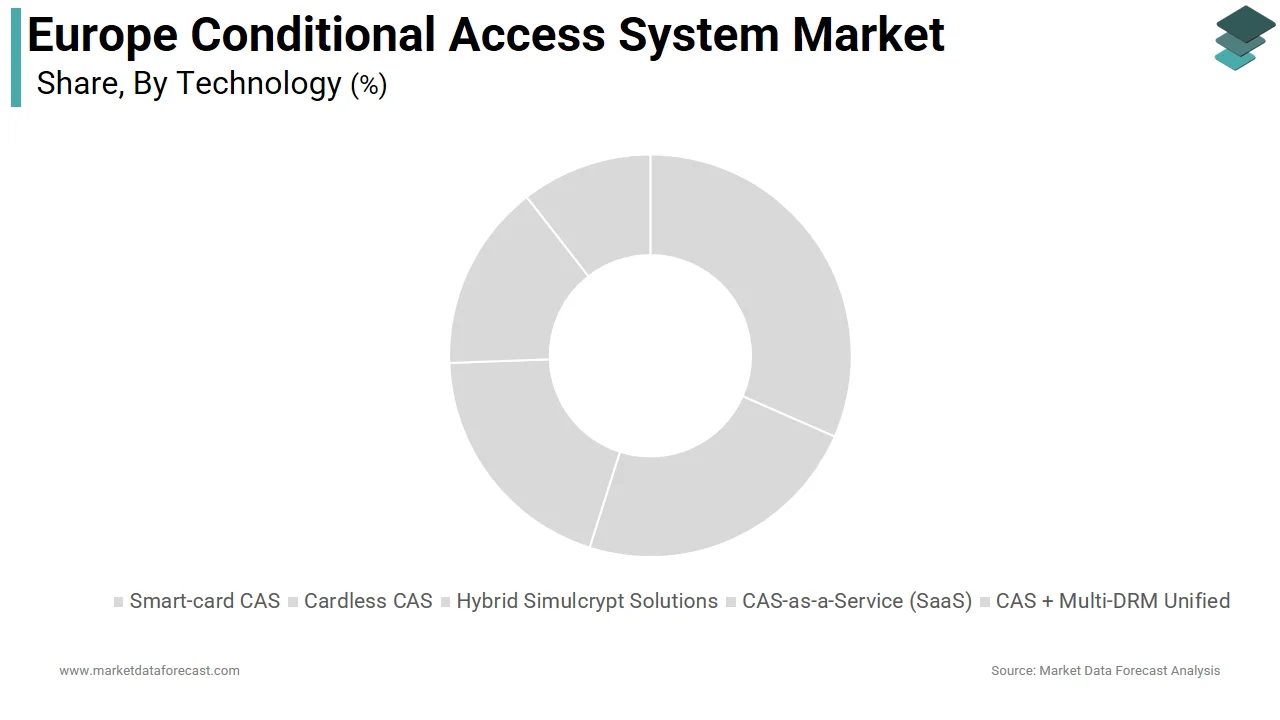
The CAS-As-A-Service segment is projected to register the highest CAGR of 13.2% over the forecast period in the Europe conditional access system market. The explosive growth of the CAS-As-A-Service model is primarily driven by its ability to transform high upfront capital expenditures into manageable operational expenses, making advanced security accessible to a broader range of content providers including smaller streaming services and niche broadcasters. Traditional on-premise conditional access systems require significant investment in specialized hardware, data center space, and dedicated maintenance teams, which creates a high barrier to entry. As per the European Cloud Partnership, migrating to a cloud-based service model reduces total cost of ownership significantly by eliminating hardware refresh cycles and leveraging shared infrastructure economies. This economic efficiency allows operators to scale their security capabilities dynamically based on subscriber numbers and viewing peaks, such as during major sporting events, without over-provisioning resources. According to adoption trends among emerging over-the-top platforms in Europe, the speed of deployment for cloud services is measured in weeks rather than months, enabling faster time to market for new content offerings. The flexibility to pay only for used capacity aligns perfectly with the variable revenue models of modern streaming businesses, driving rapid adoption across the region.
By End User Insights
The pay tv operators segment accounted for the largest share of the Europe conditional access system market in 2025. The dominance of pay tv operators segment in the European market is driven by their role as the primary aggregators of premium content, the sheer volume of subscribers they manage, and the critical necessity to protect high-value sports and movie rights. The loss of control over this content due to piracy can lead to catastrophic financial damages and subscriber churn, making investment in top-tier conditional access systems a non-negotiable operational priority. As per financial disclosures from major European media groups, acquiring sports rights involves extremely high costs, compelling operators to deploy the most advanced encryption and entitlement management systems available to safeguard these assets. According to anti-piracy coalitions, pay television operators are the primary targets of sophisticated hacking attempts, necessitating continuous upgrades to their security infrastructure to stay ahead of threats. The regulatory obligation to prevent unauthorized access under copyright laws further reinforces this demand. The scale of operations managed by these operators, often serving millions of subscribers across multiple countries, creates a massive and consistent demand for enterprise-grade conditional access solutions that can handle complex billing models and multi-tiered subscription packages.
The content aggregators and over-the-top (OTT) segment is projected to grow at the fastest CAGR of 16.4% during the forecast period owing to the explosion of standalone streaming services, the fragmentation of content ownership, and the need for agile, cloud-native security solutions. The launch of numerous proprietary streaming platforms by studios, broadcasters, and sports leagues has created a fragmented landscape where each service requires its own dedicated conditional access and digital rights management infrastructure. As per Ampere Analysis, the number of active SVOD services in Europe has increased significantly in recent years, each needing scalable security to protect their unique content libraries. According to industry observations, these aggregators often lack the legacy baggage of traditional operators, allowing them to adopt cutting-edge cloud-based conditional access solutions from day one. The need to compete globally while complying with local European regulations forces these players to implement highly adaptable security frameworks that can manage rights across borders effortlessly. The rapid pace of new service launches and the aggressive marketing strategies employed by these aggregators are fuelling an unprecedented demand for flexible and cost-effective content protection technologies.
COUNTRY-LEVEL ANALYSIS
United Kingdom Conditional Access System Market Analysis
The United Kingdom held the dominant role in the Europe conditional access system market in 2025 with 23.2% of the regional market share due to its mature pay television ecosystem, high concentration of premium content rights holders, and aggressive stance against piracy. The nation serves as a primary testing ground for new security technologies and business models. The catalyst for this dominance is the presence of major global media conglomerates and sports rights owners who invest heavily in protecting their valuable intellectual property. As per Ofcom, the UK has one of the highest penetrations of pay television and streaming services globally, creating a massive demand for robust conditional access solutions. The government's strong legal framework for copyright enforcement and the active involvement of industry bodies in anti-piracy initiatives further stimulate the market. According to industry reports, British operators are early adopters of hybrid and cloud-based security architectures to support their multi-platform strategies. The vibrant production sector and the hosting of major international sporting events necessitate state-of-the-art protection measures, ensuring the UK remains the central hub for conditional access innovation and deployment in Europe.
Germany Conditional Access System Market Analysis
Germany held the second largest position in the regional market in 2025 due to its strong public and private broadcasting sectors, high demand for encrypted sports content, and stringent data privacy regulations. The country's market strength is derived from a diverse mix of satellite, cable, and IPTV subscribers who rely on secure access for premium programming. As per the State Media Authorities, Germany has a deeply entrenched culture of paid content consumption, particularly for football and other popular sports, driving continuous investment in conditional access infrastructure. The implementation of strict GDPR compliance requirements has forced operators to adopt sophisticated entitlement management systems that balance security with user privacy. According to market analysis, the transition from analog to digital terrestrial television has been completed with a focus on secure encryption standards, boosting the adoption of modern conditional access technologies. The presence of leading technology providers and a robust manufacturing base for set-top boxes further strengthens the domestic supply chain. The combination of high content value, regulatory rigor, and technological expertise sustains Germany's significant influence in the European market.
France Conditional Access System Market Analysis
France is anticipated to account for a prominent share of the Europe conditional access system market over the forecast period owing to its powerful domestic film industry, strong protectionist policies for cultural content, and a highly consolidated pay television landscape. The nation's market is distinguished by rigorous government mandates to combat piracy and support local creators. As per the Superior Audiovisual Council, France enforces some of the strictest anti-piracy laws in Europe, compelling operators to deploy advanced conditional access systems to avoid heavy penalties. The dominance of a few major integrated telecom and media operators creates a concentrated demand for enterprise-grade security solutions capable of managing millions of subscribers. According to industry observations, the French market is a pioneer in adopting hybrid simulcrypt solutions to manage the coexistence of satellite and IPTV platforms. The high value placed on French cinema and exclusive sports rights drives operators to invest in the highest levels of encryption available. The proactive role of government agencies in monitoring and shutting down illegal streams further reinforces the necessity for robust legal and technical protection measures, solidifying France's position as a key market driver.
Italy Conditional Access System Market Analysis
Italy is estimated to showcase a healthy CAGR in the Europe conditional access system market during the forecast period due to its passionate fan base for football, a thriving satellite television sector, and ongoing efforts to digitize terrestrial broadcasting. The country's market status is characterized by a high sensitivity to sports content piracy, which drives continuous upgrades in security technologies. As per the Communications Regulatory Authority, Italy has one of the highest rates of satellite television consumption in Europe, creating a substantial installed base requiring conditional access protection. The intense competition among pay television providers for Serie A broadcasting rights has led to an arms race in security features to prevent signal theft and unauthorized sharing. According to sector reports, Italian operators are increasingly adopting cardless and software-based conditional access systems to reduce costs and improve flexibility for mobile viewers. The government's recent crackdown on illegal streaming sites and devices has created a favorable environment for legitimate service providers to expand their secure offerings. The combination of cultural passion for sports, regulatory enforcement, and technological migration ensures Italy remains a critical growth engine for the conditional access market.
Spain Conditional Access System Market Analysis
Spain is expected to exhibit a notable CAGR in the Europe conditional access system market over the forecast period. The dynamic telecommunications sector, rapid adoption of fiber optics, and a growing appetite for over-the-top streaming services are propelling the Spanish market expansion. The market in Spain is distinct due to the aggressive expansion of bundled services by major telecom operators who integrate television, internet, and mobile services. As per the National Statistics Institute, the penetration of high-speed broadband has enabled a swift shift toward IPTV and OTT platforms, necessitating modern IP-based conditional access solutions. The strong presence of international streaming giants alongside domestic players creates a competitive landscape that demands flexible and scalable security architectures. According to industry trends, Spanish consumers are quick to adopt new viewing technologies, pushing operators to implement multi-screen conditional access capabilities rapidly. The fight against piracy, particularly in the realm of live sports, remains a top priority, driving investment in real-time threat detection systems. The convergence of telecom and media sectors, coupled with a tech-savvy population, positions Spain as a forward-looking market where innovative conditional access strategies are quickly deployed and scaled.
COMPETITIVE LANDSCAPE
The competition within the Europe conditional access system market is characterized by intense rivalry between established security giants and agile specialized vendors striving for dominance in the rapidly evolving digital media landscape. The surge in over the top streaming services and the fragmentation of content delivery channels have triggered a race to innovate with companies vying to offer the most flexible and scalable cloud based protection solutions. Major contractors leverage their extensive portfolios of integrated digital rights management and encryption tools to retain large pay television operators while simultaneously courting emerging streaming platforms with cost effective and easily deployable security packages. The landscape features a mix of full service providers who offer end to end anti-piracy ecosystems and niche players who focus on specific technologies like forensic watermarking or application shielding. Differentiation increasingly relies on advanced capabilities such as real time artificial intelligence driven threat detection and seamless multi-screen entitlement management rather than traditional encryption strength alone. The constant evolution of piracy techniques forces competitors to continuously upgrade their offerings, creating a dynamic environment where agility and innovation are paramount. Strategic collaborations with telecommunications firms and content owners are common as companies seek to embed their security protocols into the foundational layers of next generation broadcasting infrastructure to meet surging demand driven by the explosion of digital content consumption across the continent.
KEY MARKET PLAYERS
The leading companies operating in the Europe conditional access system market include:
- Nagravision (Kudelski Group)
- Irdeto
- Synamedia
- Conax AS
- Verimatrix Inc
- Viaccess-Orca
TOP PLAYERS IN THE MARKET
- Nagravision Kudelski Group stands as a preeminent force in the Europe conditional access system market with a profound influence on global content security standards. The Swiss technology leader specializes in comprehensive digital rights management and multi-screen protection solutions for broadcasters and streaming services. Recently the company has aggressively expanded its cloud native security portfolio to address the rising threats of piracy in the over the top sector. Nagravision initiated strategic partnerships with major European telecom operators to deploy advanced hybrid simulcrypt solutions that secure both legacy and modern devices. The firm continues to invest heavily in artificial intelligence driven threat detection systems that identify and mitigate piracy attempts in real time. Its commitment to innovation ensures it remains the preferred choice for protecting high value sports rights and premium content throughout the continent and worldwide.
- Verimatrix Inc operates as a pivotal entity in the European sector leveraging its extensive expertise in application shielding and content protection to deliver robust security for diverse media ecosystems. The corporation offers a comprehensive suite of conditional access and digital rights management tools renowned for their ability to secure video streams across mobile devices and smart televisions. Recent strategic actions include the enhancement of its unified security platform to support seamless integration with emerging advertising technologies and subscription models. Verimatrix has intensified its focus on helping European broadcasters combat sophisticated piracy rings through advanced forensic watermarking and behavioral analysis. The company actively collaborates with content aggregators to ensure secure delivery of linear and on demand programming across fragmented networks. Its continuous investment in research and development facilitates the creation of agile security architectures that adapt quickly to new attack vectors. These initiatives solidify its reputation as an innovator driving the transition toward resilient and flexible content protection across international markets.
- Conax AS maintains a formidable presence in the Europe conditional access system market through its deep roots in the satellite and cable television industries and its forward looking approach to internet protocol security. The Norwegian manufacturer produces a wide array of encryption and entitlement management systems catering primarily to pay television operators and emerging streaming platforms. The company recently accelerated its shift toward software defined security by introducing modular solutions that allow operators to customize protection levels based on specific business needs. Conax has focused on expanding its global service network to provide rapid response capabilities against piracy incidents and technical disruptions. Its strong commitment to interoperability enables seamless migration from hardware based smart cards to cardless environments without compromising security. By prioritizing scalability and ease of integration Conax continues to capture significant demand from businesses seeking reliable and future proof content protection strategies across the continent and beyond.
TOP STRATEGIES USED BY KEY MARKET PARTICIPANTS
Key players in the Europe conditional access system market primarily employ product innovation strategies focusing on the development of cloud native and software defined security architectures to replace legacy hardware dependencies. Companies frequently engage in strategic acquisitions of cybersecurity startups to enhance their artificial intelligence capabilities and broaden their threat detection portfolios. Manufacturers invest heavily in research and development to create modular solutions that support seamless migration from smart card based systems to cardless environments. Firms actively expand their partner ecosystems by collaborating with device manufacturers and content delivery networks to ensure broad compatibility and streamlined integration. Brand building through participation in major broadcasting exhibitions and anti-piracy summits remains a central tactic to showcase technological leadership and commitment to content protection. Additionally companies pursue localization strategies by establishing regional support centers to comply with specific European data privacy regulations and provide rapid response services to local operators.
MARKET SEGMENTATION
This research report on the Europe conditional access system market has been segmented and sub-segmented into the following categories.
By Technology
- Smart-card CAS
- Cardless CAS
- Hybrid Simulcrypt Solutions
- CAS-as-a-Service (SaaS)
- CAS + Multi-DRM Unified
By Network Type
- Cable TV
- Satellite TV
- IPTV
- Digital Terrestrial (DTT)
- OTT / Streaming
- 5G Broadcast / Mobile
By Device Type
- Set-Top Boxes
- Conditional Access Modules (CAM)
- Smart TVs (Embedded CAS)
- Streaming Dongles / STB-less
By End User
- Pay-TV Operators
- Content Aggregators / OTT Platforms
- Hospitality
- Healthcare
- Education and Campus TV
- Enterprise and Corporate TV
By Country
- United Kingdom
- France
- Spain
- Germany
- Italy
- Russia
- Sweden
- Denmark
- Switzerland
- Netherlands
- Rest of Europe