- Product Description Description
- Table of Contents TOC
- List of Table & Figure LOT
- Get Free Sample PDF Sample PDF
Market Size, 2025
$12.51 BnMarket Estimate, 2026
$14.43 BnMarket Forecast, 2034
$45.09 BnCAGR, 2026–2034
15.31%Europe Zero Trust Security Market Report Summary
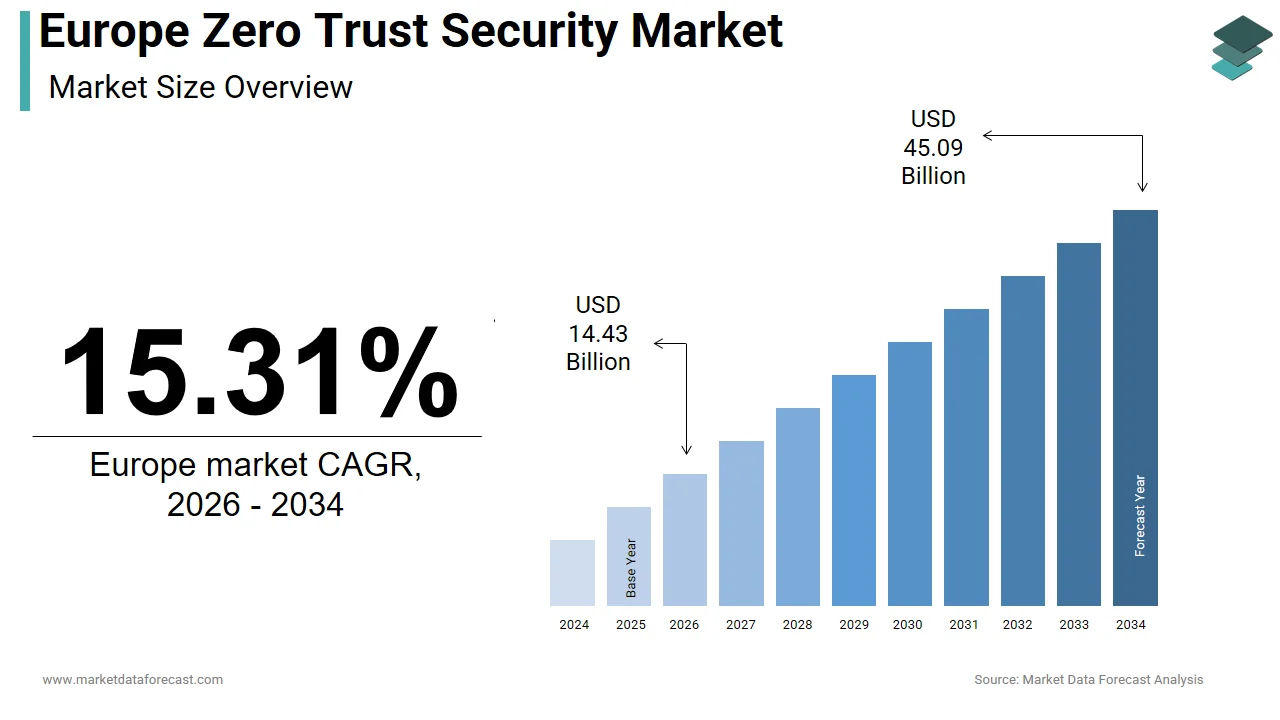
The Europe zero trust security market was valued at USD 12.51 billion in 2025, is estimated to reach USD 14.43 billion in 2026, and is projected to grow to USD 45.09 billion by 2034, registering a CAGR of 15.31% from 2026 to 2034. Market growth is driven by escalating cyber threats, stringent regulatory mandates such as NIS2 and DORA, and the rapid expansion of hybrid work, cloud-native applications, and cross-border digital operations. Zero trust security has transitioned from an optional framework to a baseline cybersecurity requirement across Europe, particularly in regulated sectors such as BFSI, healthcare, government, and critical infrastructure.
Key Market Trends
- Strong shift from perimeter-based security to identity-centric zero trust architectures.
- Rapid adoption of multi-factor and phishing-resistant authentication mechanisms.
- Growing convergence of zero trust with SASE and cloud-native security models.
- Increasing focus on data sovereignty, continuous verification, and least-privilege access.
- Rising public-sector adoption aligned with EU digital identity and sovereign cloud initiatives.
Segmental Insights
- Based on authentication, the multi-factor authentication segment held the dominant share in 2025, driven by regulatory mandates, heightened threat sophistication, and widespread adoption across BFSI and healthcare sectors.
- Based on deployment, the cloud deployment segment led the market, supported by scalable security architectures, GDPR-aligned controls, and sovereign cloud availability across Europe.
- Based on enterprise size, the large enterprises accounted for the largest share in 2025 due to complex IT environments, regulatory exposure, and higher cyber risk profiles.
- Based on end use, the BFSI segment dominated the market, driven by strict compliance requirements, financial risk exposure, and continuous authentication needs.
Regional Insights
The Europe zero trust security market is witnessing robust growth across major economies, supported by regulatory enforcement, cloud transformation, and public-sector digitalization.
- Germany led the market, driven by stringent cybersecurity mandates, advanced industrial digitization, and strong sovereign cloud infrastructure.
- The United Kingdom followed closely, supported by proactive zero trust guidance from national cybersecurity authorities and strong fintech adoption.
- France holds a significant position due to state-led digital sovereignty initiatives, healthcare modernization, and public cloud zero trust mandates.
Competitive Landscape
The Europe zero trust security market is characterized by intense competition among global cybersecurity leaders and specialized vendors offering identity-centric, compliance-ready solutions. Market participants are differentiating through regulatory alignment, sovereign cloud support, localized threat intelligence, and integration with EU digital identity frameworks. Strategic partnerships with public institutions, investments in passwordless authentication, and workforce upskilling initiatives are shaping long-term competitive advantage.
Prominent companies operating in the Europe zero trust security market include Broadcom, Inc., Microsoft Corporation, Fortinet, Inc., Palo Alto Networks, Inc., IBM Corporation, Cisco Systems, Inc., Cloudflare, Inc., Check Point Software Technologies Ltd., CrowdStrike Holdings, Inc., and Forcepoint LLC.
Europe Zero Trust Security Market Size
The Europe zero-trust security market was valued at USD 12.51 billion in 2025, is estimated to reach USD 14.43 billion in 2026, and is projected to reach USD 45.09 billion by 2034, growing at a CAGR of 15.31% from 2026 to 2034.
Zero trust security is a model that operates on the principle of "never trust, always verify," which assumes no user or device is inherently safe, whether inside or outside a network perimeter. Zero trust operates under the principle that no user or device, inside or outside the organizational network, should be inherently trusted. Instead, every access request undergoes rigorous authentication, authorization, and validation in real time. This approach has gained pronounced relevance across Europe due to the continent’s stringent regulatory environment and rising sophistication of cyber threats targeting critical digital infrastructure. The European Commission’s adoption of zero trust principles within its Cybersecurity Strategy for the Digital Decade further underscores institutional momentum. Unlike traditional models that assume safety within internal networks, zero trust responds dynamically to evolving threat vectors, making it particularly suited for hybrid workforces, cloud native applications, and multi-jurisdictional data governance requirements intrinsic to the European digital economy.
MARKET DRIVERS
Escalating Frequency and Impact of Cyber Incidents Across European Critical Sectors
Cyberattacks targeting European organizations have intensified both in volume and consequence, directly accelerating demand for zero trust architectures, which in turn contributes to the growth of the Europe zero trust security market. These breaches often stemmed from lateral movement after initial compromise, a vulnerability zero trust specifically mitigates through strict identity verification and network segmentation. The operational risk environment compels organizations to abandon implicit trust assumptions embedded in traditional firewall-centric models. Zero trust’s ability to isolate compromised endpoints and enforce granular access policies aligns precisely with the containment needs identified in post-breach forensic analyses conducted by Europol’s European Cybercrime Centre. Consequently, demand is not merely reactive but increasingly strategic, as enterprises seek architectures that assume breach inevitability and minimize blast radius through dynamic enforcement of identity and device posture.
Regulatory Imperatives Under the EU’s NIS2 Directive and DORA Framework
The region’s evolving cybersecurity regulatory landscape acts as a major factor boosting the expansion of the Europe zero trust security market. The revised Network and Information Security Directive, known as NIS2, mandates significantly stricter security and incident reporting obligations for entities across energy, transport, health, and digital infrastructure sectors. NIS2 requires continuous risk management and access control mechanisms that inherently align with zero trust principles, such as just-in-time access and identity-centric enforcement. Complementing this, the Digital Operational Resilience Act, or DORA, which applies to all EU financial entities, explicitly calls for adequate access control policies and resilience testing that assume no internal zone is secure. The European Banking Authority emphasized in its implementation guidelines that legacy perimeter defenses no longer satisfy DORA’s access governance expectations. These legal mandates compel enterprises to redesign their security architectures beyond compliance checkboxes toward proactive, verification-based models. Unlike voluntary frameworks, NIS2 and DORA carry substantial finescreating tangible financial incentives for architectural transformation. The collective effect is a market shift where zero trust is less an optional innovation and more a baseline requirement for legal operation within the EU’s digital single market.
MARKET RESTRAINTS
High Implementation Complexity and Legacy Infrastructure Incompatibility
Deploying zero trust architectures across the region faces significant friction due to the deep entrenchment of legacy systems and the operational complexity of transitioning from perimeter-based models, which negatively impacts the Europe zero trust security market. These legacy environments lack the APIs or telemetry capabilities required for real-time policy enforcement, a cornerstone of zero trust. The situation is exacerbated in industrial sectors such as manufacturing and utilities, where operational technology networks often run on proprietary protocols incompatible with identity-aware proxies or software-defined perimeters. The technical debt creates prolonged migration timelines and substantial integration overhead. Moreover, zero trust demands synchronized orchestration across identity providers, endpoint agents, network controllers, and cloud workloads, a level of architectural cohesion many European firms struggle to achieve without specialized expertise. The scarcity of skilled professionals compounds the issue.
Ambiguity in Cross-Border Data Sovereignty and Jurisdictional Enforcement
The region’s fragmented data governance landscape introduces substantial uncertainty for organizations attempting consistent zero trust deployment across multiple jurisdictions, and thereby obstructs the expansion of the Europe zero trust security market. Despite the General Data Protection Regulation providing a baseline, national derogations and sector-specific rules, such as France’s ANSSI directives or Germany’s Federal Data Protection Act, create divergent requirements for data handling, logging, and user consent that complicate unified policy design. The patchwork regulatory environment forces multinational enterprises to maintain multiple policy engines or risk non-compliance. Apart from these, zero trust’s reliance on continuous data collection for behavioral analytics intersects uneasily with emerging national laws restricting biometric or metadata processing. Such legal ambiguity elevates compliance risk and deters standardized architectural choices, compelling firms to adopt cautious, phased rollouts that undermine the holistic visibility zero trust requires to function effectively.
MARKET OPPORTUNITIES
Expansion of Secure Access Service Edge-Driven Cloud Transformation
The convergence of zero trust with Secure Access Service Edge, or SASE, frameworks offers a key opportunity for the Europe zero trust security market. SASE inherently embeds zero trust principles, such as identity-aware access and micro segmentation, into its cloud native security stack, eliminating the need for backhauling traffic to centralized data centers. This architectural synergy is particularly valuable in Europe, where distributed operations span multiple countries with varying latency and compliance needs. Cloud hyperscalers such as AWS and Google Cloud have responded by embedding regional data residency controls and GDPR aligned logging directly into their SASE offerings, accelerating adoption among regulated sectors. This integration not only simplifies deployment but also aligns with Europe’s strategic push for sovereign, scalable, and secure digital infrastructure under the EU Cloud Rulebook.
Public Sector Digitalization and Sovereign Identity Ecosystems
The region’s ambitious public sector digitization agenda offers a fertile ground for zero trust adoption, especially through the integration of sovereign digital identity frameworks, which generate fresh prospects for the expansion of the Europe zero trust security market. The EU is moving towards a standardized digital identity system, with the introduction of a Digital Identity Wallet for citizens. This new initiative leverages a zero-trust architecture for public services, which means relying on continuous verification of both the user's identity and their device. This shift moves government platforms away from static credentials toward dynamic, context-aware access, precisely the foundation of zero trust. These sovereign identity ecosystems not only enhance citizen privacy but also create standardized authentication rails that private enterprises can integrate with, fostering interoperability. The public sector's demand for zero trust is a key driver for its adoption in Europe, making it an early adopter and testing ground for new security solutions.
MARKET CHALLENGES
Fragmented Identity Management Across Multi-Cloud Environments
European enterprises increasingly operate across heterogeneous cloud environments, creating identity fragmentation that affects zero trust’s core premise of unified, continuous verification. This fragmentation is a challenge for the Europe zero-trust security market. The multiplicity leads to inconsistent policy enforcement and visibility gaps that attackers exploit. For example, a misconfigured service principal in Microsoft Azure might grant excessive permissions that go undetected because the organization’s primary monitoring tools are optimized for AWS Identity and Access Management. Zero trust requires a single, authoritative source of identity truth, yet federating identities across AWS, Google Cloud, Oracle Cloud, and on-premises Active Directory remains technically complex and operationally fragile. The lack of standardized cross-vendor identity APIs further complicates real-time risk assessment and adaptive access decisions. European firms will be unable to enforce zero trust policies effectively across their digital estates until they adopt robust identity fabric layers, such as those provided by centralized identity orchestration platforms or the OpenID Foundation’s FAPI 2.0 standard.
Talent Shortage in Zero Trust Architecture Design and Governance
A severe shortage of professionals skilled in its strategic design and operational governance also slows down the expansion of the Europe zero trust security market. Unlike traditional security roles focused on firewalls or antivirus management, zero trust demands expertise in identity orchestration, policy automation, telemetry correlation, and risk-based access modelling, competencies in short supply. The gap is particularly acute in Southern and Eastern Europe, where national cybersecurity strategies have yet to integrate zero trust into educational curricula. The consequence is a market where demand for zero-trust architects outstrips supply by a factor of three. Organizations often resort to external consultants for initial design, but lack internal teams capable of maintaining dynamic policy updates or interpreting behavioral analytics for adaptive enforcement. This dependency not only inflates costs but also creates sustainability risks. The efficacy and implementation quality of zero trust throughout the EU will be inconsistent and vulnerable to human error unless a coordinated upskilling initiative is launched at the EU level, such as the inclusion of zero trust modules in the training provided by the European Digital Innovation Hubs.
REPORT COVERAGE
| REPORT METRIC | DETAILS |
| Market Size Available | 2025 to 2034 |
| Base Year | 2025 |
| Forecast Period | 2026 to 2034 |
| Segments Covered | By Authentication, Deployment, Enterprise Size, Type, End Use, and County. |
| Various Analyses Covered | Global, Regional, and Country-Level Analysis, Segment-Level Analysis, Drivers, Restraints, Opportunities, Challenges; PESTLE Analysis; Porter’s Five Forces Analysis, Competitive Landscape, Analyst Overview of Investment Opportunities |
| Countries Covered | UK, France, Spain, Germany, Italy, Russia, Sweden, Denmark, Switzerland, Netherlands, Turkey, Czech Republic, and the Rest of Europe. |
| Market Leaders Profiled | Broadcom, Inc., Microsoft Corporation, Fortinet, Inc., Palo Alto Networks, Inc., IBM Corporation, Cisco Systems, Inc., Cloudflare, Inc., Check Point Software Technologies Ltd., CrowdStrike Holdings, Inc., Forcepoint LLC (Francisco Partners), and Others. |
SEGMENTAL ANALYSIS
By Authentication Insights
The multi-factor authentication segment captured the majority share of the Europe zero-trust security market in 2025. The leading position of the multi-factor authentication segment is driven by regulatory alignment and heightened threat sophistication. The EU’s Digital Operational Resilience Act explicitly mandates strong customer authentication for financial institutions, a requirement that inherently relies on multi-factor methods. As per research, most EU banks had fully migrated from single-factor to multi-factor authentication for both employee and customer access. This shift is not limited to finance; the healthcare sector has followed suit. The integration of phishing-resistant factors, such as FIDO2 security keys and biometric verification, has further cemented this segment’s dominance, with the European Commission’s Cybersecurity Certification Framework now recognizing such methods as a baseline for critical infrastructure operators.
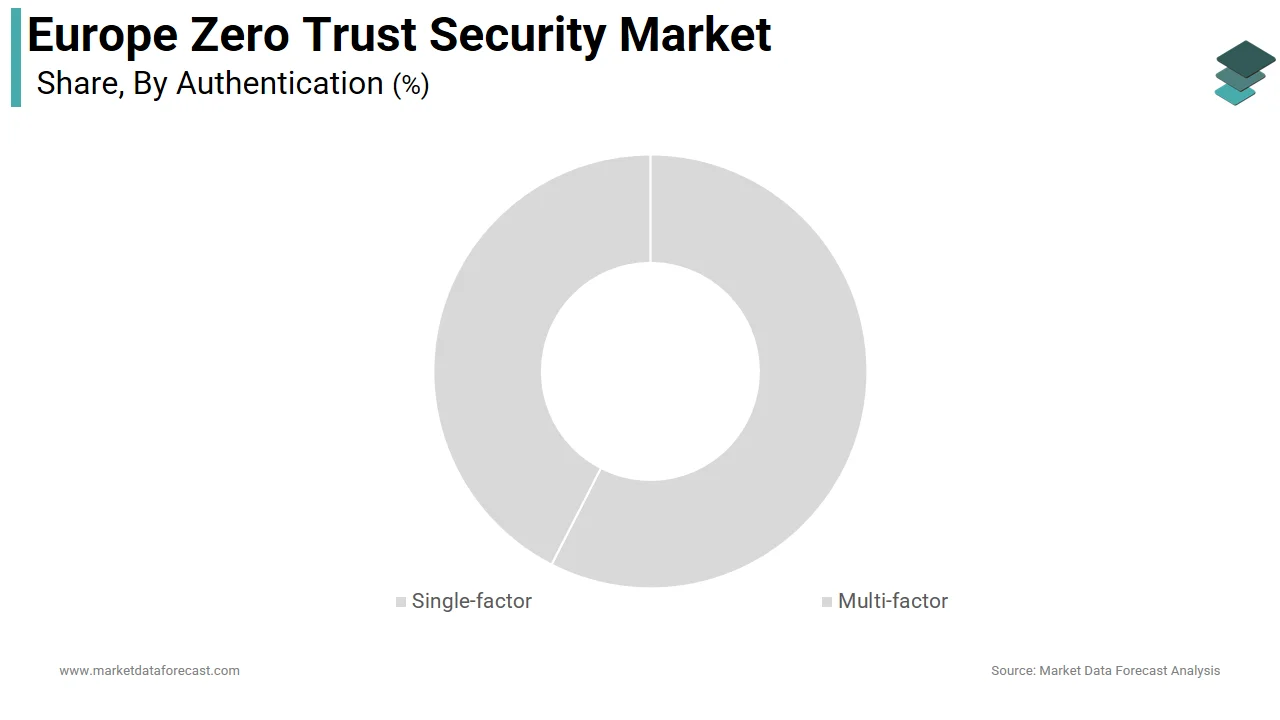
The multi-factor authentication segment is also on the rise and is expected to be the fastest growing segment in the market by witnessing a CAGR of 22.3% from 20245 to 2033 due to the convergence of workforce mobility and cloud native identity ecosystems. Cloud identity providers such as Okta and Auth0 have responded by localizing European data residency for authentication logs, addressing GDPR concerns while scaling deployment. These intertwined drivers, regulatory, technological, and behavioral, ensure multi-factor authentication’s accelerated growth trajectory across the European zero-trust landscape.
By Deployment Insights
The cloud deployment segment was the largest in the Europe zero trust security market by accounting for a 61.7% share in 2024 because of the continent’s strategic pivot toward scalable, agile security aligned with digital transformation. The European Cloud Federation’s 2025 Interoperability Guidelines designate cloud native zero trust as the preferred model for public sector digital services, accelerating adoption across member states. According to sources, many zero-trust implementations in EU agencies now run on cloud platforms, leveraging native identity and access management services from AWS, Microsoft Azure, and Google Cloud. This preference stems from cloud providers’ ability to offer built-in compliance with GDPR, NIS2, and sector-specific regulations through automated policy enforcement and audit logging. Moreover, hyperscalers have established sovereign cloud regions, such as AWS Europe Sovereign Cloud and Microsoft’s EU Data Boundary, that guarantee data residency and jurisdictional control, directly addressing European data sovereignty concerns. These features make cloud deployment not just convenient but strategically aligned with Europe’s regulatory and operational realities.
The cloud deployment segment is expected to exhibit a noteworthy CAGR of 24.1% from 2025 to 2033, owing to the structural shift toward software-defined security and the rise of Secure Access Service Edge, or SASE, as the de facto infrastructure model. The convergence eliminates costly backhauling of traffic to centralized data centers, a critical efficiency gain for multinational firms operating across diverse European geographies. Cloud vendors have further accelerated adoption by embedding zero-trust controls directly into platform services. This ecosystem maturity, combining compliance, performance, and automation, fuels cloud deployment’s unmatched growth momentum.
COUNTRY LEVEL ANALYSIS
Germany Zero Trust Security Market Analysis
Germany dominated the European zero-trust security market and captured a 21.3% share in 2024. The domination of the German market is primarily driven by its advanced industrial base, stringent cybersecurity mandates, and proactive public sector digitization. The country’s critical infrastructure operators span energy, transport, and manufacturing. Germany’s Industrie 4.0 initiative further drives demand, as smart factories generate vast volumes of machine-to-machine traffic that legacy perimeter models cannot secure. Additionally, Germany hosts the largest concentration of European hyperscaler cloud regions, including AWS Frankfurt and Microsoft Berlin, enabling localized, compliant deployments. These factors, regulatory rigor, industrial digitization, and cloud sovereignty, cement Germany’s position as the regional market leader.
United Kingdom Zero Trust Security Market Analysis
The United Kingdom maintained a strong player in the European zero trust market by capturing a share of 18.5%, underpinned by its mature financial technology sector and post-Brexit regulatory autonomy. The UK’s National Cyber Security Centre updated its Zero Trust Architecture guidance in late 2024, mandating all central government departments to achieve baseline zero trust maturity by 2026. London’s status as a global fintech hub intensifies this demand. The UK’s proactive incident disclosure regime, requiring critical sectors to report breaches within 24 hours, further incentivizes preventative architectures. This blend of regulatory clarity, financial sector innovation, and rapid response culture sustains the UK’s market prominence.
France Zero Trust Security Market Analysis
France is an attractive region in the European zero-trust security market because of state-led digital sovereignty initiatives and healthcare modernization. The French National Cybersecurity Agency, or ANSSI, mandated in its 2024 Security Framework that all public cloud contracts must include zero trust controls, directly influencing procurement across ministries and state-owned enterprises. France’s emphasis on technological autonomy is evident in its support for GAIA-X-compliant sovereign cloud providers, which embed zero trust by design. Besides, France’s strategic focus on critical infrastructure protection, especially nuclear and rail, has led to zero-trust pilots in SNCF and EDF, with ENISA citing French operators as regional leaders in operational technology segmentation. These coordinated public and private efforts solidify France’s advanced market position.
Netherlands Zero Trust Security Market Analysis
The Netherlands is moving ahead steadfastly in the Europe zero-trust security market due to its logistics innovation and cross-border digital trade infrastructure. Home to Europe’s largest seaport and a dense network of data centers, the country faces acute cybersecurity pressures from supply chain threats. The country is also a leader in privacy-preserving authentication. Furthermore, the Netherlands hosts major European headquarters for global tech firms, many of which serve as zero-trust implementation hubs for broader EU operations. This combination of trade dependency, digital governance maturity, and multinational presence fuels sustained market leadership.
Sweden Zero Trust Security Market Analysis
Sweden is likely to grow in the European zero-trust security market from 2025 to 2033 due to its world-leading digital public services and strong emphasis on sustainable cybersecurity. A directive mandates that all public sector digital interfaces must implement zero trust. The new mandate builds upon the country's existing eID infrastructure and the widespread use of multi-factor authentication in sectors like healthcare. This is a strategic move to improve security while also promoting energy efficiency by reducing unnecessary server workloads through identity-aware access controls. Additionally, Swedish fintechs and defense contractors, such as SEB and Saab, are regional pioneers in zero trust for both cloud and operational technology environments. This integration of civic trust, environmental policy, and industrial security ensures Sweden’s continued prominence in the European landscape.
COMPETITIVE LANDSCAPE
Competition in the Europe zero trust security market is intensifying as global cybersecurity vendors tailor their architectures to meet the region’s unique regulatory and operational demands. The market features a mix of international leaders and specialized European firms all striving to align with frameworks such as NIS2, DORA, and the EU Cyber Resilience Act. Differentiation hinges on data sovereignty capabilities, localized compliance features, and integration with emerging digital identity infrastructures like the European Digital Identity Wallet. Vendors are increasingly judged not only on technology but also on their commitment to EU-hosted infrastructure, transparent logging, and public sector interoperability. This environment fosters rapid innovation but also raises barriers to entry, requiring deep policy understanding and long-term investment in regional partnerships and workforce enablement.
KEY MARKET PLAYERS
Some of the companies that are playing a dominating role in the Europe zero-trust security market include
- Broadcom, Inc.
- Microsoft Corporation
- Fortinet, Inc.
- Palo Alto Networks, Inc.
- IBM Corporation
- Cisco Systems, Inc.
- Cloudflare, Inc.
- Check Point Software Technologies Ltd.
- CrowdStrike Holdings, Inc.
- Forcepoint LLC (Francisco Partners)
TOP PLAYERS IN THE MARKET
- Microsoft plays a pivotal role in shaping the Europe zero-trust security market through its integrated identity and access management ecosystem. The company’s Azure Active Directory and Microsoft Entra platform deliver core zero trust capabilities, including conditional access, passwordless authentication, and cross-cloud identity governance. It also deepened integration with the European Digital Identity Wallet framework and launched sovereign cloud enhancements in Germany and France to align with NIS2 and DORA compliance requirements, strengthening its strategic foothold across public and financial sectors.
- Palo Alto Networks has significantly advanced zero trust adoption in Europe via its ZTNA and Prisma Access solutions, which embed identity-centric security into hybrid networking. It also launched localized threat intelligence feeds aligned with ENISA’s incident reporting standards and rolled out GDPR compliant logging for all European ZTNA deployments. These actions reinforce its alignment with regional regulatory imperatives and operational resilience demands, particularly in critical infrastructure and healthcare segments.
- Cisco contributes extensively to the Europe zero trust security market through its SecureX platform and Identity Services Engine, which enable network and device posture validation across complex enterprise environments. It also introduced EU-hosted telemetry processing for its Duo multi-factor authentication service, ensuring data sovereignty. Additionally, Cisco expanded training programs through European Digital Innovation Hubs to address the region’s zero trust skills gap, solidifying its role as both a technology provider and capacity builder.
TOP STRATEGIES USED BY THE KEY MARKET PARTICIPANTS
Key players in the Europe zero-trust security market prioritize regulatory alignment by embedding compliance with NIS2, DORA, and GDPR directly into product architectures. They invest heavily in sovereign cloud deployments, ensuring data residency and jurisdictional control across EU member states. Strategic partnerships with national cybersecurity agencies and public sector bodies accelerate adoption in critical infrastructure and healthcare. Continuous innovation in passwordless and phishing-resistant authentication strengthens trust in digital identity ecosystems. Companies also localize threat intelligence and telemetry processing to meet European data governance expectations while expanding workforce training through EU-funded digital skills initiatives to overcome implementation barriers.
MARKET SEGMENTATION
This research report on the Europe zero trust security market has been segmented and sub-segmented into the following categories.
By Authentication
- Single-factor
- Multi-factor
By Deployment
- Cloud
- On-Premises
By Enterprise Size
- Large Enterprises
- SMEs
By Type
- Network Security
- Data Security
- Endpoint Security
- On-premises Security
- Other Type
By End Use
- BFSI
- IT & Telecom
- Retail
- Healthcare
- Other End Use
By Country
- United Kingdom
- France
- Spain
- Germany
- Italy
- Russia
- Sweden
- Denmark
- Switzerland
- Netherlands
- Rest of Europe