Europe Dental Insurance Market Size, Share, Trends & Growth Forecast Report By Coverage, Procedure, End-user and Country - Industry Analysis (2026 to 2034)
Market Size, 2025
$58.90 BnMarket Estimate, 2026
$63.61 BnMarket Forecast, 2034
$117.74 BnCAGR, 2026–2034
8%Europe Dental Insurance Market Report Summary
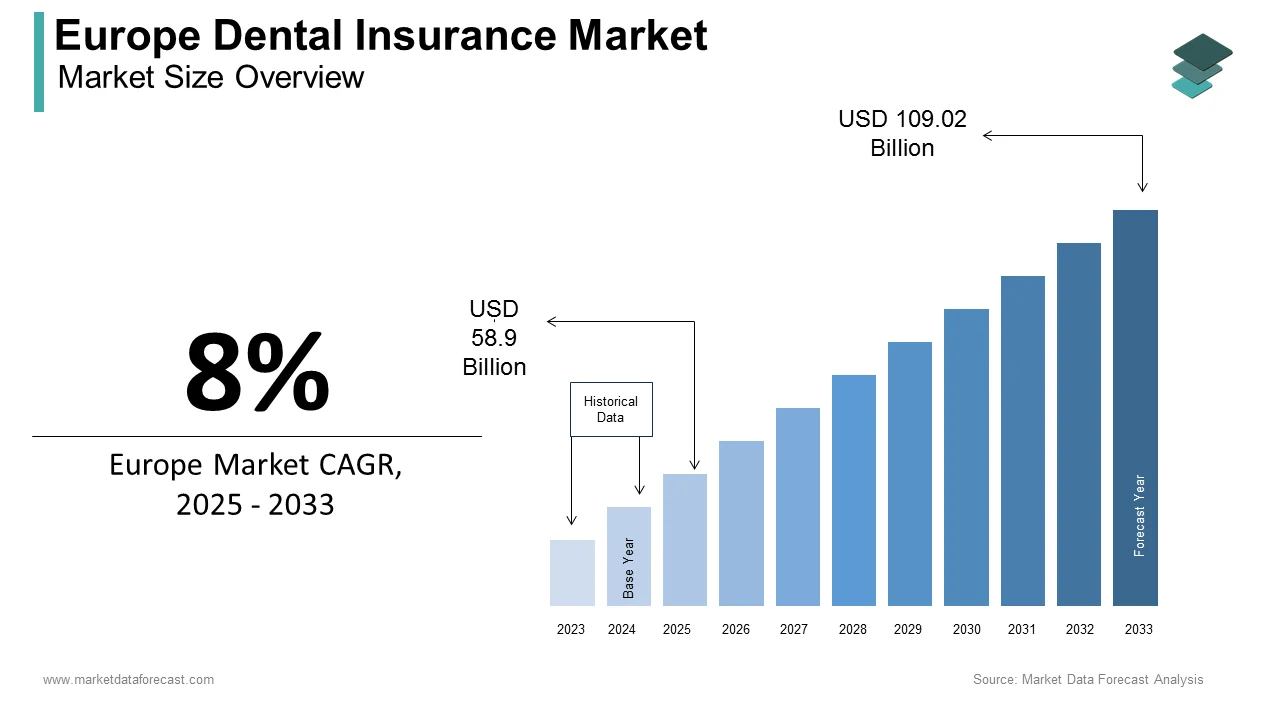
The Europe dental insurance market was valued at USD 58.90 billion in 2025 and is expected to grow from USD 63.61 billion in 2026 to USD 117.74 billion by 2034, registering a CAGR of 8% from 2026 to 2034. Market growth is driven by rising awareness of oral health, increasing dental care costs, and the growing adoption of private insurance plans across Europe. Expanding employer-sponsored coverage, demand for preventive dental services, and limited public dental coverage in several countries are further boosting the uptake of dental insurance policies among both individuals and corporate clients.
Key Market Trends
- Rising demand for preventive dental care coverage to reduce long-term treatment costs.
- Growth in employer-sponsored dental insurance plans across corporate sectors.
- Increasing preference for DPPO plans due to flexibility and cost efficiency.
- Expansion of direct-to-consumer insurance models in key European markets.
- Growing awareness of oral hygiene and routine dental check-ups.
Segmental Insights
- Based on coverage, the Dental Preferred Provider Organizations (DPPO) segment secured the majority share of 41.8% in 2025, driven by its broad provider networks, lower out-of-pocket costs, and flexible treatment options.
- Based on procedure, the preventive dental procedures segment led the market in 2025, supported by increasing focus on routine check-ups, cleanings, and early diagnosis to avoid costly treatments.
- Based on end users, the corporate clients segment dominated the market with a 62.3% share in 2025, fueled by employer-sponsored dental benefits and growing emphasis on employee wellness programs.
Regional Insights
The Europe dental insurance market is witnessing strong growth across major economies, supported by rising healthcare awareness, expanding private insurance penetration, and evolving employer-sponsored coverage models.
- Germany dominated the market with a 22.3% share in 2025, driven by high private insurance adoption and strong employer-sponsored dental plans.
- France followed closely with an 18.9% share, supported by a well-structured insurance system and increasing demand for comprehensive dental coverage.
- The United Kingdom remains a key market due to voluntary employer-sponsored schemes and a growing direct-to-consumer insurance segment, operating against a backdrop of limited NHS dental coverage for adults.
Competitive Landscape
The Europe dental insurance market is characterized by the presence of global insurance providers and regional health insurers offering diversified dental coverage plans. Leading companies are focusing on expanding provider networks, enhancing digital insurance platforms, and offering flexible policy options to attract both corporate and individual customers. Strategic partnerships with healthcare providers and investments in customer-centric services are strengthening their competitive position across Europe.
Prominent companies in the Europe dental insurance market include Aetna Inc. (CVS Health Corporation), AFLAC Inc., Allianz SE, Ameritas Life Insurance Corp., AXA S.A., Cigna, Delta Dental Plans Association, MetLife Inc., United HealthCare Services Inc., Bupa, United Concordia (Highmark Inc.), and HDFC ERGO Health Insurance Ltd. (Apollo Munich).
Europe Dental Insurance Market Size
The dental insurance market in Europe was valued at USD 58.90 billion in 2025. The European market is further anticipated to be worth USD 117.74 billion by 2034 from USD 63.61 billion in 2026, growing at a CAGR of 8% from 2026 to 2034.
Dental insurance is a type of medical coverage specifically designed to help pay for oral healthcare expenses. Unlike universal healthcare systems that typically exclude or minimally cover dentistry, dental insurance operates through employer-sponsored schemes, voluntary private policies, or state-subsidized programs targeting vulnerable populations. The structure and penetration of dental coverage vary significantly across the continent, reflecting differences in healthcare philosophy, labor market norms, and fiscal priorities. Statutory health systems across the European Union widely vary in adult dental coverage, with most countries providing only partial coverage for basic care and relying heavily on co-payments, particularly for non-emergency or advanced treatments. This coverage gap has spurred demand for complementary insurance, particularly in Western and Northern Europe. Dental care is among the most commonly skipped health services across the European Union due to financial barriers, affecting a significant portion of the population, particularly those in lower income brackets. Dental insurance in Europe is shifting from a 'nice-to-have' benefit to a strategic, essential asset for health protection. This evolution is driven by the growing recognition of the oral-systemic connection, specifically with cardiovascular and diabetic health, and rising demand for complex, age-related dental treatments.
MARKET DRIVERS
High Out-of-Pocket Expenditure Drives Demand for Complementary Coverage
A significant portion of dental care costs in the region is borne directly by patients, which drives the growth of the Europe dental insurance market. This creates strong demand for insurance solutions that mitigate financial barriers. A significant portion of overall dental costs in many European countries is covered by individuals rather than public or insurance systems. Data indicate that in several nations, a substantial majority of dental expenditures are paid directly by consumers. A notable segment of the European population indicates they have postponed or skipped dental care because of financial concerns. The tendency to forgo dental visits due to cost appears more pronounced among households with lower income levels. This gap is particularly acute for prosthetic and orthodontic treatments, which are rarely covered by public systems. A considerable portion of dental care expenses is typically not covered by the standard health insurance in certain regions. This gap in basic coverage prompts a majority of individuals, particularly employees in the private sector, to seek out and acquire additional, complementary health insurance plans. A significant percentage of the general population also chooses to purchase voluntary health insurance add-ons to ensure they have access to necessary dental benefits. The prevalence of these supplementary plans suggests a widespread pattern where individuals bridge the gap between basic public provisions and comprehensive private coverage for dental services. This structural underfunding of oral health within public systems creates a sustained and growing market for private dental insurance across income and age groups.
Growing Recognition of Oral Systemic Health Linkages Elevates Preventive Value
Scientific evidence linking poor oral health to chronic systemic conditions is reshaping perceptions of dental care from cosmetic to essential, which is among the key accelerators of the Europe dental insurance market. Consequently, this shift is increasing the perceived value of dental insurance. Advanced periodontal conditions are increasingly associated with an elevated risk of developing heart-related complications and experiencing complications during pregnancy. Managing gum health is observed to assist in the stabilization of blood sugar levels for individuals living with metabolic disorders. Evidence suggesting a link between oral health and systemic wellness has encouraged a shift toward collaborative healthcare frameworks. Clinical protocols are evolving to include regular dental evaluations as a standard component of care for patients with chronic inflammatory conditions. Primary healthcare providers are being encouraged to facilitate dental referrals for populations identified as having specific health vulnerabilities. Recognizing that preventive dental care lowers long-term systemic healthcare costs, employers and insurers are expanding benefits to include regular cleanings, scaling, and periodontal maintenance. This shift positions dental insurance not merely as cost protection but as a proactive investment in holistic health.
MARKET RESTRAINTS
Fragmented Regulatory Frameworks Across Member States Limit Scalability
The absence of a harmonized regulatory structure for dental insurance across the region impedes cross-border product standardization and market entry for pan-European insurers. This hampers the growth of the Europe dental insurance market. Each country applies distinct rules regarding policy design, mandated benefits, premium regulation, and claims processing under national insurance or health laws. Dental insurance regulation across the European Union is highly fragmented, with only a small minority of member states maintaining specific legal definitions, resulting in inconsistent consumer protection standards. Also, dental coverage is inconsistently classified across the region, ranging from specialized, regulated products to general health or ancillary coverage. Stringent, mandatory approval and high transparency rules for dental policies exist in certain Central European markets. In contrast, voluntary dental policies in Southern European regions often operate without standardized disclosure requirements, highlighting a regional disparity in oversight. This regulatory heterogeneity creates significant compliance and operational challenges for insurers operating across multiple jurisdictions, requiring tailored, localized products and marketing. The variance in regulatory frameworks across Europe contributes to higher administrative expenses for insurance providers managing cross-border operations. Jurisdictional complexity hinders market consolidation and innovation in dental insurance, an issue that requires EU-level harmonized standards for classification and safeguards.
Low Public Reimbursement Rates Discourage Provider Participation and Network Building
Chronically low reimbursement rates deter dentists from accepting insured patients in countries where public dental schemes exist, which in turn hinders the expansion of the Europe dental insurance market. This limits network adequacy and undermines the value proposition of dental insurance. Statutory reimbursements for basic procedures in certain countries often do not fully cover the actual costs of practice, leading many dentists to decline public contracts. High administrative burdens, including complex billing processes and delayed reimbursements, reduce the willingness of practitioners to participate in public dental schemes. Private dental insurers often create networks based on negotiated fees, which can lead to higher premiums. Limited participation in public insurance programs by dental professionals can result in restricted access to care, particularly in non-urban regions. Consequently, insured patients often face narrow networks, long wait times, or balance billing, eroding trust in insurance as a reliable access mechanism. Private dental insurance cannot deliver timely and affordable care unless policy reforms align reimbursement with real-world economics.
MARKET OPPORTUNITIES
Integration with Digital Health Platforms Enhances Preventive Engagement
Digital health ecosystems offer a significant opportunity for dental insurers, and thereby are anticipated to fuel the growth of the Europe dental insurance market. These technologies enable a shift from mere claims payment toward proactive oral health management. Leading European insurers are embedding teledentistry, AI-powered risk assessment, and appointment booking tools directly into mobile applications to encourage early intervention and improve member retention. Private dental insurers across several European markets are increasingly launching digital platforms focused on oral health. Insurers are collaborating with smart technology ecosystems to offer incentives for improved brushing habits verified by connected sensors. Machine learning is being utilized by insurers to analyze data and identify members for proactive, preventative outreach. Funding initiatives from European organizations are supporting the validation of digital health tools, fostering an environment for innovation. Insurers can boost health outcomes and manage long-term costs by shifting from reactive, transactional dental coverage to a proactive, continuous care partnership.
Expansion of Employer-Sponsored Group Dental Plans in Southern and Eastern Europe
Employer dental insurance is a strong prospect in the Southern/Eastern region, which is likely to boost the expansion of the Europe dental insurance market. This is happening as labor markets formalize and benefits gain strategic importance. Organizations in various European countries are enhancing their employee benefit packages with health-related offerings to attract and keep skilled workers. Dental care is particularly valued by employees and is frequently listed as a top preference during hiring. Collective bargaining discussions in certain regions are also beginning to incorporate specific health benefits as part of standard employment terms, showing a general rise in the number of employees covered by employer-sponsored plans. Insurers have responded by launching modular group dental products with tiered coverage options tailored to local wage structures. Employer-based health models provide a scalable pathway for broadening coverage as statutory systems remain underfunded and high user costs limit access; furthermore, they generate consistent, manageable risk pools for insurers in underserved markets.
MARKET CHALLENGES
Aging Population Increases Demand for Complex and Costly Dental Procedures
The region’s rapidly aging demographic is driving sustained demand for high-cost dental interventions such as implants, dentures, and periodontal surgery, which are rarely covered by public systems and often only partially reimbursed by basic insurance plans, thereby challenging the growth of the Europe dental insurance market. The population in certain regions is experiencing a structural shift, with a growing percentage of older residents. Older age groups exhibit a higher prevalence of tooth loss, leading to a greater demand for dental prosthetics and implant services. As individuals age, their potential need for more complex dental interventions increases, altering the required care profile. The financial burden for specialized dental treatments, such as implants, often falls heavily on the patient due to limited coverage. Public and basic private insurance frameworks may not fully address the high costs associated with advanced dental care for seniors. The intersection of a rising elderly demographic and costly treatment needs presents a challenge for accessibility in oral healthcare. This mismatch forces seniors to either pay out of pocket or forego treatment, exacerbating health disparities. As per a study, a notable share of retirees in Italy and Greece avoided necessary dental care due to cost. Insurers that fail to offer adequate coverage for geriatric dental needs risk losing relevance in an increasingly aged market, yet expanding benefits increases premium pressure and underwriting complexity in a population with elevated morbidity risk.
Limited Consumer Awareness and Misperception of Dental Insurance Value
Many Europeans remain unaware of dental insurance options or underestimate their financial and health benefits, despite high unmet need, which constrains the penetration of the Europe dental insurance market. Awareness of how dental coverage is structured through professional or state frameworks appears limited among many residents in certain European regions. Public sentiment in specific Mediterranean areas often classifies oral health coverage as an optional benefit rather than a fundamental component of healthcare. General participation in dental insurance programs remains notably low in these geographic areas compared to other health services. There is a visible pattern where individuals struggle to distinguish between private employer-sponsored plans and public health offerings. Even in markets with higher uptake, policy literacy is low. As per research, a portion of policyholders did not understand their annual reimbursement limits or excluded procedures, leading to dissatisfaction during claims. This knowledge gap is exacerbated by fragmented marketing and a lack of standardized product labeling. Absent aligned public awareness campaigns and transparent policies, insurers will continue to struggle with converting latent demand into active enrollment, particularly among low-income and elderly populations who stand to benefit most.
REPORT COVERAGE
| REPORT METRIC | DETAILS |
| Market Size Available | 2025 to 2034 |
| Base Year | 2025 |
| Forecast Period | 2026 to 2034 |
| Segments Covered | By Coverage, Procedure, End-user, and Country. |
| Various Analyses Covered | Global, Regional, and Country-Level Analysis, Segment-Level Analysis, Drivers, Restraints, Opportunities, Challenges; PESTLE Analysis; Porter’s Five Forces Analysis, Competitive Landscape, Analyst Overview of Investment Opportunities |
| Countries Covered | UK, France, Spain, Germany, Italy, Russia, Sweden, Denmark, Switzerland, Netherlands, Turkey, Czech Republic, and the Rest of Europe. |
| Market Leaders Profiled | Aetna Inc. (CVS Health Corporation), AFLAC Inc., Allianz SE, Ameritas Life Insurance Corp., AXA S.A., Cigna, Delta Dental Plans Association, MetLife Inc., United HealthCare Services Inc., Bupa, United Concordia (Highmark Inc.), HDFC ERGO Health Insurance Ltd. (Apollo Munich), and Others. |
SEGMENTAL ANALYSIS
By Coverage Insights
The Dental Preferred Provider Organizations (DPPO) segment secured the majority share of 41.8% of the Europe Dental Insurance Market in 2025. The prominence of the DPPO segment is attributed to its balanced value proposition, offering members freedom of choice, predictable co-payments, and access to discounted rates without requiring referrals. Unlike DHMO plans that restrict patients to a closed network, DPPOs allow insured individuals to visit any dentist while incentivizing in-network use through higher reimbursement levels. This flexibility aligns with European consumer preferences for autonomy in healthcare decisions. In France and the Netherlands, employers favor this model for its ease of administration and high employee satisfaction. Additionally, DPPO contracts enable insurers to negotiate volume-based fee schedules with dentists, creating cost stability.
The Dental Health Maintenance Organizations (DHMO) segment is likely to experience the fastest CAGR of 8.6% from 2026 to 2034 due to rising demand for cost-controlled, preventive-focused care models that align with public health goals and employer budget constraints. DHMO plans operate on a capitation basis where dentists receive a fixed monthly fee per enrolled patient, incentivizing early intervention and reducing unnecessary procedures. In Germany and Austria, where statutory dental coverage is minimal for adults, corporate HR departments are increasingly adopting DHMO plans to provide predictable dental benefits without open-ended liability. Large firms in Germany are adopting managed dental plans as a strategy to manage rising costs associated with traditional insurance models. Managed dental care networks are increasing their presence in areas that previously had limited access to care. Insurers in Poland are collaborating with local dental professionals to launch dental plans that cover employees in specific regions. The expansion of these dental plans aims to improve employee access to care while limiting overall cost increases. The increasing focus on value-based care and the need for sustainable employer benefits make DHMOs a high-growth competitor to fee-for-service arrangements, primarily due to their emphasis on preventive services, stable costs, and network efficiency.
By Procedure Insights
The preventive dental procedures segment led the Europe dental insurance market by capturing a substantial share in 2025. The leading position of the preventive dental procedures segment is credited to both insurer strategy and public health policy prioritizing early intervention to reduce long-term treatment costs. Routine cleanings, examinations, and fluoride applications are almost universally covered at a significant share across private and complementary schemes due to their proven role in averting caries, periodontitis, and tooth loss. Several European regions have policy frameworks that encourage adults to have regular, twice-yearly preventive dental check-ups. National health strategies in some Nordic and Western European countries have incorporated these recommendations into their dental care guidelines. Private insurance providers are incentivizing compliance with these preventive dental schedules through premium adjustments. Models suggest that investments in proactive dental care can result in financial savings by reducing the need for restorative treatments. This compelling cost-benefit ratio ensures preventive coverage remains the cornerstone of dental insurance design, driving high utilization and member engagement across all European markets.
The major dental procedures segment is on the rise and is expected to be thefastest-growingg segment in the market by witnessing a CAGR of 9.2% over the forecast period, owing to Europe’s aging population, rising demand for functional and aesthetic restoration, and gradual inclusion of complex treatments in enhanced insurance plans. According to sources, a portion of Europeans will be aged 65 or older by 2030, a cohort with significantly higher rates of edentulism and need for prosthetic care. In response, insurers are expanding major procedure coverage beyond basic plans. Complementary health insurers in certain European markets are raising reimbursement limits for major dental procedures, such as implants, often influenced by advocacy efforts. Insurers are introducing specialized premium coverage tiers aimed at older demographics to better cover dental implant costs. There is an observed trend of higher uptake among older policyholders for insurance products that offer enhanced coverage for significant dental work. Dataindicates a rise in claims for major oral procedures, which appears to be influenced by both an aging population and a greater consumer focus on long-term dental health. A growing willingness among consumers to invest in substantial oral health improvements is contributing to increased utilization of dental coverage. Comprehensive major medical is moving from a non-mandatory to a vital offering, driven by industry recognition of its role in improving retention and reducing systemic healthcare expenses.
By End users Insights
The corporate clients segment was the largest in the Europe dental insurance market by occupying a 62.3% share in 2025 because of the widespread use of dental coverage as a strategic employee benefit in competitive labor markets, particularly in Western and Northern Europe. In the Netherlands, Belgium, and Sweden, voluntary supplementary insurance, often facilitated through employers, is widely used to cover adult dental care costs not included in basic public health schemes. Employers favor group dental plans for their tax efficiency, high perceived value, and positive impact on absenteeism. Studies on workplace health indicate that providing employer-sponsored dental benefits helps reduce absenteeism and presenteeism caused by oral pain. Additionally, group underwriting allows insurers to offer lower premiums through risk pooling and streamlined administration. German companies are increasingly recognizing comprehensive dental insurance as a valuable, competitive benefit to attract and retain staff, particularly in response to limited public coverage. This institutional demand creates stable, predictable revenue streams that anchor the market and enable product innovation.
The individual segment is expected to exhibit a noteworthy CAGR of 7.9% from 2026 to 2034. The rapid growth of the individual segment is propelled by rising out-of-pocket dental costs, declining employer coverage in gig and freelance economies, and increasing health literacy among middle-aged consumers. A substantial portion of the European workforce is engaged in non-standard employment, frequently without access to conventional group benefits. Insurers are introducing digital dental plans directly to consumers, featuring flexible monthly subscriptions and no medical underwriting. Individual enrollment in dental plans has risen in nations where public dental coverage for adults is limited, fueled by efforts that underscore the expenses associated with postponing care. Older demographics are increasingly seeking supplementary coverage for procedures like implants and prosthetics, which statutory programs do not completely cover. The individual market is evolving from a niche offering to a mainstream growth engine, fueled by decreased acquisition costs and heightened consumer engagement.
COUNTRY-LEVEL ANALYSIS
Germany Dental Insurance Market Analysis
Germany dominated the Europe Dental Insurance Market by 22.3% share in 2025. The dominance of the German market is driven by a statutory health system that covers only basic and emergency dental care for adults, leaving complex and aesthetic treatments fully out of pocket. A significant portion of overall dental costs in the country is covered directly by individuals rather than public or mandatory systems, which represents a high rate of private out-of-pocket spending compared to neighboring nations. The gap between public dental coverage and actual treatment costs has encouraged the growth of a market for private insurance policies. A notable number of residents have chosen to purchase additional, voluntary dental insurance plans to manage these expenses. Employers increasingly include dental coverage in benefits packages to attract talent, while direct-to-consumer insurers leverage digital platforms to reach freelancers and retirees. Strict regulatory oversight by BaFin ensures product transparency, fostering consumer trust. This combination of systemic underfunding, high treatment costs, and mature private insurance infrastructure makes Germany Europe’s most financially driven and volume-rich dental insurance market.
France Dental Insurance Market Analysis
France followed closely in the Europe dental insurance market by holding a 18.9% share in 2025. The expansion of the French market is supported by its “mutuelle” system, a complementary health insurance that covers co-payments and services excluded from statutory care. The vast majority of residents in France possess health coverage that includes dental benefits. Public insurance covers a portion of dental costs, which leads to a dependency on private, supplementary coverage to cover the remaining expenses. Employer-sponsored complementary insurance is required for all companies, facilitating widespread access to dental coverage. Initiatives have been implemented to increase the coverage for certain dental services, though this often requires using specific providers and materials. Dental care makes up a significant share of supplementary health expenditures, indicating high utilization of these services. This deeply institutionalized model, combining public-private partnership and mandatory employer participation, makes France the most structurally integrated and stable dental insurance market in Europe.
United Kingdom Dental Insurance Market Analysis
The United Kingdom is also a key player in the Europe dental insurance market due to voluntary employer-sponsored schemes and a growing direct-to-consumer segment, operating against a backdrop of minimal NHS dental coverage for adults. Publicly funded dental care options often have limited coverage, focusing primarily on essential services. The availability of public dental appointments is constrained, resulting in extended waiting periods for patients. A significant portion of the working population seeks alternative dental coverage, frequently through employer-sponsored initiatives. Large insurance providers collaborate with many major corporations to offer varied levels of dental care plans. The rise of flexible benefits platforms has enabled employees to allocate salary sacrifice toward dental insurance, boosting uptake. Additionally, the UK leads in digital distribution. This blend of employer facilitation, digital innovation, and systemic NHS constraints creates a dynamic and responsive market driven by consumer choice and workplace incentives.
Netherlands Dental Insurance Market Analysis
The Netherlands is moving ahead steadfastly in the Europe Dental Insurance Market. Its structure is unique, i.e., mandatory basic health insurance excludes almost all adult dental care, making voluntary dental add-ons essential for comprehensive coverage. A notable share of the population purchases standalone dental insurance, often bundled with vision and physiotherapy in modular packages. The Dutch system emphasizes consumer choice and price transparency, with insurers required to publish standardized benefit tables. This has spurred innovation in value-based plans; for example, CZ offers premium discounts for members who complete preventive visits verified via digital health records. The government provides income-based subsidies for dental insurance for children and low-income adults, ensuring baseline access. Most dentists participate in private insurance networks due to fair reimbursement rates. This clear separation between basic and supplementary insurance, combined with strong consumer protections, creates a high penetration, high trust market where dental coverage is viewed as a normal household expense.
Sweden Dental Insurance Market Analysis
Sweden is predicted to grow in the Europe dental insurance market from 2026 to 2034. Its model blends universal public subsidies with private top-up insurance in a system designed to promote lifelong oral health. All residents receive government dental allowances that increase with age and cover preventive and basic care up to annual caps. However, major procedures like implants and advanced prosthetics require significant out-of-pocket payment, prompting a notable share of Swedes to purchase supplementary private insurance. Employers commonly include dental top-ups in benefits packages, and insurers like Folksam integrate with national health records to automate claims. The Public Health Agency of Sweden mandates regular dental screenings for high-risk groups, reinforcing a preventive culture. This hybrid approach, publicly funded prevention with privately managed complex care, achieves high access while controlling costs, making Sweden a balanced and sustainability-oriented dental insurance market.
COMPETITIVE LANDSCAPE
Competition in the Europe Dental Insurance Market is characterized by a mix of multinational insurers, national health mutuals, and specialized dental providers operating under diverse regulatory frameworks. The market is highly fragmented due to country-specific healthcare systems, which dictate coverage scope, reimbursement rules, and distribution channels. Large players like Allianz AXA and Bupa compete on digital innovation, network quality, and preventive value propositions, while smaller mutuals focus on local trust and community presence. Employer-sponsored plans dominate volume, but individual direct-to-consumer models are growing rapidly, especially among freelancers and retirees. Price transparency, regulatory compliance, and integration with public dental subsidies are key differentiators. Insurers that successfully balance affordability, comprehensive coverage, and seamless user experience gain a competitive advantage. As oral health gains recognition as integral to systemic well-being, competition is shifting from cost minimization to preventive value creation and long-term member retention.
KEY MARKET PLAYERS
The leading companies operating in the Europe dental insurance market include:
- Aetna Inc.
- AFLAC Inc.
- Allianz SE
- Ameritas Life Insurance Corp.
- AXA S.A.
- Cigna
- Delta Dental Plans Association
- MetLife Inc.
- United HealthCare Services Inc.
- Bupa
- United Concordia
- HDFC ERGO Health Insurance Ltd.
TOP PLAYERS IN THE MARKET
- Allianz SE is a leading European insurer with a significant footprint in the dental insurance segment across Germany, France, Italy, and Spain. The company offers both group and individual dental plans that integrate preventive care incentives, digital health tools, and transparent reimbursement structures. It also introduced tiered coverage options with enhanced benefits for seniors and orthodontic care tailored to local regulatory environments. Through its global health division, Allianz exports its European dental insurance models to emerging markets in Asia and Latin America, demonstrating the scalability of its preventive and value-based approach to oral health coverage.
- AXA SA is a major player in the Europe Dental Insurance Market, offering comprehensive dental coverage primarily through employer-sponsored schemes in the UK, France, Germany, and the Netherlands. The company leverages its strong B2B relationships to embed dental benefits into flexible compensation packages and has invested in proprietary risk assessment algorithms to personalize premiums. It also expanded partnerships with dental chains to create preferred provider networks that reduce out-of-pocket costs. AXA’s global health arm uses insights from its European dental operations to refine benefit designs in North America and the Middle East, reinforcing its role as an innovator in preventive dental insurance worldwide.
- Bupa operates extensively in the Europe Dental Insurance Market with a strong presence in the United Kingdom, Ireland, and Spain, focusing on both individual direct-to-consumer policies and corporate dental plans. The company differentiates itself through integrated care models that combine insurance with access to its own network of dental clinics and digital health services. It also introduced modular dental plans, allowing customers to customize coverage for orthodontics, implants, or cosmetic procedures. Bupa’s global health strategy uses its European dental innovations as a blueprint for similar offerings in Australia and Latin America, emphasizing prevention, affordability, and seamless member experience.
TOP STRATEGIES USED BY THE KEY MARKET PARTICIPANTS
Key players in the Europe Dental Insurance Market prioritize integration of digital health tools such as teledentistry, AI-driven preventive coaching, and real-time claims processing to enhance member engagement and reduce administrative costs. They develop tiered and modular plan designs that allow customers to customize coverage for preventive, basic, and major procedures based on life stage and budget. Companies actively build preferred provider networks through partnerships with dental chains and independent practitioners to control costs and ensure access. Strategic emphasis on employer-sponsored group plans leverages workplace distribution channels and improves risk pooling. Additionally, insurers incorporate preventive incentives, including premium discounts and wellness rewards, to encourage early intervention and improve long term oral health outcomes.
MARKET SEGMENTATION
This research report on the Europe dental insurance market has been segmented and sub-segmented into the following categories.
By Coverage
- Dental Health Maintenance Organizations (DHMO)
- Dental Preferred Provider Organizations (DPPO)
- Dental Indemnity Plans (DIP)
- Dental Exclusive Provider Organizations (DEPO)
- Dental Point Of Service (DPS)
By Procedure
- Preventive
- Major
- Basic
By End-users
- Individuals
- Corporates
By Country
- UK
- France
- Spain
- Germany
- Italy
- Russia
- Sweden
- Denmark
- Switzerland
- Netherlands
- Turkey
- Czech Republic
- Rest of Europe
Frequently Asked Questions
What is the Europe dental insurance market?
The Europe dental insurance market offers plans covering checkups, treatments, and orthodontics. It supplements public systems with private options for comprehensive oral care across countries.
What drives the Europe dental insurance market?
Aging populations and rising treatment costs drive the Europe dental insurance market. Greater awareness of preventive dentistry boosts demand for flexible coverage plans.
How is the Europe dental insurance market segmented?
The Europe dental insurance market segments by provider type like PPO and indemnity, plus individual versus group plans for varied user needs in oral health.
Which countries lead the Europe dental insurance market?
Germany, UK, and France lead the Europe dental insurance market with strong public-private blends. High adoption rates support advanced dental care access.
What role does PPO play in the Europe dental insurance market?
PPO dominates the Europe dental insurance market offering network flexibility and cost savings. Users access preferred dentists with partial coverage on procedures.
Why corporate plans matter in the Europe dental insurance market?
Corporate plans enhance the Europe dental insurance market as employee perks. They promote wellness and retention through subsidized preventive and major care.
What trends shape the Europe dental insurance market?
Digital platforms and preventive focus trend in the Europe dental insurance market. Customizable plans address cosmetic and orthodontic demands effectively.
How does regulation impact the Europe dental insurance market?
EU directives standardize the Europe dental insurance market ensuring consumer protections. National systems like NHS influence private plan designs regionally.
What covers typical plans in the Europe dental insurance market?
Plans in the Europe dental insurance market cover cleanings, fillings, and extractions. Many extend to orthodontics and implants based on policy tiers.
Related Reports
Access the study in MULTIPLE FORMATS
Purchase options starting from
$ 2000
Didn’t find what you’re looking for?
TALK TO OUR ANALYST TEAM
Need something within your budget?
NO WORRIES! WE GOT YOU COVERED!
Call us on: +1 888 702 9696 (U.S Toll Free)
Write to us: sales@marketdataforecast.com