- Product Description Description
- Table of Contents TOC
- List of Table & Figure LOT
- Get Free Sample PDF Sample PDF
Market Size, 2025
$1,281 MnMarket Estimate, 2026
$1,555 MnMarket Forecast, 2034
$7,337 MnCAGR, 2026–2034
21.4%Europe Digital Therapeutics Market Size
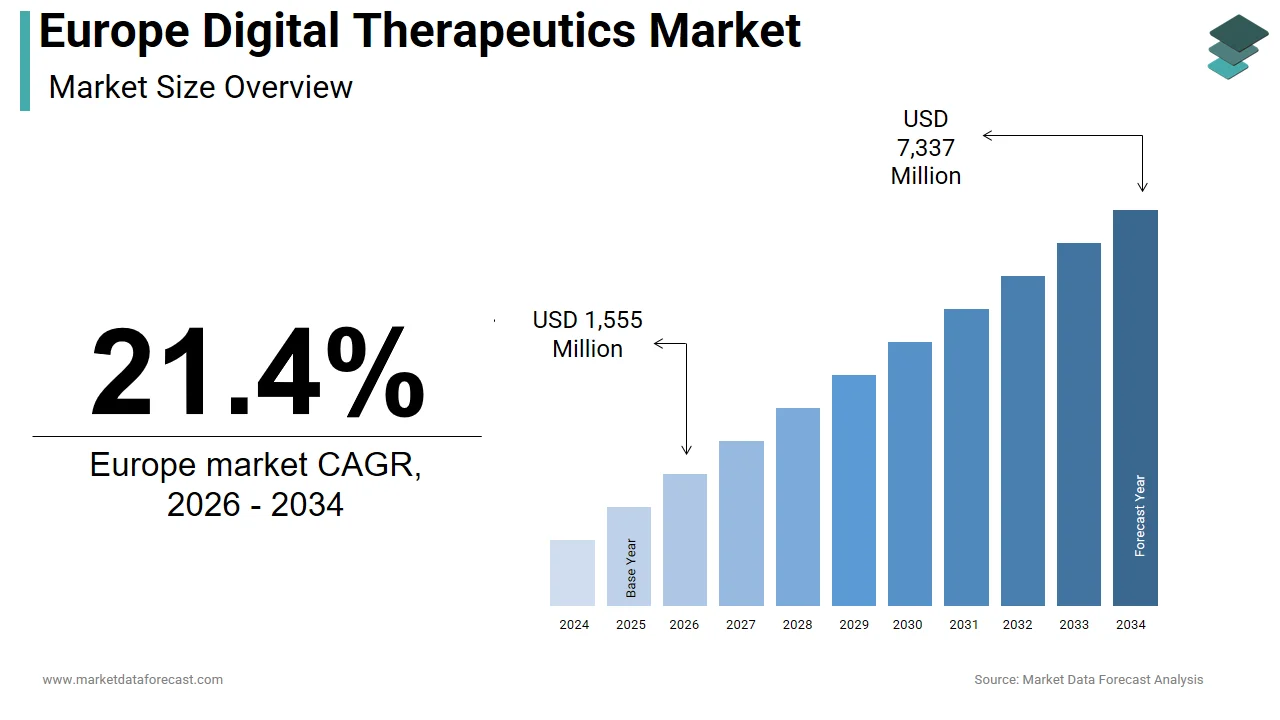
The size of the Europe digital therapeutics market was valued at USD 1,281 million in 2025. This market is expected to grow at a CAGR of 21.4% from 2026 to 2034 and be worth USD 7,337 million by 2034, up from USD 1,555 million in 2026.
Digital Therapeutics is an evidence-based software-driven intervention designed to prevent,manage, or treat medical disorders through clinically validated digital platforms. These solutions operate independently or in conjunction with pharmaceutical devices or lifestyle modifications and are increasingly integrated into national healthcare pathways across the European Union. Digital therapeutics address conditions such as type 2 diabetes, insomnia, chronic obstructive pulmonary disease, and substance use disorders using behavioral science algorithms and real-time data analytics. Regulatory recognition has accelerated adoption with Germany’s DiGA framework approving over 40 digital health applications for reimbursement by statutory health insurers as per the Federal Institute for Drugs and Medical Devices.
MARKET DRIVERS
Integration into National Reimbursement Frameworks
Germany’s Digital Health Applications Ordinance has established a pioneering pathway for digital therapeutics reimbursement, which is one of the driving factors for the growth of Europe's Digital Therapeutics Market. The process mandates rigorous clinical evidence, health economic evaluation, and data protection compliance, ensuring only high-quality interventions receive temporary reimbursement pending long-term outcomes assessment. The institutionalization of digital therapeutics within public payer systems transforms them from discretionary wellness tools into essential clinical assets, driving sustained demand across primary and specialty care settings.
Rising Burden of Chronic Non-communicable Diseases
Europe faces a mounting epidemic of chronic non-communicable diseases that digital therapeutics are uniquely positioned to address through scalable behavior change mechanisms, which is an additional factor propelling the growth of the Europe Digital Therapeutics Market. Cardiovascular diseases, diabetes, and mental health disorders collectively account for 87% of deaths in the WHO European Region, as per the World Health Organization’s 2023 Health Profile. Type 2 diabetes alone affects over 61 million adults in Europe with annual treatment costs exceeding 100 billion euros, according to the International Diabetes Federation. Digital therapeutics such as app-based cognitive behavioral therapy for insomnia and glucose management platforms offer continuous support without increasing clinician workload.
MARKET RESTRAINTS
Fragmented Regulatory and Reimbursement Landscapes
The significant regulatory fragmentation is degrading the growth of the Europe Digital Therapeutics Market. Each EU member state maintains distinct classification criteria, evidence requirements, and reimbursement procedures for digital health interventions. This heterogeneity forces developers to navigate up to 27 separate regulatory processess, increasing time to market and compliance costs. Moreover, the absence of mutual recognition agreements means a DiGA approval in Germany does not facilitate entry into Spain or Poland. Until the European Commission harmonizes medical device classification for software under the Medical Device Regulation or establishes a centralized health technology assessment bod,y developers will face disproportionate administrative burdens that stifle innovation and limit patient access.
Limited Clinical Integration and Physician Adoption
Digital therapeutics struggle to achieve seamless integration into routine clinical workflows due to insufficient training, interoperability gaps, and skepticism among healthcare professionals. Electronic health record systems in most European hospitals lack standardized APIs to exchange data with external digital platforms, creating manual documentation burdens that deter usage. Furthermore, reimbursement mechanisms often exclude follow-up consultations needed to interpret digital therapeutic output,s reducing clinician incentive. The European Society of Medical Informatics notes that workflow misalignment is the leading cause of digital therapeutic discontinuation within six months of prescription.
MARKET OPPORTUNITIES
Expansion into Mental Health and Neurological Disorders
The digital therapeutics are unlocking new treatment avenues for Europe’s escalating mental health crisis, where traditional services face severe capacity constraints is likely to gear up the growth of the Europe Digital Therapeutics Market. Over 84 million people in the EU experience mental health conditions annually, yet fewer than 30 % receive adequate care as per the European Mental Health Action Plan 2023. Regulatory bodies are responding with targeted approvals, such as the UK’s National Institute for Health and Care Excellence, recommending six digital mental health tools for routine use in 2023. Employers are also driving adoption, with 41% of large corporations in France offering reimbursed digital therapeutics as part of occupational health programs, according to the French Ministry of Labor.
Public-Private Partnerships for Real-World Evidence Generation
The strategic collaborations between digital therapeutics developers, national health services, and academic institutions are accelerating evidence generation and health technology assessment readiness, which additionally promotes the growth of the Europe Digital Therapeutics Market. The European Innovation Partnership on Active and Healthy Ageing has funded over 20 pilot projects integrating digital therapeutics into routine care for conditions like heart failure and COPD across 12 countries, as confirmed by the European Commission’s 2023 progress review. In Finland, the Kanta Services platform enables anonymized real-world data collection from digital therapeutics prescribed in primary care, supporting post-market studies required by the Finnish Medicines Agency.
MARKET CHALLENGES
Data Privacy and Cybersecurity Compliance Burdens
Digital therapeutics must navigate Europe’s stringent data governance regime, which imposes significant operational and developmental constraints. The General Data Protection Regulation mandates explicit user consent, purpose limitation, and data minimization for all health-related personal information, with non-compliance penalties reaching 4% of global turnover as enforced by national supervisory authorities. Additionally, the Medical Device Regulation requires digital therapeutics classified as Class IIa or higher to implement robust cybersecurity protocols, including penetration testing and vulnerability management, as verified by notified bodies. These requirements, while essential for patient protection, delay time to market and disproportionately impact small innovators lacking legal and technical resources, thereby limiting therapeutic diversity and competitive dynamism in the market.
Interoperability Deficits Across National Health Infrastructures
The absence of standardized data exchange protocols across European healthcare systems severely limits the clinical utility and scalability of digital therapeutics is also challenging the growth of the Europe Digital Therapeutics Market. In Italy, regional health systems use over 15 different EHR platforms with no central integration layer, preventing nationwide deployment of digital interventions. Similarly, Spain’s autonomous communities maintain separate digital health strategies, resulting in fragmented adoption even for nationally approved tools. The lack of FHIR or HL7 adoption at scale means digital therapeutics often require custom integration for each healthcare provider, increasing implementation costs and complexity.
REPORT COVERAGE
| REPORT METRIC | DETAILS |
| Market Size Available | 2025 to 2034 |
| Base Year | 2025 |
| Forecast Period | 2026 to 2034 |
| Segments Covered | By Product, Sales Channel, Application & Region. |
| Various Analyses Covered | Global, Regional and Country-Level Analysis, Segment-Level Analysis, Drivers, Restraints, Opportunities, Challenges; PESTLE Analysis; Porter’s Five Forces Analysis, Competitive Landscape, Analyst Overview of Investment Opportunities |
| Countries Covered | Germany, UK, France, Italy, Rest of Europe |
| Market Leaders Profiled | Fitbit, Inc. (Twine Health, Inc.), Medtronic Plc., Novartis International AG (Pear Therapeutics, Inc.), Resmed, Inc. (Propeller Health), Voluntis, Inc., Ada Health GmbH, Cognifit ltd, Caterna Vision GmbH, Sonormed GmbH, and Kaia Health. |
SEGMENTAL ANALYSIS
By Product Insights
The software segment held a dominant share of the Europe Digital Therapeutics Market in 2024. Unlike hardware-dependent models, software solutions offer rapid deployment, scalability, and lower marginal costs, making them ideal for public health integration. The European Medicines Agency classifies most digital therapeutics as Class IIa medical device software under Regulation EU 2017 745, requiring clinical validation but not physical manufacturing. As per a 2023 survey by the European Federation of Digital Health Companies, 92 % of developers prioritize pure software models to accelerate time to market and maintain compliance agility across diverse national frameworks.
The device segment is lucratively growing with an expected CAGR of 14.2% during the forecast period, with connected medical hardware for enhanced physiological monitoring and closed-loop intervention. These hybrid solutions combine FDA or CE-marked devices, such as glucose monitors, inhalers, or neurostimulators, with therapeutic software to deliver adaptive treatment. Companies like Berlin-based Nox Medical have partnered with digital therapeutics firms to embed therapeutic algorithms directly into sleep diagnostic devices used in over 200 European sleep clinics, as per the European Sleep Research Society. Additionally, the EU’s Horizon Europe program allocated 85 million euros in 2023 to projects developing device-enabled digital therapeutics for chronic respiratory and neurological conditions.
By Sales Channel Insights
The healthcare segment was the largest and held 36.4% of the Europe Digital Therapeutics Market share in 2024. France’s “Services Numériques en Santé” program mandates that digital therapeutics be prescribed by licensed clinicians to qualify for reimbursement, as stated by the French National Authority for Health. Hospital systems are also integrating digital therapeutics into chronic disease management protocols, with the UK’s National Health Service deploying a diabetes digital therapeutic across 45 integrated care systems serving 12 million patients as per NHS England’s 2023 digital transformation update.
The employers segment is likely to grow with an expected CAGR of 18.7% during the forecast period, with the rising workplace mental health investments and productivity preservation strategies. In 2023, 58 % of large enterprises in the Netherlands offered reimbursed access to mental health digital therapeutics as per the Dutch Ministry of Social Affairs. Swiss multinational Nestlé implemented a digital cognitive behavioral therapy program for insomnia across its European workforce in 2023, reducing absenteeism by 19 % according to internal HR metrics.
By Application Insights
The diabetes management segment accounted in holding 29.1% of the Europe Digital Therapeutics Market share in 2024, with the high prevalence of type 2 diabetes and the proven efficacy of digital interventions in glycemic control. Over 61 million adults in Europe live with diabetes, with associated healthcare costs exceeding 100 billion euros annually, according to the International Diabetes Federation. Furthermore, national diabetes programs in the UK and Sweden have incorporated digital therapeutics into structured education pathways, reaching over 300000 patients annually as per public health agency disclosures.
The central nervous system disorders segment is likely to grow with an expected CAGR of 21.3% in next coming years, with the mental health crisis unmet treatment needs and strong clinical validation of digital cognitive behavioral therapy. Regulatory momentum is accelerating with the UK’s National Institute for Health and Care Excellence recommending six CNS digital therapeutics for routine use in 2023. Germany’s DiGA registry includes 12 CNS-focused interventions, the highest of any category as reported by the Federal Institute for Drugs and Medical Devices. Additionally, the European Commission’s 2023 mental health strategy allocated 300 million euros to scale digital mental health solutions across member states.
COUNTRY LEVEL ANALYSIS
Germany Market Analysis
Germany was the top performer in the Europe Digital Therapeutics Market with 32.2% of the share in 2024. Since 2020, over 1.2 million DiGA prescriptions have been issued, with 74 % originating from general practitioners, according to the German Federal Ministry of Health. This regulatory predictability has attracted over 200 digital therapeutics developers to seek DiGA status as per the German Digital Health Association. Public awareness is also high, with 68 % of insured citizens aware of their right to request a digital therapeutic, as shown in a 2023 Robert Koch Institute survey.
France Market Analysis
France was positioned second by occupying 21.3% of the Europe Digital Therapeutics Market share in 2024. The French National Health Insurance Fund has reimbursed 14 digital therapeutics since 2021 under the “Services Numériques en Santé” decree, with 80% targeting mental health and metabolic conditions, as confirmed by the French National Authority for Health. Prescriptions must be issued by licensed physicians and are covered at 70 % similar to pharmaceuticals, ensuring equitable access. The government’s “Ma Santé 2022” digital health strategy allocated 250 million euros to scale digital therapeutics in primary care, with over 15000 general practitioners trained in their use by 2023, according to the French Ministry of Health. Real-world evidence generation is embedded in the reimbursement process, requiring developers to submit outcomes data after 12 months to maintain coverage.
United Kingdom Market Analysis
The United Kingdom Digital Therapeutics Market growth is likely to grow with the adoption through the National Health Service and National Institute for Health and Care Excellence. NICE has issued positive recommendations for six digital therapeutics as of 2024, primarily for insomnia, depression, and type 2 diabetes, according to its digital health technology assessments. The UK’s regulatory environment under the Medicines and Healthcare products Regulatory Agency classifies high-risk digital therapeutics as medical devices requiring CE UKCA marking, but offers expedited review for mental health applications under the Innovation Pathway. Additionally, the National Institute for Health Research funds real-world validation studies with 12 digital therapeutics currently in clinical trials across 30 NHS trusts.
COMPETITIVE LANDSCAPE
The Europe Digital Therapeutics Market features a dynamic competitive environment where success depends on regulatory agility, clinical credibility, and system integration rather than scale alone. While US-based companies bring capital and technological sophistication, European startups often lead in condition-specific clinical validation and alignment with national healthcare workflows. Competition is intensifying not only among pure play digital therapeutics firms but also from electronic health record vendors, pharmaceutical companies, and telehealth platforms expanding into therapeutic software. Differentiation hinges on robust randomized trial data, seamless interoperability with public health infrastructures, and sustainable reimbursement models. The absence of dominant incumbents creates opportunities for niche innovators but also fragments the landscape, requiring significant investment in country-specific regulatory and commercial strategies.
KEY MARKET PLAYERS
Some of the companies that are playing a dominating role in the Europe digital therapeutics market include
- Fitbit, Inc. (Twine Health, Inc.)
- Medtronic Plc.
- Novartis International AG (Pear Therapeutics, Inc.)
- ResMed, Inc. (Propeller Health)
- Voluntis, Inc.
- Ada Health GmbH
- Cognifit Ltd.
- Caterna Vision GmbH
- Sonormed GmbH
- Kaia Health
Top Players in the Europe Digital Therapeutics Market
- Noom Inc. operates globally with a strong foothold in Europe through its behavioral change platform targeting obesity and prediabetes. The company has secured reimbursement agreements with private health insurers in Germany and the Netherlands and collaborates with employer wellness programs across the UK and France. In 2023, Noom expanded its clinical validation efforts by partnering with the University of Oxford on a real world study of its weight management program involving 10000 European participants. It also localized its content into five European languages and integrated GDPR compliant data protocols to align with regional regulatory expectations, enhancing trust and accessibility across diverse markets.
- Pear Therapeutics pioneered the prescription digital therapeutics model and maintains significant influence in Europe through its reSET and reSET O platforms for substance use disorders. The company actively engaged with German regulators to align its evidence generation strategy with DiGA requirements and submitted its first European regulatory dossier in early 2024. Pear also established a strategic alliance with a major European pharmaceutical distributor to leverage existing sales infrastructure for clinician outreach.
- Kaia Health is a Munich-based digital therapeutics company specializing in musculoskeletal and chronic respiratory conditions using multimodal interventions combining physiotherapy AI and mindfulness. It holds multiple DiGA approvals in Germany and has secured reimbursement through statutory health insurers in France and Switzerland. The company also expanded its clinical advisory board with leading European pulmonologists and rheumatologists, reinforcing its commitment to condition-specific therapeutic excellence and healthcare system integration.
Top Strategies Used by the Key Market Participants
Key players in the Europe Digital Therapeutics Market prioritize regulatory alignment by pursuing national approvals, such as Germany’s DiGA and France’s Services Numériques en Santé, to secure reimbursement. They invest heavily in real-world evidence generation through partnerships with academic institutions and national health systems to demonstrate long-term clinical and economic value. Localization of content language and data governance ensures compliance with GDPR and cultural relevance. Strategic collaborations with pharmaceutical companies, employers, and health insurers expand access beyond traditional clinical channels.
EUROPE DIGITAL THERAPEUTICS MARKET NEWS
- In June 2022, the Digital Therapeutics Alliance partnered with Healthware to expand its digital therapeutics market into Europe. Their objective was to assemble a group of European professionals to provide a standardized framework that would create a place where a treatment can be swiftly expanded from regional to national to regional application throughout European nations.
MARKET SEGMENTATION
This Europe digital therapeutics market research report is segmented and sub-segmented into the following categories.
By Product
- Software
- Device
- Others
By Sales Channel
- B2C
- Patients
- Caregivers
- B2B
- Providers
- Payers
- Employers
- Pharmaceutical Companies
- Other Buyers
By Application
- Preventive Applications
- Prediabetes
- Obesity
- Nutrition
- Lifestyle Management
- Other Preventive Applications
- Treatment/Care-related Applications
- Diabetes
- CNS Disorders
- Chronic Respiratory Disorders
- Musculoskeletal Disorders
- Cardiovascular Diseases
- Smoking Cessation
- Medication Adherence
- Gastrointestinal Disorders
- Substance Use & Addiction Management
- Rehabilitation & Patient Care
- Other Treatment/Care-related Applications
By Country
- UK
- France
- Spain
- Germany
- Italy
- Russia
- Sweden
- Denmark
- Switzerland
- Netherlands
- Turkey
- Czech Republic
- Rest of Europe