- Product Description Description
- Table of Contents TOC
- List of Table & Figure LOT
- Get Free Sample PDF Sample PDF
Market Size, 2025
$1688.22 MnMarket Estimate, 2026
$1916.47 MnMarket Forecast, 2034
$5285.44 MnCAGR, 2026–2034
13.52%Executive Summary: Europe Remote Patient Monitoring Market
- Market Scope: Comprehensive regional remote patient monitoring market analysis covering device types, application sectors, end-user segments, country leadership frameworks, and digital health and AI integration trends.
- Market Valuation: Valued at USD 1688.22 million (2025), estimated at USD 1916.47 million (2026), and projected to reach USD 5285.44 million by 2034, registering a solid CAGR of 13.52% (2026–2034).
- Primary Growth Drivers: Escalating chronic disease prevalence (approx. 61 million adults in Europe living with diabetes), digital health infrastructure supported by the European Health Data Space, AI predictive analytics, and 5G connectivity expansion.
Key Market Segment Metrics (2026–2034)
| Category | Leading Segment (Base Position) | Fastest-Growing Segment |
|---|---|---|
| By Device Type | Heart Monitors (held a dominant share of the market in 2025 due to cardiovascular disease burden) | Multi-Sign Monitors (forecast to grow at an anticipated CAGR of 18.7%) |
| By Application Sector | Cardiovascular Diseases (captured 38.2% of the market share in 2025) | Sleep Disorder and Weight Management (expected to expand at a CAGR of 17.3%) |
| By End-Use Segment | Hospitals (accounted for 42.3% of end-use share in 2025) | Home Healthcare (projected to grow at the fastest CAGR of 19.1%) |
| By Region / Country | Germany (led with a 23.2% market share in 2025, followed by France at 16.3%) | United Kingdom (significant growth via NHS Virtual Wards monitoring over 50,000 patients) |
Major Market Players & Market Structure
Market Structure: Highly competitive regional digital health and medical technology landscape where leading healthcare companies deploy virtual wards, remote cardiac surveillance programs, and predictive analytics platforms across European hospital networks.
Key Companies: Welch Allyn, Bosch, Johnson & Johnson, Intel, Roche, Philips Healthcare, Philips, Healthanywhere Inc, Honeywell American Telecare, Biotronik, Covidien Plc, GE Healthcare, and Siemens Healthineers.
Europe Remote Patient Monitoring Market Size
The remote patient monitoring market size in Europe was worth USD 1688.22 million in 2025. The value is estimated to grow at a CAGR of 13.52% and will be worth USD 5285.44 million by 204 from USD 1916.47 million in 2026. Europe accounts for the second-largest market share in the global market.
The Remote Patient Monitoring (RPM) is a technologically integrated ecosystem enabling continuous health data collection from individuals outside traditional clinical environments, primarily through wearable sensors, mobile applications, and cloud-based platforms. This model supports proactive management of chronic conditions, post-acute care, and early intervention strategies. As healthcare systems across Europe grapple with aging populations and strained infrastructure, RPM has emerged as a structural solution rather than a supplementary tool. According to Eurostat, by 2023, 21% of the European Union’s population was aged 65 or older, a demographic with disproportionately high demand for continuous health surveillance.
MARKET DRIVERS
The escalating prevalence of chronic diseases such as cardiovascular disorders and diabetes, which demand sustained clinical oversight is driving the growth of Europe Remote Patient Monitoring Market. Simultaneously, the International Diabetes Federation reports that approximately 61 million adults in Europe were living with diabetes in 2023, a figure projected to rise to 67 million by 2045. These conditions necessitate frequent physiological monitoring, including blood pressure, glucose levels, and cardiac rhythms parameters easily tracked via remote devices. The burden on outpatient services has prompted health authorities in nations such as France and the Netherlands to adopt RPM as a standard of care for chronic disease management.
The increasing digital health infrastructure supported by governmental and supranational initiatives across Europe is additionally to fuel the growth of Europe Remote Patient Monitoring Market. The European Union’s Digital Transformation of Health and Care program has catalyzed investments in interoperable health data systems, enabling seamless integration of remote monitoring outputs into electronic health records. According to the European Commission’s 2023 Digital Economy and Society Index (DESI), 85% of EU member states now have operational national eHealth strategies, with 23 countries implementing cross-border health data exchange frameworks under the European Health Data Space (EHDS) regulation.
MARKET RESTRAINTS
The fragmented regulatory landscape across EU member states, which complicates device certification, data handling compliance, and reimbursement mechanisms is restraining the growth of Europe Remote Patient Monitoring Market. Although the EU Medical Device Regulation (MDR) 2017/745 established a unified framework, national-level interpretation and implementation vary significantly. Furthermore, disparities in reimbursement policies hinder patient access. For example, while Germany’s Digital Healthcare Act (Digitale Gesundheitsanwendungen, DiGA) allows reimbursement for approved digital therapeutics, similar frameworks are absent in countries like Greece and Bulgaria.
Data privacy and cybersecurity concerns with the sensitivity of continuous health data transmitted through RPM systems is additional factor hindering the growth of the Europe Remote Patient Monitoring Market. The General Data Protection Regulation (GDPR) imposes stringent obligations on health data processing, yet compliance remains uneven across providers. Many RPM vendors, especially startups, lack robust encryption and secure authentication protocols, exposing patient data to breaches.
MARKET OPPORTUNITIES
The integration of artificial intelligence (AI) with remote patient monitoring systems to enable predictive analytics and early clinical intervention is creating new opportunities for the growth of Europe Remote Patient Monitoring Market. AI algorithms can analyze longitudinal physiological data to detect anomalies before symptoms manifest, improving outcomes in conditions like atrial fibrillation and chronic obstructive pulmonary disease (COPD). The UK’s National Health Service piloted an AI-driven RPM platform in 2023 for COPD patients by reducing emergency admissions by 35% over six months. Germany’s Charité Hospital implemented machine learning models to interpret remote ECG data by achieving 92% accuracy in arrhythmia detection.
Expansion of 5G connectivity across urban and rural Europe presents a transformative opportunity for real-time, high-fidelity remote monitoring. The low latency and high bandwidth of 5G networks enable continuous transmission of high-resolution biometric data, including real-time echocardiography streams and multi-parameter vital sign tracking. According to the Body of European Regulators for Electronic Communications (BEREC), as of early 2024, 5G coverage reached 83% of the EU population, with full rural deployment underway under the Connecting Europe Facility (CEF) Digital program.
MARKET CHALLENGES
The variability in healthcare professional acceptance and digital literacy, which affects clinical integration and patient follow-up is degrading the growth of Europe Remote Patient Monitoring Market. Additionally, physician workload constraints limit time for reviewing remote data streams. A survey by the British Medical Association revealed that 61% of GPs in the UK were hesitant to adopt RPM due to concerns about increased administrative burden without corresponding staffing or remuneration adjustments. RPM risks becoming a data-generating tool without clinical actionability, which is undermining its intended impact.
Interoperability between RPM devices and existing healthcare IT systems is another challenge for the growth of Europe remote patient monitoring market. Many remote monitoring solutions operate on proprietary platforms, preventing seamless data exchange with hospital information systems or national electronic health records. As noted in a 2023 European Health Data & Evidence Network (EHDEN) report, only 38% of EU healthcare providers can automatically ingest RPM data into their clinical decision support systems, leading to manual data entry and potential errors. The lack of standardized data formats, such as widespread HL7 FHIR adoption, hampers scalability. In Italy, a 2022 pilot involving five regional health authorities showed that 70% of RPM-generated alerts were not integrated into central monitoring dashboards due to incompatible software architectures.
REPORT COVERAGE
| REPORT METRIC | DETAILS |
| Market Size Available | 2025 to 2034 |
| Base Year | 2025 |
| Forecast Period | 2026 to 2034 |
| Segments Covered | By Type, Application, End-Use, and Region. |
| Various Analyses Covered | Global, Regional, & Country Level Analysis; Segment-Level Analysis, Drivers, Restraints, Opportunities, Challenges, PESTLE Analysis, Porter’s Five Forces Analysis, Competitive Landscape, Analyst Overview of Investment Opportunities |
| Regions Covered | North America, Europe, Asia Pacific, Latin America, Middle East, and Africa |
| Key Market Players | Welch Allyn, Bosch, Johnson & Johnson, Intel, Roche, Philips Healthcare, Philips, Healthanywhere Inc, Honeywell American Telecare, Biotronik and Covidien Plc |
SEGMENTAL ANALYSIS
By Type Insights
The heart monitors segment was accounted in holding a dominant share of Europe Remote Patient Monitoring Market in 2025 with the persistent burden of cardiovascular diseases across the continent. According to the European Heart Network, cardiovascular conditions are responsible for nearly 45% of all deaths in Europe, with over 13 million individuals diagnosed with heart failure as of 2023. The integration of wearable cardiac monitors into national post-acute care protocols has further accelerated adoption.
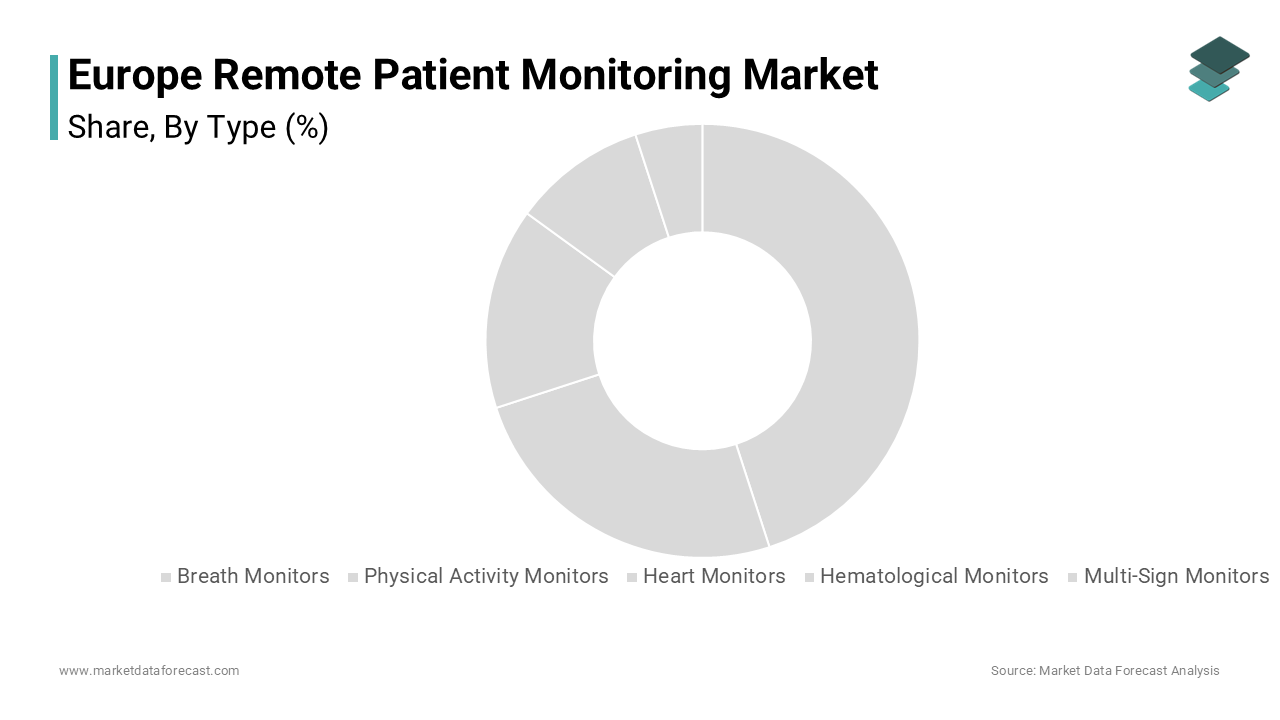
The multi-sign monitors segment is likely to grow with an anticipated CAGR of 18.7% during the forecast period. The growth of the segment is likely to be driven by the rising demand for holistic patient assessment in both chronic disease management and post-hospitalization care. Unlike single-parameter devices, multi-sign monitors simultaneously track vital parameters such as oxygen saturation, heart rate, respiratory rate, and temperature that offers a comprehensive clinical picture.
Further fueling the expansion of multi-sign monitors is their increasing adoption in home hospitalization and virtual ward models. Countries like Denmark and the UK have launched national virtual ward initiatives, where patients recovering from acute episodes are monitored remotely using multi-parameter devices.
By Application Insights
The Cardiovascular Diseases segment held 38.2% of the Europe Remote Patient Monitoring Market share in 2025 with the growing prevalence of heart-related conditions and the high clinical urgency associated with their management. The aging population, sedentary lifestyles, and rising hypertension rates have intensified the need for continuous cardiac monitoring outside hospital settings. Remote ECG devices, implantable loop recorders, and wearable Holter monitors are now routinely prescribed in countries like Germany and France for early arrhythmia detection and post-discharge surveillance. The integration of AI-driven analytics into cardiac RPM platforms has further enhanced clinical utility.
The sleep disorder and weight management segment is anticipated to grow at a CAGR of 17.3% from 2026 to 2034 owing to the rising awareness of sleep apnea and obesity-related comorbidities, both of which are increasingly recognized as public health priorities. According to the European Lung Foundation, an estimated 27 million adults in Europe suffer from obstructive sleep apnea, with over 80% remaining undiagnosed. Remote monitoring devices such as wearable oximeters, smart mattresses, and portable sleep analyzers are now enabling at-home diagnosis and treatment adherence tracking by reducing the burden on sleep clinics.
By End-Use Insights
The Hospitals segment was accounted in holding 42.3% of the Europe Remote Patient Monitoring Market share in 2025 with the integration of RPM into acute care delivery models, particularly in intensive care units, post-surgical recovery, and step-down units. Hospitals are increasingly deploying centralized remote monitoring systems to enhance patient safety and optimize staffing efficiency. For example, the implementation of enterprise-wide RPM platforms in major hospitals across Germany and Switzerland has enabled continuous surveillance of high-risk patients without requiring one-to-one bedside monitoring.
The home healthcare segment is projected to expand at a CAGR of 19.1% during the forecast period with a structural shift toward decentralized care, supported by aging populations, patient preference for home-based treatment, and cost containment pressures on public health systems. As per Eurostat, over 50% of Europeans aged 80 and above prefer to receive medical care at home, a trend reinforced by advancements in user-friendly RPM devices. Governments across Europe are actively promoting home-based monitoring to reduce hospital overcrowding. Germany’s DiGA and Digitale Pflegeanwendungen (DiPA) programs have approved over 40 remote monitoring applications for home use, including glucose trackers and respiratory sensors, with full insurance coverage.
REGIONAL ANALYSIS
Germany Remote Patient Monitoring Market Analysis
Germany was the top performer in the Europe Remote Patient Monitoring Market by holding 23.2% of share in 2025 with its robust digital health infrastructure and proactive regulatory environment. Germany’s Digital Healthcare Act (DiGA), enacted in 2020, allows patients to access FDA- and CE-approved digital therapeutics and monitoring tools through statutory health insurance, creating a direct reimbursement pathway. The country also leads in AI-integrated RPM solutions, with companies like Ada Health and Medisante advancing predictive analytics for chronic care.
France Remote Patient Monitoring Market Analysis
France was positioned second by occupying 16.3% of the Europe Remote Patient Monitoring Market share in 2024. The nation has made significant strides in integrating remote monitoring into its universal healthcare system, particularly for chronic disease management. The French government launched the “Télémédecine en Ville” initiative in 2021, which expanded reimbursement for teleconsultations and remote monitoring in primary care. A key driver is the national focus on reducing hospital readmissions for heart failure patients, with remote cardiac monitoring now standard in 18 regional health agencies.
United Kingdom Remote Patient Monitoring Market Analysis
The United Kingdom Remote Patient Monitoring Market is ascribed to have a significant CAGR during the forecast period. Following the pandemic, the NHS launched the “Virtual Wards” program, aiming to monitor 40,000 patients remotely by 2025, a target already exceeded in 2023 with over 50,000 enrolled patients. These programs rely heavily on multi-parameter RPM devices for respiratory, cardiac, and post-surgical care. The UK also benefits from a vibrant digital health startup ecosystem, with companies like Babylon Health and Huma pioneering AI-driven remote monitoring platforms.
Italy Remote Patient Monitoring Market Analysis
Italy Market growth is driven by regional disparities in healthcare access and a growing emphasis on decentralized care. The Lazio and Lombardy regions have pioneered remote monitoring for chronic obstructive pulmonary disease (COPD) and heart failure by achieving 27% fewer emergency visits in pilot cohorts, according to the Italian National Institute of Health. Italy’s fragmented healthcare system has led to localized innovation, with regional governments acting as early adopters.
COMPETITIVE LANDSCAPE
The competition in the Europe Remote Patient Monitoring Market is characterized by a convergence of medical technology leaders, digital health innovators, and national health system integrators. Established medtech firms leverage clinical credibility and regulatory expertise, while agile startups introduce AI-powered, patient-centric solutions. The fragmented nature of European healthcare systems fosters regional differentiation, with companies tailoring strategies to national reimbursement policies and digital infrastructure. Competition is intensifying around interoperability, data security, and clinical validation, with vendors striving to demonstrate measurable outcomes such as reduced hospitalizations and improved patient adherence.
KEY MARKET PLAYERS
Some of the companies that are playing a dominating role in the global remote patient monitoring market include
- Welch Allyn
- Bosch
- Johnson & Johnson
- Intel
- Roche
- Philips Healthcare
- Philips
- Healthanywhere Inc
- Honeywell American Telecare
- Biotronik and Covidien Plc
Top Players in the Europe Remote Patient Monitoring Market
Philips (Netherlands)
Philips has established itself as a transformative force in the Europe Remote Patient Monitoring Market through its integrated health technology platforms. In Europe, Philips has partnered with national health systems, including the NHS in the UK and hospitals in Germany, to deploy virtual wards and remote cardiac surveillance programs.
GE Healthcare (USA, with strong European presence)
GE Healthcare plays a pivotal role in advancing remote patient monitoring across Europe through its MUSE ECG management system and CARESCAPE platforms, which support centralized monitoring of ICU and step-down unit patients. The company has deep integration within European hospital networks, particularly in Germany, Italy, and Sweden, where its systems are used for continuous cardiac and vital sign surveillance. In recent years, GE Healthcare has enhanced its digital portfolio by incorporating predictive analytics to detect early signs of patient deterioration.
Siemens Healthineers (Germany)
Siemens Healthineers is a leading contributor to the Europe Remote Patient Monitoring Market, leveraging its expertise in medical imaging and digital health to expand into remote diagnostics and chronic disease management. Based in Erlangen, Germany, the company has developed the Teamplay digital health platform, which aggregates and analyzes patient data from connected devices, enabling remote oversight in cardiology and pulmonology. It has deployed Teamplay in over 300 European healthcare facilities, including major hospitals in Austria and the Netherlands, to support post-discharge monitoring and preventive care.
Top Strategies Used by the Key Market Participants
Key players in the Europe Remote Patient Monitoring Market employ strategic product innovation, regulatory alignment, and ecosystem partnerships to enhance their presence. Companies prioritize CE marking and compliance with EU MDR and GDPR to ensure market access and data security. Integration of artificial intelligence and predictive analytics into monitoring platforms enhances clinical value and differentiates offerings. Firms collaborate with national health systems to embed solutions within public care pathways, particularly in chronic disease and post-acute management. Expansion of reimbursable digital health applications under frameworks like Germany’s DiGA is a core focus.
MARKET SEGMENTATION
This research report on the European remote patient monitoring market has been segmented and sub-segmented into the following categories.
By Type
- Breath Monitors
- Physical Activity Monitors
- Heart Monitors
- Hematological Monitors
- Multi-Sign Monitors
By Application
- Cancer Treatment
- Cardiovascular Diseases
- Diabetes Treatment
- Sleep Disorder and Weight Management
- Fitness Monitoring
By End-Use
- Ambulatory Care Centers
- Hospitals
- Home Healthcare
By Country
- UK
- France
- Spain
- Germany
- Italy
- Russia
- Sweden
- Denmark
- Switzerland
- Netherlands
- Turkey
- Czech Republic
- Rest of Europe