- Product Description Description
- Table of Contents TOC
- List of Table & Figure LOT
- Get Free Sample PDF Sample PDF
Market Size, 2025
$2.35 BnMarket Estimate, 2026
$2.86 BnMarket Forecast, 2034
$13.93 BnCAGR, 2026–2034
21.86%Europe Hydrogen Fuel Cells Market Report Summary
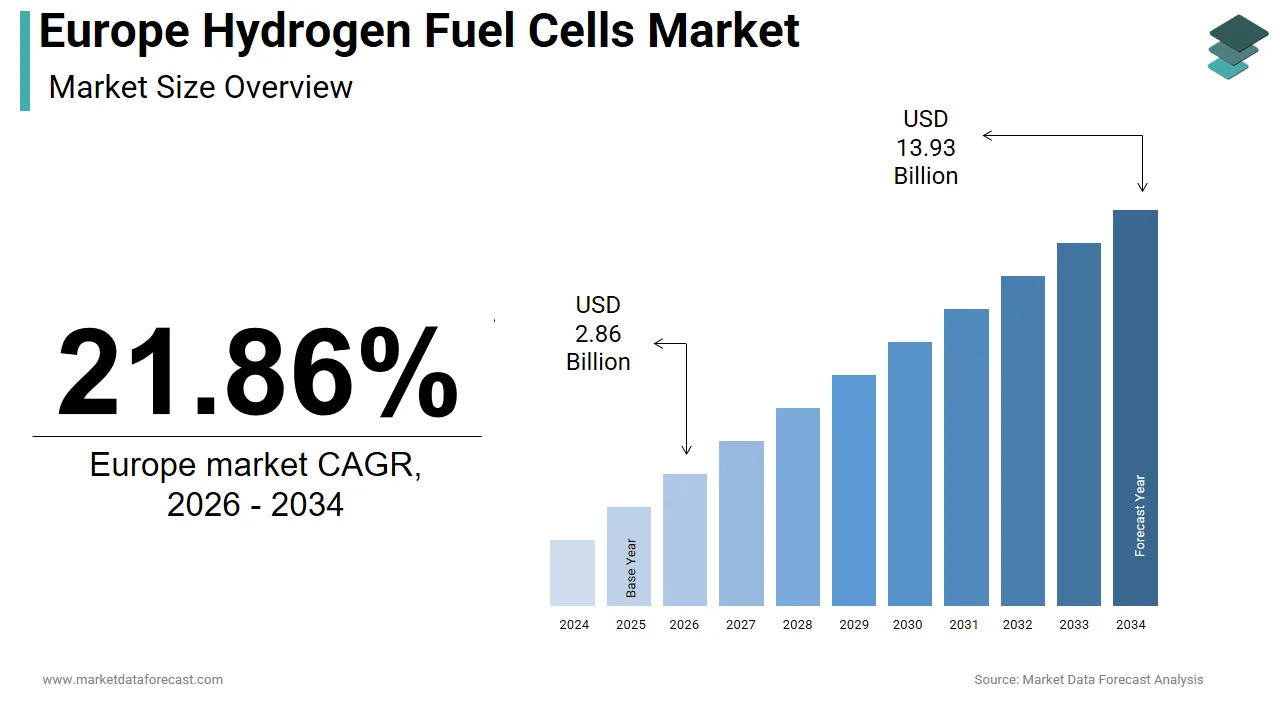
The Europe hydrogen fuel cells market was valued at USD 2.35 billion in 2025, is estimated to reach USD 2.86 billion in 2026, and is projected to reach USD 13.93 billion by 2034, growing at a CAGR of 21.86% from 2026 to 2034. Market growth is driven by increasing focus on decarbonization, rising investments in clean energy technologies, and strong government support for hydrogen-based solutions. Hydrogen fuel cells are gaining traction as a sustainable alternative for power generation and transportation, offering zero-emission energy output. The expansion of hydrogen infrastructure, integration with renewable energy sources, and growing adoption in mobility and industrial applications are further accelerating market growth across Europe.
Key Market Trends
- Increasing adoption of hydrogen as a clean energy source.
- Rising investments in fuel cell technology and hydrogen infrastructure.
- Growing demand for zero-emission transportation solutions.
- Expansion of renewable energy integration with hydrogen systems.
- Strong government support for decarbonization and green energy initiatives.
Segmental Insights
- Based on type, the water-cooled segment dominated the Europe hydrogen fuel cells market by capturing 76.7% share in 2025, driven by higher efficiency and suitability for large-scale applications.
- Based on application, the transport segment led the market with 64.6% share in 2025, supported by increasing adoption of hydrogen-powered vehicles and heavy-duty transport solutions.
Regional Insights
The Europe hydrogen fuel cells market is witnessing rapid growth across major countries due to strong policy support and clean energy transitions.
- Germany led the regional market in 2025 with 31.6% share, supported by extensive investments in hydrogen infrastructure and industrial decarbonization.
- France held the second-largest share, driven by a strong state-led approach focusing on mobility and industrial hydrogen ecosystems.
- The United Kingdom is expected to witness significant growth due to ambitious targets for offshore wind integration and hydrogen-based transport decarbonization.
Competitive Landscape
The Europe hydrogen fuel cells market is highly competitive, with the presence of global energy companies and fuel cell technology providers. Market players are focusing on innovation, scaling production capacity, and forming strategic partnerships to strengthen their position. Investments in hydrogen infrastructure, advancements in fuel cell efficiency, and collaborations with governments and industries are shaping competitive dynamics across the region.
Prominent companies operating in the Europe hydrogen fuel cells market include Ballard Power Systems, Plug Power, FuelCell Energy, Toyota Motor Corporation, Hydrogenics, ITM Power, PowerCell Sweden AB, Ceres Power, Nel ASA, Cummins Inc., Air Products and Chemicals, and Siemens AG.
Europe Hydrogen Fuel Cells Market Size
The size of the Europe hydrogen fuel cells market was worth USD 2.35 billion in 2025. The regional market is anticipated to grow at a CAGR of 21.86% from 2026 to 2034 and be worth USD 13.93 billion by 2034 from USD 2.86 billion in 2026.
Hydrogen fuel cells are electrochemical devices that convert chemical energy from hydrogen directly into electricity and serving as a critical decarbonization technology for heavy-duty transport, stationary power, and industrial processes. As of 2025, this sector operates at the intersection of the European Green Deal and the REPowerEU strategy, which explicitly identifies hydrogen as a cornerstone for achieving climate neutrality by 2050. According to the European Commission, the bloc aims to install a large capacity of renewable hydrogen electrolysers by 2030, which is creating strong downstream demand for fuel cell systems to utilize this clean gas. The market definition extends beyond automotive applications to include maritime propulsion, aviation auxiliary power units, and backup power solutions for data centers. As per Eurostat, the transport sector remains one of the largest contributors to EU greenhouse gas emissions, which indicate the urgent need for zero emission alternatives that batteries cannot fully address due to weight and range limitations. Furthermore, the European Environment Agency notes that hundreds of hydrogen refuelling stations were operational or under advanced construction across the continent by early 2025, which is forming the backbone of a continent wide network. The regulatory landscape is shaped by the Important Projects of Common European Interest on Hydrogen that mobilizes significant state aid to bridge the gap between pilot projects and commercial scalability. This strategic alignment positions fuel cells not merely as an alternative technology but as an essential component of the future European energy architecture.
MARKET DRIVERS
Mandatory De-carbonization Targets for Heavy-Duty Transport Sectors
The implementation of stringent regulatory mandates targeting CO2 emissions in heavy-duty transport is one of the major factors propelling the growth of the Europe hydrogen fuel cells market. Unlike light-duty vehicles where battery electric solutions dominate, the logistics, trucking, and bus sectors face unique challenges regarding payload capacity and operational range that fuel cells are uniquely positioned to solve. As per the European Union regulation on CO2 emission performance standards for new heavy-duty vehicles, manufacturers are legally required to achieve significant reductions in emissions by 2030 and 2035 compared to 2019 levels. According to the International Council on Clean Transportation, hydrogen fuel cells provide operational advantages for trucks covering long distances, which is offering fast refueling and extended range. In 2024, several major European cities expanded their zero-emission zones, effectively banning diesel buses and mandating the procurement of fuel cell electric buses for public transit fleets. As per the European Bus Operators Federation, orders for hydrogen buses rose sharply in 2024 as municipalities complied with urban access restrictions. Furthermore, the ReFuelEU Aviation initiative mandates a rising share of sustainable fuels, sparking interest in fuel cell applications for regional aircraft and ground support equipment. This regulatory pressure creates a non-negotiable market pull, which is compelling fleet operators to adopt fuel cell technology regardless of current cost premiums.
Strategic National Initiatives and Cross-Border Infrastructure Development
Massive government funding programs and the coordinated development of cross-border hydrogen infrastructure is further fuelling the Europe hydrogen fuel cells market expansion. The European Union has designated hydrogen as a strategic priority under the IPCEI framework that allow member states to provide substantial state aid for research, innovation, and industrial deployment of fuel cell technologies. According to the European Commission, numerous European nations have published dedicated national hydrogen strategies with combined public funding commitments in the tens of billions of euros. These funds directly subsidize the high capital expenditure associated with fuel cell stacks and system integration, which is making projects commercially viable for early adopters. The European Hydrogen Backbone initiative involves transmission system operators planning a dedicated hydrogen pipeline network by 2030, which will reduce the cost of hydrogen delivery to end users. As per the Clean Hydrogen Partnership, public-private investments in 2024 facilitated the deployment of new heavy-duty fuel cell vehicles and refueling stations along the Trans-European Transport Network corridors. Germany alone allocated substantial funding from its economic stimulus package to accelerate hydrogen mobility and establish hydrogen hubs that integrate production with vehicle deployment. This synchronized effort ensures that fuel cell vehicles have the necessary fuelling infrastructure to operate reliably across borders, which is removing the chicken-and-egg dilemma that previously hindered adoption.
MARKET RESTRAINTS
Prohibitive Costs of Green Hydrogen Production and Distribution
The high cost of producing green hydrogen and the lack of an established distribution network are primarily impeding the Europe hydrogen fuel cells market expansion. Currently, the levelized cost of green hydrogen produced via electrolysis powered by renewable energy remains significantly higher than grey hydrogen derived from natural gas or conventional diesel fuel. As per the International Energy Agency, the average cost of green hydrogen in Europe in 2024 was well above the target for cost competitiveness with fossil fuels. This price disparity makes the total cost of ownership for fuel cell vehicles unattractive for many commercial operators without heavy subsidies. The scarcity of liquid or gaseous hydrogen transport infrastructure further exacerbates the issue, as building a network of pipelines and trailers requires immense upfront capital. According to Hydrogen Europe, only a fraction of the required refueling infrastructure to support a mass market of fuel cell vehicles was operational in 2024, leading to range anxiety and logistical inefficiencies. The energy efficiency losses inherent in the power-to-gas-to-power cycle also draw criticism, as a large portion of the initial electrical energy is lost during conversion compared to direct battery charging. As per BloombergNEF, until renewable electricity prices drop consistently and electrolyzer capital costs decrease substantially, green hydrogen will remain a premium fuel accessible only to niche applications.
Technological Limitations Regarding Durability and Critical Material Dependency
Persistent technological challenges related to the durability of fuel cell stacks and the dependency on scarce critical raw materials are further hindering the growth of the Europe hydrogen fuel cells market. Proton Exchange Membrane fuel cells, which are the dominant technology for transport applications, rely heavily on platinum group metals as catalysts, which is creating supply chain vulnerabilities and cost volatility. As per the Joint Research Centre of the European Commission, the EU imports the vast majority of its platinum and iridium supplies, which is exposing the industry to geopolitical risks and price fluctuations. In 2024, platinum prices surged due to supply constraints, directly increasing the bill of materials for fuel cell systems. Furthermore, the operational lifespan of fuel cell stacks in heavy-duty applications often falls short of the required benchmarks to compete with internal combustion engines, with degradation rates accelerating under dynamic load conditions typical of trucking. According to the European Association for Storage of Energy, stack replacement costs can account for a significant portion of the total vehicle lifetime cost, which is deterring fleet operators concerned about maintenance downtime and residual values. The sensitivity of fuel cell membranes to impurities in hydrogen fuel also needs extremely high purity standards, adding complexity and cost to the refueling infrastructure. As per Ballard Power Systems, while progress has been made in reducing platinum loading, which is breakthroughs in non-precious metal catalysts or improved membrane durability are still years away from commercial readiness. These technical hurdles limit the reliability and economic viability of fuel cells, which is restricting their deployment to demonstration projects rather than mass-market commercialization.
MARKET OPPORTUNITIES
Expansion of Industrial Clusters and Sector Coupling Applications
The emergence of large-scale industrial hydrogen clusters and the concept of sector coupling present a promising opportunity for the Europe hydrogen fuel cells market to achieve critical mass. Instead of focusing solely on individual vehicles, the strategy involves creating localized ecosystems where hydrogen production, distribution, and consumption are co-located within industrial ports and manufacturing hubs. As per the European Commission, multiple large-scale hydrogen valleys have been identified across Europe, where fuel cell applications for port machinery, heavy trucks, and trains can operate on a dedicated local grid. This approach minimizes transportation costs and leverages existing industrial heat and power demands to optimize electrolyzer utilization rates. The steel and chemical industries, which require vast amounts of hydrogen for decarbonization, can serve as anchor tenants to guarantee baseline demand, thereby de-risking investments in fuel cell mobility for logistics within these zones. According to the HyDeal Ambition project, aggregating demand from multiple industrial off-takers could make fuel cell operations economically competitive by 2030. Furthermore, the integration of fuel cells with renewable energy sources allows for the storage of excess wind and solar power, providing grid balancing services that generate additional revenue streams. As per the Clean Hydrogen Partnership, projects utilizing sector coupling models secured more funding in 2024 compared to standalone mobility projects. This holistic ecosystem approach transforms fuel cells from a niche transport solution into an integral component of a flexible, decarbonized industrial energy system.
Advancement in Maritime and Aviation Propulsion Systems
The urgent need to decarbonize the maritime and aviation sectors offers a high-growth opportunity for the Europe hydrogen fuel cells market. The International Maritime Organization’s revised strategy aims for net-zero greenhouse gas emissions from international shipping by 2050, which is driving shipowners to explore hydrogen fuel cells for short-sea shipping, ferries and inland waterway vessels. As per DNV, numerous hydrogen-powered vessel projects were in development in Europe in 2024, including passenger ferries and cargo barges. Fuel cells offer the distinct advantage of zero emissions at the point of use and silent operation, which is highly valued for urban waterways and port areas with strict noise regulations. Similarly, the aviation sector is investigating fuel cells for regional turboprop aircraft and unmanned aerial vehicles, where the weight penalty of batteries makes long-range flight impossible. The European Union Aviation Safety Agency has begun drafting certification standards for hydrogen-powered aircraft, which is signalling regulatory readiness for commercial deployment. According to Airbus, its ZEROe program aims to bring a hydrogen-powered commercial aircraft to market by 2035, with fuel cells playing a key role in hybrid-electric architectures. The Clean Sky 2 joint undertaking has allocated significant funding to validate fuel cell technologies for aviation applications. Given that maritime and aviation together account for a substantial portion of global transport emissions, the successful deployment of fuel cells in these sectors could unlock a multi-billion euro market segment that is inaccessible to other zero-emission technologies.
MARKET CHALLENGES
Complexity of Regulatory Frameworks and Safety Standardization
The fragmented nature of regulatory frameworks and the lack of harmonized safety standards across European member states is challenging the growth of the Europe hydrogen fuel cells market. While the EU sets broad climate goals, the specific rules governing the production, transport, storage, and dispensing of hydrogen vary significantly between countries, which is creating legal uncertainty for investors and operators. As per Hydrogen Europe, discrepancies in national building codes and safety regulations regarding hydrogen refueling stations have led to delays in permitting. The classification of green hydrogen and the criteria for what constitutes renewable differ across jurisdictions, complicating the issuance of guarantees of origin and the application of subsidies. The European Committee for Standardization is working to unify protocols, but as of 2024, numerous local safety guidelines were still in effect, forcing manufacturers to customize equipment for each market. According to the Fraunhofer Institute, the lack of a unified EU-wide safety certification for fuel cell components increases compliance costs and hinders cross-border trade of hydrogen-powered vehicles. Furthermore, public perception regarding hydrogen safety, fueled by inconsistent messaging and a lack of standardized emergency response training, creates social resistance to infrastructure deployment in urban areas. Resolving these regulatory patchworks is essential to create a single market for hydrogen, yet the pace of legislative harmonization lags behind technological advancements and deployment ambitions.
Intense Global Competition and Supply Chain Vulnerabilities
The intensifying global competition for dominance in the hydrogen value chain and the vulnerability of critical supply lines present a strategic challenge for the Europe hydrogen fuel cells market. While Europe leads in policy ambition, it faces fierce competition from China and the United States, which are aggressively scaling up manufacturing capacities for electrolyzers and fuel cell stacks with substantial state backing. As per the International Energy Agency, China currently accounts for a large share of global fuel cell stack manufacturing capacity and produces components at lower costs than European counterparts due to vertically integrated supply chains. The US Inflation Reduction Act provides generous tax credits for clean hydrogen, creating a lucrative export market that threatens to divert European investment and talent. Europe’s reliance on imported critical raw materials such as platinum, iridium, and carbon fiber for fuel cell components exposes the industry to supply shocks and price volatility. According to the European Raw Materials Alliance, the EU has minimal domestic mining or refining capacity for these essential inputs, making the supply chain fragile. As per Wood Mackenzie, without rapid development of domestic manufacturing ecosystems and recycling capabilities, European fuel cell producers risk becoming assembly hubs dependent on foreign components, eroding their competitive edge. The race to secure long-term supply contracts for materials and establish gigafactories is intensifying, and any delay in European industrial scaling could result in a permanent loss of market share to Asian and American competitors who are moving faster to commercialize mass-production technologies.
REPORT COVERAGE
| REPORT METRIC | DETAILS |
| Market Size Available | 2025 to 2034 |
| Base Year | 2025 |
| Forecast Period | 2026 to 2034 |
| Segments Covered | By Type, Application, and Country. |
| Various Analyses Covered | Global, Regional, and Country-Level Analysis, Segment-Level Analysis, Drivers, Restraints, Opportunities, Challenges; PESTLE Analysis; Porter’s Five Forces Analysis, Competitive Landscape, Analyst Overview of Investment Opportunities |
| Countries Covered | UK, France, Spain, Germany, Italy, Russia, Sweden, Denmark, Switzerland, Netherlands, Turkey, Czech Republic, and the Rest of Europe. |
| Market Leaders Profiled | Ballard Power Systems, Plug Power, FuelCell Energy, Toyota Motor Corporation, Hydrogenics, ITM Power, PowerCell Sweden AB, Ceres Media, Nel ASA, Cummins Inc, Air Products and Chemicals, Siemens AG. |
SEGMENTAL ANALYSIS
By Type Insights
The water-cooled type segment dominated the market by accounting for 76.7% of the European market share in 2025. The dominance of water-cooled type segment in the European market is driven by superior thermal management capabilities required for high-power applications in heavy-duty transport and stationary power generation. The unmatched ability of water-cooled fuel cells to manage heat dissipation in high-power density environments, which is critical for heavy-duty trucks, buses, and trains is also boosting the expansion of the water-cooled segment in the European market. As per the European Association for Storage of Energy, the majority of heavy-duty fuel cell vehicles deployed in Europe in 2024 utilized water-cooled technology due to its ability to sustain continuous operation under full load. The specific heat capacity of water allows these systems to remove waste heat more effectively than air, enabling higher power densities essential for long-haul logistics. According to the International Council on Clean Transportation, water-cooled fuel cells achieve higher system efficiency in real-world driving cycles compared to air-cooled variants. Furthermore, the integration of waste heat recovery systems in water-cooled units allows for cabin heating in winter without compromising electrical output, a crucial feature for fleets operating in Northern Europe. This technical superiority ensures that water-cooled types remain the standard for demanding and voluminous segments of the market.
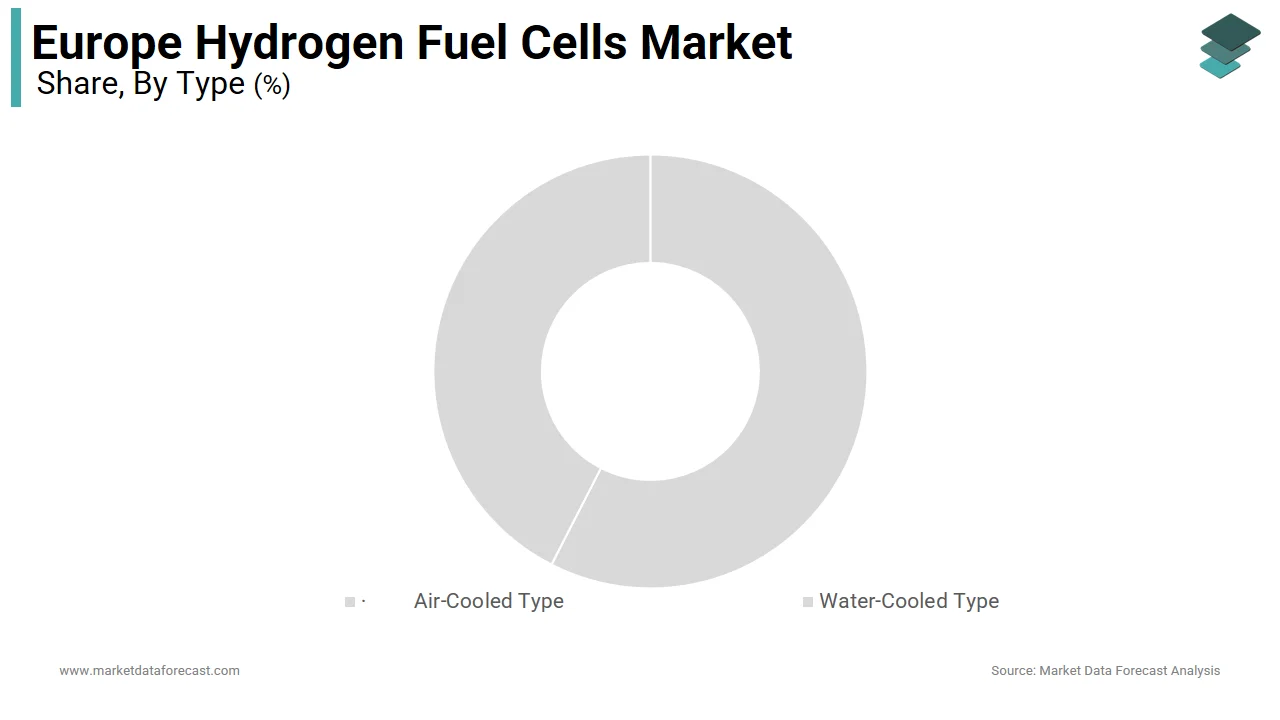
On the other side, the air-cooled type segment is the fastest growing category in the Europe hydrogen fuel cells market and is estimated to register a CAGR of 25.5% over the forecast period owing to the rising demand for lightweight, compact solutions in light-duty mobility and portable power applications. The inherent simplicity of air-cooled designs that eliminates the need for complex radiators, pumps and coolant loops is driving their rapid adoption in light-duty vehicles and urban mobility solutions, which is further contributing to the expansion of the air-cooled segment in the European market. As per BloombergNEF, the bill of materials for an air-cooled fuel cell system is significantly lower than that of a comparable water-cooled unit, improving economic viability for mass-market consumer vehicles. The absence of liquid cooling infrastructure simplifies maintenance and reduces risks, appealing to smaller fleet operators and individual consumers. According to the European Automobile Manufacturers Association, sales of light commercial vehicles equipped with air-cooled fuel cells grew strongly in 2024, driven by last-mile delivery services seeking zero-emission options. The compact form factor allows easier integration into existing vehicle platforms without major redesigns. As per IDTechEx, the power-to-weight ratio of modern air-cooled stacks has improved in recent years, enhancing competitiveness against battery electric systems in specific range brackets. This cost and weight advantage positions air-cooled technology as a key enabler for democratizing hydrogen mobility in urban settings.
By Application Insights
The transport segment led the market by capturing 64.6% of the European market share in 2025. The growth of transport segment in the European market is attributed to the regulatory push to decarbonize heavy-duty logistics and public transit where battery electrification faces limitations. Strict CO2 emission standards for heavy-duty vehicles serve as the primary catalyst for the transport segment's leadership. As per the International Council on Clean Transportation, battery electric trucks face payload penalties and charging constraints for long routes, making hydrogen fuel cells the preferred alternative. In 2024, major European logistics companies placed large orders for hydrogen fuel cell trucks to comply with upcoming low-emission zone restrictions in cities such as Paris, London, and Berlin. According to the European Commission, the Trans-European Transport Network corridors are being prioritized for hydrogen refueling infrastructure to support cross-border freight. According to ACEA, penetration of fuel cell electric buses in public transit fleets increased in 2024, which is also driven by municipal mandates for zero-emission transport. The inability of batteries to meet intensive duty cycles ensures fuel cells remain dominant in this sector.
However, the stationary segment is the fastest growing application in the Europe hydrogen fuel cells market and is anticipated to register a CAGR of 26.7% over the forecast period owing to the need for grid stability, backup power, and industrial decarbonization. The increasing volatility of electricity grids due to high shares of intermittent renewable energy sources is driving adoption of stationary fuel cells for grid balancing and peak shaving. As per the European Network of Transmission System Operators for Electricity, demand for ancillary services grew significantly in 2024, with hydrogen fuel cells emerging as a preferred technology due to their ability to run on stored green hydrogen for extended durations. Unlike batteries, fuel cells can provide power for days or weeks as long as fuel is available, making them ideal for prolonged low-wind and low-sun periods. According to the Clean Hydrogen Partnership, investments in stationary fuel cell projects for grid support increased in 2024, with several large-scale plants planned in Germany and the Netherlands. As per Aurora Energy Research, revenue potential from providing grid services could cover a substantial portion of operating costs for stationary fuel cell installations, making them financially attractive independent of subsidies. This critical role in grid architecture fuels the segment’s rapid expansion.
COUNTRY LEVEL ANALYSIS
Germany Hydrogen Fuel Cells Market Analysis
Germany dominated the hydrogen fuel cells market in Europe in 2025 with 31.6% of the regional market share. The dominance of Germany in the European market can be credited to its comprehensive National Hydrogen Strategy and massive public investment aimed at establishing a complete hydrogen value chain from production to end-use. The Federal Government has allocated billions of euros specifically for hydrogen technologies, fostering a vibrant ecosystem of automotive manufacturers, industrial giants, and startups. As per the German Ministry for Economic Affairs and Climate Action, the country expanded its hydrogen refueling network significantly in 2024, creating the densest infrastructure in Europe. Major industrial clusters in the Ruhr valley are transitioning to hydrogen for steel and chemical production, driving demand for large-scale stationary fuel cells. The presence of leading technology providers like Bosch and Siemens accelerates innovation and cost reduction. Furthermore, Germany's IPCEI projects facilitate cross-border collaboration, positioning it as the central hub for European hydrogen trade. This combination of policy ambition, industrial might, and infrastructure density secures Germany's dominant market position.
France Hydrogen Fuel Cells Market Analysis
France captured the second leading share of the Europe hydrogen fuel cells market in 2025 due to a strong state-led approach focusing on industrial decarbonization and mobility ecosystems. The French market status is influenced by the France 2030 investment plan, which dedicates billions of euros to developing a competitive hydrogen sector. The government actively supports the creation of hydrogen valleys where production and consumption are localized, such as in the Normandy and Occitanie regions. In 2024, France saw a rollout of hydrogen taxis and light commercial vehicles in Paris and Lyon, supported by purchase bonuses. As per the French Ministry of Ecological Transition, the country has set ambitious deployment targets for hydrogen vehicles by 2030, driving steady demand for fuel cell stacks. The nuclear-heavy electricity mix provides a stable source of low-carbon power for electrolysis, enhancing the sustainability profile of French green hydrogen. Companies like Michelin and Faurecia have formed joint ventures to manufacture fuel cell systems domestically, reducing reliance on imports. The port of Marseille is emerging as a hub for maritime fuel cell applications, leveraging its strategic location. This coordinated effort between state funding, industrial strategy, and urban mobility initiatives propels France's robust market growth.
United Kingdom Hydrogen Fuel Cells Market Analysis
The United Kingdom is estimated to account for a promising share of the Europe hydrogen fuel cells market during the forecast period due to its ambitious targets for offshore wind integration and heavy-duty transport decarbonization. The British market status is shaped by the UK Hydrogen Strategy, which aims to establish large-scale low-carbon hydrogen production capacity by 2030. The government has introduced innovative business models to de-risk investment and stimulate supply. In 2024, the UK launched pilot projects for hydrogen fuel cell buses in Aberdeen and London, expanding its zero-emission public transport fleet. As per the Department for Energy Security and Net Zero, the transport sector is the primary driver, with significant trials of hydrogen trucks on major logistics corridors. The country's vast offshore wind resources offer the potential for cheap green hydrogen production, attracting international developers. The presence of a strong financial services sector facilitates access to capital for large-scale fuel cell projects. Additionally, the UK is pioneering the use of fuel cells for backup power in telecommunications and data centers, driven by strict planning laws that restrict diesel generator use. This focus on integrating renewables with transport and critical infrastructure defines the UK's dynamic market landscape.
Netherlands Hydrogen Fuel Cells Market Analysis
The Netherlands is expected to witness a healthy CAGR in the Europe hydrogen fuel cells market during the forecast period owing to its role as a logistical gateway and a pioneer in port-based hydrogen economies. The Dutch market is defined by the Port of Rotterdam, which serves as the central hub for hydrogen import, production, and distribution in Northwest Europe. The national government has committed to installing several gigawatts of electrolyzer capacity by 2030, largely to serve industrial clusters and heavy transport. In 2024, the Netherlands expanded its network of public hydrogen refueling stations to support cross-border trucking routes to Germany and Belgium. As per the Netherlands Enterprise Agency, the country is a leader in deploying fuel cell electric trucks for last-mile delivery and port logistics, leveraging its dense distribution network. The "H2Delta" program fosters collaboration between grid operators, producers, and users to optimize infrastructure planning. The flat geography and high density of industrial activity make it an ideal testbed for stationary fuel cell applications in combined heat and power systems. Strong cooperation with neighboring countries ensures that Dutch initiatives have a ripple effect across the region. This strategic positioning as a hydrogen import and distribution hub drives the Netherlands' significant market presence.
Sweden Hydrogen Fuel Cells Market Analysis
Sweden is anticipated to record a notable CAGR in the Europe hydrogen fuel cells market during the forecast period. Sweden stands out as a global leader in fossil-free steel production and heavy transport innovation. The Swedish market is characterized by the HYBRIT project, which is a ground-breaking initiative to replace coking coal with green hydrogen in steelmaking and is creating massive demand for industrial fuel cell and electrolyzer technologies. The government's goal of achieving a fossil-free vehicle fleet by 2030 has spurred extensive trials of hydrogen trucks and buses, particularly in mining and forestry sectors where electrification is challenging. In 2024, Sweden inaugurated new refueling stations along the Scandinavian corridor, facilitating cross-border transport with Norway and Finland. As per the Swedish Energy Agency, the country leverages its abundant hydro and wind power to produce some of the cheapest green hydrogen in Europe, attracting energy-intensive industries. Volvo Group and Scania are actively developing and testing heavy-duty fuel cell trucks for commercial release, driving domestic technological advancement. The strong cultural commitment to sustainability and supportive regulatory framework encourage early adoption across all sectors. This unique combination of industrial transformation, natural resource abundance, and automotive innovation positions Sweden as a key player in the European market.
COMPETITIVE LANDSCAPE
The competition in the Europe hydrogen fuel cells market is intense and characterized by a mix of specialized pure-play technology providers and diversified industrial conglomerates entering the space. Market participants compete fiercely on technology performance, system durability, and the ability to scale production to meet growing demand from heavy-duty transport sectors. Differentiation increasingly relies on offering integrated solutions that combine fuel cell stacks with hydrogen storage and thermal management systems to simplify adoption for original equipment manufacturers. New entrants face significant barriers due to high capital requirements for research and development and the need for proven track records in harsh operating conditions. Incumbents leverage their established relationships with automotive giants and government bodies to secure large-scale contracts and funding opportunities. The landscape is shifting as companies form consortia to share the financial burden of infrastructure development and standardize components across different vehicle types. Regulatory compliance and the ability to source materials sustainably have become critical factors influencing procurement decisions across the region. This dynamic environment drives continuous innovation in efficiency and cost reduction while forcing companies to adapt rapidly to evolving policy frameworks and market conditions.
KEY MARKET PLAYERS
The leading companies operating in the Europe hydrogen fuel cells market include:
- Ballard Power Systems
- Plug Power
- FuelCell Energy
- Toyota Motor Corporation
- Hydrogenics
- ITM Power
- PowerCell Sweden AB
- Ceres Media
- Nel ASA
- Cummins Inc.
- Air Products and Chemicals
- Siemens AG
TOP PLAYERS IN THE MARKET
- Ballard Power Systems Inc stands as a global pioneer in proton exchange membrane fuel cell technology with a profound impact on the European heavy-duty transport sector. The Canadian company maintains a significant manufacturing and engineering presence in Europe to serve local demand for buses, trucks, and trains. Ballard recently expanded its production capabilities in Germany to accelerate the delivery of fuel cell modules to European original equipment manufacturers. The firm actively collaborates with major automotive partners to integrate its next-generation stacks into commercial vehicles designed for long-haul logistics. Its global contribution involves setting industry standards for durability and power density that drive the entire sector forward. Ballard continues to invest heavily in research to reduce platinum loading and improve cold weather performance. These strategic moves ensure its position as a primary technology provider for decarbonizing European mobility without relying on vertical integration into vehicle manufacturing.
- Cummins Inc operates as a diversified power giant that has aggressively pivoted toward hydrogen solutions through its Accelera brand to serve the European market. The American corporation leverages its extensive global distribution network to supply fuel cell systems and electrolyzers for transport and stationary applications across the continent. Cummins recently completed the acquisition of a leading European electrolyzer manufacturer to strengthen its integrated green hydrogen value chain offerings. The company actively partners with bus operators and truck manufacturers to deploy zero-emission powertrains that meet stringent EU emission regulations. Its global influence stems from providing complete energy solutions that combine generation, storage, and propulsion technologies. Cummins focuses on scaling production to lower costs and improve the total cost of ownership for fleet operators. Recent initiatives include launching high-power fuel cell engines specifically designed for heavy-duty European trucks. These efforts demonstrate its commitment to becoming a dominant supplier of comprehensive hydrogen power systems in the region.
- Toyota Motor Corporation is a Japanese automotive leader that plays a pivotal role in the European hydrogen fuel cells market through its advanced Mirai technology and commercial vehicle partnerships. The company supplies robust fuel cell stacks to European bus manufacturers and logistics firms seeking reliable zero-emission solutions. Toyota recently announced plans to expand its hydrogen engine development programs in Europe to complement its fuel cell electric vehicle strategy. The firm leverages its decades of experience to offer highly durable and efficient systems that operate effectively in diverse European climates. Its global contribution includes driving down costs through mass production techniques refined over years of passenger car deployment. Toyota actively engages with European policymakers to advocate for hydrogen infrastructure development and regulatory support. Recent actions involve collaborating with industrial partners to test hydrogen fuel cells in heavy-duty trucks and maritime applications. These strategic developments solidify its reputation as a trusted provider of proven hydrogen technology for diverse mobility needs.
TOP STRATEGIES USED BY KEY MARKET PARTICIPANTS
Key players in the Europe hydrogen fuel cells market primarily focus on forming strategic joint ventures with automotive manufacturers to co-develop and commercialize heavy-duty vehicle platforms. Companies are actively investing in vertical integration to secure supply chains for critical components like membranes and catalysts while reducing production costs. Participants pursue geographic expansion by establishing local manufacturing hubs within Europe to comply with regional content requirements and minimize logistics expenses. Market leaders engage in extensive pilot projects with public transit authorities and logistics firms to demonstrate operational viability and gather real-world performance data. Collaboration with energy utilities and infrastructure developers ensures the simultaneous growth of refueling networks to support vehicle deployment. Firms also prioritize research and development to enhance stack durability and power density while reducing reliance on precious metals. Diversification into stationary power and maritime applications allows companies to mitigate risks associated with fluctuations in the transport sector. These collective strategies aim to accelerate commercialization and achieve cost parity with conventional diesel technologies.
MARKET SEGMENTATION
This research report on the Europe hydrogen fuel cells market has been segmented and sub-segmented into the following categories.
By Type
- Air-Cooled Type
- Water-Cooled Type
By Application
- Stationary
- Transport
- Portable
By Country
- United Kingdom
- France
- Spain
- Germany
- Italy
- Russia
- Sweden
- Denmark
- Switzerland
- Netherlands
- Rest of Europe