- Product Description Description
- Table of Contents TOC
- List of Table & Figure LOT
- Get Free Sample PDF Sample PDF
Market Size, 2025
$258 BnMarket Estimate, 2026
$266.26 BnMarket Forecast, 2034
$342.56 BnCAGR, 2026–2034
3.20%Europe Legal Services Market Summary
The Europe legal services market is expanding steadily, driven by increasing regulatory complexity, cross-border corporate activity, and rising demand for compliance, ESG, and digital governance advisory. The legal ecosystem includes law firms, in-house legal teams, and alternative legal service providers delivering services across corporate law, litigation, IP, financial regulation, and public policy. EU initiatives such as the Green Deal, Digital Services Act, and AI Act continue to intensify the need for specialized legal interpretation and advisory services.
Market Size & Growth:
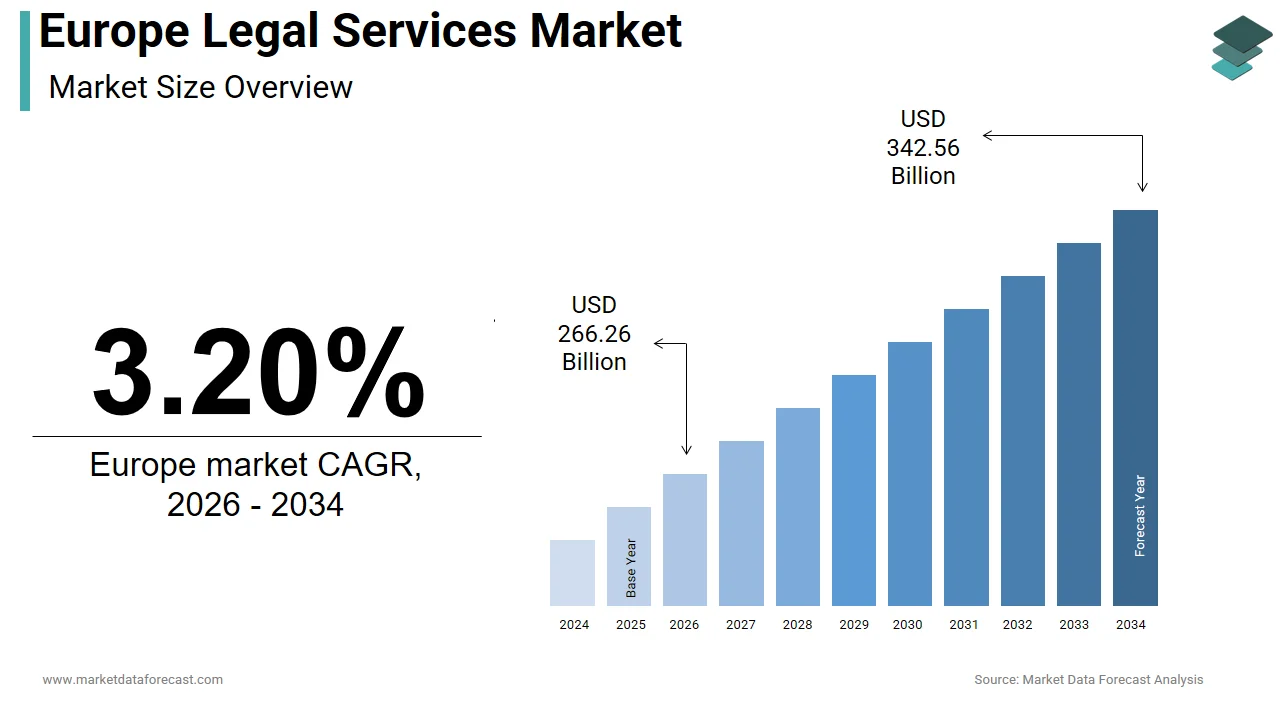
- Valued at USD 258 billion in 2025, estimated to reach USD 266.26 billion in 2026, and projected to grow to USD 342.56 billion by 2034.
- CAGR estimated at 3.20% for the 2026–2034 period.
Key Drivers:
- Regulatory Proliferation – New EU laws on sustainability, digital governance, and corporate transparency drive continuous legal advisory demand.
- Green & Digital Agendas – ESG, CSRD, DORA, and AI Act compliance requires specialized legal interpretation.
- Cross-Border M&A Activity – Rising foreign investment and intra-European mergers increase multijurisdictional legal complexity.
- Corporate Governance Reforms – Firms require legal support for disclosure, compliance, and board advisory services.
Leading Segments:
- End Users: Private Consumers, Large Businesses – Individuals drive civil and family law demand, while corporations dominate regulatory and transactional services.
- Applications: Corporate Law, Financial & Commercial Law – Corporate law leads; financial and ESG-related legal services are the fastest-growing.
- Firm Size: Large Law Firms, SME Firms – Large firms dominate complex mandates; SME firms grow rapidly with digital and niche services.
Key Trends:
- AI in Legal Processes – Automation of contract review, legal research, and compliance monitoring.
- ESG & Sustainable Finance Law – Rising demand for green finance, climate liability, and anti-greenwashing advisory.
- Digital Legal Services – Growth of hybrid and virtual legal consultations.
- Regulatory Specialization – Firms building dedicated AI, ESG, and data governance teams.
Market Restraints:
- Bar Association Restrictions – Limits on multidisciplinary partnerships restrict innovation in legal service delivery.
- Judicial Backlogs – Long case resolution times reduce litigation attractiveness in some countries.
Market Challenges:
- Talent Shortages – Lack of lawyers trained in AI law, ESG, and digital regulation.
- Data Sovereignty Conflicts – GDPR and Schrems II complicate cross-border legal tech usage.
Major Players:
- Freshfields Bruckhaus Deringer LLP, Clifford Chance LLP, Allen Overy Shearman Sterling LLP, Linklaters LLP, White & Case LLP.
Europe Legal Services Market Size
The size of the Europe legal services market was worth USD 258 billion in 2025. The regional market is anticipated to grow at a CAGR of 3.20% from 2026 to 2034 and be worth USD 342.56 billion by 2034 from USD 266.26 billion in 2026.
The legal services are a sophisticated ecosystem of law firms, corporate legal departments, and alternative legal service providers delivering counsel across regulatory compliance, dispute resolution, intellectual property, and cross-border transactions. The European Commission’s Better Regulation Agenda has intensified demand for legal interpretation as over 120 major legislative acts, including the Corporate Sustainability Reporting Directive and the Digital Operational Resilience Act, entered into force between 2022 and 2024. Meanwhile, the European Judicial Network reported a 23% increase in cross-border commercial disputes in 2023, reflecting deeper economic integration.
MARKET DRIVERS
Accelerated Regulatory Proliferation Under EU Green and Digital Agendas
The expansion of EU legislative mandates across sustainability and digital governance has created sustained demand for specialized legal advisory services. This is a major factor propelling the growth of the Europe legal services market. As per the European Commission, over 45 new regulatory frameworks were enacted between 2021 and 2024 under the European Green Deal and Digital Strategy alone, requiring businesses to reconfigure governance structures and reporting mechanisms. The Corporate Sustainability Due Diligence Directive obliges companies with significant EU operations to conduct mandatory human rights and environmental risk assessments across entire value chains, a process demanding extensive legal oversight. According to the European Environment Agency, 68% of large enterprises engaged external counsel in 2023 to interpret and implement these obligations. Similarly, the Digital Services Act and AI Act impose tiered compliance obligations based on platform size, with legal teams required to draft algorithmic transparency reports and risk mitigation plans. A 2024 survey by the Council of Bars and Law Societies of Europe found that 81% of law firms established dedicated ESG and tech regulatory practice groups in the past two years.
Rising Cross-Border Corporate Activity and Mergers and Acquisitions
The deepening economic integration and strategic realignment have intensified cross-border legal complexity is additionally leverages the growth of Europe legal services market. According to Eurostat, foreign direct investment inflows into the EU reached 690 billion euros in 2023, with intra- European M and A transactions accounting for 57% of the total volume. Each transaction necessitates multijurisdictional due diligence, merger control filings, and post-acquisition integration under varying national labor and tax regimes. The European Central Bank noted that over 400 significant cross-border banking and insurance consolidations occurred in 2023 as firms restructured post Brexit and in response to energy market volatility. Additionally, the Chips Act and Critical Raw Materials Act have spurred strategic alliances in semiconductors and battery supply chains requiring complex joint venture agreements governed by both EU competition law and national security reviews.
MARKET RESTRAINTS
National Bar Restrictions on Multidisciplinary and Alternative Service Models
Despite EU harmonization efforts, national bar associations continue to impose significant constraints on legal service innovation through restrictive practice rules. The national bar restrictions on multidisciplinary and alternative service models are majorly restraining the growth of Europe legal services market. As per the European Commission’s 2024 Services Directive review, 19 member states prohibit lawyers from forming integrated partnerships with accountants, consultants, or technologists, limiting holistic client solutions. In Germany, for instance, the Federal Lawyers Act forbids fee sharing with non-lawyers, effectively blocking law firm acquisitions by professional services giants. Similarly, Italy’s National Bar Council requires all legal advice to be delivered by individually licensed attorneys, impeding scalable technology-enabled models. A 2024 OECD assessment concluded that such barriers reduce cost efficiency and delay adoption of legal tech tools like predictive analytics and smart contracts.
Persistent Judicial Backlogs and Delays in Civil Proceedings
The chronic court congestion, across several EU jurisdictions, undermines the predictability and enforceability of legal rights, thereby dampening demand for litigation services. The persistent judicial backlogs and delays in civil proceedings are also inhibiting the growth of Europe legal services market. According to the European Commission for the Efficiency of Justice, over 40% of civil cases in Italy, Spain, and Greece take more than three years to resolve, compared to the EU median of 14 months. These delays incentivize parties to pursue out-of-court settlements or arbitration even when legal merits favor litigation. Consequently, many businesses deprioritize legal enforcement in high-backlog countries, treating it as a sunk cost rather than a recoverable right.
MARKET OPPORTUNITIES
Integration of Artificial Intelligence for Legal Process Automation
The adoption of artificial intelligence in legal workflows to enhance efficiency, scalability, and accessibility is creating new opportunities for the growth of Europe legal services market. As per the European Patent Office, over 1,200 AI-related legal tech patents were filed by European entities in 2023, with applications in contract analysis e discovery and regulatory monitoring. The European Commission’s AI Act provides a risk-based regulatory framework that legitimizes the use of high-quality AI tools in low-risk legal functions, such as document review and legal research. Moreover, the European Legal Tech Association reports that 63% of in-house legal departments now allocate dedicated budgets for AI integration.
Expansion of Legal Services in ESG and Sustainable Finance Compliance
The rapid institutionalization of environmental, social, and governance in European finance has created a specialized and high-value legal domain, which is expected to elevate the growth of Europe legal services market. As per the European Securities and Markets Authority, over 5,700 investment funds had registered as Article 9 or Article 8 under the Sustainable Finance Disclosure Regulation by early 2024, requiring rigorous legal verification of sustainability claims. The EU Taxonomy for Sustainable Activities alone contains over 100 technical screening criteria across 13 sectors, necessitating continuous legal interpretation. Law firms, such as Freshfields and Linklaters, have established dedicated sustainable finance practices advising on green bond frameworks, transition plans, and anti-greenwashing litigation risks. A 2024 survey by the Principles for Responsible Investment found that 89% of asset managers now require external legal validation of ESG data before portfolio allocation. Furthermore, the European Banking Authority’s climate stress tests mandate scenario analysis grounded in legal contracts and liability frameworks. This convergence of finance regulation and sustainability policy ensures that ESG legal advisory will remain a premium and expanding segment of the European market.
MARKET CHALLENGES
Talent Shortage in Specialized Regulatory and Tech Law Expertise
The legal profession faces a deficit of professionals skilled in emerging regulatory domains, such as AI law, data governance, and sustainable finance, which is a challenge for the growth of the Europe legal services market. According to Eurostat, Europe will require an additional 120,000 lawyers with digital and sustainability competencies by 2027, yet current law school curricula remain largely traditional. A 2024 study by the European University Association found that only 28% of EU law faculties offer mandatory courses in digital regulation or climate law. This gap is particularly acute in Central and Eastern Europe, where firms report vacancy periods exceeding 180 days for roles requiring GDPR AI Act or CSRD expertise, as per the International Bar Association. Consequently, firms resort to costly retraining or offshore augmentation, which may not satisfy EU data residency requirements.
Data Sovereignty and Cross-Border Client Confidentiality Conflicts
The increasing reliance on cloud-based legal technologies has intensified tensions between EU data protection mandates and global practice models. As per the European Data Protection Board, over 65% of international law firms use US-hosted legal tech platforms for document management and collaboration, yet the Schrems II ruling invalidates standard contractual clauses for sensitive legal data without supplementary safeguards. In 2023, the French Data Protection Authority fined a multinational firm 1.2 million euros for transferring privileged client communications to a US based e discovery vendor without adequate encryption or jurisdictional isolation. Germany’s Federal Bar has issued strict guidance prohibiting cloud storage of case files outside EU-certified data centers. These constraints fragment technology adoption, with firms maintaining separate systems for EU and non-EU matters, increasing operational cost and error risk. A 2024 survey by the Council of Bars and Law Societies of Europe revealed that 71% of firms delay technology investment due to compliance uncertainty. Until harmonized secure legal cloud standards emerge under GAIA X or similar EU infrastructures, data sovereignty will remain a structural barrier to digital transformation in the European legal market.
REPORT COVERAGE
| REPORT METRIC | DETAILS |
| Market Size Available | 2025 to 2034 |
| Base Year | 2025 |
| Forecast Period | 2026 to 2034 |
| Segments Covered | By End User, Application, Service, Mode of Delivery, Firm Size, and Country. |
| Various Analyses Covered | Global, Regional, and Country-Level Analysis, Segment-Level Analysis, Drivers, Restraints, Opportunities, Challenges; PESTLE Analysis; Porter’s Five Forces Analysis, Competitive Landscape, Analyst Overview of Investment Opportunities |
| Countries Covered | UK, France, Spain, Germany, Italy, Russia, Sweden, Denmark, Switzerland, Netherlands, Turkey, Czech Republic, and the Rest of Europe. |
| Market Leaders Profiled | Freshfields Bruckhaus Deringer LLP, Clifford Chance LLP, Allen Overy Shearman Sterling LLP, Linklaters LLP, White & Case LLP, and Others. |
SEGMENTAL ANALYSIS
By End User Insights
The private consumers segment accounted in holding 41.6% of the Europe legal services market share in 2024, with the rising civil disputes, housing complexity, and family law needs across aging and urbanizing populations. According to Eurostat, over 5.2 million civil litigation cases involving individuals were filed in EU courts in 2023, with property, inheritance, and family matters representing 68% of filings. In Germany alone, divorce rates increased by 9% between 2022 and 2024, as reported by the Federal Statistical Office, directly fueling demand for family law practitioners. Urbanization has intensified real estate transactions and tenancy conflicts. Spain recorded 320 000 landlord-tenant disputes in 2023, many requiring legal mediation. Additionally, the expansion of consumer rights under the EU Omnibus Directive empowers individuals to pursue legal remedies for unfair commercial practices, with national enforcement bodies reporting a 27% rise in consumer complaints in 2024, as per the European Consumer Organisation. The growing awareness of legal entitlements, combined with accessible digital consultation platforms, ensures sustained engagement from private individuals across the continent.
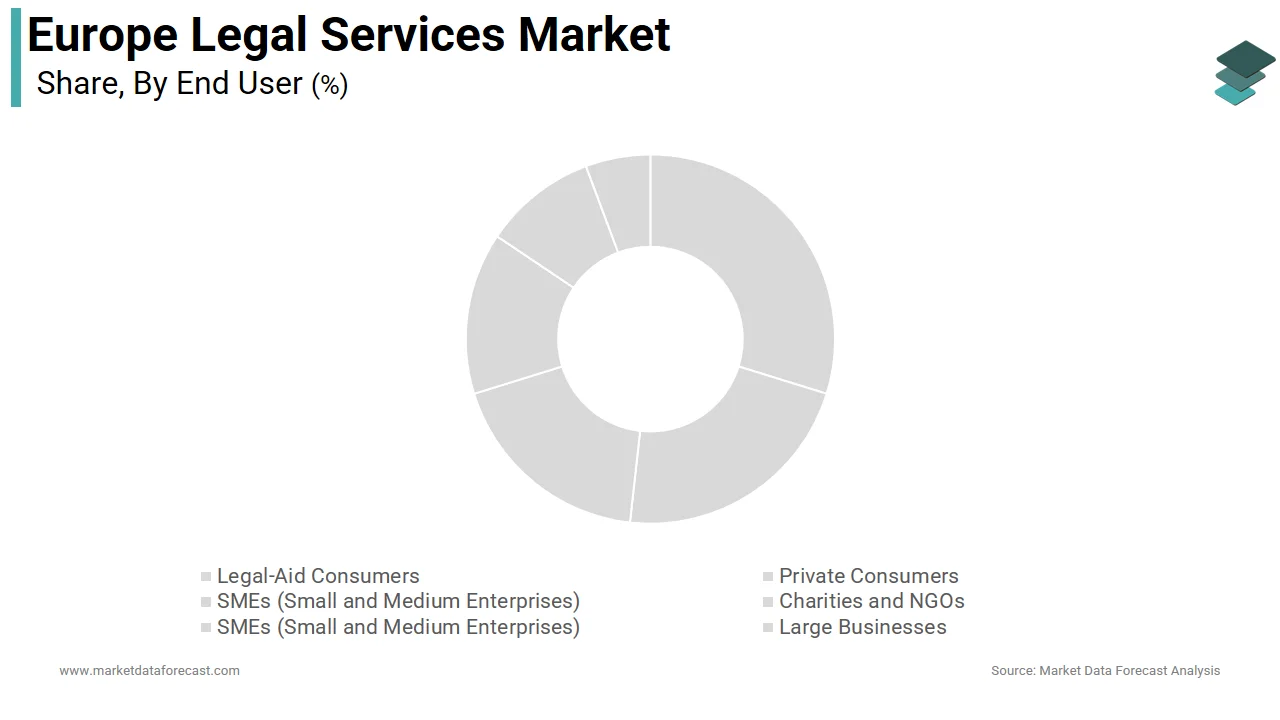
The legal aid consumer segment is projected to witness the fastest CAGR of 9.8% during the forecast period owing to the EU-mandated access-to-justice reforms, judicial efficiency initiatives, and rising socioeconomic inequality. As per the European Commission’s 2023 Justice Scoreboard, 22 member states have expanded eligibility thresholds for state-funded legal assistance since 2021, with France now covering 42% of its population compared to 35% in 2020. The European Court of Human Rights has consistently ruled that inadequate legal aid violates Article 6 of the European Convention on Human Rights, compelling national reforms. In the Netherlands, the Legal Aid Council reported a 34% increase in applications between 2022 and 2024, largely from low-income migrants and refugees navigating residency and labor disputes. The EU’s Recovery and Resilience Facility has allocated over 1.3 billion euros to modernize legal aid infrastructure, including digital intake systems and paralegal training in Italy, Spain, and Greece. Furthermore, the European Legal Network for Access to Justice documented that 58% of legal aid cases now involve digital rights or social welfare claims, areas previously underrepresented.
By Application Insights
The corporate law segment was the largest by holding 47.3% of the Europe legal services market share in 2024, with the relentless regulatory change, cross-border transactional activity, and internal governance demands. According to the European Commission, over 120 major legislative acts affecting corporate governance entered into force between 2022 and 2024, including the Corporate Sustainability Reporting Directive and the Foreign Subsidies Regulation. Compliance with these frameworks requires extensive legal interpretation, disclosure drafting, and board advisory tasks that multinational enterprises routinely outsource to specialized firms. The European Central Bank reported 412 significant cross-border M&A deals in 2023, each involving multijurisdictional due diligence, antitrust filings, and post-merger integration under diverse labor laws. Additionally, the European Corporate Governance Institute noted that 79% of EU-listed companies revised their articles of association in 2023 to align with new ESG disclosure obligations. Law firms such as Linklaters and Freshfields have expanded their corporate compliance teams by over 150 lawyers each in the past two years to meet this demand. The sheer density of EU regulatory output ensures that corporate legal advisory remains the backbone of the European legal economy.
The financial and commercial law segment is likely to witness the fastest CAGR of 11.2% from 2025 to 2033 with the rapid institutionalization of sustainable finance, banking consolidation, and digital asset regulation. As per the European Securities and Markets Authority, over 5 800 investment funds had registered under the Sustainable Finance Disclosure Regulation by early 2024, each requiring legal validation of ESG claims and taxonomy alignment. A 2024 survey by the International Swaps and Derivatives Association found that 67% of European banks hired external counsel to redesign derivatives documentation for ESG-linked terms. Moreover, the EU’s Anti-Money Laundering Authority, established in 2024, has intensified scrutiny on beneficial ownership and transaction monitoring, increasing demand for compliance audits.
By Firm Size Insights
The large law firms segment held 58.3% of the Europe legal services market share in 2024 due to their capacity to handle complex multinational mandates, regulatory depth, and institutional client relationships. According to the Council of Bars and Law Societies of Europe, firms with more than 200 lawyers account for over 70% of revenue in cross-border corporate and financial matters. These firms maintain offices in multiple EU capitals by enabling seamless navigation of divergent national implementations of EU law, such as Germany’s Supply Chain Act versus France’s Duty of Vigilance Law. Their investment in legal technology is also disproportionate; a 2024 survey by the International Bar Association found that 85% of large firms use AI-powered contract analytics, compared to only 22% of SME firms. Moreover, in-house legal departments of Fortune 500 European companies routinely consolidate external counsel to three to five elite firms to ensure consistency in ESG reporting, data governance, and litigation strategy.
The SME segment is likely to register the fastest CAGR of 10.4% from 2025 to 2033, owing to the digital democratization, niche specialization, and rising demand from small businesses and individuals. As per Eurostat, Europe is home to over 22 million SMEs, 89% of which lack in-house legal counsel and rely on external advisors for contracts, employment issues, and compliance. The European Commission’s Digital Europe Programme has funded legal tech platforms like LawTech Europe that enable small firms to offer fixed-fee services via automated workflows, thereby reducing client costs by up to 40%, as documented by the European Legal Tech Association. Many SME firms now specialize in emerging areas such as digital rights, gig economy disputes, and local ESG compliance for small manufacturers, where large firms are perceived as overpriced or inflexible. A 2024 study by the University of Bologna found that SME firms using cloud-based practice management tools grew revenue 2.3 times faster than peers. This agility, affordability, and community embeddedness position SME law firms as vital and rapidly expanding participants in Europe’s legal ecosystem.
COUNTRY-LEVEL ANALYSIS
United Kingdom Legal Services Market Analysis
The United Kingdom was the top performer of the Europe legal services market by capturing 21.3% of the market share in 2024, functioning as a global hub for international arbitration, corporate law, and financial regulation. London remains the most preferred seat for cross-border commercial disputes, with the London Court of International Arbitration registering a 19% increase in cases in 2023, as per its annual report. The UK’s common law system, English language advantage, and concentration of Magic Circle firms attract multinational clients seeking enforceable judgments. The Solicitors Regulation Authority licenses over 210 000 practicing solicitors, the highest per capita density in Europe. The Financial Conduct Authority’s aggressive enforcement of ESG disclosure rules has also spurred demand for compliance advisory, with UK law firms advising 38% of EU-based asset managers on SFDR alignment, according to the International Bar Association.
Germany Legal Services Market Analysis
Germany was positioned second by holding 18.3% of the share in 2024 with an anchored industrial economy, robust civil law tradition, and regulatory compliance. As per the German Federal Bar, over 170 000 lawyers are registered in Germany, the highest absolute number in Europe, with strong representation in manufacturing, automotive, and chemical sectors. The country’s pioneering Supply Chain Due Diligence Act has made it a focal point for corporate human rights compliance, with 73% of DAX 30 companies engaging external counsel for implementation, as noted by the German Chamber of Industry and Commerce. Frankfurt’s emergence as a post-Brexit financial center has also expanded demand for banking and capital markets law, with BaFin approving 42 new fintech licenses in 2023, requiring extensive legal structuring. Additionally, Germany’s dual education system produces highly specialized legal professionals in technical fields like patent law. The Federal Constitutional Court’s active jurisprudence on digital privacy and climate liability further drives litigation and advisory work.
France Legal Services Market Analysis
France legal services market growth is likely to grow with the strong state involvement in legal services, civil law codification, and sustainable finance law. The Paris Bar, with over 75,000 members, is Europe’s largest single-bar association and a key player in international arbitration, with the Paris International Commercial Court handling 87 cross-border disputes in 2023. France’s pioneering Duty of Vigilance Law has set a global benchmark for corporate accountability, prompting over 300 large enterprises to retain specialized counsel for risk mapping and remediation as per the French Ministry of Justice. Additionally, France mandates state-funded legal aid for 42% of its population, the highest coverage in the EU, by ensuring consistent demand from public service providers.
Netherlands Legal Services Market Analysis
The Netherlands legal services market is witnessing a steady growth with its favorable corporate regime, multilingual talent, and role as a gateway for international litigation. Dutch courts are increasingly chosen for class actions under the 2020 Collective Redress Directive, with the Amsterdam Court of Appeal adjudicating 24 cross-border collective claims in 2023 involving data privacy and consumer rights, as per the Dutch Judiciary. The country hosts over 15 000 multinational headquarters that rely on Dutch legal counsel for EU market entry, tax structuring, and IP protection. The Hague’s status as the seat of international courts, including the International Court of Justice, fosters a dense ecosystem of public international law experts. Moreover, the Netherlands Authority for the Financial Markets has led enforcement of MiFID II and SFDR, generating steady advisory work. A 2024 OECD review noted that Dutch law firms rank highest in the EU for English proficiency and digital readiness, making them preferred partners for global clients. This strategic positioning ensures outsized influence relative to national population size.
Switzerland Legal Services Market Analysis
Switzerland legal services market growth is likely to grow with its neutrality, banking secrecy legacy, and excellence in arbitration and private client law. As per the Swiss Bar Association, over 12,000 lawyers serve a highly affluent domestic and international clientele, with Zurich and Geneva ranking among the top five global cities for private wealth management. The Swiss Chambers’ Arbitration Institution handled 132 international commercial cases in 2023, many involving EU parties seeking neutral dispute resolution outside EU jurisdictional frameworks. Switzerland’s bilateral agreements with the EU ensure partial legal alignment in data protection and financial services by enabling seamless cross-border advisory. The country’s strict attorney-client privilege laws, among the strongest in Europe, make it a sanctuary for sensitive corporate matters. Additionally, Swiss firms are increasingly advising EU clients on navigating divergences between EU and Swiss regulatory regimes, particularly in medical devices and fintech. This unique combination of discretion, expertise, and strategic autonomy secures Switzerland’s prominent role in Europe’s legal landscape.
COMPETITIVE LANDSCAPE
Competition in the Europe legal services market is defined by a tiered yet intensely dynamic structure where global elite firms compete on regulatory sophistication and cross-border integration, while regional and boutique players differentiate through niche expertise and client proximity. The market is less driven by price and more by demonstrable value in navigating the EU’s dense and evolving legislative landscape. Large international firms dominate high-value corporate financial and compliance mandates, leveraging scale, multijurisdictional teams, and advanced legal tech. Meanwhile, mid-sized and national firms thrive in litigation, family law, real estate, and SME advisory, where local court knowledge and cultural fluency are paramount. Regulatory fragmentation across member states creates both opportunity and complexity as firms must balance harmonized EU frameworks with divergent national implementations. Rising client expectations for transparent pricing, alternative fee arrangements, and sustainability-aligned practices further intensify competitive pressure.
KEY MARKET PLAYERS
The leading companies operating in the Europe legal services market include:
- Freshfields Bruckhaus Deringer LLP
- Clifford Chance LLP
- Allen Overy Shearman Sterling LLP
- Linklaters LLP
- White & Case LLP
TOP PLAYERS IN THE MARKET
- Clifford Chance LLP is a leading international law firm with deep roots and a pivotal role in shaping cross-border legal standards globally. The firm advises governments, financial institutions, and multinational corporations on landmark transactions, regulatory compliance, and international arbitration. In Europe, it maintains a commanding presence in London, Frankfurt, Paris, and Amsterdam, with specialized teams for EU competition law, sustainable finance, and digital regulation. In 2024, the firm launched its Regulatory Horizon Scanner platform powered by AI to help clients anticipate and adapt to evolving EU legislation. It also established a dedicated CSRD advisory unit to support corporate clients in meeting stringent sustainability disclosure requirements.
- Linklaters LLP stands as a cornerstone of the European legal services market with extensive capabilities in corporate law, banking regulation, and ESG compliance. The firm plays a role with advised on some of the largest cross-border mergers and sustainable bond issuances in Europe. Its integrated European platform spans 14 cities, enabling seamless multijurisdictional service delivery. In 2024, Linklaters expanded its Tech Risk and AI Governance practice to assist clients with compliance under the EU AI Act and Digital Operational Resilience Act. The firm also partnered with the European Banking Federation to develop standardized ESG due diligence protocols for syndicated loans.
- Freshfields Bruckhaus Deringer LLP combines continental European legal tradition with global reach, offering distinctive expertise in competition law, international arbitration, and corporate sustainability. As one of the few firms with fully integrated offices in Germany, the UK, France, and the Nordics, it bridges civil and common law approaches effectively. The firm has been instrumental in shaping legal frameworks for climate liability and human rights due diligence across the EU. In 2024, Freshfields launched its Sustainable Transitions Group, advising industrial clients on legal aspects of decarbonization, supply chain restructuring, and just transition planning. It also published a widely cited guide on CSRD implementation co-authored with leading academics.
TOP STRATEGIES USED BY THE KEY MARKET PARTICIPANTS
Key players in the Europe legal services market focus on deep specialization in high-demand regulatory domains, such as sustainable finance data governance, and AI compliance to differentiate their offerings. They invest in proprietary legal technology platforms that enhance document analysis, risk prediction, and regulatory tracking while maintaining strict data sovereignty within EU jurisdictions. Strategic expansion through lateral partner hires and office openings in key financial and regulatory hubs ensures proximity to clients and policymakers. Firms also actively collaborate with industry associations, universities, and EU institutions to shape emerging legal standards and gain early insight into regulatory shifts. Additionally, they prioritize talent development through dedicated academies that train lawyers in cross-disciplinary skills, including ESG metrics, digital ethics, and cross-border dispute resolution.
EUROPE LEGAL SERVICES MARKET NEWS
- In March 2024, Clifford Chance LLP launched its Regulatory Horizon Scanner platform using artificial intelligence to track and interpret evolving EU legislation for corporate clients. This tool enhances proactive compliance and reinforces the firm’s strategic advisory role in the European market.
- In May 2024, Linklaters LLP expanded its Tech Risk and AI Governance practice to assist clients with the implementation of the EU AI Act and Digital Operational Resilience Act. This move positions the firm at the forefront of Europe’s digital regulatory transformation.
MARKET SEGMENTATION
This research report on the Europe legal services market has been segmented and sub-segmented into the following categories.
By End User
- Legal-Aid Consumers
- Private Consumers
- SMEs (Small and Medium Enterprises)
- Charities and NGOs
- Large Businesses
- Government and Public Sector
By Application
- Corporate, Financial, and Commercial Law
- Personal Injury
- Commercial and Residential Property
- Wills, Trusts, and Probate
- Family Law
- Employment Law
- Criminal Law
- Other Applications
By Service
- Representation
- Advisory and Consulting
- Notarial Services
- Legal Research and Support Services
By Mode of Delivery
- Traditional In-Person
- Hybrid (Blended)
- Fully Digital / Virtual
By Firm Size
- Large Law Firms
- SME Law Firms
By Country
- United Kingdom
- France
- Spain
- Germany
- Italy
- Russia
- Sweden
- Denmark
- Switzerland
- Netherlands
- Rest of Europe