- Product Description Description
- Table of Contents TOC
- List of Table & Figure LOT
- Get Free Sample PDF Sample PDF
Market Size, 2025
$3.56 BnMarket Estimate, 2026
$4.34 BnMarket Forecast, 2034
$21.10 BnCAGR, 2026–2034
21.86%Executive Summary: Europe Low Code Development Platform Market
- Market Scope: European market analysis covering components, application types, deployment models, and country-level landscapes.
- Market Valuation: Valued at USD 3.56 billion (2025), estimated at USD 4.34 billion (2026), and projected to reach USD 21.10 billion by 2034, growing at a rapid CAGR of 21.86% (2026–2034).
- Primary Growth Drivers: High enterprise cloud adoption (>85% of EU enterprises using cloud computing services and 68% optimizing processes with digital technologies) and severe labor scarcity (Europe facing an estimated 2 million unfilled ICT roles by 2026).
Key Market Segment Metrics (2026–2034)
| Category | Leading Segment (2025 Position) | Fastest-Growing Segment |
|---|---|---|
| By Component | Platform Segment (dominant market share) | Services Segment (24.3% CAGR) |
| By Application | Web-Based Applications (62.3% share) | Mobile-Based Applications (26.1% CAGR) |
| By Deployment Type | Cloud Deployment (significant share) | On-Premises Deployment (22.8% CAGR) |
| By Country | Germany (22.0% share; U.K. second at 17.2%) | — |
Major Market Players & Market Structure
Market Structure: Highly competitive landscape centering on compliance readiness, AI integration, legacy/cloud system interoperability, data sovereignty, and localized cloud infrastructure. Vendors are heavily investing in generative AI-assisted development, citizen-developer tools, and hyperscaler partnerships.
Key Companies: LANSA, TrackVia, OutSystems, Betty Blocks, Nintex, Zoho, Tyler Technologies Inc., Salesforce Inc., Pegasystems Inc., ServiceNow Inc., Appian Corp A, Siemens AG, Microsoft Corp, Fujitsu Ltd, and Oracle Corp.
Europe Low Code Development Platform Market Size
The Europe low code development platform market size was valued at USD 3.56 billion in 2025 and is projected to reach USD 21.10 billion by 2034 from USD 4.34 billion in 2026, growing at a CAGR of 21.86%.
The low-code development platform software environments facilitate rapid application design and deployment through graphical interfaces and pre-built logic components, which significantly reduce the need for manual coding. These platforms serve both professional developers and non-technical business users, often termed citizen developers, by enabling swift responses to dynamic operational and customer demands across sectors such as finance, healthcare, logistics, and public administration. According to Eurostat, over 85% of enterprises in the European Union used cloud computing services in 2023, reflecting a robust digital infrastructure.
MARKET DRIVERS
Accelerated Digital Transformation Across European Industries
The enterprises are undergoing structural digital modernisation by competitive intensity, regulatory evolution, and heightened customer expectations for seamless digital experiences, which is propelling the growth of the European low-code development platform market. According to the European Commission, 68% of EU enterprises implemented digital technologies to optimise internal processes in 2023. This shift creates urgent demand for development methodologies that bypass traditional coding bottlenecks. Low-code platforms fulfil this need by allowing cross-functional teams to prototype, test, and deploy applications in weeks rather than months. In Germany, the Federal Ministry for Economic Affairs and Climate Action reported that over 60% of mid-sized industrial firms introduced at least one new digital service in 2023, many leveraging visual development tools. France’s national digital roadmap aims for full digitisation of public services by 2026, further amplifying demand for rapidly configurable applications. These platforms help mitigate Europe’s acute shortage of software talent, estimated at 2 million unfilled ICT roles by 2026, as per the European Centre for the Development of Vocational Training, by enabling domain experts to build solutions without deep programming skills.
Persistent Developer Shortages and Rising Labour Costs
The widening gap between digital demand and skilled technical supply is a structural driver for low-code adoption, which is additionally fuelling the growth of Europe's low-code development platform market. Eurostat data from 2023 reveals that senior software engineers in Germany and the Netherlands earn average annual salaries exceeding 75000 euros, reflecting both high demand and limited supply. This economic pressure pushes enterprises to seek alternatives that reduce dependence on scarce and expensive developer resources. Low-code platforms empower business analysts, operations managers, and other non-technical staff to create functional applications, effectively expanding the internal development capacity. A 2023 survey by Bitkom, Germany’s digital industry association, found that 43% of companies using low-code tools decreased their reliance on external IT contractors. The Digitalisation Agency confirmed that municipal agencies adopted low code to develop internal workflows within constrained public budgets.
MARKET RESTRAINTS
Stringent Data Governance and Regulatory Fragmentation
Europe’s complex and multi-layered regulatory environment to seamless low code adoption is restraining the growth of Europe's low-code development platform market. The General Data Protection Regulation imposes rigorous requirements on data processing, consent, and cross-border transfers, conditions not uniformly addressed in standard low-code environments. According to the European Data Protection Board’s 2023 enforcement report, EU data protection authorities issued fines exceeding 2.7 billion euros across more than 300 cases, with the high stakes of non-compliance. A 2023 study by the Centre for European Policy Studies found that some EU enterprises delayed or abandoned low-code pilots due to uncertainty around data residency and auditability. Jurisdiction-aware compliance frameworks, many low-code platforms fail to meet the transparency and control thresholds demanded by European regulators and risk officers.
Limited Customisation and Integration Capabilities
Many low-code platforms lack the architectural flexibility required to integrate with Europe’s diverse and legacy-heavy enterprise IT ecosystems, which is also hampering the growth of Europe's low-code development platform market. According to the European DIGITAL SME Alliance, over 70% of small and medium enterprises in the EU continue to operate on premise legacy systems built decades ago using proprietary or outdated protocols. Low-code solutions often rely on standardised APIs or closed ecosystems that cannot natively communicate with such infrastructure, necessitating custom middleware that erodes the promised speed advantage. A 2025 report from Germany’s Fraunhofer Institute for Software and Systems Engineering revealed that 48% of low-code pilots in manufacturing were discontinued due to integration failures. Moreover, customisation beyond template boundaries frequently demands manual coding, undermining the citizen developer model. This technical inflexibility restricts low-code usage to non-core or front office applications, limiting its strategic impact in mission-critical domains.
MARKET OPPORTUNITIES
Expansion of Citizen Development in Public Sector Digitalisation
The public administrations are increasingly turning to low-code platforms to fulfil ambitious digital service mandates, while operating under fiscal and staffing constraints, which is additionally to elevate the growth of the European low-code development platform market. The European Commission’s Digital Europe Programme allocates over 2 billion euros through 2027 to enhance public sector digital capabilities, with a strong emphasis on agile, reusable tools. Pioneering nations like Estonia and Denmark have institutionalised citizen development by enabling non-technical civil servants to build applications. According to Estonia’s Ministry of Economic Affairs and Communications, over 60% of new internal government applications in 2023 were developed using low-code tools. Spain’s Ministry for Digital Transformation reported that its municipal low-code pilots reduced development cycles from six months to under three weeks.
Integration with Artificial Intelligence and Generative Tools
The fusion of low-code platforms with generative artificial intelligence is substantially to showcase new opportunities for the growth of Europe's low-code development platform market. Leading vendors now embed large language models to automate tasks such as form generation, data schema design, and natural language to application logic conversion. According to a 2025 study by the Technical University of Munich, enterprises using AI-enhanced low-code environments achieved a 40% reduction in application design time compared to conventional low-code alone. The EU’s AI Act, while imposing compliance obligations, also creates a structured framework for trustworthy deployment platforms that natively integrate explainability, bias mitigation, and audit trails to gain a competitive edge. Microsoft’s collaboration with Germany’s Federal Ministry of Health to pilot AI-powered low-code solutions for hospital workflows exemplifies institutional validation.
MARKET CHALLENGES
Vendor Lock In and Interoperability Deficits
The strategic risk in Europe’s low-code adoption trajectory is vendor lock-in, stemming from proprietary data formats, closed runtime environments, and limited support for open standards. According to a 2025 interoperability review by the European Telecommunications Standards Institute, fewer than 30% of evaluated low-code platforms fully supported open API specifications or standard data models such as JSON Schema. This restricts an organisation’s ability to migrate applications or integrate across multi-cloud architectures, an increasing priority under the EU’s GAIA X initiative for sovereign cloud infrastructure. In finance, where regulatory mandates require system portability and auditability, these limitations are acute. Custom extensions often viinclude endor-specificogic, complicating future upgrades or replacements.
Governance Gaps in Decentralised Development Models
The empowerment of citizen developers introduces significant governance and cybersecurity vulnerabilities in Europe’s highly regulated digital landscape, which is also a factor slowing down the growth of Europe's low-code development platform market. Decentralised application creation can lead to shadow IT proliferation, where applications bypass enterprise security policies, lack proper access controls, or incorporate unvetted components. According to a 2023 cybersecurity assessment by the European Union Agency for Cybersecurity, 58% of organisations using low code reported at least one incident involving non-compliant applications developed outside formal IT channels. In Germany, the Federal Office for Information Security found that internal low-code applications in public agencies failed to implement mandatory encryption for data at rest. Most platforms offer inadequate native capabilities for centralised monitoring, policy enforcement, or audit logging gaps under the Digital Operational Resilience Act and the EU Cybersecurity Strategy’s “secure by design” mandate.
REPORT COVERAGE
| REPORT METRIC | DETAILS |
| Market Size Available | 2025 to 2034 |
| Base Year | 2025 |
| Forecast Period | 2026 to 2034 |
| CAGR | 21.86% |
| Segments Covered | By Component, Application, Deployment, Organisation Size, Industry Vertical, and Region |
| Various Analyses Covered | Global, Regional, & Country Level Analysis; Segment-Level Analysis; DROC, PESTLE Analysis; Porter’s Five Forces Analysis; Competitive Landscape; Analyst Overview of Investment Opportunities |
| Regions Covered | UK, France, Spain, Germany, Italy, Russia, Sweden, Denmark, Switzerland, Netherlands, Turkey, and the Czech Republic |
| Market Leaders Profiled | LANSA, TrackVia, OutSystems, Betty Blocks, Nintex, Zoho, Tyler Technologies Inc, Salesforce Inc, Pegasystems Inc, ServiceNow Inc, Appian Corp A, Siemens AG, Microsoft Corp, Fujitsu Ltd, and Oracle Corp |
SEGMENTAL ANALYSIS
By Component Insights
The platform segment accounted in holding a dominant share of the European low-code development platform market in 2025, with the core value proposition of low code by enabling rapid, visual application construction without extensive coding, making the platform itself the central asset in deployment strategies across industries. European enterprises increasingly empower business units to develop solutions independently, reducing IT backlogs and accelerating digital initiatives. This shift is especially pronounced in sectors like finance and logistics, where agility directly impacts competitiveness. Over half of DAX 30 companies have institutionalised citizen development programs supported by licensed low-code platforms. The platform’s drag-and-drop interfaces, reusable components, and workflow automation features make it the primary enabler of this democratisation, which is rendering the platform component indispensable compared to ancillary services.
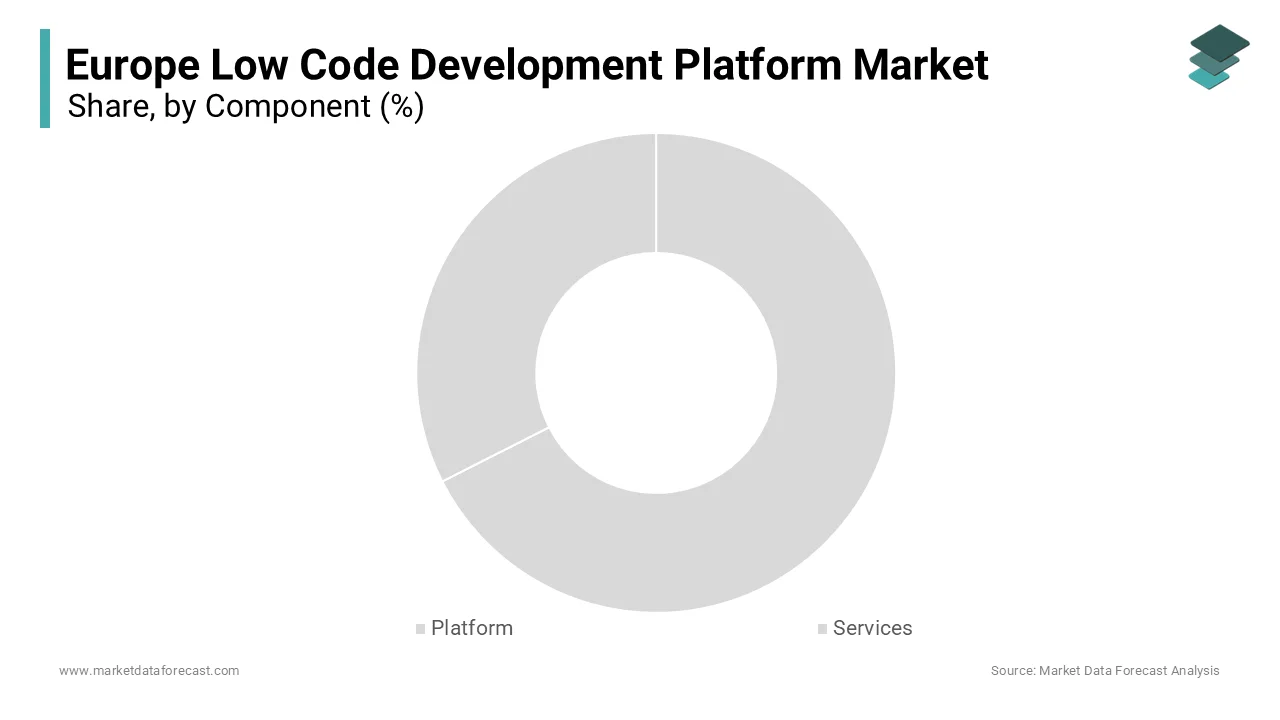
The services segment is projected to expand at a CAGR of 24.3% from 2026 to 2034. Enterprises increasingly require seamless connectivity with decades-old ERP, CRM, and industrial control systems. According to the Fraunhofer Institute for Industrial Engineering, large European manufacturers in 2025 engaged third-party consultants to integrate low-code applications with SAP or Oracle back ends. These integrations often involve custom API development, data mapping, and security protocol alignment tasks that exceed citizen developer competencies.
By Application Type Insights
The web-based segment was the largest by occupying 62.3% of the European low-code development platform market share in 2025. Internal dashboards, customer portals, case management systems, and workflow automation tools in Europe are predominantly web-based due to cross-device accessibility and centralised deployment. According to the European Commission’s 2025 Enterprise Digitalisation Survey, 78% of EU enterprises use low-code developed web applications for internal use, compared to only 34% for mobile. Public sector digital services mandated under the Digital Europe Programme also prioritise responsive web interfaces to ensure universal access across citizen demographics.
The mobile-based segment is likely to expand at a CAGR of 26.1% from 2026 to 2034. Utilities, logistics, and manufacturing sectors are equipping field technicians with mobile low-code apps for real-time reporting, asset tracking, and service validation. According to Eurostat, 47% of EU transport and storage firms deployed mobile workforce applications in 2025, up from 28% in 2021. In the Netherlands, Royal Dutch Shell’s downstream operations use a low-code mobile app for safety inspections, reducing report lag from days to minutes. These use cases demand offline capability, GPS integration, and camera access features increasingly embedded in modern mobile low-code platforms.
By Deployment Type Insights
The cloud segment accounted in holding a significant share of the European low-code development platform market in 2025. The European Commission’s Cloud Strategy aims for 75% of EU enterprises to use cloud services by 2030. According to Eurostat, 86% of large EU enterprises already used cloud computing in 2023, which is creating natural synergy with cloud-based low-code platforms. These solutions offer instant scalability, automatic updates, and reduced infrastructure management—critical for mid-sized firms lacking dedicated IT teams. Cloud low-code platforms seamlessly connect with widely adopted SaaS applications like Microsoft 365, Salesforce, and SAP S/4HANA Cloud.
The on-premises segment is lucratively to grow at a faster CAGR of 22.8% from 2026 to 2034. National security and critical infrastructure operators require full control over data and code execution environments. According to the European Defence Agency, 12 EU member states now mandate onon-premiseseployment for applications handling classified or operational data. In Germany, the Federal Office for Information Security requires on-premises low-code use for energy grid control interfaces. Banks and healthcare providers adopt hybrid models where sensitive data remains on premises while user interfaces are cloud-based. The European Banking Federation reported in 2025 that 39% of Tier 1 banks use on-premises low-code instances for core compliance workflows.
SEGMENTAL ANALYSIS
Germany Market Analysis
Germany holds the largest share of the European low-code development platform market at 22% in 2025. The country’s Industrie 4.0 initiative continues to drive enterprise modernisation, with low code serving as a key enabler for shop floor digitisation and supply chain visibility. According to Germany’s Federal Ministry for Economic Affairs and Climate Action, manufacturing firms adopted low-code tools in 2025 to develop internal logistics and quality control applications. Additionally, strict interpretations of GDPR have pushed vendors to certify local data centres by enhancing trust.
United Kingdom Market Analysis
The United Kingdom's low-code development platform market was positioned second by holding 17.2% of share in 2025, with its mature enterprise software landscape and strong fintech ecosystem. According to the UK Office for National Statistics, 79% of businesses with 10 or more employees used cloud services in 2025, creating fertile ground for cloud-based low-code platforms. London’s status as a global tech hub attracts platform vendors, with Microsoft, Mendix, and Appian maintaining large local support teams. Furthermore, the UK’s National Cyber Security Centre updated its Cloud Security Principles in 2023 to include low-code governance guidelines, which provide regulatory clarity that accelerates adoption.
France Market Analysis
France's low-code development platform market growth is likely to grow with the strong state-led digital transformation and a focus on digital sovereignty. The French government’s France Relance plan allocated 850 million euros in 2023 specifically for public sector digital tools, with low code identified, as per the source. According to France Stratégie, 51% of central government ministries launched low-code applications in 2025 for citizen services and internal coordination. Vendor partnerships with French tech champions like Capgemini and Thales enhance local support, while data hosting requirements under the French Data Protection Authority push platforms to use sovereign cloud providers like OVHcloud.
Italy Market Analysis
Italy's low-code development platform market growth is driven by a surge in digitalisation among small and medium enterprises traditionally reliant on manual processes. Italy’s National Recovery and Resilience Plan dedicates over 50 billion euros to digital transition, with specific incentives for SMEs adopting low code under the “Transition 4.0” tax credit scheme. The fashion and food manufacturing sectors, core to Italy’s export economy, are leading adopters by using low code for supply chain traceability and e-commerce integration.
COMPETITIVE LANDSCAPE
KEY MARKET PLAYERS
Some of the notable key players in the European low-code development platform market are
- LANSA
- TrackVia
- OutSystems
- Betty Blocks
- Nintex
- Zoho
- Tyler Technologies Inc
- Salesforce Inc
- Pegasystems Inc
- ServiceNow Inc
- Appian Corp A
- Siemens AG
- Microsoft Corp
- Fujitsu Ltd
- Oracle Corp
TOP STRATEGIES USED BY THE KEY MARKET PLAYERS
Key players in the European low-code development platform market prioritise strategic alignment with regional regulatory standards by embedding data sovereignty and compliance features directly into platform architecture. They invest heavily in artificial intelligence integration to enhance development speed and reduce dependency on technical expertise. Partnerships with hyperscalers and enterprise software vendors ensure seamless interoperability with existing IT ecosystems. Companies also expand localised cloud infrastructure to meet national data residency laws, particularly in Germany, France and Switzerland. Continuous upskilling initiatives through certified training programs and developer communities foster ecosystem growth. Additionally, vendors focus on industry-specific solution templates to accelerate adoption in verticals, such as healthcare logistics and public administration, across diverse European markets.
COMPETITION OVERVIEW
The European low-code development platform market features intense competition among global technology leaders and agile regional innovators vying for dominance in a rapidly digitising enterprise landscape. Vendors differentiate through compliance readiness, artificial intelligence capabilities, and depth of integration with legacy and cloud systems. European data protection laws sector-specific regulations create high entry barriers, favouring established players with proven governance frameworks. At the same time, niche providers gain traction by offering vertical-specific templates and on-premises deployment options tailored to national requirements. Continuous innovation in generative AI-assisted development and citizen developer enablement drives product evolution. Strategic partnerships with system integrators, hyperscalers, and government digital agencies further shape competitive dynamics as vendors seek to embed their platforms into Europe’s long-term digital infrastructure and public sector transformation agendas.
TOP PLAYERS IN THE MARKET
- Mendix is a prominent player in the European low-code development platform market with deep integration into enterprise workflows across finance, manufacturing, and public sectors. Originating in the Netherlands, the company has expanded its global footprint by embedding artificial intelligence capabilities and strengthening cloud native deployment options. In recent years, Mendix launched its Mendix IQ platform, which leverages generative AI to accelerate application design and logic generation. The company has also deepened partnerships with hyperscalers, including Microsoft Azure and SAP, to enhance interoperability and data governance for European cl, clients adhering to strict regulatory frameworks. Its active engagement with EU digital policy initiatives further solidifies its strategic positioning in the region and beyond.
- OutSystemsheadquartered in Lisbon,nas significantly influenced the global low-code landscape through its focus on scalability and high-performance applications. The company caters to large enterprises requiring mission-critical system development with minimal technical debt. To reinforce its presence in Europe, OutSystems introduced its OutSystems AI Mentor Studio in 202,3, which provides real-time code quality and security guidance during development. It has also invested in sovereign cloud deployments across Germany and France to comply with data residency mandates. These initiatives align with European digital sovereignty goals and enable seamless adoption in regulated industries such as healthcare and energy while supporting global expansion through localised compliance architecture.
- Microsoft leverages its Power Platform, including Power Apps, to deliver low-code solutions deeply embedded within its Microsoft 365 and Azure ecosystems. In Europe, the company benefits from widespread enterprise adoption of its productivity suite and cloud infrastructure. Recent actions include expanding Power Platform governance controls to meet GDPR and Digital Operational Resilience Act requirements. Microsoft also launched industry-specific accelerators for European public sector and manufacturing clients, enabling faster deployment of compliant applications. Its integration with Teams and Dynamics 365 creates a unified experience for citizen developers, while its extensive partner network across the continent ensures localised support and training, further strengthening its influence in both European and global markets.
MARKET SEGMENTATION
This research report on the European low-code development platform market has been segmented and sub-segmented based on categories.
By Component
- Platform
- Services
By Application
- Web-Based
- Mobile-Based
- Desktop / Server-Based / API-Centric & Micro-Services
By Deployment Type
- Cloud
- On-Premises
By Organisation Size
- Small and Medium Enterprises (SMEs)
- Large Enterprises
By Industry Vertical
- Banking, Financial Services & Insurance (BFSI)
- Retail & E-commerce
- Government & Defense
- Information Technology & Telecom
- Healthcare & Life Sciences
- Manufacturing
- Energy & Utilities
- Others
By Country
- UK
- France
- Spain
- Germany
- Italy
- Russia
- Sweden
- Denmark
- Switzerland
- Netherlands
- Turkey
- Czech Republic
- Rest of Europe