- Product Description Description
- Table of Contents TOC
- List of Table & Figure LOT
- Get Free Sample PDF Sample PDF
Market Size, 2025
$1.17 BnMarket Estimate, 2026
$1.24 BnMarket Forecast, 2034
$1.98 BnCAGR, 2026–2034
6%Europe Online Dating Market Report Summary
The Europe online dating market was valued at USD 1.17 billion in 2025, is estimated to reach USD 1.24 billion in 2026, and is projected to reach USD 1.98 billion by 2034, growing at a CAGR of 6% from 2026 to 2034. Market growth is driven by increasing smartphone penetration, evolving social norms around digital relationships, and growing acceptance of app-based matchmaking across all age groups. Online dating platforms across Europe are leveraging AI-based matching algorithms, location-based discovery, and enhanced user safety features to improve engagement and retention. The expansion of subscription-based premium models and in-app monetization strategies is further supporting market growth.
Key Market Trends
- Rising adoption of mobile-first dating applications.
- Increasing integration of AI-driven matchmaking and compatibility scoring.
- Growing demand for relationship-focused and niche dating platforms.
- Expansion of subscription-based premium services and in-app purchases.
- Strengthening focus on user verification, safety, and data privacy compliance.
Segmental Insights
- Based on type, the non-paying online dating segment dominated the market in 2025 by accounting for 64.8% share, driven by high user acquisition rates and ad-supported revenue models.
- Based on device platform, the mobile applications segment led the market in 2025, supported by deep smartphone integration into daily routines and widespread adoption of location-based matching features.
- Based on sexual orientation, the heterosexual dating platforms segment held a significant share in 2025, driven by large user bases and mainstream platform dominance.
Regional Insights
The Europe online dating market is witnessing steady growth across major economies, supported by high internet penetration, cultural acceptance of digital matchmaking, and growing urbanization.
- The United Kingdom was the largest contributor in 2025, driven by strong subscription adoption, urban population density, and high smartphone usage.
- Germany ranked second in 2025, supported by its substantial population base, advanced digital infrastructure, and steady adoption of premium dating services.
- France continues to exhibit strong growth, driven by distinctive cultural preferences that favor relationship-focused platforms and curated matchmaking experiences.
Competitive Landscape
The Europe online dating market is characterized by intense competition among global platform operators and region-specific dating services. Market players are focusing on expanding premium features, enhancing AI-powered compatibility tools, and strengthening safety and moderation systems. Strategic acquisitions, brand diversification, and localization strategies are shaping competitive dynamics across the region.
Prominent companies operating in the Europe online dating market include Match Group Inc., Bumble Inc., Badoo Ltd, happn, Spark Networks SE, and Meetic SA.
 Download Free Sample Report
Europe Online Dating Market Size
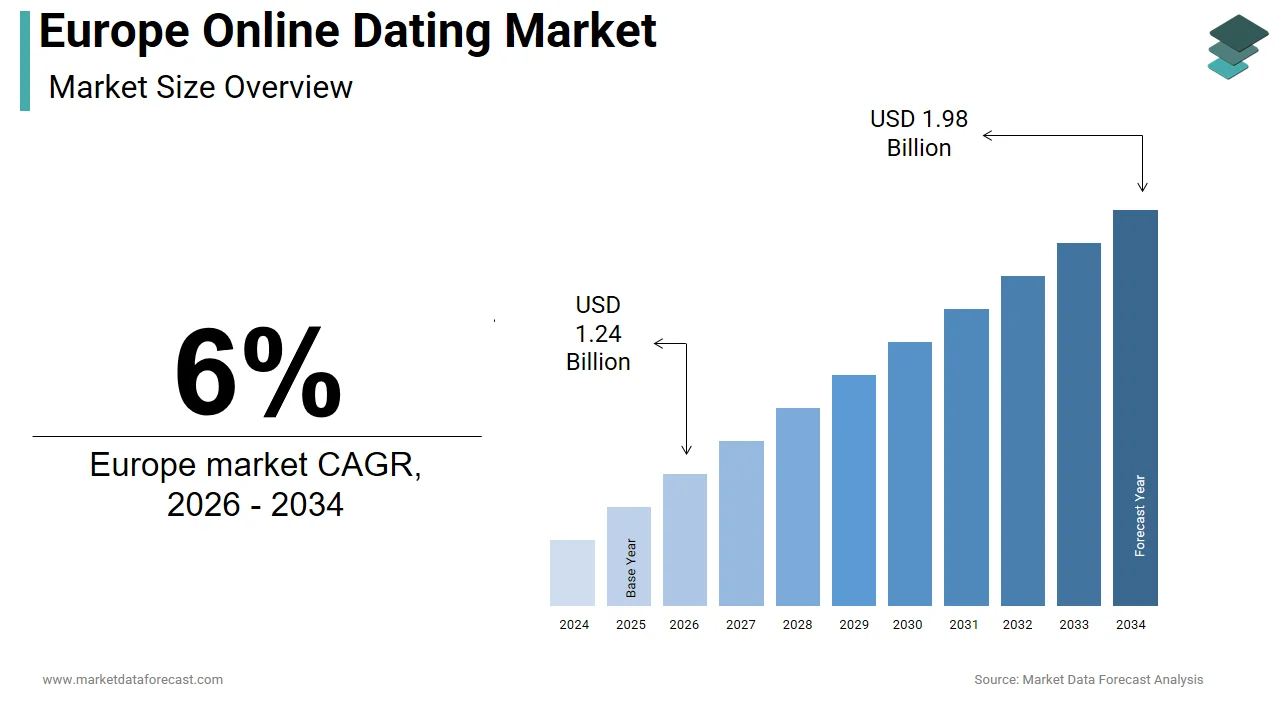
The Europe online dating market was valued at USD 1.17 billion in 2025, is estimated to reach USD 1.24 billion in 2026, and is projected to reach USD 1.98 billion by 2034, growing at a CAGR of 6% from 2026 to 2034.
Online dating is the practice of searching for and interacting with potential romantic or sexual partners through the internet, typically via dedicated websites or mobile applications. Unlike transactional social media, these services prioritize intentionality, identity verification, and behavioral compatibility to address evolving interpersonal dynamics in an increasingly urbanized and digitally native society. In the European Union, younger and middle-aged adults are increasingly residing in single-person households, a shift driven by evolving social norms such as later life-stage milestones, changing relationship dynamics, and professional relocation. Increasingly, European women are relying on digital platforms to meet partners as they enter the workforce, replacing traditional social structures. Concurrently, high rates of daily internet access and nearly universal mobile connectivity among younger generations have established digital environments as the primary medium for social interaction and service consumption. These demographic and technological conditions create fertile ground for online dating, which has evolved from niche experimentation to a normalized component of modern courtship. Regulatory frameworks like the EU Digital Services Act impose transparency obligations on matching algorithms and user safety protocols, signaling institutional recognition of the sector’s societal role beyond mere commerce.
MARKET DRIVERS
Rising Urbanization and Declining Traditional Social Infrastructure
Accelerated urban migration and the erosion of community-based social networks are fundamental drivers of the Europe online dating market. A significant portion of the European population is concentrated in urban environments, where the nature of city living often creates conditions that make fostering deep personal connections more challenging. High rates of residential turnover in many major European cities contribute to a transient environment, which can reduce the stability of local neighborhood and community ties. The decline in long-term residency in urban areas has weakened traditional social networks that previously facilitated introductions and community bonding. Extended professional working hours in several countries have reduced the available leisure time, limiting opportunities for social engagement and relationship building. Simultaneously, traditional institutions such as churches and local clubs have seen membership decline. The European Values Study indicates a significant, long-term decline in regular church attendance across Europe, which has reduced a traditional, community-based environment for meeting potential partners. In response, digital platforms fill this relational void by offering curated, time-efficient alternatives. Research suggests that in major European cities, particularly those with notable gender disparities, online dating platforms have become a primary, widely used method for urban singles to meet potential partners. This structural shift transforms online dating from a convenience into a necessity for social integration in modern European life.
Delayed Family Formation and Extended Singlehood
Changing life course patterns, including later marriage, prolonged education, and career prioritization, are expanding the pool of active online dating users across the region, and act as a major factor fueling the expansion of the Europe online dating market. As per multiple sources, the average age at which individuals enter their first marriage across Europe has continued to increase, with many couples marrying in their early-to-mid thirties. Concurrently, a growing proportion of adults in their thirties and early forties in the EU are choosing to remain unmarried, reflecting a shift away from traditional, early marriage patterns. This extended singlehood is not merely circumstantial but often intentional, with individuals seeking emotional and intellectual compatibility before commitment. The rising educational levels of women compared to men in the EU have altered partnership trends, resulting in more discerning partner choices. Among educated singles in Sweden and the Netherlands, dating platforms are heavily utilized as tools for finding partners with shared values and long-term compatibility rather than casual hookups. Furthermore, divorce rates remain elevated. High rates of relationship dissolution in France and Germany have created a large group of single individuals who prefer to use digital platforms to carefully vet potential partners. This demographic reality sustains consistent demand for sophisticated matching platforms that support complex relationship goals beyond initial attraction.
MARKET RESTRAINTS
Persistent Trust Deficits and Safety Concerns
Consumer skepticism regarding authenticity and personal security remains a significant restraint to the Europe online dating market. European consumer advocacy research indicates that a substantial majority of individuals across numerous member states encounter deceptive accounts or manipulative interface designs shortly after they begin using online services. High-profile cases of catfishing and financial scams have eroded confidence. Law enforcement data shows that financial losses stemming from emotional manipulation and deceptive relationships online have grown substantially in recent years, reaching massive annual totals across the continent. Despite the DSA's requirement for identity verification on major platforms, enforcement remains patchy, and smaller applications often lack the resources to implement robust content moderation. Cultural attitudes also play a role. In Southern and Eastern Europe, where familial introduction networks remain strong, digital dating is still viewed with suspicion as impersonal or morally ambiguous. The Fundamental Rights Agency notes that LGBTQ+ users face disproportionate harassment, with a portion reporting discriminatory messages in 2023. The lack of standardized profile validation, real-time monitoring, and transparent reporting hinders market adoption, causing potential users to disengage despite the technological accessibility of the platform.
Fragmented Regulatory Compliance Across Member States
Divergent national interpretations of EU digital regulations create operational complexity and compliance costs that hinder platform scalability, innovation, and expansion of the Europe online dating market. The Digital Services Act provides a baseline, but individual countries often layer on additional regulations. Legislative approaches in Europe to address online content vary, with some frameworks prioritizing rapid removal upon notification while others emphasize proactive detection measures. Operators within the online dating industry have indicated that inconsistent regulations across different jurisdictions can impact the timing of product feature releases. Legal uncertainty resulting from fragmented regulatory environments is cited as a factor that may affect the operational speed of online service providers. Age verification presents another challenge. Italy is implementing high-security, third-party authentication for adult platforms, whereas Spain allows more flexibility in age and assurance methods, causing fragmented compliance requirements for international companies when onboarding users. Data localization rules further strain infrastructure. New, stringent cybersecurity requirements for critical sectors are creating pressure to store data locally, raising operational costs for businesses managing sensitive information. These inconsistencies force companies to maintain multiple compliance teams and delay AI-driven features like behavior-based matching due to varying consent thresholds under national GDPR implementations. The current regulatory patchwork threatens to stifle investment and segment user experiences until accelerated harmonization is achieved through the Single Market Enforcement Action Plan.
MARKET OPPORTUNITIES
Integration with Mental Health and Relationship Wellness Services
Forward-looking platforms are transforming from pure matchmaking tools into holistic relationship wellness ecosystems, which creates a strong potential in the Europe online dating market. Dating platforms are integrating therapeutic resources to address user challenges such as anxiety and low self-esteem. Services are partnering with professionals to offer in-app coaching focused on communication and boundary setting. Specialized app features provide guided reflections on attachment styles and conflict resolution to support healthier interactions. Health insurance bodies are considering coverage for digital relationship support tools as a preventative measure. Efforts to enhance user well-being are increasing in response to recognition of the impact of social isolation on mental health. This convergence of dating and well-being aligns with the EU’s Beating Cancer Plan and mental health strategy, positioning platforms as public health allies. These services reduce churn and increase deeper engagement by shifting the focus from quick matches to genuine emotional readiness, facilitating higher-value subscriptions.
Niche Community Building for Underrepresented Groups
The rise of identity-specific dating platforms catering to cultural, religious, or lifestyle minorities shows a strategic growth avenue in the region’s diverse social landscape and is thereby expected to boost the expansion of the European online dating market. The increasing diversity and visibility of various communities are driving a greater demand for tailored digital environments that cater to specific cultural, religious, and identity-based needs. Experiences of discrimination on mainstream dating platforms are prompting a significant portion of minority users to seek out specialized, niche alternatives. Specialized platforms tailored for specific cultural or identity groups are experiencing rapid user growth in key European markets, reflecting a trend toward niche networking. Newer platforms in certain regions are focusing on values like consent and community, offering an alternative to traditional, hookup-focused digital spaces. Young adults are increasingly prioritizing shared principles, such as environmental concern or language skills, over physical proximity on dating platforms. Emerging trends show platforms adapting designs to emphasize these values and foster inclusivity. Additionally, there is a growing focus on using third-party certification to ensure digital platforms are free from bias. Regulatory bodies are encouraging the development of ethical, non-biased algorithms for digital networking. Niche platforms build defensible market positions by fostering a sense of belonging rather than just connection, driving higher retention and brand advocacy.
MARKET CHALLENGES
Algorithmic Opacity and Lack of User Control
Most European dating platforms operate with minimal transparency about how matches are generated, despite claims of AI-powered compatibility, which affects user autonomy, trust, and the growth of the Europe online dating market. Many popular dating applications do not disclose the specific user behaviors, such as messaging habits or profile engagement, that influence how profiles are presented to others. Users are generally unable to review or modify the internal metrics that determine their visibility, which creates an opaque system for profile ranking. This lack of transparency regarding algorithmic filtering may conflict with regulations designed to ensure the fair and transparent processing of user data. The absence of clear information about how profiles are curated contributes to user perceptions that the matching process is manipulated. A significant portion of users report feeling that they lack meaningful control over the visibility of their profiles, which can result in frustration and a decrease in user engagement. Moreover, algorithmic bias persists. Independent audits revealed that profiles with darker skin tones or non-Western names receive fewer recommendations across major platforms. Platforms face significant reputational and legal risks without explainable AI standards and user-controlled parameters, especially as the AI Act classifies recommendation systems as high-risk.
Monetization Pressure and Feature Fragmentation
Intensifying competition has led to aggressive paywall strategies that degrade user experience, fragment core functionality across subscription tiers, and constrain the expansion of the Europe online dating market. European consumer organizations indicate that dating platforms heavily restrict essential matching and communication tools, requiring users to pay significant fees to access the full experience. This model disproportionately excludes younger and lower-income users, skewing demographics toward affluent urban professionals and reducing match diversity. Worse, platforms frequently alter pricing structures without notice. German consumer advocates found that many popular dating apps, after an initial sign-up, apply sharp, unexpected increases to subscription fees, making services significantly more expensive for users over time. Free users are subjected to intrusive ads and limited daily actions, creating a two-tier system that feels punitive rather than aspirational. The European Commission has taken action against dating platforms for employing aggressive paywalls, hidden auto-renewals, and misleading pricing tactics that violate EU consumer protection laws. The market faces an ongoing challenge in balancing profitability, inclusivity, and user experience, which will persist until more sustainable, alternative business models, such as one-time purchases or ad-supported basic options, are established.
REPORT COVERAGE
| REPORT METRIC | DETAILS |
| Market Size Available | 2025 to 2034 |
| Base Year | 2025 |
| Forecast Period | 2026 to 2034 |
| Segments Covered | By Type, Device Platform, Age Group, Relationship Intent, Sexual Orientation, and Country. |
| Various Analyses Covered | Global, Regional, and Country-Level Analysis, Segment-Level Analysis, Drivers, Restraints, Opportunities, Challenges; PESTLE Analysis; Porter’s Five Forces Analysis, Competitive Landscape, Analyst Overview of Investment Opportunities |
| Countries Covered | UK, France, Spain, Germany, Italy, Russia, Sweden, Denmark, Switzerland, Netherlands, Turkey, Czech Republic, and the Rest of Europe. |
| Market Leaders Profiled | Match Group Inc., Bumble Inc., Badoo Ltd, FTW and Co (happn), Spark Networks SE, Meetic SA, and Others. |
SEGMENTAL ANALYSIS
By Type Insights
The non-paying online dating segment remained the largest segment in the Europe online dating market by accounting for a 64.8% share in 2025. The prominence of the non-paying online dating segment is attributed to widespread preference for low-commitment exploration and economic sensitivity among younger demographics. Many young adults in Europe operate within households with limited disposable income relative to the national average, influencing the prioritization of premium subscription spending. A preference exists for testing platform value through no-cost options, with many individuals utilizing free tiers to evaluate functionality and compatibility before considering a financial commitment. Additionally, cultural norms in Southern and Eastern Europe emphasize organic relationship development, reducing willingness to pay for digital facilitation. Platforms like Tinder and Badoo sustain massive free user bases through ad-supported models and limited-feature freemium structures, creating network effects that attract paying users seeking larger pools. This behavioral and economic reality ensures non-paying users remain the dominant segment by volume, even as revenue skews toward premium tiers.
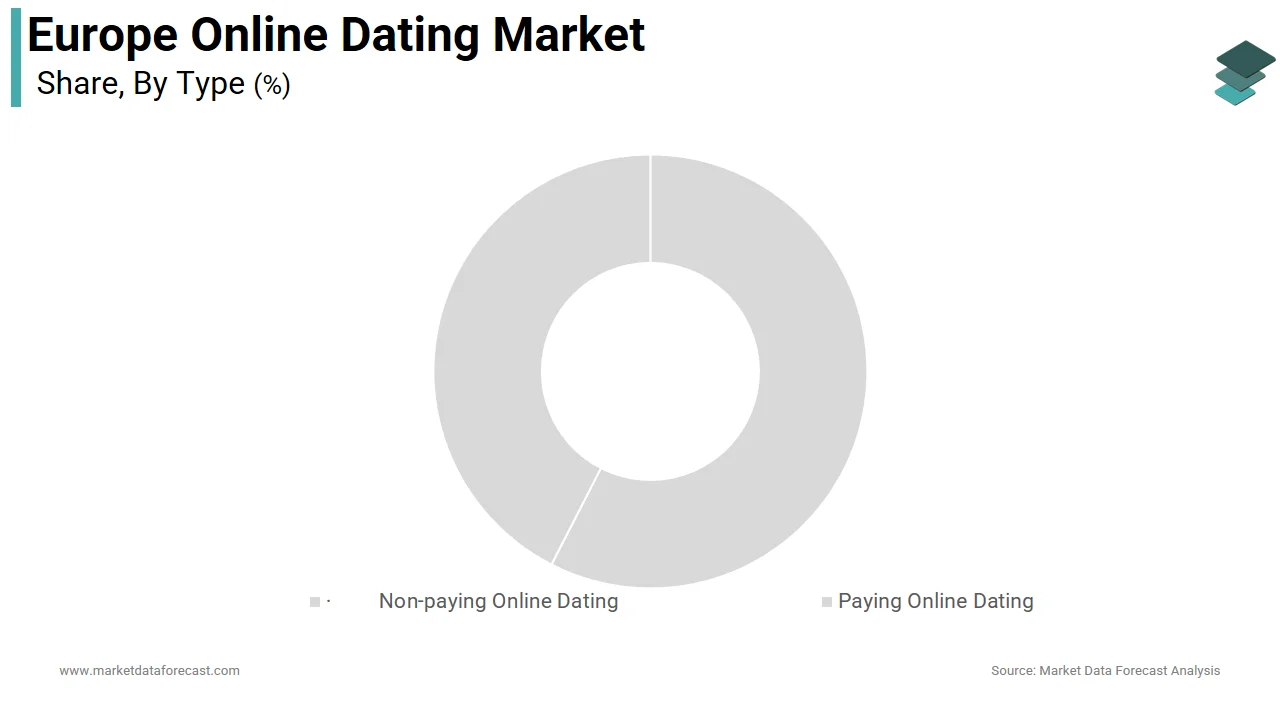
The paying online dating segment is predicted to witness the highest CAGR of 11.2% from 2026 to 2034 due to rising demand for safety features, enhanced matching quality, and ad-free experiences. Affluent urban professionals increasingly view subscriptions as investments in time efficiency and emotional well-being. Many single, educated adults are demonstrating a growing willingness to invest in dating platforms that offer verified profiles and video integration. Increased regulatory requirements are driving platforms to adopt monetization strategies that fund identity verification and human moderation. Digital service regulations are encouraging platforms to move away from data exploitation models toward subscription-based services. Platforms in certain regions are experiencing increased subscription growth driven by the integration of AI-powered compatibility tools and coaching features. Official mental health strategies are beginning to recognize digital relationship support as a form of preventive care, promoting value-driven services over manipulative engagement techniques. Trust is driving paid dating's growth; users now prefer paying for transparency and safety over free, chaotic alternatives.
By Device Platform Insights
The mobile applications segment dominated the Europe online dating market by capturing a substantial share in 2025 because of the deep integration of smartphones into daily social routines and location-based discovery logic. According to sources, mobile device usage to connect to the internet is nearly universal among younger adults in the EU, with daily internet activity increasingly common. A significant portion of the European population spends a substantial amount of their daily time on digital devices, with mobile devices dominating as the primary means of accessing the internet. Dating apps leverage this ubiquity through push notifications, real-time geolocation, and camera integration for instant profile creation. Research indicates that the overwhelming majority of new dating app registrations occur through mobile devices, where streamlined authentication processes via major technology platforms are commonly employed to simplify user onboarding. Urban design further reinforces mobile dominance. In dense cities like Paris and Amsterdam, users prefer swiping during commutes or coffee breaks rather than desktop sessions. Retail partnerships amplify reach. This seamless alignment between device behavior and platform functionality ensures mobile remains the undisputed primary channel for user acquisition and interaction.
The cross-platform integration segment is estimated to register the fastest CAGR of 14.7% during the forecast period, owing to user fatigue from app overload and demand for contextual flexibility. Professionals in Germany and Sweden increasingly manage matches via desktop during work hours using encrypted browser extensions that mask dating activity from employer monitoring software. Meanwhile, Apple Watch integrations allow discreet notifications in social settings, preserving privacy. Legislative requirements regarding digital inclusion are driving platforms to improve accessibility features, such as screen reader compatibility and voice navigation options. Data protection initiatives are encouraging the adoption of decentralized approaches to minimize the risks associated with centralized data storage. Security considerations are prompting developers to focus on creating secure synchronization protocols for user data across multiple devices. This shift from mobile exclusivity to ecosystem presence enhances user retention by meeting individuals where they already operate, transforming dating from an app into an ambient digital experience.
By Sexual Orientation Insights
The heterosexual dating platforms segment led the Europe online dating market by holding a significant share in 2025. The leading position of the heterosexual dating platforms segment is credited to its alignment with demographic composition and mainstream marketing focus. According to EU-level trends, legally registered partnerships within the European Union continue to be overwhelmingly comprised of opposite-sex couples, even as legal recognition for same-sex unions expands across member states. Major platforms like Meetic and Parship historically optimized algorithms for heterosexual dynamics, such as gender balanced matching and traditional courtship flows, which reinforced network effects. Advertising spend reflects this skew. Reports from the European Audiovisual Observatory indicate that dating app commercials across European linear TV and streaming services still predominantly feature heterosexual couples, despite increasing efforts toward broader representation. Additionally, older age groups, who are less likely to identify outside heteronormativity, comprise a growing share of digital adopters. Research emphasizes that the digital divide is closing, with internet usage among Europeans in their late fifties and early sixties having grown to a high majority by 2023. Despite expanding inclusivity initiatives, entrenched demographic distributions and historical design paradigms guarantee the numerical dominance of established platforms.
The LGBTQ+ dating platforms segment is anticipated to witness the fastest CAGR of 18.9% from 2026 to 2034. The swift growth of the LGBTQ+ dating platforms segment is propelled by heightened visibility, legal recognition, and demand for safe identity-affirming spaces. Legal recognition of same-sex partnerships across borders within Europe is influencing mobility patterns, which in turn fuels demand for digital platforms that blend local relevance with broader connectivity. Digital applications are experiencing user growth in regions with challenging political climates, acting as alternative spaces for community building where physical inclusion may be restricted. LGBTQ+ youth are increasingly relying on dating applications to establish community connections, elevating these tools beyond traditional matchmaking functions. Regulatory support is emerging. Unlike generalist apps where queer users face misgendering or fetishization, niche platforms offer granular identity options, such as non-binary pronouns or kink preferences, fostering authenticity and retention. This combination of social progress, technological specificity, and institutional backing positions LGBTQ+ dating as the most dynamic frontier in the market.
COUNTRY-LEVEL ANALYSIS
United Kingdom Online Dating Market Analysis
The United Kingdom was the largest contributor to the Europe online dating market by occupying 26.2% of the market share in 2024. British consumers demonstrate exceptional digital engagement, with penetration among adults and 11.3 million active users nationwide. London's concentration of technology talent and venture capital has fostered Europe's densest ecosystem of dating startups with over 120 specialized firms operating in the metropolitan area.
Germany Online Dating Market Analysis
Germany was ranked second by capturing 13.2% of the Europe online dating market with its substantial population base and technological infrastructure maturity. The nation's high proportion of single-person households, comprising 41% of all residences, creates substantial addressable demand, as documented by Federal Statistical Office demographic data. Berlin has emerged as continental Europe's innovation hub for relationship technology, attracting 87 million euros in venture funding for dating-related startups during 2024, according to German Startups Association investment tracking. Urban concentration remains pronounced, with 68% of active users residing in metropolitan areas containing over one million inhabitants.
France Online Dating Market Analysis
France online dating market is driven by the distinctive cultural preferences shaping platform adoption patterns. French consumers demonstrate a strong preference for relationship-focused platforms, with 64% prioritizing long-term compatibility matching over casual encounter applications. Paris maintains its status as continental Europe's second-largest concentration of dating technology talent, with approximately 14000 professionals employed in relationship technology development.
Spain Online Dating Market Analysis
Spain online dating market growth is expected to grow with the expansion among younger demographics, with adults aged 18 to 34 representing 67% of all active users. Mobile connectivity infrastructure supports robust platform engagement with 94% smartphone penetration among adults, enabling seamless application usage across geographic regions. Barcelona and Madrid have emerged as Iberian Peninsula innovation centers, attracting 42 million euros in venture capital for dating technology development during 2024, according to the Spanish Association of Startups investment tracking. Cultural factors influence platform design preferences, with Spanish consumers demonstrating 38% higher engagement rates for video-based profile verification features compared to Northern European averages.
Italy Online Dating Market Analysis
Italy online dating market growth is exhibiting distinctive characteristics shaped by demographic transitions and cultural evolution. The nation's aging population presents unique opportunities, with adults aged 50 and above representing the fastest-growing user segment, increasing 47% year over year during 2024, as per research. Italian consumers show a strong preference for relationship-oriented platforms, with 71% prioritizing serious relationship formation over casual dating, according to Eurisko consumer research surveys.
COMPETITIVE LANDSCAPE
The Europe online dating market is characterized by a tripartite competitive structure comprising global conglomerates, specialized regional operators, and agile niche startups. Global players like Match Group leverage scale, brand recognition, and cross-platform data to dominate volume, while European firms such as Spark Networks thrive through cultural nuance and community focus. Competition intensifies around trust and safety as consumers grow wary of fake profiles and algorithmic opacity. Regulatory pressure under the Digital Services Act forces all participants to invest in human moderation, and transparency reports level the playing field somewhat. Differentiation now hinges on purpose, whether facilitating casual encounters, serious relationships, or identity-affirming connections. Monetization strategies vary widely, with premium subscriptions dominating Western Europe while ad-supported models persist in price-sensitive Eastern markets. User churn remains high due to feature fragmentation and paywall fatigue, prompting innovation in hybrid models like event-based engagement and relationship coaching. Despite saturation in major cities, rural and older demographic segments offer untapped potential, driving geographic and generational expansion. Ultimately, competition is evolving from user acquisition to retention through emotional value and social responsibility.
KEY MARKET PLAYERS
The leading companies operating in the Europe online dating market include:
- Match Group Inc.
- Bumble Inc.
- Badoo Ltd
- FTW and Co (happn)
- Spark Networks SE
- Meetic SA
TOP PLAYERS IN THE MARKET
- Match Group exerts significant influence in the Europe online dating market through its portfolio of globally recognized brands, including Tinder, Hinge, and Meetic, which cater to diverse relationship intents and demographics. The company has localized its platforms to align with European cultural norms, privacy expectations, and linguistic diversity, offering interfaces in numerous European languages. Recently, Match Group enhanced safety features across its European apps by integrating real-time ID verification powered by Onfido and expanding in-app video calling to reduce catfishing risks. It also collaborated with national data protection authorities to ensure compliance with GDPR and the EU Digital Services Act. Match Group is pivoting from a pure entertainment model to a responsible social infrastructure provider, leveraging partnerships in France and Germany to introduce wellness resources that promote healthier online interactions.
- Bumble Inc has carved a distinctive position in the Europe online dating market by championing women-first communication and inclusive identity options that resonate with progressive urban users. The platform mandates that women initiate conversations in heterosexual matches, fostering a safer, more respectful environment. In recent years, Bumble expanded its European footprint by launching localized campaigns in Italy, Spain, and Poland, emphasizing empowerment and professional networking alongside romance. The company strengthened trust by implementing photo verification using AI and partnering with NGOs like Women Against Violence Europe to provide in-app support for harassment reporting. Bumble also advocates for regulatory clarity, engaging with the European Commission on ethical AI use in matchmaking algorithms. Its emphasis on values-driven design and social responsibility has attracted a loyal user base seeking meaningful connections beyond superficial swiping.
- Spark Networks SE operates as a leading European native player in the online dating market with niche platforms such as ElitePartner, Jdate, and Christian Mingle that serve specific religious, cultural, and professional communities. Headquartered in Berlin, the company leverages deep regional understanding to tailor matching logic to community guidelines and customer support to local sensibilities. Recently, Spark Networks enhanced its fraud detection systems using behavioral biometrics and introduced mandatory video profile verification for new users across all its European sites. It also launched hybrid events in major cities like Paris, Vienna, and Amsterdam, combining digital matching with in-person meetups to build trust and reduce screen fatigue. Spark Networks distinguishes itself in a saturated market by prioritizing long-term partnerships and community ties over fleeting encounters, fostering deep engagement among users who value genuine compatibility more than mere convenience.
TOP STRATEGIES USED BY THE KEY MARKET PARTICIPANTS
Key players in the Europe online dating market prioritize user safety through mandatory identity verification, real-time content moderation, and in-app emergency reporting tools to comply with the EU Digital Services Act. They invest in AI-driven but transparent matching algorithms that allow users to understand and adjust preference settings. Companies increasingly integrate mental health and relationship coaching resources to position their platforms as wellness ecosystems rather than transactional services. Localization remains critical with multilingual interfaces, culturally adapted communication norms, and region-specific marketing narratives. Subscription models are shifting toward value-based pricing, offering ad-free experiences, verified profiles, and video chat rather than manipulative gamification. Partnerships with civil society organizations and participation in EU policy dialogues further enhance credibility and shape favorable regulatory frameworks. These strategies collectively address trust fragmentation and elevate online dating from entertainment to essential social infrastructure.
MARKET SEGMENTATION
This research report on the Europe online dating market has been segmented and sub-segmented into the following categories.
By Type
- Non-paying Online Dating
- Paying Online Dating
By Device Platform
- Mobile Applications
- Desktop and Web Platforms
By Age Group
- 18–24 Years
- 25–34 Years
- 35–44 Years
- 45 Years and Above
By Relationship Intent
- Casual Dating
- Long-term Relationship
- Niche Interest Matchmaking
By Sexual Orientation
- Heterosexual Platforms
- LGBTQ+ Platforms
By Country
- United Kingdom
- France
- Spain
- Germany
- Italy
- Russia
- Sweden
- Denmark
- Switzerland
- Netherlands
- Rest of Europe