- Product Description Description
- Table of Contents TOC
- List of Table & Figure LOT
- Get Free Sample PDF Sample PDF
Market Size, 2025
$582.45 BnMarket Estimate, 2026
$605.69 BnMarket Forecast, 2034
$828.29 BnCAGR, 2026–2034
3.99%Europe Property and Casualty Insurance Market Report Summary
The Europe property and casualty (P&C) insurance market was valued at USD 582.45 billion in 2025, is estimated to reach USD 605.69 billion in 2026, and is projected to reach USD 828.29 billion by 2034, growing at a CAGR of 3.99% from 2026 to 2034. Market growth is driven by increasing demand for risk protection across motor, property, and liability insurance segments, along with rising awareness of financial security among individuals and businesses. The expansion of digital insurance platforms, regulatory advancements, and the integration of data analytics and AI in underwriting and claims management are further enhancing operational efficiency and customer experience. Additionally, growing exposure to climate-related risks and natural disasters is contributing to sustained demand for property and casualty insurance across Europe.
Key Market Trends
- Increasing demand for motor and property insurance coverage across Europe.
- Rising adoption of digital insurance platforms and insurtech solutions.
- Growing use of data analytics and AI in underwriting and claims processing.
- Expansion of customized insurance products for individuals and businesses.
- Increasing focus on climate risk assessment and catastrophe insurance coverage.
Segmental Insights
- Based on insurance type, the vehicle insurance segment dominated the Europe property and casualty insurance market by capturing 37.3% share in 2025, driven by mandatory motor insurance regulations and high vehicle ownership rates.
- Based on distribution channel, the indirect channels segment led the market with 60.5% share in 2025, supported by the strong presence of brokers, agents, and third-party distribution networks.
- Based on end user, the individuals segment held the largest share of 51.9% in 2025, driven by increasing awareness of personal financial protection and insurance coverage.
Regional Insights
The Europe property and casualty insurance market is witnessing steady growth across major countries due to strong regulatory frameworks, high insurance penetration, and evolving risk landscapes.
- The United Kingdom led the regional market in 2025 with 25.5% share, supported by a mature insurance industry and strong presence of global insurers.
- Germany holds a significant share due to its stable and highly regulated insurance environment focused on consumer protection and solvency standards.
- France is expected to maintain a prominent position during the forecast period due to its unique system where natural catastrophe coverage is integrated into property insurance through a state-backed reinsurance mechanism.
Competitive Landscape
The Europe property and casualty insurance market is highly competitive, with the presence of global insurance giants and regional players offering diversified insurance products. Market participants are focusing on digital transformation, expanding product portfolios, and enhancing customer engagement through technology-driven solutions. Strategic partnerships, mergers and acquisitions, and investments in insurtech are shaping competitive dynamics across the region.
Prominent companies operating in the Europe property and casualty insurance market include State Farm, PICC, Berkshire Hathaway Inc., Allianz SE, Lloyd's of London, AXA Group, Progressive, Allstate, Ping An Insurance, Liberty Mutual, Tokio Marine Holdings, Chubb Limited, Travelers Group, Nationwide Group, Fairfax Financial Group, Erie Insurance Group, Cincinnati Insurance Companies, Great American P&C Insurance Group, Generali Group, Zurich Insurance U.S. P&C Group, and CSAA Insurance Group.a
Europe Property and Casualty Insurance Market Size
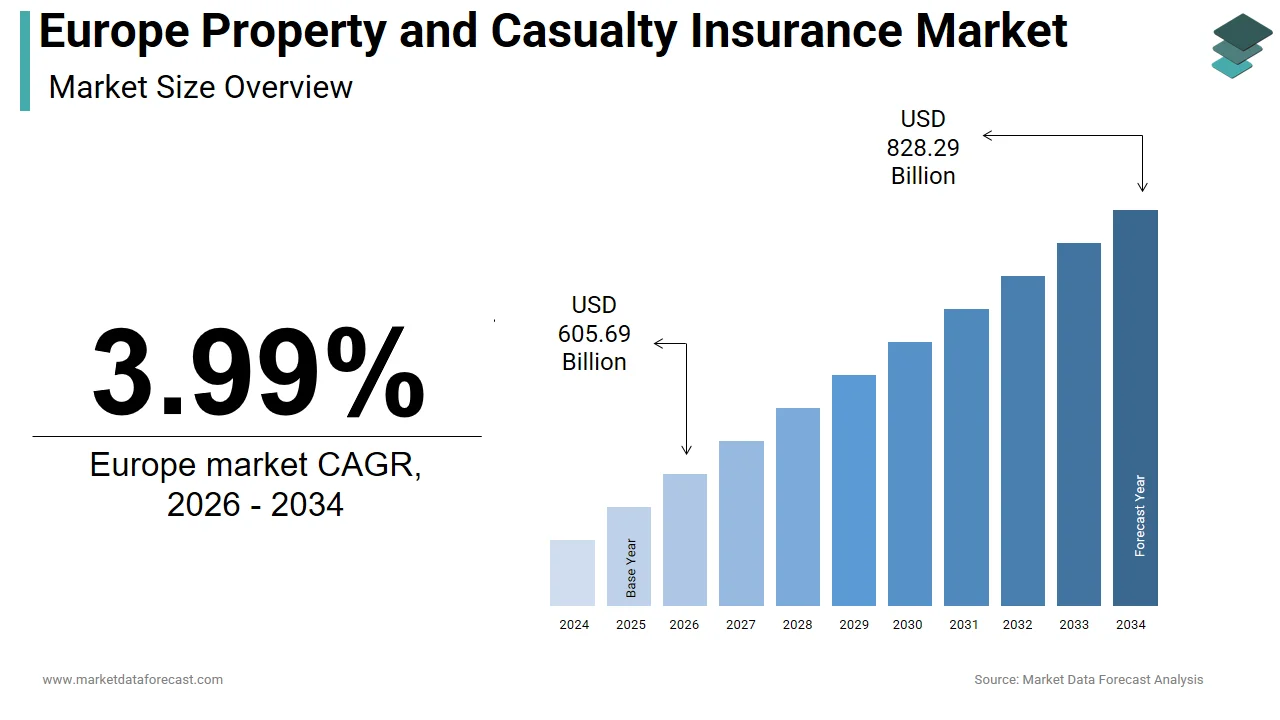
The Europe property and casualty insurance market was valued at USD 582.45 billion in 2025, is estimated to reach USD 605.69 billion in 2026, and is projected to reach USD 828.29 billion by 2034, growing at a CAGR of 3.99% from 2026 to 2034.
Property and casualty insurance serves as a critical financial safeguard, providing indemnity against physical damage to assets and legal liability for individuals and corporations across the continent. This sector encompasses diverse lines, including motor, home, commercial property, and general liability coverage, acting as a stabilizer for economic activity by enabling risk transfer in an increasingly volatile environment. The necessity for such protection intensifies as the region faces escalating environmental unpredictability and complex liability landscapes. According to Eurostat, natural catastrophes have caused significant economic losses across Europe in the last decade, underscoring the vital role of insurance in recovery. As per the European Environment Agency, the frequency of extreme weather events has increased since the nineteen eighties, which is forcing a re-evaluation of traditional risk models. According to the European Commission, the total value of insured assets in the union is vast, representing a massive exposure base that requires sophisticated underwriting. The market operates not merely as a reactive claims payer but as a proactive risk manager, integrating advanced data analytics to price exposure accurately while ensuring solvency amidst rising reconstruction costs and evolving regulatory capital requirements under the Solvency II framework.
MARKET DRIVERS
Escalating Frequency and Severity of Climate-Induced Catastrophes
The increasing volatility of weather patterns and the resultant surge in natural catastrophes are majorly fuelling the growth of the European property and casualty insurance market. As climate change accelerates, the probability of severe flooding, wildfires, and storms rises, compelling both residential and commercial entities to seek comprehensive coverage to protect their tangible assets. As per the European Environment Agency, weather-related disasters have become the most frequent type of natural hazard in the region. According to Munich Re, insured losses from natural catastrophes in Europe have been trending upward, with individual events incurring high costs. This financial reality drives policyholders to increase their coverage limits and purchase additional riders for previously excluded perils. The psychological impact of witnessing neighbouring properties suffer uninsured losses further fuels uptake. Insurers respond by refining risk models to account for these new climate realities, yet the fundamental driver remains the sheer physical threat to assets. The correlation between rising global temperatures and insurance penetration is becoming direct, as the cost of self-insuring becomes prohibitively high for most Europeans facing the prospect of total asset destruction from extreme weather.
Stringent Regulatory Mandates Compelling Mandatory Coverage Adoption
Rigorous legislative frameworks across European nations that mandate specific types of property and casualty insurance are further contributing to the expansion of the European property and casualty insurance market. Governments increasingly recognize that without compulsory coverage, the financial burden of accidents and liabilities falls unfairly on the state or victims, prompting laws that force participation in the insurance system. As per the European Commission, third-party liability insurance for motor vehicles is mandatory in all member states, which is covering hundreds of millions of vehicles and generating a consistent premium base regardless of economic cycles. Furthermore, several countries have introduced or strengthened compulsory insurance for natural hazards, with France operating a state-backed reinsurance scheme that requires all property insurers to offer coverage. According to the European Insurance and Occupational Pensions Authority, stricter building codes often link directly to insurance requirements, where obtaining a mortgage or operating a business necessitates proof of adequate property and liability coverage. In Germany, the requirement for professional liability insurance for certain sectors ensures that businesses remain compliant and protected. These legal obligations remove the element of choice for millions of consumers and corporations, creating an inelastic demand curve. The continuous tightening of these regulations to close coverage gaps ensures a steady expansion of the insured pool, which is making regulatory compliance a cornerstone of market volume growth.
MARKET RESTRAINTS
Persistent Inflation Driving Up Reconstruction and Replacement Costs
Sustained high inflation rates across the European economyares a significant restraint by drastically increasing the cost of claims settlements, thereby squeezing insurer margins and forcing a contraction in underwriting capacity. When the prices of construction materials, labor, and automotive parts surge, the amount insurers must pay out to repair or replace damaged property escalates rapidly, often outpacing premium adjustments. As per the European Central Bank, inflation rates in the construction sector have been elevated, driven by supply chain disruptions and energy price volatility. According to Eurostat, the producer price index for building materials has seen sharp increases, meaning that a claim filed today costs substantially more than one filed a year ago for identical damage. This phenomenon erodes the technical reserves of insurance companies and forces them to be more conservative in writing new business. Insurers must raise premiums aggressively to keep pace, which can price out risk-sensitive customers and reduce overall demand. Furthermore, the uncertainty regarding future cost trajectories makes accurate pricing nearly impossible, leading some carriers to withdraw from high-risk segments entirely. The inability to fully pass on these immediate cost increases due to regulatory scrutiny or competitive pressure creates a financial strain that limits market expansion and threatens the profitability of existing portfolios.
Capacity Withdrawal from High-Risk Geographical Zones
The strategic retreat of insurers from specific geographical areas prone to recurrent catastrophic losses is further hindering the growth of the European property and casualty insurance market, limiting market availability and leaving significant exposure uninsured. As the risk profile of certain regions deteriorates due to climate change, the viability of offering coverage diminishes, prompting carriers to non-renewal policies or impose prohibitive exclusions. As per the European Systemic Risk Board, flood-prone areas of Southern and Central Europe have shown a widening protection gap as private capital withdraws. According to Swiss Re, the cost of capital for underwriting catastrophe risk has risen sharply, leading major reinsurers to reduce their exposure limits for European primary insurers operating in high-hazard locations. This reduction in reinsurance support trickles down to the consumer level, where homeowners and businesses find it increasingly difficult to secure affordable coverage. In some instances, governments are forced to intervene as insurers of last resort, but this is not a scalable solution for the entire market. The concentration of risk in specific pockets creates a fragmented market where coverage is abundant in safe zones but scarce in vulnerable ones. This capacity constraint stifles growth potential and undermines the fundamental purpose of insurance as a universal risk transfer mechanism, which is creating social and economic instability in affected regions.
MARKET OPPORTUNITIES
Integration of Advanced Telematics and IoT for Precision Underwriting
The widespread adoption of telematics in motor insurance and Internet of Things sensors in property coverage is a promising opportunity in the European property and casualty insurance market. These technologies allow insurers to move from historical actuarial tables to real-time risk assessment, rewarding safe behaviours and identifying hazards before they cause damage. According to the European Transport Safety Council, vehicles equipped with telematics devices have demonstrated reductions in accident frequencies through driver feedback and monitoring, directly lowering claim costs for insurers. As per the European Telecommunications Standards Institute, connected home devices such as smart water leak detectors and smoke alarms are increasingly prevalent across the continent. Insurers leverage this data to offer dynamic premiums that reflect actual usage and risk exposure rather than broad demographic proxies. Furthermore, the ability to receive instant alerts allows for rapid intervention, such as shutting off water valves remotely, which minimizes the severity of losses. This shift fosters a partnership model where the insurer acts as a risk manager rather than just a payer. The data richness also opens new revenue streams through value-added services like maintenance alerts. By harnessing these digital tools, insurers can unlock previously uninsurable risks, improve loss ratios, and attract tech-savvy demographics who demand transparency and fairness in pricing.
Expansion of Parametric Insurance Solutions for Rapid Payouts
The development and deployment of parametric insurance products offer a significant opportunity for the European property and casualty insurance market. Unlike conventional policies that require lengthy claims adjustment processes, parametric covers release funds automatically when specific objective parameters are met. As per the European Centre for Disaster Risk Reduction, delays in traditional claim settlements often hamper business continuity and recovery efforts, a pain point that parametric solutions effectively eliminate. According to the Geneva Association, the market for parametric insurance in Europe is gaining traction, particularly in the agricultural and small business sectors, where cash flow immediacy is critical following a disaster. This model reduces administrative overheads for insurers by removing the need for complex damage verification. Furthermore, it provides certainty to policyholders who know exactly what they will receive and when. The clarity and speed of parametric products make them highly attractive for covering risks that are difficult to quantify traditionally, such as supply chain interruptions due to weather. This innovation expands the addressable market and improves the resilience of the European economy against systemic shocks.
MARKET CHALLENGES
Cybersecurity Vulnerabilities Within Digital Claims Ecosystems
The accelerating digitization of underwriting and claims processes introduces severe cybersecurity vulnerabilities that threaten the integrity of the Europe property and casualty insurance market. As insurers collect vast amounts of sensitive personal and financial data through apps and online portals, they become prime targets for ransomware attacks and data breaches that can paralyze operations. According to the European Union Agency for Cybersecurity, the insurance sector has experienced a rise in cyber incidents, with attacks aiming to steal customer databases or disrupt claims payment systems. As per ENISA, the average cost of a cyberattack on a European financial services firm has reached millions of euros, forcing companies to divert substantial resources from product innovation to defense mechanisms. The reliance on third-party vendors for cloud storage and AI analytics further expands the attack surface, creating weak links in the security chain. The challenge is compounded by the need to balance a seamless user experience with robust authentication protocols. Failure to secure these digital ecosystems not only invites regulatory scrutiny but also fundamentally undermines the trust that is the bedrock of the insurance contract, potentially stalling the adoption of beneficial digital tools.
Regulatory Fragmentation Hindering Cross-Border Product Standardization
The lack of harmonized regulations regarding insurance contract law, consumer protection, and capital requirements across European member states is further challenging the expansion of the European property and casualty insurance market. Each nation maintains its own distinct legal framework and supervisory expectations, making it exceptionally difficult for insurers to offer seamless coverage that travels with the policyholder or corporation throughout the continent. According to the European Commission, despite the single market ideal, significant disparities remain in how insurance contracts are interpreted and enforced, complicating the administration of pan-European policies. As per the European Insurance and Occupational Pensions Authority, the cost of compliance for operating in multiple jurisdictions is disproportionately high, as insurers must maintain separate legal teams and product structures for each country. This fragmentation limits the mobility of businesses and individuals, who often face coverage gaps or administrative hurdles when expanding operations across borders. Furthermore, divergent national rules on mandatory coverage elements and tax treatments prevent economies of scale in product development. Until a more unified approach to insurance regulation is achieved, the market will remain siloed, restricting the potential for truly integrated European solutions that could drive efficiency and broader coverage access.
REPORT COVERAGE
| REPORT METRIC | DETAILS |
| Market Size Available | 2025 to 2034 |
| Base Year | 2025 |
| Forecast Period | 2026 to 2034 |
| Segments Covered | By Insurance Type, Distribution Channel, End User, and Country. |
| Various Analyses Covered | Global, Regional, and Country-Level Analysis, Segment-Level Analysis, Drivers, Restraints, Opportunities, Challenges; PESTLE Analysis; Porter’s Five Forces Analysis, Competitive Landscape, Analyst Overview of Investment Opportunities |
| Countries Covered | UK, France, Spain, Germany, Italy, Russia, Sweden, Denmark, Switzerland, Netherlands, Turkey, Czech Republic, and the Rest of Europe. |
| Market Leaders Profiled | State Farm, PICC, Berkshire Hathaway Inc., Allianz SE, Lloyd’s of London, AXA Group, Progressive, Allstate, Ping An Insurance, Liberty Mutual, Tokio Marine Holdings, Chubb Limited, Travelers Group, Nationwide Group, Fairfax Financial Group, Erie Insurance Group, Cincinnati Insurance Companies, Great American P&C Insurance Group, Generali Group, Zurich Insurance U.S. PC Group, CSAA Insurance Group, and Others. |
SEGMENTAL ANALYSIS
By Insurance Type Insights
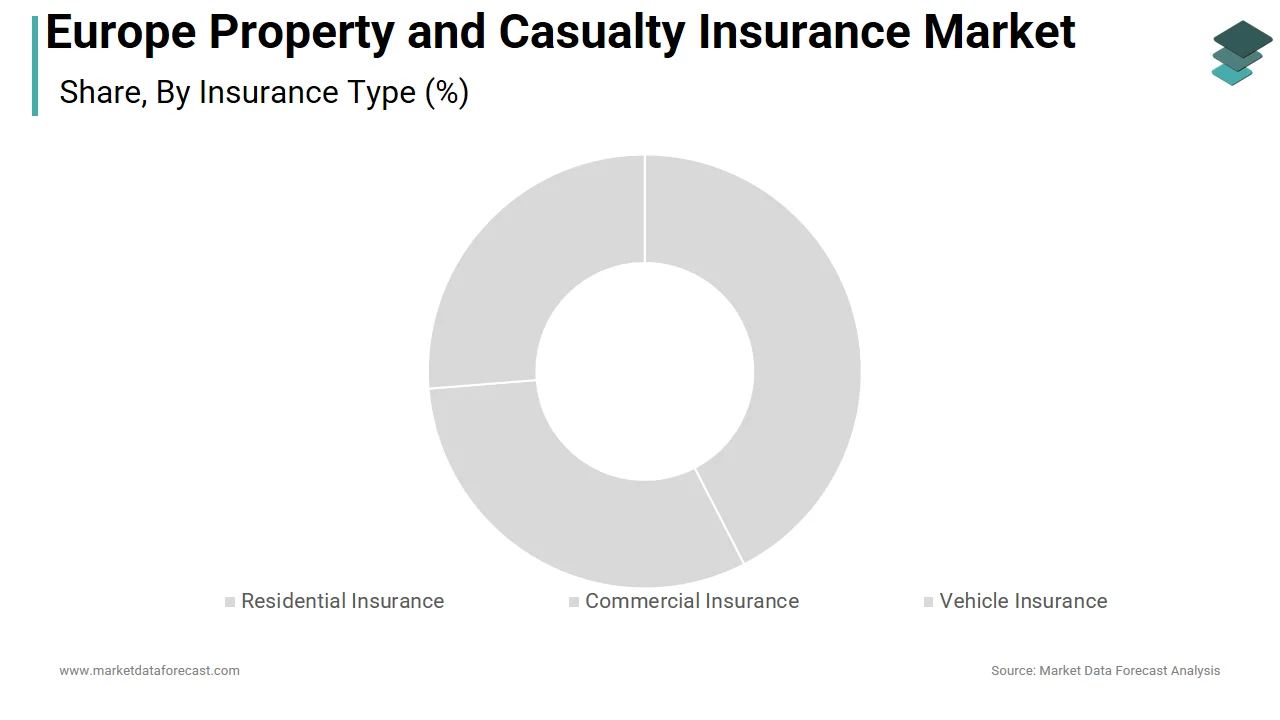
The vehicle insurance segment led the market by capturing 37.3% of the regional market share in 2025. The dominance of the vehicle insurance segment in the European market is attributed to the stringent legal mandates across the continent that make third-party liability coverage compulsory for all motor vehicle owners and the sheer volume of registered vehicles in the region. According to Eurostat, passenger cars in circulation within the European Union number in the hundreds of millions, which is creating a massive and inelastic base of mandatory policyholders. Furthermore, the high density of urban traffic and the associated risk of accidents necessitate robust coverage limits. As per the European Transport Safety Council, road accidents continue to cause significant economic losses annually, reinforcing the regulatory push for comprehensive coverage to protect victims and ensure financial responsibility. Secondly, the rising cost of vehicle repairs and medical treatments following accidents drives up premium values. According to the European Insurance and Occupational Pensions Authority, bodily injury claim costs have been rising due to inflation in healthcare and automotive parts. This combination of universal legal requirement, high asset density, and escalating claim costs ensures that vehicle insurance remains the cornerstone of the European non-life insurance sector.
However, the commercial insurance segment is projected to be the fastest-growing segment and witness a CAGR of 8.2% over the forecast period, owing to the growing complexity of business risks, including cyber threats, supply chain disruptions, and climate-related property damage, and rising awareness among corporations regarding the financial devastation caused by business interruptions. As per the European Centre for Disaster Risk Reduction, weather-related business interruptions have been increasing in frequency, prompting companies to seek specialized coverage beyond standard property policies. According to the European Commission, small and medium-sized enterprises, which constitute the vast majority of businesses in the EU, are increasingly recognizing that state aid is insufficient for full recovery, which is leading to a surge in demand for tailored commercial packages. Additionally, the rise of the gig economy and new business models has created novel liability exposures that traditional policies do not cover, spurring innovation in commercial lines. The European Federation of Insurance Intermediaries notes that inquiries for cyber liability and directors and officers insurance have been rising, reflecting a broader understanding of intangible risks. This shift from viewing insurance as a compliance cost to a strategic risk management tool drives the rapid expansion of the commercial segment.
By Distribution Channel Insights
The indirect channels segment dominated the market with 60.5% of the European market share in 2025. The complexity of insurance products, the growing consumer preference for personalized advice, and the intricate nature of property and casualty policies, which often contain exclusions and conditions that require expert interpretation, are primarily driving the dominance of the indirect channels segment in the European market. According to the European Insurance Intermediaries Association, a majority of policyholders prefer consulting with a broker or agent to ensure their specific risks are adequately covered, particularly for commercial and high-value residential properties. Furthermore, the role of intermediaries in claims advocacy is highly valued by consumers who fear being disadvantaged by insurers during the settlement process. According to the data from the European Consumer Organisation, customers who purchase through intermediaries report higher satisfaction rates with claims outcomes compared to those who buy directly. Additionally, bancassurance remains a powerful force in Southern and Western Europe, where banks leverage their extensive branch networks to cross-sell insurance products to existing account holders. As per the European Central Bank, banks in countries like France and Spain distribute a large share of non-life insurance policies, capitalizing on established trust relationships. This reliance on human expertise and trusted financial institutions ensures that indirect channels remain the preferred route for the majority of European insurance transactions.
On the other hand, the direct channels segment is promising and is estimated to register a CAGR of 10.5% over the forecast period, owing to the digital adoption, the rising demand for cost-effective solutions, and the shifting behavior of younger demographics who prioritize speed, transparency, and lower premiums over face-to-face interaction. As per Eurostat, internet usage among individuals in the European Union is widespread, with a significant portion comfortable conducting financial transactions online. Secondly, the ability of direct insurers to offer lower prices by eliminating intermediary commissions appeals to price-sensitive consumers, especially for standardized products like basic motor insurance. According to the European Commission, the Digital Single Market strategy has facilitated cross-border online sales, allowing direct insurers to reach wider audiences with streamlined digital onboarding processes. The emergence of insurtech startups has further accelerated this trend by introducing user-friendly interfaces and instant policy issuance capabilities. The European Insurtech Forum highlights that digital-first insurers have captured a growing share of the market by offering usage-based models that can only be efficiently managed through direct digital channels. This convergence of technological readiness, cost advantages, and changing consumer habits positions direct channels as the most dynamic growth engine in the distribution landscape.
By End User Insights
The individual segment led the market by accounting for 51.9% of the European market share in 2025. The dominance of individuals segment in the European market is attributed to the universal need to protect personal assets such as homes and vehicles against unforeseen events and the mandatory nature of motor insurance for private car owners, which creates a vast and consistent customer base across all European nations. According to the European Automobile Manufacturers Association, new car registrations remain robust, with millions of units sold annually, each requiring immediate insurance coverage. Furthermore, the high value of residential real estate in Europe compels homeowners to secure comprehensive property insurance to safeguard their largest financial investment. As per Eurostat, home ownership rates in many European countries remain high, and the rising cost of construction materials makes self-insurance an unviable option for most families. The increasing frequency of natural catastrophes affecting residential areas has also heightened risk awareness among households. According to the European Environment Agency, floods and storms have damaged large numbers of homes in recent years, prompting a surge in uptake of additional coverage riders. The emotional and financial security provided by these policies ensures that individuals remain the primary source of premium volume, with demand remaining relatively inelastic despite economic fluctuations.
However, the business segment is emerging as the fastest-growing end-user category and is estimated to register a CAGR of 9.2% over the forecast period in the regional market, owing to the evolving risk landscape, the increasing sophistication of corporate risk management strategies, and the growing recognition of cyber risks and the subsequent mandate for cyber liability coverage across various industries. As per the European Union Agency for Cybersecurity, cyberattacks on businesses have been increasing, forcing companies to seek specialized insurance to cover data breaches, ransomware payments, and business interruption losses. Additionally, global supply chain volatility has led businesses to invest heavily in trade credit and cargo insurance to mitigate financial losses from disrupted logistics. According to the European Chamber of Commerce, manufacturers have expanded their insurance portfolios to include coverage for supply chain delays and supplier insolvency. The rise of environmental, social, and governance criteria has also driven demand for directors' and officers' liability insurance, as corporate leaders face greater scrutiny and potential litigation. As per the European Corporate Governance Institute, lawsuits against board members have been rising, making D&O coverage essential. This broadening scope of insurable business risks ensures that the corporate segment outpaces individual growth in the coming years.
COUNTRY LEVEL ANALYSIS
United Kingdom Property and Casualty Insurance Market Analysis
The United Kingdom held 25.5% of the European market share in 2025 and held the leading position in the European market. The highly competitive landscape with a strong presence of global reinsurers, a sophisticated regulatory framework under the Prudential Regulation Authority, and the concentration of Lloyd's of London that serves as a global hub for specialty insurance and reinsurance are contributing to the dominance of the UK in the European market. As per the Association of British Insurers, the UK non-life insurance sector generates substantial annual premiums, supported by a culture of high insurance penetration. The frequent occurrence of severe weather events has also driven up demand for comprehensive home and commercial property coverage. The UK's leadership in insurtech innovation further strengthens its position, with numerous startups developing digital solutions that enhance underwriting efficiency and customer experience. The exit from the European Union has prompted some restructuring, but the depth of capital and expertise ensures the UK remains the undisputed leader in the regional market.
Germany Property and Casualty Insurance Market Analysis
Germany had a promising share of the European property and casualty insurance market in 2025 due to a stable and highly regulated environment that emphasizes consumer protection and solvency. The German market is robust and is driven by the country's strong industrial base, which generates significant demand for commercial property and liability insurance. A key driving factor is the mandatory nature of building insurance in several federal states, which ensures near-universal coverage for residential properties against fire and natural hazards. The Federal Financial Supervisory Authority reports that German insurers maintain high capital buffers, fostering trust among policyholders. Additionally, the dense network of independent brokers plays a crucial role in distributing complex commercial policies to the renowned "Mittelstand" or small and medium-sized enterprises. As per the German Insurance Association, premium income has grown steadily, fueled by rising replacement costs and the increasing value of insured assets. The country's focus on energy transition and infrastructure modernization also creates new opportunities for engineering and project insurance, cementing Germany's role as a powerhouse in the European non-life sector.
France Property and Casualty Insurance Market Analysis
France is anticipated to hold a prominent share of the European property and casualty insurance market during the forecast period, owing to a unique system where natural catastrophe coverage is automatically included in all property insurance policies through a state-backed reinsurance mechanism. The French market is highly consolidated, with a few large domestic groups dominating the landscape. The principal driver is the "Cat Nat" regime, which guarantees coverage for floods, earthquakes, and other natural disasters, providing certainty to homeowners and businesses alike. As per the French Federation of Insurance, this mandatory extension has resulted in one of the highest penetration rates for natural hazard coverage globally. Furthermore, the strict legal requirement for third-party motor insurance and the high value of agricultural assets drive substantial premium volumes. The French government's push for digital transformation in public services has also encouraged insurers to innovate their distribution channels. Data from the National Institute of Statistics and Economic Studies indicate that household spending on insurance remains resilient despite economic pressures. The combination of state support and private sector efficiency ensures that France maintains a stable and significant share of the European market.
Italy Property and Casualty Insurance Market Analysis
Italy is expected to showcase a healthy CAGR in the European property and casualty insurance market during the forecast period. The Italian market is evolving, with a gradual shift from low penetration to broader coverage as awareness of natural disaster risks grows. A major driving factor is the frequent occurrence of earthquakes and floods, which has prompted the government to incentivize private insurance uptake through tax deductions for policyholders. As per the Italian National Institute of Statistics, the penetration rate for non-life insurance has been rising steadily, although it remains below the European average, indicating significant growth potential. The automotive sector is another critical driver, with Italy having one of the highest car ownership rates in Europe, mandating a large base of motor insurance policies. The presence of a strong banking sector facilitates bancassurance distribution, which is a primary channel for selling home and personal accident policies. The ongoing modernization of the insurance regulatory framework by IVASS aims to enhance market transparency and consumer trust, positioning Italy as a high-growth territory in the region.
Spain Property and Casualty Insurance Market Analysis
Spain is estimated to command a notable share of the European property and casualty insurance market over the forecast period due to a strong bancassurance model and a high sensitivity to climate-related risks such as droughts and wildfires. The Spanish market is characterized by the dominance of large banking groups that distribute the majority of non-life insurance products through their extensive branch networks. The primary driving factor is the Consorcio de Compensación de Seguros, a public entity that provides coverage for extraordinary risks, including terrorism and natural disasters, which complements private insurance and stabilizes the market. As per the Spanish Insurance and Reinsurance Federation, penetration of home insurance has increased significantly due to mortgage requirements and rising awareness of climate risks. The tourism industry, a cornerstone of the Spanish economy, also drives demand for liability and property coverage for hotels and leisure facilities. The European Central Bank notes that the Spanish insurance sector has shown resilience and profitability, supported by prudent underwriting practices. The integration of digital tools by major insurers to streamline claims and improve customer engagement further strengthens Spain's position as a dynamic and important market within the European landscape.
COMPETITIVE LANDSCAPE
The competition within the Europe property and casualty insurance market is characterized by intense rivalry among established multinational giants and agile regional specialists who vie for market share through innovation and service differentiation. Major incumbents leverage their extensive capital reserves and broad provider networks to offer comprehensive coverage packages that appeal to corporate clients and high-net-worth individuals. However, the emergence of digital native insurers and insurtech startups has disrupted traditional dynamics by introducing user-friendly platforms and transparent pricing models that attract younger demographics. Regulatory fragmentation across European nations creates a complex battlefield where local knowledge and compliance expertise serve as significant competitive advantages. Companies are increasingly competing on the quality of digital experiences and the breadth of prevention services rather than price alone. The race to integrate advanced technologies like telematics and predictive analytics has become a defining feature of the landscape. This environment fosters continuous evolution as providers strive to balance profitability with the growing consumer expectation for personalized and accessible risk solutions.
KEY MARKET PLAYERS
The leading companies operating in the Europe property and casualty insurance market include:
- State Farm
- PICC
- Berkshire Hathaway Inc.
- Allianz SE
- Lloyd's of London
- AXA Group
- Progressive
- Allstate
- Ping An Insurance
- Liberty Mutual
- Tokio Marine Holdings
- Chubb Limited
- Travelers Group
- Nationwide Group
- Fairfax Financial Group
- Erie Ins Group
- Cincinnati Ins Cos
- Great Amer P&C Ins Grp
- Generali Group
- Zurich Ins U.S. PC Group
- CSAA Ins Group
TOP PLAYERS IN THE MARKET
- Allianz SE stands as a preeminent force in the Europe property and casualty insurance landscape, leveraging its vast global network to deliver comprehensive risk solutions across diverse sectors. The company contributes significantly to the global market by setting industry standards for sustainable underwriting and digital claims processing. Recently, Allianz has strengthened its position by launching advanced artificial intelligence-driven tools that enhance fraud detection and accelerate settlement times for policyholders. The firm actively invests in green insurance products that incentivize climate-friendly behaviors among customers and support the transition to a low-carbon economy. By forging strategic partnerships with technology providers, Allianz continues to redefine the customer experience through seamless digital interfaces. These initiatives underscore a commitment to leading the industry transformation, ensuring resilience against evolving risks while maintaining operational excellence throughout its extensive international operations.
- AXA Group operates as a dominant entity in the Europe property and casualty sector, renowned for its strategic focus on prevention and partnership-driven care models. Globally, the company influences market trends by pioneering integrated risk ecosystems that connect insurers, clients, and service providers through unified digital platforms. Recent actions to solidify its market standing include the expansion of its parametric insurance offerings, which provide rapid payouts based on predefined weather triggers for agricultural and commercial clients. AXA has also invested heavily in data analytics to predict natural catastrophe losses and intervene proactively, thereby enhancing the efficiency of its underwriting processes. The group frequently acquires niche insurtech startups to incorporate cutting-edge solutions like drone-based damage assessment into its portfolio. These moves demonstrate a commitment to evolving from a mere payer to a proactive risk partner, addressing the growing demand for agile and accessible protection services throughout the European continent.
- Generali Group maintains a robust presence in the Europe property and casualty insurance market, distinguished by its customer-centric approach and extensive distribution network. On the global stage, Generali contributes by developing flexible insurance products that cater to diverse demographic needs, ranging from individual homeowners to large industrial corporations. To reinforce its market position, the company recently launched a series of digital-first insurance products designed to appeal to younger consumers who prioritize speed and transparency. Generali has also forged strategic alliances with major automotive manufacturers to offer embedded insurance solutions directly at the point of vehicle sale. The firm emphasizes prevention through its value-added services, which include home security monitoring and driver safety coaching to reduce claim frequencies. By continuously innovating its service delivery models and expanding its digital capabilities, Generali ensures it remains competitive and responsive to the dynamic risk requirements of the European population.
TOP STRATEGIES USED BY KEY MARKET PARTICIPANTS
Key players in the Europe property and casualty insurance market primarily employ strategies centered on digital transformation and ecosystem integration to maintain competitiveness. Insurers are aggressively investing in artificial intelligence and big data analytics to refine risk assessment models and personalize premium pricing structures. Another prevalent strategy involves forming strategic partnerships with technology firms and automotive manufacturers to create seamless embedded insurance experiences that reach customers at critical touchpoints. Companies are also focusing on prevention and mitigation programs to lower claim frequencies and enhance customer retention rates. Expansion into niche segments such as cyber liability and parametric coverage allows providers to address specific emerging risks effectively. Furthermore, mergers and acquisitions remain a critical tool for consolidating market presence and acquiring innovative technological capabilities. These collective efforts aim to shift the business model from reactive claims processing to proactive risk management, ensuring sustainable growth in a highly regulated and volatile environment.
MARKET SEGMENTATION
This research report on the Europe property and casualty insurance market has been segmented and sub-segmented into the following categories.
By Insurance Type
- Residential Insurance
- Commercial Insurance
- Vehicle Insurance
- Others
By Distribution Channel
- Direct Channels
- E-commerce
- Own Sales Force
- Indirect Channels
- Agents / Brokers
- Retailers and Banks
- Others
By End User
- Individuals
- Business
- Government
By Country
- United Kingdom
- France
- Spain
- Germany
- Italy
- Russia
- Sweden
- Denmark
- Switzerland
- Netherlands
- Rest of Europe