- Product Description Description
- Table of Contents TOC
- List of Table & Figure LOT
- Get Free Sample PDF Sample PDF
Market Size, 2025
$24.80 BnMarket Estimate, 2026
$25.89 BnMarket Forecast, 2034
$36.54 BnCAGR, 2026–2034
4.4%Executive Summary: Global Feed Processing Market
- Market Scope: Comprehensive global analysis of the feed processing equipment and machinery market spanning types, modes of operation, livestock categories, physical forms, and regional country dynamics.
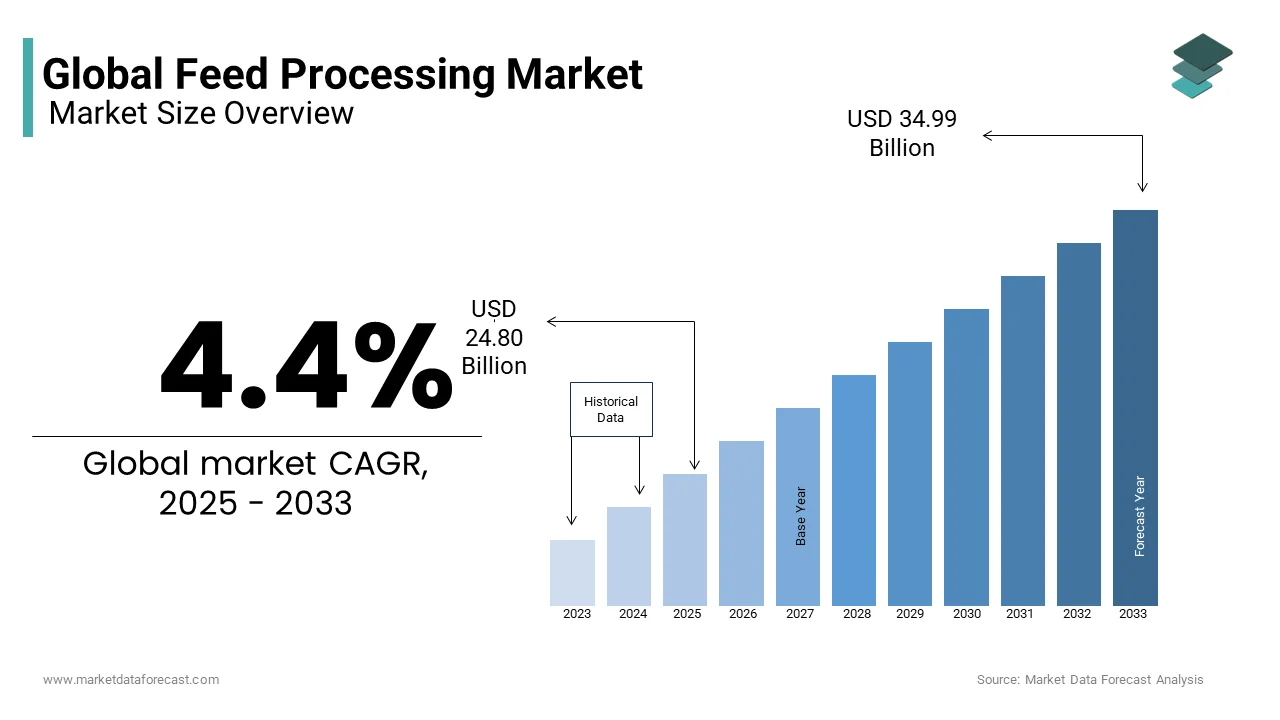
- Market Valuation: Valued at USD 24.80 billion in 2025, reaching USD 25.89 billion in 2026, and projected to scale up to USD 36.54 billion by 2034, expanding at a steady CAGR of 4.4% from 2026 to 2034.
- Primary Growth Drivers: Booming aquaculture feed requirements, rising compound feed costs, technological advancements in crushing/granulating equipment, and farmers' increasing focus on animal nutrition and feed conversion efficiency.
Key Market Segment Metrics
| Category | Leading Segment (Base Year Position) | Fastest-Growing / High-Impact Segment |
|---|---|---|
| By Form | Pellets (accounted for a significant portion due to enhanced nutrient distribution, reduced waste, and better handling) | Granules & Mash (expanding through cost-effective and specialized young-animal feeding demands) |
| By Livestock | Poultry (captured the largest market share as poultry meat production leads global consumption trends) | Aquaculture (surging rapidly driven by intensive fish and shrimp farming expansion) |
| By Mode of Operation | Manual (recorded the highest portion due to low acquisition costs and widespread use among smallholders) | Automatic & Semi-Automatic (scaling up via industrial modernization and large-scale feed mills) |
| By Region | Asia-Pacific (largest market share driven by dominant feed producers like China) | Latin America & MEA (growing steadily via infrastructure upgrades and commercial livestock expansion) |
Major Market Players & Market Structure
Market Structure: Consolidated and technology-intensive ecosystem featuring global engineering firms, specialized machinery manufacturers, and strategic cross-border acquisitions focused on advanced extrusion and milling solutions.
Key Companies: Longchang Machinery, Andritz AG, Henan, B.K. Allied Industries, HET Feed Machinery, Dinnissen BV, Bühler Holding AG, Bratney Companies, Clextral, Pavan, and Jiangsu Muyang Group Co.
Global Feed Processing Market Size
The global feed processing market size was valued at USD 24.80 billion in 2025 and is anticipated to reach USD 25.89 billion in 2026 to reach USD 36.54 billion by 2034, growing at a CAGR of 4.4% during the forecast period from 2026 to 2034.
CURRENT SCENARIO OF THE GLOBAL FEED PROCESSING MARKET
Animal feed is important and the most important factor in animal production. Food processing involves breaking down the physical nature of food to result in optimal use by animals, as well as improving the mix and stability of your food. Finely processed food particles digest better than coarse or whole food ingredients. This procedure helps improve the digestibility and bioavailability of food. Food processing not only improves the quality of food but also minimizes losses during feeding. Common food processing goals include better feed conversion or efficiency, higher feed consumption and faster average daily gain, better carcass quality or yield, reduced feed waste, and many others. The feed preparation methods used for pigs and poultry are relatively simple and few compared to the variety of methods available for feeding ruminants.
MARKET DRIVERS AND RESTRAINTS
The boom in aquaculture has attracted a lot of attention among aquaculture feed manufacturers around the world.
For the aquaculture sector to maintain its current growth rate, the supply of nutrients and food inputs may need to grow at a similar rate while the production of aquatic ingredients remains static, and other sectors are downsizing and competing for food resources. However, the constant growth of aquaculture and the demand for more feed, especially for tilapia and catfish, has sparked the interest of most smallholders in processing their own feed rather than buying complete fish feed. This, in turn, encourages small farmers to install feed processing machines.
Rising compound feed costs and growing awareness among farmers of the benefits associated with feed processing equipment are driving demand for feed processing machinery in the world. The global demand for feed processing is increasing dramatically due to the growing awareness of food nutrition and health, technological advancements in the equipment industry, personalized services, and the increasing demand for food in the world. The poor infrastructure of the crushing and granulating equipment is hampering the growth of the global feed processing market. The other important restraining factor for the growth of the feed processing market is the consolidation of the market.
REPORT COVERAGE
| REPORT METRIC | DETAILS |
| Market Size Available | 2025 to 2034 |
| Base Year | 2025 |
| Forecast Period | 2026 to 2034 |
| CAGR | 4.4% |
| Segments Covered | By Type, Mode Of Operation, Livestock, Form, and Region |
| Various Analyses Covered | Global, Regional & Country Level Analysis, Segment-Level Analysis, DROC, PESTLE Analysis, Porter’s Five Forces Analysis, Competitive Landscape, Analyst Overview on Investment Opportunities |
| Regions Covered | North America, Europe, APAC, Latin America, Middle East & Africa |
| Market Leaders Profiled | Longchang Machinery, Andritz AG, Henan, B.K. Allied Industries, HET Feed Machinery, Dinnissen BV, Bühler Holding AG, Bratney Companies, Clextral, Pavan, Jiangsu Muyang Group Co., and Others. |
SEGMENTAL ANALYSIS
By Type Insights
By Form Insights
Pellets accounted for a significant portion in 2024. The demand for feed pellets for animals is mainly due to the advantages of feed pellets, such as better feed consumption and increased weight of the animals. Due to the increasing demand for nutritious feed, the production of pellets is increasing dramatically, which also stimulates business investment in the feed pellet processing industry. In addition, reducing waste during the consumption process, providing a total mix of nutrients in each pellet, improving storage capacity, lowering transport costs, and improving food handling are some of the benefits that have driven the adoption of pallets for animals.
By Livestock Insights
The poultry segment accounted for the largest market share in 2024. Poultry meat is one of the highest among others, such as pork, beef, and fish. Therefore, a great opportunity lies in the segment of feed for birds. Manufacturers invest heavily in developing innovative feed equipment technologies for the production of various forms of high-quality poultry feed.
By Mode of Operation Insights
Manual recorded the highest portion in 2024. Manual granulating machines are designed and manufactured from locally available materials, which makes the granulating machine quite affordable. Manual operation mode does not require any technical expertise.
REGIONAL ANALYSIS

Asia Pacific Market Analysis
Asia-Pacific is expected to have the largest market share of the feed processing market during the forecast period, followed by Europe. China maintains its position as a world leader in animal feed production, with an advance of about 10 million metric tons compared to the United States. Due to the major feed-producing countries and a large number of feed manufacturers in the region, Asia-Pacific has maintained a leading position in the global market for feed processing machinery.
China Market Analysis
China remains the main feed producer and user of feed processing machinery due to economic growth and rapid development. The main driver of the market is the increasing attention of domestic feed processing machinery companies, technological advancements and government subsidies for mechanization due to population growth. The prosperity of this region is the result of its tightly integrated markets. The market is showing strong growth in terms of turnover. Due to its highly diverse industrial market, the United States dominates the economy of the North American region.
COMPETITIVE ANALYSIS
KEY MARKET PLAYERS
Major players in the Feed Processing Market include
- Longchang Machinery
- Andritz AG
- Henanand
- Band .K. Allied Industries
- HET Feed Machinery
- Dinnissen BV
- Bühler Holding AG
- Bratney Companies
- Clextral
- Pavan
- Jiangsu Muyang Group Co.
RECENT MARKET NEWS
- For example, in December 2024, GEA Group AG (Germany) acquired the Pavan Group in Italy. This acquisition has allowed GEA to expand its technological portfolio by adopting extrusion and grinding technologies for processed products for human and animal nutrition. With its head office in Galliera Veneta, near Padua, the group employs around 680 people at various production sites in Italy and China.
- In May 2024, The international technology group ANDRITZ presents its new innovative product line ADuro of recycling mills for primary and secondary crushing, fine granulation as well as for fractionation of composite materials. ADuro shredders offer maximum durability and are ideal for processing almost all raw materials in the recycling industry. They can be easily installed in existing installations, thus minimizing downtime during installation.
- In July 2024, Bratney Companies and F.H. Schule Mühlenbau announced a strategic partnership agreement. The partnership will include joint distribution, sales, and promotional efforts for new and existing milling plants in the United States. This agreement is the opportunity for the two companies to combine their experience, resources and experiences to realize their common philosophy of customer satisfaction.
MARKET SEGMENTATION
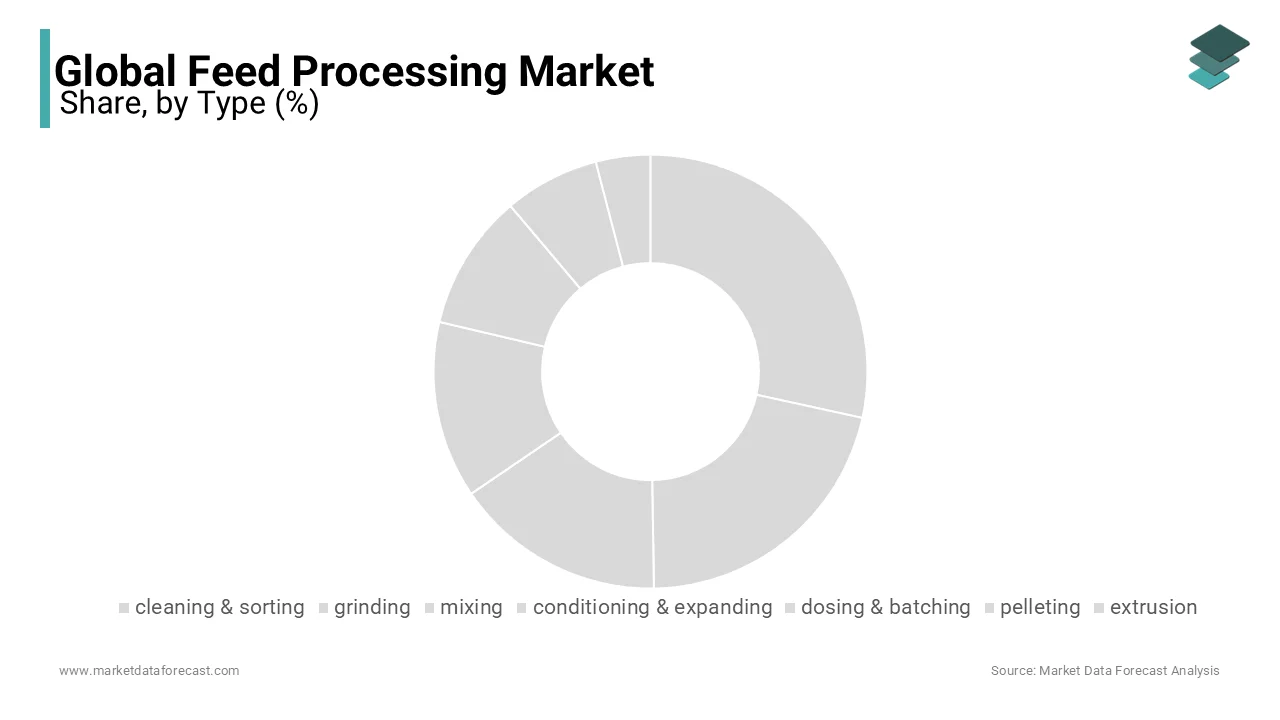
This research report on the global feed processing market is segmented and sub-segmented based on the Type, Form, Livestock Mode of operation, and Region.
By Type
- cleaning & sorting
- grinding
- mixing
- conditioning & expanding
- dosing & batching
- pelleting
- extrusion
By Form
- granules
- puree
- others
By Livestock
- poultry
- pigs
- others
By Mode of Operation
- manual
- semi-automatic
- automatic
By Region
- North America
- Europe
- Asia Pacific
- Latin America
- Middle East & Africa