- Product Description Description
- Table of Contents TOC
- List of Table & Figure LOT
- Get Free Sample PDF Sample PDF
Market Size, 2025
$47.56 BnMarket Estimate, 2026
$50.18 BnMarket Forecast, 2034
$77.01BnCAGR, 2026–2034
5.5%Executive Summary: Ophthalmology Devices Market
- Market Scope: Comprehensive global ophthalmology devices market analysis covering disorder segments, application types, device categories, regional leadership frameworks, and ocular disease drivers.
- Market Valuation: Valued at USD 47.56 billion (2025), estimated at USD 50.18 billion (2026), and projected to reach USD 77.01 billion by 2034, registering a steady CAGR of 5.5% (2026–2034).
- Primary Growth Drivers: Rising prevalence of age-related ocular disorders (cataracts affecting over 94 million globally), minimally invasive surgical system advancements, AI-diagnostic platforms, and premium IOL adoption.
Key Market Segment Metrics (2026–2034)
| Category | Leading Segment (2025 Position) | Fastest-Growing Segment |
|---|---|---|
| By Disorder & Application | Cataract (38.2% share) & Diagnostics and Monitoring Devices (46.3% application share in 2025) | Vitreo-Retinal Disorders (9.3% CAGR) & Surgery Devices (8.7% CAGR) |
| By Device & Region | Computerized Field Analysers & North America (dominated with 37.4% share in 2025) | Canaloplasty Devices (10.2% CAGR for MIGS) & Europe (29.3% share) |
Major Market Players & Market Structure
Market Structure: Highly competitive global ophthalmic technology landscape featuring major medical device manufacturers and vision care conglomerates competing on AI diagnostic integration, regional innovation hubs, and advanced surgical platforms.
Key Companies: Alcon Inc., Abbott Medical Optics Inc., Johnson & Johnson, Essilor International, Bausch & Lomb Inc., Topcon Corporation, NIDEK Co., Ltd., Haag-Streit Group, Carl Zeiss Meditec AG, Hoya Corporation, and Ziemer Ophthalmic Systems AG.
Global Ophthalmology Devices Market Size
The global ophthalmology devices market size was valued at USD 47.56 billion in 2025 and is anticipated to reach USD 50.18 billion in 2026 from USD 77.01 billion by 2034, growing at a CAGR of 5.5% during the forecast period from 2026 to 2034.
The Ophthalmology Devices is a specialized range of diagnostic, surgical, and therapeutic instruments designed to detect, manage, and treat ocular conditions such as cataracts, glaucoma, age-related macular degeneration (AMD), and diabetic retinopathy. These devices include optical coherence tomography (OCT) scanners, slit lamps, tonometers, phacoemulsification systems, intraocular lenses (IOLs), and femtosecond lasers. As per the World Health Organization (WHO), at least 2.2 billion people globally suffer from vision impairment or blindness, with over 1 billion cases remaining untreated due to lack of access to proper diagnostic and surgical interventions. The International Agency for the Prevention of Blindness (IAPB) notes that cataracts alone account for 35% of global blindness, affecting over 94 million individuals.
MARKET DRIVERS
Rising Prevalence of Age-Related and Chronic Ocular Diseases
The global surge in age-related eye disorders is a primary driving factor for the growth of the ophthalmic devices market. According to the World Health Organization (WHO), the number of people aged 60 and over is projected to reach 2.1 billion by 2050, which is significantly increasing the incidence of cataracts, glaucoma, and AMD. The Lancet Global Health Commission on Aging reports that over 65% of individuals above 75 exhibit some degree of cataract formation, necessitating surgical intervention. Additionally, the International Diabetes Federation (IDF) estimates that 537 million adults live with diabetes, a key risk factor for diabetic retinopathy, which affects nearly one-third of patients after 20 years of disease duration.
Technological Advancements in Minimally Invasive and Image-Guided Surgical Systems
Innovation in precision ophthalmic surgery has dramatically improved patient outcomes and accelerated recovery times is additionally escalating the growth of the Ophthalmology Devices Market. The integration of femtosecond lasers in cataract surgery has enhanced incision accuracy by up to 80% compared to manual techniques, as documented in a 2023 study published in Ophthalmology Science by the American Academy of Ophthalmology. Phacoemulsification systems equipped with torsional ultrasound and real-time intraoperative imaging now enable cataract removal with minimal endothelial cell loss, reducing complications. The European Society of Cataract and Refractive Surgeons (ESCRS) reported that over 70% of cataract procedures in Western Europe now utilize laser-assisted technology. Furthermore, the adoption of intraoperative OCT (iOCT) has increased surgical precision in macular and corneal procedures
MARKET RESTRAINTS
High Cost and Limited Reimbursement for Advanced Ophthalmic Devices
The financial burden associated with cutting-edge ophthalmic technologies restricts their accessibility in low- and middle-income countries and underfunded healthcare systems, which is impeding the growth of the Ophthalmology Devices Market. According to the Organisation for Economic Co-operation and Development (OECD), the average cost of a femtosecond laser-assisted cataract surgery is 2.5 times higher than conventional phacoemulsification, ranging from $2,500 to $4,000 per eye in the United States. Medicare in the U.S. does not fully reimburse laser-assisted procedures, leaving patients to cover the difference, which discourages adoption. In India, despite high disease burden, only 15% of cataract procedures use premium IOLs due to out-of-pocket payment constraints, as per the Public Health Foundation of India. These economic barriers limit the penetration of advanced devices, especially where public funding and insurance coverage remain inadequate.
Shortage of Trained Ophthalmologists and Technical Operators
The lack of skilled professionals capable of operating sophisticated ophthalmic equipment impedes the growth of the market. According to the World Health Organization (WHO), there is an average of fewer than 3 ophthalmologists per million population in low-income countries, compared to over 50 per million in high-income nations. The International Council of Ophthalmology (ICO) estimates a global deficit of over 200,000 eye care specialists, with sub-Saharan Africa and South Asia facing the most acute gaps. Even when devices are available, the absence of trained technicians to operate OCT scanners, angiography systems, or laser platforms leads to underutilization. A 2023 study by the London School of Hygiene & Tropical Medicine found that 40% of OCT machines in public hospitals across Nigeria and Bangladesh remain idle due to lack of qualified personnel.
MARKET OPPORTUNITIES
Expansion of Tele-Ophthalmology and AI-Integrated Diagnostic Platforms
The integration of artificial intelligence and remote care delivery is unlocking transformative potential in early eye disease detection in underserved regions. Google Health’s AI algorithm for diabetic retinopathy, validated in a multi-country trial published in Nature Medicine, demonstrated 98.5% sensitivity in identifying referable cases from retinal images, matching expert ophthalmologists. As per the International Telecommunication Union (ITU), over 60% of rural health centers in India and Kenya now use portable fundus cameras linked to AI cloud platforms for real-time screening. The Aravind Eye Care System in Tamil Nadu processed over 500,000 tele-consultations in 2023 using AI-assisted diagnostics, reducing specialist workload by 40%. Furthermore, the U.S. Food and Drug Administration (FDA) has cleared multiple AI-based autonomous diagnostic systems, including IDx-DR by enabling primary care providers to conduct eye screenings without specialist involvement. These innovations are democratizing access and creating scalable models for preventive eye care.
Growing Adoption of Premium Intraocular Lenses and Refractive Surgery Devices
The patient demand for enhanced visual outcomes beyond basic vision correction with multifocal, toric, and extended-depth-of-focus (EDOF) intraocular lenses (IOLs) and advanced refractive platforms is to showcase new opportunities for the growth of the Ophthalmology Devices Market. According to the European Society of Cataract and Refractive Surgeons (ESCRS), over 35% of cataract surgeries in Europe now use premium IOLs, a figure that has doubled since 2018. In the United States, the American Society of Cataract and Refractive Surgery (ASCRS) reported that refractive lens exchange procedures grew by 12% annually between 2020 and 2023.
MARKET CHALLENGES
Regulatory Hurdles and Lengthy Approval Processes for Novel Devices
The development and commercialization of advanced ophthalmic devices are often delayed by stringent regulatory requirements and divergent approval pathways across jurisdictions, which is to inhibit the growth of the Ophthalmology Devices Market. According to the U.S. Food and Drug Administration (FDA), the average premarket approval (PMA) process for high-risk ophthalmic devices takes 18 to 24 months, with clinical trials requiring multi-center data from over 300 patients. In the European Union, the transition to the Medical Device Regulation (MDR) has increased certification timelines by up to 50%, as reported by MedTech Europe, with notified bodies facing backlogs in assessing ophthalmic lasers and implantable devices. These complexities increase R&D costs and discourage innovation among small and mid-sized medical device firms aiming to enter global markets.
Risk of Device-Related Complications and Post-Operative Infections
The ophthalmic procedures carry inherent risks of complications, including endophthalmitis, IOL dislocation, and corneal edema, which can undermine patient confidence and increase liability shall also hinder the growth of the Ophthalmology Devices Market. According to the Endophthalmitis Vitrectomy Study (EVS) conducted by the National Eye Institute, the incidence of post-cataract surgery endophthalmitis ranges from 0.03% to 0.2%, but outcomes can be devastating, with up to 30% of affected eyes losing useful vision. The American Academy of Ophthalmology reports that improper sterilization of phacoemulsification tips contributes to 15% of infection cases in outpatient surgical centers. Additionally, a 2023 study in JAMA Ophthalmology found that 12% of patients receiving multifocal IOLs experienced significant visual disturbances such as glare and halos, leading to higher rates of explantation. These risks necessitate rigorous training, quality control, and post-market surveillance, placing additional burdens on healthcare providers and manufacturers alike.
REPORT COVERAGE
| REPORT METRIC | DETAILS |
| Market Size Available | 2025 to 2034 |
| Base Year | 2025 |
| Forecast Period | 2026 to 2034 |
| Segments Covered | By Application, Type of Disorder, Device, and Region |
| Various Analyses Covered | Global, Regional & Country Level Analysis, Segment-Level Analysis; DROC, PESTLE Analysis, Porter's Five Forces Analysis, Competitive Landscape, Analyst Overview of Investment Opportunities |
| Regions Covered | North America, Europe, APAC, Latin America, Middle East & Africa |
| Market Leader Profiled | Alcon Inc., Abbott Medical Optics Inc., Johnson & Johnson, Essilor International, Bausch and Lomb Inc., Topcon Corporation, Nidek Co Ltd., HAAG-Streit Group, Carl Zeiss Meditec, Hoya Corporation, and Ziemer Ophthalmic System. |
SEGMENTAL ANALYSIS
By Type of Disorder Insights
The cataract segment was accounted in holding 38.2% of the ophthalmology devices market share in 2025 by leading cause of reversible blindness worldwide, affecting over 94 million people. The sheer volume of cataract surgeries estimated at 28 million annually that drives sustained demand for phacoemulsification systems, intraocular lenses (IOLs), and surgical consumables. The U.S. Centers for Disease Control and Prevention (CDC) reports that more than half of Americans develop cataracts by age 80, ensuring a steady patient pipeline.

The Vitreo-retinal disorders segment is likely to witness a CAGR of 9.3% during the forecast period with the rising prevalence of diabetic retinopathy, age-related macular degeneration (AMD), and retinal vein occlusions, exacerbated by global increases in diabetes and aging populations. The International Diabetes Federation (IDF) estimates that one in three people with diabetes develops diabetic retinopathy, affecting over 100 million individuals worldwide. The National Eye Institute reports that AMD affects approximately 19.8 million Americans, with advanced cases requiring frequent intravitreal injections and advanced imaging. Innovations such as anti-VEGF therapies, microcannula delivery systems, and widefield imaging have expanded treatment options, increasing procedural frequency and device utilization.
By Application Insights
The diagnostics and monitoring devices segment was accounted in holding 46.3% of the ophthalmology devices market share in 2025 with the early detection and longitudinal tracking of chronic eye diseases in aging populations. Optical coherence tomography (OCT) systems, which provide high-resolution cross-sectional imaging of the retina, are now standard in managing conditions such as glaucoma and macular degeneration. According to the American Academy of Ophthalmology, over 85% of retina specialists in the U.S. use OCT in every patient visit, performing an average of 15 scans per day per device. The World Health Organization highlights that regular monitoring can reduce the risk of vision loss from diabetic retinopathy by up to 95% when treatment is initiated early.
The surgery devices segment is projected to expand at a CAGR of 8.7% from 2025 to 2033 with the rising volumes of cataract and refractive procedures, as well as the increasing adoption of premium surgical platforms. Phacoemulsification systems, which use ultrasonic energy to remove cataracts, are now used in over 90% of cataract surgeries globally, as documented by the International Society of Refractive Surgery (ISRS). The U.S. National Eye Institute estimates that more than 4 million cataract surgeries are performed annually in the United States alone, a number expected to rise by 30% by 2030 due to demographic shifts.
By Device Insights
The computerized field analyser segment dominated Ophthalmology Devices Marketby accounting for a significant share in 2025 with its essential role in diagnosing and monitoring glaucoma, a chronic condition requiring lifelong visual field assessment. The Humphrey Field Analyzer (HFA), the most widely used system globally, performs over 15 million tests annually, according to the American Academy of Ophthalmology. Glaucoma affects nearly 80 million people worldwide, as per the Lancet Global Health Commission on Eye Health, with early detection relying heavily on perimetry to identify peripheral vision loss before irreversible optic nerve damage occurs. The Royal College of Ophthalmologists recommends visual field testing every six to twelve months for glaucoma patients, ensuring recurring device usage.
The canaloplasty devices segment is attributed to grow with an expected CAGR of 10.2% from 2025 to 2033 owing to the increasing demand for minimally invasive glaucoma surgeries (MIGS) that offer safer, outpatient alternatives to traditional trabeculectomy. Canaloplasty, which involves catheter-based dilation and stenting of Schlemm’s canal, reduces intraocular pressure with a significantly lower risk of complications such as hypotony and infection. The Wohlk Canaloplasty Registry reported that 78% of patients undergoing the procedure achieved a 30% reduction in intraocular pressure at 12 months, with 65% able to discontinue one or more glaucoma medications. The American Glaucoma Society notes that MIGS procedures increased by 25% annually between 2020 and 2023 in the U.S., with canaloplasty gaining favor among surgeons for its efficacy in moderate to advanced cases
REGIONAL ANALYSIS
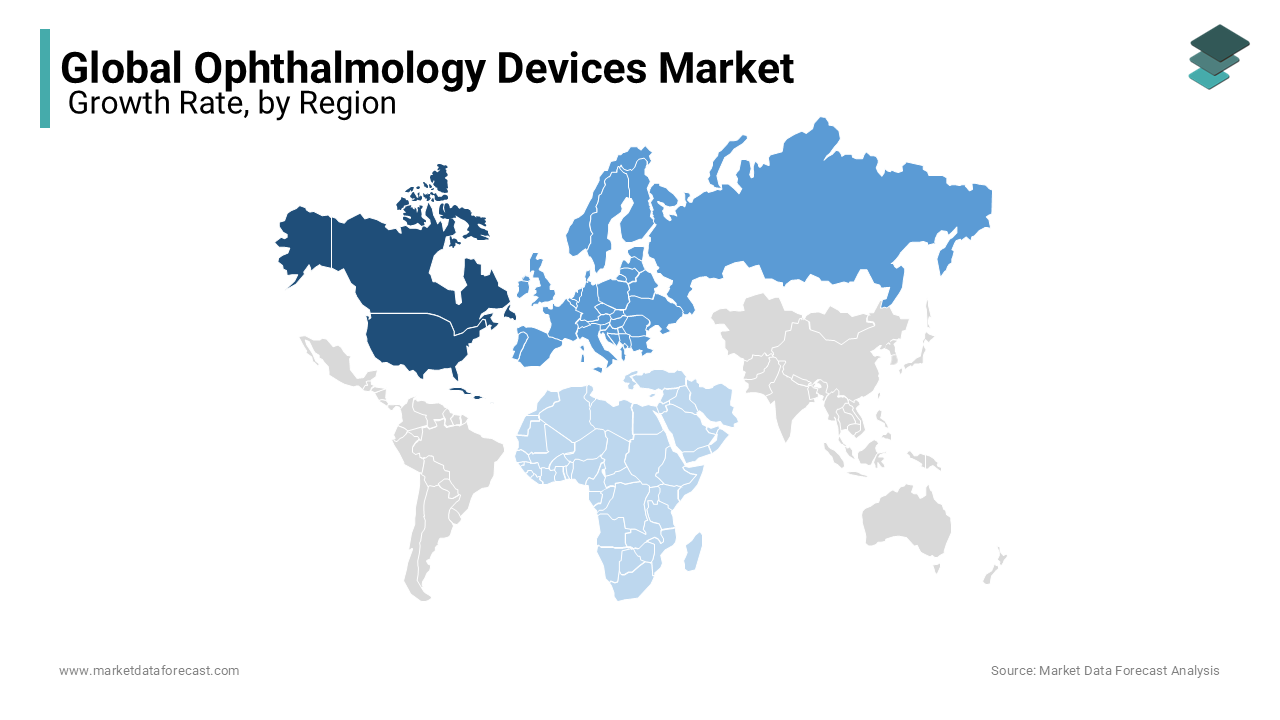
North America was the top performer of the global ophthalmology devices market by accounting for 37.4% of the share in 2025. The United States performs over 4 million cataract surgeries annually, the highest volume globally, as per American Society of Cataract and Refractive Surgery (ASCRS). The National Institutes of Health reports that over 11 million Americans undergo annual glaucoma screening using computerized perimetry by ensuring consistent demand for diagnostic devices. Additionally, the FDA’s expedited clearance pathways for AI-based diagnostic tools—such as IDx-DR—have accelerated innovation cycles.
Europe was positioned second with 29.3% of the Ophthalmology Devices Market share in 2025 with the universal healthcare coverage, stringent regulatory standards, and widespread integration of digital diagnostics. Germany ophthalmology devices market growth is likely to be driven by its high cataract surgery rate and early adoption of femtosecond lasers. The European Society of Cataract and Refractive Surgeons (ESCRS) reports that over 60% of cataract procedures in Western Europe now use premium IOLs. The United Kingdom’s National Health Service (NHS) has implemented AI-powered retinal screening programs across 40% of its diabetic care centers, reducing referral backlogs by 33%, as per NHS Digital. Additionally, the EU’s Medical Device Regulation (MDR) has spurred innovation in traceable, high-quality devices.
Asia Pacific ophthalmology devices market growth is esteemed to grow with prominent growth opportunities during the forecast period by expanding healthcare access, rising disposable incomes, and government initiatives to combat preventable blindness. China performs over 6 million cataract surgeries annually, a figure that has doubled since 2018, according to the Chinese Ophthalmological Society. India’s National Programme for Control of Blindness has increased surgical outreach, achieving a cataract surgery rate of 8,000 per million population in 2023. Japan leads in technological adoption, with over 90% of retina clinics using OCT for AMD management, as reported by the Japanese Ophthalmological Society. Moreover, tele-ophthalmology networks in Australia and Singapore have integrated AI diagnostics into primary care, processing over 2 million retinal images annually.
Latin America ophthalmology devices market is having steady growth opportunities during the forecast period. The region’s ophthalmic device demand is concentrated in Brazil, Mexico, and Argentina, where public-private partnerships are expanding access to eye care. Brazil’s Unified Health System (SUS) performed over 800,000 cataract surgeries in 2023, supported by federal funding for IOL procurement, as per the Ministry of Health. The Mexican Institute of Social Security (IMSS) has integrated optical coherence tomography into 70% of its ophthalmology clinics since 2021, improving diabetic retinopathy detection rates by 50%. Chile has implemented a national glaucoma screening program using portable field analysers in rural clinics, reaching over 120,000 patients annually, according to the Chilean Ophthalmological Society.
Middle East & Africa ophthalmology devices market growth is likely to grow with The Gulf Cooperation Council (GCC) countries lead in device adoption, with Saudi Arabia and the UAE investing heavily in specialized eye care centers. The Saudi Ministry of Health reported a 40% increase in cataract surgeries between 2020 and 2023, supported by Vision 2030 healthcare modernization goals. The UAE’s Dubai Health Authority has deployed AI-powered screening kiosks in malls and pharmacies, conducting over 150,000 diabetic retinopathy tests in 2023. In South Africa, the public sector performs over 300,000 cataract surgeries annually, though device shortages persist, as noted by the South African Medical Research Council. Egypt has launched a national campaign to eliminate avoidable blindness, procuring 50,000 IOLs annually through international partnerships.
COMPETITIVE LANDSCAPE
The competition in the ophthalmology devices market is defined by technological differentiation, clinical evidence, and strategic regional expansion. Global leaders such as Alcon, Johnson & Johnson Vision, and Carl Zeiss Meditec compete on innovation in surgical precision, imaging resolution, and patient outcomes. While established players dominate through integrated portfolios and global distribution, emerging firms are gaining traction with cost-effective devices tailored for high-volume settings. The rise of AI in diagnostics and the demand for minimally invasive procedures have intensified R&D investments.
KEY MARKET PLAYERS
Some key market participants leading the global ophthalmology device market include
- Alcon Inc. (Switzerland)
- Abbott Medical Optics Inc. (U.S.)
- Johnson & Johnson (U.S.)
- Essilor International (France)
- Bausch & Lomb Inc. (Canada)
- Topcon Corporation (Japan)
- NIDEK Co., Ltd. (Japan)
- Haag-Streit Group (Switzerland)
- Carl Zeiss Meditec AG (Germany)
- Hoya Corporation (Japan)
- Ziemer Ophthalmic Systems AG (Switzerland)
Top Players in the Ophthalmology Devices Market
Alcon Inc.
Alcon has dominant position in the Asia Pacific by delivering comprehensive ophthalmic solutions spanning cataract surgery, glaucoma management, and vision care. The company has expanded its manufacturing and distribution networks across India, Japan, and Southeast Asia, ensuring rapid access to premium intraocular lenses (IOLs) and phacoemulsification systems. In 2023, Alcon launched its next-generation PanOptix® trifocal IOL in South Korea and Australia, gaining rapid adoption among surgeons seeking advanced presbyopia-correcting options. The company also partnered with India’s LV Prasad Eye Institute to support training programs for cataract surgeons, enhancing procedural standardization. Alcon’s investment in digital education platforms has enabled over 5,000 ophthalmologists in the region to access virtual surgical simulations.
Johnson & Johnson Vision
Johnson & Johnson Vision has made significant inroads in the Asia Pacific through its focus on refractive surgery, contact lenses, and cataract technologies. The company’s iDesign™ Refractive Studio and TECNIS® portfolio of IOLs are widely adopted in Japan, China, and Singapore for their precision in correcting complex visual impairments. In 2023, Johnson & Johnson launched its ENDOVAC® HD system in Thailand and Malaysia, enhancing surgical efficiency in high-volume cataract centers. The company also collaborated with the Singapore National Eye Centre to evaluate real-world outcomes of its extended-depth-of-focus IOLs in Asian patient populations. Additionally, its ACUVUE® brand dominates the soft contact lens market in urban centers, supported by digital marketing and e-commerce expansion.
Carl Zeiss Meditec AG
Carl Zeiss Meditec has emerged as a key technology enabler in the Asia Pacific ophthalmic market through its dominance in diagnostic imaging and laser-assisted surgery. The company’s CIRRUS™ HD-OCT and RESCAN® 700 intraoperative OCT systems are standard in leading eye hospitals across Japan, South Korea, and India. In 2023, Zeiss introduced the ZEISS CALLISTO eye® with cyclotorsion compensation in Taiwan and Indonesia, improving accuracy in premium IOL placement. The company also established a regional innovation hub in Shanghai to accelerate localization of its surgical platforms for the Chinese market. Collaborations with institutions like the Aravind Eye Care System in India have expanded training on image-guided cataract surgery, benefiting over 2,000 clinicians.
Top Strategies Used by Key Market Participants
Key players in the ophthalmology devices market are leveraging product innovation, regional localization, strategic partnerships, digital integration, and clinical education to strengthen their competitive positioning. Companies are investing in next-generation IOLs, AI-enhanced diagnostics, and minimally invasive surgical platforms to meet evolving clinical demands. Expanding local manufacturing and technical support centers in high-growth regions ensures faster deployment and customization. Firms are integrating cloud-based imaging platforms and AI algorithms to improve diagnostic accuracy and workflow efficiency. Collaborations with leading eye hospitals and academic institutions facilitate clinical validation and surgeon adoption. Additionally, comprehensive training programs and digital surgical simulators are being deployed to address skill gaps.
RECENT MARKET HAPPENINGS
- In January 2023, Alcon launched the PanOptix® trifocal intraocular lens in South Korea, which is expanding its premium cataract portfolio and enhancing visual outcomes for presbyopic patients in the Asia Pacific region.
- In May 2023, Johnson & Johnson Vision introduced the ENDOVAC® HD phacoemulsification system in Malaysia by improving surgical efficiency and reducing procedure times in high-volume cataract centers.
- In September 2023, Carl Zeiss Meditec established a regional innovation hub in Shanghai, which is focusing on localizing its CIRRUS™ OCT and surgical platforms for the Chinese ophthalmic market.
- In February 2024, Alcon partnered with LV Prasad Eye Institute in India to launch a digital surgical training program by equipping over 1,000 ophthalmologists with advanced cataract techniques.
- In June 2024, Johnson & Johnson Vision collaborated with the Singapore National Eye Centre to conduct a multicenter study on the real-world performance of its TECNIS® Synergy IOL in Asian patients.
MARKET SEGMENTATION
This research report on the global ophthalmology devices market has been segmented & sub-segmented based on application, type of disorder, device, and region.
By Type of Disorder
- Cataract
- Glaucoma
- Refractor Disorders
- Vitreo Retinal Disorder
By Application
- Diagnostics & Monitoring Devices
- Surgery Devices
- Vision Care Devices
By Device
- Canaloplasty Devices
- Computerized Field Analyser
By Region
- North America
- Europe
- Asia Pacific
- Latin America
- Middle East & Africa