- Product Description Description
- Table of Contents TOC
- List of Table & Figure LOT
- Get Free Sample PDF Sample PDF
Market Size, 2025
$2792.87 MnMarket Estimate, 2026
$3471.54 MnMarket Forecast, 2034
$19,782.96 MnCAGR, 2026–2034
24.3%Executive Summary: Global Liquid Biopsy Market
- Market Scope: Comprehensive global market evaluation of the liquid biopsy industry covering cancer types, diagnostic approaches, sample types, end-user laboratory settings, and regional distribution frameworks.
- Market Valuation: Valued at USD 2,792.87 million in 2025, estimated at USD 3,471.54 million in 2026, and projected to reach USD 19,782.96 million by 2034, registering a remarkable CAGR of 24.3% from 2025 to 2033.
- Primary Growth Drivers: Increasing prevalence of genomic instability and heterogeneity in solid tumors, rising demand for dynamic real-time molecular monitoring, technological spillovers from non-invasive prenatal testing (NIPT), and rapid advancements in next-generation sequencing.
Key Market Segment Metrics (2026–2034)
| Category | Leading Segment (2025 Position) | Fastest-Growing / Preferred Segment |
|---|---|---|
| By Cancer Type | Lung Cancer (accounted for 34.6% of total revenue share in 2025 due to high mutational burden and EGFR/ALK testing needs) | Pancreatic Cancer (projected to expand at the fastest CAGR of 23.6% from 2026 to 2034) |
| By Sample / Diagnostic Type | Plasma / Blood (commanded an estimated 55.1% share in 2025 as the gold standard matrix for cell-free DNA yield) | Cerebrospinal Fluid (CSF) (projected at a rapid CAGR of 27.3% for CNS and leptomeningeal tumor profiling) |
| By End User | Reference Laboratories & Hospital/Physician Laboratories (accounted for the most significant share) | Academic and Research Centres (growing significantly due to translational oncology research) |
| By Region | North America (led with a commanding 42.4% share in 2025 anchored by genomic innovation and high health expenditure) | Asia-Pacific & Europe (rapid growth driven by rising cancer incidences, national screening guidelines, and local NGS developers) |
Major Market Players & Market Structure
Market Structure: Highly competitive global molecular diagnostics and precision oncology landscape featuring pioneering medtech enterprises, specialized sequencing firms, and diagnostic laboratories competing on assay sensitivity, AI data integration, and companion diagnostic approvals.
Key Companies: Guardant Health, F. Hoffmann-La Roche, Burning Rock Dx, Janssen Diagnostics, Qiagen, Rarecells SAS, Silicon Biosystems, SRI International, Myriad Genetics, Natera, Personal Genome Diagnostics, Sysmex Inostics, Exosome Diagnostics, Exosome Sciences, and HansaBiomed OU.
Global Liquid Biopsy Market Size
The liquid biopsy market size was valued at USD 2792.87 million in 2025. The global liquid biopsy market is estimated to grow at a CAGR of 24.3% from 2025 to 2033. As a result, the market is predicted to be worth USD 19782.96 million by 2034 from USD 3471.54 million in 2026
Liquid Biopsy refers to the transformative suite of non-invasive diagnostic technologies designed to detect and analyze circulating tumor-derived material, such as circulating tumor DNA (ctDNA), circulating tumor cells (CTCs), and exosomes, from a patient’s blood or other bodily fluids. Unlike traditional tissue biopsies, liquid biopsies enable real-time molecular profiling of tumors, facilitating early cancer detection, treatment monitoring, and assessment of resistance mutations. As per the World Health Organization, cancer remains a leading cause of death globally, with an estimated 20 million new cases diagnosed annually, underscoring the urgency for advanced diagnostic modalities. The integration of liquid biopsy into precision oncology has been accelerated by advancements in next-generation sequencing and digital PCR technologies. According to the research, a notable share of oncologists in the United States have utilized liquid biopsy in clinical decision-making for non-small cell lung cancer patients, reflecting its growing clinical validation and adoption in routine care pathways.
MARKET DRIVERS
Increasing Prevalence of Genomic Instability in Solid Tumors Driving Demand for Molecular Monitoring
The rising incidence of genomic heterogeneity within solid tumors has intensified the need for dynamic, real-time monitoring tools, positioning liquid biopsy as a pivotal solution. Tumors such as those in non-small cell lung cancer (NSCLC) and colorectal cancer exhibit significant clonal evolution, with up to 60% of patients developing resistance mutations like EGFR T790M within 10–14 months of targeted therapy initiation, as per the European Society for Medical Oncology. Traditional tissue biopsies are often inadequate in capturing this spatial and temporal heterogeneity due to their invasive nature and sampling limitations. Liquid biopsy overcomes these constraints by enabling serial monitoring, thereby allowing clinicians to detect emerging resistance mechanisms promptly. The National Cancer Institute points out that over 80% of metastatic cancer patients exhibit detectable ctDNA levels, reinforcing the biological feasibility of liquid-based genomic tracking. This demand for longitudinal molecular surveillance is further amplified by the growing use of targeted therapies and immunotherapies, which require precise biomarker assessment for optimal patient stratification and treatment adjustment.
Expansion of Non-Invasive Prenatal Testing (NIPT) Infrastructure Catalyzing Technological Spillover
The widespread adoption of non-invasive prenatal testing, which relies on the analysis of cell-free fetal DNA in maternal blood, has laid a robust technological and logistical foundation for liquid biopsy applications in oncology. As per the study, large number of NIPT procedures are performed annually in the United States alone, demonstrating the scalability and clinical acceptance of liquid-based molecular diagnostics. This established infrastructure, including standardized blood collection protocols, centralized laboratory networks, and bioinformatics pipelines, has significantly reduced the barriers to implementing ctDNA testing in oncology. Moreover, the regulatory experience gained through FDA-cleared NIPT platforms has informed the validation frameworks for oncology-focused liquid biopsy assays. The success of NIPT has also cultivated patient and physician familiarity with blood-based genetic testing, increasing receptivity to similar technologies in cancer care. This cross-domain technological maturation is accelerating the clinical integration of liquid biopsy, particularly in early detection and minimal residual disease monitoring
MARKET RESTRAINTS
Limited Analytical Sensitivity in Early-Stage Cancer Detection
Liquid biopsy faces significant limitations in detecting tumors at early stages due to low concentrations of circulating biomarkers. In stage I cancers, ctDNA levels can be exceedingly sparse, with some studies indicating that only 40–50% of early-stage colorectal and breast cancers release detectable ctDNA fragments into the bloodstream. As per research, the median variant allele frequency of ctDNA in localized tumors is often below 0.1%, necessitating ultra-sensitive sequencing techniques that are prone to false positives from sequencing artifacts. This constraint undermines the reliability of liquid biopsy for population-level cancer screening, where high sensitivity is paramount. Additionally, inter-individual variability in ctDNA shedding, affected by tumor location, vascularity, and immune clearance, further complicates consistent detection. The National Comprehensive Cancer Network showcases that current liquid biopsy assays are not recommended as standalone tools for early diagnosis, emphasizing the need for complementary imaging and clinical evaluation. These technical shortcomings hinder broad regulatory approval for screening applications and limit clinical confidence in negative results.
Regulatory and Reimbursement Hurdles Impeding Clinical Adoption
The absence of standardized regulatory pathways and inconsistent insurance coverage remains a critical barrier to the widespread implementation of liquid biopsy. Although the U.S. Food and Drug Administration has cleared several liquid biopsy tests, including Guardant360 CDx and FoundationOne Liquid CDx, for specific biomarker indications, the majority of assays operate as laboratory-developed tests (LDTs) under less stringent oversight. As per the study, fewer commercially available liquid biopsy tests have secured permanent reimbursement codes, leading to variable patient access and financial burden. A research analysis revealed that a notable share of oncologists delay or avoid ordering liquid biopsies due to uncertainty in insurance coverage. Furthermore, the lack of harmonized analytical validation criteria across laboratories contributes to variability in test performance. These systemic challenges deter investment in large-scale clinical trials necessary for broader indication approvals and impede equitable integration into standard care protocols, particularly in community oncology settings.
MARKET OPPORTUNITIES
Integration with Artificial Intelligence for Enhanced Biomarker Discovery
The convergence of liquid biopsy with artificial intelligence (AI) and machine learning is unlocking unprecedented opportunities for multi-analyte pattern recognition and early cancer signal detection. AI algorithms can analyze complex genomic, epigenomic, and fragmentomic profiles from ctDNA to distinguish malignant signals from background noise with greater accuracy than conventional methods. As per a 2023 study in The Lancet Digital Health, an AI-powered liquid biopsy platform achieved 92% specificity and 85% sensitivity in detecting eight common cancer types using methylation-based fragment patterns across a cohort of over 6,000 individuals. These models leverage vast datasets to identify subtle biological signatures, such as nucleosome positioning and DNA fragmentation biases, which are indicative of tumor origin and burden. Companies like Grail and Freenome are pioneering such multi-modal approaches, combining AI with deep sequencing to develop multi-cancer early detection (MCED) tests. The potential to shift cancer diagnosis toward pre-symptomatic stages could revolutionize population health strategies and reduce late-stage diagnosis rates, which currently account for over 50% of cancer-related deaths in low-screening-coverage regions.
Expansion into Minimal Residual Disease (MRD) Monitoring Post-Treatment
The application of liquid biopsy in minimal residual disease (MRD) assessment following curative-intent therapy represents a transformative opportunity in oncology. After surgical resection or adjuvant chemotherapy, up to 30–50% of early-stage colorectal and breast cancer patients experience recurrence, often undetectable by conventional imaging, as per the American Society of Clinical Oncology. Liquid biopsy enables the identification of residual tumor-derived DNA at levels as low as one mutant molecule among 100,000 wild-type fragments, offering a molecular window into residual disease. The DYNAMIC trial, conducted in Australia and published in The New England Journal of Medicine, demonstrated that ctDNA-guided adjuvant therapy decisions in stage II colon cancer reduced unnecessary chemotherapy use without compromising recurrence-free survival. This precision approach not only optimizes treatment intensity but also enhances patient quality of life. With ongoing trials validating MRD-guided interventions across multiple cancer types, the clinical and economic value of liquid biopsy in post-treatment surveillance is poised for exponential growth.
MARKET CHALLENGES
Pre-analytical Variability Compromising Test Reliability
A critical challenge in liquid biopsy implementation lies in the pre-analytical phase, where sample collection, processing, and storage conditions significantly influence assay performance. Delays in plasma separation beyond two hours can lead to genomic DNA contamination from lysed white blood cells, artificially diluting ctDNA signals. As per the study, improper handling can increase background noise, reducing the sensitivity of mutation detection. Variability in blood collection tube types, such as EDTA versus Streck tubes, further affects nucleic acid stability and yield. A study found that pre-analytical inconsistencies contributed to a discrepancy in ctDNA quantification across laboratories. These technical variations undermine result reproducibility and complicate cross-institutional data comparison, particularly in multi-center trials. Standardizing pre-analytical protocols remains a formidable hurdle, especially in decentralized healthcare systems where sample logistics are less controlled, threatening the reliability and clinical utility of liquid biopsy results.
Interpretation of Variants of Uncertain Significance (VUS) in Clinical Decision-Making
The detection of variants of uncertain significance (VUS) in liquid biopsy reports presents a growing clinical dilemma, complicating therapeutic decision-making and patient counseling. As per data from the Memorial Sloan Kettering Cancer Center, over 30% of patients undergoing comprehensive ctDNA profiling harbor at least one VUS in key cancer-related genes such as BRCA1, BRCA2, or TP53. Unlike pathogenic mutations, VUS lack definitive evidence linking them to oncogenesis, making it difficult to determine their clinical relevance. This ambiguity can lead to therapeutic inertia or inappropriate treatment escalation. Moreover, the dynamic nature of ctDNA means that VUS may represent clonal hematopoiesis rather than tumor-derived alterations, especially in older patients, further muddying interpretation. The American College of Medical Genetics and Genomics emphasizes that VUS should not guide treatment decisions. This gap between molecular data and clinical interpretability poses a significant barrier to the responsible integration of liquid biopsy in routine oncology practice.
REPORT COVERAGE
| REPORT METRIC | DETAILS |
| Market Size Available | 2025 to 2034 |
| Base Year | 2025 |
| Forecast Period | 2026 to 2034 |
| Segments Covered | By Cancer Type, Diagnostic Approach, Sample Type, End-User, and Region |
| Various Analyses Covered | Global, Regional & Country Level Analysis, Segment-Level Analysis; DROC, PESTLE Analysis, Porter's Five Forces Analysis, Competitive Landscape, Analyst Overview of Investment Opportunities |
| Regions Covered | North America, Europe, APAC, Latin America, Middle East & Africa |
| Market Leader Profiled | Janssen Diagnostics, Qiagen, Rarecells SAS, Silicon Biosystems, SRI International, Myriad Genetics, Natera, and Personal Genome Diagnostics, Sysmex InosticsTrovagene, Exosome Diagnostics, Exosome Sciences, and HansaBiomed OU. |
SEGMENTAL ANALYSIS
By Cancer Type Insights
The lung cancer segment dominated the liquid biopsy market by accounting for a 34.6% of total revenue share in 2025. This preeminence is due to the high mutational burden and well-characterized genomic drivers in non-small cell lung cancer (NSCLC), which necessitate frequent molecular monitoring. A pivotal factor reinforcing this dominance is the widespread reliance on EGFR, ALK, ROS1, and more recently, MET and RET mutation testing to guide first-line and subsequent therapies. According to the Study, many advanced NSCLC patients in high-income countries undergo routine liquid biopsy at disease progression to detect resistance mutations such as EGFR T790M or C797S. Additionally, the FDA’s approval of liquid biopsy companion diagnostics, such as the cobas EGFR Mutation Test v2, has institutionalized blood-based testing in treatment algorithms. The aggressive nature of lung cancer, coupled with low surgical resectability rates and the necessity for rapid therapeutic decisions, further amplifies demand for non-invasive genomic profiling, solidifying its position as the largest segment.
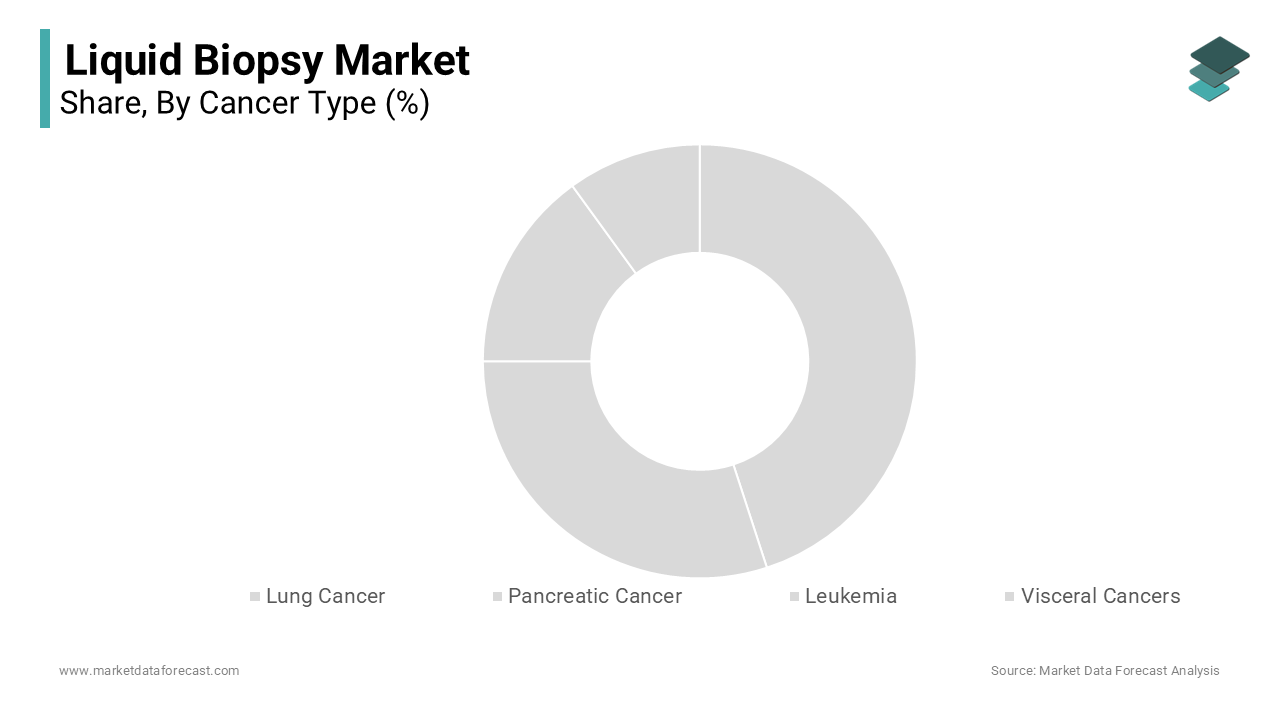
In contrast, the pancreatic cancer segment is emerging as the fastest-growing within the liquid biopsy market and is projected to expand at a CAGR of 23.6% from 2026 to 2034. This accelerated growth is driven by the critical lack of early diagnostic tools and the anatomical inaccessibility of pancreatic tumors, which renders traditional biopsies both risky and frequently inconclusive. Only about 10–15% of pancreatic cancer patients are eligible for surgical resection at diagnosis, as per the research, underscoring the urgent need for alternative monitoring strategies. Liquid biopsy offers a viable pathway for early detection, particularly through the identification of KRAS mutations present in most of pancreatic ductal adenocarcinomas, according to research. Moreover, the integration of ctDNA analysis into high-risk screening programs, such as those for individuals with hereditary pancreatitis or BRCA mutations, is gaining traction. The recent launch of multi-analyte assays combining ctDNA, protein biomarkers, and methylation signatures further enhances detection sensitivity, fueling rapid adoption in both clinical trials and emerging screening frameworks
By Diagnostic Approach Insights
The Plasma segment served as the predominant diagnostic medium in liquid biopsy by commanding an estimated 55.1% share of the global market in 2025. Its dominance is rooted in the established protocols for plasma isolation and the high yield of cell-free DNA (cfDNA) it provides, which is essential for ctDNA analysis. Plasma is collected using standardized blood draw procedures followed by double-centrifugation to remove cellular debris, minimizing genomic DNA contamination, a critical factor in assay accuracy. Moreover, the integration of plasma-based testing into pivotal clinical trials, such as the FLAURA and AURA3 studies for EGFR-mutant NSCLC, has cemented its role in regulatory decision-making. The compatibility of plasma with high-throughput sequencing platforms and its acceptance by regulatory bodies like the FDA further reinforce its position as the gold standard diagnostic matrix in liquid biopsy applications.
In contrast, the cerebrospinal fluid (CSF)segment is experiencing the most rapid growth among diagnostic matrices, with a projected CAGR of 27.3% from 2025 to 2033. This acceleration is driven by the increasing recognition of CSF as a privileged reservoir for central nervous system (CNS)-derived tumor DNA, particularly in leptomeningeal disease and gliomas. Unlike blood, CSF has limited dilution from systemic circulation, enabling the detection of brain tumor mutations at significantly higher concentrations. A study found that CSF ctDNA levels were 100-fold higher than plasma levels in patients with leptomeningeal metastases, dramatically improving sensitivity. Furthermore, the inability of many tumor-derived biomarkers to cross the blood-brain barrier limits the utility of blood-based assays in neuro-oncology. The expansion of intrathecal therapies and the need for real-time CNS tumor genotyping are catalyzing demand for CSF-based diagnostics, positioning it as the fastest-advancing segment.
By Sample Type Insights
The Plasma segment served as the predominant diagnostic medium in liquid biopsy by commanding an estimated 55.1% share of the global market in 2025. Its dominance is rooted in the established protocols for plasma isolation and the high yield of cell-free DNA (cfDNA) it provides, which is essential for ctDNA analysis. Plasma is collected using standardized blood draw procedures followed by double-centrifugation to remove cellular debris, minimizing genomic DNA contamination, a critical factor in assay accuracy. Moreover, the integration of plasma-based testing into pivotal clinical trials, such as the FLAURA and AURA3 studies for EGFR-mutant NSCLC, has cemented its role in regulatory decision-making. The compatibility of plasma with high-throughput sequencing platforms and its acceptance by regulatory bodies like the FDA further reinforce its position as the gold standard diagnostic matrix in liquid biopsy applications.
In contrast, the cerebrospinal fluid (CSF)segment is experiencing the most rapid growth among diagnostic matrices, with a projected CAGR of 27.3% from 2025 to 2033. This acceleration is driven by the increasing recognition of CSF as a privileged reservoir for central nervous system (CNS)-derived tumor DNA, particularly in leptomeningeal disease and gliomas. Unlike blood, CSF has limited dilution from systemic circulation, enabling the detection of brain tumor mutations at significantly higher concentrations. A study found that CSF ctDNA levels were 100-fold higher than plasma levels in patients with leptomeningeal metastases, dramatically improving sensitivity. Furthermore, the inability of many tumor-derived biomarkers to cross the blood-brain barrier limits the utility of blood-based assays in neuro-oncology. The expansion of intrathecal therapies and the need for real-time CNS tumor genotyping are catalyzing demand for CSF-based diagnostics, positioning it as the fastest-advancing segment.
By End User Insights
The laboratories segment accounted for the most significant share of the liquid biopsy market in 2025. Focusing on improving the patient's health condition by evaluating quality treatment procedures is one of the notable factors boosting the segment's growth rate.
However, the academic and research segment is expected to grow significantly during the forecast period due to the growing research in the treatment of cancer in educational institutes and the increased research on the same topic. Additionally, the newfound freedom of students towards experimentation and the increasing number of research institutes is helping the segment grow.
REGIONAL ANALYSIS
North America led the global liquid biopsy market with a commanding 42.4% share in 2025. The region’s lead position is underpinned by a robust ecosystem of genomic innovation, strong regulatory frameworks, and high healthcare expenditure. The U.S. leads global patent filings in liquid biopsy, reflecting dominance in technological development. The presence of leading diagnostic companies, such as Guardant Health, Exact Sciences, and Natera, alongside extensive adoption in integrated cancer networks like MD Anderson and Memorial Sloan Kettering, accelerates clinical integration. Medicare and private insurers provide coverage for FDA-approved liquid biopsy tests, though precise testing volumes are not publicly disclosed. Additionally, the Precision Medicine Initiative and All of Us Research Program have fostered large-scale genomic data collection, enabling the validation of liquid biopsy in diverse populations. These systemic advantages solidify North America’s position as the epicenter of liquid biopsy innovation and adoption.
Europe holds a significant market share at 25.3%. The region exhibits a mature but heterogeneous adoption pattern, shaped by national healthcare policies and varying reimbursement landscapes. Countries like Germany and the United Kingdom have integrated liquid biopsy into national cancer guidelines, with NHS England funding ctDNA testing for EGFR mutation screening in NSCLC. As per the research, a portion of academic cancer centers in Western Europe now offer liquid biopsy services, primarily for therapy selection and resistance monitoring. However, disparities persist in Eastern Europe, where access remains limited. The EU’s In Vitro Diagnostic Regulation (IVDR) has introduced stricter validation requirements, temporarily slowing test availability but enhancing long-term reliability. The Horizon Europe program is funding multi-center liquid biopsy trials, including the TRACERx-EU initiative, which aims to validate ctDNA for early relapse detection. These coordinated efforts are driving standardization and expanding clinical utility across the continent.
Asia Pacific is rapidly ascending as a pivotal market. The region’s growth is fueled by rising cancer incidence, expanding molecular diagnostics infrastructure, and government-led genomics initiatives. China reports large number of new cancer cases annually, with lung cancer being the most prevalent, as per the Chinese National Cancer Center. This epidemiological burden has spurred investments in liquid biopsy R&D, with BGI Genomics and Burning Rock Dx launching localized ctDNA panels tailored to Asian genomic profiles. Japan has approved several liquid biopsy kits under its Sakigake fast-track system, including the OncoBEAM RAS Panel for colorectal cancer. As per the study, many liquid biopsy tests were conducted in Japan, reflecting growing clinical acceptance. With increasing private insurance coverage and public-private collaborations, the region is transitioning from early adoption to mainstream integration.
Latin America holds a modest market share, yet it is witnessing incremental progress in liquid biopsy deployment, as noted by the Latin American Society of Medical Oncology. Brazil leads the region, driven by its centralized public health system (SUS) and growing private diagnostics sector. The country’s National Cancer Institute (INCA) has initiated pilot programs for ctDNA testing in metastatic breast and lung cancers. However, challenges such as fragmented healthcare access, limited sequencing infrastructure, and delayed regulatory approvals constrain scalability. Argentina and Mexico are emerging as secondary hubs, with academic institutions like the National Autonomous University of Mexico conducting translational research in ctDNA. The Pan American Health Organization has emphasized the need for regional harmonization in molecular testing standards, which could accelerate adoption. While still nascent, the region’s increasing oncology burden and rising awareness are laying the groundwork for future expansion.
Middle East & Africa collectively represent small share of the global market, with significant disparities between Gulf Cooperation Council (GCC) nations and sub-Saharan Africa. Countries like Saudi Arabia and the UAE are investing heavily in precision oncology, exemplified by Saudi Vision 2030’s inclusion of genomic medicine as a strategic pillar. The King Faisal Specialist Hospital in Riyadh has implemented ctDNA testing for NSCLC and colorectal cancer. In contrast, most African nations lack basic molecular diagnostics infrastructure, with fewer countries possessing next-generation sequencing capabilities, according to the study. However, initiatives like the Human Heredity and Health in Africa (H3Africa) Consortium are building genomic research capacity. The region’s growth remains constrained by economic and logistical barriers, but targeted investments in GCC countries are creating pockets of advanced adoption.
COMPETITIVE LANDSCAPE
The competition in the liquid biopsy market is intensifying as both specialized molecular diagnostics firms and global healthcare conglomerates race to capture clinical and commercial dominance. Innovation cycles have shortened, with companies differentiating through assay sensitivity, multi-analyte integration, and AI-driven data interpretation. While early entrants like Guardant Health and Foundation Medicine established first-mover advantages, regional players such as Burning Rock Dx and Genecast are challenging their influence with locally validated tests tailored to Asian genomic profiles. Pharmaceutical collaborations have become strategic battlegrounds, as diagnostic firms align with drug developers for companion diagnostic co-approval. The absence of standardized methodologies and reimbursement variability across regions creates both entry barriers and niche opportunities. As clinical utility gains recognition, the competitive edge increasingly hinges on real-world evidence generation, regulatory agility, and scalable infrastructure.
KEY MARKET PLAYERS
Companies playing a notable role in the global liquid biopsy market are
- Janssen Diagnostics
- Qiagen, Rarecells SAS
- Silicon Biosystems
- SRI International
- Myriad Genetics
- Natera
- Personal Genome Diagnostics
- Sysmex InosticsTrovagene
- Exosome Diagnostics
- Exosome Sciences
- HansaBiomed OU.
Top Players in the Liquid Biopsy Market
Guardant Health has emerged as a pioneering force in liquid biopsy, renowned for its Guardant360® and Lunar assays that enable comprehensive genomic profiling and minimal residual disease detection. In the Asia Pacific region, the company has intensified its footprint through strategic collaborations with leading cancer centers in Japan, South Korea, and Australia. The company also launched its Guardant360 CDx test through select diagnostic labs in India and Singapore, enhancing accessibility. By engaging with local regulators and investing in real-world evidence generation, Guardant Health is positioning its platforms as essential tools in precision oncology across diverse Asian populations, where unique mutation profiles necessitate region-specific validation.
F. Hoffmann-La Roche leverages its global diagnostics infrastructure to drive liquid biopsy integration across oncology care pathways. In Asia Pacific, Roche has advanced its cobas® EGFR Mutation Test v2 for plasma-based detection of EGFR alterations in non-small cell lung cancer, gaining approval from regulatory bodies in China, Japan, and South Korea. The company has expanded its partnership network with hospitals and research institutions, including a 2023 collaboration with Taiwan’s Chang Gung Memorial Hospital to assess ctDNA dynamics in early-stage lung cancer. Roche also supports large-scale screening initiatives such as the WINTHER trial’s extension in Southeast Asia, which incorporates liquid biopsy for treatment personalization. Through continuous assay innovation, regulatory engagement, and localized clinical validation, Roche is reinforcing its role as a key enabler of molecular diagnostics adoption in high-burden cancer markets across the region.
Burning Rock Dx is a China-based leader in next-generation sequencing and liquid biopsy, playing a critical role in shaping the Asia Pacific liquid biopsy landscape. The company’s NGS-based liquid biopsy platform, OncoScreen, is widely used in Chinese hospitals for real-time mutation monitoring in lung, colorectal, and gastric cancers. The company has also expanded into Southeast Asia, launching commercial operations in Malaysia and Thailand through distributor agreements. By aligning with national cancer control programs and contributing to local clinical guidelines, Burning Rock Dx is accelerating the standardization of liquid biopsy in routine oncology practice, particularly in regions with high rates of EGFR mutations and limited tissue biopsy access.
Top Strategies Used by the Key Market Participants
Key players in the liquid biopsy market are deploying a combination of product innovation, regulatory expansion, strategic partnerships, geographic penetration, and clinical validation to consolidate their positions. Companies are investing heavily in developing multi-cancer early detection assays and minimal residual disease monitoring platforms to diversify beyond therapy selection. Regulatory approvals, particularly FDA breakthrough designations and NMPA clearances, are being pursued aggressively to enhance credibility. Collaborations with academic institutions, pharmaceutical companies, and healthcare systems are enabling large-scale clinical trials that generate real-world evidence. Geographic expansion, especially in high-growth Asia Pacific markets, is being achieved through local partnerships, lab launches, and technology transfers. Additionally, vertical integration—such as combining sequencing, bioinformatics, and reporting—ensures end-to-end control and differentiation in a competitive landscape.
RECENT MARKET HAPPENINGS
- High-performing assays that offer translational insights to support possible cancer therapy approaches are part of PredPredicine'suid biopsy portfolio. Necessary details include the full range of cancer care covered by NGS solutions based on urine, blood, and tissue, from treatment selection to therapy monitoring and minimal residual disease (MRD) monitoring. In addition, Predicine's ability to conduct international clinical trials and produce companion diagnostics (CDx) using standardized assays in the USA and China. Predicine, Inc., a firm that provides worldwide molecular insights, said today that it would exhibit four posters at the ESMO conference, which will take place in Paris, France, from September 9 to 13, 2022.
- In September 2022, "ANG" E," a "global leader in liquid biopsy, released its unaudited interim financial results for the six months ending June 30, 2022.
- The Parsortix system received FDA De Novo clearance for its intended use with metastatic breast cancer (MBC) patients; the first FDA product clearance to harvest cancer cells from a patient blood sample for later user-validated analysis; first mover advantage for intact cancer cell analysis in the global liquid biopsy market with FDA clearance and CE Mark in place; and the commercial roll-out in progress with a worldwide distributor network are among the operational highlights.
- In September 2022, the PredicineCARETM cfDNA Assay, a Next-Generation Sequencing (NGS) assay for tumor mutation profiling in cfDNA isolated from liquid biopsy samples from cancer patients, received Breakthrough Device designation from the U.S. Food and Drug Administration (FDA), according to a recent announcement from Predicine, Inc., a global molecular insights company dedicated to advancing precision medicine in oncology and infectious diseases.
- The PredicineCARE cfDNA Assay is a specific, CLIA-validated assay that searches for variations in 152+ genes, including known clinically significant single nucleotide variants (SNVs), insertions and deletions (indels), DNA rearrangements (fusions), and copy number variations (CNVs). The PredicineCARE cfDNA Assay is being created to recognize cancer patients with specific indications who may benefit from treatment with targeted therapy and are biomarker-eligible.
MARKET SEGMENTATION
This research report on the global liquid biopsy market has been segmented and sub-segmented based on cancer type, diagnostic approach, sample type, end-user, and region.
By Cancer Type
- Lung Cancer
- Pancreatic Cancer
- Leukemia
- Visceral Cancers
By Diagnostic Approach
- Circulating Tumour Cells (CTC)
- Circulating Tumour DNA (ctDNA test)
- RNA in exosomes
- Extra-Cellular Vesicles
By Sample Type
- Blood
- Urine
- Plasma
- Saliva
- Cerebrospinal Fluid
By End User
- Reference Laboratories
- Hospital/Physician Laboratories
- Academic and Research Centres
By Region
- North America
- Europe
- Asia-Pacific
- Latin America
- Middle East and Africa