- Product Description Description
- Table of Contents TOC
- List of Table & Figure LOT
- Get Free Sample PDF Sample PDF
Market Size, 2025
$19 BnMarket Estimate, 2026
$21.09 BnMarket Forecast, 2034
$48.6 BnCAGR, 2026–2034
11%Global Medical Aesthetics Market Size, Growth, Trends & Forecast (2026–2034)
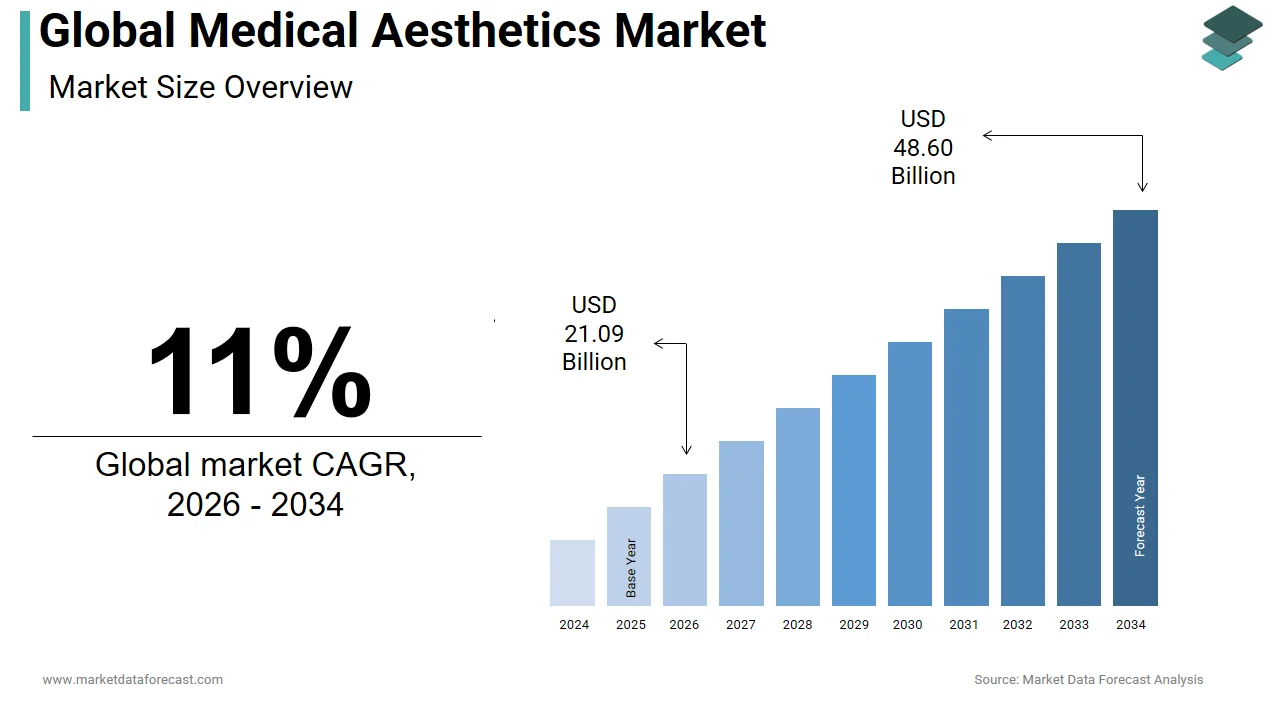
The size of the global medical aesthetics market was valued at USD 19 billion in 2025, is anticipated to reach USD 21.09 billion in 2026, and is projected to scale up to USD 48.60 billion by 2034, registering a compound annual growth rate (CAGR) of 11% during the forecast period from 2026 to 2034. Driven by the rapidly growing preference for minimally invasive procedures, expanding aging populations, and rising disposable incomes globally, the market continues to experience strong, steady expansion.
Key Executive Metrics (At-a-Glance)
- 2025 Base Valuation: USD 19 Billion
- 2026 Current Valuation: USD 21.09 Billion
- 2034 Forecast Valuation: USD 48.60 Billion
- Compound Annual Growth Rate (CAGR): 11% (2026–2034)
- Dominant Region: North America (supported by high procedure volumes, advanced healthcare infrastructure, and favorable FDA approvals)
- Fastest-Growing Region: Asia-Pacific (propelled by booming demand in China, South Korea, India, and Thailand)
Core Market Drivers
- Minimally Invasive Shift: High consumer preference for non-surgical cosmetic therapies offering less discomfort, minimal scarring, and faster recovery times over conventional surgical techniques.
- Technological Innovation: Proliferation of advanced energy-based devices, lasers, and home-use aesthetic equipment backed by rigorous R&D.
Primary Market Restraints & Challenges
- High Device and Procedure Costs: Substantial upfront device expenditures for practices (ranging from USD 120,000 to USD 300,000 for new gadgets) coupled with out-of-pocket costs for patients due to a lack of insurance reimbursement.
- Maintenance Requirements: The temporary nature of many non-surgical procedures (e.g., botulinum toxin repeating every 4–6 months) driving up long-term recurring expenses.
Global Medical Aesthetics Market Segmentation Breakdown
| Segment Category | Leading Sub-Segment / Scope | Key Focus Areas |
|---|---|---|
| By Type | Energy-Based & Non-Energy-Based Devices, Injectables, Implants, Cosmeceuticals | Botulinum Toxins, Dermal Fillers, Laser/RF/Light Systems |
| By Application | Skin Resurfacing, Body Contouring, Hair Removal, Breast Augmentation | Targeting anti-aging, cell reduction, and structural enhancements |
| By End-User | Dermatology Clinics, Hospitals, Medical Spas, Beauty Centers, Home Care | Outpatient clinics and specialized cosmetic hubs |
| By Region | North America (Leader) & Asia-Pacific (Fastest-Growing) | Expansion across Europe, Latin America, and the Middle East & Africa |
Major Industry Players Profiled
Key market leaders shaping the competitive landscape include Allergan, Alma Lasers, Ltd., Anika Therapeutics, Inc., Cutera, Inc., Cynosure, El.En. S.p.A., Fotona d.o.o., Galderma, Johnson & Johnson, Merz Aesthetics, Inc., Medytox, Inc., Sientra, Inc., Huadong Medicine Co. Ltd., Bausch Health Company, Inc., Syneron Medical, Ltd., Venus Concept, Aerolase, Sciton, Bohus Biotech, and Recosmo.
 Download Free Sample Report
Global Medical Aesthetics Market Size
The size of the global medical aesthetic market was worth USD 19 billion in 2025. The global market is anticipated to grow at a CAGR of 11% from 2026 to 2034 and be worth USD 48.60 billion by 2034 from USD 21.09 billion in 2026.
MARKET DRIVERS
Increasing adoption of minimally invasive and non-invasive aesthetic methods
The preference for minimally invasive and noninvasive cosmetic therapies over standard surgical procedures has significantly increased. Today's cosmetic surgeons have access to a wide range of instruments and methods that make minimally invasive operations like eye lifts and facelifts inexpensive and widely available. Additionally, compared to conventional surgical procedures, minimally invasive/nonsurgical options provide benefits, including less discomfort, fewer scars, and faster healing. Additionally, these techniques are less expensive than standard surgical procedures. The market expansion is being further fueled by the aforementioned factors as well as the rate at which patients are adopting new items for use during treatment and at home.
MARKET RESTRAINTS
Association of High Cost of Devices in the Medical Aesthetics Market limits the growth.
The market's various participants are concentrating on releasing new products to fulfill the growing demand for aesthetics throughout the world, which has led to an increase in the price of the products available. For instance, according to information released in 2024 by Medicreations, the average price of new cosmetic gadgets can range from USD 120,000 to USD $300,000.Additionally, consumers are restricted from getting cosmetic treatments due to the high prices of surgeries like breast augmentation and abdominoplasty and the absence of reimbursement schemes to cover these procedures, as the majority of people cannot afford such high expenses. Non-surgical cosmetic procedures also usually only last one to two years. For instance, it is necessary to repeat the botulinum toxin treatment every 4-6 months. Because of this, non-surgical cosmetic procedures are less economical.
REPORT COVERAGE
| REPORT METRIC | DETAILS |
| Market Size Available | 2025 to 2034 |
| Base Year | 2025 |
| Forecast Period | 2026 to 2034 |
| Segments Covered | By Type, Application, End-User, and Region |
| Various Analyses Covered | Global, Regional & Country Level Analysis, Segment-Level Analysis, Drivers, Restraints, Opportunities, Challenges, PESTLE Analysis, Porter’s Five Forces Analysis, Competitive Landscape, Analyst Overview on Investment Opportunities |
| Regions Covered | North America, Europe, Asia Pacific, Latin America, Middle East & Africa |
| Market Leaders Profiled | Allergan, Alma Lasers, Ltd., Anika Therapeutics, Inc., Cutera, Inc., Cynosure (A Wholly Owned Subsidiary of Hologic, Inc.), El.En. S.P.A., Fotona D.O.O., Galderma, Johnson & Johnson, Merz Aesthetics, Inc. (A Division of Merz Pharma Gmbh & Co. Kgaa), Medytox, Inc., Sientra, Inc., Huadong Medicine Co. Ltd., Bausch Health Company, Inc., Syneron Medical, Ltd. Venus Concept, Aerolase, Sciton, Bohus Biotech, and Recosmo |
REGIONAL ANALYSIS
North America held the largest share of this market. Due to the high amount of aesthetic treatments performed, the ageing of the population, growing disposable income, more knowledge, and advantageous government support for healthcare facilities, the huge percentage is explained. Other growing causes include the abundance of research being done, the creation of technologically improved goods, and FDA approvals for home-use aesthetic devices.
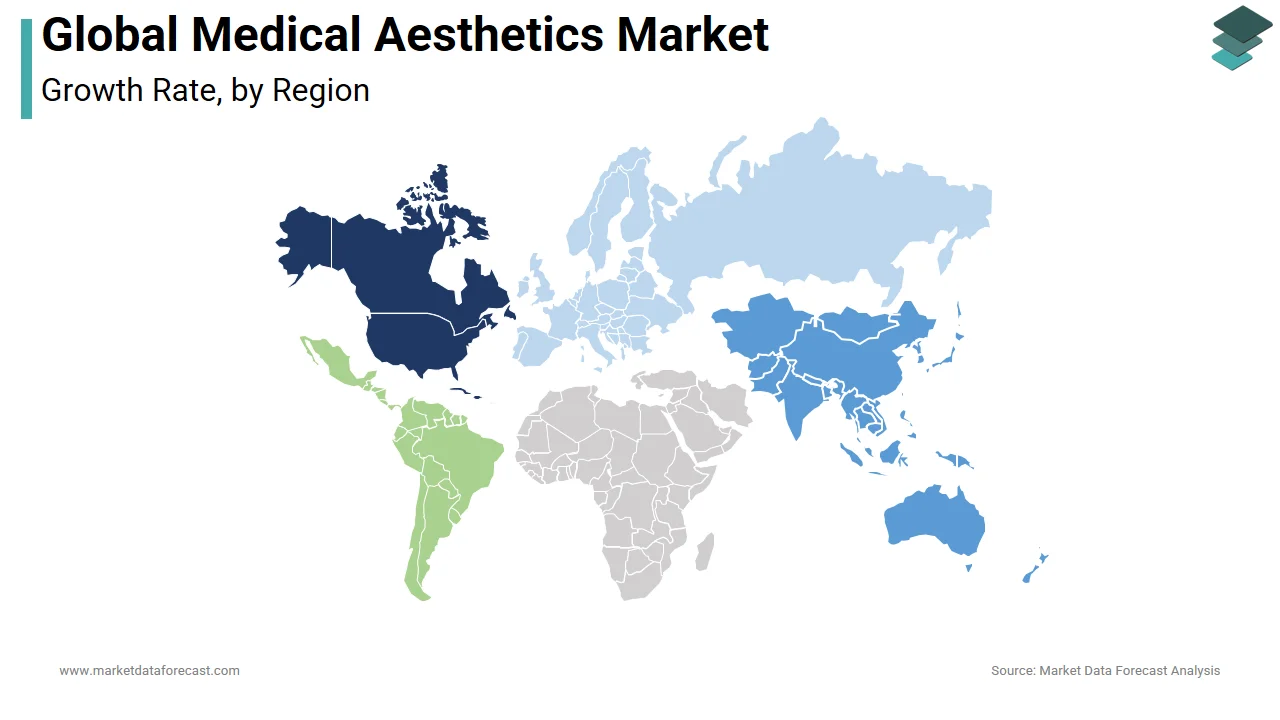
Asia Pacific held the second position in the global market. The high demand for facial cosmetic operations in nations like China and South Korea, among others, as well as the need for dermal fillers and botulinum toxin treatments in nations like India, Japan, and Thailand, are to blame for the market expansion in the Asia Pacific region.
Europe is anticipated to see a sizable CAGR throughout the predicted period. The market expansion in Europe is being driven by an increase in non-invasive treatments as well as a rise in medical tourism when individuals come from other nations to Spain, Germany, and the U.K. for different operations. The International Society of Cosmetic Plastic Surgery (ISAPS) estimates that in 2020, 14.8% of patients seeking various medical cosmetic procedures in Spain came from foreign nations.
The increasing number of aesthetic clinics in nations like Dubai and Saudi Arabia, among others, to meet the growing demand for various cosmetic procedures like botulinum toxin, dermal fillers, and breast augmentation, on the other hand, is expected to result in significant growth rates in Latin America and the Middle East & Africa during the forecast period.
For instance, according to information released by NCBI in 2024, Dubai is known as the plastic surgery hub and has 236 board-certified cosmetic surgeons as well as 400 aesthetic clinics.
KEY MARKET PLAYERS
Some of the companies that are playing a dominating role in the global medical aesthetics market include
- Allergan
- Alma Lasers, Ltd.
- Anika Therapeutics, Inc.
- Cutera, Inc.
- Cynosure (A Wholly Owned Subsidiary of Hologic, Inc.)
- El.En. S.p.A.
- Fotona d.o.o.
- Galderma
- Johnson & Johnson
- Merz Aesthetics, Inc. (A Division of Merz Pharma GmbH & Co. KGaA)
- Medytox, Inc.
- Sientra, Inc.
- Huadong Medicine Co. Ltd.
- Bausch Health Company, Inc.
- Syneron Medical, Ltd.
- Venus Concept
- Aerolase
- Sciton
- Bohus Biotech
- Recosmo
GLOBAL MEDICAL AESTHETICS MARKET NEWS
- In July 2022, Apyx Medical announced that the Renuvion device was cleared by the U.S. Food and Drug Administration (FDA) for use in aesthetic procedures to enhance the appearance of lax skin in the neck region.
- In March 2021, Bausch Health Companies Inc. launched the Clear + Brilliant Touch laser in the U.S. Clear + Brilliant Touch laser provides customizable treatment for patients of all ages and skin types.
- In January 2021, Mentor Worldwide LLC, a Johnson and Johnson Services Inc. company, received the U.S. FDA approval for the MENTOR MemoryGel BOOST breast implant in breast augmentation in women aged 22 years and above undergoing breast reconstruction.
- In October 2020, Alma Lasers launched Alma Hybrid for ablative, non-ablative, and thermal treatments for skin rejuvenation and scar revision, combining the power of CO2 laser, 1570 nm laser, and IMPACT.
MARKET SEGMENTATION
This research report on the global medical aesthetics market has been segmented and sub-segmented based on the product, end-user, and region.
By Type
- Energy-Based Aesthetic Devices
- Laser-Based Devices
- Radiofrequency (RF) Devices
- Light-Based Devices (IPL/LED)
- Ultrasound-Based Devices
- Non-Energy-Based Aesthetic Devices
- Liposuction Devices
- Microdermabrasion Devices
- Manual Microneedling Devices
- Dermabrasion Systems
- Aesthetic Injectables
- Botulinum Toxins
- Dermal Fillers
- Aesthetic Threads
- Aesthetic Implants
- Breast Implants
- Facial Implants
- Other Cosmetic Implants
- Physician-Dispensed Cosmeceuticals
- Chemical Peels
- Skin Lightening Products
- Medical-Grade Skincare Products
By Application
- Skin Resurfacing & Skin Tightening
- Body Contouring & Cellulite Reduction
- Hair Removal
- Breast Augmentation
- Other Applications
By End-User
- Dermatology Clinics, Hospitals & Medical Spas
- Beauty Centers
- Home Care Settings
- Other End Users
By Region
- North America
- Europe
- Asia Pacific
- Latin America
- The Middle East and Africa