- Product Description Description
- Table of Contents TOC
- List of Table & Figure LOT
- Get Free Sample PDF Sample PDF
Market Size, 2025
$0.11 BnMarket Estimate, 2026
$0.12 BnMarket Forecast, 2034
$0.19 BnCAGR, 2026–2034
6.22%Middle East and Africa Food Enzymes Market Size
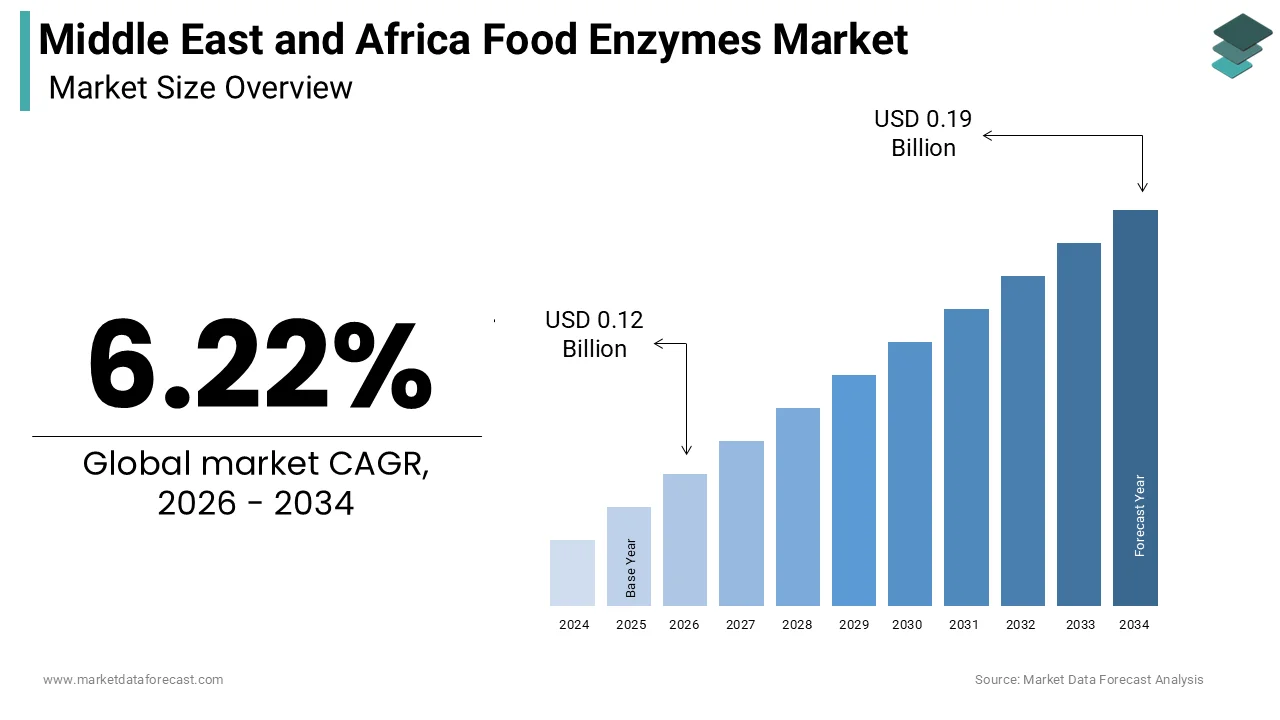
The Middle East and Africa Food Enzymes Market Size was calculated to be USD 0.11 billion in 2025 and is anticipated to be worth USD 0.19 billion by 2034 from USD 0.12 billion In 2026, growing at a CAGR of 6.22% during the forecast period.
Enzymes are biochemical catalysts that are produced by human body. Some enzymes which are vital for digestion process like pepsin is produced by human body. But, not all the enzymes required by the body are produced. Some are obtained from external sources.
With the increase in awareness of nutritional diet and also the demand for packaged food increased the demand for food enzymes which enhance the digestion process by breaking down the complex carbohydrates and fats in to simpler molecules. Previously enzymes were considered to be non-toxic for people as they are already present in the food. But, extraction of enzymes from genetically engineered animals and microorganisms required the enzymes to be tested for safety.
Market Drivers
The increased application of food enzymes in fermentation to produce alcoholic and non-alcoholic beverages, increased demand for food enzymes by food product manufacturers to use in the processing of food are the major factors driving the market. Many technological advancements taking place in the food industry and the invention of different applications of food enzymes are also driving the market growth.
Market Restraints
High cost of research and development activities and consolidation of markets due to the buyouts made by major companies are retraining the market.
SEGMENTAL ANALYSIS
Middle East and Africa Food Enzymes Market By Enzymes
- Carbohydrases
- Proteases
- Lipases
Carbohydrases dominate Food Enzymes Market in this segment as it is used to convert starch into sugar during alcohol production.
Middle East and Africa Food Enzymes Market By Application
- Beverage
- Processed Food
- Dairy
- Bakery and Confectionery
Bakery products hold the largest market in this segment. It is mainly due to the application of food enzymes in bakery products such as increasing stability of dough and uniformity of brown bread etc.
Middle East and Africa Food Enzymes Market By Forms
- Lyophilized powder
- Liquid forms
Middle East and Africa Food Enzymes Market By Source
- Plants
- Animals
- Microorganisms
Middle East and Africa Food Enzymes Market By Region
- KSA
- UAE
- Israel
- Rest of GCC countries
- South Africa
- Ethiopia
- Kenya
- Egypt
- Sudan
- Rest of MEA
The growth rate of food enzyme market in this region is somewhat slow. Due to engaging in constant warfare many regions are not available to do business. With the investment of large private organizations in this region is helping the growth of market. Developing countries like South Africa has huge potential for the growth of food enzymes market.
Key Players in the Market
Major Key Players in the MEA Food Enzymes Market are AB Enzymes GMBH, Advanced Enzymes Technologies Limited, AUM Enzymes, Dyadic International Inc, E.I. DUPONT DE Nemours & Company, Jiangsu Boli Bio products Co. Ltd, Novozymes A/, Sunson Industry Group Company Limited, Nagase Chemtex Corporation, and Puratos Group NV