Middle East And Africa Frozen Food Market Research Report – Segmented By Product (Frozen Ready Meals, Meat & Poultry, Seafood, Vegetables & Fruits, Potatoes, And Soup), User (Retail And Foodservice Industry), And Country (KSA, UAE, Israel, Rest Of GCC Countries, South Africa, Ethiopia, Kenya, Egypt, Sudan And Rest Of MEA) - Industry Analysis On Size, Share, Trends & Growth Forecast (2026 To 2034)
Middle East and Africa Frozen Food Market Size
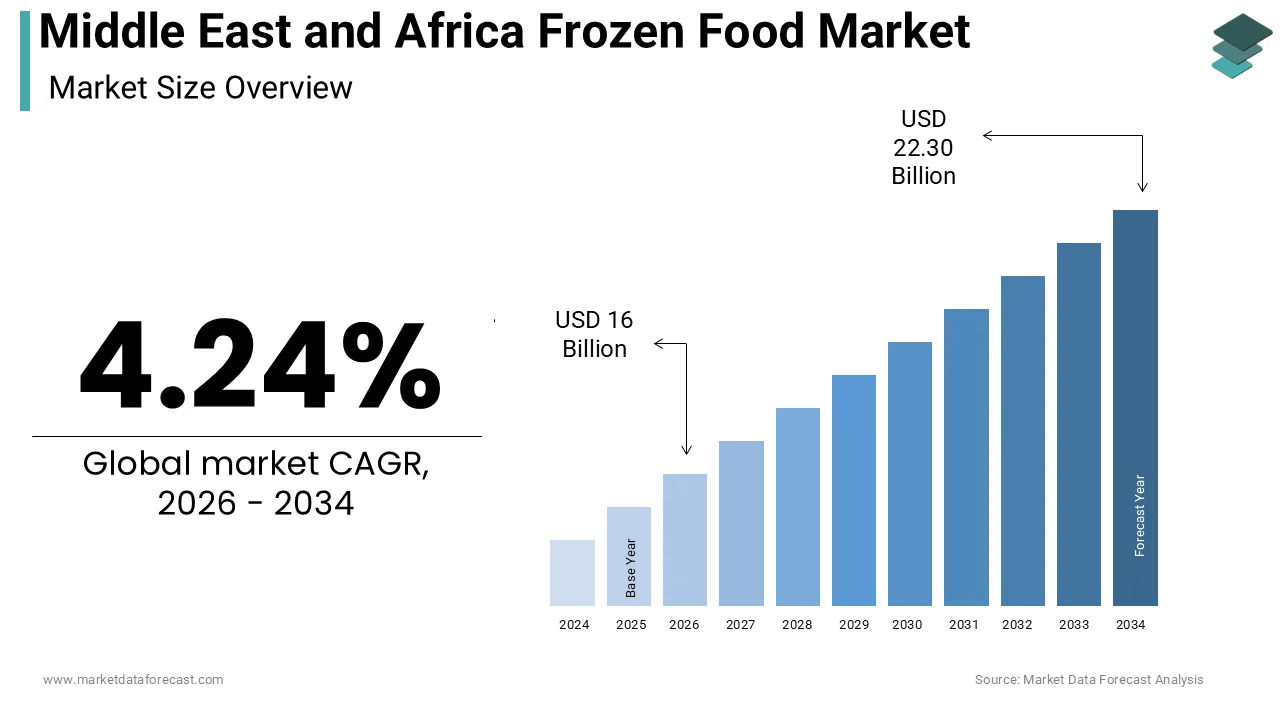
The size of the Middle East and Africa frozen food market was calculated to be USD 15.35 billion in 2025 and is anticipated to be worth USD 22.30 billion by 2034 from USD 16 billion In 2026, growing at a CAGR of 4.24% during the forecast period.
The frozen food market is expanding with steady development in the retail industry around the area. The increase in the usage of ready-to-eat foods based on the hectic lifestyles is boosting this market. Frozen food is a brilliant option in contrast to fresh and cooked foods. Convenience is the main consideration for driving the Frozen Food Market. Different drivers for the Frozen Food market are expanding discretionary cash flow and developing the number of working ladies. Based on topography, the MEA Frozen food market is sectioned into Egypt, Saudi Arabia, United Arab Emirates, Algeria, Israel, and Iraq.
The improvement of innovative items, for example, low fat, low cholesterol, whole wheat and artificial additives, is relied upon to invigorate the MEA frozen food market. The development of the frozen food industry in the Middle East and Africa is driven by the developing interest for advantageous and prepared-to-eat items because of the occupied way of life and changes in dietary patterns. Interest for prepared to-pack and simple-to-cook items will increase during the gauge time frame, reinforcing the frozen food market in the Middle East and Africa.
Interest for functional food is one of the fundamental drivers of the frozen food market in the territory. Since these foods spare customers cooking, arrangement and cleaning and time exertion. Frozen foods are presently at the forefront of general stores and hypermarkets. The frozen food market in the Middle East and Africa have been developing with the rising interest for frozen pizzas and versatile breakfast, which are situated as easy items and flourish in quality and newness. Food inclines in cafés and other food stores additionally lead the market extension. Infiltration into compartments and premium segments of frozen foods can be an incredible open door for the local frozen food market. Shoppers in the Middle East and Africa incline toward more solace and food out and about, the pattern is declining and they will, in general, eat all the more every now and again, supporting the objective business.
Frozen foods should set the ideal temperature around -18°C, so even a slight breakdown cold chain system can prompt tremendous waste. One of the fundamental difficulties looked by the MEA frozen food market is the dread that there is no sufficient supply chain system and that the refrigeration framework is conflicting. To guarantee an irrelevant loss of frozen foods, vitality reinforcement with full usefulness and steady cutoff points is required.
This research report on the Middle East and Africa frozen food market is segmented and sub-segmented into the following categories.
Middle East And Africa Frozen Food Market By Product Type
- Frozen Ready Meals
- Meat & Poultry
- Seafood
- Vegetables & Fruits
- Potatoes
- Soup
Based on type, the prepared-to-eat segment is supposed to be the leading element over the estimated period. Prepared to-eat frozen foods are those items that are completely cooked and can be eaten legitimately. Also, the convenience food and prepared dinners section are anticipated to represent the substantial portion in the frozen food business. This is credited with the rise in buyer interest in convenience foods, which is also estimated to expand more in the coming years.
Middle East and Africa Frozen Food Market By User
- Retail Users
- Food Service Industry
Among these, the foodservice section registered the most significant portion in the MEA frozen food market in 2018. The foodservice sector is expanding with a surge in cafés, quick-service restaurants, pubs, bars, and so on.
Middle East and Africa Frozen Food Market By Region
- KSA
- UAE
- Israel
- Rest Of GCC Countries
The Middle East and Africa is among the quickest developing business sectors for frozen foods. The area is encountering extraordinary development because of the accessibility of frozen food items with higher discretionary cash flow and solid distribution channels as interest for frozen food markets increases. South Africa frozen foods market is probably going to represent an imminent offer in the MEA business in the coming years.
KEY MARKET PLAYERS
Major Key Players in the MEA frozen food market are Aryzta AG, General Mills Inc., Kraft Foods Group Inc., Ajinomoto Co. Inc., Cargill Incorporated, Europastry S.A., JBS S.A., Kellogg’s Company, Nestle S.A., and Flower Foods
RECENT HAPPENINGS IN THE MARKET
- In November 2018, Nestlé propelled Wild space, an assortment of solid frozen foods in reusable and recyclable holders.
- In October 2018, Conagra propelled Pinnacle Foods Inc to be acquired. The securing helped Pinnacle Food grow its frozen, bite and sweet snack classes.
Frequently Asked Questions
1. What are the key factors driving the market?
Growth is driven by rapid urbanization, rising demand for convenient food products, expansion of modern retail formats, and improvements in cold chain logistics.
2. What are the major product segments in the market?
The market includes frozen fruits and vegetables, frozen meat and seafood, frozen ready meals, and frozen snacks and desserts.
3. Which segment holds the largest market share?
Ready-to-eat and ready-to-cook food products dominate due to their convenience and increasing consumer preference for quick meal solutions.
4. Which countries lead the frozen food market in this region?
Saudi Arabia, the United Arab Emirates, South Africa, and Egypt are among the leading contributors to market revenue.
5. What are the major distribution channels?
Supermarkets and hypermarkets dominate the market, followed by convenience stores, while online retail is emerging as the fastest-growing channel.
6. Who are the key players in the market?
Major companies include Nestlé S.A., General Mills Inc., McCain Foods Limited, Kraft Heinz Company, and Al Kabeer Group.
7. Why are frozen foods gaining popularity in this region?
Frozen foods offer longer shelf life, convenience, year-round availability, and help reduce food wastage, making them attractive to consumers.
8. What challenges does the market face?
The market faces challenges such as high logistics costs, limited cold chain infrastructure in some regions, and geopolitical instability.
9. What trends are shaping the frozen food market?
Key trends include the rise of plant-based frozen foods, increasing demand for premium products, and growing health consciousness among consumers.
10. What is the future outlook of the market?
The market is expected to experience steady growth due to increasing disposable incomes, improved infrastructure, and evolving consumer preferences toward convenience foods.
Related Reports
Access the study in MULTIPLE FORMATS
Purchase options starting from
$ 1600
Didn’t find what you’re looking for?
TALK TO OUR ANALYST TEAM
Need something within your budget?
NO WORRIES! WE GOT YOU COVERED!
Call us on: +1 888 702 9696 (U.S Toll Free)
Write to us: sales@marketdataforecast.com