- Product Description Description
- Table of Contents TOC
- List of Table & Figure LOT
- Get Free Sample PDF Sample PDF
Market Size, 2025
$788.4 MnMarket Estimate, 2026
$815.6 MnMarket Forecast, 2034
$1070.8 MnCAGR, 2026–2034
3.46%Global Palm Sugar Market Size
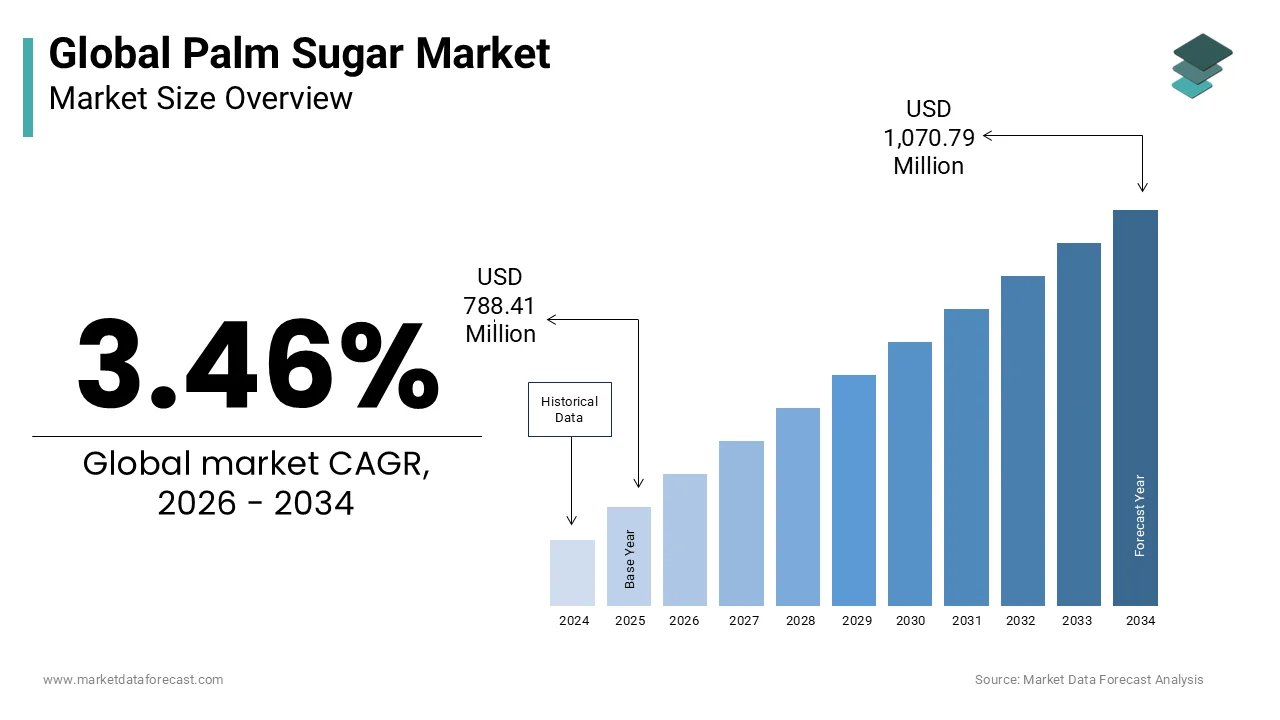
The global palm sugar market size was valued at USD 788.41 million in 2025, and the global market size is expected to be worth USD 815.69 million in 2026 and USD 1,070.79 million by 2034, growing at a CAGR of 3.46% during the forecast period.
MARKET OVERVIEW
Palm sugar is a kind of sweetener extracted from the liquid sap of any variety of palm trees. It is also often called coconut palm sugar, as they are both treated the same but from different botanical sources. It consists of sugars from various palm trees such as the Palmira palm, the sugar palm, the nipa palm, the date palm, and the coconut palm.
Palm sugar is rich in nutrients, vitamins, and minerals like iron, potassium, and zinc. It is an ingredient in sweet and savoury dishes and is produced by boiling the collected sap until it thickens. It is sold in bottles or boxes and has allowed it to thicken and crystallize over time. Its colour varies from golden brown to dark brown or black. Palm sugar is added to foods for its quality flavour and nutritional value and is primarily used in desserts, sweets, cakes, and sauces. It is healthier than conventional sugar and other natural sweeteners due to its low glycaemic index.
Palm sugar is an ingredient in both sweet and savoury dishes and produced by boiling the collected sap until it thicknesses. It is sold in bottles or tins and it allowed to thicken and crystalize over the period. Its colour is ranged from golden brown to dark brown or black. Palm sugar is added in food for the taste and quality nutritional value and it is mostly used in desserts, sweets, cakes, and sauces. It is healthier than conventional sugar and other natural sweeteners because of its low glycaemic index. The Global Palm Sugar Market is driven by factors like increasing health preferences towards nutritional components. In addition, anxiety towards delicious food, change in lifestyle, increase in the demand for confectionary food, low cost and low caloric content and an excellent substitute for oral rehydration solution also drives the market. However, the lack of skilled professionals and stringent rules are hindering the growth of the market.
The attention of the global food industry has shifted to natural sweeteners and artificial sweeteners. This change can be attributed to extensive research, which suggests that synthetically produced food products may have harmful effects on human health. Research also indicates that palm sugar may be a better option for consumers. This should stimulate income growth in the global palm sugar market. Manufacturers around the world are focusing on innovations in food products, and palm sugar is one of those products that is being innovated to provide more excellent nutritional value and a healthier variety. Agri-food companies are now focusing on research and development activities to increase the nutrient and multifunctional profile of palm sugar, which offers excellent health benefits. All of these factors create a positive impact on the global palm sugar market.
Consumers, particularly in the Asia-Pacific region, are more inclined to palm sugar products. It is the oldest form of sweetener used in Asia-Pacific countries like Indonesia, India and the Philippines. People in these countries are aware of the health benefits associated with palm sugar. For all these reasons, food and beverage manufacturers and suppliers are also optimizing the supply of products according to consumer demand. Several food manufacturers are entering the Asia Pacific palm sugar market due to high-profit margins. The preceding factors are foreseen to drive revenue growth in the global palm sugar market.
The macro consumption trend observed in the global Palm Sugar Market is currently the high demand and adoption of natural and organic food products, including palm sugar, and the growing awareness of the health benefits of the products. This should translate into increased adoption of palm sugar for domestic consumption, in both developed and developing countries. An important factor that could slow growth in the target Palm Sugar Market is the higher cost of the product compared to white sugar. Also, the availability of other alternative sweeteners like muscovado sugar, stevia, raw honey, coconut sugar, maple syrup, dark brown sugar, and dates is another factor that could hinder the growth of the world palm sugar market to some extent.
REPORT COVERAGE
| REPORT METRIC | DETAILS |
| Market Size Available | 2025 to 2034 |
| Base Year | 2025 |
| Forecast Period | 2026 to 2034 |
| CAGR | 3.46% |
| Segments Covered | By Nature, Form, Application & region |
| Various Analyses Covered | Global, Regional and Country Level Analysis; Segment-Level Analysis; DROC; PESTLE Analysis; Porter’s Five Forces Analysis; Competitive Landscape; Analyst Overview of Investment Opportunities |
| Regions Covered | North America, Europe, APAC, Latin America, Middle East & Africa |
| Market Leaders Profiled | Archer Daniel Midland Company, Associated British Foods, Burge, Cargill, Wilmar International, Conagra Foodservice, Dalmia Shop, Huiles TITAN OILS, Jivo Wellness, Richardson International |
SEGMENTAL ANALYSIS
By Application Insights
The food segment consists of bakery products, confectionery, frozen desserts, canning & freezing, and non-sweet food products and beverages segment consists of energy drinks, smoothies, and syrups. The food and beverage application holds a large share of the palm sugar market.
REGIONAL ANALYSIS
Among all the above regions, the North American Palm Sugar Market is estimated to represent the largest market share of the revenue. Factors driving growth in the North American market include increased demand for healthy and organic sweeteners and higher consumption of frozen desserts, smoothies, etc. The European Palm Sugar Market should follow North American and record the second-highest turnover share. Factors driving growth in the European market include the consumption of confectionery and bakery products, associated with the high demand for natural sugar as an ingredient Presence of leading players in the countries of the region.
The Asia-Pacific Palm Sugar industry is projected to experience an expressively larger growth rate than other regional markets during the time period of forecasting. Factors driving market growth in the Asia Pacific include increased awareness of the health benefits of palm sugar compared to conventional products, growing preference for surfing and online shopping, and rising demand for organic food. High prevalence of diabetes, especially in middle-aged people, can hinder growth revenue. Latin American Palm Sugar Market is assumed to increase at a moderate and steady growth rate during the projection period. Factors driving growth in the Latin American market are the high number of palms cultivated in the countries of the region, and early and superior adoption of products by individuals. As Indonesia is the largest producer of palm sugar, local manufacturers and regional players become regulators of market prices. The Palm Sugar Industry share of multi-nationals is very small, signifying around 5% - 10%, due to the high charges of palm sugar.
KEY MARKET PLAYERS
Major Key Players in the Global Palm Sugar Market are Real Raw Food, Felda Global Ventures, American Key Food Products, Taj Agro Products, Palm Nectar Organics, Royal Pepper Company, Wholesome, Big Tree Farms, Thai taste, Seven hills, Biona.
RECENT HAPPENINGS IN THE MARKET:
- Oudh Sugar Mills and Upper Ganges Sugar and Industries announced a multi-level restructuring whereby KK Birla group companies would divest themselves of their "non-core businesses" to become separately listed companies.
- Dhampur Sugar Mills said that its board of directors approved the merger of JK Sugar with the company and that the latter's shareholders will receive 275 shares for the 1,000 shares they own. JK Sugars has a cane crushing capacity of more than 4,000 tons per day. While Dhampur Sugar Mills has the ability to grind 39,500 tons of cane per day.
MARKET SEGMENTATION
This research report on the Global Palm Sugar Market has been segmented and sub-segmented based on Nature, Form, Application & region.
By Nature
- Organic
- Conventional
By Form
- Solid
- Liquid
By Application
- Food and Beverage Manufacturers
- Retailers
By Region
- North America
- Europe
- The Asia Pacific
- Latin America
- The Middle East and Africa