- Product Description Description
- Table of Contents TOC
- List of Table & Figure LOT
- Get Free Sample PDF Sample PDF
Market Size, 2025
$4.32 TrMarket Estimate, 2026
$5.18 TrMarket Forecast, 2034
$22.29 TrCAGR, 2026–2034
20%Global Prepaid Card Market Size, Share & Growth Analysis (2026–2034)
- Market Scope: Comprehensive global assessment evaluating card types (closed/open loop), usage categories, distribution channels, end-user segments, regional frameworks (North America, Europe, Asia-Pacific, Latin America, Middle East & Africa), growth catalysts, restraints, and competitive landscapes.
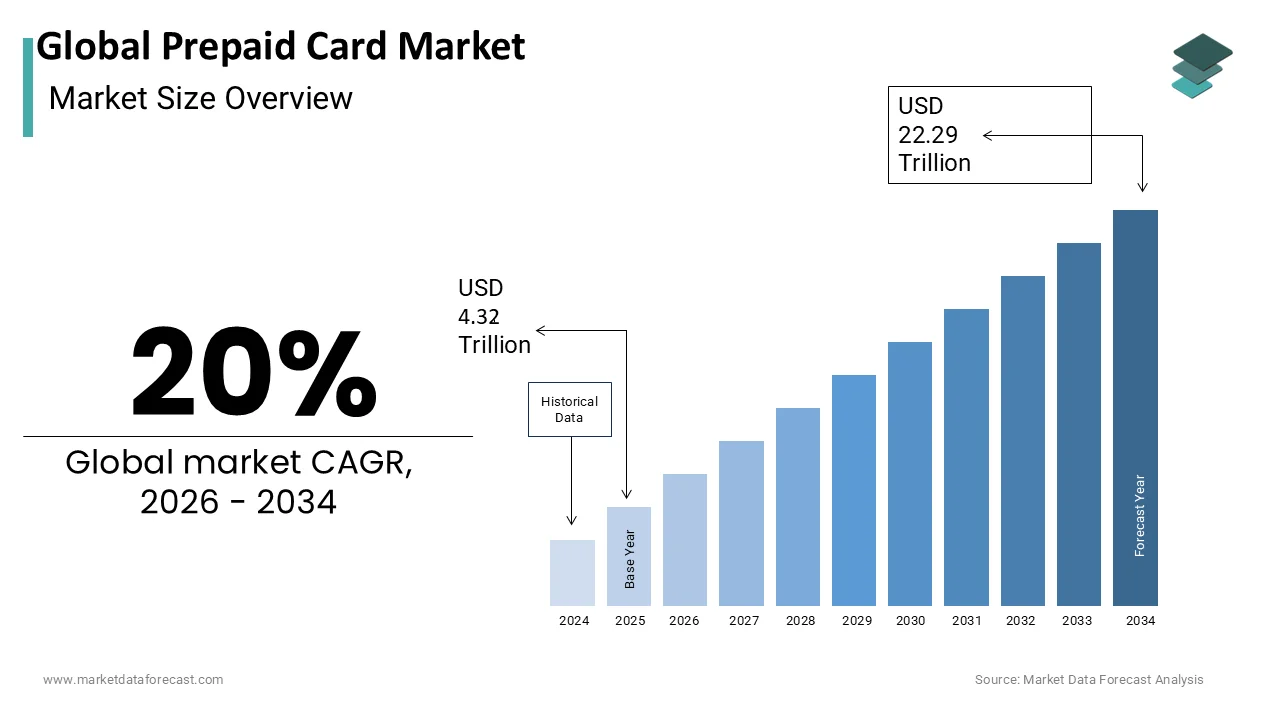
- Market Valuation: Valued at USD 4.32 trillion in 2025, estimated at USD 5.18 trillion in 2026, and projected to reach USD 22.29 trillion by 2034, registering a robust CAGR of 20% over the forecast period (2026–2034).
- Primary Growth Drivers: Rising demand for secure, budget-controlled payment alternatives to cash; expansion of e-commerce platforms and international digital remittances; and the increasing promotion of government digital banking/disbursement programs. Key restraints include security risks (theft/fraud), lack of standardized fee structures, and stringent regulatory authorization requirements.
Key Market Segment Metrics (2026–2034)
| Category | Leading Segment (2025 Position) | Fastest-Growing Segment |
|---|---|---|
| By Type | Closed-Loop Cards (led by travel and specific-merchant utility) | Open-Loop Cards (projected to dominate due to superior online transaction security and universal accessibility) |
| By Category | Gift Cards (held prominent share due to convenience and ease of money transfer) | General-Purpose Reloadable (GPR) Cards (driven by utility in bill payments and contactless daily expenses) |
| By End-User | Government Sector (ruled by massive welfare/benefit distribution programs) | Individual / Personal (expanding rapidly via digital-first financial management habits) |
| By Region | North America (held the largest regional market share) | Asia-Pacific (projected to register the highest CAGR led by China and India’s digital economy growth) |
Major Market Players & Competitive Landscape
Market Structure: Highly competitive landscape dominated by major financial institutions and fintech firms competing on transaction security, low-fee models, and e-commerce integration. Strategic mergers, such as the formation of Ouro by Netspend, signify ongoing market consolidation.
Key Companies: JP Morgan Chase & Co., NetSpend Holdings, Inc. (Ouro), H&R Block, American Express Company, PayPal Holdings Inc., BBVA Compass Bancshares, Inc., Mango Financial, Inc., Kaiku Financial LLC, and GreenDot Corporation.
Global Prepaid Card Market Size
The global prepaid card market was worth US$ 4.32 trillion in 2025 and is anticipated to reach a valuation of US$ 22.29 trillion by 2034 from US$ 5.18 trillion in 2026, and it is predicted to register a CAGR of 20% from 2026 to 2034.
Usually, a prepaid card is similar to a debit or credit card, but it does not have an account linked up and access a line of credit. These cards allow money to be preloaded into cards that can be used to make withdrawals, purchases, and pay bills. These cards are highly beneficial for everyday transactions and are the most convenient way to withdraw cash. Companies offer huge security to the prepaid card. If the card is lost by any chance, it can be easily blocked, and the money can be transferred to the other card within hours. There will be no credit checks with the card, and one can easily access the card without any tension over the credit scores.
MARKET DRIVERS
Growing prominence for the safety of money, where carrying a card is more flexible than carrying cash, is a major factor ascribed to fuel the growth rate of the market.
Individuals can limit their spending through prepaid cards where the adults get high benefits from using these cards. Adults mostly use these cards due to the ease of withdrawal of cash without having a bank account. They can use the card in most of the merchants irrespective of cash, which is safe and accountable. Around 12 million people around the world use prepaid cards. Among them, 5% of people are adults who use these cards at least once a month. According to the Federal Deposit Insurance Corporation (FDIC), 6.9% of all households are using prepaid cards for various transactions. Nowadays, people are residing globally, whereas sending amounts to their families in the most effective and convenient ways is increasing the market size to an extent. Prepaid cards are safe for exchanging money across the globe with very few additional fee charges, which is propelling the growth rate of the prepaid card market. Increasing awareness of the benefits associated with prepaid cards with the latest discount offers is likely to have a positive growth rate. People are inclined to adopt prepaid cards to overcome the challenges or issues with cheques or demand drafts, which are also elevating the size of the market to an extent.
MARKET RESTRAINTS
The risk of theft, like cash, is very high with prepaid cards. The person in hand can use the card. There will be no security factors associated with the prepaid cards.
Though it offers to transfer the money to the new card, there will be high chances for the person to withdraw or spend the money in the meantime. Therefore, high-security concerns are a prominent factor that is degrading the growth rate of the market. The rising number of fraudulent transactions is decreasing the number of people trusting prepaid cards and shifting to adopting debit or credit cards. The attacks through unauthorized access by data breaches in online transactions are also a factor that has a negative impact on the growth rate of the prepaid cards market.
MARKET OPPORTUNITIES
The penetration of the e-commerce industry, where consumers are seeking to use cards for online shopping or traveling purposes, is gaining traction in leveraging the growth opportunities for the market. The E-commerce industry is offering a good platform for prepaid cards by offering discounts. In addition to this, customers can make international purchases through the e-commerce online portals that are hugely gaining popularity around the world. Few companies are also introducing secured payment options with the latest technological advancements, which is attributed to bolstering the market share in the coming years.
MARKET CHALLENGES
Lack of standardization in the structure of fee charges is one of the major challenges for key market players. Stringent rules and regulations for the acceptance of prepaid cards are another factor that is hampering the market's growth rate. Growing stringent rules and regulations for authorization of prepaid cards from banks is additionally hindering the growth rate of the market.
REPORT COVERAGE
| REPORT METRIC | DETAILS |
| Market Size Available | 2025 to 2034 |
| Base Year | 2025 |
| Forecast Period | 2026 to 2034 |
| Segments Covered | By Type, Category, Channel, End User, Region |
| Various Analyses Covered | Global, Regional and Country Level Analysis, Segment-Level Analysis; DROC, PESTLE Analysis; Porter’s Five Forces Analysis; Competitive Landscape; Analyst Overview of Investment Opportunities |
| Regions Covered | North America, Europe, Asia Pacific, Latin America, Middle East & Africa |
| Key Market Players | JP Morgan Chase & Co. (U.S.) NetSpend Holdings, Inc. (U.S.) H&R Block (U.S.) American Express Company (U.S.) PayPal Holdings Inc. (U.S.) BBVA Compass Bancshares, Inc. (U.S.) Mango Financial, Inc. (U.S.) Kaiku Financial LLC. (U.S.) GreenDot Corporation (U.S.), and Others. |
SEGMENTAL ANALYSIS
Global Prepaid Card Market Analysis By Type
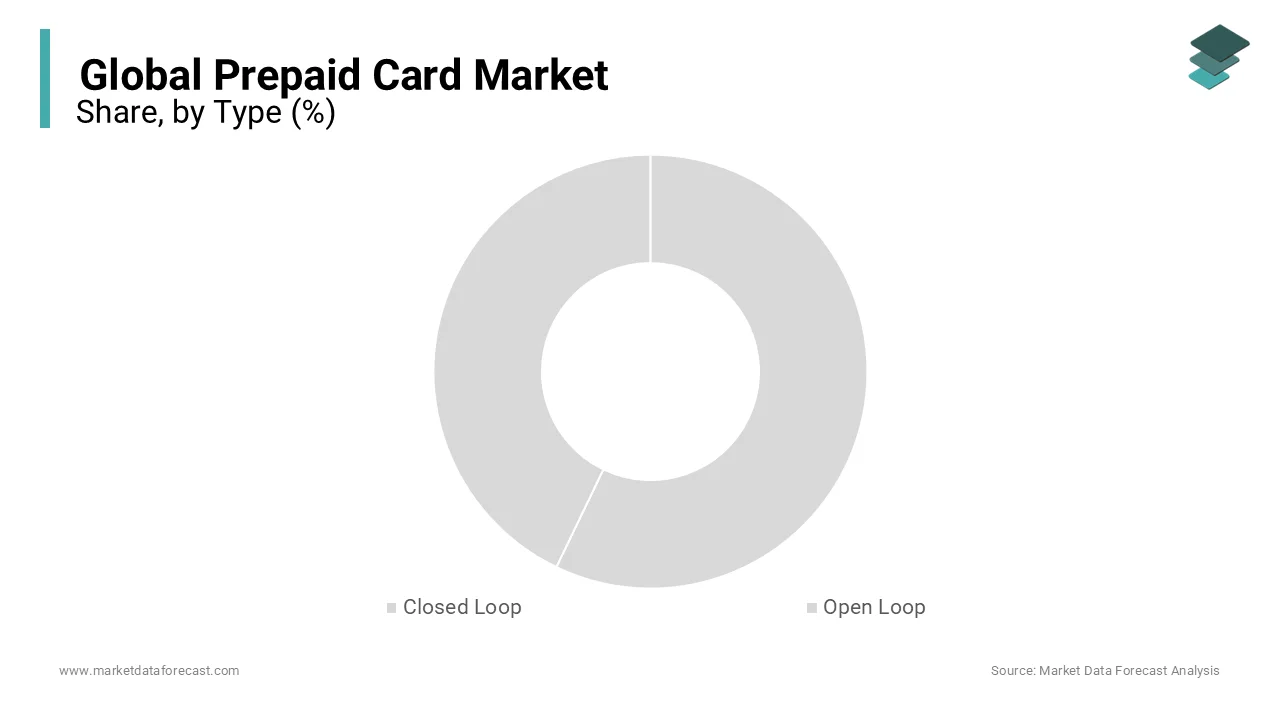
The closed loop segment is leading with the highest share of the market. The growing adoption of prepaid cards by travelers, which is an easy and safe way to carry cards instead of cash, is inclined to level up the growth rate of the closed-loop segment. The open-loop segment is likely to have the dominant growth rate during the forecast period. Open loop cards are notified as secure and have easy accessibility to online transactions with fewer additional charges.
Global Prepaid Card Market Analysis By Category
The gift cards segment is leading with the prominent share of the market. Increase awareness of the use of these cards in the form of cards that are convenient for transferring money with minimal complications when compared with the other cards. The general-purpose reloadable cards segment is likely to hit the highest CAGR by the end of 2032. GPR cards help simplify expenses and can be mostly used for contactless reloadable cards. These are contactless reloaded cards where funds are loaded by the cardholder or a third party. The user can take advantage of using this card by paying bills, making purchases, or withdrawing cash from the ATMs.
Global Prepaid Card Market Analysis By Channel
The online retail stores segment is accounted for leading with the largest share of the market, where fintech companies are likely to gain the fastest growth rate during the forecast period. The rising number of people using online transactions either for shopping or ordering various products through e-commerce platforms is eventually prompting the growth rate of the online retail store segment.
Global Prepaid Card Market Analysis By End-User
The government sector is ruling with the highest share of the market, whereas the individual/personal segment is likely to have huge growth opportunities throughout the forecast period. Rising funds from government organizations and the promotion of the digital banking process are major factors that fuel the growth rate of the prepaid cards market.
REGIONAL ANALYSIS
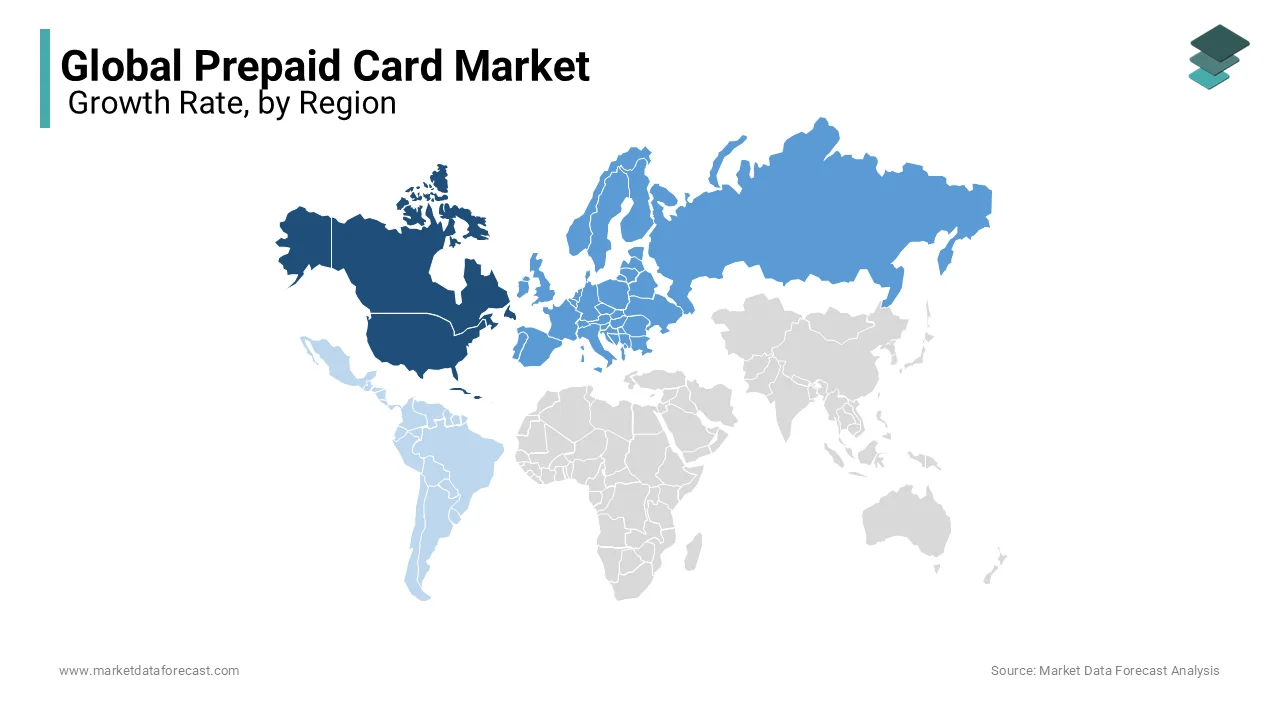
North America's prepaid card market is positioned at the top in holding the largest share, with the shifting trend towards the adoption of the traditional concept of managing finances.
Prepaid cards allow users to use the money that was loaded into the card and cater to diverse financial needs. Increasing awareness to manage finances in a more flexible way with the help of prepaid cards is attributed to leveraging the growth rate of the market. High investments from government organizations to expand small and medium-scale industries are also a factor that is outraging the market's share.
Following North America, Europe is next in ruling the largest share of the market. Digital payment solutions are rapidly growing in European countries. The need to sustain itself in developed countries like the UK, Germany, Italy, and others, with the eventually rising cost of living, is ascribed to boosting the growth rate of the market. Consumers are seeking to adopt prepaid cards so as to avoid high interest rates credit by simply managing their finances with debit cards. Consumers are more inclined to use these cards for daily purchases, which significantly bolsters the market's growth rate.
Asia Pacific prepaid cards market is likely to hit the highest CAGR by the end of the forecast period. Emerging countries like India and China are contributing the highest growth rate for the prepaid cards market. Growing disposable income, especially in the urban areas, is likely to propel the market's growth rate in the Asia Pacific region. The increasing popularity of prepaid cards through social media platforms and the growing prominence of e-commerce platforms are other factors escalating the growth rate of the market.
Latin America and Middle east & Africa are ascribed to show up with great opportunities for the prepaid cards market in the coming years. Gradually increasing focus on expanding the e-commerce platform in these countries by adopting new digital payment solutions in banking sector is likely to gear up the market's growth rate in these regions.
KEY PLAYERS IN THE GLOBAL PREPAID CARD MARKET
Companies playing a prominent role in the global prepaid card market include JP Morgan Chase & Co. (U.S.) NetSpend Holdings, Inc. (U.S.) H&R Block (U.S.) American Express Company (U.S.) PayPal Holdings Inc. (U.S.) BBVA Compass Bancshares, Inc. (U.S.) Mango Financial, Inc. (U.S.) Kaiku Financial LLC. (U.S.) GreenDot Corporation (U.S.), and Others.
RECENT HAPPENINGS IN THE GLOBAL PREPAID CARD MARKET
- In 2025, NetSpend Holdings, Inc and Rev formed a new company named Ouro. The new company shall manage all the operations by maintaining Netspend as flagship in providing the prepaid cards by continuing the usage of the Rev's X world wallet. The major goal of Ouro is to promote meaningful positive free cash flow that enhances the structure of both companies combined.
MARKET SEGMENTATION
This research report on the global prepaid card market has been segmented and sub-segmented based on type, category, channel, end user, and region.
By Type
- Closed Loop
- Open Loop
By Category
- General Purpose Reloadable (GPR) Cards
- Government Benefit Cards
- Payroll Cards
- Prepaid Debit Cards
- Gift Cards
- Fuel Cards
- Prepaid Incentive Cards
- Other Prepaid Cards
By Channel
- Online Retail Stores
- Bricks and Mortar Stores
- Fintech Companies
- Others
By End User
- Business (Large Enterprise and Small & Medium Enterprise)
- Government
- Individual/Personal
By Region
- North America
- Europe
- The Asia Pacific
- Latin America
- The Middle East and Africa