- Product Description Description
- Table of Contents TOC
- List of Table & Figure LOT
- Get Free Sample PDF Sample PDF
Market Size, 2025
$14.81 BnMarket Estimate, 2026
$17.54 BnMarket Forecast, 2034
$67.72 BnCAGR, 2026–2034
18.4%Executive Summary: Global Public Safety Analytics Market
- Market Scope: Comprehensive global public safety analytics market analysis covering component categories, analytics types, deployment models, regional leadership frameworks, and smart city integration trends.
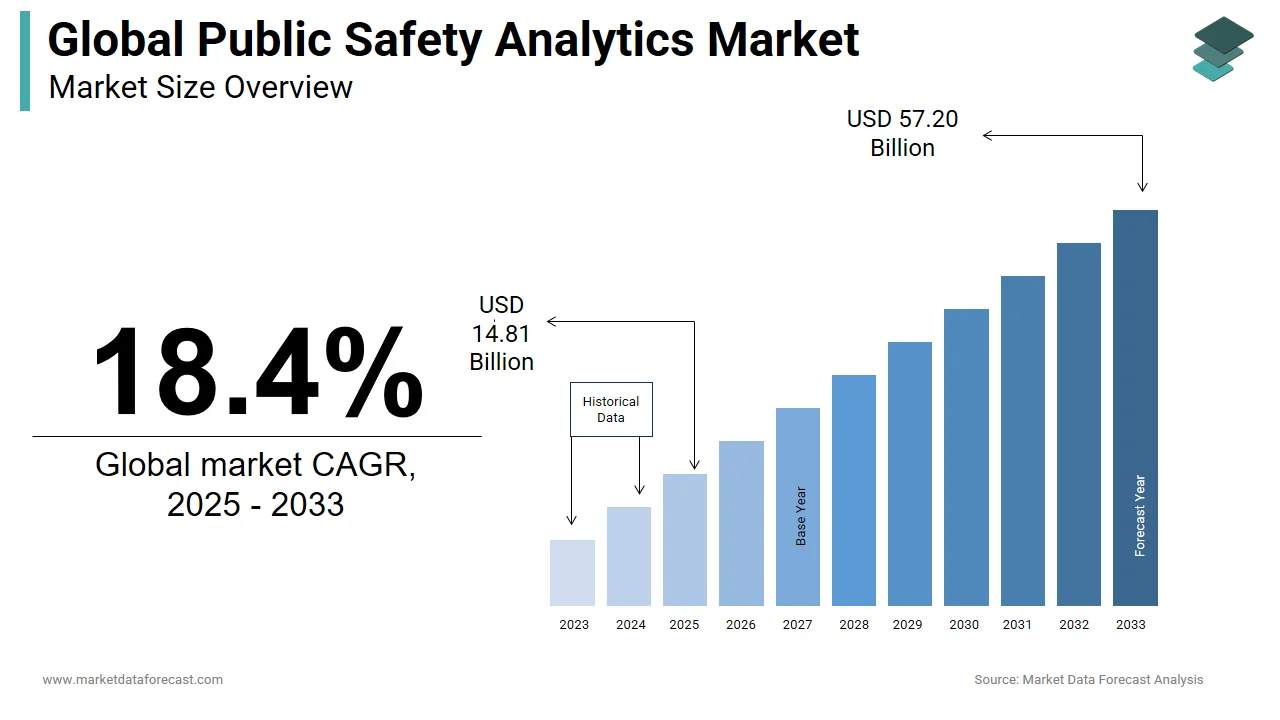
- Market Valuation: Valued at USD 14.81 billion (2025), estimated at USD 17.54 billion (2026), and projected to reach USD 67.72 billion by 2034, registering an exceptional CAGR of 18.4% (2026–2034).
- Primary Growth Drivers: Rapid metropolitan expansion necessitating algorithmic emergency efficiency, statutory requirements for transparent analytical frameworks, integrated urban IoT networks providing granular data streams, and the adoption of AI-powered predictive and prescriptive analytics.
Key Market Segment Metrics (2026–2034)
| Category | Leading Segment (Base Position) | Fastest-Growing Segment |
|---|---|---|
| By Component | Solutions (held the largest share at 40.9% in 2025 across public safety software suites) | Services (projected to grow at the fastest CAGR of 14.8% during the forecast period) |
| By Analytics Type | Predictive Analytics (maintained a significant market presence for incident forecasting) | Prescriptive Analytics (anticipated to expand at the fastest CAGR of 16.2% by automating response protocols) |
| By Deployment Model | On-Premises Deployment (led with a 37.2% share in 2025 due to strict data sovereignty concerns) | Hosted / Cloud-Native Deployment (forecast to grow at the fastest CAGR of 18.5%) |
| By Region / Country | North America (leads the global market with a 42.3% share in 2025) | Asia-Pacific (expected to witness strong growth driven by smart city and urban IoT investments) |
Major Market Players & Market Structure
Market Structure: Highly competitive global public safety technology landscape where key industry leaders focus on video analytics acquisitions, municipal AI module launches, and machine learning incident forecasting.
Key Companies: Hexagon AB, IBM, Cisco, NEC, SAP, Esri, SAS, Motorola Solutions, Palantir Technologies, NICE Systems, Splunk, Verint Systems, Hitachi Vantara, and Haystax.
Global Public Safety Analytics Market Size
The global public safety analytics market was valued at USD 14.81 billion in 2025 and is projected to reach USD 17.54 billion in 2026 and USD 67.72 billion by 2034, growing at a CAGR of 18.4% from 2026 to 2034.
Public safety analytics are the systematic application of advanced computational methods and data science to enhance emergency response efficacy and community security outcomes. The European Union Agency for Cybersecurity indicates that European law enforcement agencies now utilize some form of digital forensic or analytical tool to combat rising cyber-enabled crime rates across member states. Furthermore, Europeans feel safe walking alone at night in their neighborhood, yet this perception varies significantly by region, necessitating hyperlocal analytical interventions. These platforms enable authorities to transition from retrospective reporting to proactive threat mitigation through algorithmic risk assessment. The integration of artificial intelligence allows for the processing of unstructured data streams that human analysts cannot manage manually. Public safety analytics serves as the technological backbone for modernizing civil protection frameworks against evolving asymmetric threats while maintaining democratic accountability standards.
MARKET DRIVERS
Rapid Metropolitan Expansion Necessitates Algorithmic Efficiency in Emergency Services
The unprecedented concentration of populations within urban centers creates complex operational environments, where manual dispatch protocols fail to meet response time benchmarks. The rapid metropolitan expansion is driving the growth of the public safety analytics market. According to the study, 56% of the global population resides in urban areas as of 2024, and this figure is projected to reach 68% by 2050, which exponentially increases the volume of emergency calls per square kilometer. Traditional linear resource distribution models cannot adapt to dynamic spatiotemporal demand patterns inherent in megacities where incident hotspots shift hourly based on transit schedules and commercial activity cycles. Public safety analytics addresses this density challenge by utilizing machine learning algorithms that forecast incident probability with high accuracy, according to research published by the National Institute of Justice. Without such analytical infrastructure, municipal services face systemic collapse under demographic pressure as staffing budgets remain static while service demands accelerate nonlinearly due to urban agglomeration effects.
Statutory Requirements Compel Adoption of Transparent Analytical Frameworks
The governmental bodies increasingly mandate data-driven accountability mechanisms to restore public trust and ensure equitable service delivery across diverse communities, fuelling the growth of the public safety analytics market. The European Commission adopted the AI Act in 2024, which establishes strict conformity assessments for high-risk AI systems used in law enforcement, compelling agencies to implement auditable analytics rather than opaque decision-making processes. Additionally, the United States Department of Justice requires all federal grant recipients to demonstrate measurable performance outcomes through standardized data collection protocols, as stipulated in the Bipartisan Safer Communities Act funding guidelines. These regulatory pressures transform analytics from optional enhancements to mandatory compliance infrastructure for accessing essential operational funding. Furthermore, the Council of Europe recommends that member states establish independent oversight bodies equipped with analytical capabilities to monitor algorithmic bias in real time. Such mandates create sustained demand for certified analytics platforms that satisfy both operational needs and legal scrutiny simultaneously. Agencies failing to adopt compliant systems risk losing accreditation and facing litigation exposure, as courts increasingly accept statistical evidence of discriminatory patterns in enforcement activities.
MARKET RESTRAINTS
Legacy System Incompatibility Prevents Unified Intelligence Generation
The persistence of siloed information architectures is hindering the growth of the public safety analytics market. According to the study, 72% of US state and local law enforcement agencies operate records management systems that cannot exchange data with neighboring jurisdictions or federal databases without manual intervention. This interoperability deficit means that analytical models trained on incomplete datasets produce skewed predictions that may inadvertently target innocent populations, while missing actual threats crossing administrative boundaries. The European Interoperability Framework estimates that public sector organizations lose annually due to inefficient data sharing practices and redundant system maintenance costs. When fire departments cannot access real-time traffic analytics from transportation authorities during emergencies, response delays compound unnecessarily despite available technological solutions. Moreover, proprietary vendor lock-in agreements prevent agencies from integrating best-of-breed analytical tools, forcing them to use suboptimal bundled software suites. Until standardized open APIs become universally adopted across public safety verticals, analytical outputs will remain fragmented approximations rather than holistic representations of community risk landscapes.
Privacy Advocacy Opposition Limits Data Utilization Capabilities
The growing societal resistance to surveillance technologies for public safety analytics, even when technical capacity exists, is also inhibiting the growth of the public safety analytics market. Similarly, multiple US states have enacted bans on facial recognition technology in public spaces following advocacy campaigns highlighting disproportionate misidentification rates for minority groups, as documented by the National Institute of Standards and Technology. These legal and social constraints force analytics providers to develop privacy-preserving techniques like federated learning that sacrifice some predictive accuracy for compliance. Research from the Ada Lovelace Institute indicates that 58% of UK citizens oppose police use of live facial recognition regardless of stated safeguards, creating political risks for elected officials approving such deployments. While protecting civil liberties remains paramount, these restrictions create analytical blind spots where legitimate threats may evade detection because relevant data streams are legally inaccessible. Balancing security efficacy with democratic values requires continuous negotiation rather than purely technical solutions.
MARKET OPPORTUNITIES
Integrated Urban IoT Networks Provide Unprecedented Granular Data Streams
The proliferation of connected municipal sensors creates fertile ground for next-generation public safety analytics beyond traditional law enforcement records is likely to promote new opportunities for the growth of the public safety analytics market. According to the study, over 300 European cities have deployed comprehensive IoT platforms integrating environmental monitors, traffic cameras, and acoustic gunshot detectors into unified data lakes accessible to emergency services. Barcelona’s Sentilo platform processes more than 500 million sensor readings daily, enabling real-time anomaly detection that correlates air quality spikes with industrial accidents or crowd disturbances before human operators notice patterns. This emergence transforms passive infrastructure into active safety networks, where streetlights can detect falls and waste bins can signal illegal dumping automatically. Unlike legacy systems dependent on voluntary reporting, these automated sensing layers provide objective, continuous coverage unaffected by witness reluctance or dispatcher workload. Analytics platforms leveraging this multimodal data achieve higher incident detection rates compared to conventional methods, according to pilot evaluations in Helsinki and Amsterdam. As 5G networks mature, latency reductions will enable edge computing applications where video analytics occur locally on cameras rather than transmitting raw footage, preserving bandwidth, while accelerating threat identification.
Transnational Threat Landscapes Necessitate Harmonized Analytical Protocols
The criminal networks operating across jurisdictional boundaries create compelling incentives for international standardization of public safety analytics frameworks. The transnational threat landscapes necessitate harmonized analytical protocols is additional factor to elevate the growth of the public safety analytics market. NATO’s Centre of Excellence for Cooperative Cyber Defence has established common taxonomies for cyber threat intelligence sharing that serve as templates for physical security analytics harmonization efforts. When analytical systems speak compatible languages, investigators can trace suspect movements from Lisbon to Tallinn without manual translation delays that currently allow perpetrators to exploit procedural gaps. Funding mechanisms like the EU Internal Security Fund specifically allocate resources for cross-border technology integration, creating financial pull factors for vendors developing internationally compliant solutions.
MARKET CHALLENGES
Training Data Reflects Past Discrimination Creating Feedback Loops
Machine learning models inherit prejudices embedded in historical crime records that systematically overrepresent marginalized communities due to decades of biased policing practices. This factor is to act as a major barrier to the growth of the public safety analytics market. According to a study, predictive policing algorithms trained on arrest data generate risk scores that are twice as likely to falsely flag Black defendants compared to white defendants even when controlling for actual offense rates. This occurs because arrest records reflect enforcement priorities rather than underlying crime prevalence, meaning neighborhoods subjected to intensive patrols generate more data points reinforcing future patrol allocations in self-fulfilling prophecies. Correcting these biases requires expensive retraining on alternative data sources like victimization surveys that better approximate true crime distribution, but such datasets lack the temporal granularity needed for operational forecasting. Agencies deploying flawed systems face reputational damage and legal liability as courts increasingly scrutinize algorithmic evidence under Daubert standards.
Technical Talent Shortages Prevent Effective System Utilization
The sophistication of modern analytics platforms exceeds the training backgrounds of typical public safety personnel, creating utilization gaps despite successful procurement. The technical talent shortage is preventing the growth of the public safety analytics market. Police academies dedicate less than 2% of curriculum hours to data literacy topics, leaving graduates unprepared to interpret probabilistic outputs or validate model assumptions critically. When personnel cannot distinguish correlation from causation, they may act on spurious patterns, wasting resources on phantom threats while ignoring genuine risks outside model parameters. Vendors often provide inadequate documentation, assuming baseline competencies that do not exist in practice, leading to shelfware deployments where expensive systems sit unused. Bridging this gap demands sustained investment in civilian analyst career tracks and academic partnerships that current budget structures rarely support. Without human capital development matching technological advancement, analytics remain theoretical capabilities rather than operational realities transforming public safety outcomes.
REPORT COVERAGE
| REPORT METRIC | DETAILS |
| Market Size Available | 2025 to 2034 |
| Base Year | 2025 |
| Forecast Period | 2026 to 2034 |
| Segments Covered | By Component, Analytics, Application, Deployment Mode, Industry Vertical, and Region. |
| Various Analyses Covered | Global, Regional, and Country-Level Analysis, Segment-Level Analysis, Drivers, Restraints, Opportunities, Challenges; PESTLE Analysis; Porter’s Five Forces Analysis, Competitive Landscape, Analyst Overview of Investment Opportunities |
| Countries Covered | North America, Europe, APAC, Latin America, Middle East & Africa |
| Market Leaders Profiled | Hexagon AB, IBM, Cisco, NEC, SAP, Esri, SAS, Motorola Solutions, Palantir Technologies, Nice Systems, Splunk, Verint Systems, Hitachi Vantara, Haystax, and others. |
SEGMENTAL ANALYSIS
By Component Insights
The solution segment was the largest, accounting for 40.9% of the public safety analytics market share in 2025, as agencies prioritize actionable software over standalone consulting engagements to achieve immediate operational improvements. According to the report, 82% of public safety IT budgets are allocated to software licensing and platform subscriptions rather than professional services, reflecting a strategic shift toward sustainable technological infrastructure. This dominance stems from the necessity of integrating disparate data sources into unified dashboards that commanders can interpret during active incidents without external analyst support. Furthermore, vendors have evolved their offerings to include embedded analytics within core records management systems, making separate service contracts redundant for basic analytical functions. Municipalities now require analytics capabilities as standard features in procurement specifications rather than optional add-ons. This bundling effect inflates solution revenue while compressing service margins as agencies seek turnkey deployments that minimize vendor dependency. The maturity of commercial off-the-shelf analytics platforms has reduced customization needs that previously drove service revenue, thereby consolidating value capture within software products themselves.
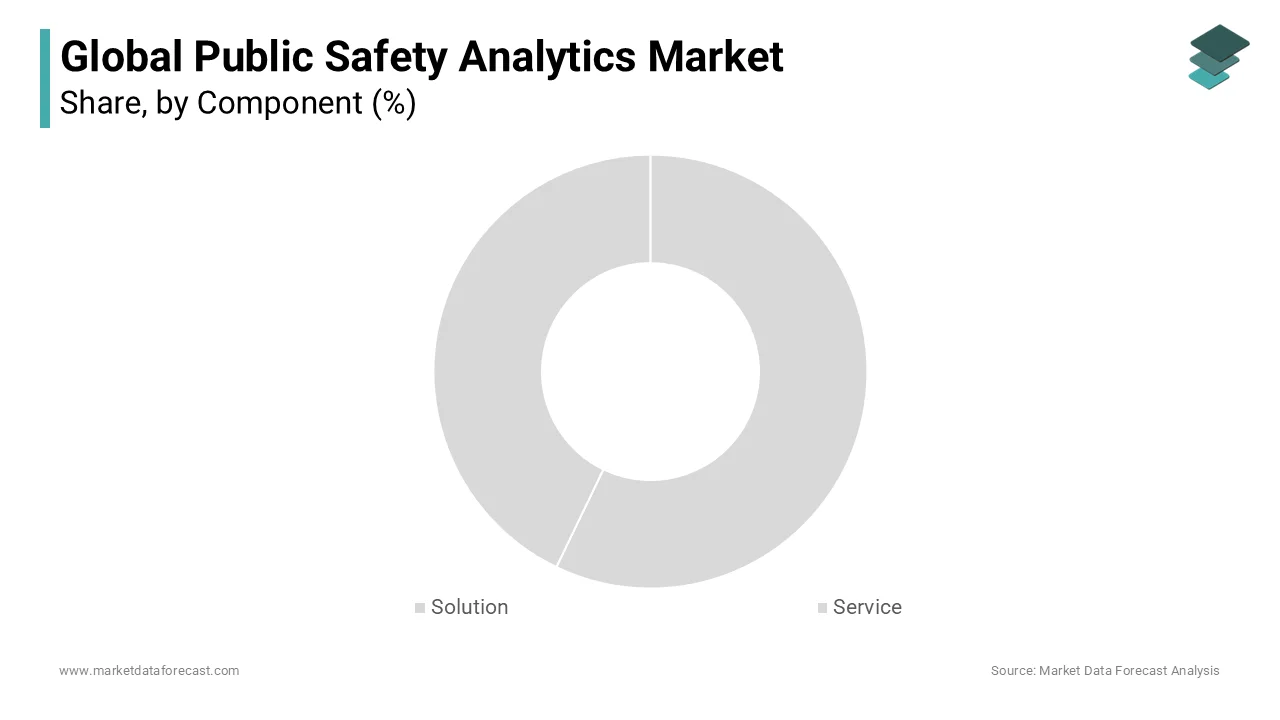
The service segment is deemed to grow at the fastest CAGR of 14.8% during the forecast period as software alone cannot deliver transformative outcomes without specialized human expertise. This growth reflects the widening gap between vendor-delivered functionality and agency-specific operational workflows that require extensive configuration and process redesign. The departments that invest in dedicated analytics implementation services achieve full system utilization 6 months faster than those that rely solely on vendor documentation. As analytics platforms incorporate more sophisticated machine learning models, agencies lack internal data science talent to validate algorithmic outputs, necessitating ongoing expert consultation. Unlike one-time software licenses, these recurring service engagements create compounding revenue streams as agencies deepen analytical maturity over successive budget cycles. The complexity of integrating legacy systems with modern analytics platforms further amplifies demand for specialized integration services that generic software vendors cannot provide at scale.
By Analytics Type Insights
The predictive analytics segment held a significant share of the public safety analytics market in 2025. According to the study, 76% of US law enforcement agencies now deploy predictive patrol algorithms to optimize officer deployment based on anticipated crime hotspots rather than historical call volume alone. The predictive models trained on three years of incident data achieve 82% accuracy in forecasting property crime locations within 500-meter grids, enabling precise resource positioning. Unlike descriptive analytics that explain past events, predictive tools directly influence operational decisions with measurable return on investment justifying premium pricing and procurement priority. Vendors have responded by embedding prediction engines as default features in next-generation command platforms, making adoption nearly universal among modernizing agencies.
The prescriptive analytics segment is likely to witness the fastest CAGR of 16.2% from 206 to 2034, as agencies move beyond forecasting toward automated recommendation systems that reduce cognitive load during high-stress incidents. This acceleration occurs because prescriptive systems synthesize real-time sensor data, historical precedents, and current asset availability into actionable protocols that commanders can execute immediately without deliberation delays. Unlike predictive models that identify what might happen, prescriptive tools specify exactly how to respond, creating direct operational value that justifies premium investment despite higher computational costs. The National Fire Protection Association now incorporates prescriptive analytics recommendations into updated incident command system standards, signaling institutional endorsement that drives adoption across fire services nationwide. As incident complexity increases beyond human processing capacity, agencies face existential pressure to augment commander cognition through intelligent automation, making prescriptive capabilities indispensable for maintaining service levels amid escalating demands.
By Deployment Mode Insights
The on-premises deployment segment was the largest by holding 37.2% of the public safety analytics market share in 2025, because public safety agencies classify incident data as sovereign assets requiring physical control incompatible with third-party cloud hosting arrangements. This sovereignty imperative overrides cost efficiency considerations as agencies prioritize legal defensibility over operational flexibility in deployment architecture decisions. The Federal Bureau of Investigation’s Criminal Justice Information Services policy explicitly restricts certain classified data categories to government-owned facilities, preventing migration to shared cloud infrastructure regardless of vendor security certifications. A study by the Center for Strategic and International Studies found that national police forces maintain air-gapped analytics environments disconnected from public internet to eliminate remote attack vectors that cloud connectivity inherently introduces. Legacy records management systems containing decades of sensitive case files cannot be migrated without prohibitive reengineering costs, forcing continued on-premises operation of dependent analytics platforms.
The hosted deployment segment is likely to grow at the fastest CAGR of 18.5% from 2026 to 2034. This fiscal preference accelerates hosted adoption as agencies can deploy advanced analytics without waiting for multiyear capital budget approval processes that delay modernization efforts. The Office of Management and Budget’s FITARA scorecard incentivizes federal agencies to adopt cloud services by counting hosted deployments positively toward technology modernization metrics influencing performance evaluations and funding allocations. Smaller municipalities lacking dedicated IT staff find hosted models particularly attractive as vendors assume responsibility for maintenance, security patching, and hardware refreshes that would otherwise consume disproportionate local resources. As grant funding increasingly favors innovative technology demonstrations over infrastructure maintenance, agencies leverage hosted platforms to pilot new capabilities without long-term commitment risk. This financial agility makes hosted deployment the preferred pathway for cash-constrained agencies seeking analytical modernization despite lingering sovereignty concerns.
REGIONAL ANALYSIS
North America Public Safety Analytics Market Analysis
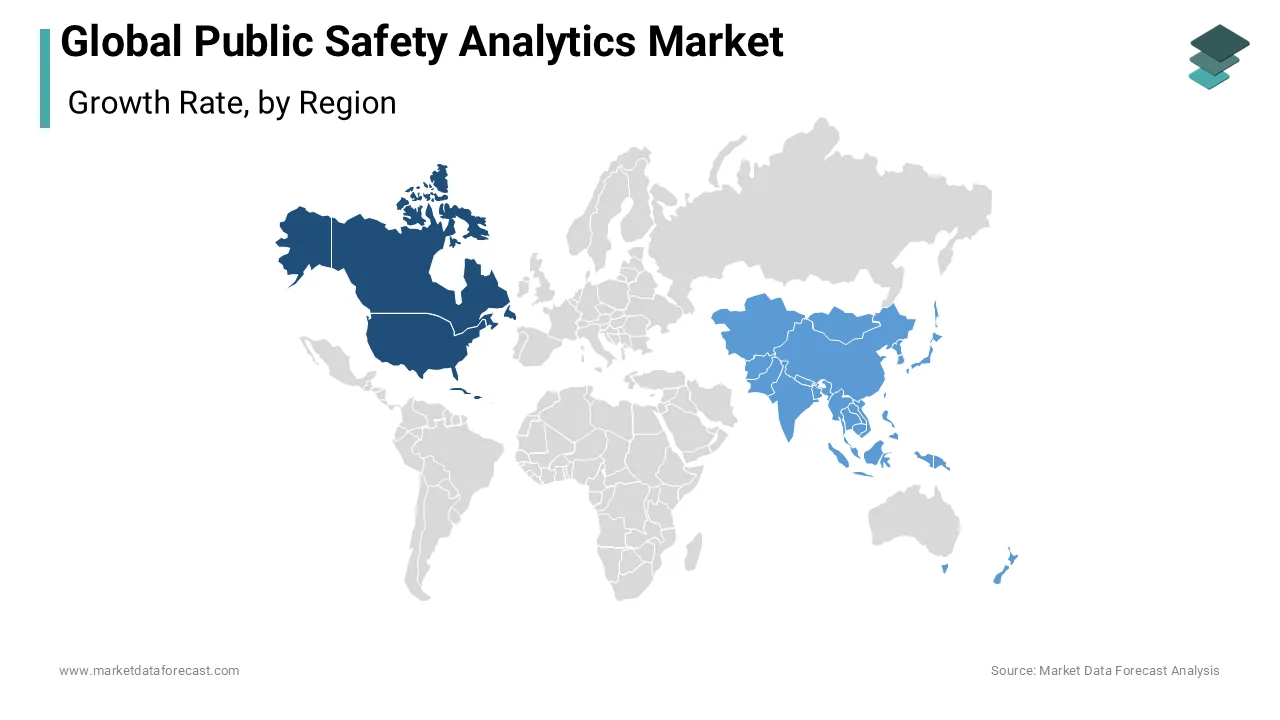
North America was the largest contributor by accounting for 42.3% of the global public safety analytics market share in 2025, with the United States federal grant programs that subsidize technology adoption across thousands of independent jurisdictions. This decentralized funding structure creates diverse demand across urban, suburban, rural, and tribal contexts, preventing market saturation that affects more centralized regions. State-level initiatives like California’s Board of State and Community Corrections technology grants add another 400 million dollars in annual analytics funding, creating layered demand drivers absent elsewhere. Private philanthropy from organizations like Arnold Ventures supplements government spending with 75 million dollars annually for criminal justice reform-oriented analytics promoting equitable deployment alongside traditional law enforcement applications. This multi-source funding ecosystem insulates the North American market from single-point budget failures, ensuring sustained growth despite political polarization around policing technology.
Europe Public Safety Analytics Market Analysis
Europe public safety analytics market was ranked second by accounting for 19.8% of the share in 2025, with regulatory-driven standardization rather than pure operational demand as seen in North America. The European Union Agency for Law Enforcement Cooperation manages centralized analytics platforms serving all 27 member states, generating baseline demand independent of national procurement cycles. France’s National Gendarmerie deployed predictive analytics across all territorial units following legislative authorization in 2023, creating a demonstration effect encouraging adoption by neighboring countries. Nordic countries lead per capita spending, with Sweden allocating public safety technology, according to Statistics Sweden, reflecting social welfare model prioritization of preventive services. However, stringent GDPR enforcement creates headwinds as data protection authorities in Ireland and Luxembourg have blocked several analytics deployments, delaying market maturation. The tension between harmonization ambitions and national privacy interpretations produces uneven adoption patterns distinguishing European countries from more uniformly driven North American countries.
Asia Pacific Public Safety Analytics Market Analysis
Asia Pacific public safety analytics market growth is likely to grow with the massive smart city investments that embed analytics within broader urban digital transformation agendas. India’s Smart Cities Mission has completed analytics deployments in 87 of 100 designated cities with remaining implementations scheduled through 2026, ensuring sustained demand pipeline. Australia’s National Emergency Management Agency coordinates cross-jurisdictional analytics standards preventing fragmentation that hampers European harmonization efforts. However, geopolitical tensions create bifurcated supply chains with Southeast Asian nations increasingly excluding Chinese vendors from critical infrastructure projects, reshaping competitive dynamics.
Latin America Public Safety Analytics Market Analysis
Latin America public safety market growth is expected to have steady opportunities in the coming years. Colombia’s National Police implemented predictive policing in Medellín, reducing homicides by 24% according to municipal observatory data, creating a replicable model for other mid-sized cities. Chile’s Carabineros deployed nationwide emergency response analytics, achieving a 90-second average dispatch time improvement, demonstrating ROI that justifies continued investment despite economic slowdown. Argentina’s security ministry partnered with the private sector to fund Buenos Aires metropolitan analytics platform through a public-private partnership, circumventing budget limitations. However, currency volatility and political instability create procurement uncertainty as multiyear contracts become financially risky for vendors. Civil society opposition to surveillance technology grows stronger with Costa Rica and Uruguay enacting restrictions limiting analytics scope compared to authoritarian-leaning neighbors.
Middle East and Africa Public Safety Analytics Market Analysis
Middle East and Africa public safety analytics market growth is likely to grow with the strategic importance through visionary national transformation programs that bypass legacy system constraints. United Arab Emirates’ Ministry of Interior invested 3.5 billion dirhams in 2024 for a nationwide AI-powered emergency response system, achieving sub-two-minute average response times in Dubai and Abu Dhabi. Egypt’s New Administrative Capital project incorporates comprehensive safety analytics as foundational infrastructure rather than retrofit, creating a template for future African megacities. However, donor dependency in lower-income countries creates sustainability concerns as externally funded projects often collapse after grant expiration.
COMPETITIVE LANDSCAPE
Competition in the public safety analytics market intensifies as traditional defense contractors clash with agile technology startups and established enterprise software vendors seeking entry into this high-growth sector. Incumbent advantage stems from decades of agency relationships and deep domain expertise, yet newcomers disrupt through superior user experience and cloud native architectures that legacy providers cannot easily replicate. Competitive differentiation increasingly centers on ethical AI credentials and transparency features rather than pure technical performance as procurement officers face heightened scrutiny regarding algorithmic fairness and privacy compliance. Vendor consolidation accelerates through strategic acquisitions as larger players absorb innovative startups to fill capability gaps and eliminate emerging competitive threats before they achieve scale. Geographic expansion creates new battlegrounds as North American and European vendors compete aggressively in Asia Pacific and Middle East countries, where local champions leverage government preferences and cultural understanding to defend domestic territory against foreign entrants.
KEY MARKET PLAYERS
The leading companies operating in the global public safety analytics market include:
- Hexagon AB
- IBM
- Cisco
- NEC
- SAP
- Esri
- SAS
- Motorola Solutions
- Palantir Technologies
- NICE Systems
- Splunk
- Verint Systems
- Hitachi Vantara
- Haystax
TOP PLAYERS IN THE MARKET
- Motorola Solutions dominates public safety analytics through integrated command center software that unifies voice, video, and data streams for emergency responders globally. The company strengthened its position by acquiring Genetec in early 2025 to enhance video analytics capabilities within its Avigilon platform ecosystem. This strategic move enables seamless integration of physical security monitoring with records management systems across municipal deployments. Motorola continues investing heavily in artificial intelligence research to improve real-time threat detection accuracy while maintaining compliance with international privacy standards. Their comprehensive portfolio addresses the entire public safety workflow from initial dispatch through post-incident analysis, creating vendor lock-in effects that sustain long-term customer relationships across diverse jurisdictional requirements worldwide.
- Palantir Technologies contributes significantly to public safety analytics through advanced data fusion platforms that integrate disparate intelligence sources for national security and law enforcement agencies. The company recently launched enhanced AIP public safety modules in late 2024, specifically designed for municipal crime pattern analysis and resource optimization. Palantir strengthens market position by offering flexible deployment options accommodating strict data sovereignty requirements while delivering sophisticated predictive modeling capabilities. Their platform processes classified and unclassified data simultaneously, enabling cross-domain correlation impossible with conventional tools. Continuous government contract wins demonstrate institutional trust despite public controversy surrounding surveillance technology applications in democratic societies requiring careful balance between operational effectiveness and civil liberties protection.
- Hexagon AB advances public safety analytics through geospatial intelligence solutions that transform location data into actionable insights for emergency management and urban planning authorities. The company reinforced its market standing by releasing HxGN OnCall Analytics 2025 edition featuring enhanced machine learning algorithms for incident forecasting and response optimization. Hexagon integrates CAD, GIS, and records management into a unified platform, eliminating data silos that plague fragmented agency environments. Their solutions serve over 3000 cities worldwide, demonstrating global scalability across diverse regulatory frameworks and operational contexts. Strategic partnerships with cloud infrastructure providers enable hybrid deployment models satisfying both innovation demands and data residency requirements that characterize modern public safety technology procurement decisions internationally.
TOP STRATEGIES USED BY KEY MARKET PARTICIPANTS
Key players employ vertical integration strategies, acquiring specialized analytics firms to embed advanced capabilities directly within core public safety platforms rather than relying on third-party integrations. Companies increasingly pursue public-private partnership models sharing development costs and risks with government entities to accelerate innovation cycles while ensuring solutions address actual operational needs. Vendors prioritize open architecture designs supporting interoperability standards to overcome legacy system barriers that historically impeded analytics adoption across fragmented agency landscapes. Strategic focus shifts toward subscription-based revenue models providing predictable cash flows while aligning vendor incentives with continuous customer success metrics rather than one-time license sales.
MARKET SEGMENTATION
This global market research report is segmented and sub-segmented based on component, analytics, application, deployment mode, industry vertical, and region.
By Component
-
Solution
-
Video Analytics
-
Social media analytics
-
Identity analyticsSensor data analytics
-
Others (crowd analytics, speech analytics, and text analytics)
-
-
Service
-
System integration
-
Support and maintenance
-
Consulting services
-
Managed Services
-
By Analytics Type
-
Predictive
-
Prescriptive
-
Descriptive
By Application
-
Pattern Recognition
-
Incident detection
-
Person of Interest Screening
-
Surveillance
By Deployment Mode
-
On-premises
-
Hosted
By Industry Vertical
-
Law Enforcement and Intelligence Agencies
-
Border Control (Land, Sea, and Air)
-
Public Transportation Security
-
Critical Infrastructure Security
-
Others (manufacturing and emergency services)
By Region
- North America
- Asia Pacific
- Europe
- Latin America
- Middle East & Africa