- Product Description Description
- Table of Contents TOC
- List of Table & Figure LOT
- Get Free Sample PDF Sample PDF
Market Size, 2025
$16.72 BnMarket Estimate, 2026
$17.92 BnMarket Forecast, 2034
$31.26 BnCAGR, 2026–2034
7.20%Philippines Cards and Payments Market Size, Growth, Trends & Forecast (2026–2034)
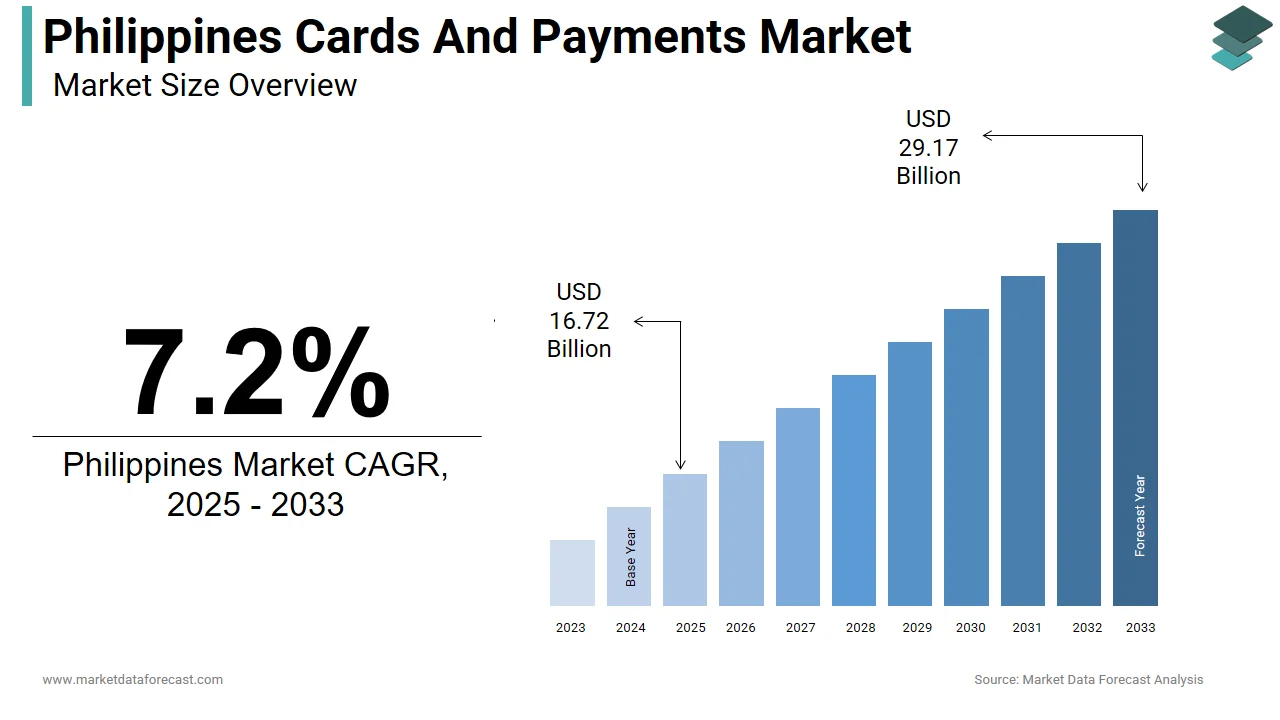
The Philippines cards and payments market size was valued at USD 16.72 billion in 2025, stands at USD 17.92 billion in 2026, and is projected to reach USD 31.26 billion by 2034, growing at a compound annual growth rate (CAGR) of 7.2% from 2026 to 2034. Propelled by rapid financial inclusion initiatives, smartphone-led e-commerce adoption, standardized interoperable QR frameworks (QR Ph), and popular mobile money ecosystems like GCash and Maya, the Philippine financial market demonstrates steady long-term expansion.
Key Executive Metrics (At-a-Glance)
- 2025 Base Valuation: USD 16.72 Billion
- 2026 Current Valuation: USD 17.92 Billion
- 2034 Forecast Valuation: USD 31.26 Billion
- Compound Annual Growth Rate (CAGR): 7.2% (2026–2034)
- Regional Highlights: Metropolitan areas like Metro Manila and Cebu spearhead advanced contactless and QR payment adoption, while rural provinces maintain high cash reliance.
Core Market Drivers & Growth Triggers
- Digital Financial Inclusion & E-Commerce: Escalating internet and mobile wallet penetration onboarding millions of unbanked citizens into formal financial networks.
- Government-Led Cashless Frameworks: Proactive implementation of the National Retail Payment System (NRPS) and standardized QR Ph interoperability protocols.
Primary Market Restraints & Challenges
- Rural Cash Preference & Infrastructure Deficits: Persistent reliance on physical currency in informal regional economies alongside uneven distribution of POS terminal infrastructure.
- Cybersecurity Risks & Regulatory Hurdles: Surging online fraud threats coupled with compliance burdens and lengthier licensing timelines for fintech startups under BSP oversight.
Philippines Cards and Payments Market Segmentation Breakdown
| Segment Category | Largest Segment | Fastest-Growing Segment |
|---|---|---|
| By Cards | Debit Cards | Credit Cards & Prepaid Tokens |
| By Payment Terminals | POS (Point of Sale) | Mobile/QR Code Terminals & SoftPOS |
| By Payment Instruments | Payment Cards & Credit Transfers | Digital Wallets & InstaPay/PESONet |
Major Industry Players Profiled
Key financial institutions shaping the Philippines' cards and payments market include Land Bank of the Philippines, Banco de Oro (BDO), Bank of the Philippine Islands (BPI), Metropolitan Bank & Trust Company (Metrobank), Rizal Commercial Banking Corporation (RCBC), Citibank, EastWest Bank, BancNet, and Megalink.
Philippines Cards and Payments Market Size
The Philippines cards and payments market size was valued at USD 16.72 billion in 2025. This market is expected to grow at a CAGR of 7.2% from 2026 to 2034 and be worth USD 31.26 billion by 2034 from USD 17.92 billion in 2026.
MARKET DRIVERS
Rapid Growth in Digital Financial Inclusion and E-Commerce Adoption
One of the key drivers of the Philippines’ cards and payments market is the rapid expansion of digital financial inclusion, supported by growing internet penetration and smartphone usage. This shift has been driven by the government’s National Retail Payment System (NRPS) and the rise of mobile money platforms like GCash and Maya, which have onboarded millions of previously unbanked Filipinos. Additionally, data from Mastercard revealed that contactless card usage grew by 45% year-on-year in 2023, reflecting increased consumer preference for secure and convenient payment methods across urban centers like Metro Manila and Cebu.
Government-Led Initiatives to Promote Cashless Transactions Nationwide
Another major driver of the Philippine cards and payments market is the strong push by both national and local governments to promote cashless transactions as part of broader financial modernization efforts. The implementation of QR Ph, the country’s standardized QR code system for payments, has significantly improved interoperability between banks and fintechs. As of December 2023, over 800,000 merchants nationwide accepted QR Ph payments, according to the Payments and Settlements System Monitor (PSSM). Additionally, local governments have integrated digital payments into public services such as transportation, taxation, and healthcare, further embedding digital transactions into daily life. These coordinated policy efforts are accelerating the transition away from cash and fostering a more inclusive, which is efficient payments ecosystem.
MARKET RESTRAINTS
Persistent Preference for Cash in Rural and Informal Economies
A significant restraint on the Philippines’ cards and payments market is the continued dominance of cash-based transactions in rural areas and informal sectors. Despite rising digital adoption in cities, a large portion of the population in Mindanao, Visayas, and remote barangays still relies heavily on physical currency due to limited banking infrastructure and low trust in digital systems. According to the World Bank’s Global Findex Database 2023, around 40% of Filipino adults remain unbanked, often operating within micro-economies such as sari-sari stores, street vending, and small-scale agriculture. Moreover, BSP reported that in 2023, cash-in-circulation still accounted for approximately 47% of total retail transactions by volume. This behavioral inertia slows the transition to a fully integrated digital payments ecosystem and requires targeted education and infrastructure development to overcome.
Limited Merchant Acquiring Infrastructure Outside Urban Centers
Another key constraint in the Philippines' cards and payments market is the uneven distribution of merchant acquiring infrastructure, particularly in non-metropolitan areas. While major cities like Manila, Davao, and Cebu have seen increased deployment of point-of-sale (POS) terminals, smaller towns and villages often lack reliable payment acceptance systems and stable internet connectivity. In contrast, Malaysia and Thailand each have more POS devices per capita despite smaller populations. The DTI noted that less than 15% of small businesses in Eastern Visayas and parts of Mindanao had access to card or QR-based payment acceptance systems in 2023. This infrastructure gap limits the ability of digital payment providers to scale and hampers broader financial inclusion goals.
MARKET OPPORTUNITIES
Expansion of Buy Now, Pay Later (BNPL) Services Across Retail and E-Commerce
A growing opportunity in the Philippines’ cards and payments market is the expansion of Buy Now, Pay Later (BNPL) services, which are gaining traction among young, digitally savvy consumers and e-commerce platforms. The Bangko Sentral ng Pilipinas (BSP) observed that BNPL adoption is particularly strong among millennials and Gen Z, who account for over 75% of all BNPL users. As consumer credit demand expands and regulatory clarity improves, BNPL services offer a viable alternative to traditional credit cards by enabling greater financial access and stimulating higher spending in both online and offline retail environments.
Rise of Super App Ecosystems Integrating Financial and Payment Services
The proliferation of super apps in the Philippines presents a transformative opportunity for the cards and payments industry, as these platforms integrate multiple financial services, including digital wallets, lending, insurance, and investment into a single interface. GCash, Maya, and GrabPay are leading this trend, offering comprehensive financial ecosystems that serve tens of millions of users daily. These super apps are not only enhancing financial inclusion but also driving card-linked payments, QR code transactions, and peer-to-peer transfers.
MARKET CHALLENGES
Cybersecurity Vulnerabilities in Expanding Digital Payment Systems
As the Philippines’ digital payment landscape expands rapidly, cybersecurity vulnerabilities pose a growing challenge to the stability and trustworthiness of the cards and payments market. The increasing number of digital transactions has attracted cybercriminals, leading to a rise in fraud incidents and data breaches. According to the National Privacy Commission (NPC), the number of reported cyberattacks targeting financial institutions surged by 50% in 2023 compared to the previous year. Smaller fintech firms and regional banks often lack the resources to invest in advanced threat detection and encryption technologies, which is making them particularly vulnerable. Strengthening digital infrastructure, which is enforcing stricter compliance standards, and improving consumer awareness are essential to mitigating these risks and ensuring sustainable growth in the Philippines’ evolving payments ecosystem.
Regulatory Complexity and Compliance Burden for Emerging Fintech Innovations
Regulatory complexity remains a major challenge for the Philippines’ cards and payments market, particularly for fintech startups aiming to introduce innovative payment solutions. While the BSP has implemented progressive policies to support digital finance, the approval process for new products and services can be lengthy and cumbersome. Furthermore, the requirement for local data storage and restrictions on cross-border fund flows complicate international expansion plans for many companies. Streamlining oversight while maintaining consumer protection and financial stability is crucial to fostering innovation and attracting further investment in the Philippines’ fast-growing digital payments sector.
MARKET KEY HIGHLIGHTS
The Bangko Sentral ng Philippines introduced a batch-based electronic credit transfer system called Philippine EFT System and Operations Network (PESONet), offering business-to-business (B2B), customer-to-business (C2B), government-to-government (G2G), and person-to-government (P2G) transactions in the country. It is the first automated clearing house in the Philippines under the National Retail Payment System (NRPS) without any electronic crediting fees.
As of November 2017, a total of 33 BSP-supervised financial institutions and other non-bank electronic money issuers had integrated with PESONet. Furthermore, BSP is working on the implementation of a 24/7 low-value electronic fund transfer system, InstaPay, which is due to launch in 2018.
The introduction of the Philippine Credit Card Industry Regulation Law allocated powers to the BSP to take care of credit card issuers and acquirers in the Philippines, mandating customer identification and due diligence procedures before card issuance to control unfair practices and promote the credit card market.
The strict regulation requires migrating to EMV chip cards from the conventional magnetic stripe by BSP to align with international payment card standards. Following this, BancNet signed an agreement with Visa in February 2015 to accelerate the migration to EMV chip cards for all domestic transactions. In addition to cards, the migration process ensures that ATMs and POS terminals are compliant with EMV standards.
KEY MARKET PLAYERS
Top players in the Philippines' cards and payments market include
- Land Bank of the Philippines
- Banco de Oro (BDO)
- Bank of the Philippine Islands (BPI)
- Metropolitan Bank & Trust Company (Metrobank)
- Rizal Commercial Banking Corporation (RCBC)
- Citibank
- EastWest Bank
- BancNet
- Megalink
MARKET SEGMENTATION
This research report on the Philippines cards and payments market has been segmented and sub-segmented based on the following categories.
By Cards
- Debit Cards
- Credit Cards
- Prepaid Cards
By Payment Terminals
- POS
- ATM's
By Payment Instruments
- Credit Transfers
- Direct Debit
- Cheques
- Payment Cards