- Product Description Description
- Table of Contents TOC
- List of Table & Figure LOT
- Get Free Sample PDF Sample PDF
Market Size, 2025
$233.51 BnMarket Estimate, 2026
$244.04 BnMarket Forecast, 2034
$347.31 BnCAGR, 2026–2034
4.51%Africa Real Estate Market Report Summary
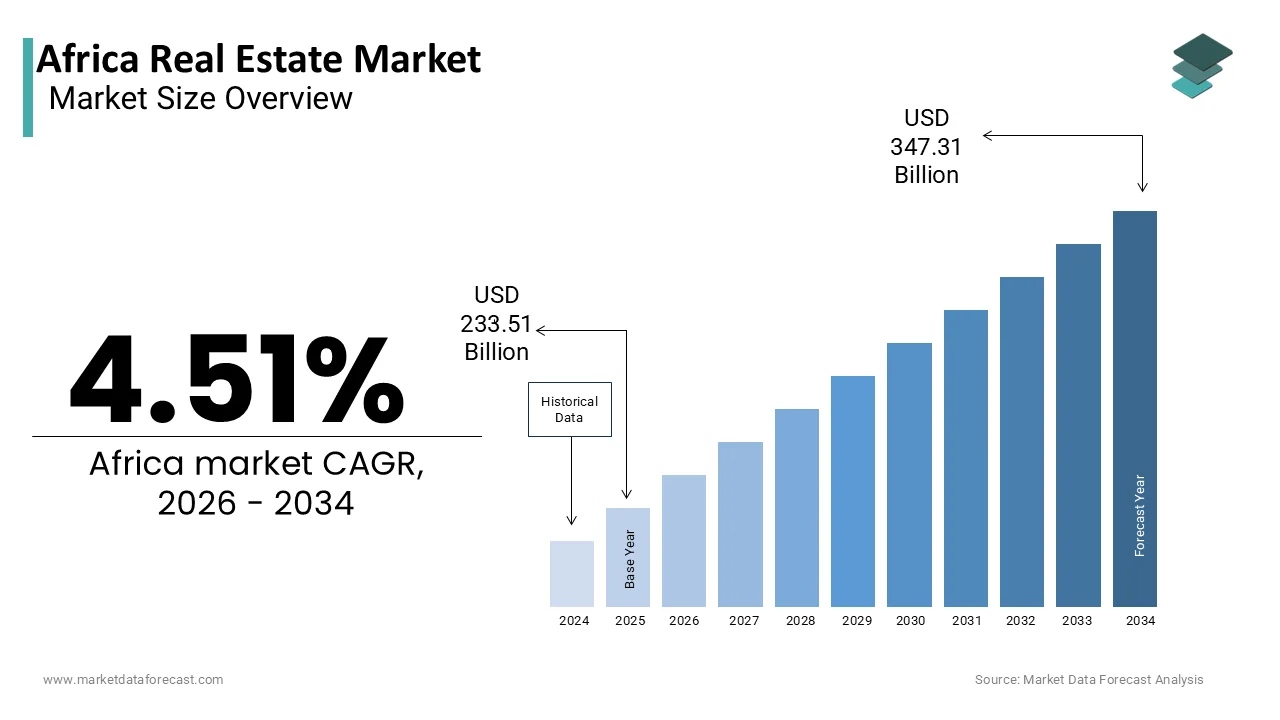
The Africa Real Estate Market was valued at USD 233.51 billion in 2025 and is projected to reach USD 347.31 billion by 2034, growing from USD 244.04 billion in 2026 at a CAGR of 4.51% during the forecast period. Growth is driven by rapid urbanization and population growth, increasing foreign direct investment in property development, and rising affordable housing programs backed by government support. Inadequate mortgage financing access and complex land tenure systems are shaping market dynamics.
Key Market Trends
- Rising expansion of smart city and mixed-use development projects across the continent
- Growing adoption of fintech-enabled property finance and micro-mortgage programs
- Increasing digitization of land registries improving title documentation transparency
- Expansion of logistics and warehouse real estate driven by e-commerce growth
- Rising government-led affordable housing schemes supported by public-private partnerships
Segmental Insights
- Based on property, residential dominated the market in 2025 by holding 58.7% of the share, driven by rapid urbanization and rising middle-class housing demand.
- Based on type, rental led the market in 2025 by holding 51.4% of the share, driven by limited mortgage accessibility across Sub-Saharan Africa.
- Commercial real estate is the fastest-growing property segment, projected at a CAGR of 8.1%, driven by rising FDI and growth of logistics and co-working spaces.
Regional Insights
- South Africa led the market in 2025 by holding 26.4% of the regional market share, supported by its advanced mortgage system and developed financial institutions.
- Egypt holds a significant share at 15.4%, driven by extensive government-led urban development and rapid Cairo population growth.
- Nigeria is a prominent market supported by its large youthful population and growing digital property finance innovation.
- Kenya contributes notably due to infrastructure development and tech-enabled real estate transaction platforms.
- Sales is the fastest-growing type segment, projected at a CAGR of 7.6%, driven by fintech-enabled home loans and digitized land registration systems.
Competitive Landscape
The market is highly competitive, with global firms and domestic developers competing on capital access, local market knowledge, and integrated smart city development. Companies are investing in public-private partnerships and technology-driven property platforms to improve transparency and transaction efficiency.
Prominent players in the market include Brookfield Asset Management Inc., ATC IP LLC., Prologis Inc., Simon Property Group L.P., Coldwell Banker, RE/MAX LLC., Keller Williams Realty Inc., CBRE Group Inc., Sotheby's International Realty Affiliates LLC., and Colliers.
Africa Real Estate Market Size
The African real estate market reached USD 233.51 billion in 2025, is forecast to grow to USD 244.04 billion in 2026, and is expected to reach USD 347.31 billion by 2034, at a CAGR of 4.51% from 2026 to 2034.
Real estate is marked by high informality, fragmented land tenure systems, and varying levels of regulatory maturity. This transition is reshaping real estate dynamics in cities like Lagos, Nairobi, Cape Town, and Cairo. International investors have also become more active in the market by collaborating with local developers to address the increasing demand for formal housing and commercial real estate. Moreover, the rise of smart city initiatives such as Egypt’s New Administrative Capital and Kenya’s Konza Technopolis is setting new benchmarks for urban planning and sustainability. Fintech-enabled property finance, growing digitization, and cross-border capital inflows are all contributing to the African real estate market's growing transition from unstructured transactions to transparent, organized, and investor-friendly frameworks that promote long-term value development.
MARKET DRIVERS
Rapid Urbanization and Population Growth
Africa is experiencing one of the fastest urbanization rates globally, which is driving the growth of the real estate market. Urban migration is further accelerating this trend, as young people move to cities in search of employment and better living standards. According to the Lagos Metropolitan Area Transport Authority (LAMATA), Lagos alone welcomes almost 300,000 new residents each year. This surge in urban dwellers is increasing demand for affordable housing, commercial offices, and retail spaces, especially in secondary cities like Kumasi, Kigali, and Lusaka. Governments and private developers are responding by launching integrated housing schemes and mixed-use developments. For instance, Rwanda’s "City Tower" project in Kigali aims to provide both residential and office space in a single complex, which caters to the growing middle class.
Increasing Foreign Direct Investment (FDI) in Property Development
Foreign direct investment has emerged as a significant driver of Africa's real estate market expansion, especially in the luxury and commercial sectors. Investors from China, the Gulf States, and Europe are increasingly viewing African cities as emerging hubs for commerce and innovation. In South Africa, Johannesburg and Cape Town have attracted substantial investment in green-certified office buildings and logistics parks. Governments are facilitating these investments through policy reforms, tax incentives, and public-private partnerships. Global investors looking for returns and diversity are finding Africa's real estate market increasingly attractive due to increased governance and transparency.
MARKET RESTRAINTS
Inadequate Access to Mortgage Financing and Credit Facilities
Lack of easily available mortgage finance is a major factor restraining the growth of the African real estate market. According to the Centre for Affordable Housing Finance in Africa (CAHF), less than 5% of the adult population in Sub-Saharan Africa owns a formal mortgage, which severely limits homeownership among middle-income earners. Traditional banking systems often exclude large portions of the population due to stringent lending criteria, low credit penetration, and high interest rates. For example, according to a 2023 assessment by the Bank of Ghana, long-term house loans are unaffordable for the majority of Ghanaians since average mortgage interest rates are still above 20%. Additionally, weak credit scoring mechanisms and limited financial literacy hinder banks from extending credit confidently to first-time homebuyers.
Complex Land Tenure Systems and Regulatory Hurdles
Land tenure insecurity poses restrictions to real estate development is limiting the growth of the market in Africa. According to UN-Habitat, only about 30% of land in Sub-Saharan Africa is formally registered, which means that millions of property owners are without legal documentation. This ambiguity discourages both domestic and foreign investors who require clear title deeds for financing and dispute resolution. In countries like Ethiopia and Malawi, customary land ownership systems prevail, where communities rather than individuals hold land rights.
MARKET OPPORTUNITIES
Rise of Affordable Housing Programs and Government Support
A growing focus on affordable housing initiatives supported by national governments and international organizations is one of the most promising developments in the African real estate market. Several governments have launched ambitious housing initiatives to bridge this gap. By 2027, the Ministry of Transport and Housing of Kenya intends to construct 500,000 affordable housing units with the help of subsidized finance and public-private partnerships. Similarly, Nigeria’s Federal Mortgage Bank introduced a National Housing Scheme in 2023 aimed at enabling lower-income families to access mortgages with favorable terms. These efforts are being complemented by international organizations such as the World Bank and the Islamic Development Bank, which are funding infrastructure-linked housing projects in countries like Senegal and Sudan. Large-scale home delivery is also becoming more viable due to the development of prefabrication and modular construction techniques, which are lowering building costs and timelines.
Expansion of Smart Cities and Mixed-Use Developments
Africa is witnessing a surge in smart city and mixed-use real estate projects designed to integrate residential, commercial, and recreational spaces within sustainable environments. As per the United Nations Economic Commission for Africa (UNECA), over 30 smart city projects were either under construction or in advanced planning stages across the continent in 2023. Kenya's planned metropolis of Konza Technopolis is attracting international investors with its distinctive fusion of ecosystems centered on innovation and real estate development. These developments are gaining traction due to their alignment with modern urban planning principles, which offer enhanced livability, security, and connectivity. Investors are also drawn by the long-term appreciation potential of such projects, which are often supported by government incentives, zoning laws, and infrastructure investments. Smart cities and mixed-use complexes are becoming important growth drivers for the African real estate market as urban populations rise and the demand for integrated living environments increases.
MARKET CHALLENGES
Infrastructure Deficits Hindering Property Development
A lack of proper infrastructure, such as roads, water supplies, power, and sewage systems, is an ongoing challenge in the African real estate market. When constructing new homes, developers are faced with increased expenses and longer deadlines in the absence of reliable infrastructure. In many cases, they must invest in independent power generation and water treatment facilities, which significantly increase project expenses. According to 2023 research by the Nigerian Building and Road Research Institute, developers in Nigeria allocate an extra 20–30% of their overall development expenditures on off-grid facilities. Moreover, inadequate road networks and poor public transport limit accessibility to newly developed residential and commercial zones, which reduces buyer interest and slows absorption rates. In Addis Ababa and Kampala, incomplete ring roads and traffic bottlenecks have discouraged investment in outlying real estate developments.
Political Instability and Policy Uncertainty
Political instability and inconsistent regulatory policies are alsohindering thee growth of the African real estate market. According to the Economist Intelligence Unit’s 2023 Democracy Index, nearly one-third of African countries were classified as authoritarian regimes, where abrupt policy changes, expropriation risks, and regulatory unpredictability can undermine investor confidence. In countries like Zimbabwe and Sudan, land reforms and nationalization policies have led to disputes over property ownership, which discourages both local and foreign investors. regulations, taxes, or land registration processes, even in economies that are generally stable. For example, in 2023, Zambia revised its land lease regulations without prior consultation, which confused developers and financiers. Similarly, in Tanzania, the introduction of new restrictions on foreign land ownership disrupted ongoing real estate projects and stalled negotiations. Long-term planning is challenging due to this volatility, and investors must pay more for risk mitigation techniques.
REPORT COVERAGE
| REPORT METRIC | DETAILS |
| Market Size Available | 2025 to 2034 |
| Base Year | 2025 |
| Forecast Period | 2026 to 2034 |
| Segments Covered | By Property, Type, and Region. |
| Various Analyses Covered | Global, Regional, and Country-Level Analysis, Segment-Level Analysis, Drivers, Restraints, Opportunities, Challenges; PESTLE Analysis; Porter’s Five Forces Analysis, Competitive Landscape, Analyst Overview of Investment Opportunities |
| Countries Covered | Sudan, Egypt, Kenya, Ethiopia, Ghana, South Africa, Rest of Africa |
| Market Leaders Profiled | Brookfield Asset Management Inc., ATC IP LLC., Prologis, Inc., Simon Property Group, L.P., Coldwell Banker, RE/MAX, LLC., Keller Williams Realty, Inc., CBRE Group, Inc., Sotheby’s International Realty Affiliates LLC., and Colliers. |
SEGMENTAL ANALYSIS
By Property Insights
The residential real estate segment dominated the African real estate market and held 58.7% of the share in 2025, and the segment is driven by rapid urbanization and a growing middle class seeking formal housing solutions. The rapid increase in population in large cities like Lagos, Nairobi, and Addis Ababa is a major contributing factor to this development. The migration to urban centers has led to increased demand for affordable and mid-tier housing, especially among young professionals and expanding families. The expansion of government-sponsored housing initiatives in several nations is a further significant factor. For instance, Kenya’s Ministry of Transport and Housing launched an initiative in 2023 to deliver 500,000 affordable homes by 2027, which was supported by public-private partnerships and subsidized financing.
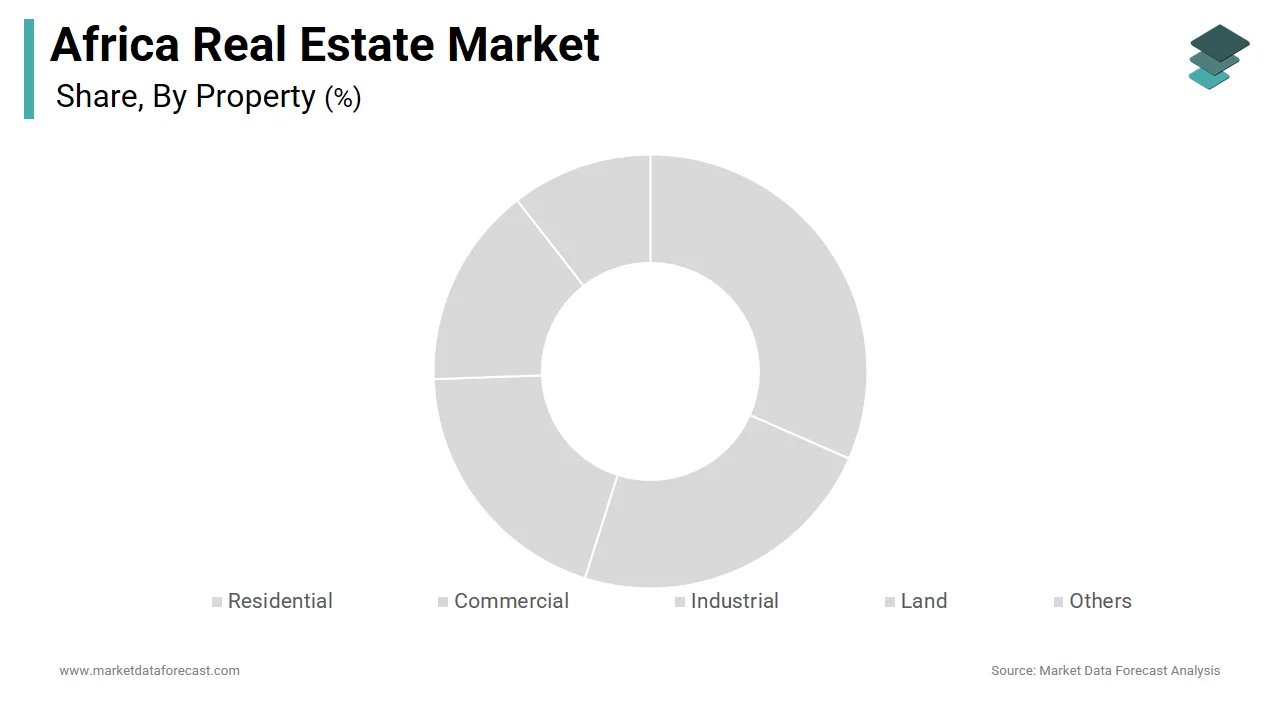
The commercial real estate segment is estimated to register the fastest CAGR of 8.1% over the forecast period, owing to factors such as increasing foreign direct investment (FDI), digital transformation, and the rise of co-working spaces and logistics hubs. The expansion of the business process outsourcing (BPO) and technology sectors, especially in East and West Africa, is one of the main drivers. Additionally, e-commerce growth and supply chain modernization are boosting demand for warehouse and distribution center space. According to JLL, increasing cross-border commerce made possible by the African Continental Free Trade Area (AfCFTA) led to a 15% rise in lease activity in South Africa's logistics real estate market in 2022. Furthermore, governments in countries like Egypt and Morocco have implemented tax incentives and infrastructure investments to attract global investors into commercial property development.
By Type Insights
The rental segment led the African estate market by occupying a share of 51.4% in 2025. A substantial portion of the population has financial restrictions and limited mortgage accessibility, which are major factors contributing to this high level of rental participation. Homeownership rates throughout the continent are impacted by the absence of official mortgage finance alternatives, which is a major factor pushing rental dominance. According to the World Bank, less than 5% of adults in Sub-Saharan Africa own a formal mortgage, which prevents the majority of the population from affording long-term property purchases. People thus depend largely on rental housing, particularly in cities where demand exceeds supply. Additionally, urban migration and job mobility contribute to the preference for short- to medium-term rentals. In cities such as Accra, Dar es Salaam, and Johannesburg, young professionals and expatriates often opt for flexible lease agreements rather than committing to property ownership.
The sales segment is likely to experience a CAGR of 7.6% from 2025 to 2033 due to factors such as rising disposable incomes, government-led housing initiatives, and increased access to alternative financing models. The emergence of fintech-enabled house loans and micro-mortgage programs is one important growth factor that is progressively making middle-class purchases more affordable. Additionally, increased investor confidence in prime residential and commercial assets is stimulating property sales. According to the South African Property Owners Association (SAPOA), sales of luxury homes in South Africa increased by 14% in 2022, with both Cape Town and Durban drawing the attention of international purchasers. Moreover, government reforms in land registration and title documentation are reducing legal barriers to property acquisition. According to the Lands Registrar Office, legal property transfers increased by 9% in 2023 as a result of the National Land Information Management System (NLIMS) in Kenya, which digitized land records and expedited transaction procedures.
COUNTRY-LEVEL ANALYSIS
South Africa Real Estate Market Insights
South Africa outperformed other countries in the African real estate market by accounting for 26.4% of the share in 2025. It has a diverse economy that encourages the development of both residential and commercial real estate, as well as a well-established legal system and developed financial institutions. This country's advanced mortgage system, which makes it possible for a larger percentage of the populace to obtain house finance than in other African countries, is one of the primary drivers. Additionally, urban renewal projects and infrastructure investments are revitalizing inner-city areas. Commercial real estate is also thriving, particularly in Cape Town and Pretoria, where demand for green-certified office buildings and logistics parks is rising. South Africa continues to lead the regional real estate market due to continued governmental support and the digital revolution of property management.
Egypt Real Estate Market Insights
Egypt was positioned second in the African real estate market by holding 15.4% of the share in 2025. Egypt is well-positioned as a major center in North Africa due to its advantageous geographic location, extensive government-led urban development, and growing private sector involvement. Additionally, affordable housing initiatives have boosted real estate activity. According to Cairo University's Urban Studies Institute, the city is welcoming more than 500,000 new residents each year, which is dramatically raising the demand for infrastructure and resources.
Nigeria Real Estate Market Insights
Nigeria's real estate market is growing due to factors such as a large and youthful population, growing urbanization, and increasing reliance on private housing solutions. According to the Federal Mortgage Bank of Nigeria, more than 80% of urban people rent their homes, making the enormous amount of informal rental transactions one of the main expansion factors. To address this gap, the government launched the National Housing Scheme in 2023, which offers tax exemptions and low-interest loans for developers constructing affordable units. Additionally, digital innovations in property finance are transforming the market. Startups like RentNow and HouseAfrica introduced mobile-based rental and purchase platforms, which improved transparency and accessibility. Nigeria's enormous consumer base and continuous regulatory reforms suggest that the real estate market has long-term potential to grow even more, despite obstacles including unstable land tenure and irregular electricity supplies.
Morocco Real Estate Market Insights
Moroccan real estate market in 2025 is growing with the development of a robust real estate ecosystem, which attracts foreign direct investment in both residential and commercial sectors. One of the main growth drivers is the government’s focus on sustainable urban development, particularly under the "Green Cities" initiative launched in 2023. This program encourages eco-friendly construction practices and energy-efficient building materials, which align with global sustainability goals. Additionally, tourism-driven real estate investments continue to boost demand for holiday homes and hospitality properties. Morocco is solidifying its position as a major participant in North Africa's evolving real estate market with better infrastructure, better government, and targeted marketing to European investors.
Kenya Real Estate Market Insights
KKenya'sreal estate market is likely to have significant growth opportunities in the coming years. Kenya, one of the economic superpowers in the area, is a center for financial and logistical services, which increases demand for both residential and commercial real estate. The primary goal of Kenya Mortgage Refinance Company (KMRC) is to promote access to home finance and make current mortgages more affordable by refinancing them. Additionally, tech-enabled real estate platforms are streamlining property transactions. Companies like BuyRentKenya and MyPropertyAfrica introduced online listing and verification tools, which improve buyer confidence and transparency. The Standard Gauge Railway and Nairobi Expressway are two instances of infrastructure development that have increased demand for commercial and industrial real estate. Kenya is establishing itself as one of the main drivers of real estate expansion in Eastern Africa due to its advantageous trade policies and incorporation of digital payments.
KEY MARKET PLAYERS
Some of the noteworthy companies in the African real estate market profiled in this report are
Brookfield Asset Management Inc., ATC IP LLC., Prologis, Inc., Simon Property Group, L.P., Coldwell Banker, RE/MAX, LLC., Keller Williams Realty, Inc., CBRE Group, Inc., Sotheby’s International Realty Affiliates LLC., and Colliers.
TOP LEADING PLAYERS IN THE MARKET
Old Mutual Property (South Africa)
Old Mutual Property is a leading real estate investment trust (REIT) with a strong presence across Southern and East Africa. This company is well-known for its wide range of commercial, retail, and industrial buildings, and it has a significant influence on institutional real estate investment and urban development. It contributes to global market trends by aligning its strategies with international sustainability standards and promoting green building certifications. Multinational tenants looking for reliable, high-yield real estate solutions choose the company because of its expertise in asset management and long-term lease structuring.
Majid Al Futtaim (UAE-based, operating in Egypt, Kenya, and South Africa)
Majid Al Futtaim is a major regional player in Africa, particularly through its development of integrated retail and residential complexes such as City Centres and mixed-use communities. Its influence extends beyond Africa into global markets, where it sets benchmarks for lifestyle-led urban development. In Africa, the company focuses on experiential retail, smart infrastructure, and community-driven planning. Its ventures reflect a broader shift toward sustainable and digitally integrated real estate ecosystems that cater to evolving consumer expectations.
Orascom Development Holding (Switzerland/Egypt)
Orascom Development Holding is a key force behind large-scale real estate projects in Egypt, which include tourism-linked developments like El Gouna and the New Administrative Capital’s luxury districts. The company blends hospitality, residential, and commercial real estate to create self-sustaining urban environments. Globally, Orascom contributes to redefining African real estate through innovative master-planned communities that integrate leisure, infrastructure, and technology. Its strategic focus on mixed-use destinations positions it as a trendsetter in the continent’s premium real estate segment.
TOP STRATEGIES USED BY KEY MARKET PARTICIPANTS
- One of the most impactful strategies employed by leading players in the African real estate market is developing integrated and smart city projects. Developers are increasingly focusing on creating self-sufficient communities that combine residential, commercial, and recreational spaces, which are often embedded with digital infrastructure and sustainability features.
- Another key strategy involves leveraging public-private partnerships (PPPs) to fund and execute large-scale housing and infrastructure initiatives. These collaborations enable developers to access government support while mitigating financial risks associated with massive urban development projects.
- Lastly, companies are adopting technology-driven property platforms to enhance transparency, streamline transactions, and improve customer engagement. These technologies, which range from blockchain-backed land registries to online property listings, are revolutionizing the marketing, acquisition, and administration of real estate throughout the continent.
COMPETITION OVERVIEW
- The competition in the African real estate market is intensifying as both local and international players seek to capitalize on growing demand driven by urbanization, economic expansion, and changing lifestyles. Established global firms bring capital, expertise, and standardized development models, while domestic developers offer deep market knowledge and localized execution capabilities. These dynamics foster a competitive yet collaborative environment where innovation and adaptability are crucial for success.
- A key battleground lies in the race to develop affordable and sustainable housing, especially in rapidly expanding cities where supply struggles to meet demand. Meanwhile, commercial real estate is witnessing increased competition from new entrants offering flexible workspaces, logistics hubs, and e-commerce-enabled retail formats. Investors are also showing greater interest in alternative asset classes such as student housing, senior living, and healthcare facilities.
- Regulatory reforms, financing innovations, and digital transformation are reshaping how real estate is transacted and managed. Governments are pushing for formalization and transparency, and companies that can handle legal issues while producing scalable, high-quality projects are becoming leaders in this changing environment.
RECENT MARKET DEVELOPMENTS
- In February 2023, Old Mutual Property launched an integrated residential and retail development in Nairobi, Kenya, to improve the middle-class population and enhance urban living experiences.
- In July 2023, Majid Al Futtaim announced a partnership with a local Egyptian developer to co-develop a mixed-use lifestyle complex in Cairo, which combines residential units, retail centers, and entertainment zones under one ecosystem.
- In October 2023, Orascom Development Holding initiated phase two of its flagship project in El Gouna, which introduced eco-friendly housing and renewable energy integration to attract environmentally conscious investors.
- In May 2025, South African real estate firm Growthpoint Properties expanded its footprint in Ghana by acquiring a prime commercial site in Accra and focusing on multinational tenants seeking modern office spaces.
- In November 2025, Dubai-based Nakheel Africa entered the Tanzanian market with plans to develop a waterfront residential and retail district in Dar es Salaam, which shows confidence in East Africa’s real estate growth potential.
MARKET SEGMENTATION
This Africa real estate market research report is segmented and sub-segmented into the following categories.
By Property
- Residential
- Commercial
- Industrial
- Land
- Others
By Type
- Sales
- Rental
- Lease
By Country
- Sudan
- Egypt
- Kenya
- Ethiopia
- Ghana
- South Africa
- Rest of Africa